
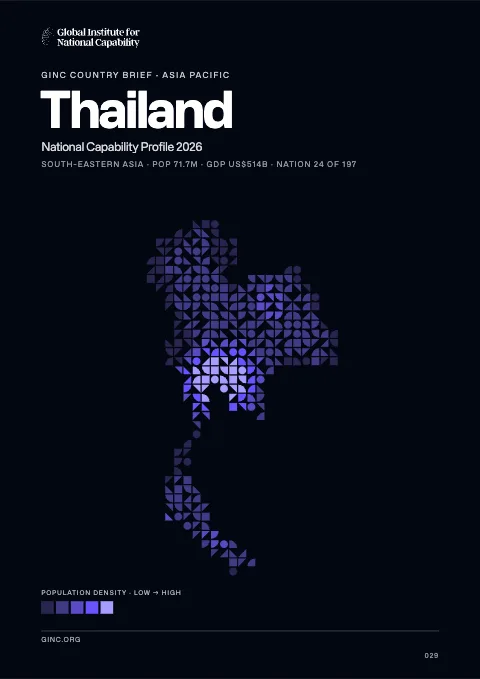
Thailand
Thailand is a constitutional monarchy in East and Southeast Asia, home to 68 million people, with its capital at Bangkok.
Contents
12 chapters
Foundations
01–03
At a glance
- Area
- 513.1Kkm²#51 World#4 E & SE Asia
- Population
- 67.7M#21 World#5 E & SE Asia
- GDP (market)
- $401B
- GDP (PPP)
- $673B#24 World#5 E & SE Asia
- GDP per capita
- $9.9K#120 World#10 E & SE Asia
The whole brief
Thailand National Capability Profile 2026
Foundations · Chapter 01
Historical Context
🇹🇭 Thailand’s understanding the origins and evolution of the modern nation
BackgroundBack to top ↑
A unified Thai kingdom was established in the mid-14th century. Known as Siam until 1939, Thailand is the only Southeast Asian country never to have been taken over by a European power. A bloodless revolution in 1932 led to a constitutional monarchy. In alliance with Japan during World War II, Thailand became a US treaty ally in 1954 after sending troops to Korea and later fighting alongside the United States in Vietnam. Thailand since 2005 has experienced several rounds of political turmoil including a military coup in 2006 that ousted then Prime Minister THAKSIN Chinnawat, followed by large-scale street protests by competing political factions in 2008, 2009, and 2010. THAKSIN's youngest sister, YINGLAK Chinnawat, in 2011 led the Puea Thai Party to an electoral win and assumed control of the government. A blanket amnesty bill for individuals involved in street protests, altered at the last minute to include all political crimes - including all convictions against THAKSIN - triggered months of large-scale anti-government protests in Bangkok beginning in November 2013. In early May 2014 YINGLAK was removed from office and in late May 2014 the Royal Thai Army staged a coup against the caretaker government. Thailand has also experienced violence associated with the ethno-nationalist insurgency in Thailand's southern Malay-Muslim majority provinces. Since January 2004, thousands have been killed and wounded in the insurgency.
IndependenceBack to top ↑
1238 (traditional founding date; never colonized)
National holidayBack to top ↑
Birthday of King PHUMIPHON (BHUMIBOL), 5 December (1927)
Foundations · Chapter 02
Geography
🇹🇭 Thailand’s territory, resources and strategic position
Location and areaBack to top ↑
Southeastern Asia, bordering the Andaman Sea and the Gulf of Thailand, southeast of Burma
15 00 N, 100 00 E
Southeast Asia
slightly more than twice the size of Wyoming
3,219 km
Terrain and resourcesBack to top ↑
central plain; Khorat Plateau in the east; mountains elsewhere
tin, rubber, natural gas, tungsten, tantalum, timber, lead, fish, gypsum, lignite, fluorite, arable land
64,150 sq km (2007)
Settlement and hazardsBack to top ↑
land subsidence in Bangkok area resulting from the depletion of the water table; droughts
controls only land route from Asia to Malaysia and Singapore
OtherBack to top ↑
438.6 cu km (2011)
air pollution from vehicle emissions; water pollution from organic and factory wastes; deforestation; soil erosion; wildlife populations threatened by illegal hunting
Foundations · Chapter 03
Environment
🇹🇭 Thailand’s environmental conditions, resources and national resilience
ClimateBack to top ↑
tropical; rainy, warm, cloudy southwest monsoon (mid-May to September); dry, cool northeast monsoon (November to mid-March); southern isthmus always hot and humid
Emissions and pollutionBack to top ↑
Water, waste and foodBack to top ↑
Resources and agreementsBack to top ↑
GINC Capability Domains · Chapter 04
Critical Technology
🇹🇭 Thailand’s technology frontiers and the pursuit of national advantage
Two counts are set side by side for 2015–2024: on the left, the papers researchers in Thailand published; on the right, the patent families that began there and were filed in more than one country. First by capability group, then group by group with each group’s capabilities. The badge on a card is the nation’s place among all nations. Papers are from GINC Research Analytics, patent families from GINC Patents.
Research by capability group
#45 WorldPapers published, 2015–2024
2,379
1,452
1,343
951
658
409
228
133
127
14
Patents by capability group
#43 WorldInternational patent families, 2015–2024
Advanced Materials & ManufacturingBack to top ↑
Research
#43 WorldPapers published, 2015–2024
Patents
#33 WorldInternational patent families, 2015–2024
Energy TechnologiesBack to top ↑
Research
#36 WorldPapers published, 2015–2024
Patents
#43 WorldInternational patent families, 2015–2024
Semiconductors & Advanced ComputingBack to top ↑
Research
#51 WorldPapers published, 2015–2024
No research topic: Semiconductor Design & EDA · Advanced Semiconductor Fabrication · Semiconductor Equipment & Materials · Advanced Packaging & Heterogeneous Integration
Patents
#51 WorldInternational patent families, 2015–2024
Artificial IntelligenceBack to top ↑
Research
#41 WorldPapers published, 2015–2024
Patents
#46 WorldInternational patent families, 2015–2024
Quantum TechnologiesBack to top ↑
Research
#53 WorldPapers published, 2015–2024
Patents
International patent families, 2015–2024
No international patent families on record for 2015–2024.
Connectivity, Cyber & Trust TechnologiesBack to top ↑
Research
#51 WorldPapers published, 2015–2024
Patents
#51 WorldInternational patent families, 2015–2024
Sensing, Timing & NavigationBack to top ↑
Research
#50 WorldPapers published, 2015–2024
Patents
#62 WorldInternational patent families, 2015–2024
Robotics & Autonomous SystemsBack to top ↑
Research
#46 WorldPapers published, 2015–2024
No research topic: Human-Machine Interfaces
Patents
#49 WorldInternational patent families, 2015–2024
Biotechnology & Health TechnologiesBack to top ↑
Research
#29 WorldPapers published, 2015–2024
Patents
#40 WorldInternational patent families, 2015–2024
Medicine and BioTech
Clinical research and life-science invention, drawn from the same series that drive the metric pages. Each card opens the full cross-country comparison.
Space TechnologiesBack to top ↑
Research
#45 WorldPapers published, 2015–2024
Patents
International patent families, 2015–2024
No international patent families on record for 2015–2024.
GINC Capability Domains · Chapter 05
Strategic Infrastructure
🇹🇭 Thailand’s energy, connectivity and the material foundations of capability
Resource InfrastructureBack to top ↑
574,000 bbl/day (2012 est.)
32,200 bbl/day (2011 est.)
793,900 bbl/day (2011 est.)
453.3 million bbl (1 January 2013 est.)
913,600 bbl/day (2011 est.)
721,100 bbl/day (2011 est.)
192,400 bbl/day (2011 est.)
41,700 bbl/day (2011 est.)
36.99 billion cu m (2011 est.)
45.08 billion cu m (2010 est.)
0 cu m (2011 est.)
9.58 billion cu m (2011 est.)
284.9 billion cu m (1 January 2013 est.)
condensate 2 km; gas 5,900 km; liquid petroleum gas 85 km; oil 1 km; refined products 1,097 km (2013)
Agriculture & Food InfrastructureBack to top ↑
- Irrigation & Agricultural Water
- Livestock & Veterinary
- Fisheries & Aquaculture
- Storage, Cold Chain & Markets
Energy InfrastructureBack to top ↑
- Thermal Generation
- Nuclear Generation
- Nuclear Fuel Cycle & Radioactive Waste
- Hydropower
- Renewable Generation
- Transmission & Distribution
- System Control & Dispatch
- Storage & Fuel Supply
32.6 million kW (2012 est.)
173.3 billion kWh (2012 est.)
169.4 billion kWh (2012 est.)
1.535 billion kWh (2012 est.)
9.575 billion kWh (2012 est.)
89% of total installed capacity (2012 est.)
0% of total installed capacity (2012 est.)
10.9% of total installed capacity (2012 est.)
0.2% of total installed capacity (2012 est.)
269.6 million Mt (2011 est.)
Water, Sanitation & Waste InfrastructureBack to top ↑
- Dams, Reservoirs & Flood Defence
- Water Supply & Treatment
- Bulk Water Transfer & Desalination
- Wastewater & Sanitation
- Solid Waste & Recycling
Advanced ManufacturingBack to top ↑
- Materials & Inputs
- Chemicals & Hazardous Process Industry
- Production Systems
- Supply Chain & Ecosystem
- Workforce & Innovation
Transport InfrastructureBack to top ↑
- Seaports & Terminals
- Air Infrastructure
- Air Navigation & Traffic Management
- Inland Waterways & Ferries
- Rail Infrastructure
- Roads & Bridges
- Logistics, Multimodal & Border Infrastructure
- Postal & Parcel
101 (2013)
7 (2013)
4,000 km (3,701 km navigable by boats with drafts up to 0.9 m) (2011)
Communications & Digital InfrastructureBack to top ↑
- Subsea Cables & International Gateways
- Core & Backbone Networks
- Mobile & Wireless Networks
- Spectrum & Broadcasting
- Data Centres, Compute & Cloud
- Data Resources
- AI Tools & Applications
6.391 million (2012)
84.075 million (2012)
17.483 million (2009)
3.399 million (2012)
.th
Financial InfrastructureBack to top ↑
- Currency & Reserves
- Payments & Settlement Systems
- Markets, Exchanges & Depositories
- Banks, Insurers & Systemic Institutions
Social InfrastructureBack to top ↑
- Health Infrastructure
- Public Health & Laboratories
- Medical Supply & Stockpiles
- Education & Skills Infrastructure
- Research & Scientific Facilities
- Housing, Community & Social Services
- Government & Public Administration
- Cultural, Community & Recreational Infrastructure
- Justice & Corrections
- Emergency Services & Civil Protection
- Hydrometeorology & Early Warning
Space, Aerospace & Defence InfrastructureBack to top ↑
GINC Capability Domains · Chapter 06
National Security
🇹🇭 Thailand’s force, intelligence and the defence of the nation
Disputes and terrorismBack to top ↑
separatist violence in Thailand's predominantly Malay-Muslim southern provinces prompt border closures and controls with Malaysia to stem insurgent activities; Southeast Asian states have enhanced border surveillance to check the spread of avian flu; talks continue on completion of demarcation with Laos but disputes remain over several islands in the Mekong River; despite continuing border committee talks, Thailand must deal with Karen and other ethnic rebels, refugees, and illegal cross-border activities; Cambodia and Thailand dispute sections of boundary; in 2011 Thailand and Cambodia resorted to arms in the dispute over the location of the boundary on the precipice surmounted by Preah Vihear temple ruins, awarded to Cambodia by ICJ decision in 1962 and part of a planned UN World Heritage site; Thailand is studying the feasibility of jointly constructing the Hatgyi Dam on the Salween river near the border with Burma; in 2004, international environmentalist pressure prompted China to halt construction of 13 dams on the Salween River that flows through China, Burma, and Thailand; 140,000 mostly Karen refugees fleeing civil strife, political upheaval and economic stagnation in Burma live in remote camps in Thailand near the border
Force Generation & MobilisationBack to top ↑
Royal Thai Army (Kongthap Bok Thai, RTA), Royal Thai Navy (Kongthap Ruea Thai, RTN, includes Royal Thai Marine Corps), Royal Thai Air Force (Kongthap Agard Thai, RTAF) (2013)
21 years of age for compulsory military service; 18 years of age for voluntary military service; males register at 18 years of age; 2-year conscript service obligation (2012)
1.47% of GDP (2012)//1.6% of GDP (2011)//1.47% of GDP (2010)
Forces under arms
Active-duty strength on the Correlates of War series, which reaches back to 1816 and so carries a nation’s whole record of mobilisation rather than its present establishment. The card opens the full cross-country comparison.
Intelligence & AssessmentBack to top ↑
- Imagery & Geospatial Intelligence
- Signals & Cyber Intelligence
- Technical & Measurement Intelligence
- Open-Source & Financial Intelligence
- Human Intelligence & Counterintelligence
- All-Source Analysis & Warning
Joint Command, Projection & SustainmentBack to top ↑
- Command, Control & Communications
- Strategic Lift & Mobility
- Expeditionary & Peace Operations
- Operational Sustainment & War Reserves
- Defence Industrial Mobilisation
- CBRN Defence
Land PowerBack to top ↑
- Combined Arms Manoeuvre
- Land Fires
- Battlefield Aviation & Uncrewed Systems
- Special Operations & Irregular Warfare
Maritime PowerBack to top ↑
- Maritime Security & Constabulary
- Sea Denial & Undersea Warfare
- Sea Control
- Amphibious & Expeditionary Operations
Air PowerBack to top ↑
- Air Sovereignty & Policing
- Control of the Air
- Air Strike & Interdiction
- Airborne ISR, Early Warning & Battle Management
Strategic Strike & Missile DefenceBack to top ↑
Space OperationsBack to top ↑
Cyber & Electromagnetic OperationsBack to top ↑
Nuclear DeterrenceBack to top ↑
GINC Capability Domains · Chapter 07
Human Capital
🇹🇭 Thailand’s population, health and the skills that sustain capability
DemographyBack to top ↑
67,741,401
0.35% (2014 est.)
11.26 births/1,000 population (2014 est.)
7.72 deaths/1,000 population (2014 est.)
1.5 children born/woman (2014 est.)
23.3 (2009 est.)
79.6% (2009)
Migration and urbanisationBack to top ↑
0 migrant(s)/1,000 population (2014 est.)
BANGKOK (capital) 8.426 million; Samut Prakan 1.212 million (2011)
Welfare and equityBack to top ↑
13.2% (2011 est.)
39.4 (2010)//42 (2002)
DisplacementBack to top ↑
Early Childhood DevelopmentBack to top ↑
7% (2006)
Foundational EducationBack to top ↑
5.8% of GDP (2011)
Advanced EducationBack to top ↑
Technical & Vocational SkillsBack to top ↑
Digital & AI CompetenceBack to top ↑
Generative AI adoption
Modelled share of working-age adults using generative AI, from Microsoft telemetry scaled to each country’s 15–64 population. A measure of how fast a workforce is absorbing the technology rather than of how much of it a nation builds. The card opens the full cross-country comparison.
Lifelong Learning & ReskillingBack to top ↑
Research Talent & Knowledge CreationBack to top ↑
Population HealthBack to top ↑
48 deaths/100,000 live births (2010)
8.8% (2008)
1.1% (2012 est.)
443,100 (2012 est.)
20,800 (2012 est.)
Health System CapabilityBack to top ↑
4.1% of GDP (2011)
0.3 physicians/1,000 population (2004)
2.1 beds/1,000 population (2010)
GINC Capability Domains · Chapter 08
Governance and Integrity
🇹🇭 Thailand’s institutions, law and the integrity of the state
State structureBack to top ↑
constitutional monarchy
77 provinces (changwat, singular and plural); Amnat Charoen, Ang Thong, Bueng Kan, Buriram, Chachoengsao, Chai Nat, Chaiyaphum, Chanthaburi, Chiang Mai, Chiang Rai, Chon Buri, Chumphon, Kalasin, Kamphaeng Phet, Kanchanaburi, Khon Kaen, Krabi, Krung Thep Mahanakhon (Bangkok), Lampang, Lamphun, Loei, Lop Buri, Mae Hong Son, Maha Sarakham, Mukdahan, Nakhon Nayok, Nakhon Pathom, Nakhon Phanom, Nakhon Ratchasima, Nakhon Sawan, Nakhon Si Thammarat, Nan, Narathiwat, Nong Bua Lamphu, Nong Khai, Nonthaburi, Pathum Thani, Pattani, Phangnga, Phatthalung, Phayao, Phetchabun, Phetchaburi, Phichit, Phitsanulok, Phra Nakhon Si Ayutthaya, Phrae, Phuket, Prachin Buri, Prachuap Khiri Khan, Ranong, Ratchaburi, Rayong, Roi Et, Sa Kaeo, Sakon Nakhon, Samut Prakan, Samut Sakhon, Samut Songkhram, Sara Buri, Satun, Sing Buri, Sisaket, Songkhla, Sukhothai, Suphan Buri, Surat Thani, Surin, Tak, Trang, Trat, Ubon Ratchathani, Udon Thani, Uthai Thani, Uttaradit, Yala, Yasothon
many previous; latest approved by referendum 19 August 2007, effective 24 August 2007 (2013)
18 years of age; universal and compulsory
Political Institutions & Civic ParticipationBack to top ↑
- Electoral Management & Integrity
- Legislature & Deliberative Institutions
- Citizen Participation & Civic Space
bicameral National Assembly or Rathasapha consisted of the Senate or Wuthisapha (150 seats; 76 members elected by popular vote representing 75 provinces and 1 metropolitan district (Bangkok), 74 appointed by the Senate Selection Committee; members serve six-year terms) and the House of Representatives or Sapha Phuthaen Ratsadon (500 seats; 375 members elected from 375 single-seat constituencies and 125 elected on proportional party-list basis; members serve four-year terms)
Chat Pattana Party or CPN (Nation Development Party) [WANNARAT Channukul]//Chat Thai Phattana Party or CTP (Thai Nation Development Party) [THEERA Wongsamut]//Mahachon Party or Mass Party [APHIRAT Sirinawin]//Matubhum Party (Motherland Party) [ Gen. SONTHI Bunyaratkalin]//Phalang Chon Party (People Chonburi Power Party) [SONTHAYA Khunpluem]//Phumjai (Bhumjai) Thai Party or PJT (Thai Pride) [ANUTIN Charnvirakul]//Prachathipat Party or DP (Democrat Party) [ABHISIT Wechachiwa, also spelled ABHISIT Vejjajiva]//Prachathipathai Mai Party (New Democracy Party) [SURATIN Phijarn]//Puea Thai Party (For Thais Party) or PTP [CHARUPHONG Rueangsuwan also spelled JARUPONG Ruangsuwan]//Rak Prathet Thai Party (Love Thailand Party) [CHUWIT Kamonwisit]//Rak Santi Party (Peace Conservation Party) [Pol. Lt. Gen. THAWIL Surachetphong]
Multicolor Group//People's Alliance for Democracy or PAD//People's Democratic Reform Committee or PDRC//Student and People Network for Thailand's Reform or STR//United Front for Democracy Against Dictatorship or UDD
Justice System & Fundamental RightsBack to top ↑
- Judicial Independence & Court Capability
- Access to Justice & Legal Services
- Fundamental Rights Protection
- Human Rights Institutions & Equality Bodies
civil law system with common law influences
has not submitted an ICJ jurisdiction declaration; non-party state to the ICCt
Internal Security & OrderBack to top ↑
a minor producer of opium, heroin, and marijuana; transit point for illicit heroin en route to the international drug market from Burma and Laos; eradication efforts have reduced the area of cannabis cultivation and shifted some production to neighboring countries; opium poppy cultivation has been reduced by eradication efforts; also a drug money-laundering center; minor role in methamphetamine production for regional consumption; major consumer of methamphetamine since the 1990s despite a series of government crackdowns
Regulatory Governance & Strategic ControlsBack to top ↑
- Regulatory Quality & Better Regulation
- Regulatory Delivery & Independent Regulators
- Strategic Controls & Economic Security Administration
Government Effectiveness & Public AdministrationBack to top ↑
- Centre of Government & Policy Coordination
- Civil Service & Public Workforce
- Digital Government & Service Delivery
- Legal Identity & Civil Registration
- Statistical & Data Capability
Public Integrity & Anti-CorruptionBack to top ↑
Transparency, Oversight & AccountabilityBack to top ↑
- Right to Information & Open Government
- Independent Oversight & Supreme Audit
- Independent Media & Journalist Safety
National Resilience & Crisis ManagementBack to top ↑
GINC Capability Domains · Chapter 09
Information and Influence
🇹🇭 Thailand’s identity, media and the projection of influence
Identity and cultureBack to top ↑
Thai (official) 90.7%, Burmese 1.3%, other 8%
Buddhist (official) 93.6%, Muslim 4.9%, Christian 1.2%, other 0.2%, none 0.1% (2010 est.)
Thai 95.9%, Burmese 2%, other 1.3%, unspecified 0.9% (2010 est.)
garuda (mythical half-man, half-bird figure); elephant
five horizontal bands of red (top), white, blue (double width), white, and red; the red color symbolizes the nation and the blood of life; white represents religion and the purity of Buddhism; blue stands for the monarchy
Diplomatic Statecraft & Global NetworksBack to top ↑
- Diplomatic Network & Consular Reach
- Multilateral Leadership & Norm Setting
- Agenda-Setting & Convening
- Mediation & Crisis Diplomacy
ADB, APEC, ARF, ASEAN, BIMSTEC, BIS, CD, CICA, CP, EAS, FAO, G-77, IAEA, IBRD, ICAO, ICC (national committees), ICRM, IDA, IFAD, IFC, IFRCS, IHO, ILO, IMF, IMO, IMSO, Interpol, IOC, IOM, IPU, ISO, ITSO, ITU, ITUC (NGOs), MIGA, NAM, OAS (observer), OIC (observer), OIF (observer), OPCW, OSCE (partner), PCA, PIF (partner), UN, UNAMID, UNCTAD, UNESCO, UNHCR, UNIDO, UNMOGIP, UNWTO, UPU, WCO, WFTU (NGOs), WHO, WIPO, WMO, WTO
Alliances & Security CooperationBack to top ↑
Development Cooperation & Global AssistanceBack to top ↑
Culture, Language & Education DiplomacyBack to top ↑
- Cultural & Language Institutes
- Creative Industries & Cultural Export Reach
- Heritage & Cultural Institutions
- Education Diplomacy & Alumni Networks
- Sports & Major Events
Diaspora & Global CommunitiesBack to top ↑
Information Environment & Strategic CommunicationBack to top ↑
- Strategic Communications & Public Diplomacy
- International Media & Broadcasting
- Information Defence & Counter-Interference
6 terrestrial TV stations in Bangkok broadcast nationally via relay stations - 2 of the networks are owned by the military, the other 4 are government-owned or controlled, leased to private enterprise, and all are required to broadcast government-produced news programs twice a day; multi-channel satellite and cable TV subscription services are available; radio frequencies have been allotted for more than 500 government and commercial radio stations; many small community radio stations operate with low-power transmitters (2008)
GINC Capability Domains · Chapter 10
Financial Strength
🇹🇭 Thailand’s fiscal depth, reserves and the capacity to act
Monetary & Currency CapabilityBack to top ↑
- Monetary Policy & Price Stability
- Exchange Rate & External Account Management
- Currency Issuance & Digital Money
2.2% (2013 est.)//3% (2012 est.)
baht per US dollar -//30.59 (2013 est.)//31.083 (2012 est.)//31.686 (2010 est.)//34.286 (2009)//33.37 (2008)
2.25% (31 December 2013 est.)//3.25% (31 December 2011 est.)
6.9% (31 December 2013 est.)//7.1% (31 December 2012 est.)
$50.18 billion (31 December 2013 est.)//$52.18 billion (31 December 2012 est.)
$516.4 billion (31 December 2013 est.)//$488.6 billion (31 December 2012 est.)
Fiscal Capacity & Public FinanceBack to top ↑
- Revenue Mobilisation & Tax Administration
- Public Expenditure & Budget Management
- Sovereign Debt & Treasury Management
- Public Investment Management
20.2% of GDP (2013 est.)
-4% of GDP (2013 est.)
45.9% of GDP (2013 est.)//45.8% of GDP (2012 est.)
1 October - 30 September
Financial System Depth & AccessBack to top ↑
- Banking System Capacity
- Capital Markets Depth & Development
- Long-Term & Institutional Capital
- Financial Inclusion & Household Access
- Development & Policy Finance
$511.2 billion (31 December 2013 est.)//$480.5 billion (31 December 2012 est.)
$348.5 billion (31 December 2013 est.)//$383 billion (31 December 2012)//$268.5 billion (31 December 2011 est.)
30.8% of GDP (2013 est.)//30.5% of GDP (2012 est.)//28.3% of GDP (2011 est.)
Financial Regulation & IntegrityBack to top ↑
- Prudential Regulation & Supervision
- Financial Integrity & Illicit Finance Control
- Market Conduct & Consumer Protection
- Payment & Market Infrastructure Oversight
Financial Stability & Crisis ManagementBack to top ↑
- Macroprudential & Systemic Oversight
- Crisis Management, Resolution & Deposit Insurance
- External Liquidity & Financial Safety Nets
Sovereign Capital & External Financial PowerBack to top ↑
- Official Reserves Management
- Sovereign Wealth & Public Asset Management
- Currency Internationalisation & Reserve Status
- Capital Account & Flow Management
- International Financial Centre Capability
$167.2 billion (31 December 2013 est.)//$181.6 billion (31 December 2012 est.)
$142.6 billion (31 December 2013 est.)//$130.9 billion (31 December 2012 est.)
GINC Capability Domains · Chapter 11
Production and Innovation
🇹🇭 Thailand’s output, industry and the engine of prosperity
Economic Output & ProductivityBack to top ↑
With a well-developed infrastructure, a free-enterprise economy, generally pro-investment policies, and strong export industries, Thailand achieved steady growth due largely to industrial and agriculture exports - mostly electronics, agricultural commodities, automobiles and parts, and processed foods. Unemployment, at less than 1% of the labor force, stands as one of the lowest levels in the world, which puts upward pressure on wages in some industries. Thailand also attracts nearly 2.5 million migrant workers from neighboring countries. The Thai government in 2013 implemented a nation-wide 300 baht ($10) per day minimum wage policy and deployed new tax reforms designed to lower rates on middle-income earners. The Thai economy has weathered internal and external economic shocks in recent years. The global economic recession severely cut Thailand's exports, with most sectors experiencing double-digit drops. In late 2011 Thailand's recovery was interrupted by historic flooding in the industrial areas in Bangkok and its five surrounding provinces, crippling the manufacturing sector. The government approved flood mitigation projects worth $11.7 billion, which were started in 2012, to prevent similar economic damage, and an additional $75 billion for infrastructure over the following seven years. This was expected to lead to an economic upsurge but growth has remained slow, in part due to ongoing political unrest and resulting uncertainties. Spending on infrastructure will require re-approval once a new government is seated.
$673 billion (2013 est.)//$654 billion (2012 est.)//$614.2 billion (2011 est.)
2.9% (2013 est.)//6.5% (2012 est.)//0.1% (2011 est.)
$9,900 (2013 est.)//$9,600 (2012 est.)//$9,100 (2011 est.)
$400.9 billion (2013 est.)
Labour & EmploymentBack to top ↑
- Employment & Labour Force Participation
- Labour Market Institutions & Wage Setting
- Employment Services & Skills Matching
- Labour Adjustment, Transition & Formalisation
39.38 million (2013 est.)
0.7% (2013 est.)//0.7% (2012 est.)
Industrial & Sectoral BaseBack to top ↑
- Manufacturing & Advanced Industry
- Foundational & Process Industries
- Agrifood & Primary Production
- Services Economy
rice, cassava (manioc, tapioca), rubber, corn, sugarcane, coconuts, soybeans
tourism, textiles and garments, agricultural processing, beverages, tobacco, cement, light manufacturing such as jewelry and electric appliances, computers and parts, integrated circuits, furniture, plastics, automobiles and automotive parts; world's second-largest tungsten producer and third-largest tin producer
-3.1% (2013 est.)
Structural Transformation & ComplexityBack to top ↑
Business Dynamism & EntrepreneurshipBack to top ↑
- Entrepreneurship & Firm Creation
- Risk Capital & Scale-Up Finance
- Firm Growth, Exit & Renewal
- Competition & Market Contestability
Innovation & CommercialisationBack to top ↑
- Business Innovation Capability
- Research Commercialisation & Knowledge Transfer
- Intellectual Property & Intangible Assets
- Innovation Ecosystems & Clusters
Technology Adoption & DiffusionBack to top ↑
GINC Capability Domains · Chapter 12
Trade and Investment
🇹🇭 Thailand’s markets, capital and the terms of global exchange
Overall tradeBack to top ↑
$345B of exports to 218 partners and $300B of imports from 222 in 2024, a surplus of $44.8B.
- Exports
- $345B218 partners
- Imports
- $300B222 partners
- Balance
- +$44.8Bsurplus
- Total trade
- $645B2024
ExportsBack to top ↑
Where its exports go
The largest partners in 2024, with each one's share of the nation's exports.
| Partner | Value | Share | |
|---|---|---|---|
| United States | $64.8B | 19% | |
| China | $40.7B | 12% | |
| Japan | $24.1B | 7.0% | |
| Australia | $14.0B | 4.1% | |
| Singapore | $13.6B | 4.0% | |
| Malaysia | $13.0B | 3.8% | |
| India | $12.4B | 3.6% | |
| Vietnam | $11.8B | 3.4% | |
| Hong Kong | $11.2B | 3.2% | |
| Indonesia | $9.74B | 2.8% | |
| Mexico | $9.04B | 2.6% | |
| Cambodia | $8.50B | 2.5% | |
| Germany | $8.42B | 2.4% | |
| Philippines | $7.88B | 2.3% | |
| Netherlands | $7.15B | 2.1% | |
| South Korea | $6.64B | 1.9% | |
| Taiwan | $6.28B | 1.8% | |
| United Kingdom | $5.16B | 1.5% | |
| Laos | $4.93B | 1.4% | |
| Saudi Arabia | $4.22B | 1.2% |
What it exports
The largest categories in 2024.
| Category | Value | Share | |
|---|---|---|---|
| Electrical, electronic equipment | $70.0B | 20% | |
| Machinery, nuclear reactors, boilers | $61.9B | 18% | |
| Vehicles other than railway, tramway | $37.2B | 11% | |
| Rubbers | $20.2B | 5.9% | |
| Pearls, precious stones, metals, coins | $17.8B | 5.2% | |
| Plastics | $13.7B | 4.0% | |
| Mineral fuels, oils, distillation products | $9.28B | 2.7% | |
| Optical, photo, technical, medical apparatus | $8.90B | 2.6% | |
| Meat, fish and seafood preparations | $7.23B | 2.1% | |
| Edible fruits, nuts, peel of citrus fruit, melons | $7.00B | 2.0% | |
| Cereals | $6.81B | 2.0% | |
| Articles of iron or steel | $4.86B | 1.4% | |
| Organic chemicals | $4.43B | 1.3% | |
| Copper | $4.20B | 1.2% | |
| Sugars and sugar confectionery | $4.08B | 1.2% |
ImportsBack to top ↑
Where its imports come from
The largest partners in 2024, with each one's share of the nation's imports.
| Partner | Value | Share | |
|---|---|---|---|
| China | $84.1B | 28% | |
| Japan | $26.6B | 8.9% | |
| Taiwan | $19.9B | 6.6% | |
| United States | $19.3B | 6.4% | |
| United Arab Emirates | $17.4B | 5.8% | |
| Malaysia | $13.6B | 4.5% | |
| Vietnam | $9.15B | 3.0% | |
| South Korea | $9.06B | 3.0% | |
| Indonesia | $8.57B | 2.9% | |
| Singapore | $7.79B | 2.6% | |
| Hong Kong | $6.69B | 2.2% | |
| Switzerland | $6.38B | 2.1% | |
| Australia | $5.40B | 1.8% | |
| Germany | $5.25B | 1.7% | |
| India | $5.19B | 1.7% | |
| Saudi Arabia | $5.05B | 1.7% | |
| Qatar | $3.71B | 1.2% | |
| Brazil | $3.68B | 1.2% | |
| Laos | $3.36B | 1.1% | |
| France | $3.35B | 1.1% |
What it imports
The largest categories in 2024.
| Category | Value | Share | |
|---|---|---|---|
| Electrical, electronic equipment | $61.0B | 20% | |
| Mineral fuels, oils, distillation products | $50.2B | 17% | |
| Machinery, nuclear reactors, boilers | $35.9B | 12% | |
| Pearls, precious stones, metals, coins | $18.7B | 6.2% | |
| Iron and steel | $11.0B | 3.7% | |
| Plastics | $10.9B | 3.6% | |
| Vehicles other than railway, tramway | $10.8B | 3.6% | |
| Articles of iron or steel | $7.79B | 2.6% | |
| Optical, photo, technical, medical apparatus | $6.91B | 2.3% | |
| Copper | $5.70B | 1.9% | |
| Aluminum | $5.62B | 1.9% | |
| Organic chemicals | $4.76B | 1.6% | |
| Miscellaneous chemical products | $4.10B | 1.4% | |
| Fish, crustaceans, molluscs, aquatics invertebrates | $3.53B | 1.2% | |
| Pharmaceutical products | $2.90B | 1.0% |
In a list, the bar runs to the largest in that list. The line is each figure’s history from 2000, drawn to its own peak: it shows the shape of the years, and the value shows the size.
External balanceBack to top ↑
-$3.2 billion (2013 est.)//-$1.4 billion (2012 est.)
Trade Facilitation & LogisticsBack to top ↑
Trade Policy & Market AccessBack to top ↑
- Trade Policy & Negotiation Capability
- Market Access & Agreements Network
- Trade Law & Enforcement
- Standards, Conformity & Quality Infrastructure
Digital & Services TradeBack to top ↑
- Services Trade Capability
- Digital Trade & E-Commerce
- Data Flows & Digital Trade Governance
- Tourism & Visitor Economy
Investment Attraction & ProjectionBack to top ↑
- Investment Attraction & Facilitation
- Investment Absorption & Linkages
- Outward Investment & Global Corporate Presence
$193.7 billion (31 December 2013 est.)//$159.6 billion (31 December 2012 est.)
$65.14 billion (31 December 2013 est.)//$52.56 billion (31 December 2012 est.)
Export Capability & SophisticationBack to top ↑
$225.4 billion (2013 est.)//$225.8 billion (2012 est.)
China 11.7%, Japan 10.2%, US 9.9%, Hong Kong 5.7%, Malaysia 5.4%, Indonesia 4.9%, Singapore 4.7%, Australia 4.3% (2012)
electronics, computer parts, automobiles and parts, electrical appliances, machinery and equipment, textiles and footwear, fishery products, rice, rubber
Global Value Chain PositionBack to top ↑
- Value Chain Participation & Integration
- Value Chain Position & Upgrading
- Regional Integration & Hub Anchoring
Economic Leverage & DependenceBack to top ↑
- Strategic Supply Security
- Concentration Risk & Revenue Stabilisation
- Economic Leverage & Coercion Resistance
$219 billion (2013 est.)//$219.8 billion (2012 est.)
Japan 20%, China 14.9%, UAE 6.3%, Malaysia 5.3%, US 5.3% (2012)
capital goods, intermediate goods and raw materials, consumer goods, fuels
Thailand · you are in
Historical Context
Foundations
GINC Capability Domains
Find in this brief · Thailand