
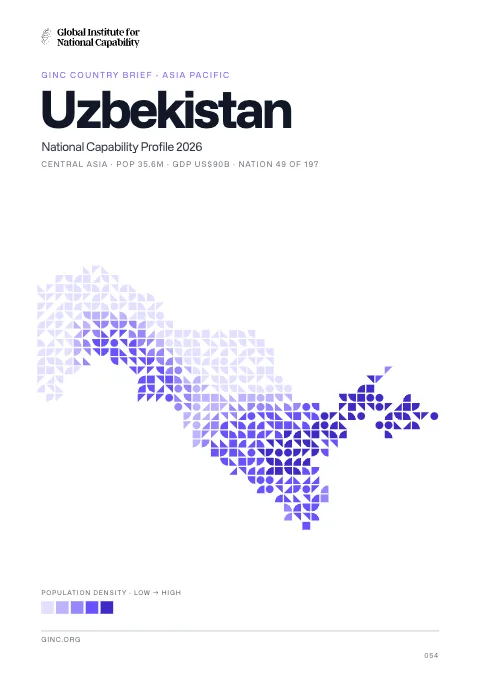
Uzbekistan
Uzbekistan is a landlocked republic in Central Asia, home to 29 million people, with its capital at Tashkent.
Contents
12 chapters
Foundations
01–03
At a glance
- Area
- 447.4Kkm²#57 World#4 C. Asia
- Population
- 28.9M#44 World#2 C. Asia
- GDP (market)
- $55.2B
- GDP (PPP)
- $112.6B#69 World#3 C. Asia
- GDP per capita
- $3.8K#171 World#4 C. Asia
The whole brief
Uzbekistan National Capability Profile 2026
Foundations · Chapter 01
Historical Context
🇺🇿 Uzbekistan’s understanding the origins and evolution of the modern nation
BackgroundBack to top ↑
Russia conquered the territory of present-day Uzbekistan in the late 19th century. Stiff resistance to the Red Army after the Bolshevik Revolution was eventually suppressed and a socialist republic established in 1924. During the Soviet era, intensive production of "white gold" (cotton) and grain led to overuse of agrochemicals and the depletion of water supplies, which have left the land degraded and the Aral Sea and certain rivers half dry. Independent since 1991, the country has lessened its dependence on the cotton monoculture by diversifying agricultural production while developing its mineral and petroleum export capacity and increasing its manufacturing base. However, longserving septuagenarian President Islom KARIMOV, who rose through the ranks of the Soviet-era State Planning Committee (Gosplan), remains wedded to the concepts of a command economy, creating a challenging environment for foreign investment. Current concerns include post-KARIMOV succession, terrorism by Islamic militants, economic stagnation, and the curtailment of human rights and democratization.
IndependenceBack to top ↑
1 September 1991 (from the Soviet Union)
National holidayBack to top ↑
Independence Day, 1 September (1991)
Foundations · Chapter 02
Geography
🇺🇿 Uzbekistan’s territory, resources and strategic position
Location and areaBack to top ↑
Central Asia, north of Turkmenistan, south of Kazakhstan
41 00 N, 64 00 E
Asia
slightly larger than California
0 km (doubly landlocked); note - Uzbekistan includes the southern portion of the Aral Sea with a 420 km shoreline
none (doubly landlocked)
Terrain and resourcesBack to top ↑
mostly flat-to-rolling sandy desert with dunes; broad, flat intensely irrigated river valleys along course of Amu Darya, Syr Darya (Sirdaryo), and Zarafshon; Fergana Valley in east surrounded by mountainous Tajikistan and Kyrgyzstan; shrinking Aral Sea in west
natural gas, petroleum, coal, gold, uranium, silver, copper, lead and zinc, tungsten, molybdenum
41,980 sq km (2005)
Settlement and hazardsBack to top ↑
NA
along with Liechtenstein, one of the only two doubly landlocked countries in the world
OtherBack to top ↑
48.87 cu km (2011)
shrinkage of the Aral Sea has resulted in growing concentrations of chemical pesticides and natural salts; these substances are then blown from the increasingly exposed lake bed and contribute to desertification and respiratory health problems; water pollution from industrial wastes and the heavy use of fertilizers and pesticides is the cause of many human health disorders; increasing soil salination; soil contamination from buried nuclear processing and agricultural chemicals, including DDT
Foundations · Chapter 03
Environment
🇺🇿 Uzbekistan’s environmental conditions, resources and national resilience
ClimateBack to top ↑
mostly midlatitude desert, long, hot summers, mild winters; semiarid grassland in east
Emissions and pollutionBack to top ↑
Water, waste and foodBack to top ↑
Resources and agreementsBack to top ↑
GINC Capability Domains · Chapter 04
Critical Technology
🇺🇿 Uzbekistan’s technology frontiers and the pursuit of national advantage
Two counts are set side by side for 2015–2024: on the left, the papers researchers in Uzbekistan published; on the right, the patent families that began there and were filed in more than one country. First by capability group, then group by group with each group’s capabilities. The badge on a card is the nation’s place among all nations. Papers are from GINC Research Analytics, patent families from GINC Patents.
Research by capability group
#83 WorldPapers published, 2015–2024
335
240
171
110
63
45
42
35
15
1
Patents by capability group
#109 WorldInternational patent families, 2015–2024
Advanced Materials & ManufacturingBack to top ↑
Research
#72 WorldPapers published, 2015–2024
Patents
International patent families, 2015–2024
No international patent families on record for 2015–2024.
Energy TechnologiesBack to top ↑
Research
#70 WorldPapers published, 2015–2024
Patents
#98 WorldInternational patent families, 2015–2024
Semiconductors & Advanced ComputingBack to top ↑
Research
#77 WorldPapers published, 2015–2024
No research topic: Semiconductor Design & EDA · Advanced Semiconductor Fabrication · Semiconductor Equipment & Materials · Advanced Packaging & Heterogeneous Integration
Patents
#69 WorldInternational patent families, 2015–2024
Artificial IntelligenceBack to top ↑
Research
#82 WorldPapers published, 2015–2024
Patents
#89 WorldInternational patent families, 2015–2024
Quantum TechnologiesBack to top ↑
Research
#71 WorldPapers published, 2015–2024
Patents
International patent families, 2015–2024
No international patent families on record for 2015–2024.
Connectivity, Cyber & Trust TechnologiesBack to top ↑
Research
#82 WorldPapers published, 2015–2024
Patents
International patent families, 2015–2024
No international patent families on record for 2015–2024.
Sensing, Timing & NavigationBack to top ↑
Research
#96 WorldPapers published, 2015–2024
Patents
International patent families, 2015–2024
No international patent families on record for 2015–2024.
Robotics & Autonomous SystemsBack to top ↑
Research
#85 WorldPapers published, 2015–2024
No research topic: Human-Machine Interfaces
Patents
International patent families, 2015–2024
No international patent families on record for 2015–2024.
Biotechnology & Health TechnologiesBack to top ↑
Research
#133 WorldPapers published, 2015–2024
Patents
#94 WorldInternational patent families, 2015–2024
Medicine and BioTech
Clinical research and life-science invention, drawn from the same series that drive the metric pages. Each card opens the full cross-country comparison.
Space TechnologiesBack to top ↑
Research
#95 WorldPapers published, 2015–2024
Patents
International patent families, 2015–2024
No international patent families on record for 2015–2024.
GINC Capability Domains · Chapter 05
Strategic Infrastructure
🇺🇿 Uzbekistan’s energy, connectivity and the material foundations of capability
Resource InfrastructureBack to top ↑
102,600 bbl/day (2012 est.)
0 bbl/day (2010 est.)
0 bbl/day (2010 est.)
594 million bbl (1 January 2013 est.)
92,300 bbl/day (2010 est.)
137,100 bbl/day (2011 est.)
4,968 bbl/day (2010 est.)
656 bbl/day (2010 est.)
62.9 billion cu m (2012 est.)
46.8 billion cu m (2012 est.)
13.4 billion cu m (2012 est.)
0 cu m (2012 est.)
1.841 trillion cu m (1 January 2013 est.)
gas 10,401 km; oil 944 km (2013)
Agriculture & Food InfrastructureBack to top ↑
- Irrigation & Agricultural Water
- Livestock & Veterinary
- Fisheries & Aquaculture
- Storage, Cold Chain & Markets
Energy InfrastructureBack to top ↑
- Thermal Generation
- Nuclear Generation
- Nuclear Fuel Cycle & Radioactive Waste
- Hydropower
- Renewable Generation
- Transmission & Distribution
- System Control & Dispatch
- Storage & Fuel Supply
11.6 million kW (2010 est.)
52.53 billion kWh (2012 est.)
44.51 billion kWh (2010 est.)
12.09 billion kWh (2010 est.)
12 billion kWh (2010 est.)
85.1% of total installed capacity (2010 est.)
0% of total installed capacity (2010 est.)
14.9% of total installed capacity (2010 est.)
0% of total installed capacity (2010 est.)
115.9 million Mt (2011 est.)
Water, Sanitation & Waste InfrastructureBack to top ↑
- Dams, Reservoirs & Flood Defence
- Water Supply & Treatment
- Bulk Water Transfer & Desalination
- Wastewater & Sanitation
- Solid Waste & Recycling
Advanced ManufacturingBack to top ↑
- Materials & Inputs
- Chemicals & Hazardous Process Industry
- Production Systems
- Supply Chain & Ecosystem
- Workforce & Innovation
Transport InfrastructureBack to top ↑
- Seaports & Terminals
- Air Infrastructure
- Air Navigation & Traffic Management
- Inland Waterways & Ferries
- Rail Infrastructure
- Roads & Bridges
- Logistics, Multimodal & Border Infrastructure
- Postal & Parcel
53 (2013)
1,100 km (2012)
Communications & Digital InfrastructureBack to top ↑
- Subsea Cables & International Gateways
- Core & Backbone Networks
- Mobile & Wireless Networks
- Spectrum & Broadcasting
- Data Centres, Compute & Cloud
- Data Resources
- AI Tools & Applications
1.963 million (2012)
20.274 million (2012)
4.689 million (2009)
56,075 (2012)
.uz
Financial InfrastructureBack to top ↑
- Currency & Reserves
- Payments & Settlement Systems
- Markets, Exchanges & Depositories
- Banks, Insurers & Systemic Institutions
Social InfrastructureBack to top ↑
- Health Infrastructure
- Public Health & Laboratories
- Medical Supply & Stockpiles
- Education & Skills Infrastructure
- Research & Scientific Facilities
- Housing, Community & Social Services
- Government & Public Administration
- Cultural, Community & Recreational Infrastructure
- Justice & Corrections
- Emergency Services & Civil Protection
- Hydrometeorology & Early Warning
Space, Aerospace & Defence InfrastructureBack to top ↑
GINC Capability Domains · Chapter 06
National Security
🇺🇿 Uzbekistan’s force, intelligence and the defence of the nation
Disputes and terrorismBack to top ↑
prolonged drought and cotton monoculture in Uzbekistan and Turkmenistan created water-sharing difficulties for Amu Darya river states; field demarcation of the boundaries with Kazakhstan commenced in 2004; border delimitation of 130 km of border with Kyrgyzstan is hampered by serious disputes around enclaves and other areas
Force Generation & MobilisationBack to top ↑
Uzbek Armed Forces: Army, Air and Air Defense Forces (2013)
18 years of age for compulsory military service; 1-month or 1-year conscript service obligation for males; moving toward a professional military, but conscription in some form will continue; the military cannot accommodate everyone who wishes to enlist, and competition for entrance into the military is similar to the competition for admission to universities (2013)
Forces under arms
Active-duty strength on the Correlates of War series, which reaches back to 1816 and so carries a nation’s whole record of mobilisation rather than its present establishment. The card opens the full cross-country comparison.
Intelligence & AssessmentBack to top ↑
- Imagery & Geospatial Intelligence
- Signals & Cyber Intelligence
- Technical & Measurement Intelligence
- Open-Source & Financial Intelligence
- Human Intelligence & Counterintelligence
- All-Source Analysis & Warning
Joint Command, Projection & SustainmentBack to top ↑
- Command, Control & Communications
- Strategic Lift & Mobility
- Expeditionary & Peace Operations
- Operational Sustainment & War Reserves
- Defence Industrial Mobilisation
- CBRN Defence
Land PowerBack to top ↑
- Combined Arms Manoeuvre
- Land Fires
- Battlefield Aviation & Uncrewed Systems
- Special Operations & Irregular Warfare
Maritime PowerBack to top ↑
- Maritime Security & Constabulary
- Sea Denial & Undersea Warfare
- Sea Control
- Amphibious & Expeditionary Operations
Air PowerBack to top ↑
- Air Sovereignty & Policing
- Control of the Air
- Air Strike & Interdiction
- Airborne ISR, Early Warning & Battle Management
Strategic Strike & Missile DefenceBack to top ↑
Space OperationsBack to top ↑
Cyber & Electromagnetic OperationsBack to top ↑
Nuclear DeterrenceBack to top ↑
GINC Capability Domains · Chapter 07
Human Capital
🇺🇿 Uzbekistan’s population, health and the skills that sustain capability
DemographyBack to top ↑
28,929,716 (July 2014 est.)
0.93% (2014 est.)
17.02 births/1,000 population (2014 est.)
5.29 deaths/1,000 population (2014 est.)
1.8 children born/woman (2014 est.)
23.8 (2006 est.)
64.9% (2006)
Migration and urbanisationBack to top ↑
-2.46 migrant(s)/1,000 population (2014 est.)
TASHKENT (capital) 2.227 million (2011)
Welfare and equityBack to top ↑
17% (2011 est.)
36.8 (2003)//44.7 (1998)
DisplacementBack to top ↑
Early Childhood DevelopmentBack to top ↑
4.4% (2006)
Foundational EducationBack to top ↑
NA
Advanced EducationBack to top ↑
Technical & Vocational SkillsBack to top ↑
Digital & AI CompetenceBack to top ↑
Generative AI adoption
Modelled share of working-age adults using generative AI, from Microsoft telemetry scaled to each country’s 15–64 population. A measure of how fast a workforce is absorbing the technology rather than of how much of it a nation builds. The card opens the full cross-country comparison.
Lifelong Learning & ReskillingBack to top ↑
Research Talent & Knowledge CreationBack to top ↑
Population HealthBack to top ↑
28 deaths/100,000 live births (2010)
15.1% (2008)
0.1% (2012 est.)
29,700 (2012 est.)
2,400 (2012 est.)
Health System CapabilityBack to top ↑
5.4% of GDP (2011)
2.54 physicians/1,000 population (2010)
4.5 beds/1,000 population (2010)
GINC Capability Domains · Chapter 08
Governance and Integrity
🇺🇿 Uzbekistan’s institutions, law and the integrity of the state
State structureBack to top ↑
republic; authoritarian presidential rule with little power outside the executive branch
12 provinces (viloyatlar, singular - viloyat), 1 autonomous republic* (avtonom respublikasi), and 1 city** (shahar); Andijon Viloyati, Buxoro Viloyati, Farg'ona Viloyati, Jizzax Viloyati, Namangan Viloyati, Navoiy Viloyati, Qashqadaryo Viloyati (Qarshi), Qoraqalpog'iston Respublikasi [Karakalpakstan Republic]* (Nukus), Samarqand Viloyati, Sirdaryo Viloyati (Guliston), Surxondaryo Viloyati (Termiz), Toshkent Shahri [Tashkent City]**, Toshkent Viloyati [Tashkent province], Xorazm Viloyati (Urganch)
several previous; latest adopted 8 December 1992; amended several times, last in 2012 (2012)
18 years of age; universal
Political Institutions & Civic ParticipationBack to top ↑
- Electoral Management & Integrity
- Legislature & Deliberative Institutions
- Citizen Participation & Civic Space
bicameral Supreme Assembly or Oliy Majlis consists of an upper house or Senate (100 seats; 84 members elected by regional governing councils and 16 appointed by the president; members to serve five-year terms) and a lower house or Legislative Chamber (Qonunchilik Palatasi) (150 seats; 135 members elected by popular vote to serve five-year terms, while 15 spots reserved for the Ecological Movement of Uzbekistan)
Ecological Movement of Uzbekistan (O'zbekiston Ekologik Harakati) [Boriy ALIXONOV]//Justice (Adolat) Social Democratic Party of Uzbekistan [Narimon UMAROV]//Liberal Democratic Party of Uzbekistan (O'zbekiston Liberal-Demokratik Partiyasi) or LDPU [Sodiqjon TURDIYEV]//National Rebirth Democratic Party of Uzbekistan (Milliy Tiklanish) [Sarvar OTAMURATOV]//People's Democratic Party of Uzbekistan (Xalq Demokratik Partiyas) or NDP [Hotamjon KETMONOV] (formerly Communist Party)
there are no significant opposition political parties or pressure groups operating in Uzbekistan
Justice System & Fundamental RightsBack to top ↑
- Judicial Independence & Court Capability
- Access to Justice & Legal Services
- Fundamental Rights Protection
- Human Rights Institutions & Equality Bodies
civil law system
has not submitted an ICJ jurisdiction declaration; non-party state to the ICCt
Internal Security & OrderBack to top ↑
transit country for Afghan narcotics bound for Russian and, to a lesser extent, Western European markets; limited illicit cultivation of cannabis and small amounts of opium poppy for domestic consumption; poppy cultivation almost wiped out by government crop eradication program; transit point for heroin precursor chemicals bound for Afghanistan
Regulatory Governance & Strategic ControlsBack to top ↑
- Regulatory Quality & Better Regulation
- Regulatory Delivery & Independent Regulators
- Strategic Controls & Economic Security Administration
Government Effectiveness & Public AdministrationBack to top ↑
- Centre of Government & Policy Coordination
- Civil Service & Public Workforce
- Digital Government & Service Delivery
- Legal Identity & Civil Registration
- Statistical & Data Capability
Public Integrity & Anti-CorruptionBack to top ↑
Transparency, Oversight & AccountabilityBack to top ↑
- Right to Information & Open Government
- Independent Oversight & Supreme Audit
- Independent Media & Journalist Safety
National Resilience & Crisis ManagementBack to top ↑
GINC Capability Domains · Chapter 09
Information and Influence
🇺🇿 Uzbekistan’s identity, media and the projection of influence
Identity and cultureBack to top ↑
Uzbek (official) 74.3%, Russian 14.2%, Tajik 4.4%, other 7.1%
Muslim 88% (mostly Sunni), Eastern Orthodox 9%, other 3%
Uzbek 80%, Russian 5.5%, Tajik 5%, Kazakh 3%, Karakalpak 2.5%, Tatar 1.5%, other 2.5% (1996 est.)
khumo (mythical bird)
three equal horizontal bands of blue (top), white, and green separated by red fimbriations with a white crescent moon (closed side to the hoist) and 12 white stars shifted to the hoist on the top band; blue is the color of the Turkic peoples and of the sky, white signifies peace and the striving for purity in thoughts and deeds, while green represents nature and is the color of Islam; the red stripes are the vital force of all living organisms that links good and pure ideas with the eternal sky and with deeds on earth; the crescent represents Islam and the 12 stars the months and constellations of the Uzbek calendar
Diplomatic Statecraft & Global NetworksBack to top ↑
- Diplomatic Network & Consular Reach
- Multilateral Leadership & Norm Setting
- Agenda-Setting & Convening
- Mediation & Crisis Diplomacy
ADB, CICA, CIS, EAPC, EBRD, ECO, FAO, IAEA, IBRD, ICAO, ICC (NGOs), ICRM, IDA, IDB, IFAD, IFC, IFRCS, ILO, IMF, Interpol, IOC, ISO, ITSO, ITU, MIGA, NAM, OIC, OPCW, OSCE, PFP, SCO, UN, UNCTAD, UNESCO, UNIDO, UNWTO, UPU, WCO, WFTU (NGOs), WHO, WIPO, WMO, WTO (observer)
Alliances & Security CooperationBack to top ↑
Development Cooperation & Global AssistanceBack to top ↑
Culture, Language & Education DiplomacyBack to top ↑
- Cultural & Language Institutes
- Creative Industries & Cultural Export Reach
- Heritage & Cultural Institutions
- Education Diplomacy & Alumni Networks
- Sports & Major Events
Diaspora & Global CommunitiesBack to top ↑
Information Environment & Strategic CommunicationBack to top ↑
- Strategic Communications & Public Diplomacy
- International Media & Broadcasting
- Information Defence & Counter-Interference
government controls media; 14 state-owned broadcasters - 10 TV and 4 radio - provide service to virtually the entire country; about 20 privately owned TV stations, overseen by local officials, broadcast to local markets; privately owned TV stations are required to lease transmitters from the government-owned Republic TV and Radio Industry Corporation; in 2013, the government closed TV and radio broadcasters affiliated with the National Association of Electronic Mass Media of Uzbekistan, a government-sponsored NGO for private broadcast media
GINC Capability Domains · Chapter 10
Financial Strength
🇺🇿 Uzbekistan’s fiscal depth, reserves and the capacity to act
Monetary & Currency CapabilityBack to top ↑
- Monetary Policy & Price Stability
- Exchange Rate & External Account Management
- Currency Issuance & Digital Money
10.1% (2013 est.)//11.4% (2012 est.)
Uzbekistani soum (UZS) per US dollar -//2,082.3 (2013 est.)//1,890.1 (2012 est.)//1,587.2 (2010 est.)//1,466.7 (2009)//1,317 (2008)
$6.514 billion (31 December 2013 est.)//$5.994 billion (31 December 2012 est.)
$10.88 billion (31 December 2013 est.)//$9.463 billion (31 December 2012 est.)
Fiscal Capacity & Public FinanceBack to top ↑
- Revenue Mobilisation & Tax Administration
- Public Expenditure & Budget Management
- Sovereign Debt & Treasury Management
- Public Investment Management
32.3% of GDP (2013 est.)
-0.4% of GDP (2013 est.)
7.6% of GDP (2013 est.)//6.2% of GDP (2012 est.)
calendar year
Financial System Depth & AccessBack to top ↑
- Banking System Capacity
- Capital Markets Depth & Development
- Long-Term & Institutional Capital
- Financial Inclusion & Household Access
- Development & Policy Finance
$7.661 billion (31 December 2013 est.)//$7.244 billion (31 December 2012 est.)
$NA (31 December 2012)//$715.3 million (31 December 2006)
Financial Regulation & IntegrityBack to top ↑
- Prudential Regulation & Supervision
- Financial Integrity & Illicit Finance Control
- Market Conduct & Consumer Protection
- Payment & Market Infrastructure Oversight
Financial Stability & Crisis ManagementBack to top ↑
- Macroprudential & Systemic Oversight
- Crisis Management, Resolution & Deposit Insurance
- External Liquidity & Financial Safety Nets
Sovereign Capital & External Financial PowerBack to top ↑
- Official Reserves Management
- Sovereign Wealth & Public Asset Management
- Currency Internationalisation & Reserve Status
- Capital Account & Flow Management
- International Financial Centre Capability
$17 billion (31 December 2013 est.)//$16 billion (31 December 2012 est.)
$8.773 billion (31 December 2013 est.)//$7.342 billion (31 December 2012 est.)
GINC Capability Domains · Chapter 11
Production and Innovation
🇺🇿 Uzbekistan’s output, industry and the engine of prosperity
Economic Output & ProductivityBack to top ↑
Uzbekistan is a dry, landlocked country; 11% of the land is intensely cultivated, in irrigated river valleys. More than 60% of the population lives in densely populated rural communities. Export of hydrocarbons, primarily natural gas, provides a significant share of foreign exchange earnings. Other major export earners include gold and cotton. Despite ongoing efforts to diversify crops, Uzbekistani agriculture remains largely centered around cotton, although production has dropped by 35% since 1991. Uzbekistan is now the world's fifth largest cotton exporter and sixth largest producer. The country is addressing international criticism for the use of child labor in its cotton harvest. Following independence in September 1991, the government sought to prop up its Soviet-style command economy with subsidies and tight controls on production and prices. While aware of the need to improve the investment climate, the government still sponsors measures that often increase, not decrease, its control over business decisions. A sharp increase in the inequality of income distribution has hurt the lower ranks of society since independence. In 2003, the government accepted Article VIII obligations under the IMF, providing for full currency convertibility. However, strict currency controls and tightening of borders have lessened the effects of convertibility and have also led to some shortages that have further stifled economic activity. The Central Bank often delays or restricts convertibility, especially for consumer goods. Uzbekistan's growth has been driven primarily by state-led investments and a favorable export environment. In the past Uzbekistani authorities have accused US and other foreign companies operating in Uzbekistan of violating Uzbekistani laws and have frozen and even seized their assets. At the same time, the Uzbekistani Government has actively courted several major US and international corporations, offering financing and tax advantages. A major US automaker opened a powertrain manufacturing facility in Tashkent in November 2011, but there have been no sizable US investments since then. Diminishing foreign investment and difficulties transporting goods across borders further challenge the economy of Uzbekistan.
$112.6 billion (2013 est.)//$105.2 billion (2012 est.)//$97.21 billion (2011 est.)
7% (2013 est.)//8.2% (2012 est.)//8.3% (2011 est.)
$3,800 (2013 est.)//$3,600 (2012 est.)//$3,300 (2011 est.)
$55.18 billion (2013 est.)
Labour & EmploymentBack to top ↑
- Employment & Labour Force Participation
- Labour Market Institutions & Wage Setting
- Employment Services & Skills Matching
- Labour Adjustment, Transition & Formalisation
16.99 million (2013 est.)
4.9% (2013 est.)//4.9% (2012 est.)
Industrial & Sectoral BaseBack to top ↑
- Manufacturing & Advanced Industry
- Foundational & Process Industries
- Agrifood & Primary Production
- Services Economy
cotton, vegetables, fruits, grain; livestock
textiles, food processing, machine building, metallurgy, mining, hydrocarbon extraction, chemicals
7.1% (2013 est.)
Structural Transformation & ComplexityBack to top ↑
Business Dynamism & EntrepreneurshipBack to top ↑
- Entrepreneurship & Firm Creation
- Risk Capital & Scale-Up Finance
- Firm Growth, Exit & Renewal
- Competition & Market Contestability
Innovation & CommercialisationBack to top ↑
- Business Innovation Capability
- Research Commercialisation & Knowledge Transfer
- Intellectual Property & Intangible Assets
- Innovation Ecosystems & Clusters
Technology Adoption & DiffusionBack to top ↑
GINC Capability Domains · Chapter 12
Trade and Investment
🇺🇿 Uzbekistan’s markets, capital and the terms of global exchange
Overall tradeBack to top ↑
$22.9B of exports to 140 partners and $36.5B of imports from 148 in 2024, a deficit of $13.6B.
- Exports
- $22.9B140 partners
- Imports
- $36.5B148 partners
- Balance
- −$13.6Bdeficit
- Total trade
- $59.3B2024
ExportsBack to top ↑
Where its exports go
The largest partners in 2024, with each one's share of the nation's exports.
| Partner | Value | Share | |
|---|---|---|---|
| Switzerland | $6.14B | 27% | |
| United Kingdom | $3.53B | 15% | |
| Russia | $2.98B | 13% | |
| China | $2.01B | 8.8% | |
| Kazakhstan | $1.28B | 5.6% | |
| Turkey | $1.16B | 5.1% | |
| Afghanistan | $922M | 4.0% | |
| Kyrgyzstan | $507M | 2.2% | |
| Brazil | $437M | 1.9% | |
| Saudi Arabia | $414M | 1.8% | |
| Tajikistan | $381M | 1.7% | |
| Pakistan | $258M | 1.1% | |
| India | $223M | 1.0% | |
| Lithuania | $219M | 1.0% | |
| Azerbaijan | $202M | 0.9% | |
| United Arab Emirates | $188M | 0.8% | |
| United States | $166M | 0.7% | |
| France | $165M | 0.7% | |
| Belarus | $157M | 0.7% | |
| Iran | $121M | 0.5% |
What it exports
The largest categories in 2024.
| Category | Value | Share | |
|---|---|---|---|
| Pearls, precious stones, metals, coins | $9.85B | 43% | |
| Copper | $1.73B | 7.6% | |
| Mineral fuels, oils, distillation products | $1.54B | 6.7% | |
| Cotton | $1.43B | 6.3% | |
| Fertilizers | $923M | 4.0% | |
| Edible fruits, nuts, peel of citrus fruit, melons | $801M | 3.5% | |
| Articles of apparel, knit or crocheted | $749M | 3.3% | |
| Edible vegetables and certain roots and tubers | $696M | 3.0% | |
| Machinery, nuclear reactors, boilers | $430M | 1.9% | |
| Vehicles other than railway, tramway | $418M | 1.8% | |
| Plastics | $354M | 1.5% | |
| Milling products, malt, starches, inulin, wheat gluten | $324M | 1.4% | |
| Knitted or crocheted fabric | $280M | 1.2% | |
| Electrical, electronic equipment | $268M | 1.2% | |
| Other made textile articles, sets, worn clothing | $231M | 1.0% |
ImportsBack to top ↑
Where its imports come from
The largest partners in 2024, with each one's share of the nation's imports.
| Partner | Value | Share | |
|---|---|---|---|
| China | $10.5B | 29% | |
| Russia | $7.71B | 21% | |
| Kazakhstan | $2.74B | 7.5% | |
| Turkey | $1.93B | 5.3% | |
| South Korea | $1.88B | 5.2% | |
| Turkmenistan | $1.02B | 2.8% | |
| Germany | $1.02B | 2.8% | |
| India | $864M | 2.4% | |
| Belarus | $520M | 1.4% | |
| Japan | $493M | 1.4% | |
| United States | $453M | 1.2% | |
| Lithuania | $438M | 1.2% | |
| Italy | $419M | 1.1% | |
| France | $386M | 1.1% | |
| Czech Republic | $353M | 1.0% | |
| Brazil | $352M | 1.0% | |
| Poland | $338M | 0.9% | |
| Iran | $333M | 0.9% | |
| Kyrgyzstan | $329M | 0.9% | |
| United Arab Emirates | $279M | 0.8% |
What it imports
The largest categories in 2024.
| Category | Value | Share | |
|---|---|---|---|
| Machinery, nuclear reactors, boilers | $6.35B | 17% | |
| Mineral fuels, oils, distillation products | $3.93B | 11% | |
| Vehicles other than railway, tramway | $3.72B | 10% | |
| Electrical, electronic equipment | $3.65B | 10% | |
| Iron and steel | $1.98B | 5.4% | |
| Pharmaceutical products | $1.65B | 4.5% | |
| Plastics | $1.29B | 3.5% | |
| Articles of iron or steel | $1.18B | 3.2% | |
| Wood and articles of wood, wood charcoal | $846M | 2.3% | |
| Optical, photo, technical, medical apparatus | $662M | 1.8% | |
| Cereals | $630M | 1.7% | |
| Aircraft, spacecraft | $587M | 1.6% | |
| Sugars and sugar confectionery | $548M | 1.5% | |
| Rubbers | $505M | 1.4% | |
| Meat and edible meat offal | $492M | 1.4% |
In a list, the bar runs to the largest in that list. The line is each figure’s history from 2000, drawn to its own peak: it shows the shape of the years, and the value shows the size.
External balanceBack to top ↑
$1.801 billion (2013 est.)//$1.807 billion (2012 est.)
Trade Facilitation & LogisticsBack to top ↑
Trade Policy & Market AccessBack to top ↑
- Trade Policy & Negotiation Capability
- Market Access & Agreements Network
- Trade Law & Enforcement
- Standards, Conformity & Quality Infrastructure
Digital & Services TradeBack to top ↑
- Services Trade Capability
- Digital Trade & E-Commerce
- Data Flows & Digital Trade Governance
- Tourism & Visitor Economy
Investment Attraction & ProjectionBack to top ↑
- Investment Attraction & Facilitation
- Investment Absorption & Linkages
- Outward Investment & Global Corporate Presence
$NA
$NA
Export Capability & SophisticationBack to top ↑
$14.91 billion (2013 est.)//$14.38 billion (2012 est.)
China 21.2%, Kazakhstan 15.9%, Turkey 15.8%, Russia 14.7%, Bangladesh 9.5%, Kyrgyzstan 4% (2012)
energy products, cotton, gold, mineral fertilizers, ferrous and nonferrous metals, textiles, food products, machinery, automobiles
Global Value Chain PositionBack to top ↑
- Value Chain Participation & Integration
- Value Chain Position & Upgrading
- Regional Integration & Hub Anchoring
Economic Leverage & DependenceBack to top ↑
- Strategic Supply Security
- Concentration Risk & Revenue Stabilisation
- Economic Leverage & Coercion Resistance
$12.64 billion (2013 est.)//$12.06 billion (2012 est.)
Russia 20.7%, China 16.6%, South Korea 16.4%, Kazakhstan 12.5%, Germany 4.6%, Turkey 4.2%, Ukraine 4% (2012)
machinery and equipment, foodstuffs, chemicals, ferrous and nonferrous metals
Uzbekistan · you are in
Historical Context
Foundations
GINC Capability Domains
Find in this brief · Uzbekistan