
Kosovo
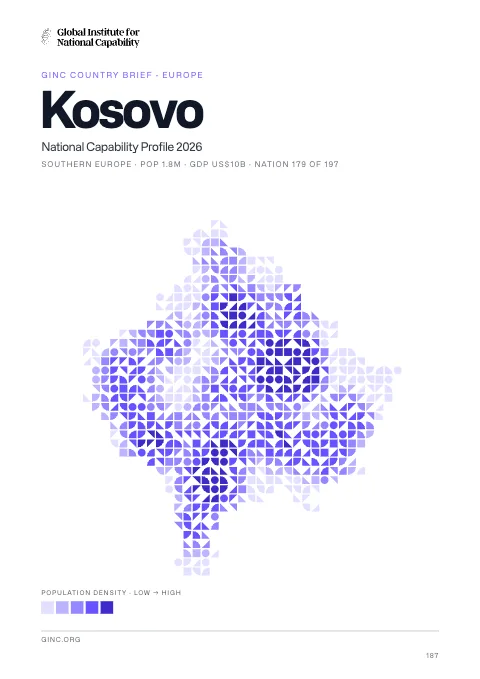
Kosovo is a landlocked republic in Europe, home to 1.9 million people, with its capital at Pristina.
Contents
12 chapters
Foundations
01–03
At a glance
- Area
- 10.9Kkm²#168 World#37 Europe
- Population
- 1.9M#150 World#33 Europe
- GDP (market)
- $7.2B
- GDP (PPP)
- $14.1B#145 World#35 Europe
- GDP per capita
- $7.6K#137 World#45 Europe
The whole brief
Kosovo National Capability Profile 2026
Foundations · Chapter 01
Historical Context
🇽🇰 Kosovo’s understanding the origins and evolution of the modern nation
BackgroundBack to top ↑
The central Balkans were part of the Roman and Byzantine Empires before ethnic Serbs migrated to the territories of modern Kosovo in the 7th century. During the medieval period, Kosovo became the center of a Serbian Empire and saw the construction of many important Serb religious sites, including many architecturally significant Serbian Orthodox monasteries. The defeat of Serbian forces at the Battle of Kosovo in 1389 led to five centuries of Ottoman rule during which large numbers of Turks and Albanians moved to Kosovo. By the end of the 19th century, Albanians replaced the Serbs as the dominant ethnic group in Kosovo. Serbia reacquired control over Kosovo from the Ottoman Empire during the First Balkan War of 1912. After World War II, Kosovo became an autonomous province of Serbia in the Socialist Federal Republic of Yugoslavia (S.F.R.Y.) with status almost equivalent to that of a republic under the 1974 S.F.R.Y. constitution. Despite legislative concessions, Albanian nationalism increased in the 1980s, which led to riots and calls for Kosovo's independence. At the same time, Serb nationalist leaders, such as Slobodan MILOSEVIC, exploited Kosovo Serb claims of maltreatment to secure votes from supporters, many of whom viewed Kosovo as their cultural heartland. Under MILOSEVIC's leadership, Serbia instituted a new constitution in 1989 that revoked Kosovo's status as an autonomous province of Serbia. Kosovo's Albanian leaders responded in 1991 by organizing a referendum that declared Kosovo independent. Under MILOSEVIC, Serbia carried out repressive measures against the Kosovar Albanians in the early 1990s as the unofficial Kosovo government, led by Ibrahim RUGOVA, used passive resistance in an attempt to try to gain international assistance and recognition of an independent Kosovo. Albanians dissatisfied with RUGOVA's passive strategy in the 1990s created the Kosovo Liberation Army and launched an insurgency. Starting in 1998, Serbian military, police, and paramilitary forces under MILOSEVIC conducted a brutal counterinsurgency campaign that resulted in massacres and massive expulsions of ethnic Albanians. Approximately 800,000 ethnic Albanians were forced from their homes in Kosovo during this time. International attempts to mediate the conflict failed, and MILOSEVIC's rejection of a proposed settlement led to a three-month NATO military operation against Serbia beginning in March 1999 that forced Serbia to agree to withdraw its military and police forces from Kosovo. UN Security Council Resolution 1244 (1999) placed Kosovo under a transitional administration, the UN Interim Administration Mission in Kosovo (UNMIK), pending a determination of Kosovo's future status. A UN-led process began in late 2005 to determine Kosovo's final status. The negotiations ran in stages between 2006 and 2007, but ended without agreement between Belgrade and Pristina. On 17 February 2008, the Kosovo Assembly declared Kosovo independent. Since then, over 100 countries have recognized Kosovo, and it has joined the International Monetary Fund, World Bank, European Bank for Reconstruction and Development, the Council of Europe Development Bank, and signed a framework agreement with the European Investment Bank (EIB). In October 2008, Serbia sought an advisory opinion from the International Court of Justice (ICJ) on the legality under international law of Kosovo's declaration of independence. The ICJ released the advisory opinion in July 2010 affirming that Kosovo's declaration of independence did not violate general principles of international law, UN Security Council Resolution 1244, or the Constitutive Framework. The opinion was closely tailored to Kosovo's unique history and circumstances. Serbia continues to reject Kosovo's independence, but the two countries reached an agreement to normalize their relations in April 2013 through EU-facilitated talks and are currently engaged in the implementation process.
IndependenceBack to top ↑
17 February 2008 (from Serbia)
National holidayBack to top ↑
Independence Day, 17 February (2008)
Foundations · Chapter 02
Geography
🇽🇰 Kosovo’s territory, resources and strategic position
Location and areaBack to top ↑
Southeast Europe, between Serbia and Macedonia
42 35 N, 21 00 E
Europe
slightly larger than Delaware
0 km (landlocked)
none (landlocked)
Terrain and resourcesBack to top ↑
flat fluvial basin with an elevation of 400-700 m above sea level surrounded by several high mountain ranges with elevations of 2,000 to 2,500 m
nickel, lead, zinc, magnesium, lignite, kaolin, chrome, bauxite
OtherBack to top ↑
Foundations · Chapter 03
Environment
🇽🇰 Kosovo’s environmental conditions, resources and national resilience
ClimateBack to top ↑
influenced by continental air masses resulting in relatively cold winters with heavy snowfall and hot, dry summers and autumns; Mediterranean and alpine influences create regional variation; maximum rainfall between October and December
GINC Capability Domains · Chapter 04
Critical Technology
🇽🇰 Kosovo’s technology frontiers and the pursuit of national advantage
Two counts are set side by side for 2015–2024: on the left, the papers researchers in Kosovo published; on the right, the patent families that began there and were filed in more than one country. First by capability group, then group by group with each group’s capabilities. The badge on a card is the nation’s place among all nations. Papers are from GINC Research Analytics, patent families from GINC Patents.
Research by capability group
#141 WorldPapers published, 2015–2024
Patents by capability group
International patent families, 2015–2024
No international patent families on record for 2015–2024.
Advanced Materials & ManufacturingBack to top ↑
Research
#130 WorldPapers published, 2015–2024
Patents
International patent families, 2015–2024
No international patent families on record for 2015–2024.
Energy TechnologiesBack to top ↑
Research
#142 WorldPapers published, 2015–2024
Patents
International patent families, 2015–2024
No international patent families on record for 2015–2024.
Semiconductors & Advanced ComputingBack to top ↑
Research
#136 WorldPapers published, 2015–2024
No research topic: Semiconductor Design & EDA · Advanced Semiconductor Fabrication · Semiconductor Equipment & Materials · Advanced Packaging & Heterogeneous Integration
Patents
International patent families, 2015–2024
No international patent families on record for 2015–2024.
Artificial IntelligenceBack to top ↑
Research
#130 WorldPapers published, 2015–2024
Patents
International patent families, 2015–2024
No international patent families on record for 2015–2024.
Quantum TechnologiesBack to top ↑
Research
#134 WorldPapers published, 2015–2024
Patents
International patent families, 2015–2024
No international patent families on record for 2015–2024.
Connectivity, Cyber & Trust TechnologiesBack to top ↑
Research
#112 WorldPapers published, 2015–2024
Patents
International patent families, 2015–2024
No international patent families on record for 2015–2024.
Sensing, Timing & NavigationBack to top ↑
Research
#159 WorldPapers published, 2015–2024
Patents
International patent families, 2015–2024
No international patent families on record for 2015–2024.
Robotics & Autonomous SystemsBack to top ↑
Research
#109 WorldPapers published, 2015–2024
No research topic: Human-Machine Interfaces
Patents
International patent families, 2015–2024
No international patent families on record for 2015–2024.
Biotechnology & Health TechnologiesBack to top ↑
Research
#158 WorldPapers published, 2015–2024
Patents
International patent families, 2015–2024
No international patent families on record for 2015–2024.
Medicine and BioTech
Clinical research and life-science invention, drawn from the same series that drive the metric pages. Each card opens the full cross-country comparison.
Space TechnologiesBack to top ↑
- Space Launch & Reusable Systems
- Advanced Propulsion & Hypersonic Systems
- Satellite & Constellation Technologies
GINC Capability Domains · Chapter 05
Strategic Infrastructure
🇽🇰 Kosovo’s energy, connectivity and the material foundations of capability
Resource InfrastructureBack to top ↑
NA bbl
0 bbl/day (2007)
NA bbl/day (2011 est.)
0 cu m (2007)
0 cu m (2007)
NA cu m
Agriculture & Food InfrastructureBack to top ↑
- Irrigation & Agricultural Water
- Livestock & Veterinary
- Fisheries & Aquaculture
- Storage, Cold Chain & Markets
Energy InfrastructureBack to top ↑
- Thermal Generation
- Nuclear Generation
- Nuclear Fuel Cycle & Radioactive Waste
- Hydropower
- Renewable Generation
- Transmission & Distribution
- System Control & Dispatch
- Storage & Fuel Supply
1.526 million kW
5.847 billion kWh (2012)
5.467 billion kWh (2012)
371.3 million kWh
625.1 million kWh
Water, Sanitation & Waste InfrastructureBack to top ↑
- Dams, Reservoirs & Flood Defence
- Water Supply & Treatment
- Bulk Water Transfer & Desalination
- Wastewater & Sanitation
- Solid Waste & Recycling
Advanced ManufacturingBack to top ↑
- Materials & Inputs
- Chemicals & Hazardous Process Industry
- Production Systems
- Supply Chain & Ecosystem
- Workforce & Innovation
Transport InfrastructureBack to top ↑
- Seaports & Terminals
- Air Infrastructure
- Air Navigation & Traffic Management
- Inland Waterways & Ferries
- Rail Infrastructure
- Roads & Bridges
- Logistics, Multimodal & Border Infrastructure
- Postal & Parcel
6 (2013)
2 (2013)
Communications & Digital InfrastructureBack to top ↑
- Subsea Cables & International Gateways
- Core & Backbone Networks
- Mobile & Wireless Networks
- Spectrum & Broadcasting
- Data Centres, Compute & Cloud
- Data Resources
- AI Tools & Applications
106,300 (2006)
562,000 (2007)
Financial InfrastructureBack to top ↑
- Currency & Reserves
- Payments & Settlement Systems
- Markets, Exchanges & Depositories
- Banks, Insurers & Systemic Institutions
Social InfrastructureBack to top ↑
- Health Infrastructure
- Public Health & Laboratories
- Medical Supply & Stockpiles
- Education & Skills Infrastructure
- Research & Scientific Facilities
- Housing, Community & Social Services
- Government & Public Administration
- Cultural, Community & Recreational Infrastructure
- Justice & Corrections
- Emergency Services & Civil Protection
- Hydrometeorology & Early Warning
Space, Aerospace & Defence InfrastructureBack to top ↑
GINC Capability Domains · Chapter 06
National Security
🇽🇰 Kosovo’s force, intelligence and the defence of the nation
Disputes and terrorismBack to top ↑
Serbia with several other states protest the US and other states' recognition of Kosovo's declaration of its status as a sovereign and independent state in February 2008; ethnic Serbian municipalities along Kosovo's northern border challenge final status of Kosovo-Serbia boundary; several thousand NATO-led Kosovo Force peacekeepers under United Nations Interim Administration Mission in Kosovo authority continue to keep the peace within Kosovo between the ethnic Albanian majority and the Serb minority in Kosovo; Kosovo and Macedonia completed demarcation of their boundary in September 2008
Force Generation & MobilisationBack to top ↑
Kosovo Security Force (FSK) (2010)
Intelligence & AssessmentBack to top ↑
- Imagery & Geospatial Intelligence
- Signals & Cyber Intelligence
- Technical & Measurement Intelligence
- Open-Source & Financial Intelligence
- Human Intelligence & Counterintelligence
- All-Source Analysis & Warning
Joint Command, Projection & SustainmentBack to top ↑
- Command, Control & Communications
- Strategic Lift & Mobility
- Expeditionary & Peace Operations
- Operational Sustainment & War Reserves
- Defence Industrial Mobilisation
- CBRN Defence
Land PowerBack to top ↑
- Combined Arms Manoeuvre
- Land Fires
- Battlefield Aviation & Uncrewed Systems
- Special Operations & Irregular Warfare
Maritime PowerBack to top ↑
- Maritime Security & Constabulary
- Sea Denial & Undersea Warfare
- Sea Control
- Amphibious & Expeditionary Operations
Air PowerBack to top ↑
- Air Sovereignty & Policing
- Control of the Air
- Air Strike & Interdiction
- Airborne ISR, Early Warning & Battle Management
Strategic Strike & Missile DefenceBack to top ↑
Space OperationsBack to top ↑
Cyber & Electromagnetic OperationsBack to top ↑
Nuclear DeterrenceBack to top ↑
GINC Capability Domains · Chapter 07
Human Capital
🇽🇰 Kosovo’s population, health and the skills that sustain capability
DemographyBack to top ↑
1,859,203 (July 2014 est.)
Welfare and equityBack to top ↑
30% (2013 est.)
30 (FY05/06)
Early Childhood DevelopmentBack to top ↑
Foundational EducationBack to top ↑
4.3% of GDP (2008)
Advanced EducationBack to top ↑
Technical & Vocational SkillsBack to top ↑
Digital & AI CompetenceBack to top ↑
Lifelong Learning & ReskillingBack to top ↑
Research Talent & Knowledge CreationBack to top ↑
Population HealthBack to top ↑
Health System CapabilityBack to top ↑
GINC Capability Domains · Chapter 08
Governance and Integrity
🇽🇰 Kosovo’s institutions, law and the integrity of the state
State structureBack to top ↑
republic
37 municipalities (komunat, singular - komuna (Albanian); opstine, singular - opstina (Serbian)); Decan (Decani), Dragash (Dragas), Ferizaj (Urosevac), Fushe Kosove (Kosovo Polje), Gjakove (Dakovica), Gjilan (Gnjilane), Gllogovc (Glogovac), Gracanice (Gracanica), Hani i Elezit (Deneral Jankovic), Istog (Istok), Junik, Kacanik, Kamenice/Dardana (Kamenica), Kline (Klina), Kllokot (Klokot), Leposaviq (Leposavic), Lipjan (Lipljan), Malisheve (Malisevo), Mamushe (Mamusa), Mitrovice (Mitrovica), Novoberde (Novo Brdo), Obiliq (Obilic), Partesh (Partes), Peje (Pec), Podujeve (Podujevo), Prishtine (Pristina), Prizren, Rahovec (Orahovac), Ranillug (Ranilug), Shterpce (Strpce), Shtime (Stimlje), Skenderaj (Srbica), Suhareke (Suva Reka), Viti (Vitina), Vushtrri (Vucitrn), Zubin Potok, Zvecan; note - a 38th municipality (Mitrovica e Veriut/Severna Mitrovica (Mitrovica North)) may have been created; when/if approved by the US Board on Geographic Names it will be added to the above listing
previous 1974, 1990; latest (postindependence) draft finalized 2 April 2008, signed 7 April 2008, ratified 8 April 2008, entered into force 15 June 2008; amended 2013 (2013)
18 years of age; universal
Political Institutions & Civic ParticipationBack to top ↑
- Electoral Management & Integrity
- Legislature & Deliberative Institutions
- Citizen Participation & Civic Space
unicameral national Assembly (120 seats; 100 seats directly elected, 10 seats guaranteed for ethnic Serbs, 10 seats guaranteed for other ethnic minorities; members to serve three-year terms)
Albanian Christian Democratic Party of Kosovo or PSHDK [Uke BERISHA]//Alliance for a New Kosovo or AKR [Behgjet PACOLLI]//Alliance for the Future of Kosovo or AAK [Ramush HARADINAJ]//Ashkali Party for Integration or PAI//Bosniak Party of Democratic Action of Kosovo or BSDAK//Citizens' Initiative of Gora or GIG [Murselj HALJILJI]//Civic Initiative for Kosovo or NISMA [Fatmir LIMAJ]//Conservative Party of Kosovo or PK [Munir BASHA]//Democratic Action Party or SDA [Numan BALIC]//Democratic League of Dardania or LDD [Nexhat DACI]//Democratic League of Kosovo or LDK [Isa MUSTAFA]//Democratic Party of Ashkali of Kosovo or PDAK [Berat QERIMI]//Democratic Party of Kosovo or PDK [Hashim THACI]//Independent Liberal Party or SLS [Slobadan PETROVIC]//Justice Party of Kosovo or PD (formerly part of the Coalition for New Kosovo or KKR) [Ferid AGANI]//Kosovo Democratic Turkish Party or KDTP [Mahir YAGCILAR]//Movement for Self-Determination (Vetevendosje) or VV [Albin KURTI]//Movement for Unification or LB [Avni KLINAKU]//National Democratic Party of Albania or PNDSH [Bujar ABDULLAHU]//New Democratic Initiative of Kosovo or IRDK [Xhevdet NEZIRAJ]//New Democratic Party or NDS [Predrag JOVIC]//Serb People's Party or SNS [Mihailo SCEPANOVIC]//Serb People's Party of Kosovo or SNPK//Serbian Democratic Party of Kosovo and Metohija or SDSKiM [Sasa DJOKIC]//Serbian Kosovo and Metohija Party or SKMS [Dragisa MIRIC]//Serbian List [Aleksandar JABLANOVIC]//Serbian National Council of Northern Kosovo and Metohija or SNV [Milan IVANOVIC]//Serbian Social Democratic Party or SSDS//Social Democratic Party of Kosovo or PSDK//Socialist Party of Kosovo or PSK [Ilaz KADOLLI]//Turkish Democratic Party of Kosovo or KDTP [Mahir YAGCILAR]//Union of Independent Social Democrats of Kosovo and Metohija or SNSKiM [Ljubisa ZIVIC]//United Roma Party of Kosovo or PREBK [Haxhi Zylfi MERXHA]//United Serb List or JSL//Vakat Coalition or VAKAT [Sadik IDRIZI]//a coalition formed for the 2014 parliamentary elections included, the PDK, PD, LB, PSHDK, and PK
Council for the Defense of Human Rights and Freedom (human rights)//Organization for Democracy, Anti-Corruption and Dignity Rise! [Avni ZOGIANI]//Serb National Council (SNV)//The Speak Up Movement [Ramadan ILAZI]
Justice System & Fundamental RightsBack to top ↑
- Judicial Independence & Court Capability
- Access to Justice & Legal Services
- Fundamental Rights Protection
- Human Rights Institutions & Equality Bodies
evolving legal system; mixture of applicable Kosovo law, UNMIK laws and regulations, and applicable laws of the Former Socialist Republic of Yugoslavia that were in effect in Kosovo as of 22 March 1989
has not submitted an ICJ jurisdiction declaration; non-party state to the ICCt
Internal Security & OrderBack to top ↑
Regulatory Governance & Strategic ControlsBack to top ↑
- Regulatory Quality & Better Regulation
- Regulatory Delivery & Independent Regulators
- Strategic Controls & Economic Security Administration
Government Effectiveness & Public AdministrationBack to top ↑
- Centre of Government & Policy Coordination
- Civil Service & Public Workforce
- Digital Government & Service Delivery
- Legal Identity & Civil Registration
- Statistical & Data Capability
Public Integrity & Anti-CorruptionBack to top ↑
Transparency, Oversight & AccountabilityBack to top ↑
- Right to Information & Open Government
- Independent Oversight & Supreme Audit
- Independent Media & Journalist Safety
National Resilience & Crisis ManagementBack to top ↑
GINC Capability Domains · Chapter 09
Information and Influence
🇽🇰 Kosovo’s identity, media and the projection of influence
Identity and cultureBack to top ↑
Albanian (official), Serbian (official), Bosnian, Turkish, Roma
Muslim, Serbian Orthodox, Roman Catholic
Albanians 92%, other (Serb, Bosniak, Gorani, Roma, Turk, Ashkali, Egyptian) 8% (2008)
centered on a dark blue field is the geographical shape of Kosovo in a gold color surmounted by six white, five-pointed stars arrayed in a slight arc; each star represents one of the major ethnic groups of Kosovo: Albanians, Serbs, Turks, Gorani, Roma, and Bosniaks
Diplomatic Statecraft & Global NetworksBack to top ↑
- Diplomatic Network & Consular Reach
- Multilateral Leadership & Norm Setting
- Agenda-Setting & Convening
- Mediation & Crisis Diplomacy
IBRD, IDA, IFC, IMF, ITUC (NGOs), MIGA
Alliances & Security CooperationBack to top ↑
Development Cooperation & Global AssistanceBack to top ↑
Culture, Language & Education DiplomacyBack to top ↑
- Cultural & Language Institutes
- Creative Industries & Cultural Export Reach
- Heritage & Cultural Institutions
- Education Diplomacy & Alumni Networks
- Sports & Major Events
Diaspora & Global CommunitiesBack to top ↑
Information Environment & Strategic CommunicationBack to top ↑
GINC Capability Domains · Chapter 10
Financial Strength
🇽🇰 Kosovo’s fiscal depth, reserves and the capacity to act
Monetary & Currency CapabilityBack to top ↑
- Monetary Policy & Price Stability
- Exchange Rate & External Account Management
- Currency Issuance & Digital Money
1.8% (2013 est.)//2.5% (2012 est.)
euros (EUR) per US dollar -//0.7634 (2013 est.)//0.7752 (2012 est.)//0.755 (2010 est.)//0.7198 (2009 est.)//0.6827 (2008 est.)
NA% (30 June 2013 est.)//13.7% (31 December 2012 est.)
$2.773 billion//$2.637 billion
Fiscal Capacity & Public FinanceBack to top ↑
- Revenue Mobilisation & Tax Administration
- Public Expenditure & Budget Management
- Sovereign Debt & Treasury Management
- Public Investment Management
26.8% of GDP (2013 est.)
-1.8% of GDP (2013 est.)
9.1% of GDP (2013)//8.4% of GDP (2012)
Financial System Depth & AccessBack to top ↑
- Banking System Capacity
- Capital Markets Depth & Development
- Long-Term & Institutional Capital
- Financial Inclusion & Household Access
- Development & Policy Finance
$2.505 billion//$2.445 billion
12.7% of GDP (2013 est.)//12.5% of GDP (2012 est.)//12.4% of GDP (2011 est.)
Financial Regulation & IntegrityBack to top ↑
- Prudential Regulation & Supervision
- Financial Integrity & Illicit Finance Control
- Market Conduct & Consumer Protection
- Payment & Market Infrastructure Oversight
Financial Stability & Crisis ManagementBack to top ↑
- Macroprudential & Systemic Oversight
- Crisis Management, Resolution & Deposit Insurance
- External Liquidity & Financial Safety Nets
Sovereign Capital & External Financial PowerBack to top ↑
- Official Reserves Management
- Sovereign Wealth & Public Asset Management
- Currency Internationalisation & Reserve Status
- Capital Account & Flow Management
- International Financial Centre Capability
$NA
$448.2 million (2013 est.)//$466 million (2012 est.)
GINC Capability Domains · Chapter 11
Production and Innovation
🇽🇰 Kosovo’s output, industry and the engine of prosperity
Economic Output & ProductivityBack to top ↑
Kosovo's economy has shown significant progress in transitioning to a market-based system and maintaining macroeconomic stability, but it is still highly dependent on the international community and the diaspora for financial and technical assistance. Kosovo's citizens are the poorest in Europe with a per capita GDP (PPP) of $7,600 in 2013. An unemployment rate of 45% encourages emigration and fuels a significant informal, unreported economy. Remittances from the diaspora - located mainly in Germany, Switzerland, and the Nordic countries - are estimated to account for about 15% of GDP, and donor-financed activities and aid for approximately 10%. Most of Kosovo's population lives in rural towns outside of the capital, Pristina. Inefficient, near-subsistence farming is common - the result of small plots, limited mechanization, and lack of technical expertise. With international assistance, Kosovo has been able to privatize a majority of its state-owned-enterprises. Minerals and metals - including lignite, lead, zinc, nickel, chrome, aluminum, magnesium, and a wide variety of construction materials - once formed the backbone of industry, but output has declined because of ageing equipment and insufficient investment. A limited and unreliable electricity supply due to technical and financial problems is a major impediment to economic development, but Kosovo has received technical assistance to help improve accounting and controls and, in 2012, privatized its distribution network. The US Government is cooperating with the Ministry for Energy and Mines and the World Bank to prepare commercial tenders for the construction of a new power plant, rehabilitation of an old plant, and the development of a coal mine that could supply both. In July 2008, Kosovo received pledges of $1.9 billion from 37 countries in support of its reform priorities, but the global financial crisis has limited this assistance and also negatively affected remittance inflows. In June 2009, Kosovo joined the World Bank and International Monetary Fund, and Kosovo began servicing its share of the former Yugoslavia's debt. In order to help integrate Kosovo into regional economic structures, UNMIK signed (on behalf of Kosovo) its accession to the Central Europe Free Trade Area (CEFTA) in 2006. Serbia and Bosnia previously had refused to recognize Kosovo's customs stamp or extend reduced tariff privileges for Kosovo products under CEFTA, but both countries resumed trade with Kosovo in 2011. The official currency of Kosovo is the euro, but the Serbian dinar is also used illegally in Serb enclaves. Kosovo's tie to the euro has helped keep core inflation low. Kosovo maintained a budget surplus until 2011, when government expenditures climbed sharply. In 2013 Kosovo signed a Free Trade Agreement with Turkey and is negotiating liberalization of trade with EU as part of a Stabilization and Association Agreement.
$14.11 billion (2013 est.)//$13.77 billion (2012 est.)//$13.43 billion (2011 est.)
2.5% (2013 est.)//2.5% (2012 est.)//4.4% (2011 est.)
$7,600 (2013 est.)//$7,500 (2012 est.)//$7,400 (2011 est.)
$7.15 billion (2013 est.)
Labour & EmploymentBack to top ↑
- Employment & Labour Force Participation
- Labour Market Institutions & Wage Setting
- Employment Services & Skills Matching
- Labour Adjustment, Transition & Formalisation
800,000
30.9% (2013 est.)//45% (1)
Industrial & Sectoral BaseBack to top ↑
- Manufacturing & Advanced Industry
- Foundational & Process Industries
- Agrifood & Primary Production
- Services Economy
wheat, corn, berries, potatoes, peppers, fruit; dairy, livestock; fish
mineral mining, construction materials, base metals, leather, machinery, appliances, foodstuffs and beverages, textiles
Structural Transformation & ComplexityBack to top ↑
Business Dynamism & EntrepreneurshipBack to top ↑
- Entrepreneurship & Firm Creation
- Risk Capital & Scale-Up Finance
- Firm Growth, Exit & Renewal
- Competition & Market Contestability
Innovation & CommercialisationBack to top ↑
- Business Innovation Capability
- Research Commercialisation & Knowledge Transfer
- Intellectual Property & Intangible Assets
- Innovation Ecosystems & Clusters
Technology Adoption & DiffusionBack to top ↑
GINC Capability Domains · Chapter 12
Trade and Investment
🇽🇰 Kosovo’s markets, capital and the terms of global exchange
External balanceBack to top ↑
-$919.7 million (2013 est.)//-$1.083 billion (2012 est.)
Trade Facilitation & LogisticsBack to top ↑
Trade Policy & Market AccessBack to top ↑
- Trade Policy & Negotiation Capability
- Market Access & Agreements Network
- Trade Law & Enforcement
- Standards, Conformity & Quality Infrastructure
Digital & Services TradeBack to top ↑
- Services Trade Capability
- Digital Trade & E-Commerce
- Data Flows & Digital Trade Governance
- Tourism & Visitor Economy
Investment Attraction & ProjectionBack to top ↑
- Investment Attraction & Facilitation
- Investment Absorption & Linkages
- Outward Investment & Global Corporate Presence
$21.2 billion (31 December 2013 est.)//$25.8 million (31 December 2012 est.)
Export Capability & SophisticationBack to top ↑
$408 million (2013 est.)//$382.8 million (2012 est.)
Italy 25.8%, Albania 14.6%, Macedonia 9.6%, China 5.5%, Gernamy 5.4%, Switzerland 5.4%, Turkey 4.1% (2012 est.)
mining and processed metal products, scrap metals, leather products, machinery, appliances, prepared foodstuffs, beverages and tobacco, vegetable products, textile and textile articles
Global Value Chain PositionBack to top ↑
- Value Chain Participation & Integration
- Value Chain Position & Upgrading
- Regional Integration & Hub Anchoring
Economic Leverage & DependenceBack to top ↑
- Strategic Supply Security
- Concentration Risk & Revenue Stabilisation
- Economic Leverage & Coercion Resistance
$3.398 billion (2013 est.)//$3.477 billion (2012 est.)
Germany 11.9%, Macedonia 11.5%, Serbia 11.1%, Italy 8.5%, Turkey 9%, China 6.4%, Albania 4.4% (2012 est.)
foodstuffs, livestock, wood, petroleum, chemicals, machinery, minerals, textiles, stone, ceramic and glass products, electrical equipment
Kosovo · you are in
Historical Context
Foundations
GINC Capability Domains
Find in this brief · Kosovo