
Belize
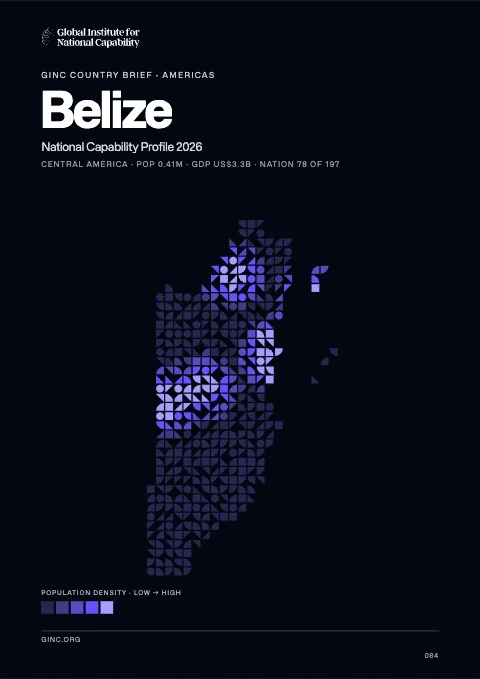
Belize is a parliamentary democracy and a Commonwealth realm in Central America and the Caribbean, home to 341,000 people, with its capital at Belmopan.
Contents
12 chapters
Foundations
01–03
At a glance
- Area
- 23Kkm²#151 World#9 C. America
- Population
- 340.8K#177 World#13 C. America
- GDP (market)
- $1.6B
- GDP (PPP)
- $3.1B#182 World#16 C. America
- GDP per capita
- $8.8K#128 World#25 C. America
The whole brief
Belize National Capability Profile 2026
Foundations · Chapter 01
Historical Context
🇧🇿 Belize’s understanding the origins and evolution of the modern nation
BackgroundBack to top ↑
Belize was the site of several Mayan city states until their decline at the end of the first millennium A.D. The British and Spanish disputed the region in the 17th and 18th centuries; it formally became the colony of British Honduras in 1854. Territorial disputes between the UK and Guatemala delayed the independence of Belize until 1981. Guatemala refused to recognize the new nation until 1992 and the two countries are involved in an ongoing border dispute. Tourism has become the mainstay of the economy. Current concerns include the country's heavy foreign debt burden, high unemployment, growing involvement in the Mexican and South American drug trade, high crime rates, and one of the highest HIV/AIDS prevalence rates in Central America.
IndependenceBack to top ↑
21 September 1981 (from the UK)
National holidayBack to top ↑
Independence Day, 21 September (1981)
Foundations · Chapter 02
Geography
🇧🇿 Belize’s territory, resources and strategic position
Location and areaBack to top ↑
Central America, bordering the Caribbean Sea, between Guatemala and Mexico
17 15 N, 88 45 W
Central America and the Caribbean
slightly smaller than Massachusetts
386 km
Terrain and resourcesBack to top ↑
flat, swampy coastal plain; low mountains in south
arable land potential, timber, fish, hydropower
30 sq km (2003)
Settlement and hazardsBack to top ↑
frequent, devastating hurricanes (June to November) and coastal flooding (especially in south)
only country in Central America without a coastline on the North Pacific Ocean
OtherBack to top ↑
18.55 cu km (2011)
deforestation; water pollution from sewage, industrial effluents, agricultural runoff; solid and sewage waste disposal
Foundations · Chapter 03
Environment
🇧🇿 Belize’s environmental conditions, resources and national resilience
ClimateBack to top ↑
tropical; very hot and humid; rainy season (May to November); dry season (February to May)
Emissions and pollutionBack to top ↑
Water, waste and foodBack to top ↑
Resources and agreementsBack to top ↑
GINC Capability Domains · Chapter 04
Critical Technology
🇧🇿 Belize’s technology frontiers and the pursuit of national advantage
Two counts are set side by side for 2015–2024: on the left, the papers researchers in Belize published; on the right, the patent families that began there and were filed in more than one country. First by capability group, then group by group with each group’s capabilities. The badge on a card is the nation’s place among all nations. Papers are from GINC Research Analytics, patent families from GINC Patents.
Research by capability group
#197 WorldPapers published, 2015–2024
Patents by capability group
#110 WorldInternational patent families, 2015–2024
Advanced Materials & ManufacturingBack to top ↑
- Structural & Composite Materials
- Functional Materials & Coatings
- Nanomaterials & Metamaterials
- Superconducting, Magnetic & Photonic Materials
- Energetic Materials
- Additive & Precision Manufacturing
- Advanced Chemical & Process Manufacturing
Energy TechnologiesBack to top ↑
- Batteries & Energy Storage
- Hydrogen, Ammonia & Sustainable Fuels
- Next-Generation Solar & Renewables
- Advanced Nuclear & Fusion
- Directed Energy Technologies
Semiconductors & Advanced ComputingBack to top ↑
- Semiconductor Design & EDA
- Advanced Semiconductor Fabrication
- Semiconductor Equipment & Materials
- Advanced Packaging & Heterogeneous Integration
- Compound & Power Semiconductors
- High-Performance & AI Computing
Artificial IntelligenceBack to top ↑
Research
Papers published, 2015–2024
No papers on record for 2015–2024.
Patents
#89 WorldInternational patent families, 2015–2024
Quantum TechnologiesBack to top ↑
Connectivity, Cyber & Trust TechnologiesBack to top ↑
Research
Papers published, 2015–2024
No papers on record for 2015–2024.
Patents
#87 WorldInternational patent families, 2015–2024
Sensing, Timing & NavigationBack to top ↑
- Precision Timing & Atomic Clocks
- Resilient Positioning & Navigation
- Advanced Imaging & Photonic Sensing
- Radar & Radiofrequency Sensing
- Acoustic & Undersea Sensing
Robotics & Autonomous SystemsBack to top ↑
- Advanced Robotics
- Autonomous Systems & Trusted Autonomy
- Uncrewed & Collaborative Systems
- Human-Machine Interfaces
Biotechnology & Health TechnologiesBack to top ↑
Research
#174 WorldPapers published, 2015–2024
Patents
International patent families, 2015–2024
No international patent families on record for 2015–2024.
Medicine and BioTech
Clinical research and life-science invention, drawn from the same series that drive the metric pages. Each card opens the full cross-country comparison.
Space TechnologiesBack to top ↑
- Space Launch & Reusable Systems
- Advanced Propulsion & Hypersonic Systems
- Satellite & Constellation Technologies
GINC Capability Domains · Chapter 05
Strategic Infrastructure
🇧🇿 Belize’s energy, connectivity and the material foundations of capability
Resource InfrastructureBack to top ↑
3,239 bbl/day (2012 est.)
4,345 bbl/day (2010 est.)
0 bbl/day (2010 est.)
6.7 million bbl (1 January 2013 est.)
0 bbl/day (2010 est.)
7,044 bbl/day (2011 est.)
0 bbl/day (2010 est.)
3,493 bbl/day (2010 est.)
0 cu m (2011 est.)
0 cu m (2010 est.)
0 cu m (2011 est.)
0 cu m (2011 est.)
0 cu m (1 January 2013 est.)
Agriculture & Food InfrastructureBack to top ↑
- Irrigation & Agricultural Water
- Livestock & Veterinary
- Fisheries & Aquaculture
- Storage, Cold Chain & Markets
Energy InfrastructureBack to top ↑
- Thermal Generation
- Nuclear Generation
- Nuclear Fuel Cycle & Radioactive Waste
- Hydropower
- Renewable Generation
- Transmission & Distribution
- System Control & Dispatch
- Storage & Fuel Supply
178,100 kW (2010 est.)
524.2 million kWh (2010 est.)
630 million kWh (2011 est.)
0 kWh (2012 est.)
171 million kWh (2011 est.)
51.1% of total installed capacity (2010 est.)
0% of total installed capacity (2010 est.)
32% of total installed capacity (2010 est.)
16.9% of total installed capacity (2010 est.)
536,300 Mt (2011 est.)
Water, Sanitation & Waste InfrastructureBack to top ↑
- Dams, Reservoirs & Flood Defence
- Water Supply & Treatment
- Bulk Water Transfer & Desalination
- Wastewater & Sanitation
- Solid Waste & Recycling
Advanced ManufacturingBack to top ↑
- Materials & Inputs
- Chemicals & Hazardous Process Industry
- Production Systems
- Supply Chain & Ecosystem
- Workforce & Innovation
Transport InfrastructureBack to top ↑
- Seaports & Terminals
- Air Infrastructure
- Air Navigation & Traffic Management
- Inland Waterways & Ferries
- Rail Infrastructure
- Roads & Bridges
- Logistics, Multimodal & Border Infrastructure
- Postal & Parcel
47 (2013)
825 km (navigable only by small craft) (2011)
Communications & Digital InfrastructureBack to top ↑
- Subsea Cables & International Gateways
- Core & Backbone Networks
- Mobile & Wireless Networks
- Spectrum & Broadcasting
- Data Centres, Compute & Cloud
- Data Resources
- AI Tools & Applications
25,400 (2012)
164,200 (2012)
36,000 (2009)
3,392 (2012)
.bz
Financial InfrastructureBack to top ↑
- Currency & Reserves
- Payments & Settlement Systems
- Markets, Exchanges & Depositories
- Banks, Insurers & Systemic Institutions
Social InfrastructureBack to top ↑
- Health Infrastructure
- Public Health & Laboratories
- Medical Supply & Stockpiles
- Education & Skills Infrastructure
- Research & Scientific Facilities
- Housing, Community & Social Services
- Government & Public Administration
- Cultural, Community & Recreational Infrastructure
- Justice & Corrections
- Emergency Services & Civil Protection
- Hydrometeorology & Early Warning
Space, Aerospace & Defence InfrastructureBack to top ↑
GINC Capability Domains · Chapter 06
National Security
🇧🇿 Belize’s force, intelligence and the defence of the nation
Disputes and terrorismBack to top ↑
Guatemala persists in its territorial claim to half of Belize, but agrees to the Line of Adjacency to keep Guatemalan squatters out of Belize's forested interior; both countries agreed in April 2012 to hold simultaneous referenda, which was scheduled for 6 October 2013, to decide whether to refer the dispute to the ICJ for binding resolution, though this has been suspended indefinitely; Belize and Mexico are working to solve minor border demarcation discrepancies arising from inaccuracies in the 1898 border treaty
Force Generation & MobilisationBack to top ↑
Belize Defense Force (BDF): Army, BDF Air Wing (includes Special Boat Unit), BDF Volunteer Guard (2011)
18 years of age for voluntary military service; laws allow for conscription only if volunteers are insufficient; conscription has never been implemented; volunteers typically outnumber available positions by 3:1; initial service obligation 12 years (2012)
NA% (2012)//1.08% of GDP (2011)//NA% (2010)
Forces under arms
Active-duty strength on the Correlates of War series, which reaches back to 1816 and so carries a nation’s whole record of mobilisation rather than its present establishment. The card opens the full cross-country comparison.
Intelligence & AssessmentBack to top ↑
- Imagery & Geospatial Intelligence
- Signals & Cyber Intelligence
- Technical & Measurement Intelligence
- Open-Source & Financial Intelligence
- Human Intelligence & Counterintelligence
- All-Source Analysis & Warning
Joint Command, Projection & SustainmentBack to top ↑
- Command, Control & Communications
- Strategic Lift & Mobility
- Expeditionary & Peace Operations
- Operational Sustainment & War Reserves
- Defence Industrial Mobilisation
- CBRN Defence
Land PowerBack to top ↑
- Combined Arms Manoeuvre
- Land Fires
- Battlefield Aviation & Uncrewed Systems
- Special Operations & Irregular Warfare
Maritime PowerBack to top ↑
- Maritime Security & Constabulary
- Sea Denial & Undersea Warfare
- Sea Control
- Amphibious & Expeditionary Operations
Air PowerBack to top ↑
- Air Sovereignty & Policing
- Control of the Air
- Air Strike & Interdiction
- Airborne ISR, Early Warning & Battle Management
Strategic Strike & Missile DefenceBack to top ↑
Space OperationsBack to top ↑
Cyber & Electromagnetic OperationsBack to top ↑
Nuclear DeterrenceBack to top ↑
GINC Capability Domains · Chapter 07
Human Capital
🇧🇿 Belize’s population, health and the skills that sustain capability
DemographyBack to top ↑
340,844 (July 2014 est.)
Migration continues to transform Belize's population. About 16% of Belizeans live abroad, while immigrants constitute approximately 15% of Belize's population. Belizeans seeking job and educational opportunities have preferred to emigrate to the United States rather than former colonizer Great Britain because of the United States' closer proximity and stronger trade ties with Belize. Belizeans also emigrate to Canada, Mexico, and English-speaking Caribbean countries. The emigration of a large share of Creoles (Afro-Belizeans) and the influx of Central American immigrants, mainly Guatemalans, Salvadorans, and Hondurans, has changed Belize's ethnic composition. Mestizos have become the largest ethnic group, and Belize now has more native Spanish speakers than English or Creole speakers, despite English being the official language. In addition, Central American immigrants are establishing new communities in rural areas, which contrasts with the urbanization trend seen in neighboring countries. Recently, Chinese, European, and North American immigrants have become more frequent.//Immigration accounts for an increasing share of Belize's population growth rate, which is steadily falling due to fertility decline. Belize's declining birth rate and its increased life expectancy are creating an aging population. As the elderly population grows and nuclear families replace extended households, Belize's government will be challenged to balance a rising demand for pensions, social services, and healthcare for its senior citizens with the need to reduce poverty and social inequality and to improve sanitation.
1.92% (2014 est.)
25.14 births/1,000 population (2014 est.)
5.95 deaths/1,000 population (2014 est.)
3.02 children born/woman (2014 est.)
55.2% (2011)
Migration and urbanisationBack to top ↑
0 migrant(s)/1,000 population (2014 est.)
BELMOPAN (capital) 14,000 (2011)
Welfare and equityBack to top ↑
41% (2013 est.)
Early Childhood DevelopmentBack to top ↑
6.2% (2011)
Foundational EducationBack to top ↑
6.6% of GDP (2010)
Advanced EducationBack to top ↑
Technical & Vocational SkillsBack to top ↑
Digital & AI CompetenceBack to top ↑
Lifelong Learning & ReskillingBack to top ↑
Research Talent & Knowledge CreationBack to top ↑
Population HealthBack to top ↑
53 deaths/100,000 live births (2010)
33.7% (2008)
1.4% (2012 est.)
3,100 (2012 est.)
100 (2012 est.)
Health System CapabilityBack to top ↑
5.7% of GDP (2011)
0.83 physicians/1,000 population (2009)
1.1 beds/1,000 population (2011)
GINC Capability Domains · Chapter 08
Governance and Integrity
🇧🇿 Belize’s institutions, law and the integrity of the state
State structureBack to top ↑
parliamentary democracy and a Commonwealth realm
6 districts; Belize, Cayo, Corozal, Orange Walk, Stann Creek, Toledo
previous 1954, 1963 (preindependence); latest signed and entered into force 21 September 1981; amended several times, last in 2012 (2013)
18 years of age; universal
Political Institutions & Civic ParticipationBack to top ↑
- Electoral Management & Integrity
- Legislature & Deliberative Institutions
- Citizen Participation & Civic Space
bicameral National Assembly consists of the Senate (12 seats; members appointed by the governor general - 6 on the advice of the prime minister, 3 on the advice of the leader of the opposition, and 1 each on the advice of the Belize Council of Churches and Evangelical Association of Churches, the Belize Chamber of Commerce and Industry and the Belize Better Business Bureau, and the National Trade Union Congress and the Civil Society Steering Committee; to serve five-year terms) and the House of Representatives (31 seats; members are elected by direct popular vote to serve five-year terms)
National Alliance for Belizean Rights or NABR//National Reform Party or NRP [Cornelius DUECK]//People's National Party or PNP [Wil MAHEIA]//People's United Party or PUP [John BRICENO]//United Democratic Party or UDP [Dean Oliver BARROW]//Vision Inspired by the People or VIP [Paul MORGAN]//We the People Reform Movement or WTP [Hipolito BAUTISTA]
Society for the Promotion of Education and Research or SPEAR [Nicole HAYLOCK]//Association of Concerned Belizeans or ACB [David VASQUEZ]//National Trade Union Congress of Belize or NTUC/B [Rene GOMEZ]
Justice System & Fundamental RightsBack to top ↑
- Judicial Independence & Court Capability
- Access to Justice & Legal Services
- Fundamental Rights Protection
- Human Rights Institutions & Equality Bodies
English common law
has not submitted an ICJ jurisdiction declaration; accepts ICCt jurisdiction
Internal Security & OrderBack to top ↑
transshipment point for cocaine; small-scale illicit producer of cannabis, primarily for local consumption; offshore sector money-laundering activity related to narcotics trafficking and other crimes (2008)
Regulatory Governance & Strategic ControlsBack to top ↑
- Regulatory Quality & Better Regulation
- Regulatory Delivery & Independent Regulators
- Strategic Controls & Economic Security Administration
Government Effectiveness & Public AdministrationBack to top ↑
- Centre of Government & Policy Coordination
- Civil Service & Public Workforce
- Digital Government & Service Delivery
- Legal Identity & Civil Registration
- Statistical & Data Capability
Public Integrity & Anti-CorruptionBack to top ↑
Transparency, Oversight & AccountabilityBack to top ↑
- Right to Information & Open Government
- Independent Oversight & Supreme Audit
- Independent Media & Journalist Safety
National Resilience & Crisis ManagementBack to top ↑
GINC Capability Domains · Chapter 09
Information and Influence
🇧🇿 Belize’s identity, media and the projection of influence
Identity and cultureBack to top ↑
Spanish 46%, Creole 32.9%, Mayan dialects 8.9%, English 3.9% (official), Garifuna 3.4% (Carib), German 3.3%, other 1.4%, unknown 0.2% (2000 census)
Roman Catholic 39.3%, Pentacostal 8.3%, Seventh Day Adventist 5.3%, Anglican 4.5%, Mennonite 3.7%, Baptist 3.5%, Methodist 2.8%, Nazarene 2.8%, Jehovah's Witnesses 1.6%, other 9.9% (includes Baha'i Faith, Buddhism, Hinduism, Islam, and Mormon), other (unknown) 3.1%, none 15.2% (2010 census)
mestizo 48.7%, Creole 24.9%, Maya 10.6%, Garifuna 6.1%, other 9.7% (2000 census)
Baird's tapir (a large, browsing, forest-dwelling mammal); keel-billed toucan
blue with a narrow red stripe along the top and the bottom edges; centered is a large white disk bearing the coat of arms; the coat of arms features a shield flanked by two workers in front of a mahogany tree with the related motto SUB UMBRA FLOREO (I Flourish in the Shade) on a scroll at the bottom, all encircled by a green garland of 50 mahogany leaves; the colors are those of the two main political parties: blue for the PUP and red for the UDP; various elements of the coat of arms - the figures, the tools, the mahogany tree, and the garland of leaves - recall the logging industry that led to British settlement of Belize
Diplomatic Statecraft & Global NetworksBack to top ↑
- Diplomatic Network & Consular Reach
- Multilateral Leadership & Norm Setting
- Agenda-Setting & Convening
- Mediation & Crisis Diplomacy
ACP, AOSIS, C, Caricom, CD, CDB, CELAC, FAO, G-77, IADB, IAEA, IBRD, ICAO, ICC (NGOs), ICRM, IDA, IFAD, IFC, IFRCS, ILO, IMF, IMO, Interpol, IOC, IOM, ITU, LAES, MIGA, NAM, OAS, OPANAL, OPCW, PCA, Petrocaribe, SICA, UN, UNCTAD, UNESCO, UNIDO, UPU, WCO, WHO, WIPO, WMO, WTO
Alliances & Security CooperationBack to top ↑
Development Cooperation & Global AssistanceBack to top ↑
Culture, Language & Education DiplomacyBack to top ↑
- Cultural & Language Institutes
- Creative Industries & Cultural Export Reach
- Heritage & Cultural Institutions
- Education Diplomacy & Alumni Networks
- Sports & Major Events
Diaspora & Global CommunitiesBack to top ↑
Information Environment & Strategic CommunicationBack to top ↑
- Strategic Communications & Public Diplomacy
- International Media & Broadcasting
- Information Defence & Counter-Interference
8 privately owned TV stations; multi-channel cable TV provides access to foreign stations; about 25 radio stations broadcasting on roughly 50 different frequencies; state-run radio was privatized in 1998 (2007)
GINC Capability Domains · Chapter 10
Financial Strength
🇧🇿 Belize’s fiscal depth, reserves and the capacity to act
Monetary & Currency CapabilityBack to top ↑
- Monetary Policy & Price Stability
- Exchange Rate & External Account Management
- Currency Issuance & Digital Money
1.3% (2013 est.)//1.3% (2012 est.)
Belizean dollars (BZD) per US dollar -//2 (2013 est.)//2 (2012 est.)//2 (2010 est.)//2 (2009)//2 (2008)
18% (31 December 2010 est.)//12% (31 December 2009 est.)
11.8% (31 December 2013 est.)//12.4% (31 December 2012 est.)
$573 million (31 December 2013 est.)//$551.5 million (31 December 2012 est.)
$1.3 billion (31 December 2013 est.)//$1.222 billion (31 December 2012 est.)
Fiscal Capacity & Public FinanceBack to top ↑
- Revenue Mobilisation & Tax Administration
- Public Expenditure & Budget Management
- Sovereign Debt & Treasury Management
- Public Investment Management
25.1% of GDP (2013 est.)
3.5% of GDP (2013 est.)
75.1% of GDP (2013 est.)//84.6% of GDP (2012 est.)
1 April - 31 March
Financial System Depth & AccessBack to top ↑
- Banking System Capacity
- Capital Markets Depth & Development
- Long-Term & Institutional Capital
- Financial Inclusion & Household Access
- Development & Policy Finance
$1.05 billion (31 December 2013 est.)//$1 billion (31 December 2012 est.)
$NA
31.2% of GDP (2013 est.)//29.2% of GDP (2012 est.)//28.2% of GDP (2011 est.)
Financial Regulation & IntegrityBack to top ↑
- Prudential Regulation & Supervision
- Financial Integrity & Illicit Finance Control
- Market Conduct & Consumer Protection
- Payment & Market Infrastructure Oversight
Financial Stability & Crisis ManagementBack to top ↑
- Macroprudential & Systemic Oversight
- Crisis Management, Resolution & Deposit Insurance
- External Liquidity & Financial Safety Nets
Sovereign Capital & External Financial PowerBack to top ↑
- Official Reserves Management
- Sovereign Wealth & Public Asset Management
- Currency Internationalisation & Reserve Status
- Capital Account & Flow Management
- International Financial Centre Capability
$273 million (31 December 2013 est.)//$288.9 million (31 December 2012 est.)
$1.048 billion (31 December 2013 est.)//$1.033 billion (31 December 2012 est.)
GINC Capability Domains · Chapter 11
Production and Innovation
🇧🇿 Belize’s output, industry and the engine of prosperity
Economic Output & ProductivityBack to top ↑
Tourism is the number one foreign exchange earner in this small economy, followed by exports of marine products, citrus, cane sugar, bananas, and garments. The government's expansionary monetary and fiscal policies, initiated in September 1998, led to GDP growth averaging nearly 4% in 1999-2007. Oil discoveries in 2006 bolstered this growth. Exploration efforts have continued and production has increased a small amount. Growth slipped to 0% in 2009, resulting from the global economic slowdown, natural disasters, and a temporary drop in the price of oil, but grew to 2.5% in 2013. With weak economic growth and a large public debt burden, fiscal spending is likely to be tight. In January 2013, the government announced that it had reached a deal with creditors to restructure its $544 million commercial external debt, commonly referred to as the "superbond." The superbond represents one half of the country's public debt. A key government objective remains the reduction of poverty and inequality with the help of international donors. Although Belize has the second highest per capita income in Central America, the average income figure masks a huge income disparity between rich and poor. The sizable trade deficit and heavy foreign debt burden continue to be major concerns.
$3.083 billion (2013 est.)//$3.008 billion (2012 est.)//$2.857 billion (2011 est.)
2.5% (2013 est.)//5.3% (2012 est.)//1.9% (2011 est.)
$8,800 (2013 est.)//$8,800 (2012 est.)//$8,500 (2011 est.)
$1.637 billion (2013 est.)
Labour & EmploymentBack to top ↑
- Employment & Labour Force Participation
- Labour Market Institutions & Wage Setting
- Employment Services & Skills Matching
- Labour Adjustment, Transition & Formalisation
120,500
15.5% (2013)//11.3% (2012)
Industrial & Sectoral BaseBack to top ↑
- Manufacturing & Advanced Industry
- Foundational & Process Industries
- Agrifood & Primary Production
- Services Economy
bananas, cacao, citrus, sugar; fish, cultured shrimp; lumber
garment production, food processing, tourism, construction, oil
-1% (2013 est.)
Structural Transformation & ComplexityBack to top ↑
Business Dynamism & EntrepreneurshipBack to top ↑
- Entrepreneurship & Firm Creation
- Risk Capital & Scale-Up Finance
- Firm Growth, Exit & Renewal
- Competition & Market Contestability
Innovation & CommercialisationBack to top ↑
- Business Innovation Capability
- Research Commercialisation & Knowledge Transfer
- Intellectual Property & Intangible Assets
- Innovation Ecosystems & Clusters
Technology Adoption & DiffusionBack to top ↑
GINC Capability Domains · Chapter 12
Trade and Investment
🇧🇿 Belize’s markets, capital and the terms of global exchange
Overall tradeBack to top ↑
$424M of exports to 123 partners and $1.62B of imports from 121 in 2024, a deficit of $1.19B.
- Exports
- $424M123 partners
- Imports
- $1.62B121 partners
- Balance
- −$1.19Bdeficit
- Total trade
- $2.04B2024
ExportsBack to top ↑
Where its exports go
The largest partners in 2024, with each one's share of the nation's exports.
| Partner | Value | Share | |
|---|---|---|---|
| United States | $111M | 26% | |
| United Kingdom | $71.5M | 17% | |
| Spain | $39.9M | 9.4% | |
| Ivory Coast | $24.3M | 5.7% | |
| Trinidad and Tobago | $18.7M | 4.4% | |
| Honduras | $14.9M | 3.5% | |
| Ireland | $14.5M | 3.4% | |
| Guatemala | $14.2M | 3.4% | |
| Jamaica | $9.79M | 2.3% | |
| Mexico | $8.07M | 1.9% | |
| Gambia | $7.99M | 1.9% | |
| Suriname | $6.88M | 1.6% | |
| Hungary | $5.92M | 1.4% | |
| Germany | $5.86M | 1.4% | |
| Barbados | $5.50M | 1.3% | |
| Senegal | $5.34M | 1.3% | |
| Guyana | $5.29M | 1.2% | |
| Indonesia | $3.83M | 0.9% | |
| Taiwan | $3.46M | 0.8% | |
| South Korea | $3.42M | 0.8% |
What it exports
The largest categories in 2024.
| Category | Value | Share | |
|---|---|---|---|
| Sugars and sugar confectionery | $129M | 30% | |
| Fish, crustaceans, molluscs, aquatics invertebrates | $77.4M | 18% | |
| Edible fruits, nuts, peel of citrus fruit, melons | $58.6M | 14% | |
| Vegetable, fruit, nut food preparations | $20.1M | 4.7% | |
| Tobacco and manufactures tobacco substitutes | $14.8M | 3.5% | |
| Mineral fuels, oils, distillation products | $12.2M | 2.9% | |
| Residues, wastes of food industry, animal fodder | $10.8M | 2.6% | |
| Electrical, electronic equipment | $7.41M | 1.7% | |
| Beverages, spirits and vinegar | $6.62M | 1.6% | |
| Live animals | $6.03M | 1.4% | |
| Machinery, nuclear reactors, boilers | $5.25M | 1.2% | |
| Optical, photo, technical, medical apparatus | $5.13M | 1.2% | |
| Organic chemicals | $5.08M | 1.2% | |
| Miscellaneous edible preparations | $4.68M | 1.1% | |
| Animal, vegetable fats and oils, cleavage products | $4.37M | 1.0% |
ImportsBack to top ↑
Where its imports come from
The largest partners in 2024, with each one's share of the nation's imports.
| Partner | Value | Share | |
|---|---|---|---|
| United States | $656M | 41% | |
| China | $281M | 17% | |
| Guatemala | $149M | 9.2% | |
| Mexico | $138M | 8.5% | |
| Trinidad and Tobago | $26.2M | 1.6% | |
| Costa Rica | $25.8M | 1.6% | |
| Japan | $22.7M | 1.4% | |
| El Salvador | $20.7M | 1.3% | |
| Panama | $20.5M | 1.3% | |
| Brazil | $18.6M | 1.2% | |
| United Kingdom | $17.8M | 1.1% | |
| India | $16.2M | 1.0% | |
| South Korea | $14.8M | 0.9% | |
| Hong Kong | $14.2M | 0.9% | |
| Turkey | $13.6M | 0.8% | |
| Netherlands | $13.2M | 0.8% | |
| Canada | $12.5M | 0.8% | |
| Germany | $9.69M | 0.6% | |
| Taiwan | $8.46M | 0.5% | |
| Spain | $8.05M | 0.5% |
What it imports
The largest categories in 2024.
| Category | Value | Share | |
|---|---|---|---|
| Mineral fuels, oils, distillation products | $236M | 15% | |
| Machinery, nuclear reactors, boilers | $167M | 10% | |
| Electrical, electronic equipment | $111M | 6.8% | |
| Vehicles other than railway, tramway | $98.7M | 6.1% | |
| Tobacco and manufactures tobacco substitutes | $59.9M | 3.7% | |
| Plastics | $56.8M | 3.5% | |
| Articles of apparel, knit or crocheted | $49.1M | 3.0% | |
| Articles of iron or steel | $45.4M | 2.8% | |
| Ships, boats, and other floating structures | $43.7M | 2.7% | |
| Iron and steel | $40.0M | 2.5% | |
| Miscellaneous edible preparations | $36.4M | 2.2% | |
| Animal, vegetable fats and oils, cleavage products | $36.0M | 2.2% | |
| Optical, photo, technical, medical apparatus | $34.2M | 2.1% | |
| Miscellaneous chemical products | $31.9M | 2.0% | |
| Footwear, gaiters and the like | $31.6M | 1.9% |
In a list, the bar runs to the largest in that list. The line is each figure’s history from 2000, drawn to its own peak: it shows the shape of the years, and the value shows the size.
External balanceBack to top ↑
-$32 million (2013 est.)//-$28 million (2012 est.)
Trade Facilitation & LogisticsBack to top ↑
Trade Policy & Market AccessBack to top ↑
- Trade Policy & Negotiation Capability
- Market Access & Agreements Network
- Trade Law & Enforcement
- Standards, Conformity & Quality Infrastructure
Digital & Services TradeBack to top ↑
- Services Trade Capability
- Digital Trade & E-Commerce
- Data Flows & Digital Trade Governance
- Tourism & Visitor Economy
Investment Attraction & ProjectionBack to top ↑
- Investment Attraction & Facilitation
- Investment Absorption & Linkages
- Outward Investment & Global Corporate Presence
Export Capability & SophisticationBack to top ↑
$633 million (2013 est.)//$628.3 million (2012 est.)
US 31.8%, UK 21.9%, Nigeria 4.8%, Japan 4.1%, Netherlands 4.1% (2012)
sugar, bananas, citrus, clothing, fish products, molasses, wood, crude oil
Global Value Chain PositionBack to top ↑
- Value Chain Participation & Integration
- Value Chain Position & Upgrading
- Regional Integration & Hub Anchoring
Economic Leverage & DependenceBack to top ↑
- Strategic Supply Security
- Concentration Risk & Revenue Stabilisation
- Economic Leverage & Coercion Resistance
$864 million (2013 est.)//$837.1 million (2012 est.)
US 23.6%, Germany 15%, Mexico 11.5%, Cuba 8.4%, Guatemala 4.8%, China 4.7%, Singapore 4% (2012)
machinery and transport equipment, manufactured goods; fuels, chemicals, pharmaceuticals; food, beverages, tobacco
Belize · you are in
Historical Context
Foundations
GINC Capability Domains
Find in this brief · Belize