
Guatemala
Guatemala is a constitutional democratic republic in Central America and the Caribbean, home to 15 million people, with its capital at Guatemala City.
Contents
12 chapters
Foundations
01–03
At a glance
- Area
- 108.9Kkm²#107 World#4 C. America
- Population
- 14.6M#69 World#1 C. America
- GDP (market)
- $53.9B
- GDP (PPP)
- $81.5B#79 World#3 C. America
- GDP per capita
- $5.3K#158 World#28 C. America
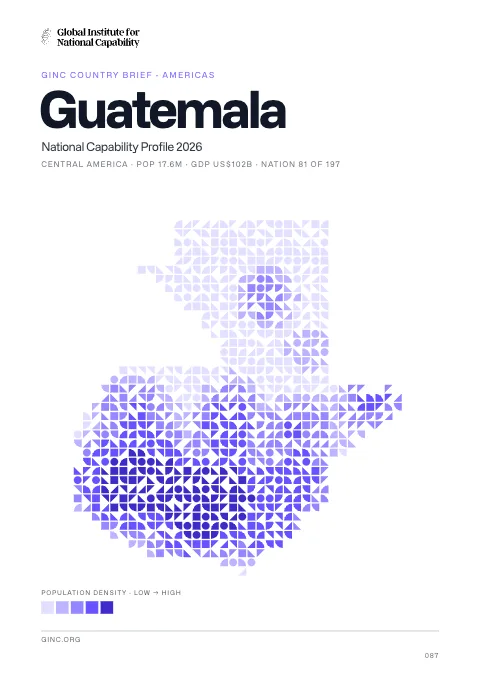
The whole brief
Guatemala National Capability Profile 2026
Foundations · Chapter 01
Historical Context
🇬🇹 Guatemala’s understanding the origins and evolution of the modern nation
BackgroundBack to top ↑
The Maya civilization flourished in Guatemala and surrounding regions during the first millennium A.D. After almost three centuries as a Spanish colony, Guatemala won its independence in 1821. During the second half of the 20th century, it experienced a variety of military and civilian governments, as well as a 36-year guerrilla war. In 1996, the government signed a peace agreement formally ending the internal conflict, which had left more than 200,000 people dead and had created, by some estimates, about 1 million refugees.
IndependenceBack to top ↑
15 September 1821 (from Spain)
National holidayBack to top ↑
Independence Day, 15 September (1821)
Foundations · Chapter 02
Geography
🇬🇹 Guatemala’s territory, resources and strategic position
Location and areaBack to top ↑
Central America, bordering the North Pacific Ocean, between El Salvador and Mexico, and bordering the Gulf of Honduras (Caribbean Sea) between Honduras and Belize
15 30 N, 90 15 W
Central America and the Caribbean
slightly smaller than Pennsylvania
400 km
Terrain and resourcesBack to top ↑
mostly mountains with narrow coastal plains and rolling limestone plateau
petroleum, nickel, rare woods, fish, chicle, hydropower
3,121 sq km (2003)
Settlement and hazardsBack to top ↑
numerous volcanoes in mountains, with occasional violent earthquakes; Caribbean coast extremely susceptible to hurricanes and other tropical storms
no natural harbors on west coast
OtherBack to top ↑
111.3 cu km (2011)
deforestation in the Peten rainforest; soil erosion; water pollution
Foundations · Chapter 03
Environment
🇬🇹 Guatemala’s environmental conditions, resources and national resilience
ClimateBack to top ↑
tropical; hot, humid in lowlands; cooler in highlands
Emissions and pollutionBack to top ↑
Water, waste and foodBack to top ↑
Resources and agreementsBack to top ↑
GINC Capability Domains · Chapter 04
Critical Technology
🇬🇹 Guatemala’s technology frontiers and the pursuit of national advantage
Two counts are set side by side for 2015–2024: on the left, the papers researchers in Guatemala published; on the right, the patent families that began there and were filed in more than one country. First by capability group, then group by group with each group’s capabilities. The badge on a card is the nation’s place among all nations. Papers are from GINC Research Analytics, patent families from GINC Patents.
Research by capability group
#135 WorldPapers published, 2015–2024
Patents by capability group
#118 WorldInternational patent families, 2015–2024
Advanced Materials & ManufacturingBack to top ↑
Research
#141 WorldPapers published, 2015–2024
Patents
#85 WorldInternational patent families, 2015–2024
Energy TechnologiesBack to top ↑
Research
#152 WorldPapers published, 2015–2024
Patents
International patent families, 2015–2024
No international patent families on record for 2015–2024.
Semiconductors & Advanced ComputingBack to top ↑
- Semiconductor Design & EDA
- Advanced Semiconductor Fabrication
- Semiconductor Equipment & Materials
- Advanced Packaging & Heterogeneous Integration
- Compound & Power Semiconductors
- High-Performance & AI Computing
Artificial IntelligenceBack to top ↑
Research
#132 WorldPapers published, 2015–2024
Patents
International patent families, 2015–2024
No international patent families on record for 2015–2024.
Quantum TechnologiesBack to top ↑
Research
#111 WorldPapers published, 2015–2024
Patents
International patent families, 2015–2024
No international patent families on record for 2015–2024.
Connectivity, Cyber & Trust TechnologiesBack to top ↑
Research
#132 WorldPapers published, 2015–2024
Patents
International patent families, 2015–2024
No international patent families on record for 2015–2024.
Sensing, Timing & NavigationBack to top ↑
Research
#147 WorldPapers published, 2015–2024
Patents
International patent families, 2015–2024
No international patent families on record for 2015–2024.
Robotics & Autonomous SystemsBack to top ↑
Research
#110 WorldPapers published, 2015–2024
No research topic: Human-Machine Interfaces
Patents
International patent families, 2015–2024
No international patent families on record for 2015–2024.
Biotechnology & Health TechnologiesBack to top ↑
Research
#116 WorldPapers published, 2015–2024
Patents
#94 WorldInternational patent families, 2015–2024
Medicine and BioTech
Clinical research and life-science invention, drawn from the same series that drive the metric pages. Each card opens the full cross-country comparison.
Space TechnologiesBack to top ↑
Research
#79 WorldPapers published, 2015–2024
Patents
International patent families, 2015–2024
No international patent families on record for 2015–2024.
GINC Capability Domains · Chapter 05
Strategic Infrastructure
🇬🇹 Guatemala’s energy, connectivity and the material foundations of capability
Resource InfrastructureBack to top ↑
14,020 bbl/day (2012 est.)
10,960 bbl/day (2010 est.)
0 bbl/day (2010 est.)
83.07 million bbl (1 January 2013 est.)
1,253 bbl/day (2010 est.)
80,810 bbl/day (2011 est.)
4,911 bbl/day (2010 est.)
71,390 bbl/day (2010 est.)
0 cu m (2011 est.)
0 cu m (2010 est.)
0 cu m (2011 est.)
0 cu m (2011 est.)
2.96 billion cu m (1 January 2006 est.)
oil 480 km (2013)
Agriculture & Food InfrastructureBack to top ↑
- Irrigation & Agricultural Water
- Livestock & Veterinary
- Fisheries & Aquaculture
- Storage, Cold Chain & Markets
Energy InfrastructureBack to top ↑
- Thermal Generation
- Nuclear Generation
- Nuclear Fuel Cycle & Radioactive Waste
- Hydropower
- Renewable Generation
- Transmission & Distribution
- System Control & Dispatch
- Storage & Fuel Supply
2.745 million kW (2010 est.)
8.146 billion kWh (2011 est.)
8.161 billion kWh (2011 est.)
193.3 million kWh (2011 est.)
525.6 million kWh (2011 est.)
56.5% of total installed capacity (2010 est.)
0% of total installed capacity (2010 est.)
31.1% of total installed capacity (2010 est.)
12.4% of total installed capacity (2010 est.)
11.71 million Mt (2011 est.)
Water, Sanitation & Waste InfrastructureBack to top ↑
- Dams, Reservoirs & Flood Defence
- Water Supply & Treatment
- Bulk Water Transfer & Desalination
- Wastewater & Sanitation
- Solid Waste & Recycling
Advanced ManufacturingBack to top ↑
- Materials & Inputs
- Chemicals & Hazardous Process Industry
- Production Systems
- Supply Chain & Ecosystem
- Workforce & Innovation
Transport InfrastructureBack to top ↑
- Seaports & Terminals
- Air Infrastructure
- Air Navigation & Traffic Management
- Inland Waterways & Ferries
- Rail Infrastructure
- Roads & Bridges
- Logistics, Multimodal & Border Infrastructure
- Postal & Parcel
291 (2013)
1 (2013)
990 km (260 km navigable year round; additional 730 km navigable during high-water season) (2012)
Communications & Digital InfrastructureBack to top ↑
- Subsea Cables & International Gateways
- Core & Backbone Networks
- Mobile & Wireless Networks
- Spectrum & Broadcasting
- Data Centres, Compute & Cloud
- Data Resources
- AI Tools & Applications
1.744 million (2012)
20.787 million (2012)
2.279 million (2009)
357,552 (2012)
.gt
Financial InfrastructureBack to top ↑
- Currency & Reserves
- Payments & Settlement Systems
- Markets, Exchanges & Depositories
- Banks, Insurers & Systemic Institutions
Social InfrastructureBack to top ↑
- Health Infrastructure
- Public Health & Laboratories
- Medical Supply & Stockpiles
- Education & Skills Infrastructure
- Research & Scientific Facilities
- Housing, Community & Social Services
- Government & Public Administration
- Cultural, Community & Recreational Infrastructure
- Justice & Corrections
- Emergency Services & Civil Protection
- Hydrometeorology & Early Warning
Space, Aerospace & Defence InfrastructureBack to top ↑
GINC Capability Domains · Chapter 06
National Security
🇬🇹 Guatemala’s force, intelligence and the defence of the nation
Disputes and terrorismBack to top ↑
annual ministerial meetings under the Organization of American States-initiated Agreement on the Framework for Negotiations and Confidence Building Measures continue to address Guatemalan land and maritime claims in Belize and the Caribbean Sea; Guatemala persists in its territorial claim to half of Belize, but agrees to Line of Adjacency to keep Guatemalan squatters out of Belize's forested interior; both countries agreed in April 2012 to hold simultaneous referenda, which was scheduled for 6 October 2013, to decide whether to refer the dispute to the ICJ for binding resolution, though this has been suspended indefinitely; Mexico must deal with thousands of impoverished Guatemalans and other Central Americans who cross the porous border looking for work in Mexico and the United States
Force Generation & MobilisationBack to top ↑
National Army of Guatemala (Ejercito Nacional de Guatemala, ENG; includes Guatemalan Navy (Fuerza de Mar, including Marines) and Guatemalan Air Force (Fuerza Aerea Guatemalteca, FAG)) (2013)
all male citizens between the ages of 18 and 50 are eligible for military service; in practice, most of the force is volunteer, however, a selective draft system is employed, resulting in a small portion of 17-21 year-olds conscripted; conscript service obligation varies from 1 to 2 years; women can serve as officers (2013)
0.42% of GDP (2012)//0.41% of GDP (2011)//0.42% of GDP (2010)
Forces under arms
Active-duty strength on the Correlates of War series, which reaches back to 1816 and so carries a nation’s whole record of mobilisation rather than its present establishment. The card opens the full cross-country comparison.
Intelligence & AssessmentBack to top ↑
- Imagery & Geospatial Intelligence
- Signals & Cyber Intelligence
- Technical & Measurement Intelligence
- Open-Source & Financial Intelligence
- Human Intelligence & Counterintelligence
- All-Source Analysis & Warning
Joint Command, Projection & SustainmentBack to top ↑
- Command, Control & Communications
- Strategic Lift & Mobility
- Expeditionary & Peace Operations
- Operational Sustainment & War Reserves
- Defence Industrial Mobilisation
- CBRN Defence
Land PowerBack to top ↑
- Combined Arms Manoeuvre
- Land Fires
- Battlefield Aviation & Uncrewed Systems
- Special Operations & Irregular Warfare
Maritime PowerBack to top ↑
- Maritime Security & Constabulary
- Sea Denial & Undersea Warfare
- Sea Control
- Amphibious & Expeditionary Operations
Air PowerBack to top ↑
- Air Sovereignty & Policing
- Control of the Air
- Air Strike & Interdiction
- Airborne ISR, Early Warning & Battle Management
Strategic Strike & Missile DefenceBack to top ↑
Space OperationsBack to top ↑
Cyber & Electromagnetic OperationsBack to top ↑
Nuclear DeterrenceBack to top ↑
GINC Capability Domains · Chapter 07
Human Capital
🇬🇹 Guatemala’s population, health and the skills that sustain capability
DemographyBack to top ↑
14,647,083 (July 2014 est.)
Guatemala is a predominantly poor country that struggles in several areas of health and development, including infant, child, and maternal mortality, malnutrition, literacy, and contraceptive awareness and use. The country's large indigenous population is disproportionately affected. Guatemala is the most populous country in Central America and has the highest fertility rate in Latin America. It also has the highest population growth rate in Latin America, which is likely to continue because of its large reproductive-age population and high birth rate. Almost half of Guatemala's population is under age 19, making it the youngest population in Latin America. Guatemala's total fertility rate has slowly declined during the last few decades due in part to limited government-funded health programs. However, the birth rate is still more than three children per woman and is markedly higher among its rural and indigenous populations.//Guatemalans have a history of emigrating legally and illegally to Mexico, the United States, and Canada because of a lack of economic opportunity, political instability, and natural disasters. Emigration, primarily to the United States, escalated during the 1960 to 1996 civil war and accelerated after a peace agreement was signed. Thousands of Guatemalans who fled to Mexico returned after the war, but labor migration to southern Mexico continues.
1.86% (2014 est.)
25.46 births/1,000 population (2014 est.)
4.82 deaths/1,000 population (2014 est.)
2.99 children born/woman (2014 est.)
20.3
43.3% (2002)
Migration and urbanisationBack to top ↑
-2 migrant(s)/1,000 population (2014 est.)
GUATEMALA CITY (capital) 1.168 million (2011)
Welfare and equityBack to top ↑
54% (2011 est.)
55.1 (2007)//55.8 (1998)
DisplacementBack to top ↑
Early Childhood DevelopmentBack to top ↑
13% (2009)
Foundational EducationBack to top ↑
3% of GDP (2012)
Advanced EducationBack to top ↑
Technical & Vocational SkillsBack to top ↑
Digital & AI CompetenceBack to top ↑
Generative AI adoption
Modelled share of working-age adults using generative AI, from Microsoft telemetry scaled to each country’s 15–64 population. A measure of how fast a workforce is absorbing the technology rather than of how much of it a nation builds. The card opens the full cross-country comparison.
Lifelong Learning & ReskillingBack to top ↑
Research Talent & Knowledge CreationBack to top ↑
Population HealthBack to top ↑
120 deaths/100,000 live births (2010)
19.2% (2008)
0.7% (2012 est.)
57,800 (2012 est.)
3,400 (2012 est.)
Health System CapabilityBack to top ↑
6.7% of GDP (2011)
0.93 physicians/1,000 population (2009)
0.7 beds/1,000 population (2011)
GINC Capability Domains · Chapter 08
Governance and Integrity
🇬🇹 Guatemala’s institutions, law and the integrity of the state
State structureBack to top ↑
constitutional democratic republic
22 departments (departamentos, singular - departamento); Alta Verapaz, Baja Verapaz, Chimaltenango, Chiquimula, El Progreso, Escuintla, Guatemala, Huehuetenango, Izabal, Jalapa, Jutiapa, Peten, Quetzaltenango, Quiche, Retalhuleu, Sacatepequez, San Marcos, Santa Rosa, Solola, Suchitepequez, Totonicapan, Zacapa
several previous; latest adopted 31 May 1985, effective 14 January 1986; suspended, reinstated, and amended in 1993 (2013)
18 years of age; universal; note - active duty members of the armed forces and police by law cannot vote and are restricted to their barracks on election day
Political Institutions & Civic ParticipationBack to top ↑
- Electoral Management & Integrity
- Legislature & Deliberative Institutions
- Citizen Participation & Civic Space
unicameral Congress of the Republic or Congreso de la Republica (158 seats; members elected through a party list proportional representation system)
Commitment, Renewal, and Order or CREO [Roberto GONZALEZ Diaz-Duran]//Democratic Union or UD [Edwin Armando MARTINEZ Herrera]//Encounter for Guatemala or EG [Nineth MONTENEGRO Cottom]//Everyone Together for Guatemala or TODOS [Felipe ALEJOS]//Grand National Alliance or GANA [Jaime Antonio MARTINEZ Lohayza]//Guatemalan National Revolutionary Unity or URNG [Angel SANCHEZ Viesca]//Institutional Republican Party (formerly the Guatemalan Republican Front) or PRI [Luis Fernando PEREZ]//National Advancement Party or PAN [Juan GUTIERREZ Strauss]//National Unity for Hope or UNE [Sandra TORRES]//Nationalist Change Union or UCN [Mario ESTRADA]//New National Alternative or ANN [Pablo MONSANTO]//Patriot Party or PP [Ingrid Roxana BALDETTI Elias]//Renewed Democratic Liberty or LIDER [Manuel BALDIZON]//Unionista Party or PU [Alvaro ARZU Irigoyen]//Victoria (Victory) [Amilcar RIVERA]//Vision with Values or VIVA [Harold CABALLEROS] (part of a coalition with EG during the last legislative election)//Winaq [Rigoberta MENCHU]
Alliance Against Impunity or AI (which includes among others Center for Legal Action on Human Rights (CALDH), and Family and Friends of the Disappeared of Guatemala (FAMDEGUA))//Civic and Political Convergence of Women//Committee for Campesino Unity or CUC//Coordinating Committee of Agricultural, Commercial, Industrial, and Financial Associations or CACIF//Foundation for the Development of Guatemala or FUNDESA//Guatemala Visible//Mutual Support Group or GAM//Movimiento PRO-Justicia//National Union of Agriculture Workers or UNAGRO
Justice System & Fundamental RightsBack to top ↑
- Judicial Independence & Court Capability
- Access to Justice & Legal Services
- Fundamental Rights Protection
- Human Rights Institutions & Equality Bodies
civil law system; judicial review of legislative acts
has not submitted an ICJ jurisdiction declaration; the Congress ratified Statute of Rome on 18 January 2012, and ICCt jurisdiction entered into force on 23 February 2012
Internal Security & OrderBack to top ↑
major transit country for cocaine and heroin; in 2005, cultivated 100 hectares of opium poppy after reemerging as a potential source of opium in 2004; potential production of less than 1 metric ton of pure heroin; marijuana cultivation for mostly domestic consumption; proximity to Mexico makes Guatemala a major staging area for drugs (particularly for cocaine); money laundering is a serious problem; corruption is a major problem
Regulatory Governance & Strategic ControlsBack to top ↑
- Regulatory Quality & Better Regulation
- Regulatory Delivery & Independent Regulators
- Strategic Controls & Economic Security Administration
Government Effectiveness & Public AdministrationBack to top ↑
- Centre of Government & Policy Coordination
- Civil Service & Public Workforce
- Digital Government & Service Delivery
- Legal Identity & Civil Registration
- Statistical & Data Capability
Public Integrity & Anti-CorruptionBack to top ↑
Transparency, Oversight & AccountabilityBack to top ↑
- Right to Information & Open Government
- Independent Oversight & Supreme Audit
- Independent Media & Journalist Safety
National Resilience & Crisis ManagementBack to top ↑
GINC Capability Domains · Chapter 09
Information and Influence
🇬🇹 Guatemala’s identity, media and the projection of influence
Identity and cultureBack to top ↑
Spanish (official) 60%, Amerindian languages 40%
Roman Catholic, Protestant, indigenous Mayan beliefs
Mestizo (mixed Amerindian-Spanish - in local Spanish called Ladino) and European 59.4%, K'iche 9.1%, Kaqchikel 8.4%, Mam 7.9%, Q'eqchi 6.3%, other Mayan 8.6%, indigenous non-Mayan 0.2%, other 0.1% (2001 census)
quetzal (bird)
three equal vertical bands of light blue (hoist side), white, and light blue, with the coat of arms centered in the white band; the coat of arms includes a green and red quetzal (the national bird) representing liberty and a scroll bearing the inscription LIBERTAD 15 DE SEPTIEMBRE DE 1821 (the original date of independence from Spain) all superimposed on a pair of crossed rifles signifying Guatemala's willingness to defend itself and a pair of crossed swords representing honor and framed by a laurel wreath symbolizing victory; the blue bands represent the Pacific Ocean and Caribbean Sea; the white band denotes peace and purity
Diplomatic Statecraft & Global NetworksBack to top ↑
- Diplomatic Network & Consular Reach
- Multilateral Leadership & Norm Setting
- Agenda-Setting & Convening
- Mediation & Crisis Diplomacy
BCIE, CACM, CD, CELAC, EITI (candidate country), FAO, G-24, G-77, IADB, IAEA, IBRD, ICAO, ICC (national committees), ICRM, IDA, IFAD, IFC, IFRCS, IHO, ILO, IMF, IMO, Interpol, IOC, IOM, IPU, ISO (correspondent), ITSO, ITU, ITUC (NGOs), LAES, LAIA (observer), MIGA, MINUSTAH, MONUSCO, NAM, OAS, OPANAL, OPCW, Pacific Alliance (observer), PCA, Petrocaribe, SICA, UN, UNAMID, UNCTAD, UNESCO, UNIDO, UNIFIL, Union Latina, UNISFA, UNITAR, UNMISS, UNOCI, UNWTO, UPU, WCO, WFTU (NGOs), WHO, WIPO, WMO, WTO
Alliances & Security CooperationBack to top ↑
Development Cooperation & Global AssistanceBack to top ↑
Culture, Language & Education DiplomacyBack to top ↑
- Cultural & Language Institutes
- Creative Industries & Cultural Export Reach
- Heritage & Cultural Institutions
- Education Diplomacy & Alumni Networks
- Sports & Major Events
Diaspora & Global CommunitiesBack to top ↑
Information Environment & Strategic CommunicationBack to top ↑
- Strategic Communications & Public Diplomacy
- International Media & Broadcasting
- Information Defence & Counter-Interference
4 privately owned national terrestrial TV channels dominate TV broadcasting; multi-channel satellite and cable services are available; 1 government-owned radio station and hundreds of privately owned radio stations (2007)
GINC Capability Domains · Chapter 10
Financial Strength
🇬🇹 Guatemala’s fiscal depth, reserves and the capacity to act
Monetary & Currency CapabilityBack to top ↑
- Monetary Policy & Price Stability
- Exchange Rate & External Account Management
- Currency Issuance & Digital Money
4.4% (2013 est.)//3.8% (2012 est.)
quetzales (GTQ) per US dollar -//7.883 (2013 est.)//7.8336 (2012 est.)//8.0578 (2010 est.)//8.1616 (2009)//7.5895 (2008)
6.5% (31 December 2010 est.)
13.4% (31 December 2013 est.)//13.49% (31 December 2012 est.)
$8.461 billion (31 December 2013 est.)//$7.975 billion (31 December 2012 est.)
$23.83 billion (31 December 2013 est.)//$22.3 billion (31 December 2012 est.)
Fiscal Capacity & Public FinanceBack to top ↑
- Revenue Mobilisation & Tax Administration
- Public Expenditure & Budget Management
- Sovereign Debt & Treasury Management
- Public Investment Management
11.9% of GDP (2013 est.)
-2.7% of GDP (2013 est.)
31% of GDP (2013 est.)//29.5% of GDP (2012 est.)
calendar year
Financial System Depth & AccessBack to top ↑
- Banking System Capacity
- Capital Markets Depth & Development
- Long-Term & Institutional Capital
- Financial Inclusion & Household Access
- Development & Policy Finance
$22.6 billion (31 December 2013 est.)//$20.5 billion (31 December 2012 est.)
$NA
Financial Regulation & IntegrityBack to top ↑
- Prudential Regulation & Supervision
- Financial Integrity & Illicit Finance Control
- Market Conduct & Consumer Protection
- Payment & Market Infrastructure Oversight
Financial Stability & Crisis ManagementBack to top ↑
- Macroprudential & Systemic Oversight
- Crisis Management, Resolution & Deposit Insurance
- External Liquidity & Financial Safety Nets
Sovereign Capital & External Financial PowerBack to top ↑
- Official Reserves Management
- Sovereign Wealth & Public Asset Management
- Currency Internationalisation & Reserve Status
- Capital Account & Flow Management
- International Financial Centre Capability
$7.118 billion (31 December 2013 est.)//$6.694 billion (31 December 2012 est.)
$17.67 billion (31 December 2013 est.)//$16.61 billion (31 December 2012 est.)
GINC Capability Domains · Chapter 11
Production and Innovation
🇬🇹 Guatemala’s output, industry and the engine of prosperity
Economic Output & ProductivityBack to top ↑
Guatemala is the most populous country in Central America with a GDP per capita roughly one-half that of the average for Latin America and the Caribbean. The agricultural sector accounts for 13.5% of GDP and 30% of the labor force; key agricultural exports include coffee, sugar, bananas, and vegetables. The 1996 peace accords, which ended 36 years of civil war, removed a major obstacle to foreign investment, and since then Guatemala has pursued important reforms and macroeconomic stabilization. The Dominican Republic-Central America Free Trade Agreement (CAFTA-DR) entered into force in July 2006, spurring increased investment and diversification of exports, with the largest increases in ethanol and non-traditional agricultural exports. While CAFTA-DR has helped improve the investment climate, concerns over security, the lack of skilled workers, and poor infrastructure continue to hamper foreign direct investment. The distribution of income remains highly unequal with the richest 20% of the population accounting for more than 51% of Guatemala's overall consumption. More than half of the population is below the national poverty line, and 13% of the population lives in extreme poverty. Poverty among indigenous groups, which make up more than 40% of the population, averages 73%, with 22% of the indigenous population living in extreme poverty. Nearly one-half of Guatemala's children under age five are chronically malnourished, one of the highest malnutrition rates in the world. Guatemala is the top remittance recipient in Central America as a result of Guatemala's large expatriate community in the United States. These inflows are a primary source of foreign income, equivalent to one-half of the country's exports or one-tenth of its GDP.
$81.51 billion (2013 est.)//$78.91 billion (2012 est.)//$76.64 billion (2011 est.)
3.3% (2013 est.)//3% (2012 est.)//4.2% (2011 est.)
$5,300 (2013 est.)//$5,200 (2012 est.)//$5,200 (2011 est.)
$53.9 billion (2013 est.)
Labour & EmploymentBack to top ↑
- Employment & Labour Force Participation
- Labour Market Institutions & Wage Setting
- Employment Services & Skills Matching
- Labour Adjustment, Transition & Formalisation
4.465 million (2013 est.)
4.1% (2011 est.)//3.5% (2010 est.)
Industrial & Sectoral BaseBack to top ↑
- Manufacturing & Advanced Industry
- Foundational & Process Industries
- Agrifood & Primary Production
- Services Economy
sugarcane, corn, bananas, coffee, beans, cardamom; cattle, sheep, pigs, chickens
sugar, textiles and clothing, furniture, chemicals, petroleum, metals, rubber, tourism
3.7% (2013 est.)
Structural Transformation & ComplexityBack to top ↑
Business Dynamism & EntrepreneurshipBack to top ↑
- Entrepreneurship & Firm Creation
- Risk Capital & Scale-Up Finance
- Firm Growth, Exit & Renewal
- Competition & Market Contestability
Innovation & CommercialisationBack to top ↑
- Business Innovation Capability
- Research Commercialisation & Knowledge Transfer
- Intellectual Property & Intangible Assets
- Innovation Ecosystems & Clusters
Technology Adoption & DiffusionBack to top ↑
GINC Capability Domains · Chapter 12
Trade and Investment
🇬🇹 Guatemala’s markets, capital and the terms of global exchange
Overall tradeBack to top ↑
$15.4B of exports to 160 partners and $32.8B of imports from 183 in 2024, a deficit of $17.4B.
- Exports
- $15.4B160 partners
- Imports
- $32.8B183 partners
- Balance
- −$17.4Bdeficit
- Total trade
- $48.3B2024
ExportsBack to top ↑
Where its exports go
The largest partners in 2024, with each one's share of the nation's exports.
| Partner | Value | Share | |
|---|---|---|---|
| United States | $5.26B | 34% | |
| El Salvador | $1.69B | 11% | |
| Honduras | $1.33B | 8.6% | |
| Nicaragua | $995M | 6.5% | |
| Mexico | $744M | 4.8% | |
| Costa Rica | $641M | 4.2% | |
| Netherlands | $509M | 3.3% | |
| Canada | $482M | 3.1% | |
| Dominican Republic | $323M | 2.1% | |
| Panama | $318M | 2.1% | |
| Spain | $190M | 1.2% | |
| Saudi Arabia | $186M | 1.2% | |
| Germany | $164M | 1.1% | |
| United Kingdom | $157M | 1.0% | |
| Belize | $149M | 1.0% | |
| Japan | $144M | 0.9% | |
| United Arab Emirates | $141M | 0.9% | |
| Taiwan | $139M | 0.9% | |
| Chile | $133M | 0.9% | |
| Colombia | $130M | 0.8% |
What it exports
The largest categories in 2024.
| Category | Value | Share | |
|---|---|---|---|
| Edible fruits, nuts, peel of citrus fruit, melons | $2.16B | 14% | |
| Articles of apparel, knit or crocheted | $1.63B | 11% | |
| Coffee, tea, mate and spices | $1.57B | 10% | |
| Sugars and sugar confectionery | $1.03B | 6.7% | |
| Animal, vegetable fats and oils, cleavage products | $777M | 5.0% | |
| Plastics | $527M | 3.4% | |
| Beverages, spirits and vinegar | $450M | 2.9% | |
| Edible vegetables and certain roots and tubers | $448M | 2.9% | |
| Paper and paperboard, articles of pulp, paper and board | $405M | 2.6% | |
| Soaps, lubricants, waxes, candles, modelling pastes | $402M | 2.6% | |
| Miscellaneous edible preparations | $383M | 2.5% | |
| Miscellaneous chemical products | $340M | 2.2% | |
| Pharmaceutical products | $340M | 2.2% | |
| Cereal, flour, starch, milk preparations and products | $336M | 2.2% | |
| Mineral fuels, oils, distillation products | $328M | 2.1% |
ImportsBack to top ↑
Where its imports come from
The largest partners in 2024, with each one's share of the nation's imports.
| Partner | Value | Share | |
|---|---|---|---|
| United States | $9.68B | 29% | |
| China | $6.39B | 19% | |
| Mexico | $3.32B | 10% | |
| El Salvador | $1.24B | 3.8% | |
| Costa Rica | $995M | 3.0% | |
| Japan | $889M | 2.7% | |
| Brazil | $766M | 2.3% | |
| India | $751M | 2.3% | |
| Honduras | $704M | 2.1% | |
| Colombia | $618M | 1.9% | |
| Germany | $612M | 1.9% | |
| Vietnam | $518M | 1.6% | |
| Canada | $485M | 1.5% | |
| Argentina | $455M | 1.4% | |
| South Korea | $432M | 1.3% | |
| Spain | $406M | 1.2% | |
| Italy | $390M | 1.2% | |
| Indonesia | $373M | 1.1% | |
| Thailand | $301M | 0.9% | |
| Chile | $251M | 0.8% |
What it imports
The largest categories in 2024.
| Category | Value | Share | |
|---|---|---|---|
| Mineral fuels, oils, distillation products | $5.02B | 15% | |
| Vehicles other than railway, tramway | $2.96B | 9.0% | |
| Electrical, electronic equipment | $2.75B | 8.4% | |
| Machinery, nuclear reactors, boilers | $2.71B | 8.3% | |
| Plastics | $1.71B | 5.2% | |
| Iron and steel | $1.16B | 3.5% | |
| Pharmaceutical products | $1.05B | 3.2% | |
| Paper and paperboard, articles of pulp, paper and board | $948M | 2.9% | |
| Miscellaneous edible preparations | $908M | 2.8% | |
| Cereals | $835M | 2.5% | |
| Essential oils, perfumes, cosmetics, toiletries | $559M | 1.7% | |
| Organic chemicals | $529M | 1.6% | |
| Residues, wastes of food industry, animal fodder | $506M | 1.5% | |
| Articles of iron or steel | $500M | 1.5% | |
| Cotton | $491M | 1.5% |
In a list, the bar runs to the largest in that list. The line is each figure’s history from 2000, drawn to its own peak: it shows the shape of the years, and the value shows the size.
External balanceBack to top ↑
-$1.822 billion (2013 est.)//-$1.489 billion (2012 est.)
Trade Facilitation & LogisticsBack to top ↑
Trade Policy & Market AccessBack to top ↑
- Trade Policy & Negotiation Capability
- Market Access & Agreements Network
- Trade Law & Enforcement
- Standards, Conformity & Quality Infrastructure
Digital & Services TradeBack to top ↑
- Services Trade Capability
- Digital Trade & E-Commerce
- Data Flows & Digital Trade Governance
- Tourism & Visitor Economy
Investment Attraction & ProjectionBack to top ↑
- Investment Attraction & Facilitation
- Investment Absorption & Linkages
- Outward Investment & Global Corporate Presence
Export Capability & SophisticationBack to top ↑
$10.29 billion (2013 est.)//$10.11 billion (2012 est.)
US 40.2%, El Salvador 11.1%, Honduras 8%, Mexico 5.5%, Nicaragua 4.7%, Costa Rica 4.3% (2012)
coffee, sugar, petroleum, apparel, bananas, fruits and vegetables, cardamom
Global Value Chain PositionBack to top ↑
- Value Chain Participation & Integration
- Value Chain Position & Upgrading
- Regional Integration & Hub Anchoring
Economic Leverage & DependenceBack to top ↑
- Strategic Supply Security
- Concentration Risk & Revenue Stabilisation
- Economic Leverage & Coercion Resistance
$16.7 billion (2013 est.)//$15.84 billion (2012 est.)
US 38%, Mexico 11.3%, China 7.4%, El Salvador 4.6% (2012)
fuels, machinery and transport equipment, construction materials, grain, fertilizers, electricity, mineral products, chemical products, plastic materials and products
Guatemala · you are in
Historical Context
Foundations
GINC Capability Domains
Find in this brief · Guatemala