
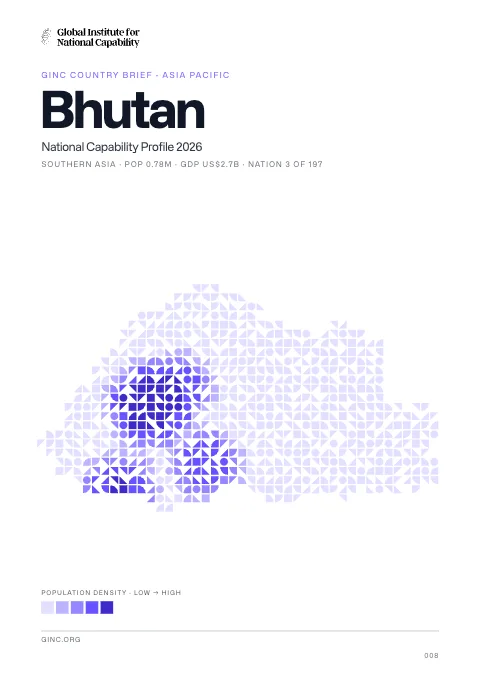
Bhutan
Bhutan is a landlocked constitutional monarchy in South Asia, home to 734,000 people, with its capital at Thimphu.
Contents
12 chapters
Foundations
01–03
At a glance
- Area
- 38.4Kkm²#136 World#6 South Asia
- Population
- 733.6K#165 World#6 South Asia
- GDP (market)
- $2.1B
- GDP (PPP)
- $5.2B#170 World#6 South Asia
- GDP per capita
- $7K#143 World#2 South Asia
The whole brief
Bhutan National Capability Profile 2026
Foundations · Chapter 01
Historical Context
🇧🇹 Bhutan’s understanding the origins and evolution of the modern nation
BackgroundBack to top ↑
In 1865, Britain and Bhutan signed the Treaty of Sinchulu, under which Bhutan would receive an annual subsidy in exchange for ceding some border land to British India. Under British influence, a monarchy was set up in 1907; three years later, a treaty was signed whereby the British agreed not to interfere in Bhutanese internal affairs, and Bhutan allowed Britain to direct its foreign affairs. This role was assumed by independent India after 1947. Two years later, a formal Indo-Bhutanese accord returned to Bhutan the areas annexed by the British, formalized the annual subsidies the country received, and defined India's responsibilities in defense and foreign relations. In March 2005, King Jigme Singye WANGCHUCK unveiled the government's draft constitution - which introduced major democratic reforms - and pledged to hold a national referendum for its approval. In December 2006, the King abdicated the throne in favor of his son, Jigme Khesar Namgyel WANGCHUCK, in order to give him experience as head of state before the democratic transition. In early 2007, India and Bhutan renegotiated their treaty, eliminating the clause that stated that Bhutan would be "guided by" India in conducting its foreign policy, although Thimphu continues to coordinate closely with New Delhi. Elections for seating the country's first parliament were completed in March 2008; the king ratified the country's first constitution in July 2008. Bhutan experienced a peaceful turnover of power following parliamentary elections in 2013, which routed the incumbent party. The disposition of some 30,000 Bhutanese refugees - housed in two UN refugee camps in Nepal - remains unresolved.
IndependenceBack to top ↑
1907 (became a unified kingdom under its first hereditary king)
National holidayBack to top ↑
National Day (Ugyen WANGCHUCK became first hereditary king), 17 December (1907)
Foundations · Chapter 02
Geography
🇧🇹 Bhutan’s territory, resources and strategic position
Location and areaBack to top ↑
Southern Asia, between China and India
27 30 N, 90 30 E
Asia
about one-half the size of Indiana
0 km (landlocked)
none (landlocked)
Terrain and resourcesBack to top ↑
mostly mountainous with some fertile valleys and savanna
timber, hydropower, gypsum, calcium carbonate
319.1 sq km (2010)
Settlement and hazardsBack to top ↑
violent storms from the Himalayas are the source of the country's name, which translates as Land of the Thunder Dragon; frequent landslides during the rainy season
landlocked; strategic location between China and India; controls several key Himalayan mountain passes
OtherBack to top ↑
78 cu km (2011)
soil erosion; limited access to potable water
Foundations · Chapter 03
Environment
🇧🇹 Bhutan’s environmental conditions, resources and national resilience
ClimateBack to top ↑
varies; tropical in southern plains; cool winters and hot summers in central valleys; severe winters and cool summers in Himalayas
Emissions and pollutionBack to top ↑
Water, waste and foodBack to top ↑
Resources and agreementsBack to top ↑
GINC Capability Domains · Chapter 04
Critical Technology
🇧🇹 Bhutan’s technology frontiers and the pursuit of national advantage
Two counts are set side by side for 2015–2024: on the left, the papers researchers in Bhutan published; on the right, the patent families that began there and were filed in more than one country. First by capability group, then group by group with each group’s capabilities. The badge on a card is the nation’s place among all nations. Papers are from GINC Research Analytics, patent families from GINC Patents.
Research by capability group
#163 WorldPapers published, 2015–2024
Patents by capability group
International patent families, 2015–2024
No international patent families on record for 2015–2024.
Advanced Materials & ManufacturingBack to top ↑
Research
#155 WorldPapers published, 2015–2024
Patents
International patent families, 2015–2024
No international patent families on record for 2015–2024.
Energy TechnologiesBack to top ↑
Research
#161 WorldPapers published, 2015–2024
Patents
International patent families, 2015–2024
No international patent families on record for 2015–2024.
Semiconductors & Advanced ComputingBack to top ↑
- Semiconductor Design & EDA
- Advanced Semiconductor Fabrication
- Semiconductor Equipment & Materials
- Advanced Packaging & Heterogeneous Integration
- Compound & Power Semiconductors
- High-Performance & AI Computing
Artificial IntelligenceBack to top ↑
Research
#150 WorldPapers published, 2015–2024
Patents
International patent families, 2015–2024
No international patent families on record for 2015–2024.
Quantum TechnologiesBack to top ↑
Connectivity, Cyber & Trust TechnologiesBack to top ↑
Research
#144 WorldPapers published, 2015–2024
Patents
International patent families, 2015–2024
No international patent families on record for 2015–2024.
Sensing, Timing & NavigationBack to top ↑
Research
#147 WorldPapers published, 2015–2024
Patents
International patent families, 2015–2024
No international patent families on record for 2015–2024.
Robotics & Autonomous SystemsBack to top ↑
Research
#149 WorldPapers published, 2015–2024
No research topic: Human-Machine Interfaces
Patents
International patent families, 2015–2024
No international patent families on record for 2015–2024.
Biotechnology & Health TechnologiesBack to top ↑
Research
#163 WorldPapers published, 2015–2024
Patents
International patent families, 2015–2024
No international patent families on record for 2015–2024.
Medicine and BioTech
Clinical research and life-science invention, drawn from the same series that drive the metric pages. Each card opens the full cross-country comparison.
Space TechnologiesBack to top ↑
- Space Launch & Reusable Systems
- Advanced Propulsion & Hypersonic Systems
- Satellite & Constellation Technologies
GINC Capability Domains · Chapter 05
Strategic Infrastructure
🇧🇹 Bhutan’s energy, connectivity and the material foundations of capability
Resource InfrastructureBack to top ↑
0 bbl/day (2012 est.)
0 bbl/day (2010 est.)
0 bbl/day (2010 est.)
0 bbl (1 January 2013 est.)
0 bbl/day (2010 est.)
1,719 bbl/day (2011 est.)
0 bbl/day (2010 est.)
1,998 bbl/day (2010 est.)
0 cu m (2011 est.)
0 cu m (2010 est.)
0 cu m (2011 est.)
0 cu m (2011 est.)
0 cu m (1 January 2013 est.)
Agriculture & Food InfrastructureBack to top ↑
- Irrigation & Agricultural Water
- Livestock & Veterinary
- Fisheries & Aquaculture
- Storage, Cold Chain & Markets
Energy InfrastructureBack to top ↑
- Thermal Generation
- Nuclear Generation
- Nuclear Fuel Cycle & Radioactive Waste
- Hydropower
- Renewable Generation
- Transmission & Distribution
- System Control & Dispatch
- Storage & Fuel Supply
1.505 million kW (2010 est.)
7.23 billion kWh (2010 est.)
1.68 billion kWh (2010 est.)
5.4 billion kWh (2010 est.)
20 million kWh (2010 est.)
1.1% of total installed capacity (2010 est.)
0% of total installed capacity (2010 est.)
98.9% of total installed capacity (2010 est.)
0% of total installed capacity (2010 est.)
335,700 Mt (2011 est.)
Water, Sanitation & Waste InfrastructureBack to top ↑
- Dams, Reservoirs & Flood Defence
- Water Supply & Treatment
- Bulk Water Transfer & Desalination
- Wastewater & Sanitation
- Solid Waste & Recycling
Advanced ManufacturingBack to top ↑
- Materials & Inputs
- Chemicals & Hazardous Process Industry
- Production Systems
- Supply Chain & Ecosystem
- Workforce & Innovation
Transport InfrastructureBack to top ↑
- Seaports & Terminals
- Air Infrastructure
- Air Navigation & Traffic Management
- Inland Waterways & Ferries
- Rail Infrastructure
- Roads & Bridges
- Logistics, Multimodal & Border Infrastructure
- Postal & Parcel
2 (2013)
Communications & Digital InfrastructureBack to top ↑
- Subsea Cables & International Gateways
- Core & Backbone Networks
- Mobile & Wireless Networks
- Spectrum & Broadcasting
- Data Centres, Compute & Cloud
- Data Resources
- AI Tools & Applications
27,000 (2012)
560,000 (2012)
50,000 (2009)
14,590 (2012)
.bt
Financial InfrastructureBack to top ↑
- Currency & Reserves
- Payments & Settlement Systems
- Markets, Exchanges & Depositories
- Banks, Insurers & Systemic Institutions
Social InfrastructureBack to top ↑
- Health Infrastructure
- Public Health & Laboratories
- Medical Supply & Stockpiles
- Education & Skills Infrastructure
- Research & Scientific Facilities
- Housing, Community & Social Services
- Government & Public Administration
- Cultural, Community & Recreational Infrastructure
- Justice & Corrections
- Emergency Services & Civil Protection
- Hydrometeorology & Early Warning
Space, Aerospace & Defence InfrastructureBack to top ↑
GINC Capability Domains · Chapter 06
National Security
🇧🇹 Bhutan’s force, intelligence and the defence of the nation
Disputes and terrorismBack to top ↑
lacking any treaty describing the boundary, Bhutan and China continue negotiations to establish a common boundary alignment to resolve territorial disputes arising from substantial cartographic discrepancies, the largest of which lie in Bhutan's northwest and along the Chumbi salient
Force Generation & MobilisationBack to top ↑
Royal Bhutan Army (includes Royal Bodyguard and Royal Bhutan Police) (2009)
18 years of age for voluntary military service; no conscription; militia training is compulsory for males aged 20-25, over a 3-year period (2012)
Forces under arms
Active-duty strength on the Correlates of War series, which reaches back to 1816 and so carries a nation’s whole record of mobilisation rather than its present establishment. The card opens the full cross-country comparison.
Intelligence & AssessmentBack to top ↑
- Imagery & Geospatial Intelligence
- Signals & Cyber Intelligence
- Technical & Measurement Intelligence
- Open-Source & Financial Intelligence
- Human Intelligence & Counterintelligence
- All-Source Analysis & Warning
Joint Command, Projection & SustainmentBack to top ↑
- Command, Control & Communications
- Strategic Lift & Mobility
- Expeditionary & Peace Operations
- Operational Sustainment & War Reserves
- Defence Industrial Mobilisation
- CBRN Defence
Land PowerBack to top ↑
- Combined Arms Manoeuvre
- Land Fires
- Battlefield Aviation & Uncrewed Systems
- Special Operations & Irregular Warfare
Maritime PowerBack to top ↑
- Maritime Security & Constabulary
- Sea Denial & Undersea Warfare
- Sea Control
- Amphibious & Expeditionary Operations
Air PowerBack to top ↑
- Air Sovereignty & Policing
- Control of the Air
- Air Strike & Interdiction
- Airborne ISR, Early Warning & Battle Management
Strategic Strike & Missile DefenceBack to top ↑
Space OperationsBack to top ↑
Cyber & Electromagnetic OperationsBack to top ↑
Nuclear DeterrenceBack to top ↑
GINC Capability Domains · Chapter 07
Human Capital
🇧🇹 Bhutan’s population, health and the skills that sustain capability
DemographyBack to top ↑
733,643
1.13% (2014 est.)
18.12 births/1,000 population (2014 est.)
6.78 deaths/1,000 population (2014 est.)
2.02 children born/woman (2014 est.)
65.6% (2010)
Migration and urbanisationBack to top ↑
0 migrant(s)/1,000 population (2014 est.)
THIMPHU (capital) 99,000 (2011)
Welfare and equityBack to top ↑
12% (2012)
38.7//38.1
Early Childhood DevelopmentBack to top ↑
12.8% (2010)
Foundational EducationBack to top ↑
4.7% of GDP (2011)
Advanced EducationBack to top ↑
Technical & Vocational SkillsBack to top ↑
Digital & AI CompetenceBack to top ↑
Lifelong Learning & ReskillingBack to top ↑
Research Talent & Knowledge CreationBack to top ↑
Population HealthBack to top ↑
180 deaths/100,000 live births (2010)
5.3% (2008)
0.2% (2012 est.)
1,100 (2012 est.)
100 (2012 est.)
Health System CapabilityBack to top ↑
4.1% of GDP (2011)
0.07 physicians/1,000 population (2008)
1.8 beds/1,000 population (2011)
GINC Capability Domains · Chapter 08
Governance and Integrity
🇧🇹 Bhutan’s institutions, law and the integrity of the state
State structureBack to top ↑
constitutional monarchy
20 districts (dzongkhag, singular and plural); Bumthang, Chhukha, Chirang, Daga, Gasa, Geylegphug, Ha, Lhuntshi, Mongar, Paro, Pemagatsel, Punakha, Samchi, Samdrup Jongkhar, Shemgang, Tashigang, Tashi Yangtse, Thimphu, Tongsa, Wangdi Phodrang
previous (various royal decrees); first constitution drafted November 2001 - March 2005, ratified 18 July 2008 (2011)
18 years of age; universal
Political Institutions & Civic ParticipationBack to top ↑
- Electoral Management & Integrity
- Legislature & Deliberative Institutions
- Citizen Participation & Civic Space
bicameral Parliament or Chi Tshog consists of the non-partisan National Council or Gyelyong Tshogde (25 seats; 20 members elected by each of the 20 administrative districts (dzongkhags) for four-year terms and 5 members appointed by the king); and the National Assembly or Tshogdu (47 seats; members nominated by the two parties and elected by direct, popular vote for five-year terms)
Bhutan Peace and Prosperity Party (Druk Phuensum Tshogpa) or DPT [Jigme THINLEY]; Bhutan Kuen-Nyam Party or BNK [Sonam TOBGAY]; People's Democratic Party or PDP [Tshering TOBGAY]; Druk Nymrub Tshogpa or DNT; Druck Chirwang Tshogpa or DCT
United Front for Democracy (exiled); Druk National Congress (exiled)
Justice System & Fundamental RightsBack to top ↑
- Judicial Independence & Court Capability
- Access to Justice & Legal Services
- Fundamental Rights Protection
- Human Rights Institutions & Equality Bodies
civil law based on Buddhist religious law
has not submitted an ICJ jurisdiction declaration; non-party state to the ICCt
Internal Security & OrderBack to top ↑
Regulatory Governance & Strategic ControlsBack to top ↑
- Regulatory Quality & Better Regulation
- Regulatory Delivery & Independent Regulators
- Strategic Controls & Economic Security Administration
Government Effectiveness & Public AdministrationBack to top ↑
- Centre of Government & Policy Coordination
- Civil Service & Public Workforce
- Digital Government & Service Delivery
- Legal Identity & Civil Registration
- Statistical & Data Capability
Public Integrity & Anti-CorruptionBack to top ↑
Transparency, Oversight & AccountabilityBack to top ↑
- Right to Information & Open Government
- Independent Oversight & Supreme Audit
- Independent Media & Journalist Safety
National Resilience & Crisis ManagementBack to top ↑
GINC Capability Domains · Chapter 09
Information and Influence
🇧🇹 Bhutan’s identity, media and the projection of influence
Identity and cultureBack to top ↑
Sharchhopka 28%, Dzongkha (official) 24%, Lhotshamkha 22%, other 26% (includes foreign languages) (2005 est.)
Lamaistic Buddhist 75.3%, Indian- and Nepalese-influenced Hinduism 22.1%, other 2.6% (2005 est.)
Ngalop (also known as Bhote) 50%, ethnic Nepalese 35% (includes Lhotsampas - one of several Nepalese ethnic groups), indigenous or migrant tribes 15%
thunder dragon known as Druk
divided diagonally from the lower hoist-side corner; the upper triangle is yellow and the lower triangle is orange; centered along the dividing line is a large black and white dragon facing away from the hoist side; the dragon, called the Druk (Thunder Dragon), is the emblem of the nation; its white color stands for purity and the jewels in its claws symbolize wealth; the background colors represent spiritual and secular powers within Bhutan: the orange is associated with Buddhism, while the yellow denotes the ruling dynasty
Diplomatic Statecraft & Global NetworksBack to top ↑
- Diplomatic Network & Consular Reach
- Multilateral Leadership & Norm Setting
- Agenda-Setting & Convening
- Mediation & Crisis Diplomacy
ADB, BIMSTEC, CP, FAO, G-77, IBRD, ICAO, IDA, IFAD, IFC, IMF, Interpol, IOC, IOM (observer), ISO (correspondent), ITSO, ITU, NAM, OPCW, SAARC, SACEP, UN, UNCTAD, UNESCO, UNIDO, UNWTO, UPU, WCO, WHO, WIPO, WMO, WTO (observer)
none; note - the Permanent Mission to the UN for Bhutan has consular jurisdiction in the US; the permanent representative to the UN is Kunzang C. NAMGYEL (since February 2014); address: 343 East 43rd Street, New York, NY 10017; telephone [1] (212) 682-2268; FAX [1] (212) 661-0551
the US and Bhutan have no formal diplomatic relations, although frequent informal contact is maintained via the US embasssy in New Delhi (India) and Bhutan's Permanent Mission to the UN
Alliances & Security CooperationBack to top ↑
Development Cooperation & Global AssistanceBack to top ↑
Culture, Language & Education DiplomacyBack to top ↑
- Cultural & Language Institutes
- Creative Industries & Cultural Export Reach
- Heritage & Cultural Institutions
- Education Diplomacy & Alumni Networks
- Sports & Major Events
Diaspora & Global CommunitiesBack to top ↑
Information Environment & Strategic CommunicationBack to top ↑
- Strategic Communications & Public Diplomacy
- International Media & Broadcasting
- Information Defence & Counter-Interference
state-owned TV station established in 1999; cable TV service offers dozens of Indian and other international channels; first radio station, privately launched in 1973, is now state-owned; 5 private radio stations are currently broadcasting (2012)
GINC Capability Domains · Chapter 10
Financial Strength
🇧🇹 Bhutan’s fiscal depth, reserves and the capacity to act
Monetary & Currency CapabilityBack to top ↑
- Monetary Policy & Price Stability
- Exchange Rate & External Account Management
- Currency Issuance & Digital Money
11% (2013 est.)//10.9% (2012 est.)
ngultrum (BTN) per US dollar -//56.61 (2013 est.)//53.44 (2012 est.)//45.73 (2010 est.)//46.68 (2009 est.)//43.51 (2008 est.)
NA%
14% (31 December 2013 est.)//14% (31 December 2012 est.)
$224.9 million (31 December 2013 est.)//$191.9 million (31 December 2012 est.)
$1.099 billion (31 December 2013 est.)//$1.062 billion (31 December 2012 est.)
Fiscal Capacity & Public FinanceBack to top ↑
- Revenue Mobilisation & Tax Administration
- Public Expenditure & Budget Management
- Sovereign Debt & Treasury Management
- Public Investment Management
27.6% of GDP (2013 est.)
-2.4% of GDP (2013 est.)
38.9% of GDP (2013 est.)//44.1% of GDP (2012 est.)
1 July - 30 June
Financial System Depth & AccessBack to top ↑
- Banking System Capacity
- Capital Markets Depth & Development
- Long-Term & Institutional Capital
- Financial Inclusion & Household Access
- Development & Policy Finance
$915 million (31 December 2013 est.)//$874.4 million (31 December 2012 est.)
$NA//$283.4 million
29.6% of GDP (2013 est.)//29.1% of GDP (2012 est.)//29.2% of GDP (2011 est.)
Financial Regulation & IntegrityBack to top ↑
- Prudential Regulation & Supervision
- Financial Integrity & Illicit Finance Control
- Market Conduct & Consumer Protection
- Payment & Market Infrastructure Oversight
Financial Stability & Crisis ManagementBack to top ↑
- Macroprudential & Systemic Oversight
- Crisis Management, Resolution & Deposit Insurance
- External Liquidity & Financial Safety Nets
Sovereign Capital & External Financial PowerBack to top ↑
- Official Reserves Management
- Sovereign Wealth & Public Asset Management
- Currency Internationalisation & Reserve Status
- Capital Account & Flow Management
- International Financial Centre Capability
$1.275 billion (2011)//$836 million (2009)
GINC Capability Domains · Chapter 11
Production and Innovation
🇧🇹 Bhutan’s output, industry and the engine of prosperity
Economic Output & ProductivityBack to top ↑
Bhutan's economy, small and less developed, is based largely on agriculture and forestry, which provide the main livelihood for more than half of the population. Because rugged mountains dominate the terrain and make the building of roads and other infrastructure difficult and expensive, industrial production is primarily of the cottage industry type. The economy is closely aligned with India's through strong trade and monetary links and is dependent on India for financial assistance and migrant laborers for development projects, especially for road construction. Multilateral development organizations administer most educational, social, and environment programs, and take into account the government's desire to protect the country's environment and cultural traditions. For example, the government, in its cautious expansion of the tourist sector, encourages visits by upscale, environmentally conscientious tourists. Complicated controls and uncertain policies in areas such as industrial licensing, trade, labor, and finance continue to hamper foreign investment. Bhutan’s largest export - hydropower to India - is creating employment and will probably sustain growth in the coming years. Only 5% of Bhutan’s 30,000 megawatt hydropower potential is currently tapped. The large amount of equipment needed to import materials to build hydropower plants has expanded Bhutan's trade and current account deficits. Bhutan’s GDP has rebounded strongly since the global recession began in 2008. Bhutan hopes to play a larger role in regional economic integration as a member of the South Asia Association for Regional Cooperation and the Bay of Bengal Initiative for Multi-Sectoral Technical and Economic Cooperation.
$5.235 billion (2013 est.)//$4.947 billion (2012 est.)//$4.529 billion (2011 est.)
5.8% (2013 est.)//9.2% (2012 est.)//8.5% (2011 est.)
$7,000 (2013 est.)//$6,700 (2012 est.)//$6,100 (2011 est.)
$2.133 billion (2013 est.)
Labour & EmploymentBack to top ↑
- Employment & Labour Force Participation
- Labour Market Institutions & Wage Setting
- Employment Services & Skills Matching
- Labour Adjustment, Transition & Formalisation
336,400
2.1% (2013)//4% (2009)
Industrial & Sectoral BaseBack to top ↑
- Manufacturing & Advanced Industry
- Foundational & Process Industries
- Agrifood & Primary Production
- Services Economy
rice, corn, root crops, citrus; dairy products, eggs
cement, wood products, processed fruits, alcoholic beverages, calcium carbide, tourism
7% (2013 est.)
Structural Transformation & ComplexityBack to top ↑
Business Dynamism & EntrepreneurshipBack to top ↑
- Entrepreneurship & Firm Creation
- Risk Capital & Scale-Up Finance
- Firm Growth, Exit & Renewal
- Competition & Market Contestability
Innovation & CommercialisationBack to top ↑
- Business Innovation Capability
- Research Commercialisation & Knowledge Transfer
- Intellectual Property & Intangible Assets
- Innovation Ecosystems & Clusters
Technology Adoption & DiffusionBack to top ↑
GINC Capability Domains · Chapter 12
Trade and Investment
🇧🇹 Bhutan’s markets, capital and the terms of global exchange
Overall tradeBack to top ↑
$461M of exports to 72 partners and $1.44B of imports from 49 in 2024, a deficit of $977M.
- Exports
- $461M72 partners
- Imports
- $1.44B49 partners
- Balance
- −$977Mdeficit
- Total trade
- $1.90B2024
ExportsBack to top ↑
Where its exports go
The largest partners in 2024, with each one's share of the nation's exports.
| Partner | Value | Share | |
|---|---|---|---|
| India | $436M | 94% | |
| South Korea | $13.0M | 2.8% | |
| United States | $3.41M | 0.7% | |
| Singapore | $3.20M | 0.7% | |
| Italy | $943K | 0.2% | |
| Brazil | $733K | 0.2% | |
| Japan | $727K | 0.2% | |
| Spain | $683K | 0.1% | |
| South Africa | $673K | 0.1% | |
| Canada | $457K | <0.1% | |
| Germany | $284K | <0.1% | |
| Austria | $197K | <0.1% | |
| Czech Republic | $173K | <0.1% | |
| United Kingdom | $159K | <0.1% | |
| Australia | $102K | <0.1% | |
| Thailand | $98.7K | <0.1% | |
| Saudi Arabia | $93.2K | <0.1% | |
| Switzerland | $66.9K | <0.1% | |
| France | $48.0K | <0.1% | |
| Belgium | $44.1K | <0.1% |
What it exports
The largest categories in 2024.
| Category | Value | Share | |
|---|---|---|---|
| Iron and steel | $213M | 46% | |
| Aircraft, spacecraft | $98.7M | 21% | |
| Salt, sulphur, earth, stone, plaster, lime and cement | $93.8M | 20% | |
| Beverages, spirits and vinegar | $21.3M | 4.6% | |
| Inorganic chemicals, precious metal compound, isotope | $12.5M | 2.7% | |
| Wood and articles of wood, wood charcoal | $6.96M | 1.5% | |
| Coffee, tea, mate and spices | $5.10M | 1.1% | |
| Electrical, electronic equipment | $1.50M | 0.3% | |
| Cereal, flour, starch, milk preparations and products | $1.41M | 0.3% | |
| Machinery, nuclear reactors, boilers | $1.23M | 0.3% | |
| Edible vegetables and certain roots and tubers | $1.18M | 0.3% | |
| Vegetable, fruit, nut food preparations | $771K | 0.2% | |
| Optical, photo, technical, medical apparatus | $694K | 0.2% | |
| Plastics | $653K | 0.1% | |
| Edible fruits, nuts, peel of citrus fruit, melons | $507K | 0.1% |
ImportsBack to top ↑
Where its imports come from
The largest partners in 2024, with each one's share of the nation's imports.
| Partner | Value | Share | |
|---|---|---|---|
| India | $1.17B | 82% | |
| Singapore | $115M | 8.0% | |
| China | $68.8M | 4.8% | |
| Hong Kong | $29.9M | 2.1% | |
| Thailand | $12.9M | 0.9% | |
| South Korea | $5.79M | 0.4% | |
| Japan | $4.70M | 0.3% | |
| Austria | $4.32M | 0.3% | |
| United States | $3.13M | 0.2% | |
| United Kingdom | $3.12M | 0.2% | |
| Brazil | $2.77M | 0.2% | |
| France | $2.00M | 0.1% | |
| Switzerland | $1.54M | 0.1% | |
| Germany | $1.38M | <0.1% | |
| Norway | $1.35M | <0.1% | |
| Netherlands | $1.25M | <0.1% | |
| Slovenia | $1.05M | <0.1% | |
| Malaysia | $1.05M | <0.1% | |
| Belgium | $1.01M | <0.1% | |
| Australia | $786K | <0.1% |
What it imports
The largest categories in 2024.
| Category | Value | Share | |
|---|---|---|---|
| Mineral fuels, oils, distillation products | $267M | 19% | |
| Electrical, electronic equipment | $196M | 14% | |
| Machinery, nuclear reactors, boilers | $122M | 8.5% | |
| Pearls, precious stones, metals, coins | $85.5M | 5.9% | |
| Aircraft, spacecraft | $81.2M | 5.6% | |
| Iron and steel | $70.0M | 4.9% | |
| Vehicles other than railway, tramway | $51.8M | 3.6% | |
| Articles of iron or steel | $46.9M | 3.3% | |
| Plastics | $43.9M | 3.1% | |
| Wood and articles of wood, wood charcoal | $42.3M | 2.9% | |
| Cereals | $37.4M | 2.6% | |
| Dairy products, eggs, honey, edible products | $24.1M | 1.7% | |
| Animal, vegetable fats and oils, cleavage products | $22.6M | 1.6% | |
| Rubbers | $18.0M | 1.3% | |
| Furniture, lighting signs, prefabricated buildings | $18.0M | 1.3% |
In a list, the bar runs to the largest in that list. The line is each figure’s history from 2000, drawn to its own peak: it shows the shape of the years, and the value shows the size.
External balanceBack to top ↑
$401.5 million (2013 est.)//-$311.6 million (2012 est.)
Trade Facilitation & LogisticsBack to top ↑
Trade Policy & Market AccessBack to top ↑
- Trade Policy & Negotiation Capability
- Market Access & Agreements Network
- Trade Law & Enforcement
- Standards, Conformity & Quality Infrastructure
Digital & Services TradeBack to top ↑
- Services Trade Capability
- Digital Trade & E-Commerce
- Data Flows & Digital Trade Governance
- Tourism & Visitor Economy
Investment Attraction & ProjectionBack to top ↑
- Investment Attraction & Facilitation
- Investment Absorption & Linkages
- Outward Investment & Global Corporate Presence
$63.5 million
Export Capability & SophisticationBack to top ↑
$721.8 million (2012 est.)//$662.2 million (2011 est.)
India 83.8%, Hong Kong 10.8% (2013 est.)
electricity (to India), ferrosilicon, cement, calcium carbide, copper wire, manganese, vegetable oil
Global Value Chain PositionBack to top ↑
- Value Chain Participation & Integration
- Value Chain Position & Upgrading
- Regional Integration & Hub Anchoring
Economic Leverage & DependenceBack to top ↑
- Strategic Supply Security
- Concentration Risk & Revenue Stabilisation
- Economic Leverage & Coercion Resistance
$1.28 billion (2012 est.)//$1.185 billion (2011 est.)
India 72.3%, South Korea 6% (2013 est.)
fuel and lubricants, passenger cars, machinery and parts, fabrics, rice
Bhutan · you are in
Historical Context
Foundations
GINC Capability Domains
Find in this brief · Bhutan