
Saudi Arabia
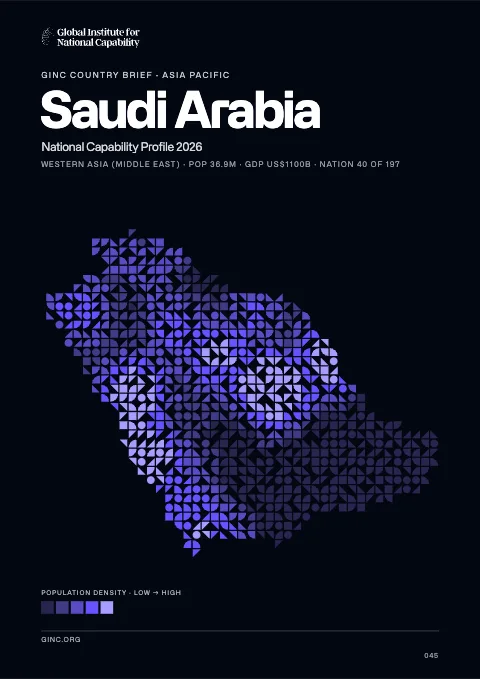
Saudi Arabia is a monarchy in the Middle East, home to 27 million people, with its capital at Riyadh, and the world’s 13th-largest country by area.
Contents
12 chapters
Foundations
01–03
At a glance
- Area
- 2.1Mkm²#13 World#1 Middle East
- Population
- 27.3M#46 World#4 Middle East
- GDP (market)
- $719B
- GDP (PPP)
- $927.8B#19 World#3 Middle East
- GDP per capita
- $31.3K#43 World#4 Middle East
The whole brief
Saudi Arabia National Capability Profile 2026
Foundations · Chapter 01
Historical Context
🇸🇦 Saudi Arabia’s understanding the origins and evolution of the modern nation
BackgroundBack to top ↑
Saudi Arabia is the birthplace of Islam and home to Islam's two holiest shrines in Mecca and Medina. The king's official title is the Custodian of the Two Holy Mosques. The modern Saudi state was founded in 1932 by ABD AL-AZIZ bin Abd al-Rahman Al SAUD (Ibn Saud) after a 30-year campaign to unify most of the Arabian Peninsula. One of his male descendants rules the country today, as required by the country's 1992 Basic Law. King ABDALLAH bin Abd al-Aziz ascended to the throne in 2005. Following Iraq's invasion of Kuwait in 1990, Saudi Arabia accepted the Kuwaiti royal family and 400,000 refugees while allowing Western and Arab troops to deploy on its soil for the liberation of Kuwait the following year. The continuing presence of foreign troops on Saudi soil after the liberation of Kuwait became a source of tension between the royal family and the public until all operational US troops left the country in 2003. Major terrorist attacks in May and November 2003 spurred a strong on-going campaign against domestic terrorism and extremism. King ABDALLAH since 2005 has worked to incrementally modernize the Kingdom - driven by personal ideology and political pragmatism - through a series of social and economic initiatives, including expanding employment and social opportunities for women, attracting foreign investment, increasing the role of the private sector in the economy, and discouraging businesses from hiring foreign workers. The Arab Spring inspired protests - increasing in number since 2011 but usually small in size - over primarily domestic issues among Saudi Arabia's majority Sunni population. Riyadh has taken a cautious but firm approach by arresting some protesters but releasing most of them quickly, and by using its state-sponsored clerics to counter political and Islamist activism. In addition, Saudi Arabia has seen protests among the Shia populace in the Eastern Province, who have protested primarily against the detention of political prisoners, endemic discrimination, and Bahraini and Saudi Government actions in Bahrain. Protests are met by a strong police presence, with some arrests, but not the level of bloodshed seen in protests elsewhere in the region. In response to the unrest, King ABDALLAH in February and March 2011 announced a series of benefits to Saudi citizens including funds to build affordable housing, salary increases for government workers, and unemployment entitlements. To promote increased political participation, the government held elections nationwide in September 2011 for half the members of 285 municipal councils - a body that holds little influence in the Saudi Government. Also in September, the king announced that women will be allowed to run for and vote in future municipal elections - first held in 2005 - and serve as full members of the advisory Consultative Council. The country remains a leading producer of oil and natural gas and holds about 17% of the world's proven oil reserves. The government continues to pursue economic reform and diversification, particularly since Saudi Arabia's accession to the WTO in 2005, and promotes foreign investment in the kingdom. A burgeoning population, aquifer depletion, and an economy largely dependent on petroleum output and prices are ongoing governmental concerns.
IndependenceBack to top ↑
23 September 1932 (unification of the kingdom)
National holidayBack to top ↑
Unification of the Kingdom, 23 September (1932)
Foundations · Chapter 02
Geography
🇸🇦 Saudi Arabia’s territory, resources and strategic position
Location and areaBack to top ↑
Middle East, bordering the Persian Gulf and the Red Sea, north of Yemen
25 00 N, 45 00 E
Middle East
slightly more than one-fifth the size of the US
2,640 km
Terrain and resourcesBack to top ↑
mostly uninhabited, sandy desert
petroleum, natural gas, iron ore, gold, copper
16,200 sq km (2004)
Settlement and hazardsBack to top ↑
frequent sand and dust storms
Saudi Arabia is the largest country in the world without a river; extensive coastlines on the Persian Gulf and Red Sea provide great leverage on shipping (especially crude oil) through the Persian Gulf and Suez Canal
OtherBack to top ↑
2.4 cu km (2011)
desertification; depletion of underground water resources; the lack of perennial rivers or permanent water bodies has prompted the development of extensive seawater desalination facilities; coastal pollution from oil spills
Foundations · Chapter 03
Environment
🇸🇦 Saudi Arabia’s environmental conditions, resources and national resilience
ClimateBack to top ↑
harsh, dry desert with great temperature extremes
Emissions and pollutionBack to top ↑
Water, waste and foodBack to top ↑
Resources and agreementsBack to top ↑
GINC Capability Domains · Chapter 04
Critical Technology
🇸🇦 Saudi Arabia’s technology frontiers and the pursuit of national advantage
Two counts are set side by side for 2015–2024: on the left, the papers researchers in Saudi Arabia published; on the right, the patent families that began there and were filed in more than one country. First by capability group, then group by group with each group’s capabilities. The badge on a card is the nation’s place among all nations. Papers are from GINC Research Analytics, patent families from GINC Patents.
Research by capability group
#16 WorldPapers published, 2015–2024
9,575
3,608
3,120
2,800
1,567
1,317
796
593
544
19
Patents by capability group
#27 WorldInternational patent families, 2015–2024
410
393
346
248
136
112
104
98
5
0
Advanced Materials & ManufacturingBack to top ↑
Research
#20 WorldPapers published, 2015–2024
Patents
#24 WorldInternational patent families, 2015–2024
Energy TechnologiesBack to top ↑
Research
#14 WorldPapers published, 2015–2024
Patents
#26 WorldInternational patent families, 2015–2024
Semiconductors & Advanced ComputingBack to top ↑
Research
#18 WorldPapers published, 2015–2024
No research topic: Semiconductor Design & EDA · Advanced Semiconductor Fabrication · Semiconductor Equipment & Materials · Advanced Packaging & Heterogeneous Integration
Patents
#28 WorldInternational patent families, 2015–2024
Artificial IntelligenceBack to top ↑
Research
#12 WorldPapers published, 2015–2024
Patents
#26 WorldInternational patent families, 2015–2024
Quantum TechnologiesBack to top ↑
Research
#25 WorldPapers published, 2015–2024
Patents
International patent families, 2015–2024
No international patent families on record for 2015–2024.
Connectivity, Cyber & Trust TechnologiesBack to top ↑
Research
#12 WorldPapers published, 2015–2024
Patents
#27 WorldInternational patent families, 2015–2024
Sensing, Timing & NavigationBack to top ↑
Research
#33 WorldPapers published, 2015–2024
Patents
#27 WorldInternational patent families, 2015–2024
Robotics & Autonomous SystemsBack to top ↑
Research
#32 WorldPapers published, 2015–2024
No research topic: Human-Machine Interfaces
Patents
#30 WorldInternational patent families, 2015–2024
Biotechnology & Health TechnologiesBack to top ↑
Research
#26 WorldPapers published, 2015–2024
Patents
#35 WorldInternational patent families, 2015–2024
Medicine and BioTech
Clinical research and life-science invention, drawn from the same series that drive the metric pages. Each card opens the full cross-country comparison.
Space TechnologiesBack to top ↑
Research
#38 WorldPapers published, 2015–2024
Patents
#38 WorldInternational patent families, 2015–2024
GINC Capability Domains · Chapter 05
Strategic Infrastructure
🇸🇦 Saudi Arabia’s energy, connectivity and the material foundations of capability
Resource InfrastructureBack to top ↑
11.73 million bbl/day (2012 est.)
6.88 million bbl/day (2011 est.)
0 bbl/day (2011 est.)
267.9 billion bbl (1 January 2013 est.)
1.935 million bbl/day (2010 est.)
2.817 million bbl/day (2011 est.)
1.471 million bbl/day (2010 est.)
196,700 bbl/day (2010 est.)
103.2 billion cu m (2012 est.)
99.23 billion cu m (2011 est.)
0 cu m (2011 est.)
0 cu m (2011 est.)
8.15 trillion cu m (1 January 2013 est.)
condensate 209 km; gas 2,940 km; liquid petroleum gas 1,183 km; oil 5,117 km; refined products 1,151 km (2013)
Agriculture & Food InfrastructureBack to top ↑
- Irrigation & Agricultural Water
- Livestock & Veterinary
- Fisheries & Aquaculture
- Storage, Cold Chain & Markets
Energy InfrastructureBack to top ↑
- Thermal Generation
- Nuclear Generation
- Nuclear Fuel Cycle & Radioactive Waste
- Hydropower
- Renewable Generation
- Transmission & Distribution
- System Control & Dispatch
- Storage & Fuel Supply
49.05 million kW (2010 est.)
239.2 billion kWh (2011 est.)
190.9 billion kWh (2010 est.)
0 kWh (2012 est.)
0 kWh (2012 est.)
100% of total installed capacity (2010 est.)
0% of total installed capacity (2010 est.)
0% of total installed capacity (2010 est.)
0% of total installed capacity (2010 est.)
513.5 million Mt (2011 est.)
Water, Sanitation & Waste InfrastructureBack to top ↑
- Dams, Reservoirs & Flood Defence
- Water Supply & Treatment
- Bulk Water Transfer & Desalination
- Wastewater & Sanitation
- Solid Waste & Recycling
Advanced ManufacturingBack to top ↑
- Materials & Inputs
- Chemicals & Hazardous Process Industry
- Production Systems
- Supply Chain & Ecosystem
- Workforce & Innovation
Transport InfrastructureBack to top ↑
- Seaports & Terminals
- Air Infrastructure
- Air Navigation & Traffic Management
- Inland Waterways & Ferries
- Rail Infrastructure
- Roads & Bridges
- Logistics, Multimodal & Border Infrastructure
- Postal & Parcel
214 (2013)
10 (2013)
Communications & Digital InfrastructureBack to top ↑
- Subsea Cables & International Gateways
- Core & Backbone Networks
- Mobile & Wireless Networks
- Spectrum & Broadcasting
- Data Centres, Compute & Cloud
- Data Resources
- AI Tools & Applications
4.8 million (2012)
53 million (2012)
9.774 million (2009)
145,941 (2012)
.sa
Financial InfrastructureBack to top ↑
- Currency & Reserves
- Payments & Settlement Systems
- Markets, Exchanges & Depositories
- Banks, Insurers & Systemic Institutions
Social InfrastructureBack to top ↑
- Health Infrastructure
- Public Health & Laboratories
- Medical Supply & Stockpiles
- Education & Skills Infrastructure
- Research & Scientific Facilities
- Housing, Community & Social Services
- Government & Public Administration
- Cultural, Community & Recreational Infrastructure
- Justice & Corrections
- Emergency Services & Civil Protection
- Hydrometeorology & Early Warning
Space, Aerospace & Defence InfrastructureBack to top ↑
GINC Capability Domains · Chapter 06
National Security
🇸🇦 Saudi Arabia’s force, intelligence and the defence of the nation
Disputes and terrorismBack to top ↑
Saudi Arabia has reinforced its concrete-filled security barrier along sections of the now fully demarcated border with Yemen to stem illegal cross-border activities; Kuwait and Saudi Arabia continue discussions on a maritime boundary with Iran; Saudi Arabia claims Egyptian-administered islands of Tiran and Sanafir
Force Generation & MobilisationBack to top ↑
Ministry of Defense and Aviation Forces: Royal Saudi Land Forces, Royal Saudi Naval Forces (includes Marine Forces and Special Forces), Royal Saudi Air Force (Al-Quwwat al-Jawwiya al-Malakiya as-Sa'udiya), Royal Saudi Air Defense Forces, Royal Saudi Strategic Rocket Forces, Saudi Arabian National Guard (SANG)
17 is the legal minimum age for voluntary military service; no conscription (2012)
7.98% of GDP (2012)//7.25% of GDP (2011)//7.98% of GDP (2010)
Forces under arms
Active-duty strength on the Correlates of War series, which reaches back to 1816 and so carries a nation’s whole record of mobilisation rather than its present establishment. The card opens the full cross-country comparison.
Intelligence & AssessmentBack to top ↑
- Imagery & Geospatial Intelligence
- Signals & Cyber Intelligence
- Technical & Measurement Intelligence
- Open-Source & Financial Intelligence
- Human Intelligence & Counterintelligence
- All-Source Analysis & Warning
Joint Command, Projection & SustainmentBack to top ↑
- Command, Control & Communications
- Strategic Lift & Mobility
- Expeditionary & Peace Operations
- Operational Sustainment & War Reserves
- Defence Industrial Mobilisation
- CBRN Defence
Land PowerBack to top ↑
- Combined Arms Manoeuvre
- Land Fires
- Battlefield Aviation & Uncrewed Systems
- Special Operations & Irregular Warfare
Maritime PowerBack to top ↑
- Maritime Security & Constabulary
- Sea Denial & Undersea Warfare
- Sea Control
- Amphibious & Expeditionary Operations
Air PowerBack to top ↑
- Air Sovereignty & Policing
- Control of the Air
- Air Strike & Interdiction
- Airborne ISR, Early Warning & Battle Management
Strategic Strike & Missile DefenceBack to top ↑
Space OperationsBack to top ↑
Cyber & Electromagnetic OperationsBack to top ↑
Nuclear DeterrenceBack to top ↑
GINC Capability Domains · Chapter 07
Human Capital
🇸🇦 Saudi Arabia’s population, health and the skills that sustain capability
DemographyBack to top ↑
27,345,986
1.49% (2014 est.)
18.78 births/1,000 population (2014 est.)
3.32 deaths/1,000 population (2014 est.)
2.17 children born/woman (2014 est.)
23.8% (2007)
Migration and urbanisationBack to top ↑
-0.59 migrant(s)/1,000 population (2014 est.)
RIYADH (capital) 5.451 million; Jeddah 3.578 million; Mecca 1.591 million; Medina 1.142 million; Ad Dammam 941,000 (2011)
Welfare and equityBack to top ↑
NA%
DisplacementBack to top ↑
Early Childhood DevelopmentBack to top ↑
5.3% (2005)
Foundational EducationBack to top ↑
5.1% of GDP (2008)
Advanced EducationBack to top ↑
Technical & Vocational SkillsBack to top ↑
Digital & AI CompetenceBack to top ↑
Generative AI adoption
Modelled share of working-age adults using generative AI, from Microsoft telemetry scaled to each country’s 15–64 population. A measure of how fast a workforce is absorbing the technology rather than of how much of it a nation builds. The card opens the full cross-country comparison.
Lifelong Learning & ReskillingBack to top ↑
Research Talent & Knowledge CreationBack to top ↑
Population HealthBack to top ↑
24 deaths/100,000 live births (2010)
33% (2008)
0.01% (2001 est.)
NA
NA
Health System CapabilityBack to top ↑
3.7% of GDP (2011)
0.94 physicians/1,000 population (2008)
2.2 beds/1,000 population (2009)
GINC Capability Domains · Chapter 08
Governance and Integrity
🇸🇦 Saudi Arabia’s institutions, law and the integrity of the state
State structureBack to top ↑
monarchy
13 provinces (mintaqat, singular - mintaqah); Al Bahah, Al Hudud ash Shamaliyah (Northern Border), Al Jawf, Al Madinah (Medina), Al Qasim, Ar Riyad (Riyadh), Ash Sharqiyah (Eastern), 'Asir, Ha'il, Jazan, Makkah (Mecca), Najran, Tabuk
1 March 1992 - Basic Law of Government, issued by royal decree, serves as the constitutional framework and is based on the Qur'an and the life and tradition of the Prophet Muhammad (2013)
21 years of age; male
Political Institutions & Civic ParticipationBack to top ↑
- Electoral Management & Integrity
- Legislature & Deliberative Institutions
- Citizen Participation & Civic Space
Consultative Council or Majlis al-Shura (150 members and a chairman appointed by the monarch to serve four-year terms); note - though the Council of Ministers announced in October 2003 its intent to introduce elections for a third of the Majlis al-Shura incrementally over a period of four to five years, to date no such elections have been held or announced
none
Ansar Al Marah (supports women's rights); Freedom and Justice Coalition (supports Shia rights)
Justice System & Fundamental RightsBack to top ↑
- Judicial Independence & Court Capability
- Access to Justice & Legal Services
- Fundamental Rights Protection
- Human Rights Institutions & Equality Bodies
Islamic (sharia) legal system with some elements of Egyptian, French, and customary law; note - several secular codes have been introduced; commercial disputes handled by special committees
has not submitted an ICJ jurisdiction declaration; non-party state to the ICCt
Internal Security & OrderBack to top ↑
death penalty for traffickers; improving anti-money-laundering legislation and enforcement
Regulatory Governance & Strategic ControlsBack to top ↑
- Regulatory Quality & Better Regulation
- Regulatory Delivery & Independent Regulators
- Strategic Controls & Economic Security Administration
Government Effectiveness & Public AdministrationBack to top ↑
- Centre of Government & Policy Coordination
- Civil Service & Public Workforce
- Digital Government & Service Delivery
- Legal Identity & Civil Registration
- Statistical & Data Capability
Public Integrity & Anti-CorruptionBack to top ↑
Transparency, Oversight & AccountabilityBack to top ↑
- Right to Information & Open Government
- Independent Oversight & Supreme Audit
- Independent Media & Journalist Safety
National Resilience & Crisis ManagementBack to top ↑
GINC Capability Domains · Chapter 09
Information and Influence
🇸🇦 Saudi Arabia’s identity, media and the projection of influence
Identity and cultureBack to top ↑
Arabic (official)
Muslim (official; citizens are 85-90% Sunni and 10-15% Shia), other (includes Eastern Orthodox, Protestant, Roman Catholic, Jewish, Hindu, Buddhist, and Sikh) (2012 est.)
Arab 90%, Afro-Asian 10%
palm tree surmounting two crossed swords
green, a traditional color in Islamic flags, with the Shahada or Muslim creed in large white Arabic script (translated as "There is no god but God; Muhammad is the Messenger of God") above a white horizontal saber (the tip points to the hoist side); design dates to the early twentieth century and is closely associated with the Al Saud family which established the kingdom in 1932; the flag is manufactured with differing obverse and reverse sides so that the Shahada reads - and the sword points - correctly from right to left on both sides
Diplomatic Statecraft & Global NetworksBack to top ↑
- Diplomatic Network & Consular Reach
- Multilateral Leadership & Norm Setting
- Agenda-Setting & Convening
- Mediation & Crisis Diplomacy
ABEDA, AfDB (nonregional member), AFESD, AMF, BIS, CAEU, CP, FAO, G-20, G-77, GCC, IAEA, IBRD, ICAO, ICC (national committees), ICRM, IDA, IDB, IFAD, IFC, IFRCS, IHO, ILO, IMF, IMO, IMSO, Interpol, IOC, IOM (observer), IPU, ISO, ITSO, ITU, LAS, MIGA, NAM, OAPEC, OAS (observer), OIC, OPCW, OPEC, PCA, UN, UNCTAD, UNESCO, UNIDO, UNRWA, UNWTO, UPU, WCO, WFTU (NGOs), WHO, WIPO, WMO, WTO
Alliances & Security CooperationBack to top ↑
Development Cooperation & Global AssistanceBack to top ↑
Culture, Language & Education DiplomacyBack to top ↑
- Cultural & Language Institutes
- Creative Industries & Cultural Export Reach
- Heritage & Cultural Institutions
- Education Diplomacy & Alumni Networks
- Sports & Major Events
Diaspora & Global CommunitiesBack to top ↑
Information Environment & Strategic CommunicationBack to top ↑
- Strategic Communications & Public Diplomacy
- International Media & Broadcasting
- Information Defence & Counter-Interference
broadcast media are state-controlled; state-run TV operates 4 networks; Saudi Arabia is a major market for pan-Arab satellite TV broadcasters; state-run radio operates several networks; multiple international broadcasters are available (2007)
GINC Capability Domains · Chapter 10
Financial Strength
🇸🇦 Saudi Arabia’s fiscal depth, reserves and the capacity to act
Monetary & Currency CapabilityBack to top ↑
- Monetary Policy & Price Stability
- Exchange Rate & External Account Management
- Currency Issuance & Digital Money
3.7% (2013 est.)//2.9% (2012 est.)
Saudi riyals (SAR) per US dollar -//3.75 (2013 est.)//3.75 (2012 est.)//3.75 (2010 est.)//3.75 (2009)//3.75 (2008)
2.5% (31 December 2008)//
6.7% (31 December 2013 est.)//6.8% (31 December 2012 est.)
$263.8 billion (31 December 2013 est.)//$236.6 billion (31 December 2012 est.)
$416.3 billion (31 December 2013 est.)//$371.7 billion (31 December 2012 est.)
Fiscal Capacity & Public FinanceBack to top ↑
- Revenue Mobilisation & Tax Administration
- Public Expenditure & Budget Management
- Sovereign Debt & Treasury Management
- Public Investment Management
42.1% of GDP (2013 est.)
6.2% of GDP (2013 est.)
12.2% of GDP (2013 est.)//11.8% of GDP (2012 est.)
calendar year
Financial System Depth & AccessBack to top ↑
- Banking System Capacity
- Capital Markets Depth & Development
- Long-Term & Institutional Capital
- Financial Inclusion & Household Access
- Development & Policy Finance
$-52.29 billion (31 December 2013 est.)//$-74.71 billion (31 December 2012 est.)
$373.4 billion (31 December 2012 est.)//$338.9 billion (31 December 2011)//$353.4 billion (31 December 2010 est.)
45% of GDP (2013 est.)//48.8% of GDP (2012 est.)//50.5% of GDP (2011 est.)
Financial Regulation & IntegrityBack to top ↑
- Prudential Regulation & Supervision
- Financial Integrity & Illicit Finance Control
- Market Conduct & Consumer Protection
- Payment & Market Infrastructure Oversight
Financial Stability & Crisis ManagementBack to top ↑
- Macroprudential & Systemic Oversight
- Crisis Management, Resolution & Deposit Insurance
- External Liquidity & Financial Safety Nets
Sovereign Capital & External Financial PowerBack to top ↑
- Official Reserves Management
- Sovereign Wealth & Public Asset Management
- Currency Internationalisation & Reserve Status
- Capital Account & Flow Management
- International Financial Centre Capability
$739.5 billion (31 December 2013 est.)//$656.9 billion (31 December 2012 est.)
$149.4 billion (31 December 2013 est.)//$136.3 billion (31 December 2012 est.)
GINC Capability Domains · Chapter 11
Production and Innovation
🇸🇦 Saudi Arabia’s output, industry and the engine of prosperity
Economic Output & ProductivityBack to top ↑
Saudi Arabia has an oil-based economy with strong government controls over major economic activities. It possesses about 16% of the world's proven petroleum reserves, ranks as the largest exporter of petroleum, and plays a leading role in OPEC. The petroleum sector accounts for roughly 80% of budget revenues, 45% of GDP, and 90% of export earnings. Saudi Arabia is encouraging the growth of the private sector in order to diversify its economy and to employ more Saudi nationals. Diversification efforts are focusing on power generation, telecommunications, natural gas exploration, and petrochemical sectors. Over 6 million foreign workers play an important role in the Saudi economy, particularly in the oil and service sectors, while Riyadh is struggling to reduce unemployment among its own nationals. Saudi officials are particularly focused on employing its large youth population, which generally lacks the education and technical skills the private sector needs. Riyadh has substantially boosted spending on job training and education, most recently with the opening of the King Abdallah University of Science and Technology - Saudi Arabia's first co-educational university. As part of its effort to attract foreign investment, Saudi Arabia acceded to the WTO in 2005. The government has begun establishing six "economic cities" in different regions of the country to promote foreign investment and plans to spend $373 billion between 2010 and 2014 on social development and infrastructure projects to advance Saudi Arabia's economic development.
$927.8 billion (2013 est.)//$895.8 billion (2012 est.)//$852.1 billion (2011 est.)
3.6% (2013 est.)//5.1% (2012 est.)//8.6% (2011 est.)
$31,300 (2013 est.)//$30,900 (2012 est.)//$30,000 (2011 est.)
$718.5 billion (2013 est.)
Labour & EmploymentBack to top ↑
- Employment & Labour Force Participation
- Labour Market Institutions & Wage Setting
- Employment Services & Skills Matching
- Labour Adjustment, Transition & Formalisation
8.412 million
10.5% (2013 est.)//10.6% (2012 est.)
Industrial & Sectoral BaseBack to top ↑
- Manufacturing & Advanced Industry
- Foundational & Process Industries
- Agrifood & Primary Production
- Services Economy
wheat, barley, tomatoes, melons, dates, citrus; mutton, chickens, eggs, milk
crude oil production, petroleum refining, basic petrochemicals, ammonia, industrial gases, sodium hydroxide (caustic soda), cement, fertilizer, plastics, metals, commercial ship repair, commercial aircraft repair, construction
2.7% (2013 est.)
Structural Transformation & ComplexityBack to top ↑
Business Dynamism & EntrepreneurshipBack to top ↑
- Entrepreneurship & Firm Creation
- Risk Capital & Scale-Up Finance
- Firm Growth, Exit & Renewal
- Competition & Market Contestability
Innovation & CommercialisationBack to top ↑
- Business Innovation Capability
- Research Commercialisation & Knowledge Transfer
- Intellectual Property & Intangible Assets
- Innovation Ecosystems & Clusters
Technology Adoption & DiffusionBack to top ↑
GINC Capability Domains · Chapter 12
Trade and Investment
🇸🇦 Saudi Arabia’s markets, capital and the terms of global exchange
Overall tradeBack to top ↑
$308B of exports to 183 partners and $223B of imports from 211 in 2024, a surplus of $85.1B.
- Exports
- $308B183 partners
- Imports
- $223B211 partners
- Balance
- +$85.1Bsurplus
- Total trade
- $532B2024
ExportsBack to top ↑
Where its exports go
The largest partners in 2024, with each one's share of the nation's exports.
| Partner | Value | Share | |
|---|---|---|---|
| China | $58.1B | 19% | |
| South Korea | $31.5B | 10% | |
| India | $30.8B | 10% | |
| Japan | $29.8B | 9.7% | |
| United Arab Emirates | $18.7B | 6.1% | |
| United States | $13.3B | 4.3% | |
| Poland | $8.68B | 2.8% | |
| Taiwan | $8.44B | 2.7% | |
| Malaysia | $8.21B | 2.7% | |
| Egypt | $8.20B | 2.7% | |
| Singapore | $7.64B | 2.5% | |
| Italy | $5.60B | 1.8% | |
| Thailand | $5.05B | 1.6% | |
| France | $4.63B | 1.5% | |
| Pakistan | $4.43B | 1.4% | |
| Indonesia | $4.21B | 1.4% | |
| Netherlands | $3.97B | 1.3% | |
| Spain | $3.59B | 1.2% | |
| Turkey | $3.22B | 1.0% | |
| Brazil | $3.20B | 1.0% |
What it exports
The largest categories in 2024.
| Category | Value | Share | |
|---|---|---|---|
| Mineral fuels, oils, distillation products | $223B | 72% | |
| Plastics | $19.7B | 6.4% | |
| Organic chemicals | $12.9B | 4.2% | |
| Electrical, electronic equipment | $7.85B | 2.5% | |
| Ships, boats, and other floating structures | $7.26B | 2.4% | |
| Fertilizers | $4.96B | 1.6% | |
| Machinery, nuclear reactors, boilers | $2.88B | 0.9% | |
| Aluminum | $2.72B | 0.9% | |
| Pearls, precious stones, metals, coins | $2.60B | 0.8% | |
| Inorganic chemicals, precious metal compound, isotope | $2.00B | 0.6% | |
| Aircraft, spacecraft | $1.75B | 0.6% | |
| Copper | $1.75B | 0.6% | |
| Vehicles other than railway, tramway | $1.44B | 0.5% | |
| Dairy products, eggs, honey, edible products | $1.38B | 0.4% | |
| Miscellaneous chemical products | $1.07B | 0.3% |
ImportsBack to top ↑
Where its imports come from
The largest partners in 2024, with each one's share of the nation's imports.
| Partner | Value | Share | |
|---|---|---|---|
| China | $53.3B | 24% | |
| United States | $14.9B | 6.7% | |
| India | $14.0B | 6.3% | |
| United Arab Emirates | $12.4B | 5.6% | |
| Germany | $9.44B | 4.2% | |
| Japan | $8.07B | 3.6% | |
| Egypt | $7.82B | 3.5% | |
| Switzerland | $7.31B | 3.3% | |
| Italy | $6.97B | 3.1% | |
| South Korea | $6.07B | 2.7% | |
| United Kingdom | $4.59B | 2.1% | |
| Thailand | $4.22B | 1.9% | |
| France | $4.17B | 1.9% | |
| Turkey | $3.94B | 1.8% | |
| Netherlands | $3.68B | 1.6% | |
| Indonesia | $3.66B | 1.6% | |
| Oman | $3.60B | 1.6% | |
| Brazil | $3.52B | 1.6% | |
| Russia | $3.41B | 1.5% | |
| Bahrain | $3.12B | 1.4% |
What it imports
The largest categories in 2024.
| Category | Value | Share | |
|---|---|---|---|
| Machinery, nuclear reactors, boilers | $29.6B | 13% | |
| Vehicles other than railway, tramway | $28.4B | 13% | |
| Electrical, electronic equipment | $24.7B | 11% | |
| Mineral fuels, oils, distillation products | $13.5B | 6.0% | |
| Pearls, precious stones, metals, coins | $9.97B | 4.5% | |
| Pharmaceutical products | $8.68B | 3.9% | |
| Articles of iron or steel | $7.91B | 3.5% | |
| Plastics | $6.02B | 2.7% | |
| Iron and steel | $5.93B | 2.7% | |
| Optical, photo, technical, medical apparatus | $5.75B | 2.6% | |
| Cereals | $5.18B | 2.3% | |
| Furniture, lighting signs, prefabricated buildings | $4.65B | 2.1% | |
| Copper | $4.07B | 1.8% | |
| Aircraft, spacecraft | $3.32B | 1.5% | |
| Organic chemicals | $2.89B | 1.3% |
In a list, the bar runs to the largest in that list. The line is each figure’s history from 2000, drawn to its own peak: it shows the shape of the years, and the value shows the size.
External balanceBack to top ↑
$132.2 billion (2013 est.)//$164.8 billion (2012 est.)
Trade Facilitation & LogisticsBack to top ↑
Trade Policy & Market AccessBack to top ↑
- Trade Policy & Negotiation Capability
- Market Access & Agreements Network
- Trade Law & Enforcement
- Standards, Conformity & Quality Infrastructure
Digital & Services TradeBack to top ↑
- Services Trade Capability
- Digital Trade & E-Commerce
- Data Flows & Digital Trade Governance
- Tourism & Visitor Economy
Investment Attraction & ProjectionBack to top ↑
- Investment Attraction & Facilitation
- Investment Absorption & Linkages
- Outward Investment & Global Corporate Presence
$240.6 billion (31 December 2013 est.)//$223.2 billion (31 December 2012 est.)
$26.08 billion (31 December 2013 est.)//$22.12 billion (31 December 2012 est.)
Export Capability & SophisticationBack to top ↑
$376.3 billion (2013 est.)//$388.4 billion (2012 est.)
US 14.2%, China 13.6%, Japan 13.6%, South Korea 9.9%, India 8.2%, Singapore 4.3% (2012)
petroleum and petroleum products 90%
Global Value Chain PositionBack to top ↑
- Value Chain Participation & Integration
- Value Chain Position & Upgrading
- Regional Integration & Hub Anchoring
Economic Leverage & DependenceBack to top ↑
- Strategic Supply Security
- Concentration Risk & Revenue Stabilisation
- Economic Leverage & Coercion Resistance
$147 billion (2013 est.)//$141.8 billion (2012 est.)
China 13.5%, US 13.2%, South Korea 6.6%, Germany 6.5%, India 6.3%, Japan 6% (2012)
machinery and equipment, foodstuffs, chemicals, motor vehicles, textiles
Saudi Arabia · you are in
Historical Context
Foundations
GINC Capability Domains
Find in this brief · Saudi Arabia