
Vietnam
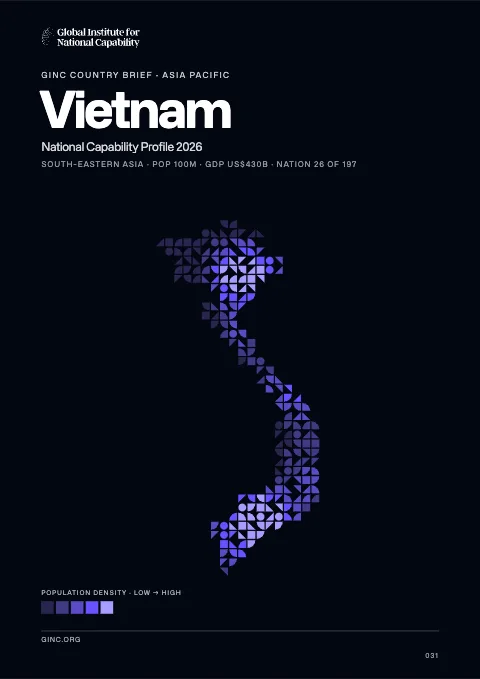
Vietnam is a Communist state in East and Southeast Asia, home to 93 million people, with its capital at Hanoi.
Contents
12 chapters
Foundations
01–03
At a glance
- Area
- 331.2Kkm²#66 World#7 E & SE Asia
- Population
- 93.4M#14 World#4 E & SE Asia
- GDP (market)
- $170B
- GDP (PPP)
- $358.9B#38 World#9 E & SE Asia
- GDP per capita
- $4K#169 World#14 E & SE Asia
The whole brief
Vietnam National Capability Profile 2026
Foundations · Chapter 01
Historical Context
🇻🇳 Vietnam’s understanding the origins and evolution of the modern nation
BackgroundBack to top ↑
The conquest of Vietnam by France began in 1858 and was completed by 1884. It became part of French Indochina in 1887. Vietnam declared independence after World War II, but France continued to rule until its 1954 defeat by communist forces under Ho Chi MINH. Under the Geneva Accords of 1954, Vietnam was divided into the communist North and anti-communist South. US economic and military aid to South Vietnam grew through the 1960s in an attempt to bolster the government, but US armed forces were withdrawn following a cease-fire agreement in 1973. Two years later, North Vietnamese forces overran the South reuniting the country under communist rule. Despite the return of peace, for over a decade the country experienced little economic growth because of conservative leadership policies, the persecution and mass exodus of individuals - many of them successful South Vietnamese merchants - and growing international isolation. However, since the enactment of Vietnam's "doi moi" (renovation) policy in 1986, Vietnamese authorities have committed to increased economic liberalization and enacted structural reforms needed to modernize the economy and to produce more competitive, export-driven industries. The communist leaders, however, maintain control on political expression and have resisted outside calls to improve human rights. The country continues to experience small-scale protests from various groups - the vast majority connected to land-use issues, calls for increased political space, and the lack of equitable mechanisms for resolving disputes. Various ethnic minorities, such as the Montagnards of the Central Highlands and the Khmer Krom in the southern delta region, have also held protests.
IndependenceBack to top ↑
2 September 1945 (from France)
National holidayBack to top ↑
Independence Day, 2 September (1945)
Foundations · Chapter 02
Geography
🇻🇳 Vietnam’s territory, resources and strategic position
Location and areaBack to top ↑
Southeastern Asia, bordering the Gulf of Thailand, Gulf of Tonkin, and South China Sea, as well as China, Laos, and Cambodia
16 10 N, 107 50 E
Southeast Asia
slightly larger than New Mexico
3,444 km (excludes islands)
Terrain and resourcesBack to top ↑
low, flat delta in south and north; central highlands; hilly, mountainous in far north and northwest
phosphates, coal, manganese, rare earth elements, bauxite, chromate, offshore oil and gas deposits, timber, hydropower
45,850 sq km (2005)
Settlement and hazardsBack to top ↑
occasional typhoons (May to January) with extensive flooding, especially in the Mekong River delta
extending 1,650 km north to south, the country is only 50 km across at its narrowest point
OtherBack to top ↑
884.1 cu km (2011)
logging and slash-and-burn agricultural practices contribute to deforestation and soil degradation; water pollution and overfishing threaten marine life populations; groundwater contamination limits potable water supply; growing urban industrialization and population migration are rapidly degrading environment in Hanoi and Ho Chi Minh City
Foundations · Chapter 03
Environment
🇻🇳 Vietnam’s environmental conditions, resources and national resilience
ClimateBack to top ↑
tropical in south; monsoonal in north with hot, rainy season (May to September) and warm, dry season (October to March)
Emissions and pollutionBack to top ↑
Water, waste and foodBack to top ↑
Resources and agreementsBack to top ↑
GINC Capability Domains · Chapter 04
Critical Technology
🇻🇳 Vietnam’s technology frontiers and the pursuit of national advantage
Two counts are set side by side for 2015–2024: on the left, the papers researchers in Vietnam published; on the right, the patent families that began there and were filed in more than one country. First by capability group, then group by group with each group’s capabilities. The badge on a card is the nation’s place among all nations. Papers are from GINC Research Analytics, patent families from GINC Patents.
Research by capability group
#37 WorldPapers published, 2015–2024
3,112
1,558
1,512
740
731
621
334
197
196
6
Patents by capability group
#65 WorldInternational patent families, 2015–2024
Advanced Materials & ManufacturingBack to top ↑
Research
#37 WorldPapers published, 2015–2024
Patents
#66 WorldInternational patent families, 2015–2024
Energy TechnologiesBack to top ↑
Research
#42 WorldPapers published, 2015–2024
Patents
#54 WorldInternational patent families, 2015–2024
Semiconductors & Advanced ComputingBack to top ↑
Research
#40 WorldPapers published, 2015–2024
No research topic: Semiconductor Design & EDA · Advanced Semiconductor Fabrication · Semiconductor Equipment & Materials · Advanced Packaging & Heterogeneous Integration
Patents
#61 WorldInternational patent families, 2015–2024
Artificial IntelligenceBack to top ↑
Research
#34 WorldPapers published, 2015–2024
Patents
#56 WorldInternational patent families, 2015–2024
Quantum TechnologiesBack to top ↑
Research
#45 WorldPapers published, 2015–2024
Patents
International patent families, 2015–2024
No international patent families on record for 2015–2024.
Connectivity, Cyber & Trust TechnologiesBack to top ↑
Research
#35 WorldPapers published, 2015–2024
Patents
#52 WorldInternational patent families, 2015–2024
Sensing, Timing & NavigationBack to top ↑
Research
#41 WorldPapers published, 2015–2024
Patents
#70 WorldInternational patent families, 2015–2024
Robotics & Autonomous SystemsBack to top ↑
Research
#28 WorldPapers published, 2015–2024
No research topic: Human-Machine Interfaces
Patents
#62 WorldInternational patent families, 2015–2024
Biotechnology & Health TechnologiesBack to top ↑
Research
#48 WorldPapers published, 2015–2024
Patents
#73 WorldInternational patent families, 2015–2024
Medicine and BioTech
Clinical research and life-science invention, drawn from the same series that drive the metric pages. Each card opens the full cross-country comparison.
Space TechnologiesBack to top ↑
Research
#58 WorldPapers published, 2015–2024
Patents
International patent families, 2015–2024
No international patent families on record for 2015–2024.
GINC Capability Domains · Chapter 05
Strategic Infrastructure
🇻🇳 Vietnam’s energy, connectivity and the material foundations of capability
Resource InfrastructureBack to top ↑
363,500 bbl/day (2012 est.)
188,000 bbl/day (2012 est.)
0 bbl/day (2012 est.)
4.4 billion bbl (1 January 2013 est.)
112,000 bbl/day (2012 est.)
259,900 bbl/day (2012 est.)
37,050 bbl/day (2012 est.)
184,900 bbl/day (2012 est.)
9.3 billion cu m (2012 est.)
10.2 billion cu m (2012 est.)
0 cu m (2012 est.)
890 million cu m (2012 est.)
699.4 billion cu m (1 January 2013 est.)
condensate 72 km; condensate/gas 398 km; gas 955 km; oil 128 km; oil/gas/water 33 km; refined products 206 km; water 13 km (2013)
Agriculture & Food InfrastructureBack to top ↑
- Irrigation & Agricultural Water
- Livestock & Veterinary
- Fisheries & Aquaculture
- Storage, Cold Chain & Markets
Energy InfrastructureBack to top ↑
- Thermal Generation
- Nuclear Generation
- Nuclear Fuel Cycle & Radioactive Waste
- Hydropower
- Renewable Generation
- Transmission & Distribution
- System Control & Dispatch
- Storage & Fuel Supply
26.3 million kW (2012 est.)
117 billion kWh (2012 est.)
104 billion kWh (2012 est.)
964 million kWh (2010 est.)
2.7 billion kWh (2012 est.)
55% of total installed capacity (2012 est.)
0% of total installed capacity (2012 est.)
45% of total installed capacity (2012 est.)
0.1% of total installed capacity (2012 est.)
112.7 million Mt (2011 est.)
Water, Sanitation & Waste InfrastructureBack to top ↑
- Dams, Reservoirs & Flood Defence
- Water Supply & Treatment
- Bulk Water Transfer & Desalination
- Wastewater & Sanitation
- Solid Waste & Recycling
Advanced ManufacturingBack to top ↑
- Materials & Inputs
- Chemicals & Hazardous Process Industry
- Production Systems
- Supply Chain & Ecosystem
- Workforce & Innovation
Transport InfrastructureBack to top ↑
- Seaports & Terminals
- Air Infrastructure
- Air Navigation & Traffic Management
- Inland Waterways & Ferries
- Rail Infrastructure
- Roads & Bridges
- Logistics, Multimodal & Border Infrastructure
- Postal & Parcel
45 (2013)
1 (2013)
47,130 km (30,831 km weight under 50 tons) (2011)
the International Maritime Bureau reports the territorial and offshore waters in the South China Sea as high risk for piracy and armed robbery against ships; numerous commercial vessels have been attacked and hijacked both at anchor and while underway; hijacked vessels are often disguised and cargo diverted to ports in East Asia; crews have been murdered or cast adrift
Communications & Digital InfrastructureBack to top ↑
- Subsea Cables & International Gateways
- Core & Backbone Networks
- Mobile & Wireless Networks
- Spectrum & Broadcasting
- Data Centres, Compute & Cloud
- Data Resources
- AI Tools & Applications
10.191 million (2012)
134.066 million (2012)
23.382 million (2009)
189,553 (2012)
.vn
Financial InfrastructureBack to top ↑
- Currency & Reserves
- Payments & Settlement Systems
- Markets, Exchanges & Depositories
- Banks, Insurers & Systemic Institutions
Social InfrastructureBack to top ↑
- Health Infrastructure
- Public Health & Laboratories
- Medical Supply & Stockpiles
- Education & Skills Infrastructure
- Research & Scientific Facilities
- Housing, Community & Social Services
- Government & Public Administration
- Cultural, Community & Recreational Infrastructure
- Justice & Corrections
- Emergency Services & Civil Protection
- Hydrometeorology & Early Warning
Space, Aerospace & Defence InfrastructureBack to top ↑
GINC Capability Domains · Chapter 06
National Security
🇻🇳 Vietnam’s force, intelligence and the defence of the nation
Disputes and terrorismBack to top ↑
southeast Asian states have enhanced border surveillance to check the spread of avian flu; Cambodia and Laos protest Vietnamese squatters and armed encroachments along border; Cambodia accuses Vietnam of a wide variety of illicit cross-border activities; progress on a joint development area with Cambodia is hampered by an unresolved dispute over sovereignty of offshore islands; an estimated 300,000 Vietnamese refugees reside in China; establishment of a maritime boundary with Cambodia is hampered by unresolved dispute over the sovereignty of offshore islands; the decade-long demarcation of the China-Vietnam land boundary was completed in 2009; China occupies the Paracel Islands also claimed by Vietnam and Taiwan; Brunei claims a maritime boundary extending beyond as far as a median with Vietnam, thus asserting an implicit claim to Lousia Reef; the 2002 "Declaration on the Conduct of Parties in the South China Sea" has eased tensions but falls short of a legally binding "code of conduct" desired by several of the disputants; Vietnam continues to expand construction of facilities in the Spratly Islands; in March 2005, the national oil companies of China, the Philippines, and Vietnam signed a joint accord to conduct marine seismic activities in the Spratly Islands; Economic Exclusion Zone negotiations with Indonesia are ongoing, and the two countries in Fall 2011 agreed to work together to reduce illegal fishing along their maritime boundary
Force Generation & MobilisationBack to top ↑
People's Armed Forces: People's Army of Vietnam (PAVN; includes Vietnam People's Navy (with Naval Infantry), Vietnam People's Air and Air Defense Force, Border Defense Command, Coast Guard) (2013)
18-25 years of age for male compulsory and voluntary military service; females may volunteer for active duty military service; conscription typically takes place twice annually and service obligation is 18 months (Army, Air Defense), 2 years (Navy and Air Force); 18-45 years of age (male) or 18-40 years of age (female) for Militia Force or Self Defense Force service; males may enroll in military schools at age 17 (2013)
2.37% of GDP (2012)//2.17% of GDP (2011)//2.37% of GDP (2010)
Forces under arms
Active-duty strength on the Correlates of War series, which reaches back to 1816 and so carries a nation’s whole record of mobilisation rather than its present establishment. The card opens the full cross-country comparison.
Intelligence & AssessmentBack to top ↑
- Imagery & Geospatial Intelligence
- Signals & Cyber Intelligence
- Technical & Measurement Intelligence
- Open-Source & Financial Intelligence
- Human Intelligence & Counterintelligence
- All-Source Analysis & Warning
Joint Command, Projection & SustainmentBack to top ↑
- Command, Control & Communications
- Strategic Lift & Mobility
- Expeditionary & Peace Operations
- Operational Sustainment & War Reserves
- Defence Industrial Mobilisation
- CBRN Defence
Land PowerBack to top ↑
- Combined Arms Manoeuvre
- Land Fires
- Battlefield Aviation & Uncrewed Systems
- Special Operations & Irregular Warfare
Maritime PowerBack to top ↑
- Maritime Security & Constabulary
- Sea Denial & Undersea Warfare
- Sea Control
- Amphibious & Expeditionary Operations
Air PowerBack to top ↑
- Air Sovereignty & Policing
- Control of the Air
- Air Strike & Interdiction
- Airborne ISR, Early Warning & Battle Management
Strategic Strike & Missile DefenceBack to top ↑
Space OperationsBack to top ↑
Cyber & Electromagnetic OperationsBack to top ↑
Nuclear DeterrenceBack to top ↑
GINC Capability Domains · Chapter 07
Human Capital
🇻🇳 Vietnam’s population, health and the skills that sustain capability
DemographyBack to top ↑
93,421,835 (July 2014 est.)
1% (2014 est.)
16.26 births/1,000 population (2014 est.)
5.93 deaths/1,000 population (2014 est.)
1.85 children born/woman (2014 est.)
22.6
77.8% (2010/11)
Migration and urbanisationBack to top ↑
-0.32 migrant(s)/1,000 population (2014 est.)
Ho Chi Minh City 6.405 million; HANOI (capital) 2.955 million; Haiphong 925,000; Da Nang 834,000 (2011)
Welfare and equityBack to top ↑
11.3% (2012 est.)
37.6 (2008)//36.1 (1998)
DisplacementBack to top ↑
Early Childhood DevelopmentBack to top ↑
12% (2011)
Foundational EducationBack to top ↑
6.3% of GDP (2010)
Advanced EducationBack to top ↑
Technical & Vocational SkillsBack to top ↑
Digital & AI CompetenceBack to top ↑
Generative AI adoption
Modelled share of working-age adults using generative AI, from Microsoft telemetry scaled to each country’s 15–64 population. A measure of how fast a workforce is absorbing the technology rather than of how much of it a nation builds. The card opens the full cross-country comparison.
Lifelong Learning & ReskillingBack to top ↑
Research Talent & Knowledge CreationBack to top ↑
Population HealthBack to top ↑
59 deaths/100,000 live births (2010)
1.7% (2008)
0.4% (2012 est.)
259,200 (2012 est.)
11,700 (2012 est.)
Health System CapabilityBack to top ↑
6.8% of GDP (2011)
1.22 physicians/1,000 population (2008)
2.2 beds/1,000 population (2010)
GINC Capability Domains · Chapter 08
Governance and Integrity
🇻🇳 Vietnam’s institutions, law and the integrity of the state
State structureBack to top ↑
Communist state
58 provinces (tinh, singular and plural) and 5 municipalities (thanh pho, singular and plural)
several previous; latest adopted 15 April 1992, effective 1 January 1995; amended 2001, 2013 (2014)
18 years of age; universal
Political Institutions & Civic ParticipationBack to top ↑
- Electoral Management & Integrity
- Legislature & Deliberative Institutions
- Citizen Participation & Civic Space
unicameral National Assembly or Quoc Hoi (500 seats; members elected by popular vote to serve five-year terms)
Communist Party of Vietnam or CPV [Nguyen Phu TRONG]//
8406 Bloc//Democratic Party of Vietnam or DPV//People's Democratic Party Vietnam or PDP-VN//Alliance for Democracy//
Justice System & Fundamental RightsBack to top ↑
- Judicial Independence & Court Capability
- Access to Justice & Legal Services
- Fundamental Rights Protection
- Human Rights Institutions & Equality Bodies
civil law system; note - the civil code of 2005 reflects a European-style civil law
has not submitted an ICJ jurisdiction declaration; non-party state to the ICCt
Internal Security & OrderBack to top ↑
minor producer of opium poppy; probable minor transit point for Southeast Asian heroin; government continues to face domestic opium/heroin/methamphetamine addiction problems despite longstanding crackdowns
Regulatory Governance & Strategic ControlsBack to top ↑
- Regulatory Quality & Better Regulation
- Regulatory Delivery & Independent Regulators
- Strategic Controls & Economic Security Administration
Government Effectiveness & Public AdministrationBack to top ↑
- Centre of Government & Policy Coordination
- Civil Service & Public Workforce
- Digital Government & Service Delivery
- Legal Identity & Civil Registration
- Statistical & Data Capability
Public Integrity & Anti-CorruptionBack to top ↑
Transparency, Oversight & AccountabilityBack to top ↑
- Right to Information & Open Government
- Independent Oversight & Supreme Audit
- Independent Media & Journalist Safety
National Resilience & Crisis ManagementBack to top ↑
GINC Capability Domains · Chapter 09
Information and Influence
🇻🇳 Vietnam’s identity, media and the projection of influence
Identity and cultureBack to top ↑
Vietnamese (official), English (increasingly favored as a second language), some French, Chinese, and Khmer, mountain area languages (Mon-Khmer and Malayo-Polynesian)
Buddhist 9.3%, Catholic 6.7%, Hoa Hao 1.5%, Cao Dai 1.1%, Protestant 0.5%, Muslim 0.1%, none 80.8% (1999 census)
Kinh (Viet) 85.7%, Tay 1.9%, Thai 1.8%, Muong 1.5%, Khmer 1.5%, Mong 1.2%, Nung 1.1%, others 5.3% (1999 census)
yellow, five-pointed star on red field; lotus blossom
red field with a large yellow five-pointed star in the center; red symbolizes revolution and blood, the five-pointed star represents the five elements of the populace - peasants, workers, intellectuals, traders, and soldiers - that unite to build socialism
Diplomatic Statecraft & Global NetworksBack to top ↑
- Diplomatic Network & Consular Reach
- Multilateral Leadership & Norm Setting
- Agenda-Setting & Convening
- Mediation & Crisis Diplomacy
ADB, APEC, ARF, ASEAN, CICA, CP, EAS, FAO, G-77, IAEA, IBRD, ICAO, ICC (NGOs), ICRM, IDA, IFAD, IFC, IFRCS, ILO, IMF, IMO, IMSO, Interpol, IOC, IOM, IPU, ISO, ITSO, ITU, MIGA, NAM, OIF, OPCW, PCA, UN, UNCTAD, UNESCO, UNIDO, UNWTO, UPU, WCO, WFTU (NGOs), WHO, WIPO, WMO, WTO
Alliances & Security CooperationBack to top ↑
Development Cooperation & Global AssistanceBack to top ↑
Culture, Language & Education DiplomacyBack to top ↑
- Cultural & Language Institutes
- Creative Industries & Cultural Export Reach
- Heritage & Cultural Institutions
- Education Diplomacy & Alumni Networks
- Sports & Major Events
Diaspora & Global CommunitiesBack to top ↑
Information Environment & Strategic CommunicationBack to top ↑
- Strategic Communications & Public Diplomacy
- International Media & Broadcasting
- Information Defence & Counter-Interference
government controls all broadcast media exercising oversight through the Ministry of Information and Communication (MIC); government-controlled national TV provider, Vietnam Television (VTV), operates a network of 9 channels with several regional broadcasting centers; programming is relayed nationwide via a network of provincial and municipal TV stations; law limits access to satellite TV but many households are able to access foreign programming via home satellite equipment; government-controlled Voice of Vietnam, the national radio broadcaster, broadcasts on 6 channels and is repeated on AM, FM, and shortwave stations throughout Vietnam (2008)
GINC Capability Domains · Chapter 10
Financial Strength
🇻🇳 Vietnam’s fiscal depth, reserves and the capacity to act
Monetary & Currency CapabilityBack to top ↑
- Monetary Policy & Price Stability
- Exchange Rate & External Account Management
- Currency Issuance & Digital Money
6.8% (2013 est.)//9.1% (2012 est.)
dong (VND) per US dollar -//21,118 (2013 est.)//20,859 (2012 est.)//18,612.92 (2010 est.)//17,799.6 (2009)//16,548.3 (2008)
9% (31 December 2012)//15% (31 December 2011)
10.5% (31 December 2013 est.)//13.47% (31 December 2012 est.)
$43.99 billion (31 December 2013 est.)//$40.34 billion (31 December 2012 est.)
$184.9 billion (31 December 2013 est.)//$165.9 billion (31 December 2012 est.)
Fiscal Capacity & Public FinanceBack to top ↑
- Revenue Mobilisation & Tax Administration
- Public Expenditure & Budget Management
- Sovereign Debt & Treasury Management
- Public Investment Management
25.2% of GDP (2013 est.)
-4.2% of GDP (2013 est.)
48.2% of GDP (2013 est.)//48.1% of GDP (2012 est.)
calendar year
Financial System Depth & AccessBack to top ↑
- Banking System Capacity
- Capital Markets Depth & Development
- Long-Term & Institutional Capital
- Financial Inclusion & Household Access
- Development & Policy Finance
$173.8 billion (31 December 2013 est.)//$163.5 billion (31 December 2012 est.)
$38.2 billion (31 December 2011 est.)//$26 billion (31 December 2011)//$37 billion (31 December 2010 est.)
38.4% of GDP (2013 est.)//39% of GDP (2012 est.)//32.8% of GDP (2011 est.)
Financial Regulation & IntegrityBack to top ↑
- Prudential Regulation & Supervision
- Financial Integrity & Illicit Finance Control
- Market Conduct & Consumer Protection
- Payment & Market Infrastructure Oversight
Financial Stability & Crisis ManagementBack to top ↑
- Macroprudential & Systemic Oversight
- Crisis Management, Resolution & Deposit Insurance
- External Liquidity & Financial Safety Nets
Sovereign Capital & External Financial PowerBack to top ↑
- Official Reserves Management
- Sovereign Wealth & Public Asset Management
- Currency Internationalisation & Reserve Status
- Capital Account & Flow Management
- International Financial Centre Capability
$32.49 billion (31 December 2013 est.)//$26.11 billion (31 December 2012 est.)
$68.38 billion (31 December 2013 est.)//$63.95 billion (31 December 2012 est.)
GINC Capability Domains · Chapter 11
Production and Innovation
🇻🇳 Vietnam’s output, industry and the engine of prosperity
Economic Output & ProductivityBack to top ↑
Vietnam is a densely-populated developing country that has been transitioning from the rigidities of a centrally-planned economy since 1986. Vietnamese authorities have reaffirmed their commitment to economic modernization in recent years. Vietnam joined the World Trade Organization in January 2007, which has promoted more competitive, export-driven industries. Vietnam became an official negotiating partner in the Trans-Pacific Partnership trade agreement in 2010. Agriculture's share of economic output has continued to shrink from about 25% in 2000 to less than 20% in 2013, while industry's share increased from 36% to more than 42% in the same period. State-owned enterprises account for about 40% of GDP. Poverty has declined significantly, and Vietnam is working to create jobs to meet the challenge of a labor force that is growing by more than one million people every year. The global recession hurt Vietnam's export-oriented economy, with GDP in 2013 growing at 5%, the slowest rate of growth since 1999. In 2013, however, exports increased by more than 12%, year-on-year; several administrative actions brought the trade deficit back into balance. Between 2008 and 2011, Vietnam's managed currency, the dong, was devalued in excess of 20%, but its value remained relatively stable in 2013. Hanoi has oscillated between promoting growth and emphasizing macroeconomic stability in recent years. In February 2011, the government shifted from policies aimed at achieving a high rate of economic growth, which had stoked inflation, to those aimed at stabilizing the economy, through tighter monetary and fiscal control. Although Vietnam unveiled a broad, "three pillar" economic reform program in early 2012, proposing the restructuring of public investment, state-owned enterprises, and the banking sector, little perceptible progress has been made. Vietnam's economy continues to face challenges from an undercapitalized banking sector. Non-performing loans weigh heavily on banks and businesses.
$358.9 billion (2013 est.)//$340.8 billion (2012 est.)//$323.8 billion (2011 est.)
5.3% (2013 est.)//5.2% (2012 est.)//6.2% (2011 est.)
$4,000 (2013 est.)//$3,800 (2012 est.)//$3,700 (2011 est.)
$170 billion (2013 est.)
Labour & EmploymentBack to top ↑
- Employment & Labour Force Participation
- Labour Market Institutions & Wage Setting
- Employment Services & Skills Matching
- Labour Adjustment, Transition & Formalisation
52.93 million (2013 est.)
1.3% (2013 est.)//3.2% (2012 est.)
Industrial & Sectoral BaseBack to top ↑
- Manufacturing & Advanced Industry
- Foundational & Process Industries
- Agrifood & Primary Production
- Services Economy
rice, coffee, rubber, tea, pepper, soybeans, cashews, sugar cane, peanuts, bananas; poultry; fish, seafood
food processing, garments, shoes, machine-building; mining, coal, steel; cement, chemical fertilizer, glass, tires, oil, mobile phones
5% (2013 est.)
Structural Transformation & ComplexityBack to top ↑
Business Dynamism & EntrepreneurshipBack to top ↑
- Entrepreneurship & Firm Creation
- Risk Capital & Scale-Up Finance
- Firm Growth, Exit & Renewal
- Competition & Market Contestability
Innovation & CommercialisationBack to top ↑
- Business Innovation Capability
- Research Commercialisation & Knowledge Transfer
- Intellectual Property & Intangible Assets
- Innovation Ecosystems & Clusters
Technology Adoption & DiffusionBack to top ↑
GINC Capability Domains · Chapter 12
Trade and Investment
🇻🇳 Vietnam’s markets, capital and the terms of global exchange
Overall tradeBack to top ↑
$505B of exports to 132 partners and $377B of imports from 121 in 2024, a surplus of $128B.
- Exports
- $505B132 partners
- Imports
- $377B121 partners
- Balance
- +$128Bsurplus
- Total trade
- $882B2024
ExportsBack to top ↑
Where its exports go
The largest partners in 2024, with each one's share of the nation's exports.
| Partner | Value | Share | |
|---|---|---|---|
| United States | $140B | 28% | |
| China | $94.0B | 19% | |
| South Korea | $28.4B | 5.6% | |
| Japan | $26.5B | 5.2% | |
| Hong Kong | $21.0B | 4.2% | |
| Germany | $15.4B | 3.1% | |
| Mexico | $13.2B | 2.6% | |
| United Kingdom | $10.8B | 2.1% | |
| India | $10.6B | 2.1% | |
| Canada | $10.4B | 2.0% | |
| Thailand | $9.15B | 1.8% | |
| Netherlands | $8.68B | 1.7% | |
| Taiwan | $7.89B | 1.6% | |
| Australia | $7.87B | 1.6% | |
| France | $7.60B | 1.5% | |
| Indonesia | $6.48B | 1.3% | |
| Singapore | $6.40B | 1.3% | |
| Malaysia | $6.39B | 1.3% | |
| Philippines | $5.72B | 1.1% | |
| Poland | $5.67B | 1.1% |
What it exports
The largest categories in 2024.
| Category | Value | Share | |
|---|---|---|---|
| Electrical, electronic equipment | $199B | 39% | |
| Machinery, nuclear reactors, boilers | $78.5B | 16% | |
| Footwear, gaiters and the like | $32.8B | 6.5% | |
| Articles of apparel, not knit or crocheted | $19.7B | 3.9% | |
| Furniture, lighting signs, prefabricated buildings | $19.5B | 3.9% | |
| Articles of apparel, knit or crocheted | $19.4B | 3.8% | |
| Plastics | $10.2B | 2.0% | |
| Iron and steel | $8.09B | 1.6% | |
| Edible fruits, nuts, peel of citrus fruit, melons | $7.87B | 1.6% | |
| Rubbers | $7.34B | 1.5% | |
| Wood and articles of wood, wood charcoal | $6.88B | 1.4% | |
| Optical, photo, technical, medical apparatus | $6.59B | 1.3% | |
| Toys, games, sports requisites | $6.25B | 1.2% | |
| Coffee, tea, mate and spices | $5.84B | 1.2% | |
| Fish, crustaceans, molluscs, aquatics invertebrates | $5.57B | 1.1% |
ImportsBack to top ↑
Where its imports come from
The largest partners in 2024, with each one's share of the nation's imports.
| Partner | Value | Share | |
|---|---|---|---|
| China | $159B | 42% | |
| South Korea | $58.3B | 15% | |
| Hong Kong | $19.7B | 5.2% | |
| Singapore | $17.0B | 4.5% | |
| Japan | $15.9B | 4.2% | |
| Taiwan | $14.2B | 3.8% | |
| United States | $12.6B | 3.3% | |
| Malaysia | $11.8B | 3.1% | |
| Thailand | $11.8B | 3.1% | |
| Indonesia | $9.51B | 2.5% | |
| Australia | $6.87B | 1.8% | |
| India | $5.48B | 1.5% | |
| Brazil | $4.05B | 1.1% | |
| Germany | $3.84B | 1.0% | |
| Cambodia | $3.62B | 1.0% | |
| Argentina | $3.18B | 0.8% | |
| Philippines | $1.65B | 0.4% | |
| France | $1.65B | 0.4% | |
| Italy | $1.60B | 0.4% | |
| Netherlands | $1.17B | 0.3% |
What it imports
The largest categories in 2024.
| Category | Value | Share | |
|---|---|---|---|
| Electrical, electronic equipment | $139B | 37% | |
| Machinery, nuclear reactors, boilers | $34.4B | 9.1% | |
| Plastics | $19.9B | 5.3% | |
| Mineral fuels, oils, distillation products | $16.5B | 4.4% | |
| Iron and steel | $14.0B | 3.7% | |
| Vehicles other than railway, tramway | $8.84B | 2.3% | |
| Optical, photo, technical, medical apparatus | $7.84B | 2.1% | |
| Knitted or crocheted fabric | $7.20B | 1.9% | |
| Manmade filaments | $5.44B | 1.4% | |
| Cereals | $5.42B | 1.4% | |
| Organic chemicals | $5.13B | 1.4% | |
| Articles of iron or steel | $4.99B | 1.3% | |
| Cotton | $4.83B | 1.3% | |
| Aluminum | $4.60B | 1.2% | |
| Edible fruits, nuts, peel of citrus fruit, melons | $4.60B | 1.2% |
In a list, the bar runs to the largest in that list. The line is each figure’s history from 2000, drawn to its own peak: it shows the shape of the years, and the value shows the size.
External balanceBack to top ↑
$8.162 billion (2013 est.)//$9.062 billion (2012 est.)
Trade Facilitation & LogisticsBack to top ↑
Trade Policy & Market AccessBack to top ↑
- Trade Policy & Negotiation Capability
- Market Access & Agreements Network
- Trade Law & Enforcement
- Standards, Conformity & Quality Infrastructure
Digital & Services TradeBack to top ↑
- Services Trade Capability
- Digital Trade & E-Commerce
- Data Flows & Digital Trade Governance
- Tourism & Visitor Economy
Investment Attraction & ProjectionBack to top ↑
- Investment Attraction & Facilitation
- Investment Absorption & Linkages
- Outward Investment & Global Corporate Presence
$84.61 billion (31 December 2013 est.)//$73.71 billion (31 December 2012 est.)
$NA (31 December 2009 est.)//$5.3 billion (31 December 2008)
Export Capability & SophisticationBack to top ↑
$128.9 billion (2013 est.)//$114.6 billion (2012 est.)
US 17.8%, Japan 11.8%, China 11.2%, South Korea 5%, Malaysia 4.1% (2012)
clothes, shoes, electronics, seafood, crude oil, rice, coffee, wooden products, machinery
Global Value Chain PositionBack to top ↑
- Value Chain Participation & Integration
- Value Chain Position & Upgrading
- Regional Integration & Hub Anchoring
Economic Leverage & DependenceBack to top ↑
- Strategic Supply Security
- Concentration Risk & Revenue Stabilisation
- Economic Leverage & Coercion Resistance
$121.4 billion (2013 est.)//$104.7 billion (2012 est.)
China 25.8%, South Korea 13.9%, Japan 10.4%, Singapore 6%, Thailand 5.2%, US 4.3% (2012)
machinery and equipment, petroleum products, steel products, raw materials for the clothing and shoe industries, electronics, plastics, automobiles
Vietnam · you are in
Historical Context
Foundations
GINC Capability Domains
Find in this brief · Vietnam