
The Dominican
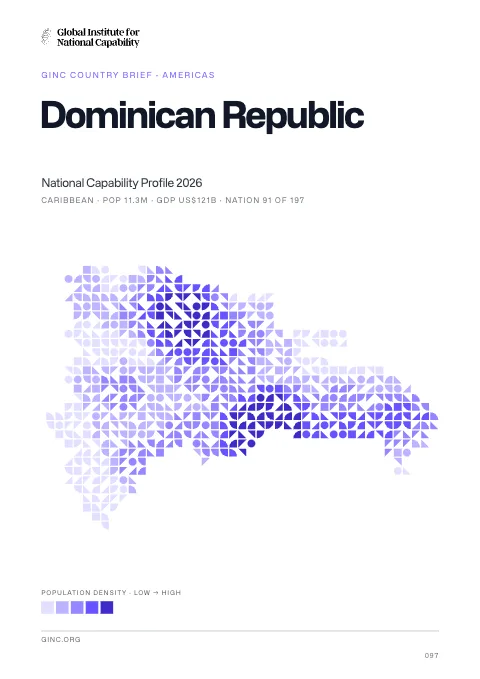
The Dominican is a democratic republic in Central America and the Caribbean, home to 10 million people, with its capital at Santo Domingo.
Contents
12 chapters
Foundations
01–03
At a glance
- Area
- 48.7Kkm²#131 World#7 C. America
- Population
- 10.3M#86 World#3 C. America
- GDP (market)
- $59.3B
- GDP (PPP)
- $101B#75 World#2 C. America
- GDP per capita
- $9.7K#123 World#23 C. America
The whole brief
The Dominican National Capability Profile 2026
Foundations · Chapter 01
Historical Context
🇩🇴 The Dominican’s understanding the origins and evolution of the modern nation
BackgroundBack to top ↑
The Taino - indigenous inhabitants of Hispaniola prior to the arrival of the Europeans - divided the island into five chiefdoms and territories. Christopher COLUMBUS explored and claimed the island on his first voyage in 1492; it became a springboard for Spanish conquest of the Caribbean and the American mainland. In 1697, Spain recognized French dominion over the western third of the island, which in 1804 became Haiti. The remainder of the island, by then known as Santo Domingo, sought to gain its own independence in 1821 but was conquered and ruled by the Haitians for 22 years; it finally attained independence as the Dominican Republic in 1844. In 1861, the Dominicans voluntarily returned to the Spanish Empire, but two years later they launched a war that restored independence in 1865. A legacy of unsettled, mostly non-representative rule followed, capped by the dictatorship of Rafael Leonidas TRUJILLO from 1930 to 1961. Juan BOSCH was elected president in 1962 but was deposed in a military coup in 1963. In 1965, the United States led an intervention in the midst of a civil war sparked by an uprising to restore BOSCH. In 1966, Joaquin BALAGUER defeated BOSCH in an election to become president. BALAGUER maintained a tight grip on power for most of the next 30 years when international reaction to flawed elections forced him to curtail his term in 1996. Since then, regular competitive elections have been held in which opposition candidates have won the presidency. Former President Leonel FERNANDEZ Reyna (first term 1996-2000) won election to a new term in 2004 following a constitutional amendment allowing presidents to serve more than one term, and was later reelected to a second consecutive term. In 2012, Danilo MEDINA Sanchez was elected president.
IndependenceBack to top ↑
27 February 1844 (from Haiti)
National holidayBack to top ↑
Independence Day, 27 February (1844)
Foundations · Chapter 02
Geography
🇩🇴 The Dominican’s territory, resources and strategic position
Location and areaBack to top ↑
Caribbean, eastern two-thirds of the island of Hispaniola, between the Caribbean Sea and the North Atlantic Ocean, east of Haiti
19 00 N, 70 40 W
Central America and the Caribbean
slightly more than twice the size of New Hampshire
1,288 km
measured from claimed archipelagic straight baselines
Terrain and resourcesBack to top ↑
rugged highlands and mountains with fertile valleys interspersed
nickel, bauxite, gold, silver
3,065 sq km (2009)
Settlement and hazardsBack to top ↑
lies in the middle of the hurricane belt and subject to severe storms from June to October; occasional flooding; periodic droughts
shares island of Hispaniola with Haiti
OtherBack to top ↑
21 cu km (2011)
water shortages; soil eroding into the sea damages coral reefs; deforestation
Foundations · Chapter 03
Environment
🇩🇴 The Dominican’s environmental conditions, resources and national resilience
ClimateBack to top ↑
tropical maritime; little seasonal temperature variation; seasonal variation in rainfall
Emissions and pollutionBack to top ↑
Water, waste and foodBack to top ↑
Resources and agreementsBack to top ↑
GINC Capability Domains · Chapter 04
Critical Technology
🇩🇴 The Dominican’s technology frontiers and the pursuit of national advantage
Two counts are set side by side for 2015–2024: on the left, the papers researchers in The Dominican published; on the right, the patent families that began there and were filed in more than one country. First by capability group, then group by group with each group’s capabilities. The badge on a card is the nation’s place among all nations. Papers are from GINC Research Analytics, patent families from GINC Patents.
Research by capability group
#145 WorldPapers published, 2015–2024
Patents by capability group
#100 WorldInternational patent families, 2015–2024
Advanced Materials & ManufacturingBack to top ↑
Research
#130 WorldPapers published, 2015–2024
Patents
#85 WorldInternational patent families, 2015–2024
Energy TechnologiesBack to top ↑
Research
#137 WorldPapers published, 2015–2024
Patents
#84 WorldInternational patent families, 2015–2024
Semiconductors & Advanced ComputingBack to top ↑
Research
#121 WorldPapers published, 2015–2024
No research topic: Semiconductor Design & EDA · Advanced Semiconductor Fabrication · Semiconductor Equipment & Materials · Advanced Packaging & Heterogeneous Integration
Patents
#61 WorldInternational patent families, 2015–2024
Artificial IntelligenceBack to top ↑
Research
#134 WorldPapers published, 2015–2024
Patents
International patent families, 2015–2024
No international patent families on record for 2015–2024.
Quantum TechnologiesBack to top ↑
Research
#129 WorldPapers published, 2015–2024
Patents
International patent families, 2015–2024
No international patent families on record for 2015–2024.
Connectivity, Cyber & Trust TechnologiesBack to top ↑
Research
#144 WorldPapers published, 2015–2024
Patents
#93 WorldInternational patent families, 2015–2024
Sensing, Timing & NavigationBack to top ↑
Research
#140 WorldPapers published, 2015–2024
Patents
International patent families, 2015–2024
No international patent families on record for 2015–2024.
Robotics & Autonomous SystemsBack to top ↑
Research
#129 WorldPapers published, 2015–2024
No research topic: Human-Machine Interfaces
Patents
International patent families, 2015–2024
No international patent families on record for 2015–2024.
Biotechnology & Health TechnologiesBack to top ↑
Research
#145 WorldPapers published, 2015–2024
Patents
#94 WorldInternational patent families, 2015–2024
Medicine and BioTech
Clinical research and life-science invention, drawn from the same series that drive the metric pages. Each card opens the full cross-country comparison.
Space TechnologiesBack to top ↑
- Space Launch & Reusable Systems
- Advanced Propulsion & Hypersonic Systems
- Satellite & Constellation Technologies
GINC Capability Domains · Chapter 05
Strategic Infrastructure
🇩🇴 The Dominican’s energy, connectivity and the material foundations of capability
Resource InfrastructureBack to top ↑
61.1 bbl/day (2012 est.)
0 bbl/day (2010 est.)
27,260 bbl/day (2010 est.)
0 bbl (1 January 2013 est.)
28,050 bbl/day (2010 est.)
122,300 bbl/day (2011 est.)
0 bbl/day (2010 est.)
85,490 bbl/day (2010 est.)
0 cu m (2011 est.)
820 million cu m (2010 est.)
0 cu m (2011 est.)
930 million cu m (2011 est.)
0 cu m (1 January 2013 est.)
gas 27 km; oil 103 km (2013)
Agriculture & Food InfrastructureBack to top ↑
- Irrigation & Agricultural Water
- Livestock & Veterinary
- Fisheries & Aquaculture
- Storage, Cold Chain & Markets
Energy InfrastructureBack to top ↑
- Thermal Generation
- Nuclear Generation
- Nuclear Fuel Cycle & Radioactive Waste
- Hydropower
- Renewable Generation
- Transmission & Distribution
- System Control & Dispatch
- Storage & Fuel Supply
5.701 million kW (2010 est.)
13.09 billion kWh (2011 est.)
13.11 billion kWh (2010 est.)
0 kWh (2012 est.)
0 kWh (2012 est.)
90.6% of total installed capacity (2010 est.)
0% of total installed capacity (2010 est.)
9.2% of total installed capacity (2010 est.)
0.2% of total installed capacity (2010 est.)
20.64 million Mt (2011 est.)
Water, Sanitation & Waste InfrastructureBack to top ↑
- Dams, Reservoirs & Flood Defence
- Water Supply & Treatment
- Bulk Water Transfer & Desalination
- Wastewater & Sanitation
- Solid Waste & Recycling
Advanced ManufacturingBack to top ↑
- Materials & Inputs
- Chemicals & Hazardous Process Industry
- Production Systems
- Supply Chain & Ecosystem
- Workforce & Innovation
Transport InfrastructureBack to top ↑
- Seaports & Terminals
- Air Infrastructure
- Air Navigation & Traffic Management
- Inland Waterways & Ferries
- Rail Infrastructure
- Roads & Bridges
- Logistics, Multimodal & Border Infrastructure
- Postal & Parcel
36 (2013)
1 (2013)
Communications & Digital InfrastructureBack to top ↑
- Subsea Cables & International Gateways
- Core & Backbone Networks
- Mobile & Wireless Networks
- Spectrum & Broadcasting
- Data Centres, Compute & Cloud
- Data Resources
- AI Tools & Applications
1.065 million (2012)
9.038 million (2012)
2.701 million (2009)
404,500 (2012)
.do
Financial InfrastructureBack to top ↑
- Currency & Reserves
- Payments & Settlement Systems
- Markets, Exchanges & Depositories
- Banks, Insurers & Systemic Institutions
Social InfrastructureBack to top ↑
- Health Infrastructure
- Public Health & Laboratories
- Medical Supply & Stockpiles
- Education & Skills Infrastructure
- Research & Scientific Facilities
- Housing, Community & Social Services
- Government & Public Administration
- Cultural, Community & Recreational Infrastructure
- Justice & Corrections
- Emergency Services & Civil Protection
- Hydrometeorology & Early Warning
Space, Aerospace & Defence InfrastructureBack to top ↑
GINC Capability Domains · Chapter 06
National Security
🇩🇴 The Dominican’s force, intelligence and the defence of the nation
Disputes and terrorismBack to top ↑
Haitian migrants cross the porous border into the Dominican Republic to find work; illegal migrants from the Dominican Republic cross the Mona Passage each year to Puerto Rico to find better work
Force Generation & MobilisationBack to top ↑
Army (Ejercito Nacional, EN), Navy (Marina de Guerra, MdG; includes naval infantry), Dominican Air Force (Fuerza Aerea Dominicana, FAD) (2013)
17-21 years of age for voluntary military service; recruits must have completed primary school and be Dominican Republic citizens; women may volunteer (2012)
0.61% of GDP (2012)//0.63% of GDP (2011)//0.61% of GDP (2010)
Forces under arms
Active-duty strength on the Correlates of War series, which reaches back to 1816 and so carries a nation’s whole record of mobilisation rather than its present establishment. The card opens the full cross-country comparison.
Intelligence & AssessmentBack to top ↑
- Imagery & Geospatial Intelligence
- Signals & Cyber Intelligence
- Technical & Measurement Intelligence
- Open-Source & Financial Intelligence
- Human Intelligence & Counterintelligence
- All-Source Analysis & Warning
Joint Command, Projection & SustainmentBack to top ↑
- Command, Control & Communications
- Strategic Lift & Mobility
- Expeditionary & Peace Operations
- Operational Sustainment & War Reserves
- Defence Industrial Mobilisation
- CBRN Defence
Land PowerBack to top ↑
- Combined Arms Manoeuvre
- Land Fires
- Battlefield Aviation & Uncrewed Systems
- Special Operations & Irregular Warfare
Maritime PowerBack to top ↑
- Maritime Security & Constabulary
- Sea Denial & Undersea Warfare
- Sea Control
- Amphibious & Expeditionary Operations
Air PowerBack to top ↑
- Air Sovereignty & Policing
- Control of the Air
- Air Strike & Interdiction
- Airborne ISR, Early Warning & Battle Management
Strategic Strike & Missile DefenceBack to top ↑
Space OperationsBack to top ↑
Cyber & Electromagnetic OperationsBack to top ↑
Nuclear DeterrenceBack to top ↑
GINC Capability Domains · Chapter 07
Human Capital
🇩🇴 The Dominican’s population, health and the skills that sustain capability
DemographyBack to top ↑
10,349,741 (July 2014 est.)
1.25% (2014 est.)
18.97 births/1,000 population (2014 est.)
4.5 deaths/1,000 population (2014 est.)
2.36 children born/woman (2014 est.)
20.3
72.9% (2007)
Migration and urbanisationBack to top ↑
-1.93 migrant(s)/1,000 population (2014 est.)
SANTO DOMINGO (capital) 2.191 million (2011)
Welfare and equityBack to top ↑
34.4% (2010 est.)
47.2 (2010 est.)//52 (2000 est.)
Early Childhood DevelopmentBack to top ↑
3.4% (2007)
Foundational EducationBack to top ↑
2.2% of GDP (2012)
Advanced EducationBack to top ↑
Technical & Vocational SkillsBack to top ↑
Digital & AI CompetenceBack to top ↑
Generative AI adoption
Modelled share of working-age adults using generative AI, from Microsoft telemetry scaled to each country’s 15–64 population. A measure of how fast a workforce is absorbing the technology rather than of how much of it a nation builds. The card opens the full cross-country comparison.
Lifelong Learning & ReskillingBack to top ↑
Research Talent & Knowledge CreationBack to top ↑
Population HealthBack to top ↑
150 deaths/100,000 live births (2010)
21.2% (2008)
0.7% (2012 est.)
45,000 (2012 est.)
1,900 (2012 est.)
Health System CapabilityBack to top ↑
5.4% of GDP (2011)
1.88 physicians/1,000 population (2000)
1.7 beds/1,000 population (2011)
GINC Capability Domains · Chapter 08
Governance and Integrity
🇩🇴 The Dominican’s institutions, law and the integrity of the state
State structureBack to top ↑
democratic republic
10 regions (regiones, singular - region);Cibao Nordeste, Cibao Noroeste, Cibao Norte, Cibao Sur, El Valle, Enriquillo, Higuamo, Ozama, Valdesia, Yuma
many previous (38 total); latest proclaimed 26 January 2010; note - the Dominican Republic Government has a practice of promulgating a "new" constitution whenever an amendment is ratified (2013)
18 years of age, universal and compulsory; married persons regardless of age can vote; note - members of the armed forces and national police by law cannot vote
Political Institutions & Civic ParticipationBack to top ↑
- Electoral Management & Integrity
- Legislature & Deliberative Institutions
- Citizen Participation & Civic Space
bicameral National Congress or Congreso Nacional consists of the Senate or Senado (32 seats; members elected by popular vote to serve four-year terms) and the House of Representatives or Camara de Diputados (183 seats; members are elected by popular vote to serve four-year terms)
Dominican Liberation Party or PLD [Leonel FERNANDEZ Reyna]//Dominican Revolutionary Party or PRD [Miguel VARGAS Maldonado]//National Progressive Front [Vinicio CASTILLO, Pelegrin CASTILLO]//Social Christian Reformist Party or PRSC [Carlos MORALES Troncoso]
Citizen Participation Group (Participacion Ciudadania)//Collective of Popular Organizations or COP//Foundation for Institution-Building and Justice or FINJUS
Justice System & Fundamental RightsBack to top ↑
- Judicial Independence & Court Capability
- Access to Justice & Legal Services
- Fundamental Rights Protection
- Human Rights Institutions & Equality Bodies
civil law system based on the French civil code; Criminal Procedures Code modified in 2004 to include important elements of an accusatory system
accepts compulsory ICJ jurisdiction; accepts ICCt jurisdiction
Internal Security & OrderBack to top ↑
transshipment point for South American drugs destined for the US and Europe; has become a transshipment point for ecstasy from the Netherlands and Belgium destined for US and Canada; substantial money laundering activity in particular by Colombian narcotics traffickers; significant amphetamine consumption (2008)
Regulatory Governance & Strategic ControlsBack to top ↑
- Regulatory Quality & Better Regulation
- Regulatory Delivery & Independent Regulators
- Strategic Controls & Economic Security Administration
Government Effectiveness & Public AdministrationBack to top ↑
- Centre of Government & Policy Coordination
- Civil Service & Public Workforce
- Digital Government & Service Delivery
- Legal Identity & Civil Registration
- Statistical & Data Capability
Public Integrity & Anti-CorruptionBack to top ↑
Transparency, Oversight & AccountabilityBack to top ↑
- Right to Information & Open Government
- Independent Oversight & Supreme Audit
- Independent Media & Journalist Safety
National Resilience & Crisis ManagementBack to top ↑
GINC Capability Domains · Chapter 09
Information and Influence
🇩🇴 The Dominican’s identity, media and the projection of influence
Identity and cultureBack to top ↑
Spanish (official)
Roman Catholic 95%, other 5%
mixed 73%, white 16%, black 11%
palmchat (bird)
a centered white cross that extends to the edges divides the flag into four rectangles - the top ones are blue (hoist side) and red, and the bottom ones are red (hoist side) and blue; a small coat of arms featuring a shield supported by a laurel branch (left) and a palm branch (right) is at the center of the cross; above the shield a blue ribbon displays the motto, DIOS, PATRIA, LIBERTAD (God, Fatherland, Liberty), and below the shield, REPUBLICA DOMINICANA appears on a red ribbon; in the shield a bible is opened to a verse that reads "Y la verdad nos hara libre" (And the truth shall set you free); blue stands for liberty, white for salvation, and red for the blood of heroes
Diplomatic Statecraft & Global NetworksBack to top ↑
- Diplomatic Network & Consular Reach
- Multilateral Leadership & Norm Setting
- Agenda-Setting & Convening
- Mediation & Crisis Diplomacy
ACP, AOSIS, BCIE, Caricom (observer), CD, CELAC, FAO, G-77, IADB, IAEA, IBRD, ICAO, ICC (national committees), ICRM, IDA, IFAD, IFC, IFRCS, IHO, ILO, IMF, IMO, Interpol, IOC, IOM, IPU, ISO (correspondent), ITSO, ITU, ITUC (NGOs), LAES, LAIA (observer), MIGA, MINUSMA, NAM, OAS, OIF (observer), OPANAL, OPCW, Pacific Alliance (observer), PCA, Petrocaribe, SICA (associated member), UN, UNCTAD, UNESCO, UNIDO, Union Latina, UNWTO, UPU, WCO, WFTU (NGOs), WHO, WIPO, WMO, WTO
Alliances & Security CooperationBack to top ↑
Development Cooperation & Global AssistanceBack to top ↑
Culture, Language & Education DiplomacyBack to top ↑
- Cultural & Language Institutes
- Creative Industries & Cultural Export Reach
- Heritage & Cultural Institutions
- Education Diplomacy & Alumni Networks
- Sports & Major Events
Diaspora & Global CommunitiesBack to top ↑
Information Environment & Strategic CommunicationBack to top ↑
- Strategic Communications & Public Diplomacy
- International Media & Broadcasting
- Information Defence & Counter-Interference
combination of state-owned and privately owned broadcast media; 1 state-owned TV network and a number of private TV networks; networks operate repeaters to extend signals throughout country; combination of state-owned and privately owned radio stations with more than 300 radio stations operating (2007)
GINC Capability Domains · Chapter 10
Financial Strength
🇩🇴 The Dominican’s fiscal depth, reserves and the capacity to act
Monetary & Currency CapabilityBack to top ↑
- Monetary Policy & Price Stability
- Exchange Rate & External Account Management
- Currency Issuance & Digital Money
5% (2013 est.)//3.7% (2012 est.)
Dominican pesos (DOP) per US dollar -//41.8 (2013 est.)//39.336 (2012 est.)//37.307 (2010 est.)//36.03 (2009)//34.775 (2008)
13.6% (31 December 2013 est.)//15.48% (31 December 2012 est.)
$4.943 billion (31 December 2013 est.)//$4.738 billion (31 December 2012 est.)
$15.54 billion (31 December 2013 est.)//$14.83 billion (31 December 2012 est.)
Fiscal Capacity & Public FinanceBack to top ↑
- Revenue Mobilisation & Tax Administration
- Public Expenditure & Budget Management
- Sovereign Debt & Treasury Management
- Public Investment Management
15.2% of GDP (2013 est.)
-3% of GDP (2013 est.)
47% of GDP (2013 est.)//41.5% of GDP (2012 est.)
calendar year
Financial System Depth & AccessBack to top ↑
- Banking System Capacity
- Capital Markets Depth & Development
- Long-Term & Institutional Capital
- Financial Inclusion & Household Access
- Development & Policy Finance
$25.09 billion (31 December 2013 est.)//$23.71 billion (31 December 2012 est.)
$NA
Financial Regulation & IntegrityBack to top ↑
- Prudential Regulation & Supervision
- Financial Integrity & Illicit Finance Control
- Market Conduct & Consumer Protection
- Payment & Market Infrastructure Oversight
Financial Stability & Crisis ManagementBack to top ↑
- Macroprudential & Systemic Oversight
- Crisis Management, Resolution & Deposit Insurance
- External Liquidity & Financial Safety Nets
Sovereign Capital & External Financial PowerBack to top ↑
- Official Reserves Management
- Sovereign Wealth & Public Asset Management
- Currency Internationalisation & Reserve Status
- Capital Account & Flow Management
- International Financial Centre Capability
$4.379 billion (31 December 2013 est.)//$3.579 billion (31 December 2012 est.)
$18.01 billion (31 December 2013 est.)//$16.33 billion (31 December 2012 est.)
GINC Capability Domains · Chapter 11
Production and Innovation
🇩🇴 The Dominican’s output, industry and the engine of prosperity
Economic Output & ProductivityBack to top ↑
The Dominican Republic has long been viewed primarily as an exporter of sugar, coffee, and tobacco, but in recent years the service sector has overtaken agriculture as the economy's largest employer, due to growth in telecommunications, tourism, and free trade zones. The economy is highly dependent upon the US, the destination for approximately half of exports. Remittances from the US amount to about 5% of GDP, equivalent to about a third of exports and two-thirds of tourism receipts. The country suffers from marked income inequality; the poorest half of the population receives less than one-fifth of GDP, while the richest 10% enjoys nearly 40% of GDP. High unemployment and underemployment remains an important long-term challenge. The Central America-Dominican Republic Free Trade Agreement (CAFTA-DR) came into force in March 2007, boosting investment and exports and reducing losses to the Asian garment industry. The Dominican Republic's economy rebounded from the global recession in 2010-13, and the fiscal situation is improving. A tax reform package passed in November 2012 and a reduction in government spending helped to narrow the central government budget deficit from 6.6% of GDP in 2012 to below 3% in 2013. A successful government bond placement in 2013 helped finance the deficit.
$101 billion (2013 est.)//$99.02 billion (2012 est.)//$95.32 billion (2011 est.)
2% (2013 est.)//3.9% (2012 est.)//4.5% (2011 est.)
$9,700 (2013 est.)//$9,700 (2012 est.)//$9,500 (2011 est.)
$59.27 billion (2013 est.)
Labour & EmploymentBack to top ↑
- Employment & Labour Force Participation
- Labour Market Institutions & Wage Setting
- Employment Services & Skills Matching
- Labour Adjustment, Transition & Formalisation
4.912 million (2013 est.)
15% (2013 est.)//14.3% (2012 est.)
Industrial & Sectoral BaseBack to top ↑
- Manufacturing & Advanced Industry
- Foundational & Process Industries
- Agrifood & Primary Production
- Services Economy
sugarcane, coffee, cotton, cocoa, tobacco, rice, beans, potatoes, corn, bananas; cattle, pigs, dairy products, beef, eggs
tourism, sugar processing, ferronickel and gold mining, textiles, cement, tobacco
2.5% (2013 est.)
Structural Transformation & ComplexityBack to top ↑
Business Dynamism & EntrepreneurshipBack to top ↑
- Entrepreneurship & Firm Creation
- Risk Capital & Scale-Up Finance
- Firm Growth, Exit & Renewal
- Competition & Market Contestability
Innovation & CommercialisationBack to top ↑
- Business Innovation Capability
- Research Commercialisation & Knowledge Transfer
- Intellectual Property & Intangible Assets
- Innovation Ecosystems & Clusters
Technology Adoption & DiffusionBack to top ↑
GINC Capability Domains · Chapter 12
Trade and Investment
🇩🇴 The Dominican’s markets, capital and the terms of global exchange
Overall tradeBack to top ↑
$14.5B of exports to 162 partners and $33.0B of imports from 185 in 2024, a deficit of $18.4B.
- Exports
- $14.5B162 partners
- Imports
- $33.0B185 partners
- Balance
- −$18.4Bdeficit
- Total trade
- $47.5B2024
ExportsBack to top ↑
Where its exports go
The largest partners in 2024, with each one's share of the nation's exports.
| Partner | Value | Share | |
|---|---|---|---|
| United States | $7.60B | 52% | |
| Haiti | $896M | 6.2% | |
| Switzerland | $761M | 5.2% | |
| India | $756M | 5.2% | |
| China | $595M | 4.1% | |
| Canada | $368M | 2.5% | |
| Netherlands | $356M | 2.5% | |
| Germany | $298M | 2.1% | |
| United Kingdom | $204M | 1.4% | |
| Mexico | $203M | 1.4% | |
| France | $184M | 1.3% | |
| Spain | $173M | 1.2% | |
| Jamaica | $117M | 0.8% | |
| Taiwan | $109M | 0.8% | |
| Japan | $107M | 0.7% | |
| South Korea | $101M | 0.7% | |
| Cuba | $81.2M | 0.6% | |
| Belgium | $75.2M | 0.5% | |
| Guyana | $74.5M | 0.5% | |
| Singapore | $72.4M | 0.5% |
What it exports
The largest categories in 2024.
| Category | Value | Share | |
|---|---|---|---|
| Optical, photo, technical, medical apparatus | $2.73B | 19% | |
| Pearls, precious stones, metals, coins | $2.06B | 14% | |
| Tobacco and manufactures tobacco substitutes | $1.39B | 9.6% | |
| Electrical, electronic equipment | $1.32B | 9.1% | |
| Plastics | $822M | 5.7% | |
| Articles of apparel, knit or crocheted | $664M | 4.6% | |
| Edible fruits, nuts, peel of citrus fruit, melons | $512M | 3.5% | |
| Cocoa and cocoa preparations | $462M | 3.2% | |
| Iron and steel | $383M | 2.6% | |
| Machinery, nuclear reactors, boilers | $259M | 1.8% | |
| Pharmaceutical products | $233M | 1.6% | |
| Footwear, gaiters and the like | $211M | 1.5% | |
| Beverages, spirits and vinegar | $210M | 1.4% | |
| Articles of apparel, not knit or crocheted | $204M | 1.4% | |
| Sugars and sugar confectionery | $203M | 1.4% |
ImportsBack to top ↑
Where its imports come from
The largest partners in 2024, with each one's share of the nation's imports.
| Partner | Value | Share | |
|---|---|---|---|
| United States | $13.0B | 39% | |
| China | $6.26B | 19% | |
| Spain | $1.33B | 4.0% | |
| Brazil | $1.20B | 3.6% | |
| Mexico | $1.15B | 3.5% | |
| Italy | $816M | 2.5% | |
| Colombia | $679M | 2.1% | |
| Germany | $610M | 1.9% | |
| Japan | $539M | 1.6% | |
| India | $490M | 1.5% | |
| South Korea | $382M | 1.2% | |
| United Kingdom | $367M | 1.1% | |
| Argentina | $366M | 1.1% | |
| Canada | $349M | 1.1% | |
| Guatemala | $323M | 1.0% | |
| Netherlands | $302M | 0.9% | |
| Costa Rica | $295M | 0.9% | |
| France | $270M | 0.8% | |
| Turkey | $249M | 0.8% | |
| Trinidad and Tobago | $234M | 0.7% |
What it imports
The largest categories in 2024.
| Category | Value | Share | |
|---|---|---|---|
| Mineral fuels, oils, distillation products | $5.37B | 16% | |
| Machinery, nuclear reactors, boilers | $3.00B | 9.1% | |
| Vehicles other than railway, tramway | $2.77B | 8.4% | |
| Electrical, electronic equipment | $2.55B | 7.7% | |
| Plastics | $2.42B | 7.3% | |
| Iron and steel | $1.10B | 3.3% | |
| Pharmaceutical products | $830M | 2.5% | |
| Pearls, precious stones, metals, coins | $807M | 2.4% | |
| Cereals | $798M | 2.4% | |
| Articles of iron or steel | $732M | 2.2% | |
| Paper and paperboard, articles of pulp, paper and board | $730M | 2.2% | |
| Meat and edible meat offal | $623M | 1.9% | |
| Cotton | $537M | 1.6% | |
| Beverages, spirits and vinegar | $502M | 1.5% | |
| Tobacco and manufactures tobacco substitutes | $494M | 1.5% |
In a list, the bar runs to the largest in that list. The line is each figure’s history from 2000, drawn to its own peak: it shows the shape of the years, and the value shows the size.
External balanceBack to top ↑
-$2.33 billion (2013 est.)//-$4.037 billion (2012 est.)
Trade Facilitation & LogisticsBack to top ↑
Trade Policy & Market AccessBack to top ↑
- Trade Policy & Negotiation Capability
- Market Access & Agreements Network
- Trade Law & Enforcement
- Standards, Conformity & Quality Infrastructure
Digital & Services TradeBack to top ↑
- Services Trade Capability
- Digital Trade & E-Commerce
- Data Flows & Digital Trade Governance
- Tourism & Visitor Economy
Investment Attraction & ProjectionBack to top ↑
- Investment Attraction & Facilitation
- Investment Absorption & Linkages
- Outward Investment & Global Corporate Presence
$26.76 billion (31 December 2013 est.)//$24.86 billion (31 December 2012 est.)
$59 million (31 December 2013 est.)//$59 million (31 December 2012 est.)
Export Capability & SophisticationBack to top ↑
$9.825 billion (2013 est.)//$9.079 billion (2012 est.)
US 47%, Haiti 16.1%, China 4.3% (2012)
ferronickel, sugar, gold, silver, coffee, cocoa, tobacco, meats, consumer goods
Global Value Chain PositionBack to top ↑
- Value Chain Participation & Integration
- Value Chain Position & Upgrading
- Regional Integration & Hub Anchoring
Economic Leverage & DependenceBack to top ↑
- Strategic Supply Security
- Concentration Risk & Revenue Stabilisation
- Economic Leverage & Coercion Resistance
$16.8 billion (2013 est.)//$17.76 billion (2012 est.)
US 43.3%, Venezuela 7.7%, China 6.3%, Mexico 5.3%, Colombia 4.1% (2012)
foodstuffs, petroleum, cotton and fabrics, chemicals and pharmaceuticals
The Dominican · you are in
Historical Context
Foundations
GINC Capability Domains
Find in this brief · The Dominican