
Portugal
Portugal is a republic in Europe, home to 11 million people, with its capital at Lisbon.
Contents
12 chapters
Foundations
01–03
At a glance
- Area
- 92.1Kkm²#111 World#16 Europe
- Population
- 10.8M#79 World#9 Europe
- GDP (market)
- $219B
- GDP (PPP)
- $243.3B#53 World#16 Europe
- GDP per capita
- $22.9K#64 World#30 Europe
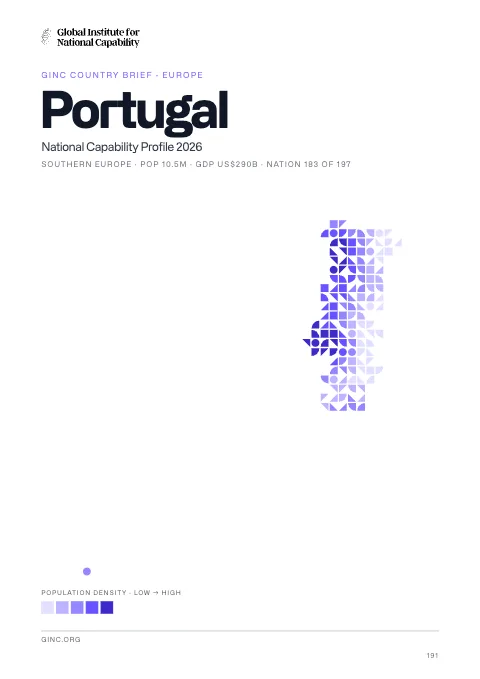
The whole brief
Portugal National Capability Profile 2026
Foundations · Chapter 01
Historical Context
🇵🇹 Portugal’s understanding the origins and evolution of the modern nation
BackgroundBack to top ↑
Following its heyday as a global maritime power during the 15th and 16th centuries, Portugal lost much of its wealth and status with the destruction of Lisbon in a 1755 earthquake, occupation during the Napoleonic Wars, and the independence of Brazil, its wealthiest colony, in 1822. A 1910 revolution deposed the monarchy; for most of the next six decades, repressive governments ran the country. In 1974, a left-wing military coup installed broad democratic reforms. The following year, Portugal granted independence to all of its African colonies. Portugal is a founding member of NATO and entered the EC (now the EU) in 1986.
IndependenceBack to top ↑
1143 (Kingdom of Portugal recognized); 5 October 1910 (republic proclaimed)
National holidayBack to top ↑
Portugal Day (Dia de Portugal), 10 June (1580); note - also called Camoes Day, the day that revered national poet Luis de Camoes (1524-80) died
Foundations · Chapter 02
Geography
🇵🇹 Portugal’s territory, resources and strategic position
Location and areaBack to top ↑
Southwestern Europe, bordering the North Atlantic Ocean, west of Spain
39 30 N, 8 00 W
Europe
slightly smaller than Indiana
1,793 km
Terrain and resourcesBack to top ↑
mountainous north of the Tagus River, rolling plains in south
fish, forests (cork), iron ore, copper, zinc, tin, tungsten, silver, gold, uranium, marble, clay, gypsum, salt, arable land, hydropower
5,837 sq km (2007)
Settlement and hazardsBack to top ↑
Azores subject to severe earthquakes
Azores and Madeira Islands occupy strategic locations along western sea approaches to Strait of Gibraltar
OtherBack to top ↑
68.7 cu km (2011)
soil erosion; air pollution caused by industrial and vehicle emissions; water pollution, especially in coastal areas
Foundations · Chapter 03
Environment
🇵🇹 Portugal’s environmental conditions, resources and national resilience
ClimateBack to top ↑
maritime temperate; cool and rainy in north, warmer and drier in south
Emissions and pollutionBack to top ↑
Water, waste and foodBack to top ↑
Resources and agreementsBack to top ↑
GINC Capability Domains · Chapter 04
Critical Technology
🇵🇹 Portugal’s technology frontiers and the pursuit of national advantage
Two counts are set side by side for 2015–2024: on the left, the papers researchers in Portugal published; on the right, the patent families that began there and were filed in more than one country. First by capability group, then group by group with each group’s capabilities. The badge on a card is the nation’s place among all nations. Papers are from GINC Research Analytics, patent families from GINC Patents.
Research by capability group
#31 WorldPapers published, 2015–2024
3,007
2,694
1,745
1,097
959
825
639
339
249
25
Patents by capability group
#31 WorldInternational patent families, 2015–2024
273
209
132
100
89
87
61
33
6
2
Advanced Materials & ManufacturingBack to top ↑
Research
#26 WorldPapers published, 2015–2024
Patents
#35 WorldInternational patent families, 2015–2024
Energy TechnologiesBack to top ↑
Research
#41 WorldPapers published, 2015–2024
Patents
#33 WorldInternational patent families, 2015–2024
Semiconductors & Advanced ComputingBack to top ↑
Research
#35 WorldPapers published, 2015–2024
No research topic: Semiconductor Design & EDA · Advanced Semiconductor Fabrication · Semiconductor Equipment & Materials · Advanced Packaging & Heterogeneous Integration
Patents
#36 WorldInternational patent families, 2015–2024
Artificial IntelligenceBack to top ↑
Research
#35 WorldPapers published, 2015–2024
Patents
#29 WorldInternational patent families, 2015–2024
Quantum TechnologiesBack to top ↑
Research
#34 WorldPapers published, 2015–2024
Patents
#33 WorldInternational patent families, 2015–2024
Connectivity, Cyber & Trust TechnologiesBack to top ↑
Research
#27 WorldPapers published, 2015–2024
Patents
#32 WorldInternational patent families, 2015–2024
Sensing, Timing & NavigationBack to top ↑
Research
#31 WorldPapers published, 2015–2024
Patents
#31 WorldInternational patent families, 2015–2024
Robotics & Autonomous SystemsBack to top ↑
Research
#26 WorldPapers published, 2015–2024
No research topic: Human-Machine Interfaces
Patents
#33 WorldInternational patent families, 2015–2024
Biotechnology & Health TechnologiesBack to top ↑
Research
#39 WorldPapers published, 2015–2024
Patents
#29 WorldInternational patent families, 2015–2024
Medicine and BioTech
Clinical research and life-science invention, drawn from the same series that drive the metric pages. Each card opens the full cross-country comparison.
Space TechnologiesBack to top ↑
Research
#34 WorldPapers published, 2015–2024
Patents
#36 WorldInternational patent families, 2015–2024
GINC Capability Domains · Chapter 05
Strategic Infrastructure
🇵🇹 Portugal’s energy, connectivity and the material foundations of capability
Resource InfrastructureBack to top ↑
5,250 bbl/day (2012 est.)
0 bbl/day (2010 est.)
222,300 bbl/day (2010 est.)
0 bbl (1 January 2013 est.)
252,200 bbl/day (2010 est.)
259,700 bbl/day (2011 est.)
61,010 bbl/day (2010 est.)
84,080 bbl/day (2010 est.)
4.904 billion cu m (2012 est.)
5.143 billion cu m (2010 est.)
0 cu m (2011 est.)
5.185 billion cu m (2011 est.)
0 cu m (1 January 2013 est.)
gas 1,344 km; oil 11 km; refined products 188 km (2013)
Agriculture & Food InfrastructureBack to top ↑
- Irrigation & Agricultural Water
- Livestock & Veterinary
- Fisheries & Aquaculture
- Storage, Cold Chain & Markets
Energy InfrastructureBack to top ↑
- Thermal Generation
- Nuclear Generation
- Nuclear Fuel Cycle & Radioactive Waste
- Hydropower
- Renewable Generation
- Transmission & Distribution
- System Control & Dispatch
- Storage & Fuel Supply
18.92 million kW (2010 est.)
49.92 billion kWh (2011 est.)
50.26 billion kWh (2010 est.)
2.873 billion kWh (2012 est.)
10.76 billion kWh (2012 est.)
49% of total installed capacity (2010 est.)
0% of total installed capacity (2010 est.)
21.5% of total installed capacity (2010 est.)
24.1% of total installed capacity (2010 est.)
54.17 million Mt (2011 est.)
Water, Sanitation & Waste InfrastructureBack to top ↑
- Dams, Reservoirs & Flood Defence
- Water Supply & Treatment
- Bulk Water Transfer & Desalination
- Wastewater & Sanitation
- Solid Waste & Recycling
Advanced ManufacturingBack to top ↑
- Materials & Inputs
- Chemicals & Hazardous Process Industry
- Production Systems
- Supply Chain & Ecosystem
- Workforce & Innovation
Transport InfrastructureBack to top ↑
- Seaports & Terminals
- Air Infrastructure
- Air Navigation & Traffic Management
- Inland Waterways & Ferries
- Rail Infrastructure
- Roads & Bridges
- Logistics, Multimodal & Border Infrastructure
- Postal & Parcel
64 (2013)
210 km (on Douro River from Porto) (2011)
Communications & Digital InfrastructureBack to top ↑
- Subsea Cables & International Gateways
- Core & Backbone Networks
- Mobile & Wireless Networks
- Spectrum & Broadcasting
- Data Centres, Compute & Cloud
- Data Resources
- AI Tools & Applications
4.558 million (2012)
12.312 million (2012)
5.168 million (2009)
3.748 million (2012)
.pt
Financial InfrastructureBack to top ↑
- Currency & Reserves
- Payments & Settlement Systems
- Markets, Exchanges & Depositories
- Banks, Insurers & Systemic Institutions
Social InfrastructureBack to top ↑
- Health Infrastructure
- Public Health & Laboratories
- Medical Supply & Stockpiles
- Education & Skills Infrastructure
- Research & Scientific Facilities
- Housing, Community & Social Services
- Government & Public Administration
- Cultural, Community & Recreational Infrastructure
- Justice & Corrections
- Emergency Services & Civil Protection
- Hydrometeorology & Early Warning
Space, Aerospace & Defence InfrastructureBack to top ↑
GINC Capability Domains · Chapter 06
National Security
🇵🇹 Portugal’s force, intelligence and the defence of the nation
Disputes and terrorismBack to top ↑
Portugal does not recognize Spanish sovereignty over the territory of Olivenza based on a difference of interpretation of the 1815 Congress of Vienna and the 1801 Treaty of Badajoz
Force Generation & MobilisationBack to top ↑
Portuguese Army (Exercito Portuguesa), Portuguese Navy (Marinha Portuguesa; includes Marine Corps), Portuguese Air Force (Forca Aerea Portuguesa, FAP) (2013)
18-30 years of age for voluntary military service; no compulsory military service, but conscription possible if insufficient volunteers available; women serve in the armed forces, on naval ships since 1993, but are prohibited from serving in some combatant specialties; reserve obligation to age 35 (2012)
1.29% of GDP (2014)//1.2% of GDP (2013)//1.78% of GDP (2012)
Forces under arms
Active-duty strength on the Correlates of War series, which reaches back to 1816 and so carries a nation’s whole record of mobilisation rather than its present establishment. The card opens the full cross-country comparison.
Intelligence & AssessmentBack to top ↑
- Imagery & Geospatial Intelligence
- Signals & Cyber Intelligence
- Technical & Measurement Intelligence
- Open-Source & Financial Intelligence
- Human Intelligence & Counterintelligence
- All-Source Analysis & Warning
Joint Command, Projection & SustainmentBack to top ↑
- Command, Control & Communications
- Strategic Lift & Mobility
- Expeditionary & Peace Operations
- Operational Sustainment & War Reserves
- Defence Industrial Mobilisation
- CBRN Defence
Land PowerBack to top ↑
- Combined Arms Manoeuvre
- Land Fires
- Battlefield Aviation & Uncrewed Systems
- Special Operations & Irregular Warfare
Maritime PowerBack to top ↑
- Maritime Security & Constabulary
- Sea Denial & Undersea Warfare
- Sea Control
- Amphibious & Expeditionary Operations
Air PowerBack to top ↑
- Air Sovereignty & Policing
- Control of the Air
- Air Strike & Interdiction
- Airborne ISR, Early Warning & Battle Management
Strategic Strike & Missile DefenceBack to top ↑
Space OperationsBack to top ↑
Cyber & Electromagnetic OperationsBack to top ↑
Nuclear DeterrenceBack to top ↑
GINC Capability Domains · Chapter 07
Human Capital
🇵🇹 Portugal’s population, health and the skills that sustain capability
DemographyBack to top ↑
10,813,834 (July 2014 est.)
0.12% (2014 est.)
9.42 births/1,000 population (2014 est.)
10.97 deaths/1,000 population (2014 est.)
1.52 children born/woman (2014 est.)
29.2 (2011 est.)
86.8% (2005/06)
Migration and urbanisationBack to top ↑
2.74 migrant(s)/1,000 population (2014 est.)
LISBON (capital) 2.843 million; Porto 1.367 million (2011)
Welfare and equityBack to top ↑
18% (2006)
38.5 (2007)//35.6 (1995)
DisplacementBack to top ↑
Early Childhood DevelopmentBack to top ↑
Foundational EducationBack to top ↑
5.6% of GDP (2010)
Advanced EducationBack to top ↑
Technical & Vocational SkillsBack to top ↑
Digital & AI CompetenceBack to top ↑
Generative AI adoption
Modelled share of working-age adults using generative AI, from Microsoft telemetry scaled to each country’s 15–64 population. A measure of how fast a workforce is absorbing the technology rather than of how much of it a nation builds. The card opens the full cross-country comparison.
Lifelong Learning & ReskillingBack to top ↑
Research Talent & Knowledge CreationBack to top ↑
Population HealthBack to top ↑
8 deaths/100,000 live births (2010)
24% (2008)
0.6% (2009 est.)
42,000 (2009 est.)
fewer than 500 (2009 est.)
Health System CapabilityBack to top ↑
10.4% of GDP (2011)
3.76 physicians/1,000 population (2009)
3.4 beds/1,000 population (2010)
GINC Capability Domains · Chapter 08
Governance and Integrity
🇵🇹 Portugal’s institutions, law and the integrity of the state
State structureBack to top ↑
republic; parliamentary democracy
18 districts (distritos, singular - distrito) and 2 autonomous regions* (regioes autonomas, singular - regiao autonoma); Aveiro, Acores (Azores)*, Beja, Braga, Braganca, Castelo Branco, Coimbra, Evora, Faro, Guarda, Leiria, Lisboa (Lisbon), Madeira*, Portalegre, Porto, Santarem, Setubal, Viana do Castelo, Vila Real, Viseu
several previous; latest adopted 2 April 1976, effective 25 April 1976; amended several times, last in 2005 (2013)
18 years of age; universal
Political Institutions & Civic ParticipationBack to top ↑
- Electoral Management & Integrity
- Legislature & Deliberative Institutions
- Citizen Participation & Civic Space
unicameral Assembly of the Republic or Assembleia da Republica (230 seats; members elected by popular vote to serve four-year terms)
Democratic and Social Center/Popular Party or CDS/PP [Paulo PORTAS]//Social Democratic Party or PPD/PSD [Pedro PASSOS COELHO]//Socialist Party or PS [Antonio Jose SEGURO]//The Left Bloc or BE [Joao Pedro Furtado da Cunha SEMEDO and Catarina Soares MARTINS//Unitarian Democratic Coalition or CDU [Jeronimo DE SOUSA] (includes Portuguese Communist Party or PCP and Ecologist Party ("The Greens") or PEV)
Armed Forces Officers' Association (AOFA) [Colonel Pereira CRACEL]//the Desperate Generation (youth movement protesting against low wages, precarious labor conditions, and unemployment)//the General Workers Union or General Confederation of Portuguese Workers (UGT) [Carlos SILVA]//Portuguese National Workers' Conference (CGTP) [Armenio CARLOS]//TugaLeaks (a website that has become a mouthpiece for publicizing diverse protest action)//
Justice System & Fundamental RightsBack to top ↑
- Judicial Independence & Court Capability
- Access to Justice & Legal Services
- Fundamental Rights Protection
- Human Rights Institutions & Equality Bodies
civil law system; Constitutional Court review of legislative acts
accepts compulsory ICJ jurisdiction with reservations; accepts ICCt jurisdiction
Internal Security & OrderBack to top ↑
seizing record amounts of Latin American cocaine destined for Europe; a European gateway for Southwest Asian heroin; transshipment point for hashish from North Africa to Europe; consumer of Southwest Asian heroin
Regulatory Governance & Strategic ControlsBack to top ↑
- Regulatory Quality & Better Regulation
- Regulatory Delivery & Independent Regulators
- Strategic Controls & Economic Security Administration
Government Effectiveness & Public AdministrationBack to top ↑
- Centre of Government & Policy Coordination
- Civil Service & Public Workforce
- Digital Government & Service Delivery
- Legal Identity & Civil Registration
- Statistical & Data Capability
Public Integrity & Anti-CorruptionBack to top ↑
Transparency, Oversight & AccountabilityBack to top ↑
- Right to Information & Open Government
- Independent Oversight & Supreme Audit
- Independent Media & Journalist Safety
National Resilience & Crisis ManagementBack to top ↑
GINC Capability Domains · Chapter 09
Information and Influence
🇵🇹 Portugal’s identity, media and the projection of influence
Identity and cultureBack to top ↑
Portuguese (official), Mirandese (official, but locally used)
Roman Catholic 81%, other Christian 3.3%, other (includes Jewish, Muslim, other) 0.6%, none 6.8%, unspecified 8.3%
homogeneous Mediterranean stock; citizens of black African descent who immigrated to mainland during decolonization number less than 100,000; since 1990 East Europeans have entered Portugal
armillary sphere (a spherical astrolabe modeling objects in the sky and representing the Republic)
two vertical bands of green (hoist side, two-fifths) and red (three-fifths) with the national coat of arms (armillary sphere and Portuguese shield) centered on the dividing line; explanations for the color meanings are ambiguous, but a popular interpretation has green symbolizing hope and red the blood of those defending the nation
Diplomatic Statecraft & Global NetworksBack to top ↑
- Diplomatic Network & Consular Reach
- Multilateral Leadership & Norm Setting
- Agenda-Setting & Convening
- Mediation & Crisis Diplomacy
ADB (nonregional member), AfDB (nonregional member), Australia Group, BIS, CD, CE, CERN, CPLP, EAPC, EBRD, ECB, EIB, EMU, ESA, EU, FAO, FATF, IADB, IAEA, IBRD, ICAO, ICC (national committees), ICRM, IDA, IEA, IFAD, IFC, IFRCS, IHO, ILO, IMF, IMO, IMSO, Interpol, IOC, IOM, IPU, ISO, ITSO, ITU, ITUC (NGOs), LAIA (observer), MIGA, NATO, NEA, NSG, OAS (observer), OECD, OPCW, OSCE, Pacific Alliance (observer), Paris Club (associate), PCA, Schengen Convention, SELEC (observer), UN, UNCTAD, UNESCO, UNHCR, UNIDO, Union Latina, UNMIT, UNSC (temporary), UNWTO, UPU, WCO, WFTU (NGOs), WHO, WIPO, WMO, WTO, ZC
Alliances & Security CooperationBack to top ↑
Development Cooperation & Global AssistanceBack to top ↑
Culture, Language & Education DiplomacyBack to top ↑
- Cultural & Language Institutes
- Creative Industries & Cultural Export Reach
- Heritage & Cultural Institutions
- Education Diplomacy & Alumni Networks
- Sports & Major Events
Diaspora & Global CommunitiesBack to top ↑
Information Environment & Strategic CommunicationBack to top ↑
- Strategic Communications & Public Diplomacy
- International Media & Broadcasting
- Information Defence & Counter-Interference
Radio e Televisao de Portugal (RTP),the publicly-owned TV broadcaster, operates 2 domestic channels and external service channels to Africa; overall, roughly 40 domestic TV stations; viewers have widespread access to international broadcasters with more than half of all households connected to multi-channel cable or satellite TV systems; publicly owned radio operates 3 national networks and provides regional and external services; several privately owned national radio stations and some 300 regional and local commercial radio stations (2008)
GINC Capability Domains · Chapter 10
Financial Strength
🇵🇹 Portugal’s fiscal depth, reserves and the capacity to act
Monetary & Currency CapabilityBack to top ↑
- Monetary Policy & Price Stability
- Exchange Rate & External Account Management
- Currency Issuance & Digital Money
0.4% (2013 est.)//2.8% (2012 est.)
euros (EUR) per US dollar -//0.7634 (2013 est.)//0.7752 (2012 est.)//0.755 (2010 est.)//0.7198 (2009 est.)//0.6827 (2008 est.)
0.75% (31 December 2013)//1.5% (31 December 2010)
6% (31 December 2013 est.)//6.37% (31 December 2012 est.)
$86.57 billion (31 December 2013 est.)//$88.92 billion (31 December 2012 est.)
$283.9 billion (31 December 2013 est.)//$301.5 billion (31 December 2012 est.)
Fiscal Capacity & Public FinanceBack to top ↑
- Revenue Mobilisation & Tax Administration
- Public Expenditure & Budget Management
- Sovereign Debt & Treasury Management
- Public Investment Management
43.5% of GDP (2013 est.)
-5.1% of GDP (2013 est.)
127.8% of GDP (2013 est.)//123.6% of GDP (2012 est.)
calendar year
Financial System Depth & AccessBack to top ↑
- Banking System Capacity
- Capital Markets Depth & Development
- Long-Term & Institutional Capital
- Financial Inclusion & Household Access
- Development & Policy Finance
$408.3 billion (31 December 2013 est.)//$433.6 billion (31 December 2012 est.)
$65.53 billion (31 December 2012 est.)//$61.69 billion (31 December 2011)//$82 billion (31 December 2010 est.)
15.4% of GDP (2013 est.)//15% of GDP (2012 est.)//11.3% of GDP (2011 est.)
Financial Regulation & IntegrityBack to top ↑
- Prudential Regulation & Supervision
- Financial Integrity & Illicit Finance Control
- Market Conduct & Consumer Protection
- Payment & Market Infrastructure Oversight
Financial Stability & Crisis ManagementBack to top ↑
- Macroprudential & Systemic Oversight
- Crisis Management, Resolution & Deposit Insurance
- External Liquidity & Financial Safety Nets
Sovereign Capital & External Financial PowerBack to top ↑
- Official Reserves Management
- Sovereign Wealth & Public Asset Management
- Currency Internationalisation & Reserve Status
- Capital Account & Flow Management
- International Financial Centre Capability
$22.66 billion (31 December 2012 est.)//$21.34 billion (31 December 2011 est.)
$508.3 billion (31 December 2012 est.)//$482.2 billion (31 December 2011)
GINC Capability Domains · Chapter 11
Production and Innovation
🇵🇹 Portugal’s output, industry and the engine of prosperity
Economic Output & ProductivityBack to top ↑
Portugal has become a diversified and increasingly service-based economy since joining the European Community - the EU's predecessor - in 1986. Over the following two decades, successive governments privatized many state-controlled firms and liberalized key areas of the economy, including the financial and telecommunications sectors. The country qualified for the Economic and Monetary Union (EMU) in 1998 and began circulating the euro on 1 January 2002 along with 11 other EU members. The economy grew by more than the EU average for much of the 1990s, but the rate of growth slowed in 2001-08. The economy contracted in 2009, and fell again from 2011 to 2013, as the government implemented spending cuts and tax increases to comply with conditions of an EU-IMF financial rescue package, signed in May 2011. Austerity measures also have contributed to record unemployment and a wave of emigration not seen since the 1960s. Booming exports will contribute to growth and employment in 2014, but the need to continue to reduce private- and public-sector debt could weigh on consumption and investment. The government of Pedro PASSOS COELHO has stated its intention to reduce labor market rigidity, and, this, along with steps to trim the budget deficit, could make Portugal more attractive to foreign investors. The government reduced the budget deficit from 10.1% of GDP in 2009 to 5.1% in 2013, lower than the EU-IMF fiscal target of 5.5%. Despite these efforts, public debt has continued to grow and, in 2013, stands among the highest in the EU. As a result, the government may have difficulty regaining full bond market financing when the EU-IMF financing program expires in May 2014.
$243.3 billion (2013 est.)//$247.7 billion (2012 est.)//$256 billion (2011 est.)
-1.8% (2013 est.)//-3.2% (2012 est.)//-1.3% (2011 est.)
$22,900 (2013 est.)//$23,400 (2012 est.)//$24,000 (2011 est.)
$219.3 billion (2013 est.)
Labour & EmploymentBack to top ↑
- Employment & Labour Force Participation
- Labour Market Institutions & Wage Setting
- Employment Services & Skills Matching
- Labour Adjustment, Transition & Formalisation
5.395 million (2013 est.)
16.8% (2013 est.)//15.7% (2012 est.)
Industrial & Sectoral BaseBack to top ↑
- Manufacturing & Advanced Industry
- Foundational & Process Industries
- Agrifood & Primary Production
- Services Economy
grain, potatoes, tomatoes, olives, grapes; sheep, cattle, goats, pigs, poultry, dairy products; fish
textiles, clothing, footwear, wood and cork, paper, chemicals, auto parts, base metals, porcelain and ceramics, glassware, technology, telecommunications; dairy products, wine, other foodstuffs; ship construction and refurbishment; tourism
-1% (2013 est.)
Structural Transformation & ComplexityBack to top ↑
Business Dynamism & EntrepreneurshipBack to top ↑
- Entrepreneurship & Firm Creation
- Risk Capital & Scale-Up Finance
- Firm Growth, Exit & Renewal
- Competition & Market Contestability
Innovation & CommercialisationBack to top ↑
- Business Innovation Capability
- Research Commercialisation & Knowledge Transfer
- Intellectual Property & Intangible Assets
- Innovation Ecosystems & Clusters
Technology Adoption & DiffusionBack to top ↑
GINC Capability Domains · Chapter 12
Trade and Investment
🇵🇹 Portugal’s markets, capital and the terms of global exchange
Overall tradeBack to top ↑
$84.8B of exports to 210 partners and $114B of imports from 206 in 2024, a deficit of $29.3B.
- Exports
- $84.8B210 partners
- Imports
- $114B206 partners
- Balance
- −$29.3Bdeficit
- Total trade
- $199B2024
ExportsBack to top ↑
Where its exports go
The largest partners in 2024, with each one's share of the nation's exports.
| Partner | Value | Share | |
|---|---|---|---|
| Spain | $17.7B | 21% | |
| Germany | $9.18B | 11% | |
| France | $8.59B | 10% | |
| United States | $6.34B | 7.5% | |
| United Kingdom | $4.42B | 5.2% | |
| Italy | $3.89B | 4.6% | |
| Netherlands | $2.85B | 3.4% | |
| Morocco | $2.82B | 3.3% | |
| China | $1.93B | 2.3% | |
| Belgium | $1.87B | 2.2% | |
| Canada | $1.74B | 2.1% | |
| Poland | $1.44B | 1.7% | |
| Switzerland | $1.37B | 1.6% | |
| Brazil | $1.35B | 1.6% | |
| Turkey | $1.33B | 1.6% | |
| Angola | $1.29B | 1.5% | |
| Sweden | $1.03B | 1.2% | |
| Czech Republic | $840M | 1.0% | |
| Denmark | $663M | 0.8% | |
| Romania | $649M | 0.8% |
What it exports
The largest categories in 2024.
| Category | Value | Share | |
|---|---|---|---|
| Vehicles other than railway, tramway | $11.0B | 13% | |
| Electrical, electronic equipment | $8.33B | 9.8% | |
| Machinery, nuclear reactors, boilers | $5.83B | 6.9% | |
| Pharmaceutical products | $4.64B | 5.5% | |
| Mineral fuels, oils, distillation products | $3.85B | 4.5% | |
| Plastics | $3.65B | 4.3% | |
| Articles of apparel, knit or crocheted | $2.96B | 3.5% | |
| Paper and paperboard, articles of pulp, paper and board | $2.43B | 2.9% | |
| Footwear, gaiters and the like | $2.29B | 2.7% | |
| Furniture, lighting signs, prefabricated buildings | $2.27B | 2.7% | |
| Optical, photo, technical, medical apparatus | $2.24B | 2.6% | |
| Articles of iron or steel | $2.08B | 2.4% | |
| Animal, vegetable fats and oils, cleavage products | $2.03B | 2.4% | |
| Rubbers | $1.95B | 2.3% | |
| Iron and steel | $1.70B | 2.0% |
ImportsBack to top ↑
Where its imports come from
The largest partners in 2024, with each one's share of the nation's imports.
| Partner | Value | Share | |
|---|---|---|---|
| Spain | $37.1B | 33% | |
| Germany | $12.7B | 11% | |
| France | $8.24B | 7.2% | |
| Netherlands | $6.16B | 5.4% | |
| Italy | $5.79B | 5.1% | |
| China | $5.72B | 5.0% | |
| Brazil | $3.85B | 3.4% | |
| Belgium | $3.47B | 3.0% | |
| United States | $2.58B | 2.3% | |
| Ireland | $2.11B | 1.8% | |
| Poland | $1.95B | 1.7% | |
| Turkey | $1.59B | 1.4% | |
| United Kingdom | $1.37B | 1.2% | |
| South Korea | $1.26B | 1.1% | |
| Algeria | $1.26B | 1.1% | |
| Nigeria | $1.23B | 1.1% | |
| India | $1.15B | 1.0% | |
| Sweden | $1.02B | 0.9% | |
| Czech Republic | $887M | 0.8% | |
| Austria | $753M | 0.7% |
What it imports
The largest categories in 2024.
| Category | Value | Share | |
|---|---|---|---|
| Vehicles other than railway, tramway | $13.4B | 12% | |
| Mineral fuels, oils, distillation products | $12.1B | 11% | |
| Electrical, electronic equipment | $10.9B | 9.5% | |
| Machinery, nuclear reactors, boilers | $10.4B | 9.1% | |
| Plastics | $5.16B | 4.5% | |
| Pharmaceutical products | $4.09B | 3.6% | |
| Iron and steel | $3.68B | 3.2% | |
| Organic chemicals | $3.65B | 3.2% | |
| Optical, photo, technical, medical apparatus | $2.60B | 2.3% | |
| Fish, crustaceans, molluscs, aquatics invertebrates | $2.28B | 2.0% | |
| Meat and edible meat offal | $1.89B | 1.7% | |
| Articles of iron or steel | $1.87B | 1.6% | |
| Articles of apparel, knit or crocheted | $1.68B | 1.5% | |
| Furniture, lighting signs, prefabricated buildings | $1.66B | 1.5% | |
| Paper and paperboard, articles of pulp, paper and board | $1.63B | 1.4% |
In a list, the bar runs to the largest in that list. The line is each figure’s history from 2000, drawn to its own peak: it shows the shape of the years, and the value shows the size.
External balanceBack to top ↑
$1 billion (2013 est.)//-$3.365 billion (2012 est.)
Trade Facilitation & LogisticsBack to top ↑
Trade Policy & Market AccessBack to top ↑
- Trade Policy & Negotiation Capability
- Market Access & Agreements Network
- Trade Law & Enforcement
- Standards, Conformity & Quality Infrastructure
Digital & Services TradeBack to top ↑
- Services Trade Capability
- Digital Trade & E-Commerce
- Data Flows & Digital Trade Governance
- Tourism & Visitor Economy
Investment Attraction & ProjectionBack to top ↑
- Investment Attraction & Facilitation
- Investment Absorption & Linkages
- Outward Investment & Global Corporate Presence
$121.6 billion (31 December 2013 est.)//$117.2 billion (31 December 2012 est.)
$71.26 billion (31 December 2013 est.)//$71.26 billion (31 December 2012 est.)
Export Capability & SophisticationBack to top ↑
$61 billion (2013 est.)//$58.29 billion (2012 est.)
Spain 22.7%, Germany 12.4%, France 11.9%, Angola 6.5%, UK 5.3%, Netherlands 4.2% (2012)
agricultural products, food products, wine, oil products, chemical products, plastics and rubber, hides, leather, wood and cork, wood pulp and paper, textile materials, clothing, footwear, machinery and tools, base metals
Global Value Chain PositionBack to top ↑
- Value Chain Participation & Integration
- Value Chain Position & Upgrading
- Regional Integration & Hub Anchoring
Economic Leverage & DependenceBack to top ↑
- Strategic Supply Security
- Concentration Risk & Revenue Stabilisation
- Economic Leverage & Coercion Resistance
$59 billion (2013 est.)//$72.35 billion (2012 est.)
Spain 32%, Germany 11.5%, France 6.7%, Italy 5.3%, Netherlands 4.9% (2012)
agricultural products, chemical products, vehicles and other transport material, optical and precision instruments, computer accessories and parts, semi-conductors and related devices, oil products, base metals, food products, textile materials
Portugal · you are in
Historical Context
Foundations
GINC Capability Domains
Find in this brief · Portugal