
South Sudan
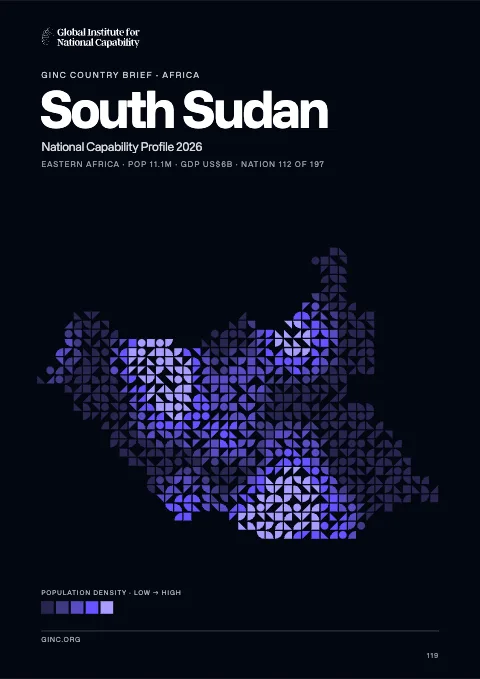
South Sudan is a landlocked republic in Africa, home to 12 million people, with its capital at Juba.
Contents
12 chapters
Foundations
01–03
At a glance
- Area
- 644.3Kkm²#42 World#18 Africa
- Population
- 11.6M#74 World#26 Africa
- GDP (market)
- $11.8B
- GDP (PPP)
- $14.7B#143 World#34 Africa
- GDP per capita
- $1.4K#208 World#39 Africa
The whole brief
South Sudan National Capability Profile 2026
Foundations · Chapter 01
Historical Context
🇸🇸 the South Sudan’s understanding the origins and evolution of the modern nation
BackgroundBack to top ↑
Egypt attempted to colonize the region of southern Sudan by establishing the province of Equatoria in the 1870s. Islamic Mahdist revolutionaries overran the region in 1885, but in 1898 a British force was able to overthrow the Mahdist regime. An Anglo-Egyptian Sudan was established the following year with Equatoria being the southernmost of its eight provinces. The isolated region was largely left to itself over the following decades, but Christian missionaries converted much of the population and facilitated the spread of English. When Sudan gained its independence in 1956, it was with the understanding that the southerners would be able to participate fully in the political system. When the Arab Khartoum government reneged on its promises, a mutiny began that led to two prolonged periods of conflict (1955-1972 and 1983-2005) in which perhaps 2.5 million people died - mostly civilians - due to starvation and drought. Ongoing peace talks finally resulted in a Comprehensive Peace Agreement, signed in January 2005. As part of this agreement the south was granted a six-year period of autonomy to be followed by a referendum on final status. The result of this referendum, held in January 2011, was a vote of 98% in favor of secession. Independence was attained on 9 July 2011. Since independence South Sudan has struggled with good governance and nation building and has attempted to control rebel militia groups operating in its territory. Economic conditions have deteriorated since January 2012 when the government decided to shut down oil production following bilateral disagreements with Sudan.
IndependenceBack to top ↑
9 July 2011 (from Sudan)
National holidayBack to top ↑
Independence Day, 9 July (2011)
Foundations · Chapter 02
Geography
🇸🇸 the South Sudan’s territory, resources and strategic position
Location and areaBack to top ↑
East-Central Africa; south of Sudan, north of Uganda and Kenya, west of Ethiopia
8 00 N, 30 00 E
Africa
slightly smaller than Texas
0 km (landlocked)
none (landlocked)
Terrain and resourcesBack to top ↑
the terrain gradually rises from plains in the north and center to southern highlands along the border with Uganda and Kenya; the White Nile, flowing north out of the uplands of Central Africa, is the major geographic feature of the country supporting agriculture and extensive wild animal populations; The Sudd (a name derived from floating vegetation that hinders navigation) is a large swampy area of more than 100,000 sq km fed by the waters of the White Nile that dominates the center of the country
hydropower, fertile agricultural land, gold, diamonds, petroleum, hardwoods, limestone, iron ore, copper, chromium ore, zinc, tungsten, mica, silver
Settlement and hazardsBack to top ↑
The Sudd is a vast swamp in South Sudan, formed by the White Nile, comprising more than 15% of the total area; it is one of the world's largest wetlands
OtherBack to top ↑
Foundations · Chapter 03
Environment
🇸🇸 the South Sudan’s environmental conditions, resources and national resilience
ClimateBack to top ↑
hot with seasonal rainfall influenced by the annual shift of the Inter-Tropical Convergence Zone; rainfall is heaviest in the upland areas of the south and diminishes to the north
Emissions and pollutionBack to top ↑
Water, waste and foodBack to top ↑
Resources and agreementsBack to top ↑
GINC Capability Domains · Chapter 04
Critical Technology
🇸🇸 the South Sudan’s technology frontiers and the pursuit of national advantage
Two counts are set side by side for 2015–2024: on the left, the papers researchers in the South Sudan published; on the right, the patent families that began there and were filed in more than one country. First by capability group, then group by group with each group’s capabilities. The badge on a card is the nation’s place among all nations. Papers are from GINC Research Analytics, patent families from GINC Patents.
Research by capability group
#119 WorldPapers published, 2015–2024
Patents by capability group
International patent families, 2015–2024
No international patent families on record for 2015–2024.
Advanced Materials & ManufacturingBack to top ↑
Research
#114 WorldPapers published, 2015–2024
Patents
International patent families, 2015–2024
No international patent families on record for 2015–2024.
Energy TechnologiesBack to top ↑
Research
#98 WorldPapers published, 2015–2024
Patents
International patent families, 2015–2024
No international patent families on record for 2015–2024.
Semiconductors & Advanced ComputingBack to top ↑
Research
#99 WorldPapers published, 2015–2024
No research topic: Semiconductor Design & EDA · Advanced Semiconductor Fabrication · Semiconductor Equipment & Materials · Advanced Packaging & Heterogeneous Integration
Patents
International patent families, 2015–2024
No international patent families on record for 2015–2024.
Artificial IntelligenceBack to top ↑
Research
#121 WorldPapers published, 2015–2024
Patents
International patent families, 2015–2024
No international patent families on record for 2015–2024.
Quantum TechnologiesBack to top ↑
Research
#90 WorldPapers published, 2015–2024
Patents
International patent families, 2015–2024
No international patent families on record for 2015–2024.
Connectivity, Cyber & Trust TechnologiesBack to top ↑
Research
#118 WorldPapers published, 2015–2024
Patents
International patent families, 2015–2024
No international patent families on record for 2015–2024.
Sensing, Timing & NavigationBack to top ↑
Research
#120 WorldPapers published, 2015–2024
Patents
International patent families, 2015–2024
No international patent families on record for 2015–2024.
Robotics & Autonomous SystemsBack to top ↑
Research
#121 WorldPapers published, 2015–2024
No research topic: Human-Machine Interfaces
Patents
International patent families, 2015–2024
No international patent families on record for 2015–2024.
Biotechnology & Health TechnologiesBack to top ↑
Research
#129 WorldPapers published, 2015–2024
Patents
International patent families, 2015–2024
No international patent families on record for 2015–2024.
Medicine and BioTech
Clinical research and life-science invention, drawn from the same series that drive the metric pages. Each card opens the full cross-country comparison.
Space TechnologiesBack to top ↑
- Space Launch & Reusable Systems
- Advanced Propulsion & Hypersonic Systems
- Satellite & Constellation Technologies
GINC Capability Domains · Chapter 05
Strategic Infrastructure
🇸🇸 the South Sudan’s energy, connectivity and the material foundations of capability
Resource InfrastructureBack to top ↑
220,000 bbl/day (Second half of 20)
291,800 bbl/day (2010 est.)
0 bbl/day (2010 est.)
3.75 billion bbl (1 January 2013 est.)
13,050 bbl/day
0 cu m (2011 est.)
0 cu m (2010 est.)
0 cu m (2011 est.)
0 cu m (2011 est.)
63.71 billion cu m (1 January 2013 est.)
Agriculture & Food InfrastructureBack to top ↑
- Irrigation & Agricultural Water
- Livestock & Veterinary
- Fisheries & Aquaculture
- Storage, Cold Chain & Markets
Energy InfrastructureBack to top ↑
- Thermal Generation
- Nuclear Generation
- Nuclear Fuel Cycle & Radioactive Waste
- Hydropower
- Renewable Generation
- Transmission & Distribution
- System Control & Dispatch
- Storage & Fuel Supply
255,200 kW (2010 est.)
881.3 million kWh (2010 est.)
694.1 million kWh (2010 est.)
0 kWh (2012 est.)
0 kWh (2012 est.)
30.7% of total installed capacity (2010 est.)
0% of total installed capacity (2010 est.)
66.3% of total installed capacity (2010 est.)
3% of total installed capacity (2010 est.)
2.016 million Mt (2011 est.)
Water, Sanitation & Waste InfrastructureBack to top ↑
- Dams, Reservoirs & Flood Defence
- Water Supply & Treatment
- Bulk Water Transfer & Desalination
- Wastewater & Sanitation
- Solid Waste & Recycling
Advanced ManufacturingBack to top ↑
- Materials & Inputs
- Chemicals & Hazardous Process Industry
- Production Systems
- Supply Chain & Ecosystem
- Workforce & Innovation
Transport InfrastructureBack to top ↑
- Seaports & Terminals
- Air Infrastructure
- Air Navigation & Traffic Management
- Inland Waterways & Ferries
- Rail Infrastructure
- Roads & Bridges
- Logistics, Multimodal & Border Infrastructure
- Postal & Parcel
85 (2013)
1 (2013)
248 km; note - a narrow guage, single-track railroad between Babonosa (Sudan) and Wau, the only existing rail system, was repaired in 2010 with $250 million in United Nations funds (2014)
7,000 km; note - little of the road network is paved and much of it is in disrepair; a 192 km paved road between the capital, Juba, and Nimule on the Ugandan border was constructed with USAID funds in 2012 (2012)
see entry for Sudan
Communications & Digital InfrastructureBack to top ↑
- Subsea Cables & International Gateways
- Core & Backbone Networks
- Mobile & Wireless Networks
- Spectrum & Broadcasting
- Data Centres, Compute & Cloud
- Data Resources
- AI Tools & Applications
2,200 (2012)
2 million (2012)
.ss
Financial InfrastructureBack to top ↑
- Currency & Reserves
- Payments & Settlement Systems
- Markets, Exchanges & Depositories
- Banks, Insurers & Systemic Institutions
Social InfrastructureBack to top ↑
- Health Infrastructure
- Public Health & Laboratories
- Medical Supply & Stockpiles
- Education & Skills Infrastructure
- Research & Scientific Facilities
- Housing, Community & Social Services
- Government & Public Administration
- Cultural, Community & Recreational Infrastructure
- Justice & Corrections
- Emergency Services & Civil Protection
- Hydrometeorology & Early Warning
Space, Aerospace & Defence InfrastructureBack to top ↑
GINC Capability Domains · Chapter 06
National Security
🇸🇸 the South Sudan’s force, intelligence and the defence of the nation
Disputes and terrorismBack to top ↑
South Sudan-Sudan boundary represents 1 January 1956 alignment, final alignment pending negotiations and demarcation; final sovereignty status of Abyei Area pending negotiations between South Sudan and Sudan; periodic violent skirmishes with South Sudanese residents over water and grazing rights persist among related pastoral populations along the border with the Central African Republic; the boundary that separates Kenya and South Sudan's sovereignty is unclear in the "Ilemi Triangle," which Kenya has administered since colonial times
Force Generation & MobilisationBack to top ↑
Sudan People's Liberation Army (SPLA)
18 is the legal minimum age for compulsory and voluntary military service; the Government of South Sudan signed a revised action plan with the UN in March 2012 to demobilize all child soldiers within the SPLA; UNICEF reported 250 confirmed cases of the SPLA's association with children at the end of 2012 (2012)
10.32% of GDP (2012)//5.8% of GDP (2011)//10.32% of GDP (2010)
Forces under arms
Active-duty strength on the Correlates of War series, which reaches back to 1816 and so carries a nation’s whole record of mobilisation rather than its present establishment. The card opens the full cross-country comparison.
Intelligence & AssessmentBack to top ↑
- Imagery & Geospatial Intelligence
- Signals & Cyber Intelligence
- Technical & Measurement Intelligence
- Open-Source & Financial Intelligence
- Human Intelligence & Counterintelligence
- All-Source Analysis & Warning
Joint Command, Projection & SustainmentBack to top ↑
- Command, Control & Communications
- Strategic Lift & Mobility
- Expeditionary & Peace Operations
- Operational Sustainment & War Reserves
- Defence Industrial Mobilisation
- CBRN Defence
Land PowerBack to top ↑
- Combined Arms Manoeuvre
- Land Fires
- Battlefield Aviation & Uncrewed Systems
- Special Operations & Irregular Warfare
Maritime PowerBack to top ↑
- Maritime Security & Constabulary
- Sea Denial & Undersea Warfare
- Sea Control
- Amphibious & Expeditionary Operations
Air PowerBack to top ↑
- Air Sovereignty & Policing
- Control of the Air
- Air Strike & Interdiction
- Airborne ISR, Early Warning & Battle Management
Strategic Strike & Missile DefenceBack to top ↑
Space OperationsBack to top ↑
Cyber & Electromagnetic OperationsBack to top ↑
Nuclear DeterrenceBack to top ↑
GINC Capability Domains · Chapter 07
Human Capital
🇸🇸 the South Sudan’s population, health and the skills that sustain capability
DemographyBack to top ↑
11,562,695 (July 2014 est.)
4.12% (2014 est.)
37.68 births/1,000 population (2014 est.)
8.42 deaths/1,000 population (2014 est.)
5.43 children born/woman (2014 est.)
3.5% (2006)
Migration and urbanisationBack to top ↑
11.94 migrant(s)/1,000 population (2014 est.)
JUBA (capital) 269,000 (2011)
Welfare and equityBack to top ↑
50.6% (2009 est.)
46 (2010 est.)
DisplacementBack to top ↑
Early Childhood DevelopmentBack to top ↑
32.5% (2006)
Foundational EducationBack to top ↑
Advanced EducationBack to top ↑
Technical & Vocational SkillsBack to top ↑
Digital & AI CompetenceBack to top ↑
Generative AI adoption
Modelled share of working-age adults using generative AI, from Microsoft telemetry scaled to each country’s 15–64 population. A measure of how fast a workforce is absorbing the technology rather than of how much of it a nation builds. The card opens the full cross-country comparison.
Lifelong Learning & ReskillingBack to top ↑
Research Talent & Knowledge CreationBack to top ↑
Population HealthBack to top ↑
2,054 deaths/100,000 live births (2006)
2.7% (2012 est.)
153,800 (2012 est.)
12,900 (2012 est.)
//63.4% of population//55% of population//56.5% of population////36.6% of population//45% of population//43.5% of population (2012 est.)
Health System CapabilityBack to top ↑
GINC Capability Domains · Chapter 08
Governance and Integrity
🇸🇸 the South Sudan’s institutions, law and the integrity of the state
State structureBack to top ↑
republic
10 states; Central Equatoria, Eastern Equatoria, Jonglei, Lakes, Northern Bahr el Ghazal, Unity, Upper Nile, Warrap, Western Bahr el Ghazal, Western Equatoria
previous 2005 (preindependence); latest signed 7 July 2011 (Transitional Constitution of the Republic of South Sudan, 2011); note - in January 2013, the mandate of the South Sudan National Constitutional Review Commission to address additional constitutional amendments was extended (2013)
18 years of age; universal
Political Institutions & Civic ParticipationBack to top ↑
- Electoral Management & Integrity
- Legislature & Deliberative Institutions
- Citizen Participation & Civic Space
bicameral National Legislature consists of the National Legislative Assembly (332 seats) and the Council of States (50 seats); members serve four-year terms
Sudan People's Liberation Movement or SPLM [Salva KIIR Mayardit]//Sudan People's Liberation Movement for Democratic Change or SPLM-DC [Lam AKOL]
Justice System & Fundamental RightsBack to top ↑
- Judicial Independence & Court Capability
- Access to Justice & Legal Services
- Fundamental Rights Protection
- Human Rights Institutions & Equality Bodies
Internal Security & OrderBack to top ↑
Regulatory Governance & Strategic ControlsBack to top ↑
- Regulatory Quality & Better Regulation
- Regulatory Delivery & Independent Regulators
- Strategic Controls & Economic Security Administration
Government Effectiveness & Public AdministrationBack to top ↑
- Centre of Government & Policy Coordination
- Civil Service & Public Workforce
- Digital Government & Service Delivery
- Legal Identity & Civil Registration
- Statistical & Data Capability
Public Integrity & Anti-CorruptionBack to top ↑
Transparency, Oversight & AccountabilityBack to top ↑
- Right to Information & Open Government
- Independent Oversight & Supreme Audit
- Independent Media & Journalist Safety
National Resilience & Crisis ManagementBack to top ↑
GINC Capability Domains · Chapter 09
Information and Influence
🇸🇸 the South Sudan’s identity, media and the projection of influence
Identity and cultureBack to top ↑
English (official), Arabic (includes Juba and Sudanese variants), regional languages include Dinka, Nuer, Bari, Zande, Shilluk
animist, Christian
Dinka 35.8%, Nuer 15.6%, Shilluk, Azande, Bari, Kakwa, Kuku, Murle, Mandari, Didinga, Ndogo, Bviri, Lndi, Anuak, Bongo, Lango, Dungotona, Acholi (2011 est.)
African fish eagle
three equal horizontal bands of black (top), red, and green; the red band is edged in white; a blue isosceles triangle based on the hoist side contains a gold, five-pointed star; black represents the people of South Sudan, red the blood shed in the struggle for freedom, green the verdant land, and blue the waters of the Nile; the gold star represents the unity of the states making up South Sudan
Diplomatic Statecraft & Global NetworksBack to top ↑
- Diplomatic Network & Consular Reach
- Multilateral Leadership & Norm Setting
- Agenda-Setting & Convening
- Mediation & Crisis Diplomacy
AU, IBRD, ICAO, IDA, IFAD, IFC, IFRCS, ILO, IMF, Interpol, IOM, ITU, MIGA, UN, UNCTAD, UNESCO, UPU
Alliances & Security CooperationBack to top ↑
Development Cooperation & Global AssistanceBack to top ↑
Culture, Language & Education DiplomacyBack to top ↑
- Cultural & Language Institutes
- Creative Industries & Cultural Export Reach
- Heritage & Cultural Institutions
- Education Diplomacy & Alumni Networks
- Sports & Major Events
Diaspora & Global CommunitiesBack to top ↑
Information Environment & Strategic CommunicationBack to top ↑
- Strategic Communications & Public Diplomacy
- International Media & Broadcasting
- Information Defence & Counter-Interference
TV is controlled by the government; several private FM stations are operational in South Sudan; some foreign radio broadcasts are available
GINC Capability Domains · Chapter 10
Financial Strength
🇸🇸 the South Sudan’s fiscal depth, reserves and the capacity to act
Monetary & Currency CapabilityBack to top ↑
- Monetary Policy & Price Stability
- Exchange Rate & External Account Management
- Currency Issuance & Digital Money
1.7% (2013 est.)//79% (May 2012 est.)
South Sudanese pounds (SSP) per US dollar -//0.7634 (2013 est.)//0.7752 (2012 est.)
$1.873 billion (31 December 2013)//$2.032 billion (31 December 2012)
$2.194 billion (31 December 2013)//$2.23 billion (31 December 2012)
Fiscal Capacity & Public FinanceBack to top ↑
- Revenue Mobilisation & Tax Administration
- Public Expenditure & Budget Management
- Sovereign Debt & Treasury Management
- Public Investment Management
3.7% of GDP (FY 2013 est.)
-15.5% of GDP (FY 2013 est.)
Financial System Depth & AccessBack to top ↑
- Banking System Capacity
- Capital Markets Depth & Development
- Long-Term & Institutional Capital
- Financial Inclusion & Household Access
- Development & Policy Finance
Financial Regulation & IntegrityBack to top ↑
- Prudential Regulation & Supervision
- Financial Integrity & Illicit Finance Control
- Market Conduct & Consumer Protection
- Payment & Market Infrastructure Oversight
Financial Stability & Crisis ManagementBack to top ↑
- Macroprudential & Systemic Oversight
- Crisis Management, Resolution & Deposit Insurance
- External Liquidity & Financial Safety Nets
Sovereign Capital & External Financial PowerBack to top ↑
GINC Capability Domains · Chapter 11
Production and Innovation
🇸🇸 the South Sudan’s output, industry and the engine of prosperity
Economic Output & ProductivityBack to top ↑
Following several decades of civil war with Sudan, industry and infrastructure in landlocked South Sudan are severely underdeveloped and poverty is widespread. Subsistence agriculture provides a living for the vast majority of the population. Property rights are insecure and price signals are weak, because markets are not well organized. South Sudan has little infrastructure - approximately 250 of paved roads. Electricity is produced mostly by costly diesel generators and indoor plumbing and potable water are scarce. South Sudan depends largely on imports of goods, services, and capital - mainly from Uganda, Kenya and Sudan. Nevertheless, South Sudan does have abundant natural resources. At independence in 2011, South Sudan produced nearly three-fourths of former Sudan's total oil output of nearly a half million barrels per day. The government of South Sudan derives nearly 98% of its budget revenues from oil. Oil is exported through two pipelines that run to refineries and shipping facilities at Port Sudan on the Red Sea. The economy of South Sudan will remain linked to Sudan for some time, given the long lead time and great expense required to build another pipeline, should the government decide to do so. In January 2012 South Sudan suspended production of oil because of its dispute with Sudan over transshipment fees. This suspension lasted fifteen months and had a devastating impact on GDP, which declined by 48% in 2012. With the resumption of oil flows the economy rebounded strongly during the second half of calendar year 2013. This occurred in spite of the fact that oil production, at an average level of 222,000 barrels per day, was 40% lower compared with 2011, prior to the shutdown. GDP is estimated to have grown by about 25% in 2013. However, the outbreak of conflict on December 15, 2013 combined with a further reduction of oil exports, means that GDP growth forecasts for 2014 are being revised downwards again, and poverty and food insecurity are rising. South Sudan holds one of the richest agricultural areas in Africa with fertile soils and abundant water supplies. Currently the region supports 10-20 million head of cattle. South Sudan is currently burdened by considerable debt, accrued largely in 2012, based on rapidly accumulating arrears, and increased military spending. South Sudan has received more than $4 billion in foreign aid since 2005, largely from the UK, the US, Norway, and the Netherlands. Following independence, South Sudan's central bank issued a new currency, the South Sudanese Pound, allowing a short grace period for turning in the old currency. Annual inflation peaked at 79.5% in May 2012 but declined rapidly thereafter, to an average of 1.7% in 2013. Following the December 2013 outbreak of violence, inflation is on the rise again. Long-term challenges include diversifying the formal economy, alleviating poverty, maintaining macroeconomic stability, improving tax collection and financial management and improving the business environment.
$14.71 billion (2013 est.)//$11.79 billion (2012 est.)//$22.49 billion (2011 est.)
24.7% (2013 est.)//-47.6% (2012 est.)//
$1,400 (2013 est.)//$1,100 (2012 est.)//$2,300 (2011 est.)
$11.77 billion (2013 est.)
Labour & EmploymentBack to top ↑
- Employment & Labour Force Participation
- Labour Market Institutions & Wage Setting
- Employment Services & Skills Matching
- Labour Adjustment, Transition & Formalisation
Industrial & Sectoral BaseBack to top ↑
- Manufacturing & Advanced Industry
- Foundational & Process Industries
- Agrifood & Primary Production
- Services Economy
sorghum, maize, rice, millet, wheat, gum arabic, sugarcane, mangoes, papayas, bananas, sweet potatoes, sunflower seeds, cotton, sesame seeds, cassava (manioc, tapioca), beans, peanuts; cattle, sheep
Structural Transformation & ComplexityBack to top ↑
Business Dynamism & EntrepreneurshipBack to top ↑
- Entrepreneurship & Firm Creation
- Risk Capital & Scale-Up Finance
- Firm Growth, Exit & Renewal
- Competition & Market Contestability
Innovation & CommercialisationBack to top ↑
- Business Innovation Capability
- Research Commercialisation & Knowledge Transfer
- Intellectual Property & Intangible Assets
- Innovation Ecosystems & Clusters
Technology Adoption & DiffusionBack to top ↑
GINC Capability Domains · Chapter 12
Trade and Investment
🇸🇸 the South Sudan’s markets, capital and the terms of global exchange
Overall tradeBack to top ↑
$507M of exports to 47 partners and $1.13B of imports from 57 in 2024, a deficit of $619M.
- Exports
- $507M47 partners
- Imports
- $1.13B57 partners
- Balance
- −$619Mdeficit
- Total trade
- $1.63B2024
ExportsBack to top ↑
Where its exports go
The largest partners in 2024, with each one's share of the nation's exports.
| Partner | Value | Share | |
|---|---|---|---|
| China | $300M | 59% | |
| Singapore | $158M | 31% | |
| Uganda | $34.7M | 6.8% | |
| Japan | $9.13M | 1.8% | |
| France | $1.31M | 0.3% | |
| India | $839K | 0.2% | |
| United States | $802K | 0.2% | |
| Ukraine | $795K | 0.2% | |
| Switzerland | $433K | <0.1% | |
| Germany | $304K | <0.1% | |
| Tanzania | $127K | <0.1% | |
| Uzbekistan | $114K | <0.1% | |
| Canada | $102K | <0.1% | |
| Kenya | $97.2K | <0.1% | |
| Egypt | $65.9K | <0.1% | |
| Mozambique | $52.0K | <0.1% | |
| United Kingdom | $45.0K | <0.1% | |
| Trinidad and Tobago | $43.6K | <0.1% | |
| Malaysia | $37.0K | <0.1% | |
| Bulgaria | $31.1K | <0.1% |
What it exports
The largest categories in 2024.
| Category | Value | Share | |
|---|---|---|---|
| Mineral fuels, oils, distillation products | $467M | 92% | |
| Iron and steel | $22.0M | 4.3% | |
| Fish, crustaceans, molluscs, aquatics invertebrates | $4.19M | 0.8% | |
| Copper | $2.81M | 0.6% | |
| Wood and articles of wood, wood charcoal | $2.54M | 0.5% | |
| Lac, gums, resins | $2.48M | 0.5% | |
| Plastics | $1.55M | 0.3% | |
| Machinery, nuclear reactors, boilers | $939K | 0.2% | |
| Milling products, malt, starches, inulin, wheat gluten | $568K | 0.1% | |
| Works of art, collectors' pieces and antiques | $507K | 0.1% | |
| Articles of iron or steel | $362K | <0.1% | |
| Live animals | $237K | <0.1% | |
| Electrical, electronic equipment | $235K | <0.1% | |
| Glass and glassware | $179K | <0.1% | |
| Essential oils, perfumes, cosmetics, toiletries | $136K | <0.1% |
ImportsBack to top ↑
Where its imports come from
The largest partners in 2024, with each one's share of the nation's imports.
| Partner | Value | Share | |
|---|---|---|---|
| Uganda | $490M | 44% | |
| Kenya | $220M | 20% | |
| China | $166M | 15% | |
| United States | $57.4M | 5.1% | |
| Japan | $30.5M | 2.7% | |
| India | $25.4M | 2.3% | |
| Turkey | $21.9M | 1.9% | |
| Malta | $15.6M | 1.4% | |
| Egypt | $12.6M | 1.1% | |
| Tanzania | $10.1M | 0.9% | |
| Netherlands | $7.59M | 0.7% | |
| Thailand | $7.11M | 0.6% | |
| South Korea | $6.13M | 0.5% | |
| Germany | $6.06M | 0.5% | |
| United Kingdom | $5.79M | 0.5% | |
| Belgium | $5.28M | 0.5% | |
| Denmark | $3.99M | 0.4% | |
| Italy | $3.73M | 0.3% | |
| Ukraine | $3.36M | 0.3% | |
| Spain | $2.97M | 0.3% |
What it imports
The largest categories in 2024.
| Category | Value | Share | |
|---|---|---|---|
| Milling products, malt, starches, inulin, wheat gluten | $90.3M | 8.0% | |
| Vehicles other than railway, tramway | $82.0M | 7.3% | |
| Machinery, nuclear reactors, boilers | $73.3M | 6.5% | |
| Electrical, electronic equipment | $64.6M | 5.7% | |
| Salt, sulphur, earth, stone, plaster, lime and cement | $62.8M | 5.6% | |
| Beverages, spirits and vinegar | $55.6M | 4.9% | |
| Miscellaneous edible preparations | $55.2M | 4.9% | |
| Sugars and sugar confectionery | $54.9M | 4.9% | |
| Iron and steel | $52.5M | 4.7% | |
| Animal, vegetable fats and oils, cleavage products | $46.3M | 4.1% | |
| Articles of iron or steel | $46.3M | 4.1% | |
| Cereals | $44.4M | 3.9% | |
| Pharmaceutical products | $36.6M | 3.3% | |
| Plastics | $34.7M | 3.1% | |
| Edible vegetables and certain roots and tubers | $32.9M | 2.9% |
In a list, the bar runs to the largest in that list. The line is each figure’s history from 2000, drawn to its own peak: it shows the shape of the years, and the value shows the size.
South Sudan · you are in
Historical Context
Foundations
GINC Capability Domains
Find in this brief · South Sudan