
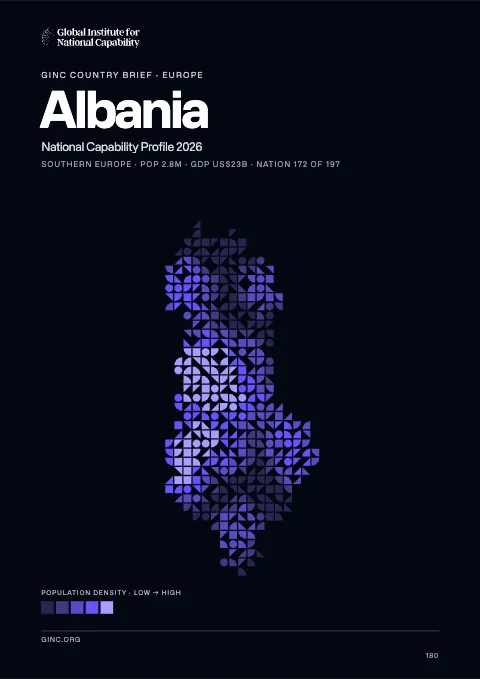
Albania
Albania is a parliamentary democracy in Europe, home to 3.0 million people, with its capital at Tirana.
Contents
12 chapters
Foundations
01–03
At a glance
- Area
- 28.7Kkm²#144 World#33 Europe
- Population
- 3M#137 World#29 Europe
- GDP (market)
- $12.8B
- GDP (PPP)
- $28.3B#115 World#32 Europe
- GDP per capita
- $10.7K#116 World#43 Europe
The whole brief
Albania National Capability Profile 2026
Foundations · Chapter 01
Historical Context
🇦🇱 Albania’s understanding the origins and evolution of the modern nation
BackgroundBack to top ↑
Albania declared its independence from the Ottoman Empire in 1912, but was conquered by Italy in 1939, and occupied by Germany in 1943. Communist partisans took over the country in 1944. Albania allied itself first with the USSR (until 1960), and then with China (to 1978). In the early 1990s, Albania ended 46 years of xenophobic communist rule and established a multiparty democracy. The transition has proven challenging as successive governments have tried to deal with high unemployment, widespread corruption, dilapidated infrastructure, powerful organized crime networks, and combative political opponents. Albania has made progress in its democratic development since first holding multiparty elections in 1991, but deficiencies remain. International observers judged elections to be largely free and fair since the restoration of political stability following the collapse of pyramid schemes in 1997; however, each of Albania's post-communist elections have been marred by claims of electoral fraud. The 2009 general elections resulted in a coalition government, the first such in the country's history. In 2013, general elections achieved a peaceful transition of power and a second successive coalition government. Albania joined NATO in April 2009 and is a potential candidate for EU accession. Although Albania's economy continues to grow, it has slowed, and the country is still one of the poorest in Europe. A large informal economy and an inadequate energy and transportation infrastructure remain obstacles.
IndependenceBack to top ↑
28 November 1912 (from the Ottoman Empire)
National holidayBack to top ↑
Independence Day, 28 November (1912) also known as Flag Day
Foundations · Chapter 02
Geography
🇦🇱 Albania’s territory, resources and strategic position
Location and areaBack to top ↑
Southeastern Europe, bordering the Adriatic Sea and Ionian Sea, between Greece in the south and Montenegro and Kosovo to the north
41 00 N, 20 00 E
Europe
slightly smaller than Maryland
362 km
Terrain and resourcesBack to top ↑
mostly mountains and hills; small plains along coast
petroleum, natural gas, coal, bauxite, chromite, copper, iron ore, nickel, salt, timber, hydropower
1,884 sq km (2006)
Settlement and hazardsBack to top ↑
destructive earthquakes; tsunamis occur along southwestern coast; floods; drought
strategic location along Strait of Otranto (links Adriatic Sea to Ionian Sea and Mediterranean Sea)
OtherBack to top ↑
41.7 cu km (2011)
deforestation; soil erosion; water pollution from industrial and domestic effluents
Foundations · Chapter 03
Environment
🇦🇱 Albania’s environmental conditions, resources and national resilience
ClimateBack to top ↑
mild temperate; cool, cloudy, wet winters; hot, clear, dry summers; interior is cooler and wetter
Emissions and pollutionBack to top ↑
Water, waste and foodBack to top ↑
Resources and agreementsBack to top ↑
GINC Capability Domains · Chapter 04
Critical Technology
🇦🇱 Albania’s technology frontiers and the pursuit of national advantage
Two counts are set side by side for 2015–2024: on the left, the papers researchers in Albania published; on the right, the patent families that began there and were filed in more than one country. First by capability group, then group by group with each group’s capabilities. The badge on a card is the nation’s place among all nations. Papers are from GINC Research Analytics, patent families from GINC Patents.
Research by capability group
#106 WorldPapers published, 2015–2024
Patents by capability group
#100 WorldInternational patent families, 2015–2024
Advanced Materials & ManufacturingBack to top ↑
Research
#112 WorldPapers published, 2015–2024
Patents
International patent families, 2015–2024
No international patent families on record for 2015–2024.
Energy TechnologiesBack to top ↑
Research
#133 WorldPapers published, 2015–2024
Patents
#76 WorldInternational patent families, 2015–2024
Semiconductors & Advanced ComputingBack to top ↑
Research
#106 WorldPapers published, 2015–2024
No research topic: Semiconductor Design & EDA · Advanced Semiconductor Fabrication · Semiconductor Equipment & Materials · Advanced Packaging & Heterogeneous Integration
Patents
International patent families, 2015–2024
No international patent families on record for 2015–2024.
Artificial IntelligenceBack to top ↑
Research
#99 WorldPapers published, 2015–2024
Patents
International patent families, 2015–2024
No international patent families on record for 2015–2024.
Quantum TechnologiesBack to top ↑
Research
#111 WorldPapers published, 2015–2024
Patents
#36 WorldInternational patent families, 2015–2024
Connectivity, Cyber & Trust TechnologiesBack to top ↑
Research
#78 WorldPapers published, 2015–2024
Patents
#87 WorldInternational patent families, 2015–2024
Sensing, Timing & NavigationBack to top ↑
Research
#103 WorldPapers published, 2015–2024
Patents
International patent families, 2015–2024
No international patent families on record for 2015–2024.
Robotics & Autonomous SystemsBack to top ↑
Research
#134 WorldPapers published, 2015–2024
No research topic: Human-Machine Interfaces
Patents
International patent families, 2015–2024
No international patent families on record for 2015–2024.
Biotechnology & Health TechnologiesBack to top ↑
Research
#129 WorldPapers published, 2015–2024
Patents
International patent families, 2015–2024
No international patent families on record for 2015–2024.
Medicine and BioTech
Clinical research and life-science invention, drawn from the same series that drive the metric pages. Each card opens the full cross-country comparison.
Space TechnologiesBack to top ↑
- Space Launch & Reusable Systems
- Advanced Propulsion & Hypersonic Systems
- Satellite & Constellation Technologies
GINC Capability Domains · Chapter 05
Strategic Infrastructure
🇦🇱 Albania’s energy, connectivity and the material foundations of capability
Resource InfrastructureBack to top ↑
23,930 bbl/day (2013 est.)
23,320 bbl/day (2013 est.)
0 bbl/day (2013 est.)
172.4 million bbl (1 January 2013 est.)
3,121 bbl/day (2010 est.)
38,390 bbl/day (2011 est.)
68 bbl/day (2010 est.)
22,810 bbl/day (2010 est.)
0 cu m (2012 est.)
0 cu m (2012 est.)
0 cu m (2012 est.)
0 cu m (2012 est.)
849.5 million cu m (1 January 2013 est.)
gas 331 km; oil 249 km (2013)
Agriculture & Food InfrastructureBack to top ↑
- Irrigation & Agricultural Water
- Livestock & Veterinary
- Fisheries & Aquaculture
- Storage, Cold Chain & Markets
Energy InfrastructureBack to top ↑
- Thermal Generation
- Nuclear Generation
- Nuclear Fuel Cycle & Radioactive Waste
- Hydropower
- Renewable Generation
- Transmission & Distribution
- System Control & Dispatch
- Storage & Fuel Supply
1.726 million kW (2012 est.)
6.987 billion kWh (2013 est.)
4.551 billion kWh (2013 est.)
1.424 billion kWh (2013 est.)
2.322 billion kWh (2013 est.)
5.6% of total installed capacity (2012 est.)
0% of total installed capacity (2012 est.)
94.4% of total installed capacity (2012 est.)
0% of total installed capacity (2012 est.)
4.183 million Mt (2011 est.)
Water, Sanitation & Waste InfrastructureBack to top ↑
- Dams, Reservoirs & Flood Defence
- Water Supply & Treatment
- Bulk Water Transfer & Desalination
- Wastewater & Sanitation
- Solid Waste & Recycling
Advanced ManufacturingBack to top ↑
- Materials & Inputs
- Chemicals & Hazardous Process Industry
- Production Systems
- Supply Chain & Ecosystem
- Workforce & Innovation
Transport InfrastructureBack to top ↑
- Seaports & Terminals
- Air Infrastructure
- Air Navigation & Traffic Management
- Inland Waterways & Ferries
- Rail Infrastructure
- Roads & Bridges
- Logistics, Multimodal & Border Infrastructure
- Postal & Parcel
4 (2013)
1 (2013)
41 km (on the Bojana River) (2011)
Communications & Digital InfrastructureBack to top ↑
- Subsea Cables & International Gateways
- Core & Backbone Networks
- Mobile & Wireless Networks
- Spectrum & Broadcasting
- Data Centres, Compute & Cloud
- Data Resources
- AI Tools & Applications
312,000 (2012)
3.5 million (2012)
1.3 million (2009)
15,528 (2012)
.al
Financial InfrastructureBack to top ↑
- Currency & Reserves
- Payments & Settlement Systems
- Markets, Exchanges & Depositories
- Banks, Insurers & Systemic Institutions
Social InfrastructureBack to top ↑
- Health Infrastructure
- Public Health & Laboratories
- Medical Supply & Stockpiles
- Education & Skills Infrastructure
- Research & Scientific Facilities
- Housing, Community & Social Services
- Government & Public Administration
- Cultural, Community & Recreational Infrastructure
- Justice & Corrections
- Emergency Services & Civil Protection
- Hydrometeorology & Early Warning
Space, Aerospace & Defence InfrastructureBack to top ↑
GINC Capability Domains · Chapter 06
National Security
🇦🇱 Albania’s force, intelligence and the defence of the nation
Disputes and terrorismBack to top ↑
none
Force Generation & MobilisationBack to top ↑
Land Forces Command, Navy Force Command, Air Forces Command (2013)
19 is the legal minimum age for voluntary military service; 18 is the legal minimum age in case of general/partial compulsory mobilization (2012)
1.47% of GDP (2012)//1.52% of GDP (2011)//1.47% of GDP (2010)
Forces under arms
Active-duty strength on the Correlates of War series, which reaches back to 1816 and so carries a nation’s whole record of mobilisation rather than its present establishment. The card opens the full cross-country comparison.
Intelligence & AssessmentBack to top ↑
- Imagery & Geospatial Intelligence
- Signals & Cyber Intelligence
- Technical & Measurement Intelligence
- Open-Source & Financial Intelligence
- Human Intelligence & Counterintelligence
- All-Source Analysis & Warning
Joint Command, Projection & SustainmentBack to top ↑
- Command, Control & Communications
- Strategic Lift & Mobility
- Expeditionary & Peace Operations
- Operational Sustainment & War Reserves
- Defence Industrial Mobilisation
- CBRN Defence
Land PowerBack to top ↑
- Combined Arms Manoeuvre
- Land Fires
- Battlefield Aviation & Uncrewed Systems
- Special Operations & Irregular Warfare
Maritime PowerBack to top ↑
- Maritime Security & Constabulary
- Sea Denial & Undersea Warfare
- Sea Control
- Amphibious & Expeditionary Operations
Air PowerBack to top ↑
- Air Sovereignty & Policing
- Control of the Air
- Air Strike & Interdiction
- Airborne ISR, Early Warning & Battle Management
Strategic Strike & Missile DefenceBack to top ↑
Space OperationsBack to top ↑
Cyber & Electromagnetic OperationsBack to top ↑
Nuclear DeterrenceBack to top ↑
GINC Capability Domains · Chapter 07
Human Capital
🇦🇱 Albania’s population, health and the skills that sustain capability
DemographyBack to top ↑
3,020,209 (July 2014 est.)
0.3% (2014 est.)
12.73 births/1,000 population (2014 est.)
6.47 deaths/1,000 population (2014 est.)
1.5 children born/woman (2014 est.)
23.4 (2010 est.)
69.3% (2008/09)
Migration and urbanisationBack to top ↑
-3.31 migrant(s)/1,000 population (2014 est.)
TIRANA (capital) 419,000 (2011)
Welfare and equityBack to top ↑
14.3% (2012 est.)
34.5 (2008)//26.7 (2005)
DisplacementBack to top ↑
Early Childhood DevelopmentBack to top ↑
6.3% (2009)
Foundational EducationBack to top ↑
3.3% of GDP (2007)
Advanced EducationBack to top ↑
Technical & Vocational SkillsBack to top ↑
Digital & AI CompetenceBack to top ↑
Generative AI adoption
Modelled share of working-age adults using generative AI, from Microsoft telemetry scaled to each country’s 15–64 population. A measure of how fast a workforce is absorbing the technology rather than of how much of it a nation builds. The card opens the full cross-country comparison.
Lifelong Learning & ReskillingBack to top ↑
Research Talent & Knowledge CreationBack to top ↑
Population HealthBack to top ↑
27 deaths/100,000 live births (2010)
21.3% (2008)
NA
NA
NA
Health System CapabilityBack to top ↑
6.3% of GDP (2011)
1.11 physicians/1,000 population (2011)
2.4 beds/1,000 population (2011)
GINC Capability Domains · Chapter 08
Governance and Integrity
🇦🇱 Albania’s institutions, law and the integrity of the state
State structureBack to top ↑
parliamentary democracy
12 counties (qarqe, singular - qark); Berat, Diber, Durres, Elbasan, Fier, Gjirokaster, Korce, Kukes, Lezhe, Shkoder, Tirane, Vlore
several previous; latest approved by parliament 21 October 1998, adopted by popular referendum 22 November 1998, promulgated 28 November 1998; amended 2007, 2008, 2012 (2014)
18 years of age; universal
Political Institutions & Civic ParticipationBack to top ↑
- Electoral Management & Integrity
- Legislature & Deliberative Institutions
- Citizen Participation & Civic Space
unicameral Assembly or Kuvendi (140 deputies elected through a regional proportional system from multi-name lists of parties or party coalitions according to their respective order; elected for a four-year term)
Confederation of Trade Unions of Albania or KSSH [Kol NIKOLLAJ]//Omonia [Vasil BOLLANO]//Union of Independent Trade Unions of Albania or BSPSH [Gezim KALAJA]
Justice System & Fundamental RightsBack to top ↑
- Judicial Independence & Court Capability
- Access to Justice & Legal Services
- Fundamental Rights Protection
- Human Rights Institutions & Equality Bodies
civil law system except in the northern rural areas where customary law known as the "Code of Leke" prevails
has not submitted an ICJ jurisdiction declaration; accepts ICCt jurisdiction
Internal Security & OrderBack to top ↑
increasingly active transshipment point for Southwest Asian opiates, hashish, and cannabis transiting the Balkan route and - to a lesser extent - cocaine from South America destined for Western Europe; limited opium and expanding cannabis production; ethnic Albanian narcotrafficking organizations active and expanding in Europe; vulnerable to money laundering associated with regional trafficking in narcotics, arms, contraband, and illegal aliens
Regulatory Governance & Strategic ControlsBack to top ↑
- Regulatory Quality & Better Regulation
- Regulatory Delivery & Independent Regulators
- Strategic Controls & Economic Security Administration
Government Effectiveness & Public AdministrationBack to top ↑
- Centre of Government & Policy Coordination
- Civil Service & Public Workforce
- Digital Government & Service Delivery
- Legal Identity & Civil Registration
- Statistical & Data Capability
Public Integrity & Anti-CorruptionBack to top ↑
Transparency, Oversight & AccountabilityBack to top ↑
- Right to Information & Open Government
- Independent Oversight & Supreme Audit
- Independent Media & Journalist Safety
National Resilience & Crisis ManagementBack to top ↑
GINC Capability Domains · Chapter 09
Information and Influence
🇦🇱 Albania’s identity, media and the projection of influence
Identity and cultureBack to top ↑
Albanian 98.8% (official - derived from Tosk dialect), Greek 0.5%, other 0.6% (including Macedonian, Roma, Vlach, Turkish, Italian, and Serbo-Croatian), unspecified 0.1% (2011 est.)
Muslim 56.7%, Roman Catholic 10%, Orthodox 6.8%, atheist 2.5%, Bektashi (a Sufi order) 2.1%, other 5.7%, unspecified 16.2%
Albanian 82.6%, Greek 0.9%, other 1% (including Vlach, Roma (Gypsy), Macedonian, Montenegrin, and Egyptian), unspecified 15.5% (2011 est.)
double-headed eagle
red with a black two-headed eagle in the center; the design is claimed to be that of 15th-century hero George Kastrioti SKANDERBEG, who led a successful uprising against the Turks that resulted in a short-lived independence for some Albanian regions (1443-78); an unsubstantiated explanation for the eagle symbol is the tradition that Albanians see themselves as descendants of the eagle; they refer to themselves as "Shqipetare," which translates as "sons of the eagle"
Diplomatic Statecraft & Global NetworksBack to top ↑
- Diplomatic Network & Consular Reach
- Multilateral Leadership & Norm Setting
- Agenda-Setting & Convening
- Mediation & Crisis Diplomacy
BSEC, CD, CE, CEI, EAPC, EBRD, EITI (candidate country), FAO, IAEA, IBRD, ICAO, ICC (national committees), ICRM, IDA, IDB, IFAD, IFC, IFRCS, ILO, IMF, IMO, Interpol, IOC, IOM, IPU, ISO (correspondent), ITU, ITUC (NGOs), MIGA, NATO, OAS (observer), OIC, OIF, OPCW, OSCE, PCA, SELEC, UN, UNCTAD, UNESCO, UNIDO, UNWTO, UPU, WCO, WFTU (NGOs), WHO, WIPO, WMO, WTO
Alliances & Security CooperationBack to top ↑
Development Cooperation & Global AssistanceBack to top ↑
Culture, Language & Education DiplomacyBack to top ↑
- Cultural & Language Institutes
- Creative Industries & Cultural Export Reach
- Heritage & Cultural Institutions
- Education Diplomacy & Alumni Networks
- Sports & Major Events
Diaspora & Global CommunitiesBack to top ↑
Information Environment & Strategic CommunicationBack to top ↑
- Strategic Communications & Public Diplomacy
- International Media & Broadcasting
- Information Defence & Counter-Interference
3 public TV networks, one of which transmits by satellite to Albanian-language communities in neighboring countries; more than 60 private TV stations; many viewers can pick up Italian and Greek TV broadcasts via terrestrial reception; cable TV service is available; 2 public radio networks and roughly 25 private radio stations; several international broadcasters are available (2010)
GINC Capability Domains · Chapter 10
Financial Strength
🇦🇱 Albania’s fiscal depth, reserves and the capacity to act
Monetary & Currency CapabilityBack to top ↑
- Monetary Policy & Price Stability
- Exchange Rate & External Account Management
- Currency Issuance & Digital Money
1.7% (2013 est.)//2.1% (2012 est.)
leke (ALL) per US dollar -//109.2 (2013 est.)//108.19 (2012 est.)//103.94 (2010 est.)//94.98 (2009)//79.546 (2008)
$NA (31 December 2013 est.)//4% (31 December 2012 est.)
9.52% (31 December 2013 est.)//10.28% (31 December 2012 est.)
$2.791 billion (31 December 2013 est.)//$2.652 billion (31 December 2012 est.)
$6.539 billion (31 December 2013 est.)//$6.316 billion (31 December 2012 est.)
Fiscal Capacity & Public FinanceBack to top ↑
- Revenue Mobilisation & Tax Administration
- Public Expenditure & Budget Management
- Sovereign Debt & Treasury Management
- Public Investment Management
24% of GDP (2013 est.)
-6.1% of GDP (2013 est.)
70.5% of GDP (2013 est.)//62.5% of GDP (2012 est.)
calendar year
Financial System Depth & AccessBack to top ↑
- Banking System Capacity
- Capital Markets Depth & Development
- Long-Term & Institutional Capital
- Financial Inclusion & Household Access
- Development & Policy Finance
$5.17 billion (31 December 2013 est.)//$5.233 billion (31 December 2012 est.)
$NA
14.1% of GDP (2013 est.)//13.6% of GDP (2012 est.)//13.6% of GDP (2011 est.)
Financial Regulation & IntegrityBack to top ↑
- Prudential Regulation & Supervision
- Financial Integrity & Illicit Finance Control
- Market Conduct & Consumer Protection
- Payment & Market Infrastructure Oversight
Financial Stability & Crisis ManagementBack to top ↑
- Macroprudential & Systemic Oversight
- Crisis Management, Resolution & Deposit Insurance
- External Liquidity & Financial Safety Nets
Sovereign Capital & External Financial PowerBack to top ↑
- Official Reserves Management
- Sovereign Wealth & Public Asset Management
- Currency Internationalisation & Reserve Status
- Capital Account & Flow Management
- International Financial Centre Capability
$2.827 billion (31 December 2013 est.)//$2.784 billion (31 December 2012 est.)
$3.213 billion (31 December 2013 est.)//$2.957 billion (31 December 2012 est.)
GINC Capability Domains · Chapter 11
Production and Innovation
🇦🇱 Albania’s output, industry and the engine of prosperity
Economic Output & ProductivityBack to top ↑
Albania, a formerly closed, centrally-planned state, is making the difficult transition to a more modern open-market economy. Albania managed to weather the first waves of the global financial crisis but, more recently, its negative effects have put some pressure on the Albanian economy. While the government is focused on establishing a favorable business climate through the simplification of licensing requirements and tax codes, it entered into a new arrangement with the IMF for additional financial and technical support. Remittances, a significant catalyst for economic growth declined from 12-15% of GDP before the 2008 financial crisis to 7% of GDP in 2012, mostly from Albanians residing in Greece and Italy. The agricultural sector, which accounts for almost half of employment but only about one-fifth of GDP, is limited primarily to small family operations and subsistence farming, because of a lack of modern equipment, unclear property rights, and the prevalence of small, inefficient plots of land. Complex tax codes and licensing requirements, a weak judicial system, poor enforcement of contracts and property issues, and antiquated infrastructure contribute to Albania's poor business environment and makes attracting foreign investment more difficult. Inward FDI is among the lowest in the region, but the government has embarked on an ambitious program to improve the business climate through fiscal and legislative reforms. Albania’s energy supply has improved in recent years mostly due to upgraded transmission capacities that Albania has developed with its neighboring countries. However, technical and non-technical losses - including energy theft and non-payment - continue to be a threat to the financial viability of the entire system. Also, with help from international donors, the government is taking steps to improve the poor national road and rail network, a long-standing barrier to sustained economic growth. The country will continue to face challenges from increasing public debt, having exceeded its former statutory limit of 60% of GDP in 2013. Strong trade, remittance, and banking sector ties with Greece and Italy make Albania vulnerable to spillover effects of debt crises and weak growth in the euro zone.
$28.34 billion (2013 est.)//$28.14 billion (2012 est.)//$27.78 billion (2011 est.)
0.7% (2013 est.)//1.3% (2012 est.)//3.1% (2011 est.)
$10,700 (2013 est.)//$10,400 (2012 est.)//$9,900 (2011 est.)
$12.8 billion (2013 est.)
Labour & EmploymentBack to top ↑
- Employment & Labour Force Participation
- Labour Market Institutions & Wage Setting
- Employment Services & Skills Matching
- Labour Adjustment, Transition & Formalisation
1.098 million (2013 est.)
16.9% (2013 est.)//14.4% (2012 est.)
Industrial & Sectoral BaseBack to top ↑
- Manufacturing & Advanced Industry
- Foundational & Process Industries
- Agrifood & Primary Production
- Services Economy
wheat, corn, potatoes, vegetables, fruits, sugar beets, grapes; meat, dairy products; sheep
food and tobacco products; textiles and clothing; lumber, oil, cement, chemicals, mining, basic metals, hydropower
3.1% (2013 est.)
Structural Transformation & ComplexityBack to top ↑
Business Dynamism & EntrepreneurshipBack to top ↑
- Entrepreneurship & Firm Creation
- Risk Capital & Scale-Up Finance
- Firm Growth, Exit & Renewal
- Competition & Market Contestability
Innovation & CommercialisationBack to top ↑
- Business Innovation Capability
- Research Commercialisation & Knowledge Transfer
- Intellectual Property & Intangible Assets
- Innovation Ecosystems & Clusters
Technology Adoption & DiffusionBack to top ↑
GINC Capability Domains · Chapter 12
Trade and Investment
🇦🇱 Albania’s markets, capital and the terms of global exchange
Overall tradeBack to top ↑
$3.79B of exports to 118 partners and $9.22B of imports from 123 in 2024, a deficit of $5.42B.
- Exports
- $3.79B118 partners
- Imports
- $9.22B123 partners
- Balance
- −$5.42Bdeficit
- Total trade
- $13.0B2024
ExportsBack to top ↑
Where its exports go
The largest partners in 2024, with each one's share of the nation's exports.
| Partner | Value | Share | |
|---|---|---|---|
| Italy | $1.50B | 40% | |
| Greece | $348M | 9.2% | |
| Germany | $223M | 5.9% | |
| China | $175M | 4.6% | |
| Serbia | $169M | 4.5% | |
| Spain | $136M | 3.6% | |
| United States | $96.0M | 2.5% | |
| Montenegro | $92.3M | 2.4% | |
| North Macedonia | $91.1M | 2.4% | |
| France | $89.4M | 2.4% | |
| Slovakia | $78.3M | 2.1% | |
| Czech Republic | $66.8M | 1.8% | |
| Turkey | $65.2M | 1.7% | |
| Switzerland | $52.0M | 1.4% | |
| Austria | $47.2M | 1.2% | |
| Poland | $46.7M | 1.2% | |
| Bulgaria | $46.7M | 1.2% | |
| United Kingdom | $42.3M | 1.1% | |
| Romania | $36.7M | 1.0% | |
| Bosnia and Herzegovina | $36.6M | 1.0% |
What it exports
The largest categories in 2024.
| Category | Value | Share | |
|---|---|---|---|
| Footwear, gaiters and the like | $578M | 15% | |
| Articles of apparel, not knit or crocheted | $440M | 12% | |
| Mineral fuels, oils, distillation products | $363M | 9.6% | |
| Articles of apparel, knit or crocheted | $276M | 7.3% | |
| Electrical, electronic equipment | $261M | 6.9% | |
| Iron and steel | $202M | 5.3% | |
| Ores slag and ash | $184M | 4.8% | |
| Edible vegetables and certain roots and tubers | $125M | 3.3% | |
| Aluminum | $122M | 3.2% | |
| Articles of iron or steel | $110M | 2.9% | |
| Salt, sulphur, earth, stone, plaster, lime and cement | $79.1M | 2.1% | |
| Paper and paperboard, articles of pulp, paper and board | $69.6M | 1.8% | |
| Fish, crustaceans, molluscs, aquatics invertebrates | $68.3M | 1.8% | |
| Edible fruits, nuts, peel of citrus fruit, melons | $65.7M | 1.7% | |
| Furniture, lighting signs, prefabricated buildings | $65.1M | 1.7% |
ImportsBack to top ↑
Where its imports come from
The largest partners in 2024, with each one's share of the nation's imports.
| Partner | Value | Share | |
|---|---|---|---|
| Italy | $1.98B | 22% | |
| China | $1.11B | 12% | |
| Turkey | $955M | 10% | |
| Greece | $709M | 7.7% | |
| Germany | $652M | 7.1% | |
| Serbia | $402M | 4.4% | |
| Saudi Arabia | $205M | 2.2% | |
| Poland | $202M | 2.2% | |
| United States | $188M | 2.0% | |
| South Korea | $179M | 1.9% | |
| Bulgaria | $156M | 1.7% | |
| France | $143M | 1.6% | |
| Netherlands | $130M | 1.4% | |
| North Macedonia | $124M | 1.3% | |
| Spain | $123M | 1.3% | |
| India | $110M | 1.2% | |
| Switzerland | $108M | 1.2% | |
| Hungary | $107M | 1.2% | |
| Egypt | $106M | 1.1% | |
| Romania | $100M | 1.1% |
What it imports
The largest categories in 2024.
| Category | Value | Share | |
|---|---|---|---|
| Vehicles other than railway, tramway | $947M | 10% | |
| Mineral fuels, oils, distillation products | $848M | 9.2% | |
| Machinery, nuclear reactors, boilers | $803M | 8.7% | |
| Electrical, electronic equipment | $691M | 7.5% | |
| Plastics | $367M | 4.0% | |
| Iron and steel | $365M | 4.0% | |
| Pharmaceutical products | $284M | 3.1% | |
| Beverages, spirits and vinegar | $218M | 2.4% | |
| Articles of iron or steel | $206M | 2.2% | |
| Articles of apparel, not knit or crocheted | $198M | 2.2% | |
| Articles of apparel, knit or crocheted | $197M | 2.1% | |
| Paper and paperboard, articles of pulp, paper and board | $171M | 1.9% | |
| Furniture, lighting signs, prefabricated buildings | $160M | 1.7% | |
| Aluminum | $146M | 1.6% | |
| Essential oils, perfumes, cosmetics, toiletries | $141M | 1.5% |
In a list, the bar runs to the largest in that list. The line is each figure’s history from 2000, drawn to its own peak: it shows the shape of the years, and the value shows the size.
External balanceBack to top ↑
-$1.28 billion (2013 est.)//-$1.316 billion (2012 est.)
Trade Facilitation & LogisticsBack to top ↑
Trade Policy & Market AccessBack to top ↑
- Trade Policy & Negotiation Capability
- Market Access & Agreements Network
- Trade Law & Enforcement
- Standards, Conformity & Quality Infrastructure
Digital & Services TradeBack to top ↑
- Services Trade Capability
- Digital Trade & E-Commerce
- Data Flows & Digital Trade Governance
- Tourism & Visitor Economy
Investment Attraction & ProjectionBack to top ↑
- Investment Attraction & Facilitation
- Investment Absorption & Linkages
- Outward Investment & Global Corporate Presence
$4.226 billion (31 December 2011)//$3.534 billion (31 December 2010)
Export Capability & SophisticationBack to top ↑
$2.323 billion (2013 est.)//$2.1 billion (2012 est.)
Italy 51.1%, Spain 9.2%, Turkey 6.3%, Greece 4.4% (2012)
textiles and footwear; asphalt, metals and metallic ores, crude oil; vegetables, fruits, tobacco
Global Value Chain PositionBack to top ↑
- Value Chain Participation & Integration
- Value Chain Position & Upgrading
- Regional Integration & Hub Anchoring
Economic Leverage & DependenceBack to top ↑
- Strategic Supply Security
- Concentration Risk & Revenue Stabilisation
- Economic Leverage & Coercion Resistance
$4.835 billion (2013 est.)//$4.985 billion (2012 est.)
Italy 31.9%, Greece 9.5%, China 6.4%, Germany 6%, Turkey 5.7% (2012)
machinery and equipment, foodstuffs, textiles, chemicals
Albania · you are in
Historical Context
Foundations
GINC Capability Domains
Find in this brief · Albania