
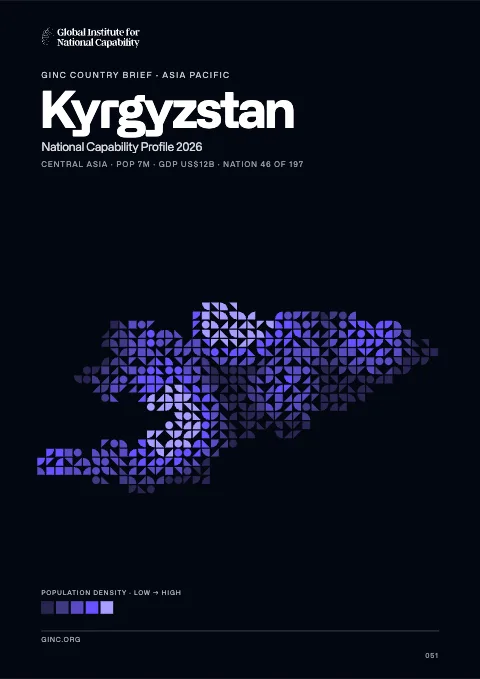
Kyrgyzstan
Kyrgyzstan is a landlocked republic in Central Asia, home to 5.6 million people, with its capital at Bishkek.
Contents
12 chapters
Foundations
01–03
At a glance
- Area
- 200Kkm²#87 World#5 C. Asia
- Population
- 5.6M#113 World#5 C. Asia
- GDP (market)
- $7.2B
- GDP (PPP)
- $14.3B#144 World#6 C. Asia
- GDP per capita
- $2.5K#185 World#5 C. Asia
The whole brief
Kyrgyzstan National Capability Profile 2026
Foundations · Chapter 01
Historical Context
🇰🇬 Kyrgyzstan’s understanding the origins and evolution of the modern nation
BackgroundBack to top ↑
A Central Asian country of incredible natural beauty and proud nomadic traditions, most of Kyrgyzstan was formally annexed to Russia in 1876. The Kyrgyz staged a major revolt against the Tsarist Empire in 1916 in which almost one-sixth of the Kyrgyz population was killed. Kyrgyzstan became a Soviet republic in 1936 and achieved independence in 1991 when the USSR dissolved. Nationwide demonstrations in the spring of 2005 resulted in the ouster of President Askar AKAEV, who had run the country since 1990. Former prime minister Kurmanbek BAKIEV overwhelmingly won the presidential election in the summer of 2005. Over the next few years, he manipulated the parliament to accrue new powers for the presidency. In July 2009, after months of harassment against his opponents and media critics, BAKIEV won re-election in a presidential campaign that the international community deemed flawed. In April 2010, violent protests in Bishkek led to the collapse of the BAKIEV regime and his eventual fleeing to Minsk, Belarus. His successor, Roza OTUNBAEVA, served as transitional president until Almazbek ATAMBAEV was inaugurated in December 2011, marking the first peaceful transfer of presidential power in independent Kyrgyzstan's history. Continuing concerns include: the trajectory of democratization, endemic corruption, poor interethnic relations, and terrorism.
IndependenceBack to top ↑
31 August 1991 (from the Soviet Union)
National holidayBack to top ↑
Independence Day, 31 August (1991)
Foundations · Chapter 02
Geography
🇰🇬 Kyrgyzstan’s territory, resources and strategic position
Location and areaBack to top ↑
Central Asia, west of China, south of Kazakhstan
41 00 N, 75 00 E
Asia
slightly smaller than South Dakota
0 km (landlocked)
none (landlocked)
Terrain and resourcesBack to top ↑
peaks of Tien Shan and associated valleys and basins encompass entire nation
abundant hydropower; significant deposits of gold and rare earth metals; locally exploitable coal, oil, and natural gas; other deposits of nepheline, mercury, bismuth, lead, and zinc
10,210 sq km (2005)
Settlement and hazardsBack to top ↑
NA
landlocked; entirely mountainous, dominated by the Tien Shan range; 94% of the country is 1,000 m above sea level with an average elevation of 2,750 m; many tall peaks, glaciers, and high-altitude lakes
OtherBack to top ↑
23.62 cu km (2011)
water pollution; many people get their water directly from contaminated streams and wells; as a result, water-borne diseases are prevalent; increasing soil salinity from faulty irrigation practices
Foundations · Chapter 03
Environment
🇰🇬 Kyrgyzstan’s environmental conditions, resources and national resilience
ClimateBack to top ↑
dry continental to polar in high Tien Shan Mountains; subtropical in southwest (Fergana Valley); temperate in northern foothill zone
Emissions and pollutionBack to top ↑
Water, waste and foodBack to top ↑
Resources and agreementsBack to top ↑
GINC Capability Domains · Chapter 04
Critical Technology
🇰🇬 Kyrgyzstan’s technology frontiers and the pursuit of national advantage
Two counts are set side by side for 2015–2024: on the left, the papers researchers in Kyrgyzstan published; on the right, the patent families that began there and were filed in more than one country. First by capability group, then group by group with each group’s capabilities. The badge on a card is the nation’s place among all nations. Papers are from GINC Research Analytics, patent families from GINC Patents.
Research by capability group
#143 WorldPapers published, 2015–2024
Patents by capability group
#110 WorldInternational patent families, 2015–2024
Advanced Materials & ManufacturingBack to top ↑
Research
#139 WorldPapers published, 2015–2024
Patents
#76 WorldInternational patent families, 2015–2024
Energy TechnologiesBack to top ↑
Research
#130 WorldPapers published, 2015–2024
Patents
International patent families, 2015–2024
No international patent families on record for 2015–2024.
Semiconductors & Advanced ComputingBack to top ↑
Research
#136 WorldPapers published, 2015–2024
No research topic: Semiconductor Design & EDA · Advanced Semiconductor Fabrication · Semiconductor Equipment & Materials · Advanced Packaging & Heterogeneous Integration
Patents
International patent families, 2015–2024
No international patent families on record for 2015–2024.
Artificial IntelligenceBack to top ↑
Research
#122 WorldPapers published, 2015–2024
Patents
#89 WorldInternational patent families, 2015–2024
Quantum TechnologiesBack to top ↑
Connectivity, Cyber & Trust TechnologiesBack to top ↑
Research
#128 WorldPapers published, 2015–2024
Patents
International patent families, 2015–2024
No international patent families on record for 2015–2024.
Sensing, Timing & NavigationBack to top ↑
- Precision Timing & Atomic Clocks
- Resilient Positioning & Navigation
- Advanced Imaging & Photonic Sensing
- Radar & Radiofrequency Sensing
- Acoustic & Undersea Sensing
Robotics & Autonomous SystemsBack to top ↑
Research
#138 WorldPapers published, 2015–2024
No research topic: Human-Machine Interfaces
Patents
International patent families, 2015–2024
No international patent families on record for 2015–2024.
Biotechnology & Health TechnologiesBack to top ↑
Research
#152 WorldPapers published, 2015–2024
Patents
International patent families, 2015–2024
No international patent families on record for 2015–2024.
Medicine and BioTech
Clinical research and life-science invention, drawn from the same series that drive the metric pages. Each card opens the full cross-country comparison.
Space TechnologiesBack to top ↑
- Space Launch & Reusable Systems
- Advanced Propulsion & Hypersonic Systems
- Satellite & Constellation Technologies
GINC Capability Domains · Chapter 05
Strategic Infrastructure
🇰🇬 Kyrgyzstan’s energy, connectivity and the material foundations of capability
Resource InfrastructureBack to top ↑
1,000 bbl/day (2011 est.)
0 bbl/day (2010 est.)
0 bbl/day (2010 est.)
40 million bbl (1 January 2013 est.)
0 bbl/day (2010 est.)
16,640 bbl/day (2011 est.)
2,433 bbl/day (2010 est.)
35,040 bbl/day (2010 est.)
10 million cu m (2011 est.)
462.5 million cu m (2010 est.)
0 cu m (2011 est.)
390 million cu m (2011 est.)
5.663 billion cu m (1 January 2013 est.)
gas 480 km; oil 16 km (2013)
Agriculture & Food InfrastructureBack to top ↑
- Irrigation & Agricultural Water
- Livestock & Veterinary
- Fisheries & Aquaculture
- Storage, Cold Chain & Markets
Energy InfrastructureBack to top ↑
- Thermal Generation
- Nuclear Generation
- Nuclear Fuel Cycle & Radioactive Waste
- Hydropower
- Renewable Generation
- Transmission & Distribution
- System Control & Dispatch
- Storage & Fuel Supply
3.64 million kW (2010 est.)
14.9 billion kWh (2011 est.)
7.326 billion kWh (2010 est.)
2.62 billion kWh (2011 est.)
0 kWh (2010 est.)
20.1% of total installed capacity (2010 est.)
0% of total installed capacity (2010 est.)
79.9% of total installed capacity (2010 est.)
0% of total installed capacity (2010 est.)
7.793 million Mt (2011 est.)
Water, Sanitation & Waste InfrastructureBack to top ↑
- Dams, Reservoirs & Flood Defence
- Water Supply & Treatment
- Bulk Water Transfer & Desalination
- Wastewater & Sanitation
- Solid Waste & Recycling
Advanced ManufacturingBack to top ↑
- Materials & Inputs
- Chemicals & Hazardous Process Industry
- Production Systems
- Supply Chain & Ecosystem
- Workforce & Innovation
Transport InfrastructureBack to top ↑
- Seaports & Terminals
- Air Infrastructure
- Air Navigation & Traffic Management
- Inland Waterways & Ferries
- Rail Infrastructure
- Roads & Bridges
- Logistics, Multimodal & Border Infrastructure
- Postal & Parcel
28 (2013)
600 km (2010)
Communications & Digital InfrastructureBack to top ↑
- Subsea Cables & International Gateways
- Core & Backbone Networks
- Mobile & Wireless Networks
- Spectrum & Broadcasting
- Data Centres, Compute & Cloud
- Data Resources
- AI Tools & Applications
489,000 (2012)
6.8 million (2012)
2.195 million (2009)
115,573 (2012)
.kg
Financial InfrastructureBack to top ↑
- Currency & Reserves
- Payments & Settlement Systems
- Markets, Exchanges & Depositories
- Banks, Insurers & Systemic Institutions
Social InfrastructureBack to top ↑
- Health Infrastructure
- Public Health & Laboratories
- Medical Supply & Stockpiles
- Education & Skills Infrastructure
- Research & Scientific Facilities
- Housing, Community & Social Services
- Government & Public Administration
- Cultural, Community & Recreational Infrastructure
- Justice & Corrections
- Emergency Services & Civil Protection
- Hydrometeorology & Early Warning
Space, Aerospace & Defence InfrastructureBack to top ↑
GINC Capability Domains · Chapter 06
National Security
🇰🇬 Kyrgyzstan’s force, intelligence and the defence of the nation
Disputes and terrorismBack to top ↑
Kyrgyzstan has yet to ratify the 2001 boundary delimitation with Kazakhstan; disputes in Isfara Valley delay completion of delimitation with Tajikistan; delimitation of 130 km of border with Uzbekistan is hampered by serious disputes over enclaves and other areas
Force Generation & MobilisationBack to top ↑
Ground Forces, Air Force (includes Air Defense Forces) (2013)
18-27 years of age for compulsory or voluntary male military service in the Armed Forces or Interior Ministry; service obligation - 1 year, with optional fee-based 3-year service in the callup mobilization reserve; women may volunteer at age 19; 16-17 years of age for military cadets, who cannot take part in military operations (2013)
NA% (2012)//3.74% of GDP (2011)//NA% (2010)
Forces under arms
Active-duty strength on the Correlates of War series, which reaches back to 1816 and so carries a nation’s whole record of mobilisation rather than its present establishment. The card opens the full cross-country comparison.
Intelligence & AssessmentBack to top ↑
- Imagery & Geospatial Intelligence
- Signals & Cyber Intelligence
- Technical & Measurement Intelligence
- Open-Source & Financial Intelligence
- Human Intelligence & Counterintelligence
- All-Source Analysis & Warning
Joint Command, Projection & SustainmentBack to top ↑
- Command, Control & Communications
- Strategic Lift & Mobility
- Expeditionary & Peace Operations
- Operational Sustainment & War Reserves
- Defence Industrial Mobilisation
- CBRN Defence
Land PowerBack to top ↑
- Combined Arms Manoeuvre
- Land Fires
- Battlefield Aviation & Uncrewed Systems
- Special Operations & Irregular Warfare
Maritime PowerBack to top ↑
- Maritime Security & Constabulary
- Sea Denial & Undersea Warfare
- Sea Control
- Amphibious & Expeditionary Operations
Air PowerBack to top ↑
- Air Sovereignty & Policing
- Control of the Air
- Air Strike & Interdiction
- Airborne ISR, Early Warning & Battle Management
Strategic Strike & Missile DefenceBack to top ↑
Space OperationsBack to top ↑
Cyber & Electromagnetic OperationsBack to top ↑
Nuclear DeterrenceBack to top ↑
GINC Capability Domains · Chapter 07
Human Capital
🇰🇬 Kyrgyzstan’s population, health and the skills that sustain capability
DemographyBack to top ↑
5,604,212 (July 2014 est.)
1.04% (2014 est.)
23.33 births/1,000 population (2014 est.)
6.74 deaths/1,000 population (2014 est.)
2.68 children born/woman (2014 est.)
22.6
47.8% (2005/06)
Migration and urbanisationBack to top ↑
-6.16 migrant(s)/1,000 population (2014 est.)
BISHKEK (capital) 839,000 (2011)
Welfare and equityBack to top ↑
33.7% (2011 est.)
33.4 (2007)//29 (2001)
DisplacementBack to top ↑
Early Childhood DevelopmentBack to top ↑
2.7% (2006)
Foundational EducationBack to top ↑
6.8% of GDP (2011)
Advanced EducationBack to top ↑
Technical & Vocational SkillsBack to top ↑
Digital & AI CompetenceBack to top ↑
Generative AI adoption
Modelled share of working-age adults using generative AI, from Microsoft telemetry scaled to each country’s 15–64 population. A measure of how fast a workforce is absorbing the technology rather than of how much of it a nation builds. The card opens the full cross-country comparison.
Lifelong Learning & ReskillingBack to top ↑
Research Talent & Knowledge CreationBack to top ↑
Population HealthBack to top ↑
71 deaths/100,000 live births (2010)
15.5% (2008)
0.3% (2012 est.)
8,700 (2012 est.)
300 (2012 est.)
Health System CapabilityBack to top ↑
6.2% of GDP (2010)
2.47 physicians/1,000 population (2011)
4.8 beds/1,000 population (2011)
GINC Capability Domains · Chapter 08
Governance and Integrity
🇰🇬 Kyrgyzstan’s institutions, law and the integrity of the state
State structureBack to top ↑
republic
7 provinces (oblustar, singular - oblus) and 2 cities* (shaarlar, singular - shaar); Batken Oblusu, Bishkek Shaary*, Chuy Oblusu (Bishkek), Jalal-Abad Oblusu, Naryn Oblusu, Osh Oblusu, Osh Shaary*, Talas Oblusu, Ysyk-Kol Oblusu (Karakol)
previous 1993; latest adopted 27 June 2010, effective 2 July 2010 (2010)
18 years of age; universal
Political Institutions & Civic ParticipationBack to top ↑
- Electoral Management & Integrity
- Legislature & Deliberative Institutions
- Citizen Participation & Civic Space
unicameral Supreme Council or Jogorku Kengesh (120 seats; members elected by popular vote to serve five-year terms)
Ar-Namys (Dignity) Party [Feliks KULOV]//Ata-Jurt (Homeland) [Kamchybek TASHIEV, Akhmat KELDIBEKOV, Sadyr JAPAROV]//Ata-Meken (Fatherland) [Omurbek TEKEBAEV]//Butun Kyrgyzstan (All Kyrgyzstan) [Adakhan MADUMAROV]//Respublika [Omurbek BABANOV]//Social-Democratic Party of Kyrgyzstan (SDPK) [Almazbek ATAMBAEV]
Adilet (Justice) Legal Clinic [Cholpon JAKUPOVA]//Citizens Against Corruption [Tolekan ISMAILOVA]//Coalition for Democracy and Civil Society [Dinara OSHURAKHUNOVA]//Kylym Shamy (Torch of the Century) [Aziza ABDIRASULOVA]//Precedent Partnership Group [Nurbek TOKTAKUNOV]//Societal Analysis Public Association [Rita KARASARTOVA]//Union of True Muslims [Nurlan MOTUEV]
Justice System & Fundamental RightsBack to top ↑
- Judicial Independence & Court Capability
- Access to Justice & Legal Services
- Fundamental Rights Protection
- Human Rights Institutions & Equality Bodies
civil law system which includes features of French civil law and Russian Federation laws
has not submitted an ICJ jurisdiction declaration; non-party state to the ICCt
Internal Security & OrderBack to top ↑
limited illicit cultivation of cannabis and opium poppy for CIS markets; limited government eradication of illicit crops; transit point for Southwest Asian narcotics bound for Russia and the rest of Europe; major consumer of opiates
Regulatory Governance & Strategic ControlsBack to top ↑
- Regulatory Quality & Better Regulation
- Regulatory Delivery & Independent Regulators
- Strategic Controls & Economic Security Administration
Government Effectiveness & Public AdministrationBack to top ↑
- Centre of Government & Policy Coordination
- Civil Service & Public Workforce
- Digital Government & Service Delivery
- Legal Identity & Civil Registration
- Statistical & Data Capability
Public Integrity & Anti-CorruptionBack to top ↑
Transparency, Oversight & AccountabilityBack to top ↑
- Right to Information & Open Government
- Independent Oversight & Supreme Audit
- Independent Media & Journalist Safety
National Resilience & Crisis ManagementBack to top ↑
GINC Capability Domains · Chapter 09
Information and Influence
🇰🇬 Kyrgyzstan’s identity, media and the projection of influence
Identity and cultureBack to top ↑
Kyrgyz (official) 64.7%, Uzbek 13.6%, Russian (official) 12.5%, Dungun 1%, other 8.2% (1999 census)
Muslim 75%, Russian Orthodox 20%, other 5%
Kyrgyz 64.9%, Uzbek 13.8%, Russian 12.5%, Dungan 1.1%, Ukrainian 1%, Uighur 1%, other 5.7% (1999 census)
gyrfalcon
red field with a yellow sun in the center having 40 rays representing the 40 Kyrgyz tribes; on the obverse side the rays run counterclockwise, on the reverse, clockwise; in the center of the sun is a red ring crossed by two sets of three lines, a stylized representation of a "tunduk" - the crown of a traditional Kyrgyz yurt; red symbolizes bravery and valor, the sun evinces peace and wealth
Diplomatic Statecraft & Global NetworksBack to top ↑
- Diplomatic Network & Consular Reach
- Multilateral Leadership & Norm Setting
- Agenda-Setting & Convening
- Mediation & Crisis Diplomacy
ADB, CICA, CIS, CSTO, EAEC, EAPC, EBRD, ECO, EITI (compliant country), FAO, GCTU, IAEA, IBRD, ICAO, ICC (NGOs), ICRM, IDA, IDB, IFAD, IFC, IFRCS, ILO, IMF, Interpol, IOC, IOM, IPU, ISO (correspondent), ITSO, ITU, MIGA, NAM (observer), OIC, OPCW, OSCE, PCA, PFP, SCO, UN, UNCTAD, UNESCO, UNIDO, UNISFA, UNMIL, UNMISS, UNWTO, UPU, WCO, WFTU (NGOs), WHO, WIPO, WMO, WTO
Alliances & Security CooperationBack to top ↑
Development Cooperation & Global AssistanceBack to top ↑
Culture, Language & Education DiplomacyBack to top ↑
- Cultural & Language Institutes
- Creative Industries & Cultural Export Reach
- Heritage & Cultural Institutions
- Education Diplomacy & Alumni Networks
- Sports & Major Events
Diaspora & Global CommunitiesBack to top ↑
Information Environment & Strategic CommunicationBack to top ↑
- Strategic Communications & Public Diplomacy
- International Media & Broadcasting
- Information Defence & Counter-Interference
state-run TV broadcaster operates 2 nationwide networks and 6 regional stations; roughly 20 private TV stations operating with most rebroadcasting other channels; state-run radio broadcaster operates 2 networks; about 20 private radio stations (2007)
GINC Capability Domains · Chapter 10
Financial Strength
🇰🇬 Kyrgyzstan’s fiscal depth, reserves and the capacity to act
Monetary & Currency CapabilityBack to top ↑
- Monetary Policy & Price Stability
- Exchange Rate & External Account Management
- Currency Issuance & Digital Money
6.8% (2013 est.)//2.7% (2012 est.)
soms (KGS) per US dollar -//48.87 (2013 est.)//47.005 (2012 est.)//45.964 (2010 est.)//42.905 (2009)//36.108 (2008)
13.73% (22 December 2011 est.)//2.5% (31 December 2010 est.)
25% (31 December 2013 est.)//28.43% (31 December 2012 est.)
$1.479 billion (31 December 2013 est.)//$1.372 billion (31 December 2012 est.)
$1.776 billion (31 December 2013 est.)//$1.634 billion (31 December 2012 est.)
Fiscal Capacity & Public FinanceBack to top ↑
- Revenue Mobilisation & Tax Administration
- Public Expenditure & Budget Management
- Sovereign Debt & Treasury Management
- Public Investment Management
29.4% of GDP (2013 est.)
-4.6% of GDP (2013 est.)
calendar year
Financial System Depth & AccessBack to top ↑
- Banking System Capacity
- Capital Markets Depth & Development
- Long-Term & Institutional Capital
- Financial Inclusion & Household Access
- Development & Policy Finance
$1.011 billion (31 December 2013 est.)//$932.5 million (31 December 2012 est.)
$165 million (31 December 2012 est.)//$165 million (31 December 2011)//$79 million (31 December 2010 est.)
9.1% of GDP (2013 est.)//2.4% of GDP (2012 est.)//15% of GDP (2011 est.)
Financial Regulation & IntegrityBack to top ↑
- Prudential Regulation & Supervision
- Financial Integrity & Illicit Finance Control
- Market Conduct & Consumer Protection
- Payment & Market Infrastructure Oversight
Financial Stability & Crisis ManagementBack to top ↑
- Macroprudential & Systemic Oversight
- Crisis Management, Resolution & Deposit Insurance
- External Liquidity & Financial Safety Nets
Sovereign Capital & External Financial PowerBack to top ↑
- Official Reserves Management
- Sovereign Wealth & Public Asset Management
- Currency Internationalisation & Reserve Status
- Capital Account & Flow Management
- International Financial Centre Capability
$2.199 billion (31 December 2013 est.)//$2.066 billion (31 December 2012 est.)
$3.859 billion (31 December 2013 est.)//$3.746 billion (31 December 2012 est.)
GINC Capability Domains · Chapter 11
Production and Innovation
🇰🇬 Kyrgyzstan’s output, industry and the engine of prosperity
Economic Output & ProductivityBack to top ↑
Kyrgyzstan is a poor, mountainous country with a dominant agricultural sector. Cotton, tobacco, wool, and meat are the main agricultural products, although only tobacco and cotton are exported in any quantity. Industrial exports include gold, mercury, uranium, natural gas, and electricity. The economy depends heavily on gold exports - mainly from output at the Kumtor gold mine - and on remittances from Kyrgyzstani migrant workers primarily in Russia. Following independence, Kyrgyzstan was progressive in carrying out market reforms, such as an improved regulatory system and land reform. Kyrgyzstan was the first Commonwealth of Independent States (CIS) country to be accepted into the World Trade Organization. Much of the government's stock in enterprises has been sold. Drops in production had been severe after the breakup of the Soviet Union in December 1991, but by mid-1995, production began to recover and exports began to increase. The overthrow of President BAKIEV in April 2010 and subsequent ethnic clashes left hundreds dead and damaged infrastructure. Under President ATAMBAYEV, Kyrgyzstan has developed a plan for economic development in coordination with international donors, and has also expressed its intent to join the Customs Union of Russia, Belarus, and Kazakhstan. Progress in fighting corruption, improving transparency in licensing, business permits and taxations, restructuring domestic industry, and attracting foreign aid and investment are key to future growth.
$14.3 billion (2013 est.)//$13.32 billion (2012 est.)//$13.44 billion (2011 est.)
7.4% (2013 est.)//-0.9% (2012 est.)//6% (2011 est.)
$2,500 (2013 est.)//$2,400 (2012 est.)//$2,400 (2011 est.)
$7.234 billion (2013 est.)
Labour & EmploymentBack to top ↑
- Employment & Labour Force Participation
- Labour Market Institutions & Wage Setting
- Employment Services & Skills Matching
- Labour Adjustment, Transition & Formalisation
2.344 million (2007)
8.6% (2011 est.)//18% (2004 est.)
Industrial & Sectoral BaseBack to top ↑
- Manufacturing & Advanced Industry
- Foundational & Process Industries
- Agrifood & Primary Production
- Services Economy
tobacco, cotton, potatoes, vegetables, grapes, fruits and berries; sheep, goats, cattle, wool
small machinery, textiles, food processing, cement, shoes, sawn logs, refrigerators, furniture, electric motors, gold, rare earth metals
12% (2013 est.)
Structural Transformation & ComplexityBack to top ↑
Business Dynamism & EntrepreneurshipBack to top ↑
- Entrepreneurship & Firm Creation
- Risk Capital & Scale-Up Finance
- Firm Growth, Exit & Renewal
- Competition & Market Contestability
Innovation & CommercialisationBack to top ↑
- Business Innovation Capability
- Research Commercialisation & Knowledge Transfer
- Intellectual Property & Intangible Assets
- Innovation Ecosystems & Clusters
Technology Adoption & DiffusionBack to top ↑
GINC Capability Domains · Chapter 12
Trade and Investment
🇰🇬 Kyrgyzstan’s markets, capital and the terms of global exchange
Overall tradeBack to top ↑
$9.59B of exports to 126 partners and $14.8B of imports from 151 in 2024, a deficit of $5.24B.
- Exports
- $9.59B126 partners
- Imports
- $14.8B151 partners
- Balance
- −$5.24Bdeficit
- Total trade
- $24.4B2024
ExportsBack to top ↑
Where its exports go
The largest partners in 2024, with each one's share of the nation's exports.
| Partner | Value | Share | |
|---|---|---|---|
| China | $2.78B | 29% | |
| United Kingdom | $2.42B | 25% | |
| Switzerland | $1.73B | 18% | |
| Russia | $976M | 10% | |
| Kazakhstan | $484M | 5.0% | |
| Uzbekistan | $329M | 3.4% | |
| Turkey | $166M | 1.7% | |
| Hong Kong | $129M | 1.3% | |
| United Arab Emirates | $111M | 1.2% | |
| India | $73.2M | 0.8% | |
| Afghanistan | $50.5M | 0.5% | |
| Italy | $47.2M | 0.5% | |
| Belgium | $27.2M | 0.3% | |
| Belarus | $21.9M | 0.2% | |
| France | $19.6M | 0.2% | |
| Iran | $18.3M | 0.2% | |
| Germany | $16.9M | 0.2% | |
| United States | $16.2M | 0.2% | |
| Serbia | $15.5M | 0.2% | |
| Romania | $15.2M | 0.2% |
What it exports
The largest categories in 2024.
| Category | Value | Share | |
|---|---|---|---|
| Pearls, precious stones, metals, coins | $7.05B | 73% | |
| Mineral fuels, oils, distillation products | $404M | 4.2% | |
| Ores slag and ash | $256M | 2.7% | |
| Machinery, nuclear reactors, boilers | $214M | 2.2% | |
| Footwear, gaiters and the like | $177M | 1.8% | |
| Electrical, electronic equipment | $140M | 1.5% | |
| Other made textile articles, sets, worn clothing | $114M | 1.2% | |
| Edible vegetables and certain roots and tubers | $110M | 1.1% | |
| Vehicles other than railway, tramway | $91.5M | 1.0% | |
| Plastics | $67.4M | 0.7% | |
| Copper | $66.6M | 0.7% | |
| Edible fruits, nuts, peel of citrus fruit, melons | $62.4M | 0.7% | |
| Knitted or crocheted fabric | $59.5M | 0.6% | |
| Live animals | $55.9M | 0.6% | |
| Articles of apparel, not knit or crocheted | $49.9M | 0.5% |
ImportsBack to top ↑
Where its imports come from
The largest partners in 2024, with each one's share of the nation's imports.
| Partner | Value | Share | |
|---|---|---|---|
| China | $5.48B | 37% | |
| Russia | $2.31B | 16% | |
| Kazakhstan | $1.15B | 7.7% | |
| Georgia | $840M | 5.7% | |
| Turkey | $838M | 5.6% | |
| South Korea | $680M | 4.6% | |
| Uzbekistan | $507M | 3.4% | |
| Germany | $443M | 3.0% | |
| United States | $257M | 1.7% | |
| Italy | $250M | 1.7% | |
| Poland | $180M | 1.2% | |
| Japan | $119M | 0.8% | |
| Lithuania | $107M | 0.7% | |
| France | $104M | 0.7% | |
| Czech Republic | $96.2M | 0.6% | |
| India | $94.3M | 0.6% | |
| United Kingdom | $87.9M | 0.6% | |
| Netherlands | $85.3M | 0.6% | |
| Serbia | $82.7M | 0.6% | |
| Vietnam | $74.5M | 0.5% |
What it imports
The largest categories in 2024.
| Category | Value | Share | |
|---|---|---|---|
| Vehicles other than railway, tramway | $3.71B | 25% | |
| Machinery, nuclear reactors, boilers | $1.98B | 13% | |
| Mineral fuels, oils, distillation products | $1.31B | 8.8% | |
| Electrical, electronic equipment | $1.02B | 6.9% | |
| Iron and steel | $420M | 2.8% | |
| Plastics | $386M | 2.6% | |
| Articles of apparel, not knit or crocheted | $351M | 2.4% | |
| Pearls, precious stones, metals, coins | $338M | 2.3% | |
| Articles of apparel, knit or crocheted | $336M | 2.3% | |
| Edible fruits, nuts, peel of citrus fruit, melons | $269M | 1.8% | |
| Articles of iron or steel | $247M | 1.7% | |
| Pharmaceutical products | $241M | 1.6% | |
| Footwear, gaiters and the like | $206M | 1.4% | |
| Optical, photo, technical, medical apparatus | $204M | 1.4% | |
| Manmade staple fibers | $180M | 1.2% |
In a list, the bar runs to the largest in that list. The line is each figure’s history from 2000, drawn to its own peak: it shows the shape of the years, and the value shows the size.
External balanceBack to top ↑
-$1.125 billion (2013 est.)//-$1.497 billion (2012 est.)
Trade Facilitation & LogisticsBack to top ↑
Trade Policy & Market AccessBack to top ↑
- Trade Policy & Negotiation Capability
- Market Access & Agreements Network
- Trade Law & Enforcement
- Standards, Conformity & Quality Infrastructure
Digital & Services TradeBack to top ↑
- Services Trade Capability
- Digital Trade & E-Commerce
- Data Flows & Digital Trade Governance
- Tourism & Visitor Economy
Investment Attraction & ProjectionBack to top ↑
- Investment Attraction & Facilitation
- Investment Absorption & Linkages
- Outward Investment & Global Corporate Presence
$2.005 billion (31 December 2013 est.)//$1.685 billion (31 December 2012 est.)
$39.6 million (31 December 2013 est.)//$39.6 million (31 December 2012 est.)
Export Capability & SophisticationBack to top ↑
$1.881 billion (2013 est.)//$1.921 billion (2012 est.)
Kazakhstan 26.2%, Uzbekistan 26.1%, Russia 14.6%, China 7%, UAE 6.1%, Afghanistan 5.2% (2012)
gold, cotton, wool, garments, meat, tobacco; mercury, uranium, electricity; machinery; shoes
Global Value Chain PositionBack to top ↑
- Value Chain Participation & Integration
- Value Chain Position & Upgrading
- Regional Integration & Hub Anchoring
Economic Leverage & DependenceBack to top ↑
- Strategic Supply Security
- Concentration Risk & Revenue Stabilisation
- Economic Leverage & Coercion Resistance
$5.082 billion (2013 est.)//$4.967 billion (2012 est.)
China 55.2%, Russia 17.4%, Kazakhstan 7.9% (2012)
oil and gas, machinery and equipment, chemicals, foodstuffs
Kyrgyzstan · you are in
Historical Context
Foundations
GINC Capability Domains
Find in this brief · Kyrgyzstan