
Yemen
Yemen is a republic in the Middle East, home to 26 million people, with its capital at Sanaa.
Contents
12 chapters
Foundations
01–03
At a glance
- Area
- 528Kkm²#50 World#4 Middle East
- Population
- 26.1M#47 World#5 Middle East
- GDP (market)
- $43.9B
- GDP (PPP)
- $61.6B#88 World#13 Middle East
- GDP per capita
- $2.5K#187 World#18 Middle East
The whole brief
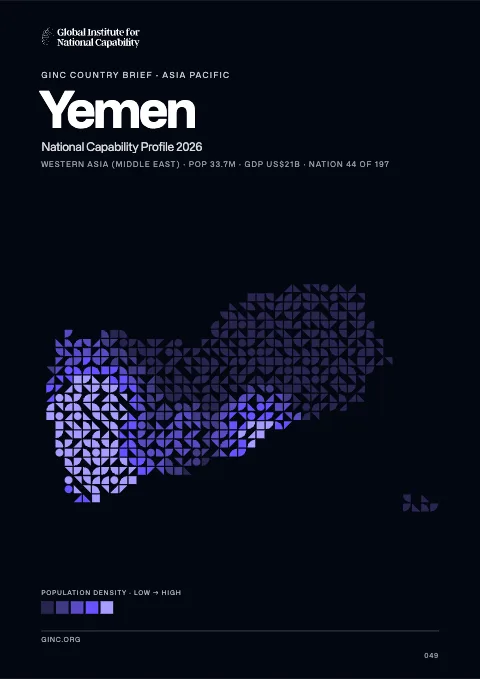
Yemen National Capability Profile 2026
Foundations · Chapter 01
Historical Context
🇾🇪 Yemen’s understanding the origins and evolution of the modern nation
BackgroundBack to top ↑
North Yemen became independent of the Ottoman Empire in 1918. The British, who had set up a protectorate area around the southern port of Aden in the 19th century, withdrew in 1967 from what became South Yemen. Three years later, the southern government adopted a Marxist orientation. The massive exodus of hundreds of thousands of Yemenis from the south to the north contributed to two decades of hostility between the states. The two countries were formally unified as the Republic of Yemen in 1990. A southern secessionist movement and brief civil war in 1994 was quickly subdued. In 2000, Saudi Arabia and Yemen agreed to a delimitation of their border. Fighting in the northwest between the government and the Huthis, a Zaydi Shia minority, began in 2004 and has since resulted in six rounds of fighting - the last ended in early 2010 with a cease-fire that continues to hold. The southern secessionist movement was revitalized in 2008 when a popular socioeconomic protest movement initiated the prior year took on political goals including secession. Public rallies in Sana'a against then President SALIH - inspired by similar demonstrations in Tunisia and Egypt - slowly built momentum starting in late January 2011 fueled by complaints over high unemployment, poor economic conditions, and corruption. By the following month, some protests had resulted in violence, and the demonstrations had spread to other major cities. By March the opposition had hardened its demands and was unifying behind calls for SALIH's immediate ouster, and prominent military and tribal leaders began defecting from SALIH's camp. The Gulf Cooperation Council (GCC) in late April 2011, in an attempt to mediate the crisis in Yemen, proposed an agreement in which the president would step down in exchange for immunity from prosecution. SALIH's refusal to sign an agreement led to heavy street fighting and his injury in an explosion in June 2011. The UN Security Council passed Resolution 2014 in October 2011 calling on both sides to end the violence and complete a power transfer deal. In late November 2011, SALIH signed the GCC-brokered agreement to step down and to transfer some of his powers to Vice President Abd Rabuh Mansur HADI. Following elections in February 2012, won by HADI, SALIH formally transferred his powers. In accordance with the GCC initiative, Yemen launched a National Dialogue in March 2013 to discuss key constitutional, political, and social issues. HADI concluded the National Dialogue in January 2014. Subsequent steps in the transition process include constitutional drafting, a constitutional referendum, and national elections.
IndependenceBack to top ↑
22 May 1990 (Republic of Yemen was established with the merger of the Yemen Arab Republic [Yemen (Sanaa) or North Yemen] and the Marxist-dominated People's Democratic Republic of Yemen [Yemen (Aden) or South Yemen]); note - previously North Yemen became independent in November 1918 (from the Ottoman Empire) and became a republic with the overthrow of the theocratic Imamate in 1962; South Yemen became independent on 30 November 1967 (from the UK)
National holidayBack to top ↑
Unification Day, 22 May (1990)
Foundations · Chapter 02
Geography
🇾🇪 Yemen’s territory, resources and strategic position
Location and areaBack to top ↑
Middle East, bordering the Arabian Sea, Gulf of Aden, and Red Sea, between Oman and Saudi Arabia
15 00 N, 48 00 E
Middle East
almost four times the size of Alabama; slightly larger than twice the size of Wyoming
1,906 km
Terrain and resourcesBack to top ↑
narrow coastal plain backed by flat-topped hills and rugged mountains; dissected upland desert plains in center slope into the desert interior of the Arabian Peninsula
petroleum, fish, rock salt, marble; small deposits of coal, gold, lead, nickel, and copper; fertile soil in west
6,801 sq km (2004)
Settlement and hazardsBack to top ↑
sandstorms and dust storms in summer
strategic location on Bab el Mandeb, the strait linking the Red Sea and the Gulf of Aden, one of world's most active shipping lanes
OtherBack to top ↑
2.1 cu km (2011)
limited natural freshwater resources; inadequate supplies of potable water; overgrazing; soil erosion; desertification
Foundations · Chapter 03
Environment
🇾🇪 Yemen’s environmental conditions, resources and national resilience
ClimateBack to top ↑
mostly desert; hot and humid along west coast; temperate in western mountains affected by seasonal monsoon; extraordinarily hot, dry, harsh desert in east
Emissions and pollutionBack to top ↑
Water, waste and foodBack to top ↑
Resources and agreementsBack to top ↑
GINC Capability Domains · Chapter 04
Critical Technology
🇾🇪 Yemen’s technology frontiers and the pursuit of national advantage
Two counts are set side by side for 2015–2024: on the left, the papers researchers in Yemen published; on the right, the patent families that began there and were filed in more than one country. First by capability group, then group by group with each group’s capabilities. The badge on a card is the nation’s place among all nations. Papers are from GINC Research Analytics, patent families from GINC Patents.
Research by capability group
#84 WorldPapers published, 2015–2024
469
133
121
105
95
42
30
27
12
2
Patents by capability group
#124 WorldInternational patent families, 2015–2024
Advanced Materials & ManufacturingBack to top ↑
Research
#88 WorldPapers published, 2015–2024
Patents
International patent families, 2015–2024
No international patent families on record for 2015–2024.
Energy TechnologiesBack to top ↑
Research
#83 WorldPapers published, 2015–2024
Patents
International patent families, 2015–2024
No international patent families on record for 2015–2024.
Semiconductors & Advanced ComputingBack to top ↑
Research
#83 WorldPapers published, 2015–2024
No research topic: Semiconductor Design & EDA · Advanced Semiconductor Fabrication · Semiconductor Equipment & Materials · Advanced Packaging & Heterogeneous Integration
Patents
International patent families, 2015–2024
No international patent families on record for 2015–2024.
Artificial IntelligenceBack to top ↑
Research
#77 WorldPapers published, 2015–2024
Patents
#89 WorldInternational patent families, 2015–2024
Quantum TechnologiesBack to top ↑
Research
#99 WorldPapers published, 2015–2024
Patents
International patent families, 2015–2024
No international patent families on record for 2015–2024.
Connectivity, Cyber & Trust TechnologiesBack to top ↑
Research
#74 WorldPapers published, 2015–2024
Patents
International patent families, 2015–2024
No international patent families on record for 2015–2024.
Sensing, Timing & NavigationBack to top ↑
Research
#88 WorldPapers published, 2015–2024
Patents
International patent families, 2015–2024
No international patent families on record for 2015–2024.
Robotics & Autonomous SystemsBack to top ↑
Research
#95 WorldPapers published, 2015–2024
No research topic: Human-Machine Interfaces
Patents
International patent families, 2015–2024
No international patent families on record for 2015–2024.
Biotechnology & Health TechnologiesBack to top ↑
Research
#101 WorldPapers published, 2015–2024
Patents
International patent families, 2015–2024
No international patent families on record for 2015–2024.
Medicine and BioTech
Clinical research and life-science invention, drawn from the same series that drive the metric pages. Each card opens the full cross-country comparison.
Space TechnologiesBack to top ↑
Research
#79 WorldPapers published, 2015–2024
Patents
International patent families, 2015–2024
No international patent families on record for 2015–2024.
GINC Capability Domains · Chapter 05
Strategic Infrastructure
🇾🇪 Yemen’s energy, connectivity and the material foundations of capability
Resource InfrastructureBack to top ↑
156,500 bbl/day (2012 est.)
175,200 bbl/day (2010 est.)
0 bbl/day (2010 est.)
3 billion bbl (1 January 2013 est.)
86,330 bbl/day (2010 est.)
177,000 bbl/day (2011 est.)
14,330 bbl/day (2010 est.)
59,050 bbl/day (2010 est.)
9.62 billion cu m (2011 est.)
869.9 million cu m (2011 est.)
8.75 billion cu m (2011 est.)
0 cu m (2011 est.)
478.5 billion cu m (1 January 2013 est.)
gas 641 km; liquid petroleum gas 22 km; oil 1,370 km (2013)
Agriculture & Food InfrastructureBack to top ↑
- Irrigation & Agricultural Water
- Livestock & Veterinary
- Fisheries & Aquaculture
- Storage, Cold Chain & Markets
Energy InfrastructureBack to top ↑
- Thermal Generation
- Nuclear Generation
- Nuclear Fuel Cycle & Radioactive Waste
- Hydropower
- Renewable Generation
- Transmission & Distribution
- System Control & Dispatch
- Storage & Fuel Supply
1.53 million kW (2011 est.)
7.292 billion kWh (2010 est.)
5.515 billion kWh (2010 est.)
0 kWh (2012 est.)
0 kWh (2012 est.)
100% of total installed capacity (2010 est.)
0% of total installed capacity (2010 est.)
0% of total installed capacity (2010 est.)
0% of total installed capacity (2010 est.)
23.75 million Mt (2011 est.)
Water, Sanitation & Waste InfrastructureBack to top ↑
- Dams, Reservoirs & Flood Defence
- Water Supply & Treatment
- Bulk Water Transfer & Desalination
- Wastewater & Sanitation
- Solid Waste & Recycling
Advanced ManufacturingBack to top ↑
- Materials & Inputs
- Chemicals & Hazardous Process Industry
- Production Systems
- Supply Chain & Ecosystem
- Workforce & Innovation
Transport InfrastructureBack to top ↑
- Seaports & Terminals
- Air Infrastructure
- Air Navigation & Traffic Management
- Inland Waterways & Ferries
- Rail Infrastructure
- Roads & Bridges
- Logistics, Multimodal & Border Infrastructure
- Postal & Parcel
57 (2013)
the International Maritime Bureau reports offshore waters in the Gulf of Aden are high risk for piracy; numerous vessels, including commercial shipping and pleasure craft, have been attacked and hijacked both at anchor and while underway; crew, passengers, and cargo are held for ransom; the presence of several naval task forces in the Gulf of Aden and additional anti-piracy measures on the part of ship operators reduced the incidence of piracy in that body of water by more than half in 2010
Communications & Digital InfrastructureBack to top ↑
- Subsea Cables & International Gateways
- Core & Backbone Networks
- Mobile & Wireless Networks
- Spectrum & Broadcasting
- Data Centres, Compute & Cloud
- Data Resources
- AI Tools & Applications
1.1 million (2012)
13.9 million (2012)
2.349 million (2009)
33,206 (2012)
.ye
Financial InfrastructureBack to top ↑
- Currency & Reserves
- Payments & Settlement Systems
- Markets, Exchanges & Depositories
- Banks, Insurers & Systemic Institutions
Social InfrastructureBack to top ↑
- Health Infrastructure
- Public Health & Laboratories
- Medical Supply & Stockpiles
- Education & Skills Infrastructure
- Research & Scientific Facilities
- Housing, Community & Social Services
- Government & Public Administration
- Cultural, Community & Recreational Infrastructure
- Justice & Corrections
- Emergency Services & Civil Protection
- Hydrometeorology & Early Warning
Space, Aerospace & Defence InfrastructureBack to top ↑
GINC Capability Domains · Chapter 06
National Security
🇾🇪 Yemen’s force, intelligence and the defence of the nation
Disputes and terrorismBack to top ↑
Saudi Arabia has reinforced its concrete-filled security barrier along sections of the fully demarcated border with Yemen to stem illegal cross-border activities
Force Generation & MobilisationBack to top ↑
Land Forces; Naval and Coastal Defense Forces (includes Marines); Air and Air Defense Force (al-Quwwat al-Jawwiya al-Yemeniya); Border Guards; Strategic Reserve Forces (2013)
18 is the legal minimum age for voluntary military service; no conscription; 2-year service obligation (2012)
4.02% of GDP (2012)//3.48% of GDP (2011)//4.02% of GDP (2010)
a Coast Guard was established in 2002
Forces under arms
Active-duty strength on the Correlates of War series, which reaches back to 1816 and so carries a nation’s whole record of mobilisation rather than its present establishment. The card opens the full cross-country comparison.
Intelligence & AssessmentBack to top ↑
- Imagery & Geospatial Intelligence
- Signals & Cyber Intelligence
- Technical & Measurement Intelligence
- Open-Source & Financial Intelligence
- Human Intelligence & Counterintelligence
- All-Source Analysis & Warning
Joint Command, Projection & SustainmentBack to top ↑
- Command, Control & Communications
- Strategic Lift & Mobility
- Expeditionary & Peace Operations
- Operational Sustainment & War Reserves
- Defence Industrial Mobilisation
- CBRN Defence
Land PowerBack to top ↑
- Combined Arms Manoeuvre
- Land Fires
- Battlefield Aviation & Uncrewed Systems
- Special Operations & Irregular Warfare
Maritime PowerBack to top ↑
- Maritime Security & Constabulary
- Sea Denial & Undersea Warfare
- Sea Control
- Amphibious & Expeditionary Operations
Air PowerBack to top ↑
- Air Sovereignty & Policing
- Control of the Air
- Air Strike & Interdiction
- Airborne ISR, Early Warning & Battle Management
Strategic Strike & Missile DefenceBack to top ↑
Space OperationsBack to top ↑
Cyber & Electromagnetic OperationsBack to top ↑
Nuclear DeterrenceBack to top ↑
GINC Capability Domains · Chapter 07
Human Capital
🇾🇪 Yemen’s population, health and the skills that sustain capability
DemographyBack to top ↑
26,052,966 (July 2014 est.)
2.72% (2014 est.)
31.02 births/1,000 population (2014 est.)
6.45 deaths/1,000 population (2014 est.)
4.09 children born/woman (2014 est.)
27.7% (2006)
Migration and urbanisationBack to top ↑
2.61 migrant(s)/1,000 population (2014 est.)
SANAA (capital) 2.419 million; Aden 784,000 (2011)
Welfare and equityBack to top ↑
45.2% (2003)
37.7 (2005)//33.4 (1998)
DisplacementBack to top ↑
Early Childhood DevelopmentBack to top ↑
43.1% (2003)
Foundational EducationBack to top ↑
5.2% of GDP (2008)
Advanced EducationBack to top ↑
Technical & Vocational SkillsBack to top ↑
Digital & AI CompetenceBack to top ↑
Lifelong Learning & ReskillingBack to top ↑
Research Talent & Knowledge CreationBack to top ↑
Population HealthBack to top ↑
200 deaths/100,000 live births (2010)
14.5% (2008)
0.1% (2012 est.)
18,800 (2012 est.)
800 (2012 est.)
Health System CapabilityBack to top ↑
5.5% of GDP (2011)
0.2 physicians/1,000 population (2010)
0.7 beds/1,000 population (2010)
GINC Capability Domains · Chapter 08
Governance and Integrity
🇾🇪 Yemen’s institutions, law and the integrity of the state
State structureBack to top ↑
republic
20 governorates (muhafazat, singular - muhafazah) and 1 municipality*; Abyan, 'Adan (Aden), Ad Dali', Al Bayda', Al Hudaydah, Al Jawf, Al Mahrah, Al Mahwit, Amanat al 'Asimah (Sanaa City)*, 'Amran, Dhamar, Hadramawt, Hajjah, Ibb, Lahij, Ma'rib, Raymah, Sa'dah, San'a' (Sanaa), Shabwah, Ta'izz
adopted by referendum 16 May 1991 (following unification); amended several times, last in 2009; note - in early 2013, the Yemeni Government launched a National Dialogue to seek reforms and recommendations for a new constitution (2013)
18 years of age; universal
Political Institutions & Civic ParticipationBack to top ↑
- Electoral Management & Integrity
- Legislature & Deliberative Institutions
- Citizen Participation & Civic Space
bicameral legislature consisting of a Shura Council (111 seats; members appointed by the president) and House of Representatives (301 seats; members elected by popular vote in single-member constituencies to serve six-year terms)
General People's Congress or GPC [Ali Abdallah SALIH, Abd Rabuh Mansur HADI]//Islamic Reform Grouping or Islah [Muhammed Abdallah al-YADUMI, Abdul Wahab al-ANSI]//Nasserite Unionist Party [Sultan al-ATWANI]//Yemeni Socialist Party or YSP [Yasin Said NU'MAN]//
Muslim Brotherhood//Women National Committee//
Justice System & Fundamental RightsBack to top ↑
- Judicial Independence & Court Capability
- Access to Justice & Legal Services
- Fundamental Rights Protection
- Human Rights Institutions & Equality Bodies
mixed legal system of Islamic law, Napoleonic law, English common law, and customary law
has not submitted an ICJ jurisdiction declaration; non-party state to the ICCt
Internal Security & OrderBack to top ↑
Regulatory Governance & Strategic ControlsBack to top ↑
- Regulatory Quality & Better Regulation
- Regulatory Delivery & Independent Regulators
- Strategic Controls & Economic Security Administration
Government Effectiveness & Public AdministrationBack to top ↑
- Centre of Government & Policy Coordination
- Civil Service & Public Workforce
- Digital Government & Service Delivery
- Legal Identity & Civil Registration
- Statistical & Data Capability
Public Integrity & Anti-CorruptionBack to top ↑
Transparency, Oversight & AccountabilityBack to top ↑
- Right to Information & Open Government
- Independent Oversight & Supreme Audit
- Independent Media & Journalist Safety
National Resilience & Crisis ManagementBack to top ↑
GINC Capability Domains · Chapter 09
Information and Influence
🇾🇪 Yemen’s identity, media and the projection of influence
Identity and cultureBack to top ↑
Arabic (official)
Muslim 99.1% (official; virtually all are citizens, an estimated 65% are Sunni and 35% are Shia), other 0.9% (includes Jewish, Baha'i, Hindu, and Christian; many are refugees or temporary foreign residents) (2010 est.)
predominantly Arab; but also Afro-Arab, South Asians, Europeans
golden eagle
three equal horizontal bands of red (top), white, and black; the band colors derive from the Arab Liberation flag and represent oppression (black), overcome through bloody struggle (red), to be replaced by a bright future (white)
Diplomatic Statecraft & Global NetworksBack to top ↑
- Diplomatic Network & Consular Reach
- Multilateral Leadership & Norm Setting
- Agenda-Setting & Convening
- Mediation & Crisis Diplomacy
AFESD, AMF, CAEU, CD, EITI (compliant country), FAO, G-77, IAEA, IBRD, ICAO, ICRM, IDA, IDB, IFAD, IFC, IFRCS, ILO, IMF, IMO, IMSO, Interpol, IOC, IOM, IPU, ISO, ITSO, ITU, ITUC (NGOs), LAS, MIGA, MINURSO, MINUSMA, MONUSCO, NAM, OAS (observer), OIC, OPCW, UN, UNAMID, UNCTAD, UNESCO, UNHCR, UNIDO, UNISFA, UNMIL, UNMIS, UNOCI, UNWTO, UPU, WCO, WFTU (NGOs), WHO, WIPO, WMO, WTO (observer)
Alliances & Security CooperationBack to top ↑
Development Cooperation & Global AssistanceBack to top ↑
Culture, Language & Education DiplomacyBack to top ↑
- Cultural & Language Institutes
- Creative Industries & Cultural Export Reach
- Heritage & Cultural Institutions
- Education Diplomacy & Alumni Networks
- Sports & Major Events
Diaspora & Global CommunitiesBack to top ↑
Information Environment & Strategic CommunicationBack to top ↑
- Strategic Communications & Public Diplomacy
- International Media & Broadcasting
- Information Defence & Counter-Interference
state-run TV with 2 stations; state-run radio with 2 national radio stations and 5 local stations; stations from Oman and Saudi Arabia can be accessed (2007)
GINC Capability Domains · Chapter 10
Financial Strength
🇾🇪 Yemen’s fiscal depth, reserves and the capacity to act
Monetary & Currency CapabilityBack to top ↑
- Monetary Policy & Price Stability
- Exchange Rate & External Account Management
- Currency Issuance & Digital Money
11.8% (2013 est.)//9.9% (2012 est.)
Yemeni rials (YER) per US dollar -//214.9 (2013 est.)//214.35 (2012 est.)//219.59 (2010 est.)//202.85 (2009)//199.76 (2008)
NA%
22% (31 December 2013 est.)//23% (31 December 2012 est.)
$5.753 billion (31 December 2013 est.)//$5.142 billion (31 December 2012 est.)
$14.2 billion (31 December 2013 est.)//$12.35 billion (31 December 2012 est.)
Fiscal Capacity & Public FinanceBack to top ↑
- Revenue Mobilisation & Tax Administration
- Public Expenditure & Budget Management
- Sovereign Debt & Treasury Management
- Public Investment Management
17.7% of GDP (2013 est.)
-10.3% of GDP (2013 est.)
47.1% of GDP (2013 est.)//45.4% of GDP (2012 est.)
calendar year
Financial System Depth & AccessBack to top ↑
- Banking System Capacity
- Capital Markets Depth & Development
- Long-Term & Institutional Capital
- Financial Inclusion & Household Access
- Development & Policy Finance
$11.2 billion (31 December 2013 est.)//$9.576 billion (31 December 2012 est.)
$NA
4.2% of GDP (2013 est.)//9.6% of GDP (2012 est.)//6.3% of GDP (2011 est.)
Financial Regulation & IntegrityBack to top ↑
- Prudential Regulation & Supervision
- Financial Integrity & Illicit Finance Control
- Market Conduct & Consumer Protection
- Payment & Market Infrastructure Oversight
Financial Stability & Crisis ManagementBack to top ↑
- Macroprudential & Systemic Oversight
- Crisis Management, Resolution & Deposit Insurance
- External Liquidity & Financial Safety Nets
Sovereign Capital & External Financial PowerBack to top ↑
- Official Reserves Management
- Sovereign Wealth & Public Asset Management
- Currency Internationalisation & Reserve Status
- Capital Account & Flow Management
- International Financial Centre Capability
$5.538 billion (31 December 2013 est.)//$6.158 billion (31 December 2012 est.)
$7.806 billion (31 December 2013 est.)//$7.419 billion (31 December 2012 est.)
GINC Capability Domains · Chapter 11
Production and Innovation
🇾🇪 Yemen’s output, industry and the engine of prosperity
Economic Output & ProductivityBack to top ↑
Yemen is a low income country that is highly dependent on declining oil resources for revenue. Petroleum accounts for roughly 25% of GDP and 63% of government revenue. Yemen has tried to counter the effects of its declining oil resources and continuing attacks on its oil pipelines by diversifying its economy through an economic reform program initiated in 2006 that is designed to bolster non-oil sectors of the economy and foreign investment. In October 2009, Yemen exported its first liquefied natural gas as part of this diversification effort. In January 2010, the international community established the Friends of Yemen group that aims to support Yemen's efforts toward economic and political reform. In 2012, the Friends of Yemen pledged nearly $7 billion in assistance to Yemen. The Yemeni Government also endorsed a Mutual Accountability Framework to facilitate the efficient implementation of donor aid. The unrest that began in early 2011 caused GDP to plunge almost 11% in 2011. Availability of basic services, including electricity, water, and fuel, has improved since the transition, but progress toward achieving more sustainable economic stability has been slow and uneven. Yemen continues to face difficult long-term challenges, including declining water resources, high unemployment, severe food scarcity, and a high population growth rate.
$61.63 billion (2013 est.)//$58.45 billion (2012 est.)//$57.36 billion (2011 est.)
3.8% (2013 est.)//0.1% (2012 est.)//-10.5% (2011 est.)
$2,500 (2013 est.)//$2,500 (2012 est.)//$2,500 (2011 est.)
$43.89 billion (2013 est.)
Labour & EmploymentBack to top ↑
- Employment & Labour Force Participation
- Labour Market Institutions & Wage Setting
- Employment Services & Skills Matching
- Labour Adjustment, Transition & Formalisation
7.1 million (2013 est.)
35% (2003 est.)
Industrial & Sectoral BaseBack to top ↑
- Manufacturing & Advanced Industry
- Foundational & Process Industries
- Agrifood & Primary Production
- Services Economy
grain, fruits, vegetables, pulses, qat, coffee, cotton; dairy products, livestock (sheep, goats, cattle, camels), poultry; fish
crude oil production and petroleum refining; small-scale production of cotton textiles, leather goods; food processing; handicrafts; aluminum products; cement; commercial ship repair; natural gas production
4.8% (2013 est.)
Structural Transformation & ComplexityBack to top ↑
Business Dynamism & EntrepreneurshipBack to top ↑
- Entrepreneurship & Firm Creation
- Risk Capital & Scale-Up Finance
- Firm Growth, Exit & Renewal
- Competition & Market Contestability
Innovation & CommercialisationBack to top ↑
- Business Innovation Capability
- Research Commercialisation & Knowledge Transfer
- Intellectual Property & Intangible Assets
- Innovation Ecosystems & Clusters
Technology Adoption & DiffusionBack to top ↑
GINC Capability Domains · Chapter 12
Trade and Investment
🇾🇪 Yemen’s markets, capital and the terms of global exchange
Overall tradeBack to top ↑
$662M of exports to 77 partners and $8.80B of imports from 81 in 2024, a deficit of $8.14B.
- Exports
- $662M77 partners
- Imports
- $8.80B81 partners
- Balance
- −$8.14Bdeficit
- Total trade
- $9.46B2024
ExportsBack to top ↑
Where its exports go
The largest partners in 2024, with each one's share of the nation's exports.
| Partner | Value | Share | |
|---|---|---|---|
| India | $198M | 30% | |
| Saudi Arabia | $175M | 26% | |
| Egypt | $55.5M | 8.4% | |
| Malaysia | $48.0M | 7.3% | |
| South Korea | $37.0M | 5.6% | |
| China | $20.0M | 3.0% | |
| Hong Kong | $15.5M | 2.3% | |
| Thailand | $15.3M | 2.3% | |
| Kuwait | $14.1M | 2.1% | |
| Turkey | $10.2M | 1.5% | |
| United States | $9.17M | 1.4% | |
| Italy | $8.79M | 1.3% | |
| Bahrain | $8.47M | 1.3% | |
| Indonesia | $7.07M | 1.1% | |
| Spain | $6.65M | 1.0% | |
| Qatar | $6.17M | 0.9% | |
| Japan | $3.85M | 0.6% | |
| Macao | $3.78M | 0.6% | |
| France | $3.53M | 0.5% | |
| Taiwan | $2.64M | 0.4% |
What it exports
The largest categories in 2024.
| Category | Value | Share | |
|---|---|---|---|
| Fish, crustaceans, molluscs, aquatics invertebrates | $172M | 26% | |
| Iron and steel | $113M | 17% | |
| Miscellaneous chemical products | $60.7M | 9.2% | |
| Edible fruits, nuts, peel of citrus fruit, melons | $58.7M | 8.9% | |
| Copper | $47.5M | 7.2% | |
| Aluminum | $38.0M | 5.7% | |
| Edible vegetables and certain roots and tubers | $36.7M | 5.5% | |
| Coffee, tea, mate and spices | $29.0M | 4.4% | |
| Plastics | $23.0M | 3.5% | |
| Meat, fish and seafood preparations | $17.6M | 2.7% | |
| Residues, wastes of food industry, animal fodder | $13.2M | 2.0% | |
| Dairy products, eggs, honey, edible products | $13.0M | 2.0% | |
| Raw hides and skins (other than furskins) and leather | $9.29M | 1.4% | |
| Animal, vegetable fats and oils, cleavage products | $4.30M | 0.7% | |
| Lead | $3.24M | 0.5% |
ImportsBack to top ↑
Where its imports come from
The largest partners in 2024, with each one's share of the nation's imports.
| Partner | Value | Share | |
|---|---|---|---|
| China | $2.47B | 28% | |
| Saudi Arabia | $1.37B | 16% | |
| India | $843M | 9.6% | |
| Turkey | $732M | 8.3% | |
| Brazil | $455M | 5.2% | |
| Australia | $453M | 5.1% | |
| Egypt | $354M | 4.0% | |
| Japan | $266M | 3.0% | |
| Thailand | $243M | 2.8% | |
| Malaysia | $136M | 1.5% | |
| Indonesia | $135M | 1.5% | |
| United States | $132M | 1.5% | |
| Argentina | $130M | 1.5% | |
| Pakistan | $110M | 1.3% | |
| Germany | $99.7M | 1.1% | |
| Belgium | $97.6M | 1.1% | |
| Ukraine | $94.6M | 1.1% | |
| France | $78.8M | 0.9% | |
| Denmark | $74.2M | 0.8% | |
| Netherlands | $66.1M | 0.8% |
What it imports
The largest categories in 2024.
| Category | Value | Share | |
|---|---|---|---|
| Cereals | $1.28B | 15% | |
| Plastics | $562M | 6.4% | |
| Iron and steel | $561M | 6.4% | |
| Sugars and sugar confectionery | $469M | 5.3% | |
| Vehicles other than railway, tramway | $468M | 5.3% | |
| Electrical, electronic equipment | $423M | 4.8% | |
| Machinery, nuclear reactors, boilers | $409M | 4.6% | |
| Cereal, flour, starch, milk preparations and products | $325M | 3.7% | |
| Pharmaceutical products | $270M | 3.1% | |
| Dairy products, eggs, honey, edible products | $248M | 2.8% | |
| Paper and paperboard, articles of pulp, paper and board | $231M | 2.6% | |
| Vegetable, fruit, nut food preparations | $219M | 2.5% | |
| Animal, vegetable fats and oils, cleavage products | $214M | 2.4% | |
| Articles of apparel, knit or crocheted | $180M | 2.0% | |
| Manmade filaments | $175M | 2.0% |
In a list, the bar runs to the largest in that list. The line is each figure’s history from 2000, drawn to its own peak: it shows the shape of the years, and the value shows the size.
External balanceBack to top ↑
-$3.312 billion (2013 est.)//-$985 million (2012 est.)
Trade Facilitation & LogisticsBack to top ↑
Trade Policy & Market AccessBack to top ↑
- Trade Policy & Negotiation Capability
- Market Access & Agreements Network
- Trade Law & Enforcement
- Standards, Conformity & Quality Infrastructure
Digital & Services TradeBack to top ↑
- Services Trade Capability
- Digital Trade & E-Commerce
- Data Flows & Digital Trade Governance
- Tourism & Visitor Economy
Investment Attraction & ProjectionBack to top ↑
- Investment Attraction & Facilitation
- Investment Absorption & Linkages
- Outward Investment & Global Corporate Presence
$NA
Export Capability & SophisticationBack to top ↑
$6.694 billion (2013 est.)//$7.57 billion (2012 est.)
China 41%, Thailand 19.2%, India 11.4%, South Korea 4.4% (2013 est.)
crude oil, coffee, dried and salted fish, liquefied natural gas
Global Value Chain PositionBack to top ↑
- Value Chain Participation & Integration
- Value Chain Position & Upgrading
- Regional Integration & Hub Anchoring
Economic Leverage & DependenceBack to top ↑
- Strategic Supply Security
- Concentration Risk & Revenue Stabilisation
- Economic Leverage & Coercion Resistance
$10.97 billion (2013 est.)//$12.49 billion (2012 est.)
EU 48.8%, UAE 9.8%, Switzerland 8.8%, China 7.4%, India 5.8% (2013 est.)
food and live animals, machinery and equipment, chemicals
Yemen · you are in
Historical Context
Foundations
GINC Capability Domains
Find in this brief · Yemen