
Colombia
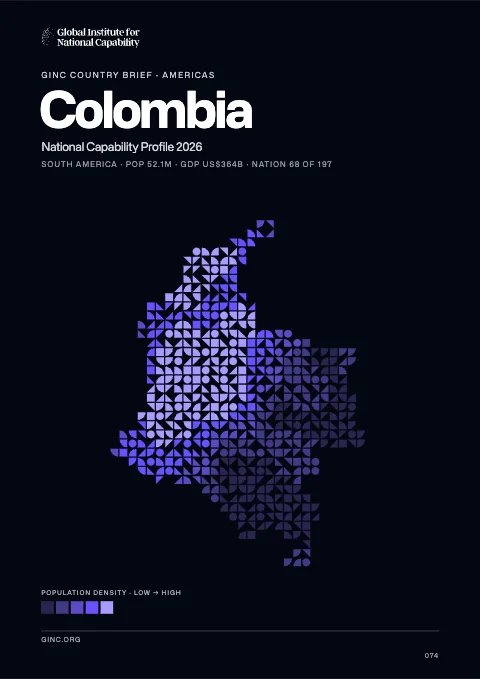
Colombia is a republic in South America, home to 46 million people, with its capital at Bogota.
Contents
12 chapters
Foundations
01–03
At a glance
- Area
- 1.1Mkm²#26 World#4 S. America
- Population
- 46.2M#29 World#2 S. America
- GDP (market)
- $369B
- GDP (PPP)
- $526.5B#28 World#3 S. America
- GDP per capita
- $11.1K#111 World#8 S. America
The whole brief
Colombia National Capability Profile 2026
Foundations · Chapter 01
Historical Context
🇨🇴 Colombia’s understanding the origins and evolution of the modern nation
BackgroundBack to top ↑
Colombia was one of the three countries that emerged from the collapse of Gran Colombia in 1830 (the others are Ecuador and Venezuela). A nearly five-decade long conflict between government forces and anti-government insurgent groups, principally the Revolutionary Armed Forces of Colombia (FARC) heavily funded by the drug trade, escalated during the 1990s. More than 31,000 former paramilitaries had demobilized by the end of 2006 and the United Self Defense Forces of Colombia as a formal organization had ceased to function. In the wake of the paramilitary demobilization, emerging criminal groups arose, whose members include some former paramilitaries. The insurgents lack the military or popular support necessary to overthrow the government, but continue attacks against civilians. Large areas of the countryside are under guerrilla influence or are contested by security forces. In November 2012, the Colombian Government started formal peace negotiations with the FARC aimed at reaching a definitive bilateral ceasefire and incorporating demobilized FARC members into mainstream society and politics. The Colombian Government has stepped up efforts to reassert government control throughout the country, and now has a presence in every one of its administrative departments. Despite decades of internal conflict and drug related security challenges, Colombia maintains relatively strong democratic institutions characterized by peaceful, transparent elections and the protection of civil liberties.
IndependenceBack to top ↑
20 July 1810 (from Spain)
National holidayBack to top ↑
Independence Day, 20 July (1810)
Foundations · Chapter 02
Geography
🇨🇴 Colombia’s territory, resources and strategic position
Location and areaBack to top ↑
Northern South America, bordering the Caribbean Sea, between Panama and Venezuela, and bordering the North Pacific Ocean, between Ecuador and Panama
4 00 N, 72 00 W
South America
slightly less than twice the size of Texas
3,208 km (Caribbean Sea 1,760 km, North Pacific Ocean 1,448 km)
Terrain and resourcesBack to top ↑
flat coastal lowlands, central highlands, high Andes Mountains, eastern lowland plains (Llanos)
petroleum, natural gas, coal, iron ore, nickel, gold, copper, emeralds, hydropower
10,870 sq km (2011)
Settlement and hazardsBack to top ↑
highlands subject to volcanic eruptions; occasional earthquakes; periodic droughts
only South American country with coastlines on both the North Pacific Ocean and Caribbean Sea
OtherBack to top ↑
2,132 cu km (2011)
deforestation; soil and water quality damage from overuse of pesticides; air pollution, especially in Bogota, from vehicle emissions
Foundations · Chapter 03
Environment
🇨🇴 Colombia’s environmental conditions, resources and national resilience
ClimateBack to top ↑
tropical along coast and eastern plains; cooler in highlands
Emissions and pollutionBack to top ↑
Water, waste and foodBack to top ↑
Resources and agreementsBack to top ↑
GINC Capability Domains · Chapter 04
Critical Technology
🇨🇴 Colombia’s technology frontiers and the pursuit of national advantage
Two counts are set side by side for 2015–2024: on the left, the papers researchers in Colombia published; on the right, the patent families that began there and were filed in more than one country. First by capability group, then group by group with each group’s capabilities. The badge on a card is the nation’s place among all nations. Papers are from GINC Research Analytics, patent families from GINC Patents.
Research by capability group
#54 WorldPapers published, 2015–2024
1,408
705
640
632
306
250
173
122
71
15
Patents by capability group
#50 WorldInternational patent families, 2015–2024
Advanced Materials & ManufacturingBack to top ↑
Research
#58 WorldPapers published, 2015–2024
Patents
#44 WorldInternational patent families, 2015–2024
Energy TechnologiesBack to top ↑
Research
#58 WorldPapers published, 2015–2024
Patents
#56 WorldInternational patent families, 2015–2024
Semiconductors & Advanced ComputingBack to top ↑
Research
#61 WorldPapers published, 2015–2024
No research topic: Semiconductor Design & EDA · Advanced Semiconductor Fabrication · Semiconductor Equipment & Materials · Advanced Packaging & Heterogeneous Integration
Patents
#48 WorldInternational patent families, 2015–2024
Artificial IntelligenceBack to top ↑
Research
#52 WorldPapers published, 2015–2024
Patents
#47 WorldInternational patent families, 2015–2024
Quantum TechnologiesBack to top ↑
Research
#54 WorldPapers published, 2015–2024
Patents
International patent families, 2015–2024
No international patent families on record for 2015–2024.
Connectivity, Cyber & Trust TechnologiesBack to top ↑
Research
#58 WorldPapers published, 2015–2024
Patents
#49 WorldInternational patent families, 2015–2024
Sensing, Timing & NavigationBack to top ↑
Research
#54 WorldPapers published, 2015–2024
Patents
#49 WorldInternational patent families, 2015–2024
Robotics & Autonomous SystemsBack to top ↑
Research
#47 WorldPapers published, 2015–2024
No research topic: Human-Machine Interfaces
Patents
#56 WorldInternational patent families, 2015–2024
Biotechnology & Health TechnologiesBack to top ↑
Research
#47 WorldPapers published, 2015–2024
Patents
#44 WorldInternational patent families, 2015–2024
Medicine and BioTech
Clinical research and life-science invention, drawn from the same series that drive the metric pages. Each card opens the full cross-country comparison.
Space TechnologiesBack to top ↑
Research
#44 WorldPapers published, 2015–2024
Patents
#44 WorldInternational patent families, 2015–2024
GINC Capability Domains · Chapter 05
Strategic Infrastructure
🇨🇴 Colombia’s energy, connectivity and the material foundations of capability
Resource InfrastructureBack to top ↑
969,100 bbl/day (2012 est.)
777,900 bbl/day (2009)
10 bbl/day (2011 est.)
2.2 billion bbl (1 January 2013 est.)
313,100 bbl/day (2010 est.)
287,000 bbl/day (2011 est.)
92,410 bbl/day (2010 est.)
49,790 bbl/day (2010 est.)
10.95 billion cu m (2011 est.)
9.08 billion cu m (2010 est.)
2.11 billion cu m (2011 est.)
40,290 cu m (2011 est.)
169.9 billion cu m (1 January 2013 est.)
gas 4,991 km; oil 6,796 km; refined products 3,429 km (2013)
Agriculture & Food InfrastructureBack to top ↑
- Irrigation & Agricultural Water
- Livestock & Veterinary
- Fisheries & Aquaculture
- Storage, Cold Chain & Markets
Energy InfrastructureBack to top ↑
- Thermal Generation
- Nuclear Generation
- Nuclear Fuel Cycle & Radioactive Waste
- Hydropower
- Renewable Generation
- Transmission & Distribution
- System Control & Dispatch
- Storage & Fuel Supply
13.54 million kW (2010 est.)
61.82 billion kWh (2011 est.)
45.35 billion kWh (2010 est.)
1.294 billion kWh (2011 est.)
8.22 billion kWh (2011 est.)
32.9% of total installed capacity (2010 est.)
0% of total installed capacity (2010 est.)
66.6% of total installed capacity (2010 est.)
0.4% of total installed capacity (2010 est.)
71.15 million Mt (2011 est.)
Water, Sanitation & Waste InfrastructureBack to top ↑
- Dams, Reservoirs & Flood Defence
- Water Supply & Treatment
- Bulk Water Transfer & Desalination
- Wastewater & Sanitation
- Solid Waste & Recycling
Advanced ManufacturingBack to top ↑
- Materials & Inputs
- Chemicals & Hazardous Process Industry
- Production Systems
- Supply Chain & Ecosystem
- Workforce & Innovation
Transport InfrastructureBack to top ↑
- Seaports & Terminals
- Air Infrastructure
- Air Navigation & Traffic Management
- Inland Waterways & Ferries
- Rail Infrastructure
- Roads & Bridges
- Logistics, Multimodal & Border Infrastructure
- Postal & Parcel
836 (2013)
3 (2013)
24,725 km (18,300 km navigable; the most important waterway, the River Magdalena, of which 1,488 km is navigable, is dredged regularly to ensure the safe passage of cargo vessels and container barges) (2012)
Communications & Digital InfrastructureBack to top ↑
- Subsea Cables & International Gateways
- Core & Backbone Networks
- Mobile & Wireless Networks
- Spectrum & Broadcasting
- Data Centres, Compute & Cloud
- Data Resources
- AI Tools & Applications
6.291 million (2012)
49.066 million (2012)
22.538 million (2009)
4.41 million (2012)
.co
Financial InfrastructureBack to top ↑
- Currency & Reserves
- Payments & Settlement Systems
- Markets, Exchanges & Depositories
- Banks, Insurers & Systemic Institutions
Social InfrastructureBack to top ↑
- Health Infrastructure
- Public Health & Laboratories
- Medical Supply & Stockpiles
- Education & Skills Infrastructure
- Research & Scientific Facilities
- Housing, Community & Social Services
- Government & Public Administration
- Cultural, Community & Recreational Infrastructure
- Justice & Corrections
- Emergency Services & Civil Protection
- Hydrometeorology & Early Warning
Space, Aerospace & Defence InfrastructureBack to top ↑
GINC Capability Domains · Chapter 06
National Security
🇨🇴 Colombia’s force, intelligence and the defence of the nation
Disputes and terrorismBack to top ↑
in December 2007, ICJ allocated San Andres, Providencia, and Santa Catalina islands to Colombia under 1928 Treaty but did not rule on 82 degrees W meridian as maritime boundary with Nicaragua; managed dispute with Venezuela over maritime boundary and Venezuelan-administered Los Monjes Islands near the Gulf of Venezuela; Colombian-organized illegal narcotics, guerrilla, and paramilitary activities penetrate all neighboring borders and have caused Colombian citizens to flee mostly into neighboring countries; Colombia, Honduras, Nicaragua, Jamaica, and the US assert various claims to Bajo Nuevo and Serranilla Bank
Force Generation & MobilisationBack to top ↑
National Army (Ejercito Nacional), Republic of Colombia Navy (Armada Republica de Colombia, ARC, includes Naval Aviation, Naval Infantry (Infanteria de Marina, IM), and Coast Guard), Colombian Air Force (Fuerza Aerea de Colombia, FAC) (2012)
18-24 years of age for compulsory and voluntary military service; service obligation is 18 months (2012)
3.28% of GDP (2012)//3.06% of GDP (2011)//3.28% of GDP (2010)
Forces under arms
Active-duty strength on the Correlates of War series, which reaches back to 1816 and so carries a nation’s whole record of mobilisation rather than its present establishment. The card opens the full cross-country comparison.
Intelligence & AssessmentBack to top ↑
- Imagery & Geospatial Intelligence
- Signals & Cyber Intelligence
- Technical & Measurement Intelligence
- Open-Source & Financial Intelligence
- Human Intelligence & Counterintelligence
- All-Source Analysis & Warning
Joint Command, Projection & SustainmentBack to top ↑
- Command, Control & Communications
- Strategic Lift & Mobility
- Expeditionary & Peace Operations
- Operational Sustainment & War Reserves
- Defence Industrial Mobilisation
- CBRN Defence
Land PowerBack to top ↑
- Combined Arms Manoeuvre
- Land Fires
- Battlefield Aviation & Uncrewed Systems
- Special Operations & Irregular Warfare
Maritime PowerBack to top ↑
- Maritime Security & Constabulary
- Sea Denial & Undersea Warfare
- Sea Control
- Amphibious & Expeditionary Operations
Air PowerBack to top ↑
- Air Sovereignty & Policing
- Control of the Air
- Air Strike & Interdiction
- Airborne ISR, Early Warning & Battle Management
Strategic Strike & Missile DefenceBack to top ↑
Space OperationsBack to top ↑
Cyber & Electromagnetic OperationsBack to top ↑
Nuclear DeterrenceBack to top ↑
GINC Capability Domains · Chapter 07
Human Capital
🇨🇴 Colombia’s population, health and the skills that sustain capability
DemographyBack to top ↑
46,245,297 (July 2014 est.)
Colombia is in the midst of a demographic transition resulting from steady declines in its fertility, mortality, and population growth rates. The birth rate has fallen from more than 6 children per woman in the 1960s to just above replacement level today as a result of increased literacy, family planning services, and urbanization. However, income inequality is among the worst in the world, and more than a third of the population lives below the poverty line.//Colombia experiences significant legal and illegal economic emigration and refugee flows. Large-scale labor emigration dates to the 1960s; Venezuela and the United States continue to be the main host countries. Colombia is the largest source of Latin American refugees in Latin America, nearly 400,000 of whom live primarily in Venezuela and Ecuador. Forced displacement remains prevalent because of violence among guerrillas, paramilitary groups, and Colombian security forces. Afro-Colombian and indigenous populations are disproportionately affected. A leading NGO estimates that 5.2 million people have been displaced since 1985, while the Colombian Government estimates 3.6 million since 2000. These estimates may undercount actual numbers because not all internally displaced persons are registered. Historically, Colombia also has one of the world's highest levels of forced disappearances. About 30,000 cases have been recorded over the last four decades - although the number is likely to be much higher - including human rights activists, trade unionists, Afro-Colombians, indigenous people, and farmers in rural conflict zones.
1.07% (2014 est.)
16.73 births/1,000 population (2014 est.)
5.36 deaths/1,000 population (2014 est.)
2.07 children born/woman (2014 est.)
21.4
79.1% (2010)
Migration and urbanisationBack to top ↑
-0.65 migrant(s)/1,000 population (2014 est.)
BOGOTA (capital) 8.743 million; Medellin 3.694 million; Cali 2.453 million; Barranquilla 1.9 million; Bucaramanga 1.12 million; Cartagena 988,000 (2011)
Welfare and equityBack to top ↑
32.7% (2012 est.)
55.9 (2010)//56.9 (1996)
DisplacementBack to top ↑
Early Childhood DevelopmentBack to top ↑
3.4% (2010)
Foundational EducationBack to top ↑
4.4% of GDP (2012)
Advanced EducationBack to top ↑
Technical & Vocational SkillsBack to top ↑
Digital & AI CompetenceBack to top ↑
Generative AI adoption
Modelled share of working-age adults using generative AI, from Microsoft telemetry scaled to each country’s 15–64 population. A measure of how fast a workforce is absorbing the technology rather than of how much of it a nation builds. The card opens the full cross-country comparison.
Lifelong Learning & ReskillingBack to top ↑
Research Talent & Knowledge CreationBack to top ↑
Population HealthBack to top ↑
92 deaths/100,000 live births (2010)
17.3% (2008)
0.5% (2012 est.)
146,500 (2012 est.)
6,500 (2012 est.)
Health System CapabilityBack to top ↑
6.1% of GDP (2011)
1.47 physicians/1,000 population (2010)
1.4 beds/1,000 population (2011)
GINC Capability Domains · Chapter 08
Governance and Integrity
🇨🇴 Colombia’s institutions, law and the integrity of the state
State structureBack to top ↑
republic; executive branch dominates government structure
32 departments (departamentos, singular - departamento) and 1 capital district* (distrito capital); Amazonas, Antioquia, Arauca, Atlantico, Bogota*, Bolivar, Boyaca, Caldas, Caqueta, Casanare, Cauca, Cesar, Choco, Cordoba, Cundinamarca, Guainia, Guaviare, Huila, La Guajira, Magdalena, Meta, Narino, Norte de Santander, Putumayo, Quindio, Risaralda, Archipielago de San Andres, Providencia y Santa Catalina (colloquially San Andres y Providencia), Santander, Sucre, Tolima, Valle del Cauca, Vaupes, Vichada
several previous; latest promulgated 5 July 1991; amended many times, last in 2011 (2013)
18 years of age; universal
Political Institutions & Civic ParticipationBack to top ↑
- Electoral Management & Integrity
- Legislature & Deliberative Institutions
- Citizen Participation & Civic Space
bicameral Congress or Congreso consists of the Senate or Senado (102 seats; members elected by popular vote to serve four-year terms) and the Chamber of Representatives or Camara de Representantes (166 seats; members elected by popular vote to serve four-year terms)
Alternative Democratic Pole or PDA [Clara LOPEZ]//Conservative Party or PC [Omar YEPES Alzate]//Democratic Center Party or CD [Alvaro URIBE Velez]//Green Party [Alfonso PRADA]//Liberal Party or PL [Simon GAVIRIA Munoz]//National Integration Party or PIN [Angel ALIRIO Moreno]//Radical Change or CR [Carlos Fernando GALAN]//Social National Unity Party or U Party [Sergio Diaz GANADOS]
Central Union of Workers or CUT//Colombian Confederation of Workers or CTC//General Confederation of Workers or CGT//National Liberation Army or ELN//Revolutionary Armed Forces of Colombia or FARC
Justice System & Fundamental RightsBack to top ↑
- Judicial Independence & Court Capability
- Access to Justice & Legal Services
- Fundamental Rights Protection
- Human Rights Institutions & Equality Bodies
civil law system influenced by the Spanish and French civil codes
has not submitted an ICJ jurisdiction declaration; accepts ICCt jurisdiction
Internal Security & OrderBack to top ↑
illicit producer of coca, opium poppy, and cannabis; world's leading coca cultivator with 83,000 hectares in coca cultivation in 2011, a 17% decrease over 2010, producing a potential of 195 mt of pure cocaine; the world's largest producer of coca derivatives; supplies cocaine to nearly all of the US market and the great majority of other international drug markets; in 2012, aerial eradication dispensed herbicide to treat over 100,549 hectares combined with manual eradication of 30,486 hectares; a significant portion of narcotics proceeds are either laundered or invested in Colombia through the black market peso exchange; important supplier of heroin to the US market; opium poppy cultivation is estimated to have fallen to 1,100 hectares in 2009 while pure heroin production declined to 2.1 mt; most Colombian heroin is destined for the US market (2013)
Regulatory Governance & Strategic ControlsBack to top ↑
- Regulatory Quality & Better Regulation
- Regulatory Delivery & Independent Regulators
- Strategic Controls & Economic Security Administration
Government Effectiveness & Public AdministrationBack to top ↑
- Centre of Government & Policy Coordination
- Civil Service & Public Workforce
- Digital Government & Service Delivery
- Legal Identity & Civil Registration
- Statistical & Data Capability
Public Integrity & Anti-CorruptionBack to top ↑
Transparency, Oversight & AccountabilityBack to top ↑
- Right to Information & Open Government
- Independent Oversight & Supreme Audit
- Independent Media & Journalist Safety
National Resilience & Crisis ManagementBack to top ↑
GINC Capability Domains · Chapter 09
Information and Influence
🇨🇴 Colombia’s identity, media and the projection of influence
Identity and cultureBack to top ↑
Spanish (official)
Roman Catholic 90%, other 10%
mestizo 58%, white 20%, mulatto 14%, black 4%, mixed black-Amerindian 3%, Amerindian 1%
Andean condor
three horizontal bands of yellow (top, double-width), blue, and red; the flag retains the three main colors of the banner of Gran Colombia, the short-lived South American republic that broke up in 1830; various interpretations of the colors exist and include: yellow for the gold in Colombia's land, blue for the seas on its shores, and red for the blood spilled in attaining freedom; alternatively, the colors have been described as representing more elemental concepts such as sovereignty and justice (yellow), loyalty and vigilance (blue), and valor and generosity (red); or simply the principles of liberty, equality, and fraternity
Diplomatic Statecraft & Global NetworksBack to top ↑
- Diplomatic Network & Consular Reach
- Multilateral Leadership & Norm Setting
- Agenda-Setting & Convening
- Mediation & Crisis Diplomacy
BCIE, BIS, CAN, Caricom (observer), CD, CDB, CELAC, FAO, G-3, G-24, G-77, IADB, IAEA, IBRD, ICAO, ICC (national committees), ICRM, IDA, IFAD, IFC, IFRCS, IHO, ILO, IMF, IMO, IMSO, Interpol, IOC, IOM, IPU, ISO, ITSO, ITU, ITUC (NGOs), LAES, LAIA, Mercosur (associate), MIGA, NAM, OAS, OPANAL, OPCW, Pacific Alliance, PCA, UN, UNASUR, UNCTAD, UNESCO, UNHCR, UNIDO, Union Latina, UNSC (temporary), UNWTO, UPU, WCO, WFTU (NGOs), WHO, WIPO, WMO, WTO
Alliances & Security CooperationBack to top ↑
Development Cooperation & Global AssistanceBack to top ↑
Culture, Language & Education DiplomacyBack to top ↑
- Cultural & Language Institutes
- Creative Industries & Cultural Export Reach
- Heritage & Cultural Institutions
- Education Diplomacy & Alumni Networks
- Sports & Major Events
Diaspora & Global CommunitiesBack to top ↑
Information Environment & Strategic CommunicationBack to top ↑
- Strategic Communications & Public Diplomacy
- International Media & Broadcasting
- Information Defence & Counter-Interference
combination of state-owned and privately owned broadcast media provide service; more than 500 radio stations and many national, regional, and local TV stations (2007)
GINC Capability Domains · Chapter 10
Financial Strength
🇨🇴 Colombia’s fiscal depth, reserves and the capacity to act
Monetary & Currency CapabilityBack to top ↑
- Monetary Policy & Price Stability
- Exchange Rate & External Account Management
- Currency Issuance & Digital Money
2.2% (2013 est.)//3.4% (2011 est.)
Colombian pesos (COP) per US dollar -//1,865.8 (2013 est.)//1,798 (2012 est.)//1,898.6 (2010 est.)//2,157.6 (2009)//2,243.6 (2008)
4.75% (31 December 2011)//5% (31 December 2010)
11% (31 December 2013 est.)//$NA (31 December 2012 est.)
$42.28 billion (31 December 2013 est.)//$41.7 billion (31 December 2012 est.)
$163.2 billion (31 December 2013 est.)//$153.1 billion (31 December 2012 est.)
Fiscal Capacity & Public FinanceBack to top ↑
- Revenue Mobilisation & Tax Administration
- Public Expenditure & Budget Management
- Sovereign Debt & Treasury Management
- Public Investment Management
29.1% of GDP (2012 est.)
0.4% of GDP (2012 est.)
39.6% of GDP (2013 est.)//40.5% of GDP (2012 est.)
calendar year
Financial System Depth & AccessBack to top ↑
- Banking System Capacity
- Capital Markets Depth & Development
- Long-Term & Institutional Capital
- Financial Inclusion & Household Access
- Development & Policy Finance
$192.6 billion (31 December 2013 est.)//$180.7 billion (31 December 2012 est.)
$262.1 billion (31 December 2012 est.)//$NA (31 December 2011)//$208.5 billion (31 December 2010 est.)
21.9% of GDP (2013 est.)//22.8% of GDP (2012 est.)//20.3% of GDP (2011 est.)
Financial Regulation & IntegrityBack to top ↑
- Prudential Regulation & Supervision
- Financial Integrity & Illicit Finance Control
- Market Conduct & Consumer Protection
- Payment & Market Infrastructure Oversight
Financial Stability & Crisis ManagementBack to top ↑
- Macroprudential & Systemic Oversight
- Crisis Management, Resolution & Deposit Insurance
- External Liquidity & Financial Safety Nets
Sovereign Capital & External Financial PowerBack to top ↑
- Official Reserves Management
- Sovereign Wealth & Public Asset Management
- Currency Internationalisation & Reserve Status
- Capital Account & Flow Management
- International Financial Centre Capability
$43.74 billion (31 December 2013 est.)//$37 billion (31 December 2012 est.)
$85.83 billion (31 December 2013 est.)//$80.72 billion (31 December 2012 est.)
GINC Capability Domains · Chapter 11
Production and Innovation
🇨🇴 Colombia’s output, industry and the engine of prosperity
Economic Output & ProductivityBack to top ↑
Colombia's consistently sound economic policies and aggressive promotion of free trade agreements in recent years have bolstered its ability to weather external shocks. Real GDP has grown more than 4% per year for the past three years, continuing almost a decade of strong economic performance. All three major ratings agencies have upgraded Colombia's government debt to investment grade. Nevertheless, Colombia depends heavily on energy and mining exports, making it vulnerable to a drop in commodity prices. Colombia is the world's fourth largest coal exporter and Latin America’s fourth largest oil producer. Economic development is stymied by inadequate infrastructure and an uncertain security situation. Moreover, the unemployment rate of 9.7% in 2013 is still one of Latin America's highest. The SANTOS Administration's foreign policy has focused on bolstering Colombia's commercial ties and boosting investment at home. Colombia has signed or is negotiating Free Trade Agreements (FTA) with more than a dozen countries; the US-Colombia FTA went into force on May 2012. Colombia is also a founding member of the Pacific Alliance - a regional grouping formed in 2012 by Chile, Colombia, Mexico, and Peru to promote regional trade and economic integration. In 2013, Colombia began its ascension process to the OECD. The annual level of foreign direct investment - notably in the oil and gas sectors - reached a record high of $16.8 billion in 2013, an increase of 7% over 2012. Inequality, poverty, and narcotrafficking remain significant challenges, and Colombia's infrastructure requires major improvements to sustain economic expansion.
$526.5 billion (2013 est.)//$505.2 billion (2012 est.)//$484.9 billion (2011 est.)
4.2% (2013 est.)//4.2% (2012 est.)//6.6% (2011 est.)
$11,100 (2013 est.)//$10,800 (2012 est.)//$10,500 (2011 est.)
$369.2 billion (2013 est.)
Labour & EmploymentBack to top ↑
- Employment & Labour Force Participation
- Labour Market Institutions & Wage Setting
- Employment Services & Skills Matching
- Labour Adjustment, Transition & Formalisation
23.75 million (2013 est.)
9.7% (2013 est.)//10.4% (2012 est.)
Industrial & Sectoral BaseBack to top ↑
- Manufacturing & Advanced Industry
- Foundational & Process Industries
- Agrifood & Primary Production
- Services Economy
coffee, cut flowers, bananas, rice, tobacco, corn, sugarcane, cocoa beans, oilseed, vegetables; shrimp; forest products
textiles, food processing, oil, clothing and footwear, beverages, chemicals, cement; gold, coal, emeralds
2.5% (2013 est.)
Structural Transformation & ComplexityBack to top ↑
Business Dynamism & EntrepreneurshipBack to top ↑
- Entrepreneurship & Firm Creation
- Risk Capital & Scale-Up Finance
- Firm Growth, Exit & Renewal
- Competition & Market Contestability
Innovation & CommercialisationBack to top ↑
- Business Innovation Capability
- Research Commercialisation & Knowledge Transfer
- Intellectual Property & Intangible Assets
- Innovation Ecosystems & Clusters
Technology Adoption & DiffusionBack to top ↑
GINC Capability Domains · Chapter 12
Trade and Investment
🇨🇴 Colombia’s markets, capital and the terms of global exchange
Overall tradeBack to top ↑
$53.6B of exports to 183 partners and $62.8B of imports from 191 in 2024, a deficit of $9.24B.
- Exports
- $53.6B183 partners
- Imports
- $62.8B191 partners
- Balance
- −$9.24Bdeficit
- Total trade
- $116B2024
ExportsBack to top ↑
Where its exports go
The largest partners in 2024, with each one's share of the nation's exports.
| Partner | Value | Share | |
|---|---|---|---|
| United States | $15.9B | 30% | |
| Panama | $4.30B | 8.0% | |
| India | $2.80B | 5.2% | |
| China | $2.48B | 4.6% | |
| Ecuador | $2.13B | 4.0% | |
| Brazil | $2.12B | 4.0% | |
| Mexico | $1.96B | 3.7% | |
| Netherlands | $1.79B | 3.3% | |
| Peru | $1.40B | 2.6% | |
| South Korea | $1.29B | 2.4% | |
| Chile | $1.11B | 2.1% | |
| Venezuela | $1.00B | 1.9% | |
| Italy | $982M | 1.8% | |
| Turkey | $896M | 1.7% | |
| Germany | $880M | 1.6% | |
| Canada | $793M | 1.5% | |
| Spain | $697M | 1.3% | |
| Dominican Republic | $679M | 1.3% | |
| Guatemala | $618M | 1.2% | |
| Switzerland | $611M | 1.1% |
What it exports
The largest categories in 2024.
| Category | Value | Share | |
|---|---|---|---|
| Mineral fuels, oils, distillation products | $24.1B | 45% | |
| Pearls, precious stones, metals, coins | $4.27B | 8.0% | |
| Coffee, tea, mate and spices | $3.73B | 7.0% | |
| Edible fruits, nuts, peel of citrus fruit, melons | $2.45B | 4.6% | |
| Live trees, plants, bulbs, roots, cut flowers | $2.35B | 4.4% | |
| Plastics | $1.79B | 3.3% | |
| Electrical, electronic equipment | $1.06B | 2.0% | |
| Essential oils, perfumes, cosmetics, toiletries | $890M | 1.7% | |
| Aluminum | $841M | 1.6% | |
| Sugars and sugar confectionery | $740M | 1.4% | |
| Animal, vegetable fats and oils, cleavage products | $718M | 1.3% | |
| Machinery, nuclear reactors, boilers | $705M | 1.3% | |
| Iron and steel | $662M | 1.2% | |
| Miscellaneous chemical products | $661M | 1.2% | |
| Paper and paperboard, articles of pulp, paper and board | $583M | 1.1% |
ImportsBack to top ↑
Where its imports come from
The largest partners in 2024, with each one's share of the nation's imports.
| Partner | Value | Share | |
|---|---|---|---|
| United States | $16.6B | 26% | |
| China | $16.0B | 25% | |
| Brazil | $3.33B | 5.3% | |
| Mexico | $3.20B | 5.1% | |
| Germany | $2.21B | 3.5% | |
| Japan | $1.41B | 2.2% | |
| India | $1.37B | 2.2% | |
| France | $1.20B | 1.9% | |
| Spain | $1.12B | 1.8% | |
| Italy | $1.06B | 1.7% | |
| Canada | $1.02B | 1.6% | |
| Vietnam | $1.01B | 1.6% | |
| South Korea | $978M | 1.6% | |
| Peru | $898M | 1.4% | |
| Ecuador | $863M | 1.4% | |
| Chile | $836M | 1.3% | |
| Argentina | $810M | 1.3% | |
| United Kingdom | $597M | 1.0% | |
| Belgium | $583M | 0.9% | |
| Netherlands | $519M | 0.8% |
What it imports
The largest categories in 2024.
| Category | Value | Share | |
|---|---|---|---|
| Machinery, nuclear reactors, boilers | $7.14B | 11% | |
| Electrical, electronic equipment | $6.25B | 10.0% | |
| Mineral fuels, oils, distillation products | $5.74B | 9.1% | |
| Vehicles other than railway, tramway | $4.89B | 7.8% | |
| Pharmaceutical products | $3.70B | 5.9% | |
| Plastics | $3.14B | 5.0% | |
| Cereals | $2.38B | 3.8% | |
| Organic chemicals | $2.36B | 3.8% | |
| Optical, photo, technical, medical apparatus | $1.97B | 3.1% | |
| Iron and steel | $1.89B | 3.0% | |
| Residues, wastes of food industry, animal fodder | $1.39B | 2.2% | |
| Miscellaneous chemical products | $1.23B | 2.0% | |
| Aircraft, spacecraft | $1.15B | 1.8% | |
| Articles of iron or steel | $1.08B | 1.7% | |
| Rubbers | $970M | 1.5% |
In a list, the bar runs to the largest in that list. The line is each figure’s history from 2000, drawn to its own peak: it shows the shape of the years, and the value shows the size.
External balanceBack to top ↑
-$11.02 billion (2013 est.)//-$12.17 billion (2012 est.)
Trade Facilitation & LogisticsBack to top ↑
Trade Policy & Market AccessBack to top ↑
- Trade Policy & Negotiation Capability
- Market Access & Agreements Network
- Trade Law & Enforcement
- Standards, Conformity & Quality Infrastructure
Digital & Services TradeBack to top ↑
- Services Trade Capability
- Digital Trade & E-Commerce
- Data Flows & Digital Trade Governance
- Tourism & Visitor Economy
Investment Attraction & ProjectionBack to top ↑
- Investment Attraction & Facilitation
- Investment Absorption & Linkages
- Outward Investment & Global Corporate Presence
$128.1 billion (31 December 2013 est.)//$111.7 billion (31 December 2012 est.)
$33.7 billion (31 December 2013 est.)//$31.65 billion (31 December 2012 est.)
Export Capability & SophisticationBack to top ↑
$58.7 billion (2013 est.)//$59.85 billion (2012 est.)
US 36.6%, China 5.5%, Spain 4.8%, Panama 4.7%, Venezuela 4.4%, Netherlands 4.1% (2012)
petroleum, coal, emeralds, coffee, nickel, cut flowers, bananas, apparel
Global Value Chain PositionBack to top ↑
- Value Chain Participation & Integration
- Value Chain Position & Upgrading
- Regional Integration & Hub Anchoring
Economic Leverage & DependenceBack to top ↑
- Strategic Supply Security
- Concentration Risk & Revenue Stabilisation
- Economic Leverage & Coercion Resistance
$53.5 billion (2013 est.)//$54.64 billion (2012 est.)
US 24.2%, China 16.3%, Mexico 10.9%, Brazil 4.8% (2012)
industrial equipment, transportation equipment, consumer goods, chemicals, paper products, fuels, electricity
Colombia · you are in
Historical Context
Foundations
GINC Capability Domains
Find in this brief · Colombia