
India
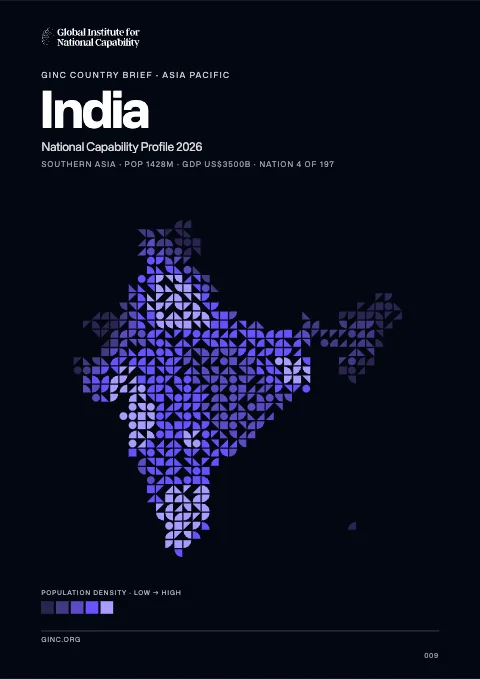
India is a federal parliamentary republic in the Asia-Pacific, home to 1.4 billion people, with its capital at New Delhi, and the world’s 7th-largest country by area.
Contents
12 chapters
Foundations
01–03
At a glance
- Area
- 3.3Mkm²#7 World#1 SA
- Population
- 1.4B#1 World#1 SA
- Life expectancy
- 68.2yrs#143 World#44 SA
- GDP (market)
- $3.9T
- GDP (PPP)
- $14.2T#3 World#1 SA
- GDP per capita
- $9.8K#125 World#4 SA
The whole brief
India National Capability Profile 2026
Foundations · Chapter 01
Historical Context
🇮🇳 India's understanding the origins and evolution of the modern nation
BackgroundBack to top ↑
The Indus Valley civilization, one of the world's oldest, flourished during the 3rd and 2nd millennia B.C. and extended into northwestern India. Aryan tribes from the northwest infiltrated the Indian subcontinent about 1500 B.C.; their merger with the earlier Dravidian inhabitants created the classical Indian culture. The Maurya Empire of the 4th and 3rd centuries B.C. -- which reached its zenith under ASHOKA -- united much of South Asia. The Gupta dynasty (4th to 6th centuries A.D.) ushered in The Golden Age, which saw a flowering of Indian science, art, and culture. Islam spread across the subcontinent over a period of 700 years. In the 10th and 11th centuries, Turks and Afghans invaded India and established the Delhi Sultanate. In the early 16th century, the Emperor BABUR established the Mughal Dynasty, which ruled large sections of India for more than three centuries. European explorers began establishing footholds in India during the 16th century.
By the 19th century, Great Britain had become the dominant political power on the subcontinent, and India was seen as the "Jewel in the Crown" of the British Empire. The British Indian Army played a vital role in both World Wars. Years of nonviolent resistance to British rule, led by Mohandas GANDHI and Jawaharlal NEHRU, eventually resulted in Indian independence in 1947. Large-scale communal violence took place before and after the subcontinent partition into two separate states -- India and Pakistan. The neighboring countries have fought three wars since independence, the last of which was in 1971 and resulted in East Pakistan becoming the separate nation of Bangladesh. India's nuclear weapons tests in 1998 emboldened Pakistan to conduct its own tests that same year. In 2008, terrorists originating from Pakistan conducted a series of coordinated attacks in Mumbai, India's financial capital. India's economic growth after economic reforms in 1991, a massive youth population, and a strategic geographic location have contributed to the country's emergence as a regional and global power. However, India still faces pressing problems such as extensive poverty, widespread corruption, and environmental degradation, and its restrictive business climate challenges economic growth expectations.
IndependenceBack to top ↑
15 August 1947 (from the UK)
National holidayBack to top ↑
Republic Day, 26 January (1950)
Foundations · Chapter 02
Geography
🇮🇳 India's territory, resources and strategic position
Location and areaBack to top ↑
Southern Asia, bordering the Arabian Sea and the Bay of Bengal, between Burma and Pakistan
20 00 N, 77 00 E
Asia
slightly more than one-third the size of the US
7,000 km
Terrain and resourcesBack to top ↑
upland plain (Deccan Plateau) in south, flat to rolling plain along the Ganges, deserts in west, Himalayas in north
coal (fourth-largest reserves in the world), antimony, iron ore, lead, manganese, mica, bauxite, rare earth elements, titanium ore, chromite, natural gas, diamonds, petroleum, limestone, arable land
754,562 sq km (2022)
WaterBack to top ↑
Brahmaputra (shared with China [s] and Bangladesh [m]) - 3,969 km; Indus (shared with China [s] and Pakistan [m]) - 3,610 km; Ganges river source (shared with Bangladesh [m]) - 2,704 km; Godavari - 1,465 km; Sutlej (shared with China [s] and Pakistan [m]) - 1,372 km; Yamuna - 1,370 km; Narmada - 1,289 km; Chenab river source (shared with Pakistan [m]) - 1,086 km ; Ghaghara river mouth (shared with China [s] and Nepal) - 1,080 km
note: [s] after country name indicates river source; [m] after country name indicates river mouth
Indus-Ganges-Brahmaputra Basin
Settlement and hazardsBack to top ↑
a very high population density exists throughout most of the country, with the notable exception of the deserts in the northwest and the mountain fringe in the north; the core of the population is in the north along the banks of the Ganges, with other river valleys and southern coastal areas also having large population concentrations
droughts; flash floods, as well as widespread and destructive flooding from monsoonal rains; severe thunderstorms; earthquakes
volcanism: Barren Island (354 m) in the Andaman Sea has been active in recent years
dominates South Asian subcontinent; near important Indian Ocean trade routes; Kanchenjunga, third tallest mountain in the world, lies on the border with Nepal
Foundations · Chapter 03
Environment
🇮🇳 India's environmental conditions, resources and national resilience
ClimateBack to top ↑
varies from tropical monsoon in south to temperate in north
Conditions and issuesBack to top ↑
deforestation; soil erosion; overgrazing; desertification; air pollution from industrial effluents and vehicle emissions; water pollution from raw sewage and agricultural pesticides; tap water not potable; growing population overstraining natural resources; biodiversity loss
Emissions and pollutionBack to top ↑
55.6 micrograms per cubic meter (2019 est.)
Water, waste and foodBack to top ↑
1.911 trillion cubic meters (2022 est.)
Resources and agreementsBack to top ↑
GINC Capability Domains · Chapter 04
Critical Technology
🇮🇳 India's technology frontiers and the pursuit of national advantage
Two counts are set side by side for 2015–2024: on the left, the papers researchers in India published; on the right, the patent families that began there and were filed in more than one country. First by capability group, then group by group with each group’s capabilities. The badge on a card is the nation’s place among all nations. Papers are from GINC Research Analytics, patent families from GINC Patents.
Research by capability group
#3 WorldPapers published, 2015–2024
76,083
29,252
19,244
13,395
10,292
8,294
5,915
4,494
4,046
347
Patents by capability group
#17 WorldInternational patent families, 2015–2024
2,438
2,377
1,223
882
650
599
226
214
65
41
Advanced Materials & ManufacturingBack to top ↑
Research
#3 WorldPapers published, 2015–2024
Patents
#22 WorldInternational patent families, 2015–2024
Energy TechnologiesBack to top ↑
Research
#3 WorldPapers published, 2015–2024
Patents
#16 WorldInternational patent families, 2015–2024
Semiconductors & Advanced ComputingBack to top ↑
Research
#5 WorldPapers published, 2015–2024
No research topic: Semiconductor Design & EDA · Advanced Semiconductor Fabrication · Semiconductor Equipment & Materials · Advanced Packaging & Heterogeneous Integration
Patents
#21 WorldInternational patent families, 2015–2024
Artificial IntelligenceBack to top ↑
Research
#3 WorldPapers published, 2015–2024
Patents
#13 WorldInternational patent families, 2015–2024
Quantum TechnologiesBack to top ↑
Research
#5 WorldPapers published, 2015–2024
Patents
#20 WorldInternational patent families, 2015–2024
Connectivity, Cyber & Trust TechnologiesBack to top ↑
Research
#2 WorldPapers published, 2015–2024
Patents
#15 WorldInternational patent families, 2015–2024
Sensing, Timing & NavigationBack to top ↑
Research
#3 WorldPapers published, 2015–2024
Patents
#24 WorldInternational patent families, 2015–2024
Robotics & Autonomous SystemsBack to top ↑
Research
#5 WorldPapers published, 2015–2024
No research topic: Human-Machine Interfaces
Patents
#18 WorldInternational patent families, 2015–2024
Biotechnology & Health TechnologiesBack to top ↑
Research
#5 WorldPapers published, 2015–2024
Patents
#20 WorldInternational patent families, 2015–2024
Medicine and BioTech
Clinical research and life-science invention, drawn from the same series that drive the metric pages. Each card opens the full cross-country comparison.
Space TechnologiesBack to top ↑
Research
#5 WorldPapers published, 2015–2024
Patents
#16 WorldInternational patent families, 2015–2024
Indian Space Research Organization (ISRO; originally established in 1962 as the Indian National Committee for Space Research (INCOSPAR); renamed ISRO in 1969); Defense Space Agency (DSA; established 2019) (2025)
Satish Dhawan Space Center (aka Sriharikota Range; located in Andhra Pradesh); Vikram Sarabhai Space Center (Kerala) (2025)
has one of the world’s largest space programs; designs, builds, launches, operates, and tracks the full spectrum of satellites, including communications, navigation, remote sensing (RS), and scientific/technology; designs, builds, and launches rockets, space/satellite launch vehicles (SLVs), and lunar/interplanetary probes; launches satellites for foreign partners; researching and developing additional technologies and capabilities; developing astronaut program and human flight capabilities (with assistance from Russia and the US); has space-related agreements with the ESA and more than 50 countries, including China, France, Germany, Japan, Russia, and the US; participates in international projects such as the Square Kilometer Array radio telescope; the Department of Space administers two government-controlled space industry corporations; has a growing private space sector (2025)
1963 - first sounding (research) rocket launched
1975 - first domestically made scientific satellite (Aryabhata) launched by Soviet Union
1979 - first experimental remote sensing (RS) satellite (Bhaskara-I) launched by Soviet Union
1980 - first successful launch of satellite (Rohini) on Indian satellite launch vehicle (SLV)
1984 - first Indian in space on a Soviet rocket
1988 - first operational RS satellite (IRS-1A) launched by Soviet Union
1994 - first successful launch of Polar Satellite Launch Vehicle (PSLV), India’s premier SLV
2008 - first lunar orbiter/probe (Chandrayaan-1) launched, reached lunar orbit, and sent a probe to the surface of the Moon
2014 - first interplanetary probe (Mangalyaan) reached orbit around Mars
2018 - Indian Regional Navigation Satellite System (INRSS) became operational
2019 - launched lunar orbiter/probe (Chandrayaan-2) with lander and rover (lander lost when it crash-landed on Moon’s surface)
2023 - successfully landed uncrewed lander/rover mission (Chandrayaan-3) on Moon's surface
2024 - launched satellite (XPoSat) to study black holes and placed solar observatory spacecraft (Aditya-L1) in orbital position to study the Sun
2025 - first docking of two orbiting satellites and sent its first astronaut to the International Space Station
GINC Capability Domains · Chapter 05
Strategic Infrastructure
🇮🇳 India's energy, connectivity and the material foundations of capability
Resource InfrastructureBack to top ↑
Agriculture & Food InfrastructureBack to top ↑
- Irrigation & Agricultural Water
- Livestock & Veterinary
- Fisheries & Aquaculture
- Storage, Cold Chain & Markets
Energy InfrastructureBack to top ↑
- Thermal Generation
- Nuclear Generation
- Nuclear Fuel Cycle & Radioactive Waste
- Hydropower
- Renewable Generation
- Transmission & Distribution
- System Control & Dispatch
- Storage & Fuel Supply
Water, Sanitation & Waste InfrastructureBack to top ↑
- Dams, Reservoirs & Flood Defence
- Water Supply & Treatment
- Bulk Water Transfer & Desalination
- Wastewater & Sanitation
- Solid Waste & Recycling
Advanced ManufacturingBack to top ↑
- Materials & Inputs
- Chemicals & Hazardous Process Industry
- Production Systems
- Supply Chain & Ecosystem
- Workforce & Innovation
Transport InfrastructureBack to top ↑
- Seaports & Terminals
- Air Infrastructure
- Air Navigation & Traffic Management
- Inland Waterways & Ferries
- Rail Infrastructure
- Roads & Bridges
- Logistics, Multimodal & Border Infrastructure
- Postal & Parcel
315 (2025)
289 (2025)
VT
Communications & Digital InfrastructureBack to top ↑
- Subsea Cables & International Gateways
- Core & Backbone Networks
- Mobile & Wireless Networks
- Spectrum & Broadcasting
- Data Centres, Compute & Cloud
- Data Resources
- AI Tools & Applications
.in
Financial InfrastructureBack to top ↑
- Currency & Reserves
- Payments & Settlement Systems
- Markets, Exchanges & Depositories
- Banks, Insurers & Systemic Institutions
Social InfrastructureBack to top ↑
- Health Infrastructure
- Public Health & Laboratories
- Medical Supply & Stockpiles
- Education & Skills Infrastructure
- Research & Scientific Facilities
- Housing, Community & Social Services
- Government & Public Administration
- Cultural, Community & Recreational Infrastructure
- Justice & Corrections
- Emergency Services & Civil Protection
- Hydrometeorology & Early Warning
Space, Aerospace & Defence InfrastructureBack to top ↑
GINC Capability Domains · Chapter 06
National Security
🇮🇳 India's force, intelligence and the defence of the nation
Disputes and terrorismBack to top ↑
al-Qa’ida; al-Qa’ida in the Indian Subcontinent (AQIS); Harakat ul-Mujahidin; Harakat ul-Jihad-i-Islami (HUJI); Hizbul Mujahideen; Indian Mujahedeen; Islamic State of Iraq and ash-Sham (ISIS) – India (ISI); Jaish-e-Mohammed (JeM); Lashkar-e Tayyiba (LeT); Islamic Revolutionary Guard Corps (IRGC)/Qods Force; The Resistance Front (TRF)
Force Generation & MobilisationBack to top ↑
Indian Armed Forces (IAF): Army, Navy, Air Force, Coast Guard
Ministry of Home Affairs: Central Police Organization, Central Armed Police Forces (includes Assam Rifles, Border Security Force, Central Industrial Security Force, Central Reserve Police Force, Indo-Tibetan Border Police, National Security Guards, Sashastra Seema Bal) (2025)
note 2: the Central Reserve Police Force (CRPF) includes a Rapid Reaction Force (RAF) for riot control and the Commando Battalion for Resolute Action (COBRA) for counter-insurgency operations
note 3: the Assam Rifles are under the administrative control of the Ministry of Home Affairs, while operational control falls under the Ministry of Defense (specifically the Indian Army)
information varies; approximately 1.5 million active Indian Armed Forces, including about 1.25 million in the Army (2025)
ages vary by branch of service and positions, but generally 17-27 years of age for voluntary military service for men and women; no conscription (2025)
note 2: the Indian military accepts citizens of Nepal and Bhutan; descendants of refugees from Tibet who arrived before 1962 and have resided permanently in India; peoples of Indian origin from nations such as Burma, the Democratic Republic of the Congo, Ethiopia, Kenya, Malawi, Pakistan, Sri Lanka, Tanzania, Uganda, and Vietnam with the intention of permanently settling in India; eligible candidates from “friendly foreign nations” may apply to the Armed Forces Medical Services
note 3: the British began to recruit Nepalese citizens (Gurkhas) into the East India Company Army during the Anglo-Nepalese War (1814-1816), and the Gurkhas subsequently were brought into the British Indian Army; following the partition of India in 1947, an agreement between Nepal, India, and Great Britain allowed for the transfer of the 10 regiments from the British Indian Army to the separate British and Indian armies; six regiments of Gurkhas (aka Gorkhas in India) regiments went to the new Indian Army; a seventh regiment was later added
the Indian military's primary mission is external/territorial defense while secondary missions include regional power projection, UN peacekeeping deployments, humanitarian operations, and support to internal security forces; it participates in multinational exercises and is one of the world's largest contributors to UN peacekeeping operations
the military's chief external focuses are China and Pakistan; the short 1962 Sino-India War left in place one of the World’s longest disputed international borders--known as the Line of Actual Control (LAC)--resulting in occasional standoffs between Indian and Chinese security forces, including lethal clashes in 1975 and 2020; naval competition and influence in the Indian Ocean is also an area of interest
India has fought four wars and several skirmishes with Pakistan; three of the wars have been over the disputed region of Jammu and Kashmir, the status of which has been unsettled since the UK's 1947 withdrawal and the partition and independence of India and Pakistan; a fragile cease-fire in Kashmir was reached in 2003, revised in 2018, and reaffirmed in 2021, although the militarized Line of Control which serves as the border remains contested, and India has accused Pakistan of backing armed separatists and terrorist organizations in Jammu and Kashmir where Indian military and security forces have conducted counterinsurgency operations since the 1980s; in the Spring of 2025, India held Pakistan responsible for a terrorist attack in India-controlled Kashmir and retaliated, sparking a brief cross-border conflict involving aircraft, artillery, drone, and missile strikes
the Kashmir dispute also includes the Siachen Glacier, located in the Karakoram Mountain Range, which was seized by India in 1984 with Pakistan attempting to retake the area several times between 1985 and 1995; despite the 2003 cease-fire, both sides continue to maintain a permanent military presence there with outposts at altitudes above 20,000 feet (over 6,000 meters) where most casualties are due to extreme weather and the hazards of operating in the high mountain terrain of the world’s highest conflict, including avalanches, exposure, and altitude sickness (2025)
Forces under arms
Active-duty strength on the Correlates of War series, which reaches back to 1816 and so carries a nation’s whole record of mobilisation rather than its present establishment. The card opens the full cross-country comparison.
Intelligence & AssessmentBack to top ↑
- Imagery & Geospatial Intelligence
- Signals & Cyber Intelligence
- Technical & Measurement Intelligence
- Open-Source & Financial Intelligence
- Human Intelligence & Counterintelligence
- All-Source Analysis & Warning
Joint Command, Projection & SustainmentBack to top ↑
- Command, Control & Communications
- Strategic Lift & Mobility
- Expeditionary & Peace Operations
- Operational Sustainment & War Reserves
- Defence Industrial Mobilisation
- CBRN Defence
the military's inventory consists of Russian- and Soviet-origin equipment along with a smaller mix of Western and domestically produced arms; Russia continues to be the leading provider of arms to India, although in recent years India has increased acquisitions from other suppliers, including France, Israel, the UK, and the US; India's defense industry is capable of producing a range of air, land, missile, and naval weapons systems for both domestic use and export; it also produces weapons systems under license (2025)
1,100 Democratic Republic of the Congo (MONUSCO); 200 Golan Heights (UNDOF); 900 Lebanon (UNIFIL); 2,400 South Sudan (UNMISS); 600 Sudan (UNISFA) (2025)
Land PowerBack to top ↑
- Combined Arms Manoeuvre
- Land Fires
- Battlefield Aviation & Uncrewed Systems
- Special Operations & Irregular Warfare
Maritime PowerBack to top ↑
- Maritime Security & Constabulary
- Sea Denial & Undersea Warfare
- Sea Control
- Amphibious & Expeditionary Operations
Air PowerBack to top ↑
- Air Sovereignty & Policing
- Control of the Air
- Air Strike & Interdiction
- Airborne ISR, Early Warning & Battle Management
Strategic Strike & Missile DefenceBack to top ↑
Space OperationsBack to top ↑
Cyber & Electromagnetic OperationsBack to top ↑
Nuclear DeterrenceBack to top ↑
GINC Capability Domains · Chapter 07
Human Capital
🇮🇳 India's population, health and the skills that sustain capability
DemographyBack to top ↑
0.72% (2025 est.)
15.91 births/1,000 population (2025 est.)
8.7 deaths/1,000 population (2025 est.)
2 children born/woman (2025 est.)
0.95 (2025 est.)
21.2 years (2019/21)
72.3% (2020 est.)
Migration and urbanisationBack to top ↑
0.03 migrant(s)/1,000 population (2025 est.)
32.941 million NEW DELHI (capital), 21.297 million Mumbai, 15.333 million Kolkata, 13.608 million Bangalore, 11.776 million Chennai, 10.801 million Hyderabad (2023)
Welfare and equityBack to top ↑
DisplacementBack to top ↑
Early Childhood DevelopmentBack to top ↑
31.5% (2020 est.)
Foundational EducationBack to top ↑
Advanced EducationBack to top ↑
Technical & Vocational SkillsBack to top ↑
Digital & AI CompetenceBack to top ↑
Generative AI adoption
Modelled share of working-age adults using generative AI, from Microsoft telemetry scaled to each country’s 15–64 population. A measure of how fast a workforce is absorbing the technology rather than of how much of it a nation builds. The card opens the full cross-country comparison.
Lifelong Learning & ReskillingBack to top ↑
Research Talent & Knowledge CreationBack to top ↑
Population HealthBack to top ↑
80 deaths/100,000 live births (2023 est.)
3.9% (2016)
Health System CapabilityBack to top ↑
0.72 physicians/1,000 population (2020)
1.6 beds/1,000 population (2021 est.)
GINC Capability Domains · Chapter 08
Governance and Integrity
🇮🇳 India's institutions, law and the integrity of the state
State structureBack to top ↑
federal parliamentary republic
28 states and 8 union territories*; Andaman and Nicobar Islands*, Andhra Pradesh, Arunachal Pradesh, Assam, Bihar, Chandigarh*, Chhattisgarh, Dadra and Nagar Haveli and Daman and Diu*, Delhi*, Goa, Gujarat, Haryana, Himachal Pradesh, Jammu and Kashmir*, Jharkhand, Karnataka, Kerala, Ladakh*, Lakshadweep*, Madhya Pradesh, Maharashtra, Manipur, Meghalaya, Mizoram, Nagaland, Odisha, Puducherry*, Punjab, Rajasthan, Sikkim, Tamil Nadu, Telangana, Tripura, Uttar Pradesh, Uttarakhand, West Bengal
18 years of age; universal
Political Institutions & Civic ParticipationBack to top ↑
- Electoral Management & Integrity
- Legislature & Deliberative Institutions
- Citizen Participation & Civic Space
2022: Droupadi MURMU elected president; percent of electoral college vote - Droupadi MURMU (BJP) 64%, Yashwant SINHA (AITC) 35.9%; Jagdeep DHANKHAR elected vice president; percent of electoral college vote - Jagdeep DHANKHAR (BJP) 74.4%, Margaret ALVA (INC) 25.6%
Aam Aadmi Party or AAP
All India Trinamool Congress or AITC
Bahujan Samaj Party or BSP
Bharatiya Janata Party or BJP
Biju Janata Dal or BJD
Communist Party of India-Marxist or CPI(M)
Dravida Munnetra Khazhagam
Indian National Congress or INC
Nationalist Congress Party or NCP
Rashtriya Janata Dal or RJD
Samajwadi Party or SP
Shiromani Akali Dal or SAD
Shiv Sena or SS
Telegana Rashtra Samithi or TRS
Telugu Desam Party or TDP
YSR Congress or YSRCP or YCP
Justice System & Fundamental RightsBack to top ↑
- Judicial Independence & Court Capability
- Access to Justice & Legal Services
- Fundamental Rights Protection
- Human Rights Institutions & Equality Bodies
common law system based on the English model; separate personal law codes apply to Muslims, Christians, and Hindus; judicial review of legislative acts
accepts compulsory ICJ jurisdiction with reservations; non-party state to the ICCt
Internal Security & OrderBack to top ↑
major illicit drug-producing and/or drug-transit country
major precursor-chemical producer (2025)
Regulatory Governance & Strategic ControlsBack to top ↑
- Regulatory Quality & Better Regulation
- Regulatory Delivery & Independent Regulators
- Strategic Controls & Economic Security Administration
Government Effectiveness & Public AdministrationBack to top ↑
- Centre of Government & Policy Coordination
- Civil Service & Public Workforce
- Digital Government & Service Delivery
- Legal Identity & Civil Registration
- Statistical & Data Capability
Public Integrity & Anti-CorruptionBack to top ↑
Transparency, Oversight & AccountabilityBack to top ↑
- Right to Information & Open Government
- Independent Oversight & Supreme Audit
- Independent Media & Journalist Safety
National Resilience & Crisis ManagementBack to top ↑
GINC Capability Domains · Chapter 09
Information and Influence
🇮🇳 India's identity, media and the projection of influence
Identity and cultureBack to top ↑
विश्व फ़ैक्टबुक, आधारभूत जानकारी का एक अनिवार्य स्रोत (Hindi)
The World Factbook, the indispensable source for basic information.note 2: Hindustani is a popular variant of Hindi/Urdu spoken widely throughout northern India but is not an official language
Hindu 79.8%, Muslim 14.2%, Christian 2.3%, Sikh 1.7%, other and unspecified 2% (2011 est.)
Indo-Aryan 72%, Dravidian 25%, and other 3% (2000)
the Lion Capital of Ashoka, which depicts four Asiatic lions standing back-to-back and mounted on a circular abacus (official); Bengal tiger and lotus flower (traditional)
description: three equal horizontal bands of saffron (top), white, and green, with a blue chakra (24-spoked wheel) centered in the white band
meaning: saffron stands for courage, sacrifice, and the spirit of renunciation; white for purity and truth; green for faith and fertility; the chakra symbolizes the wheel of life in movement and death in stagnation
saffron, white, green
Diplomatic Statecraft & Global NetworksBack to top ↑
- Diplomatic Network & Consular Reach
- Multilateral Leadership & Norm Setting
- Agenda-Setting & Convening
- Mediation & Crisis Diplomacy
Diplomatic representation from India
India maintains resident diplomatic missions in 151 countries across 7 world regions.
Diplomatic representation in India
164 countries maintain a resident diplomatic mission in India.
ADB, AfDB (nonregional member), Arctic Council (observer), ARF, ASEAN (dialogue partner), BIMSTEC, BIS, BRICS, C, CD, CERN (observer), CICA, CP, EAS, FAO, FATF, G-15, G-20, G-24, G-5, G-77, IAEA, IBRD, ICAO, ICC (national committees), ICRM, IDA, IFAD, IFC, IFRCS, IHO, ILO, IMF, IMO, IMSO, Interpol, IOC, IOM, IPU, ISO, ITSO, ITU, ITUC (NGOs), LAS (observer), MIGA, MINURSO, MONUSCO, NAM, OAS (observer), OECD, OPCW, Pacific Alliance (observer), PCA, PIF (partner), Quad, SAARC, SACEP, SCO (observer), UN, UNCTAD, UNDOF, UNESCO, UNHCR, UNHRC, UNIDO, UNIFIL, UNISFA, UNITAR, UNMISS, UNOCI, UNOOSA, UNSOM, UNWTO, UPU, Wassenaar Arrangement, WCO, WFTU (NGOs), WHO, WIPO, WMO, WTO
Alliances & Security CooperationBack to top ↑
Development Cooperation & Global AssistanceBack to top ↑
Culture, Language & Education DiplomacyBack to top ↑
- Cultural & Language Institutes
- Creative Industries & Cultural Export Reach
- Heritage & Cultural Institutions
- Education Diplomacy & Alumni Networks
- Sports & Major Events
Taj Mahal (c); Agra Fort (c); Elphanta Caves (c); Hill Forts of Rajasthan (c); Sundarbans National Park (n); Rock Shelters of Bhimbetka (c); Champaner-Pavagadh Archaeological Park (c); Jaipur (c); Mahabodhi Temple Complex at Bodh Gaya (c); Manas Wildlife Sanctuary (n); Nanda Devi and Valley of Flowers National Parks (n); Khangchendzonga National Park (m); Group of Monuments at Mahabalipuram (c); Sun Temple, Konârak (c); Kaziranga National Park (n); Churches and Convents of Goa (c); Great Living Chola Temples (c); Group of Monuments at Pattadakal (c); Buddhist Monuments at Sanchi (c); Humayun's Tomb, Delhi (c); Qutb Minar and its Monuments, Delhi (c); Great Himalayan National Park Conservation Area (n); Rani-ki-Vav (the Queen’s Stepwell) at Patan, Gujarat (c); Archaeological Site of Nalanda Mahavihara at Nalanda, Bihar (c); Historic City of Ahmadabad (c); Victorian Gothic and Art Deco Ensembles of Mumbai (c); Jaipur City, Rajasthan (c); Kakatiya Rudreshwara (Ramappa) Temple, Telangana (c); Moidams – the Mound-Burial System of the Ahom Dynasty (c); Maratha Military Landscapes of India (c)
Diaspora & Global CommunitiesBack to top ↑
Information Environment & Strategic CommunicationBack to top ↑
- Strategic Communications & Public Diplomacy
- International Media & Broadcasting
- Information Defence & Counter-Interference
Doordarshan, India's public TV network, has a monopoly on terrestrial broadcasting and operates about 20 national, regional, and local services; a large number of privately owned TV stations are distributed by cable and satellite service providers; cable and satellite TV offer over 850 TV channels; government controls AM radio, with All India Radio operating domestic and external networks; news broadcasts via radio are limited to the All India Radio Network; since 2000, privately owned FM stations have been permitted and have increased rapidly (2020)
GINC Capability Domains · Chapter 10
Financial Strength
🇮🇳 India's fiscal depth, reserves and the capacity to act
Monetary & Currency CapabilityBack to top ↑
- Monetary Policy & Price Stability
- Exchange Rate & External Account Management
- Currency Issuance & Digital Money
Fiscal Capacity & Public FinanceBack to top ↑
- Revenue Mobilisation & Tax Administration
- Public Expenditure & Budget Management
- Sovereign Debt & Treasury Management
- Public Investment Management
6.7% (of GDP) (2022 est.)
Financial System Depth & AccessBack to top ↑
- Banking System Capacity
- Capital Markets Depth & Development
- Long-Term & Institutional Capital
- Financial Inclusion & Household Access
- Development & Policy Finance
Financial Regulation & IntegrityBack to top ↑
- Prudential Regulation & Supervision
- Financial Integrity & Illicit Finance Control
- Market Conduct & Consumer Protection
- Payment & Market Infrastructure Oversight
Financial Stability & Crisis ManagementBack to top ↑
- Macroprudential & Systemic Oversight
- Crisis Management, Resolution & Deposit Insurance
- External Liquidity & Financial Safety Nets
Sovereign Capital & External Financial PowerBack to top ↑
- Official Reserves Management
- Sovereign Wealth & Public Asset Management
- Currency Internationalisation & Reserve Status
- Capital Account & Flow Management
- International Financial Centre Capability
GINC Capability Domains · Chapter 11
Production and Innovation
🇮🇳 India's output, industry and the engine of prosperity
Economic Output & ProductivityBack to top ↑
largest South Asian economy; strong, sustained GDP growth led by technology and service sectors, foreign investment, and improved regulatory framework; high poverty rate and income inequality; initiatives on infrastructure development, digitization, manufacturing, and financial access
$3.913 trillion (2024 est.)
Labour & EmploymentBack to top ↑
- Employment & Labour Force Participation
- Labour Market Institutions & Wage Setting
- Employment Services & Skills Matching
- Labour Adjustment, Transition & Formalisation
607.691 million (2024 est.)
Industrial & Sectoral BaseBack to top ↑
- Manufacturing & Advanced Industry
- Foundational & Process Industries
- Agrifood & Primary Production
- Services Economy
sugarcane, rice, milk, wheat, bison milk, potatoes, vegetables, maize, bananas, onions (2023)
textiles, chemicals, food processing, steel, transportation equipment, cement, mining, petroleum, machinery, software, pharmaceuticals
5.6% (2024 est.)
Structural Transformation & ComplexityBack to top ↑
Business Dynamism & EntrepreneurshipBack to top ↑
- Entrepreneurship & Firm Creation
- Risk Capital & Scale-Up Finance
- Firm Growth, Exit & Renewal
- Competition & Market Contestability
Innovation & CommercialisationBack to top ↑
- Business Innovation Capability
- Research Commercialisation & Knowledge Transfer
- Intellectual Property & Intangible Assets
- Innovation Ecosystems & Clusters
Technology Adoption & DiffusionBack to top ↑
GINC Capability Domains · Chapter 12
Trade and Investment
🇮🇳 India's markets, capital and the terms of global exchange
Overall tradeBack to top ↑
$459B of exports to 218 partners and $689B of imports from 207 in 2024, a deficit of $229B.
- Exports
- $459B218 partners
- Imports
- $689B207 partners
- Balance
- −$229Bdeficit
- Total trade
- $1.15T2024
ExportsBack to top ↑
Where its exports go
The largest partners in 2024, with each one's share of the nation's exports.
| Partner | Value | Share | |
|---|---|---|---|
| United States | $88.8B | 19% | |
| United Arab Emirates | $37.1B | 8.1% | |
| China | $17.2B | 3.8% | |
| United Kingdom | $15.3B | 3.3% | |
| Germany | $14.2B | 3.1% | |
| Saudi Arabia | $14.0B | 3.0% | |
| Bangladesh | $11.3B | 2.5% | |
| France | $11.0B | 2.4% | |
| Singapore | $10.7B | 2.3% | |
| Netherlands | $9.78B | 2.1% | |
| Italy | $9.20B | 2.0% | |
| Hong Kong | $8.18B | 1.8% | |
| Malaysia | $8.00B | 1.7% | |
| Australia | $7.81B | 1.7% | |
| Mexico | $7.53B | 1.6% | |
| South Africa | $7.34B | 1.6% | |
| Brazil | $7.32B | 1.6% | |
| Turkey | $7.27B | 1.6% | |
| Nepal | $6.95B | 1.5% | |
| South Korea | $6.87B | 1.5% |
What it exports
The largest categories in 2024.
| Category | Value | Share | |
|---|---|---|---|
| Mineral fuels, oils, distillation products | $53.7B | 12% | |
| Electrical, electronic equipment | $47.4B | 10% | |
| Machinery, nuclear reactors, boilers | $35.8B | 7.8% | |
| Pearls, precious stones, metals, coins | $34.0B | 7.4% | |
| Organic chemicals | $30.0B | 6.5% | |
| Pharmaceutical products | $29.1B | 6.3% | |
| Vehicles other than railway, tramway | $23.4B | 5.1% | |
| Cereals | $11.7B | 2.5% | |
| Iron and steel | $11.1B | 2.4% | |
| Articles of iron or steel | $10.0B | 2.2% | |
| Articles of apparel, not knit or crocheted | $9.51B | 2.1% | |
| Plastics | $9.04B | 2.0% | |
| Articles of apparel, knit or crocheted | $8.81B | 1.9% | |
| Aluminum | $6.99B | 1.5% | |
| Aircraft, spacecraft | $6.82B | 1.5% |
ImportsBack to top ↑
Where its imports come from
The largest partners in 2024, with each one's share of the nation's imports.
| Partner | Value | Share | |
|---|---|---|---|
| China | $122B | 18% | |
| Russia | $66.4B | 9.6% | |
| United Arab Emirates | $55.7B | 8.1% | |
| United States | $38.7B | 5.6% | |
| Saudi Arabia | $30.8B | 4.5% | |
| Iraq | $29.9B | 4.3% | |
| Indonesia | $24.4B | 3.5% | |
| Switzerland | $21.9B | 3.2% | |
| South Korea | $21.2B | 3.1% | |
| Japan | $18.6B | 2.7% | |
| Australia | $18.1B | 2.6% | |
| Germany | $17.7B | 2.6% | |
| Qatar | $12.6B | 1.8% | |
| Thailand | $12.4B | 1.8% | |
| South Africa | $12.1B | 1.8% | |
| Malaysia | $12.1B | 1.8% | |
| Taiwan | $11.3B | 1.6% | |
| Vietnam | $10.6B | 1.5% | |
| Kuwait | $8.37B | 1.2% | |
| Singapore | $7.92B | 1.2% |
What it imports
The largest categories in 2024.
| Category | Value | Share | |
|---|---|---|---|
| Mineral fuels, oils, distillation products | $220B | 32% | |
| Pearls, precious stones, metals, coins | $82.7B | 12% | |
| Electrical, electronic equipment | $79.2B | 12% | |
| Machinery, nuclear reactors, boilers | $60.9B | 8.8% | |
| Organic chemicals | $25.9B | 3.8% | |
| Plastics | $22.4B | 3.3% | |
| Animal, vegetable fats and oils, cleavage products | $17.4B | 2.5% | |
| Iron and steel | $17.0B | 2.5% | |
| Optical, photo, technical, medical apparatus | $13.5B | 2.0% | |
| Aircraft, spacecraft | $10.8B | 1.6% | |
| Copper | $10.4B | 1.5% | |
| Inorganic chemicals, precious metal compound, isotope | $8.79B | 1.3% | |
| Fertilizers | $7.71B | 1.1% | |
| Vehicles other than railway, tramway | $7.51B | 1.1% | |
| Aluminum | $7.45B | 1.1% |
In a list, the bar runs to the largest in that list. The line is each figure’s history from 2000, drawn to its own peak: it shows the shape of the years, and the value shows the size.
External balanceBack to top ↑
Trade Facilitation & LogisticsBack to top ↑
Trade Policy & Market AccessBack to top ↑
- Trade Policy & Negotiation Capability
- Market Access & Agreements Network
- Trade Law & Enforcement
- Standards, Conformity & Quality Infrastructure
Digital & Services TradeBack to top ↑
- Services Trade Capability
- Digital Trade & E-Commerce
- Data Flows & Digital Trade Governance
- Tourism & Visitor Economy
Investment Attraction & ProjectionBack to top ↑
- Investment Attraction & Facilitation
- Investment Absorption & Linkages
- Outward Investment & Global Corporate Presence
Export Capability & SophisticationBack to top ↑
USA 19%, UAE 7%, China 4%, Germany 3%, UK 3% (2023)
refined petroleum, packaged medicine, diamonds, broadcasting equipment, garments (2023)
Global Value Chain PositionBack to top ↑
- Value Chain Participation & Integration
- Value Chain Position & Upgrading
- Regional Integration & Hub Anchoring
Economic Leverage & DependenceBack to top ↑
- Strategic Supply Security
- Concentration Risk & Revenue Stabilisation
- Economic Leverage & Coercion Resistance
China 19%, Russia 10%, USA 6%, UAE 6%, Saudi Arabia 5% (2023)
crude petroleum, gold, coal, natural gas, integrated circuits (2023)
India · you are in
Historical Context
Foundations
GINC Capability Domains
Find in this brief · India