
Nauru
Nauru is a republic in Oceania, home to 9,488 people.
Contents
12 chapters
Foundations
01–03
At a glance
- Area
- 21km²#234 World#24 Oceania
- Population
- 9.5K#226 World#20 Oceania
- GDP (PPP)
- $60M#224 World#18 Oceania
- GDP per capita
- $5K#161 World#16 Oceania
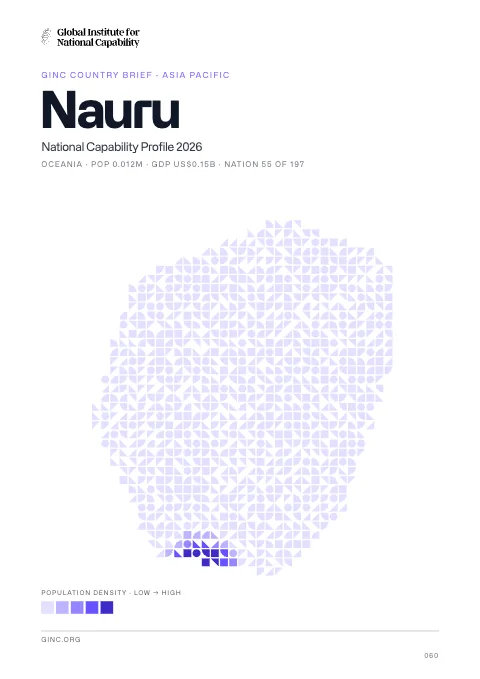
The whole brief
Nauru National Capability Profile 2026
Foundations · Chapter 01
Historical Context
🇳🇷 Nauru’s understanding the origins and evolution of the modern nation
BackgroundBack to top ↑
The exact origins of the Nauruans are unclear since their language does not resemble any other in the Pacific region. Germany annexed the island in 1888. A German-British consortium began mining the island's phosphate deposits early in the 20th century. Australian forces occupied Nauru in World War I; it subsequently became a League of Nations mandate. After the Second World War - and a brutal occupation by Japan - Nauru became a UN trust territory. It achieved independence in 1968 and joined the UN in 1999 as the world's smallest independent republic.
IndependenceBack to top ↑
31 January 1968 (from the Australia-, NZ-, and UK-administered UN trusteeship)
National holidayBack to top ↑
Independence Day, 31 January (1968)
Foundations · Chapter 02
Geography
🇳🇷 Nauru’s territory, resources and strategic position
Location and areaBack to top ↑
Oceania, island in the South Pacific Ocean, south of the Marshall Islands
0 32 S, 166 55 E
Oceania
about 0.1 times the size of Washington, DC
0 km
30 km
Terrain and resourcesBack to top ↑
sandy beach rises to fertile ring around raised coral reefs with phosphate plateau in center
phosphates, fish
NA
Settlement and hazardsBack to top ↑
periodic droughts
world's smallest island country; situated just 53 km south of the Equator; Nauru is one of the three great phosphate rock islands in the Pacific Ocean - the others are Banaba (Ocean Island) in Kiribati and Makatea in French Polynesia
OtherBack to top ↑
limited natural freshwater resources, roof storage tanks collect rainwater but mostly dependent on a single, aging desalination plant; intensive phosphate mining during the past 90 years - mainly by a UK, Australia, and NZ consortium - has left the central 90% of Nauru a wasteland and threatens limited remaining land resources
Foundations · Chapter 03
Environment
🇳🇷 Nauru’s environmental conditions, resources and national resilience
ClimateBack to top ↑
tropical with a monsoonal pattern; rainy season (November to February)
Emissions and pollutionBack to top ↑
Resources and agreementsBack to top ↑
GINC Capability Domains · Chapter 04
Critical Technology
🇳🇷 Nauru’s technology frontiers and the pursuit of national advantage
Advanced Materials & ManufacturingBack to top ↑
- Structural & Composite Materials
- Functional Materials & Coatings
- Nanomaterials & Metamaterials
- Superconducting, Magnetic & Photonic Materials
- Energetic Materials
- Additive & Precision Manufacturing
- Advanced Chemical & Process Manufacturing
Energy TechnologiesBack to top ↑
- Batteries & Energy Storage
- Hydrogen, Ammonia & Sustainable Fuels
- Next-Generation Solar & Renewables
- Advanced Nuclear & Fusion
- Directed Energy Technologies
Semiconductors & Advanced ComputingBack to top ↑
- Semiconductor Design & EDA
- Advanced Semiconductor Fabrication
- Semiconductor Equipment & Materials
- Advanced Packaging & Heterogeneous Integration
- Compound & Power Semiconductors
- High-Performance & AI Computing
Artificial IntelligenceBack to top ↑
Quantum TechnologiesBack to top ↑
Connectivity, Cyber & Trust TechnologiesBack to top ↑
- Advanced Optical Communication & Photonics
- Advanced Wireless Communication
- Resilient & Infrastructure-Independent Networks
- Protective Cybersecurity Technologies
- Privacy, Identity & Trust Technologies
Sensing, Timing & NavigationBack to top ↑
- Precision Timing & Atomic Clocks
- Resilient Positioning & Navigation
- Advanced Imaging & Photonic Sensing
- Radar & Radiofrequency Sensing
- Acoustic & Undersea Sensing
Robotics & Autonomous SystemsBack to top ↑
- Advanced Robotics
- Autonomous Systems & Trusted Autonomy
- Uncrewed & Collaborative Systems
- Human-Machine Interfaces
Biotechnology & Health TechnologiesBack to top ↑
- Genomics & Biological Data
- Synthetic Biology & Genetic Engineering
- Biomanufacturing
- Nuclear Medicine & Radioisotope Technologies
- Advanced Therapeutics, Vaccines & Medical Countermeasures
Space TechnologiesBack to top ↑
- Space Launch & Reusable Systems
- Advanced Propulsion & Hypersonic Systems
- Satellite & Constellation Technologies
GINC Capability Domains · Chapter 05
Strategic Infrastructure
🇳🇷 Nauru’s energy, connectivity and the material foundations of capability
Resource InfrastructureBack to top ↑
0 bbl/day (2012 est.)
0 bbl/day (2010 est.)
0 bbl/day (2010 est.)
0 bbl (1 January 2013 est.)
0 bbl/day (2010 est.)
1,000 bbl/day (2011 est.)
0 bbl/day (2010 est.)
1,075 bbl/day (2010 est.)
0 cu m (2011 est.)
0 cu m (2010 est.)
0 cu m (2011 est.)
0 cu m (2011 est.)
0 cu m (1 January 2013 est.)
Agriculture & Food InfrastructureBack to top ↑
- Irrigation & Agricultural Water
- Livestock & Veterinary
- Fisheries & Aquaculture
- Storage, Cold Chain & Markets
Energy InfrastructureBack to top ↑
- Thermal Generation
- Nuclear Generation
- Nuclear Fuel Cycle & Radioactive Waste
- Hydropower
- Renewable Generation
- Transmission & Distribution
- System Control & Dispatch
- Storage & Fuel Supply
1,000 kW (2010 est.)
35 million kWh (2010 est.)
32.55 million kWh (2010 est.)
0 kWh (2012 est.)
0 kWh (2012 est.)
100% of total installed capacity (2010 est.)
0% of total installed capacity (2010 est.)
0% of total installed capacity (2010 est.)
0% of total installed capacity (2010 est.)
168,800 Mt (2011 est.)
Water, Sanitation & Waste InfrastructureBack to top ↑
- Dams, Reservoirs & Flood Defence
- Water Supply & Treatment
- Bulk Water Transfer & Desalination
- Wastewater & Sanitation
- Solid Waste & Recycling
Advanced ManufacturingBack to top ↑
- Materials & Inputs
- Chemicals & Hazardous Process Industry
- Production Systems
- Supply Chain & Ecosystem
- Workforce & Innovation
Transport InfrastructureBack to top ↑
- Seaports & Terminals
- Air Infrastructure
- Air Navigation & Traffic Management
- Inland Waterways & Ferries
- Rail Infrastructure
- Roads & Bridges
- Logistics, Multimodal & Border Infrastructure
- Postal & Parcel
1 (2013)
Communications & Digital InfrastructureBack to top ↑
- Subsea Cables & International Gateways
- Core & Backbone Networks
- Mobile & Wireless Networks
- Spectrum & Broadcasting
- Data Centres, Compute & Cloud
- Data Resources
- AI Tools & Applications
1,900 (2009)
6,800 (2012)
8,162 (2012)
.nr
Financial InfrastructureBack to top ↑
- Currency & Reserves
- Payments & Settlement Systems
- Markets, Exchanges & Depositories
- Banks, Insurers & Systemic Institutions
Social InfrastructureBack to top ↑
- Health Infrastructure
- Public Health & Laboratories
- Medical Supply & Stockpiles
- Education & Skills Infrastructure
- Research & Scientific Facilities
- Housing, Community & Social Services
- Government & Public Administration
- Cultural, Community & Recreational Infrastructure
- Justice & Corrections
- Emergency Services & Civil Protection
- Hydrometeorology & Early Warning
Space, Aerospace & Defence InfrastructureBack to top ↑
GINC Capability Domains · Chapter 06
National Security
🇳🇷 Nauru’s force, intelligence and the defence of the nation
Disputes and terrorismBack to top ↑
none
Force Generation & MobilisationBack to top ↑
no regular military forces (2012)
Nauru maintains no defense forces; under an informal agreement, defense is the responsibility of Australia
Forces under arms
Active-duty strength on the Correlates of War series, which reaches back to 1816 and so carries a nation’s whole record of mobilisation rather than its present establishment. The card opens the full cross-country comparison.
Intelligence & AssessmentBack to top ↑
- Imagery & Geospatial Intelligence
- Signals & Cyber Intelligence
- Technical & Measurement Intelligence
- Open-Source & Financial Intelligence
- Human Intelligence & Counterintelligence
- All-Source Analysis & Warning
Joint Command, Projection & SustainmentBack to top ↑
- Command, Control & Communications
- Strategic Lift & Mobility
- Expeditionary & Peace Operations
- Operational Sustainment & War Reserves
- Defence Industrial Mobilisation
- CBRN Defence
Land PowerBack to top ↑
- Combined Arms Manoeuvre
- Land Fires
- Battlefield Aviation & Uncrewed Systems
- Special Operations & Irregular Warfare
Maritime PowerBack to top ↑
- Maritime Security & Constabulary
- Sea Denial & Undersea Warfare
- Sea Control
- Amphibious & Expeditionary Operations
Air PowerBack to top ↑
- Air Sovereignty & Policing
- Control of the Air
- Air Strike & Interdiction
- Airborne ISR, Early Warning & Battle Management
Strategic Strike & Missile DefenceBack to top ↑
Space OperationsBack to top ↑
Cyber & Electromagnetic OperationsBack to top ↑
Nuclear DeterrenceBack to top ↑
GINC Capability Domains · Chapter 07
Human Capital
🇳🇷 Nauru’s population, health and the skills that sustain capability
DemographyBack to top ↑
9,488 (July 2014 est.)
0.56% (2014 est.)
25.61 births/1,000 population (2014 est.)
5.9 deaths/1,000 population (2014 est.)
2.93 children born/woman (2014 est.)
22.1
35.6% (2007)
Migration and urbanisationBack to top ↑
-14.12 migrant(s)/1,000 population (2014 est.)
Welfare and equityBack to top ↑
NA%
Early Childhood DevelopmentBack to top ↑
4.8% (2007)
Foundational EducationBack to top ↑
NA
NA
Advanced EducationBack to top ↑
Technical & Vocational SkillsBack to top ↑
Digital & AI CompetenceBack to top ↑
Lifelong Learning & ReskillingBack to top ↑
Research Talent & Knowledge CreationBack to top ↑
Population HealthBack to top ↑
71.1% (2008)
NA
NA
NA
Health System CapabilityBack to top ↑
9.8% of GDP (2011)
0.71 physicians/1,000 population (2010)
GINC Capability Domains · Chapter 08
Governance and Integrity
🇳🇷 Nauru’s institutions, law and the integrity of the state
State structureBack to top ↑
republic
no official capital; government offices in Yaren District
14 districts; Aiwo, Anabar, Anetan, Anibare, Baiti, Boe, Buada, Denigomodu, Ewa, Ijuw, Meneng, Nibok, Uaboe, Yaren
effective 29 January 1968; amended 1968, 2009; note - in early 2013, further amendments were introduced (2013)
20 years of age; universal and compulsory
Political Institutions & Civic ParticipationBack to top ↑
- Electoral Management & Integrity
- Legislature & Deliberative Institutions
- Citizen Participation & Civic Space
unicameral parliament (19 seats; members elected by popular vote to serve three-year terms)
Democratic Party [Kennan ADEANG]//Nauru First (Naoero Amo) Party//Nauru Party (informal)//
Woman Information and News Agency (women's issues)
Justice System & Fundamental RightsBack to top ↑
- Judicial Independence & Court Capability
- Access to Justice & Legal Services
- Fundamental Rights Protection
- Human Rights Institutions & Equality Bodies
mixed legal system of common law based on the English model and customary law
has not submitted an ICJ jurisdiction declaration; accepts ICCt jurisdiction
Internal Security & OrderBack to top ↑
Regulatory Governance & Strategic ControlsBack to top ↑
- Regulatory Quality & Better Regulation
- Regulatory Delivery & Independent Regulators
- Strategic Controls & Economic Security Administration
Government Effectiveness & Public AdministrationBack to top ↑
- Centre of Government & Policy Coordination
- Civil Service & Public Workforce
- Digital Government & Service Delivery
- Legal Identity & Civil Registration
- Statistical & Data Capability
Public Integrity & Anti-CorruptionBack to top ↑
Transparency, Oversight & AccountabilityBack to top ↑
- Right to Information & Open Government
- Independent Oversight & Supreme Audit
- Independent Media & Journalist Safety
National Resilience & Crisis ManagementBack to top ↑
GINC Capability Domains · Chapter 09
Information and Influence
🇳🇷 Nauru’s identity, media and the projection of influence
Identity and cultureBack to top ↑
Nauruan 93% (official, a distinct Pacific Island language), English 2% (widely understood, spoken, and used for most government and commercial purposes), other 5% (includes I-Kiribati 2% and Chinese 2%)
Protestant 60.4% (includes Nauru Congregational 35.7%, Assembly of God 13%, Nauru Independent Church 9.5%, Baptist 1.5%, and Seventh Day Adventist .7%), Roman Catholic 33%, other 3.7%, none 1.8%, unspecified 1.1% (2011 est.)
Nauruan 58%, other Pacific Islander 26%, Chinese 8%, European 8%
blue with a narrow, horizontal, yellow stripe across the center and a large white 12-pointed star below the stripe on the hoist side; blue stands for the Pacific Ocean, the star indicates the country's location in relation to the Equator (the yellow stripe) and the 12 points symbolize the 12 original tribes of Nauru
Diplomatic Statecraft & Global NetworksBack to top ↑
- Diplomatic Network & Consular Reach
- Multilateral Leadership & Norm Setting
- Agenda-Setting & Convening
- Mediation & Crisis Diplomacy
ACP, ADB, AOSIS, C, FAO, G-77, ICAO, Interpol, IOC, IOM, ITU, OPCW, PIF, Sparteca, SPC, UN, UNCTAD, UNESCO, UPU, WHO
the US does not have an embassy in Nauru; the US Ambassador to Fiji, currently Ambassador Frankie A. REED, is accredited to Nauru
Alliances & Security CooperationBack to top ↑
Development Cooperation & Global AssistanceBack to top ↑
Culture, Language & Education DiplomacyBack to top ↑
- Cultural & Language Institutes
- Creative Industries & Cultural Export Reach
- Heritage & Cultural Institutions
- Education Diplomacy & Alumni Networks
- Sports & Major Events
Diaspora & Global CommunitiesBack to top ↑
Information Environment & Strategic CommunicationBack to top ↑
- Strategic Communications & Public Diplomacy
- International Media & Broadcasting
- Information Defence & Counter-Interference
1 government-owned TV station broadcasting programs from New Zealand sent via satellite or on videotape; 1 government-owned radio station, broadcasting on AM and FM, utilizes Australian and British programs (2009)
GINC Capability Domains · Chapter 10
Financial Strength
🇳🇷 Nauru’s fiscal depth, reserves and the capacity to act
Monetary & Currency CapabilityBack to top ↑
- Monetary Policy & Price Stability
- Exchange Rate & External Account Management
- Currency Issuance & Digital Money
NA% (2011 est.)
Australian dollars (AUD) per US dollar -//1.031 (2013)//0.9658 (2011 est.)//1.0902 (2010)//1.2822 (2009)//1.2059 (2008)
Fiscal Capacity & Public FinanceBack to top ↑
- Revenue Mobilisation & Tax Administration
- Public Expenditure & Budget Management
- Sovereign Debt & Treasury Management
- Public Investment Management
1 July - 30 June
Financial System Depth & AccessBack to top ↑
- Banking System Capacity
- Capital Markets Depth & Development
- Long-Term & Institutional Capital
- Financial Inclusion & Household Access
- Development & Policy Finance
Financial Regulation & IntegrityBack to top ↑
- Prudential Regulation & Supervision
- Financial Integrity & Illicit Finance Control
- Market Conduct & Consumer Protection
- Payment & Market Infrastructure Oversight
Financial Stability & Crisis ManagementBack to top ↑
- Macroprudential & Systemic Oversight
- Crisis Management, Resolution & Deposit Insurance
- External Liquidity & Financial Safety Nets
Sovereign Capital & External Financial PowerBack to top ↑
- Official Reserves Management
- Sovereign Wealth & Public Asset Management
- Currency Internationalisation & Reserve Status
- Capital Account & Flow Management
- International Financial Centre Capability
$33.3 million (2004 est.)
GINC Capability Domains · Chapter 11
Production and Innovation
🇳🇷 Nauru’s output, industry and the engine of prosperity
Economic Output & ProductivityBack to top ↑
Revenues of this tiny island traditionally have come from exports of phosphates. Few other resources exist, with most necessities being imported, mainly from Australia, its former occupier and later major source of support. In 2005 an Australian company entered into an agreement to exploit remaining supplies. Primary reserves of phosphates were exhausted and mining ceased in 2006, but mining of a deeper layer of "secondary phosphate" in the interior of the island began the following year. The secondary phosphate deposits may last another 30 years. The rehabilitation of mined land and the replacement of income from phosphates are serious long-term problems. In anticipation of the exhaustion of Nauru's phosphate deposits, substantial amounts of phosphate income were invested in trust funds to help cushion the transition and provide for Nauru's economic future. As a result of heavy spending from the trust funds, the government faced virtual bankruptcy. To cut costs the government has frozen wages and reduced overstaffed public service departments. Nauru lost further revenue in 2008 with the closure of Australia's refugee processing center, making it almost totally dependent on food imports and foreign aid. Housing, hospitals, and other capital plant are deteriorating. The cost to Australia of keeping the government and economy afloat continues to climb. Few comprehensive statistics on the Nauru economy exist with estimates of Nauru's GDP varying widely.
$60 million (2005 est.)
NA%
$5,000 (2005 est.)
$NA
Labour & EmploymentBack to top ↑
- Employment & Labour Force Participation
- Labour Market Institutions & Wage Setting
- Employment Services & Skills Matching
- Labour Adjustment, Transition & Formalisation
90% (2004 est.)
Industrial & Sectoral BaseBack to top ↑
- Manufacturing & Advanced Industry
- Foundational & Process Industries
- Agrifood & Primary Production
- Services Economy
coconuts
phosphate mining, offshore banking, coconut products
NA%
Structural Transformation & ComplexityBack to top ↑
Business Dynamism & EntrepreneurshipBack to top ↑
- Entrepreneurship & Firm Creation
- Risk Capital & Scale-Up Finance
- Firm Growth, Exit & Renewal
- Competition & Market Contestability
Innovation & CommercialisationBack to top ↑
- Business Innovation Capability
- Research Commercialisation & Knowledge Transfer
- Intellectual Property & Intangible Assets
- Innovation Ecosystems & Clusters
Technology Adoption & DiffusionBack to top ↑
GINC Capability Domains · Chapter 12
Trade and Investment
🇳🇷 Nauru’s markets, capital and the terms of global exchange
Overall tradeBack to top ↑
$202M of exports to 76 partners and $60.6M of imports from 32 in 2024, a surplus of $142M.
- Exports
- $202M76 partners
- Imports
- $60.6M32 partners
- Balance
- +$142Msurplus
- Total trade
- $263M2024
ExportsBack to top ↑
Where its exports go
The largest partners in 2024, with each one's share of the nation's exports.
| Partner | Value | Share | |
|---|---|---|---|
| Thailand | $142M | 70% | |
| Philippines | $9.98M | 4.9% | |
| Senegal | $9.55M | 4.7% | |
| South Korea | $8.84M | 4.4% | |
| China | $8.32M | 4.1% | |
| New Zealand | $5.53M | 2.7% | |
| Brazil | $2.76M | 1.4% | |
| Canada | $2.71M | 1.3% | |
| France | $2.56M | 1.3% | |
| United States | $2.28M | 1.1% | |
| Ecuador | $1.51M | 0.7% | |
| Spain | $826K | 0.4% | |
| Japan | $626K | 0.3% | |
| Bulgaria | $618K | 0.3% | |
| Bahrain | $507K | 0.3% | |
| United Kingdom | $488K | 0.2% | |
| Czech Republic | $456K | 0.2% | |
| Angola | $420K | 0.2% | |
| Saudi Arabia | $418K | 0.2% | |
| Indonesia | $252K | 0.1% |
What it exports
The largest categories in 2024.
| Category | Value | Share | |
|---|---|---|---|
| Fish, crustaceans, molluscs, aquatics invertebrates | $153M | 76% | |
| Salt, sulphur, earth, stone, plaster, lime and cement | $22.6M | 11% | |
| Cereals | $9.50M | 4.7% | |
| Machinery, nuclear reactors, boilers | $3.97M | 2.0% | |
| Electrical, electronic equipment | $3.14M | 1.5% | |
| Furniture, lighting signs, prefabricated buildings | $1.40M | 0.7% | |
| Articles of apparel, not knit or crocheted | $873K | 0.4% | |
| Headgear and parts thereof | $816K | 0.4% | |
| Optical, photo, technical, medical apparatus | $811K | 0.4% | |
| Toys, games, sports requisites | $772K | 0.4% | |
| Ships, boats, and other floating structures | $593K | 0.3% | |
| Articles of leather, animal gut, harness, travel good | $575K | 0.3% | |
| Articles of apparel, knit or crocheted | $419K | 0.2% | |
| Residues, wastes of food industry, animal fodder | $419K | 0.2% | |
| Tools, implements, cutlery of base metal | $404K | 0.2% |
ImportsBack to top ↑
Where its imports come from
The largest partners in 2024, with each one's share of the nation's imports.
| Partner | Value | Share | |
|---|---|---|---|
| Australia | $30.7M | 51% | |
| China | $11.4M | 19% | |
| Japan | $6.47M | 11% | |
| Fiji | $5.07M | 8.4% | |
| Thailand | $1.57M | 2.6% | |
| New Zealand | $1.24M | 2.1% | |
| United States | $868K | 1.4% | |
| Singapore | $652K | 1.1% | |
| Indonesia | $634K | 1.0% | |
| Malaysia | $545K | 0.9% | |
| Taiwan | $342K | 0.6% | |
| Hong Kong | $323K | 0.5% | |
| South Korea | $163K | 0.3% | |
| Luxembourg | $95.9K | 0.2% | |
| Italy | $63.1K | 0.1% | |
| Brazil | $58.7K | <0.1% | |
| Philippines | $55.3K | <0.1% | |
| Spain | $54.1K | <0.1% | |
| Netherlands | $51.4K | <0.1% | |
| United Kingdom | $48.7K | <0.1% |
What it imports
The largest categories in 2024.
| Category | Value | Share | |
|---|---|---|---|
| Electrical, electronic equipment | $8.24M | 14% | |
| Machinery, nuclear reactors, boilers | $6.22M | 10% | |
| Ships, boats, and other floating structures | $5.67M | 9.4% | |
| Vehicles other than railway, tramway | $5.30M | 8.8% | |
| Miscellaneous edible preparations | $3.25M | 5.4% | |
| Meat and edible meat offal | $2.71M | 4.5% | |
| Meat, fish and seafood preparations | $2.65M | 4.4% | |
| Mineral fuels, oils, distillation products | $2.49M | 4.1% | |
| Optical, photo, technical, medical apparatus | $2.07M | 3.4% | |
| Plastics | $1.91M | 3.2% | |
| Articles of iron or steel | $1.75M | 2.9% | |
| Dairy products, eggs, honey, edible products | $1.44M | 2.4% | |
| Cereal, flour, starch, milk preparations and products | $1.20M | 2.0% | |
| Furniture, lighting signs, prefabricated buildings | $1.19M | 2.0% | |
| Beverages, spirits and vinegar | $1.00M | 1.7% |
In a list, the bar runs to the largest in that list. The line is each figure’s history from 2000, drawn to its own peak: it shows the shape of the years, and the value shows the size.
Trade Facilitation & LogisticsBack to top ↑
Trade Policy & Market AccessBack to top ↑
- Trade Policy & Negotiation Capability
- Market Access & Agreements Network
- Trade Law & Enforcement
- Standards, Conformity & Quality Infrastructure
Digital & Services TradeBack to top ↑
- Services Trade Capability
- Digital Trade & E-Commerce
- Data Flows & Digital Trade Governance
- Tourism & Visitor Economy
Investment Attraction & ProjectionBack to top ↑
- Investment Attraction & Facilitation
- Investment Absorption & Linkages
- Outward Investment & Global Corporate Presence
Export Capability & SophisticationBack to top ↑
$64,000 (2005 est.)
phosphates
Global Value Chain PositionBack to top ↑
- Value Chain Participation & Integration
- Value Chain Position & Upgrading
- Regional Integration & Hub Anchoring
Economic Leverage & DependenceBack to top ↑
- Strategic Supply Security
- Concentration Risk & Revenue Stabilisation
- Economic Leverage & Coercion Resistance
$NA (2004 est.)
food, fuel, manufactures, building materials, machinery
Nauru · you are in
Historical Context
Foundations
GINC Capability Domains
Find in this brief · Nauru