
Armenia
Armenia is a landlocked republic in the Middle East, home to 3.1 million people, with its capital at Yerevan.
Contents
12 chapters
Foundations
01–03
At a glance
- Area
- 29.7Kkm²#142 World#12 Middle East
- Population
- 3.1M#136 World#14 Middle East
- GDP (market)
- $10.4B
- GDP (PPP)
- $20.6B#132 World#17 Middle East
- GDP per capita
- $6.3K#149 World#13 Middle East
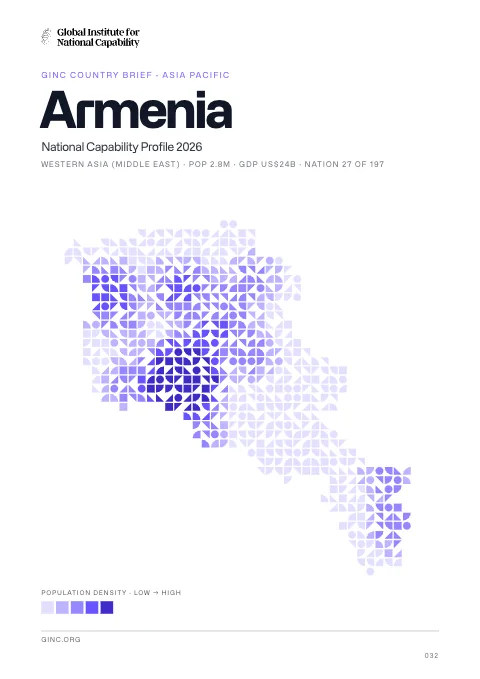
The whole brief
Armenia National Capability Profile 2026
Foundations · Chapter 01
Historical Context
🇦🇲 Armenia’s understanding the origins and evolution of the modern nation
BackgroundBack to top ↑
Armenia prides itself on being the first nation to formally adopt Christianity (early 4th century). Despite periods of autonomy, over the centuries Armenia came under the sway of various empires including the Roman, Byzantine, Arab, Persian, and Ottoman. During World War I in the western portion of Armenia, Ottoman Turkey instituted a policy of forced resettlement coupled with other harsh practices that resulted in at least 1 million Armenian deaths. The eastern area of Armenia was ceded by the Ottomans to Russia in 1828; this portion declared its independence in 1918, but was conquered by the Soviet Red Army in 1920. Armenian leaders remain preoccupied by the long conflict with Azerbaijan over Nagorno-Karabakh, a primarily Armenian-populated region, assigned to Soviet Azerbaijan in the 1920s by Moscow. Armenia and Azerbaijan began fighting over the area in 1988; the struggle escalated after both countries attained independence from the Soviet Union in 1991. By May 1994, when a cease-fire took hold, ethnic Armenian forces held not only Nagorno-Karabakh but also a significant portion of Azerbaijan proper. The economies of both sides have been hurt by their inability to make substantial progress toward a peaceful resolution. Turkey closed the common border with Armenia in 1993 in support of Azerbaijan in its conflict with Armenia over control of Nagorno-Karabakh and surrounding areas, further hampering Armenian economic growth. In 2009, senior Armenian leaders began pursuing rapprochement with Turkey, aiming to secure an opening of the border, but Turkey has not yet ratified the Protocols normalizing relations between the two countries. In September 2013, President SARGSIAN announced Armenia would join Russia, Belarus, and Kazakhstan as a member of the Eurasian Economic Union.
IndependenceBack to top ↑
21 September 1991 (from the Soviet Union)
National holidayBack to top ↑
Independence Day, 21 September (1991)
Foundations · Chapter 02
Geography
🇦🇲 Armenia’s territory, resources and strategic position
Location and areaBack to top ↑
Southwestern Asia, between Turkey (to the west) and Azerbaijan
40 00 N, 45 00 E
Middle East
slightly smaller than Maryland
0 km (landlocked)
none (landlocked)
Terrain and resourcesBack to top ↑
Armenian Highland with mountains; little forest land; fast flowing rivers; good soil in Aras River valley
small deposits of gold, copper, molybdenum, zinc, bauxite
2,735 sq km (2006)
Settlement and hazardsBack to top ↑
occasionally severe earthquakes; droughts
landlocked in the Lesser Caucasus Mountains; Sevana Lich (Lake Sevan) is the largest lake in this mountain range
OtherBack to top ↑
7.77 cu km (2011)
soil pollution from toxic chemicals such as DDT; the energy crisis of the 1990s led to deforestation when citizens scavenged for firewood; pollution of Hrazdan (Razdan) and Aras Rivers; the draining of Sevana Lich (Lake Sevan), a result of its use as a source for hydropower, threatens drinking water supplies; restart of Metsamor nuclear power plant in spite of its location in a seismically active zone
Foundations · Chapter 03
Environment
🇦🇲 Armenia’s environmental conditions, resources and national resilience
ClimateBack to top ↑
highland continental, hot summers, cold winters
Emissions and pollutionBack to top ↑
Water, waste and foodBack to top ↑
Resources and agreementsBack to top ↑
GINC Capability Domains · Chapter 04
Critical Technology
🇦🇲 Armenia’s technology frontiers and the pursuit of national advantage
Two counts are set side by side for 2015–2024: on the left, the papers researchers in Armenia published; on the right, the patent families that began there and were filed in more than one country. First by capability group, then group by group with each group’s capabilities. The badge on a card is the nation’s place among all nations. Papers are from GINC Research Analytics, patent families from GINC Patents.
Research by capability group
#111 WorldPapers published, 2015–2024
Patents by capability group
#81 WorldInternational patent families, 2015–2024
Advanced Materials & ManufacturingBack to top ↑
Research
#91 WorldPapers published, 2015–2024
Patents
#85 WorldInternational patent families, 2015–2024
Energy TechnologiesBack to top ↑
Research
#110 WorldPapers published, 2015–2024
Patents
#71 WorldInternational patent families, 2015–2024
Semiconductors & Advanced ComputingBack to top ↑
Research
#88 WorldPapers published, 2015–2024
No research topic: Semiconductor Design & EDA · Advanced Semiconductor Fabrication · Semiconductor Equipment & Materials · Advanced Packaging & Heterogeneous Integration
Patents
#69 WorldInternational patent families, 2015–2024
Artificial IntelligenceBack to top ↑
Research
#116 WorldPapers published, 2015–2024
Patents
#78 WorldInternational patent families, 2015–2024
Quantum TechnologiesBack to top ↑
Research
#79 WorldPapers published, 2015–2024
Patents
International patent families, 2015–2024
No international patent families on record for 2015–2024.
Connectivity, Cyber & Trust TechnologiesBack to top ↑
Research
#139 WorldPapers published, 2015–2024
Patents
#87 WorldInternational patent families, 2015–2024
Sensing, Timing & NavigationBack to top ↑
Research
#100 WorldPapers published, 2015–2024
Patents
#62 WorldInternational patent families, 2015–2024
Robotics & Autonomous SystemsBack to top ↑
Research
#115 WorldPapers published, 2015–2024
No research topic: Human-Machine Interfaces
Patents
#67 WorldInternational patent families, 2015–2024
Biotechnology & Health TechnologiesBack to top ↑
Research
#121 WorldPapers published, 2015–2024
Patents
International patent families, 2015–2024
No international patent families on record for 2015–2024.
Medicine and BioTech
Clinical research and life-science invention, drawn from the same series that drive the metric pages. Each card opens the full cross-country comparison.
Space TechnologiesBack to top ↑
Research
#79 WorldPapers published, 2015–2024
Patents
International patent families, 2015–2024
No international patent families on record for 2015–2024.
GINC Capability Domains · Chapter 05
Strategic Infrastructure
🇦🇲 Armenia’s energy, connectivity and the material foundations of capability
Resource InfrastructureBack to top ↑
0 bbl/day (2013 est.)
0 bbl/day (2013 est.)
0 bbl/day (2013 est.)
0 bbl (1 January 2013 est.)
0 bbl/day (2013 est.)
45,300 bbl/day (2011 est.)
32 bbl/day (2010 est.)
46,550 bbl/day (2010 est.)
0 cu m (2013 est.)
2.1 billion cu m (2013 est.)
0 cu m (2013 est.)
2.1 billion cu m (2013 est.)
0 cu m (1 January 2013 est.)
gas 2,233 km (2013)
Agriculture & Food InfrastructureBack to top ↑
- Irrigation & Agricultural Water
- Livestock & Veterinary
- Fisheries & Aquaculture
- Storage, Cold Chain & Markets
Energy InfrastructureBack to top ↑
- Thermal Generation
- Nuclear Generation
- Nuclear Fuel Cycle & Radioactive Waste
- Hydropower
- Renewable Generation
- Transmission & Distribution
- System Control & Dispatch
- Storage & Fuel Supply
3.472 million kW (2010 est.)
7.432 billion kWh (2011 est.)
5.8 billion kWh (2011 est.)
1.36 billion kWh (2011 est.)
246 million kWh (2010 est.)
55.6% of total installed capacity (2010 est.)
10.8% of total installed capacity (2010 est.)
33.5% of total installed capacity (2010 est.)
0.1% of total installed capacity (2010 est.)
11.74 million Mt (2011 est.)
Water, Sanitation & Waste InfrastructureBack to top ↑
- Dams, Reservoirs & Flood Defence
- Water Supply & Treatment
- Bulk Water Transfer & Desalination
- Wastewater & Sanitation
- Solid Waste & Recycling
Advanced ManufacturingBack to top ↑
- Materials & Inputs
- Chemicals & Hazardous Process Industry
- Production Systems
- Supply Chain & Ecosystem
- Workforce & Innovation
Transport InfrastructureBack to top ↑
- Seaports & Terminals
- Air Infrastructure
- Air Navigation & Traffic Management
- Inland Waterways & Ferries
- Rail Infrastructure
- Roads & Bridges
- Logistics, Multimodal & Border Infrastructure
- Postal & Parcel
11 (2013)
Communications & Digital InfrastructureBack to top ↑
- Subsea Cables & International Gateways
- Core & Backbone Networks
- Mobile & Wireless Networks
- Spectrum & Broadcasting
- Data Centres, Compute & Cloud
- Data Resources
- AI Tools & Applications
584,000 (2012)
3.223 million (2012)
208,200 (2009)
194,142 (2012)
.am
Financial InfrastructureBack to top ↑
- Currency & Reserves
- Payments & Settlement Systems
- Markets, Exchanges & Depositories
- Banks, Insurers & Systemic Institutions
Social InfrastructureBack to top ↑
- Health Infrastructure
- Public Health & Laboratories
- Medical Supply & Stockpiles
- Education & Skills Infrastructure
- Research & Scientific Facilities
- Housing, Community & Social Services
- Government & Public Administration
- Cultural, Community & Recreational Infrastructure
- Justice & Corrections
- Emergency Services & Civil Protection
- Hydrometeorology & Early Warning
Space, Aerospace & Defence InfrastructureBack to top ↑
GINC Capability Domains · Chapter 06
National Security
🇦🇲 Armenia’s force, intelligence and the defence of the nation
Disputes and terrorismBack to top ↑
the dispute over the break-away Nagorno-Karabakh region and the Armenian military occupation of surrounding lands in Azerbaijan remains the primary focus of regional instability; residents have evacuated the former Soviet-era small ethnic enclaves in Armenia and Azerbaijan; Turkish authorities have complained that blasting from quarries in Armenia might be damaging the medieval ruins of Ani, on the other side of the Arpacay valley; in 2009, Swiss mediators facilitated an accord reestablishing diplomatic ties between Armenia and Turkey, but neither side has ratified the agreement and the rapprochement effort has faltered; local border forces struggle to control the illegal transit of goods and people across the porous, undemarcated Armenian, Azerbaijani, and Georgian borders; ethnic Armenian groups in the Javakheti region of Georgia seek greater autonomy from the Georgian Government
Force Generation & MobilisationBack to top ↑
Armenian Armed Forces: Ground Forces, Air Force and Air Defense; "Nagorno-Karabakh Republic": Nagorno-Karabakh Self-Defense Force (NKSDF) (2011)
18-27 years of age for voluntary or compulsory military service; 2-year conscript service obligation; 17 year olds are eligible to become cadets at military higher education institutes, where they are classified as military personnel (2012)
3.92% of GDP (2012)//3.87% of GDP (2011)//3.92% of GDP (2010)
Forces under arms
Active-duty strength on the Correlates of War series, which reaches back to 1816 and so carries a nation’s whole record of mobilisation rather than its present establishment. The card opens the full cross-country comparison.
Intelligence & AssessmentBack to top ↑
- Imagery & Geospatial Intelligence
- Signals & Cyber Intelligence
- Technical & Measurement Intelligence
- Open-Source & Financial Intelligence
- Human Intelligence & Counterintelligence
- All-Source Analysis & Warning
Joint Command, Projection & SustainmentBack to top ↑
- Command, Control & Communications
- Strategic Lift & Mobility
- Expeditionary & Peace Operations
- Operational Sustainment & War Reserves
- Defence Industrial Mobilisation
- CBRN Defence
Land PowerBack to top ↑
- Combined Arms Manoeuvre
- Land Fires
- Battlefield Aviation & Uncrewed Systems
- Special Operations & Irregular Warfare
Maritime PowerBack to top ↑
- Maritime Security & Constabulary
- Sea Denial & Undersea Warfare
- Sea Control
- Amphibious & Expeditionary Operations
Air PowerBack to top ↑
- Air Sovereignty & Policing
- Control of the Air
- Air Strike & Interdiction
- Airborne ISR, Early Warning & Battle Management
Strategic Strike & Missile DefenceBack to top ↑
Space OperationsBack to top ↑
Cyber & Electromagnetic OperationsBack to top ↑
Nuclear DeterrenceBack to top ↑
GINC Capability Domains · Chapter 07
Human Capital
🇦🇲 Armenia’s population, health and the skills that sustain capability
DemographyBack to top ↑
3,060,631 (July 2014 est.)
-0.13% (2014 est.)
13.92 births/1,000 population (2014 est.)
9.3 deaths/1,000 population (2014 est.)
1.64 children born/woman (2014 est.)
23.5 (2011 est.)
54.9% (2010)
Migration and urbanisationBack to top ↑
-5.88 migrant(s)/1,000 population (2014 est.)
YEREVAN (capital) 1.116 million (2011)
Welfare and equityBack to top ↑
35.8% (2010 est.)
30.9 (2008)//44.4 (1996)
DisplacementBack to top ↑
Early Childhood DevelopmentBack to top ↑
5.3% (2010)
Foundational EducationBack to top ↑
3.3% of GDP (2012)
Advanced EducationBack to top ↑
Technical & Vocational SkillsBack to top ↑
Digital & AI CompetenceBack to top ↑
Generative AI adoption
Modelled share of working-age adults using generative AI, from Microsoft telemetry scaled to each country’s 15–64 population. A measure of how fast a workforce is absorbing the technology rather than of how much of it a nation builds. The card opens the full cross-country comparison.
Lifelong Learning & ReskillingBack to top ↑
Research Talent & Knowledge CreationBack to top ↑
Population HealthBack to top ↑
30 deaths/100,000 live births (2010)
24% (2008)
0.2% (2012 est.)
3,500 (2012 est.)
200 (2012 est.)
Health System CapabilityBack to top ↑
4.3% of GDP (2011)
2.85 physicians/1,000 population (2011)
4 beds/1,000 population (2011)
GINC Capability Domains · Chapter 08
Governance and Integrity
🇦🇲 Armenia’s institutions, law and the integrity of the state
State structureBack to top ↑
republic
11 provinces (marzer, singular - marz); Aragatsotn, Ararat, Armavir, Geghark'unik', Kotayk', Lorri, Shirak, Syunik', Tavush, Vayots' Dzor, Yerevan
previous 1915, 1978; latest adopted 5 July 1995; amended 2005 (2013)
18 years of age; universal
Political Institutions & Civic ParticipationBack to top ↑
- Electoral Management & Integrity
- Legislature & Deliberative Institutions
- Citizen Participation & Civic Space
unicameral National Assembly (Parliament) or Azgayin Zhoghov (131 seats; members elected by popular vote, 90 members elected by party list and 41 by direct vote; to serve five-year terms)
Armenian National Congress or ANC (bloc of independent and opposition parties) [Levon TER-PETROSSIAN]//Armenian National Movement or ANM [Ararat ZURABIAN]//Armenian Revolutionary Federation ("Dashnak" Party) or ARF [Hrant MARKARIAN]//Heritage Party [Raffi HOVHANNISIAN]//People's Party of Armenia [Stepan DEMIRCHIAN]//Prosperous Armenia [Gagik TSARUKIAN]//Republican Party of Armenia or RPA [Serzh SARGSIAN]//Rule of Law Party (Orinats Yerkir) [Artur BAGHDASARIAN]
Aylentrank (Impeachment Alliance) [Nikol PASHINIAN]//Yerkrapah Union [Manvel GRIGORIAN]
Justice System & Fundamental RightsBack to top ↑
- Judicial Independence & Court Capability
- Access to Justice & Legal Services
- Fundamental Rights Protection
- Human Rights Institutions & Equality Bodies
civil law system
has not submitted an ICJ jurisdiction declaration; non-party state to the ICCt
Internal Security & OrderBack to top ↑
illicit cultivation of small amount of cannabis for domestic consumption; minor transit point for illicit drugs - mostly opium and hashish - moving from Southwest Asia to Russia and to a lesser extent the rest of Europe
Regulatory Governance & Strategic ControlsBack to top ↑
- Regulatory Quality & Better Regulation
- Regulatory Delivery & Independent Regulators
- Strategic Controls & Economic Security Administration
Government Effectiveness & Public AdministrationBack to top ↑
- Centre of Government & Policy Coordination
- Civil Service & Public Workforce
- Digital Government & Service Delivery
- Legal Identity & Civil Registration
- Statistical & Data Capability
Public Integrity & Anti-CorruptionBack to top ↑
Transparency, Oversight & AccountabilityBack to top ↑
- Right to Information & Open Government
- Independent Oversight & Supreme Audit
- Independent Media & Journalist Safety
National Resilience & Crisis ManagementBack to top ↑
GINC Capability Domains · Chapter 09
Information and Influence
🇦🇲 Armenia’s identity, media and the projection of influence
Identity and cultureBack to top ↑
Armenian (official) 97.9%, Kurdish (spoken by Yezidi minority) 1%, other 1% (2011 est.)
Armenian Apostolic 92.6%, Evangelical 1%, other 2.4%, none 1.1%, unspecified 2.9% (2011 est.)
Armenian 98.1%, Yezidi (Kurd) 1.1%, other 0.7% (2011 est.)
Mount Ararat; eagle; lion
three equal horizontal bands of red (top), blue, and orange; the color red recalls the blood shed for liberty, blue the Armenian skies as well as hope, and orange the land and the courage of the workers who farm it
Diplomatic Statecraft & Global NetworksBack to top ↑
- Diplomatic Network & Consular Reach
- Multilateral Leadership & Norm Setting
- Agenda-Setting & Convening
- Mediation & Crisis Diplomacy
ADB, BSEC, CD, CE, CIS, CSTO, EAEC (observer), EAPC, EBRD, FAO, GCTU, IAEA, IBRD, ICAO, ICC (NGOs), ICRM, IDA, IFAD, IFC, IFRCS, ILO, IMF, Interpol, IOC, IOM, IPU, ISO, ITSO, ITU, MIGA, NAM (observer), OAS (observer), OIF, OPCW, OSCE, PFP, UN, UNCTAD, UNESCO, UNIDO, UNIFIL, UNWTO, UPU, WCO, WFTU (NGOs), WHO, WIPO, WMO, WTO
Alliances & Security CooperationBack to top ↑
Development Cooperation & Global AssistanceBack to top ↑
Culture, Language & Education DiplomacyBack to top ↑
- Cultural & Language Institutes
- Creative Industries & Cultural Export Reach
- Heritage & Cultural Institutions
- Education Diplomacy & Alumni Networks
- Sports & Major Events
Diaspora & Global CommunitiesBack to top ↑
Information Environment & Strategic CommunicationBack to top ↑
- Strategic Communications & Public Diplomacy
- International Media & Broadcasting
- Information Defence & Counter-Interference
2 public TV networks operating alongside more than 40 privately owned TV stations that provide local to near nationwide coverage; major Russian broadcast stations are widely available; subscription cable TV services are available in most regions; Public Radio of Armenia is a national, state-run broadcast network that operates alongside about 20 privately owned radio stations; several major international broadcasters are available (2008)
GINC Capability Domains · Chapter 10
Financial Strength
🇦🇲 Armenia’s fiscal depth, reserves and the capacity to act
Monetary & Currency CapabilityBack to top ↑
- Monetary Policy & Price Stability
- Exchange Rate & External Account Management
- Currency Issuance & Digital Money
6.2% (2013 est.)//2.6% (2012 est.)
drams (AMD) per US dollar -//410.5 (2013 est.)//401.76 (2012 est.)//373.66 (2010 est.)//363.28 (2009)//303.93 (2008)
$NA (11 January 2012)//7.25% (2 December 2008)
16.5% (31 December 2013 est.)//17.23% (31 December 2012 est.)
$1.418 billion (31 December 2013 est.)//$1.352 billion (31 December 2012 est.)
$2.051 billion (31 December 2013 est.)//$1.829 billion (31 December 2012 est.)
Fiscal Capacity & Public FinanceBack to top ↑
- Revenue Mobilisation & Tax Administration
- Public Expenditure & Budget Management
- Sovereign Debt & Treasury Management
- Public Investment Management
25.6% of GDP (2013 est.)
-0.3% of GDP (2013 est.)
37.7% of GDP (2013 est.)//41.4% of GDP (2012 est.)
calendar year
Financial System Depth & AccessBack to top ↑
- Banking System Capacity
- Capital Markets Depth & Development
- Long-Term & Institutional Capital
- Financial Inclusion & Household Access
- Development & Policy Finance
$4.355 billion (31 December 2012 est.)//$3.548 billion (31 December 2011 est.)
$132.1 million (31 December 2012 est.)//$139.6 million (31 December 2011)//$144.8 million (31 December 2010 est.)
16.2% of GDP (2013 est.)//13.2% of GDP (2012 est.)//16.1% of GDP (2011 est.)
Financial Regulation & IntegrityBack to top ↑
- Prudential Regulation & Supervision
- Financial Integrity & Illicit Finance Control
- Market Conduct & Consumer Protection
- Payment & Market Infrastructure Oversight
Financial Stability & Crisis ManagementBack to top ↑
- Macroprudential & Systemic Oversight
- Crisis Management, Resolution & Deposit Insurance
- External Liquidity & Financial Safety Nets
Sovereign Capital & External Financial PowerBack to top ↑
- Official Reserves Management
- Sovereign Wealth & Public Asset Management
- Currency Internationalisation & Reserve Status
- Capital Account & Flow Management
- International Financial Centre Capability
$1.863 billion (31 December 2013 est.)//$1.799 billion (31 December 2012 est.)
$7.839 billion (31 December 2013 est.)//$7.633 billion (31 December 2012 est.)
GINC Capability Domains · Chapter 11
Production and Innovation
🇦🇲 Armenia’s output, industry and the engine of prosperity
Economic Output & ProductivityBack to top ↑
After several years of double-digit economic growth, Armenia faced a severe economic recession with GDP declining more than 14% in 2009, despite large loans from multilateral institutions. Sharp declines in the construction sector and workers' remittances, particularly from Russia, led the downturn. The economy began to recover in 2010 with 2.1% growth, and has grown even faster in the three years since then. Under the old Soviet central planning system, Armenia developed a modern industrial sector, supplying machine tools, textiles, and other manufactured goods to sister republics, in exchange for raw materials and energy. Armenia has since switched to small-scale agriculture and away from the large agroindustrial complexes of the Soviet era. Armenia's geographic isolation, a narrow export base, and pervasive monopolies in important business sectors have made it particularly vulnerable to the sharp deterioration in the global economy and the economic downturn in Russia. Since August 2011, Armenia has experienced a sharp currency depreciation. Armenia has only two open trade borders - Iran and Georgia - because its borders with Azerbaijan and Turkey have been closed since 1991 and 1993, respectively, as a result of Armenia's ongoing conflict with Azerbaijan over the separatist Nagorno-Karabakh region. Armenia is particularly dependent on Russian commercial and governmental support and most key Armenian infrastructure is Russian-owned and/or managed, especially in the energy sector. The electricity distribution system was privatized in 2002 and bought by Russia's RAO-UES in 2005. Natural gas is primarily imported from Russia but construction of a pipeline to deliver natural gas from Iran to Armenia was completed in December 2008, and gas deliveries expanded after the April 2010 completion of the Yerevan Thermal Power Plant. Armenia's severe trade imbalance has been offset somewhat by international aid, remittances from Armenians working abroad, and foreign direct investment. Armenia joined the WTO in January 2003. The government made some improvements in tax and customs administration in recent years, but anti-corruption measures have been ineffective and the economic downturn has led to a sharp drop in tax revenue and forced the government to accept large loan packages from Russia, the IMF, and other international financial institutions. Amendments to tax legislation, including the introduction of the first ever "luxury tax" in 2011, aim to increase the ratio of budget revenues to GDP, which still remains at low levels. Armenia will need to pursue additional economic reforms and to strengthen the rule of law in order to regain economic growth and improve economic competitiveness and employment opportunities, especially given its economic isolation from two of its nearest neighbors, Turkey and Azerbaijan.
$20.61 billion (2013 est.)//$19.7 billion (2012 est.)//$18.38 billion (2011 est.)
4.6% (2013 est.)//7.2% (2012 est.)//4.7% (2011 est.)
$6,300 (2013 est.)//$6,000 (2012 est.)//$5,600 (2011 est.)
$10.44 billion (2013 est.)
Labour & EmploymentBack to top ↑
- Employment & Labour Force Participation
- Labour Market Institutions & Wage Setting
- Employment Services & Skills Matching
- Labour Adjustment, Transition & Formalisation
1.394 million (2013 est.)
17.3% (2012 est.)//18.4% (2011 est.)
Industrial & Sectoral BaseBack to top ↑
- Manufacturing & Advanced Industry
- Foundational & Process Industries
- Agrifood & Primary Production
- Services Economy
fruit (especially grapes), vegetables; livestock
diamond processing, metal-cutting machine tools, forging and pressing machines, electric motors, tires, knitted wear, hosiery, shoes, silk fabric, chemicals, trucks, instruments, microelectronics, jewelry, software, food processing, brandy, mining
3.9% (2013 est.)
Structural Transformation & ComplexityBack to top ↑
Business Dynamism & EntrepreneurshipBack to top ↑
- Entrepreneurship & Firm Creation
- Risk Capital & Scale-Up Finance
- Firm Growth, Exit & Renewal
- Competition & Market Contestability
Innovation & CommercialisationBack to top ↑
- Business Innovation Capability
- Research Commercialisation & Knowledge Transfer
- Intellectual Property & Intangible Assets
- Innovation Ecosystems & Clusters
Technology Adoption & DiffusionBack to top ↑
GINC Capability Domains · Chapter 12
Trade and Investment
🇦🇲 Armenia’s markets, capital and the terms of global exchange
Overall tradeBack to top ↑
$13.4B of exports to 136 partners and $17.6B of imports from 184 in 2024, a deficit of $4.16B.
- Exports
- $13.4B136 partners
- Imports
- $17.6B184 partners
- Balance
- −$4.16Bdeficit
- Total trade
- $31.0B2024
ExportsBack to top ↑
Where its exports go
The largest partners in 2024, with each one's share of the nation's exports.
| Partner | Value | Share | |
|---|---|---|---|
| United Arab Emirates | $5.25B | 39% | |
| Russia | $3.14B | 23% | |
| Hong Kong | $1.78B | 13% | |
| China | $1.10B | 8.2% | |
| Iraq | $246M | 1.8% | |
| Georgia | $240M | 1.8% | |
| Netherlands | $132M | 1.0% | |
| Switzerland | $122M | 0.9% | |
| Belgium | $119M | 0.9% | |
| Belarus | $114M | 0.8% | |
| Iran | $108M | 0.8% | |
| Thailand | $83.3M | 0.6% | |
| Germany | $82.4M | 0.6% | |
| Kazakhstan | $79.7M | 0.6% | |
| United States | $73.4M | 0.5% | |
| Italy | $67.1M | 0.5% | |
| Bulgaria | $63.8M | 0.5% | |
| Slovakia | $52.2M | 0.4% | |
| South Korea | $48.1M | 0.4% | |
| Japan | $42.7M | 0.3% |
What it exports
The largest categories in 2024.
| Category | Value | Share | |
|---|---|---|---|
| Pearls, precious stones, metals, coins | $8.08B | 60% | |
| Ores slag and ash | $1.02B | 7.6% | |
| Electrical, electronic equipment | $1.01B | 7.6% | |
| Tobacco and manufactures tobacco substitutes | $431M | 3.2% | |
| Beverages, spirits and vinegar | $412M | 3.1% | |
| Articles of apparel, not knit or crocheted | $345M | 2.6% | |
| Machinery, nuclear reactors, boilers | $326M | 2.4% | |
| Iron and steel | $257M | 1.9% | |
| Optical, photo, technical, medical apparatus | $141M | 1.0% | |
| Articles of apparel, knit or crocheted | $111M | 0.8% | |
| Vehicles other than railway, tramway | $100M | 0.7% | |
| Aluminum | $99.6M | 0.7% | |
| Mineral fuels, oils, distillation products | $84.4M | 0.6% | |
| Edible vegetables and certain roots and tubers | $77.1M | 0.6% | |
| Edible fruits, nuts, peel of citrus fruit, melons | $59.4M | 0.4% |
ImportsBack to top ↑
Where its imports come from
The largest partners in 2024, with each one's share of the nation's imports.
| Partner | Value | Share | |
|---|---|---|---|
| Russia | $9.24B | 53% | |
| China | $1.67B | 9.5% | |
| Vietnam | $881M | 5.0% | |
| Iran | $629M | 3.6% | |
| Georgia | $530M | 3.0% | |
| Germany | $402M | 2.3% | |
| Italy | $350M | 2.0% | |
| Turkey | $332M | 1.9% | |
| India | $318M | 1.8% | |
| Curaçao | $237M | 1.3% | |
| United States | $234M | 1.3% | |
| Egypt | $184M | 1.0% | |
| France | $162M | 0.9% | |
| Japan | $107M | 0.6% | |
| Czech Republic | $101M | 0.6% | |
| South Korea | $97.3M | 0.6% | |
| Netherlands | $95.5M | 0.5% | |
| Poland | $94.2M | 0.5% | |
| Belarus | $90.5M | 0.5% | |
| Brazil | $88.5M | 0.5% |
What it imports
The largest categories in 2024.
| Category | Value | Share | |
|---|---|---|---|
| Pearls, precious stones, metals, coins | $7.40B | 42% | |
| Electrical, electronic equipment | $1.59B | 9.0% | |
| Machinery, nuclear reactors, boilers | $1.29B | 7.3% | |
| Mineral fuels, oils, distillation products | $1.07B | 6.1% | |
| Vehicles other than railway, tramway | $803M | 4.6% | |
| Optical, photo, technical, medical apparatus | $354M | 2.0% | |
| Plastics | $269M | 1.5% | |
| Iron and steel | $236M | 1.3% | |
| Articles of apparel, not knit or crocheted | $219M | 1.2% | |
| Pharmaceutical products | $201M | 1.1% | |
| Articles of apparel, knit or crocheted | $187M | 1.1% | |
| Paper and paperboard, articles of pulp, paper and board | $182M | 1.0% | |
| Articles of iron or steel | $179M | 1.0% | |
| Furniture, lighting signs, prefabricated buildings | $155M | 0.9% | |
| Tobacco and manufactures tobacco substitutes | $140M | 0.8% |
In a list, the bar runs to the largest in that list. The line is each figure’s history from 2000, drawn to its own peak: it shows the shape of the years, and the value shows the size.
External balanceBack to top ↑
-$720.6 million (2013 est.)//-$1.052 billion (2012 est.)
Trade Facilitation & LogisticsBack to top ↑
Trade Policy & Market AccessBack to top ↑
- Trade Policy & Negotiation Capability
- Market Access & Agreements Network
- Trade Law & Enforcement
- Standards, Conformity & Quality Infrastructure
Digital & Services TradeBack to top ↑
- Services Trade Capability
- Digital Trade & E-Commerce
- Data Flows & Digital Trade Governance
- Tourism & Visitor Economy
Investment Attraction & ProjectionBack to top ↑
- Investment Attraction & Facilitation
- Investment Absorption & Linkages
- Outward Investment & Global Corporate Presence
Export Capability & SophisticationBack to top ↑
$1.653 billion (2013 est.)//$1.588 billion (2012 est.)
Russia 19.6%, Germany 10.7%, Bulgaria 9.1%, Belgium 8.9%, Iran 6.9%, US 6.1%, Canada 6%, Georgia 5.7%, Netherlands 5.6%, Switzerland 5% (2012)
pig iron, unwrought copper, nonferrous metals, diamonds, mineral products, foodstuffs, energy
Global Value Chain PositionBack to top ↑
- Value Chain Participation & Integration
- Value Chain Position & Upgrading
- Regional Integration & Hub Anchoring
Economic Leverage & DependenceBack to top ↑
- Strategic Supply Security
- Concentration Risk & Revenue Stabilisation
- Economic Leverage & Coercion Resistance
$3.459 billion (2013 est.)//$3.656 billion (2012 est.)
Russia 20%, Germany 11%, Bulgaria 9%, Belgium 9%, Iran 6.5%, US 6.1%, Canada 5.9%, Netherlands 5.6%, Georgia 5.6%, Switzerland 5.2% (2012 est.)
natural gas, petroleum, tobacco products, foodstuffs, diamonds
Armenia · you are in
Historical Context
Foundations
GINC Capability Domains
Find in this brief · Armenia