
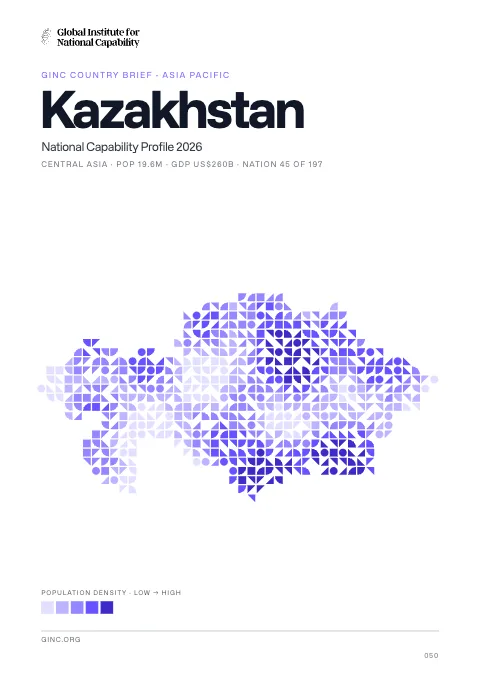
Kazakhstan
Kazakhstan is a landlocked republic in Central Asia, home to 18 million people, with its capital at Astana, and the world’s 9th-largest country by area.
Contents
12 chapters
Foundations
01–03
At a glance
- Area
- 2.7Mkm²#9 World#2 C. Asia
- Population
- 17.9M#61 World#3 C. Asia
- GDP (market)
- $225B
- GDP (PPP)
- $243.6B#52 World#2 C. Asia
- GDP per capita
- $14.1K#97 World#2 C. Asia
The whole brief
Kazakhstan National Capability Profile 2026
Foundations · Chapter 01
Historical Context
🇰🇿 Kazakhstan’s understanding the origins and evolution of the modern nation
BackgroundBack to top ↑
Ethnic Kazakhs, a mix of Turkic and Mongol nomadic tribes who migrated to the region by the 13th century, were rarely united as a single nation. The area was conquered by Russia in the 18th century, and Kazakhstan became a Soviet Republic in 1936. During the 1950s and 1960s agricultural "Virgin Lands" program, Soviet citizens were encouraged to help cultivate Kazakhstan's northern pastures. This influx of immigrants (mostly Russians, but also some other deported nationalities) skewed the ethnic mixture and enabled non-ethnic Kazakhs to outnumber natives. Non-Muslim ethnic minorities departed Kazakhstan in large numbers from the mid-1990s through the mid-2000s and a national program has repatriated about a million ethnic Kazakhs back to Kazakhstan. These trends have allowed Kazakhs to become the titular majority again. This dramatic demographic shift has also undermined the previous religious diversity and made the country more than 70 percent Muslim. Kazakhstan's economy is larger than those of all the other Central Asian states largely due to the country's vast natural resources. Current issues include: developing a cohesive national identity; managing Islamic revivalism; expanding the development of the country's vast energy resources and exporting them to world markets; diversifying the economy outside the oil, gas, and mining sectors; enhancing Kazakhstan's economic competitiveness; developing a multiparty parliament and advancing political and social reform; and strengthening relations with neighboring states and other foreign powers.
IndependenceBack to top ↑
16 December 1991 (from the Soviet Union)
National holidayBack to top ↑
Independence Day, 16 December (1991)
Foundations · Chapter 02
Geography
🇰🇿 Kazakhstan’s territory, resources and strategic position
Location and areaBack to top ↑
Central Asia, northwest of China; a small portion west of the Ural (Zhayyq) River in eastern-most Europe
48 00 N, 68 00 E
Asia
slightly less than four times the size of Texas
0 km (landlocked); note - Kazakhstan borders the Aral Sea, now split into two bodies of water (1,070 km), and the Caspian Sea (1,894 km)
none (landlocked)
Terrain and resourcesBack to top ↑
vast flat steppe extending from the Volga in the west to the Altai Mountains in the east and from the plains of western Siberia in the north to oases and deserts of Central Asia in the south
major deposits of petroleum, natural gas, coal, iron ore, manganese, chrome ore, nickel, cobalt, copper, molybdenum, lead, zinc, bauxite, gold, uranium
20,660 sq km (2010)
Settlement and hazardsBack to top ↑
earthquakes in the south; mudslides around Almaty
world's largest landlocked country; Russia leases approximately 6,000 sq km of territory enclosing the Baykonur Cosmodrome; in January 2004, Kazakhstan and Russia extended the lease to 2050
OtherBack to top ↑
107.5 cu km (2011)
radioactive or toxic chemical sites associated with former defense industries and test ranges scattered throughout the country pose health risks for humans and animals; industrial pollution is severe in some cities; because the two main rivers that flowed into the Aral Sea have been diverted for irrigation, it is drying up and leaving behind a harmful layer of chemical pesticides and natural salts; these substances are then picked up by the wind and blown into noxious dust storms; pollution in the Caspian Sea; soil pollution from overuse of agricultural chemicals and salination from poor infrastructure and wasteful irrigation practices
Foundations · Chapter 03
Environment
🇰🇿 Kazakhstan’s environmental conditions, resources and national resilience
ClimateBack to top ↑
continental, cold winters and hot summers, arid and semiarid
Emissions and pollutionBack to top ↑
Water, waste and foodBack to top ↑
Resources and agreementsBack to top ↑
GINC Capability Domains · Chapter 04
Critical Technology
🇰🇿 Kazakhstan’s technology frontiers and the pursuit of national advantage
Two counts are set side by side for 2015–2024: on the left, the papers researchers in Kazakhstan published; on the right, the patent families that began there and were filed in more than one country. First by capability group, then group by group with each group’s capabilities. The badge on a card is the nation’s place among all nations. Papers are from GINC Research Analytics, patent families from GINC Patents.
Research by capability group
#70 WorldPapers published, 2015–2024
565
394
306
245
164
146
70
56
39
10
Patents by capability group
#68 WorldInternational patent families, 2015–2024
Advanced Materials & ManufacturingBack to top ↑
Research
#64 WorldPapers published, 2015–2024
Patents
#61 WorldInternational patent families, 2015–2024
Energy TechnologiesBack to top ↑
Research
#58 WorldPapers published, 2015–2024
Patents
#53 WorldInternational patent families, 2015–2024
Semiconductors & Advanced ComputingBack to top ↑
Research
#67 WorldPapers published, 2015–2024
No research topic: Semiconductor Design & EDA · Advanced Semiconductor Fabrication · Semiconductor Equipment & Materials · Advanced Packaging & Heterogeneous Integration
Patents
International patent families, 2015–2024
No international patent families on record for 2015–2024.
Artificial IntelligenceBack to top ↑
Research
#71 WorldPapers published, 2015–2024
Patents
#71 WorldInternational patent families, 2015–2024
Quantum TechnologiesBack to top ↑
Research
#72 WorldPapers published, 2015–2024
Patents
International patent families, 2015–2024
No international patent families on record for 2015–2024.
Connectivity, Cyber & Trust TechnologiesBack to top ↑
Research
#70 WorldPapers published, 2015–2024
Patents
#79 WorldInternational patent families, 2015–2024
Sensing, Timing & NavigationBack to top ↑
Research
#70 WorldPapers published, 2015–2024
Patents
#70 WorldInternational patent families, 2015–2024
Robotics & Autonomous SystemsBack to top ↑
Research
#69 WorldPapers published, 2015–2024
No research topic: Human-Machine Interfaces
Patents
#67 WorldInternational patent families, 2015–2024
Biotechnology & Health TechnologiesBack to top ↑
Research
#86 WorldPapers published, 2015–2024
Patents
#66 WorldInternational patent families, 2015–2024
Medicine and BioTech
Clinical research and life-science invention, drawn from the same series that drive the metric pages. Each card opens the full cross-country comparison.
Space TechnologiesBack to top ↑
Research
#50 WorldPapers published, 2015–2024
Patents
#44 WorldInternational patent families, 2015–2024
GINC Capability Domains · Chapter 05
Strategic Infrastructure
🇰🇿 Kazakhstan’s energy, connectivity and the material foundations of capability
Resource InfrastructureBack to top ↑
1.606 million bbl/day (2012 est.)
1.406 million bbl/day (2010 est.)
119,600 bbl/day (2010 est.)
30 billion bbl (1 January 2013 est.)
288,600 bbl/day (2010 est.)
244,200 bbl/day (2011 est.)
149,800 bbl/day (2011 est.)
94,430 bbl/day (2010 est.)
20.2 billion cu m (2011 est.)
10.2 billion cu m (2011 est.)
9.7 billion cu m (2011 est.)
10.7 billion cu m (2011 est.)
2.407 trillion cu m (1 January 2013 est.)
condensate 658 km; gas 12,432 km; oil 11,313 km; refined products 1,095 km; water 1,465 km (2013)
Agriculture & Food InfrastructureBack to top ↑
- Irrigation & Agricultural Water
- Livestock & Veterinary
- Fisheries & Aquaculture
- Storage, Cold Chain & Markets
Energy InfrastructureBack to top ↑
- Thermal Generation
- Nuclear Generation
- Nuclear Fuel Cycle & Radioactive Waste
- Hydropower
- Renewable Generation
- Transmission & Distribution
- System Control & Dispatch
- Storage & Fuel Supply
18.73 million kW (2010 est.)
90.53 billion kWh (2012 est.)
88.11 billion kWh (2011 est.)
1.8 billion kWh (2011 est.)
3.7 billion kWh (2011 est.)
88.2% of total installed capacity (2010 est.)
0% of total installed capacity (2010 est.)
11.8% of total installed capacity (2010 est.)
0% of total installed capacity (2010 est.)
195.4 million Mt (2011 est.)
Water, Sanitation & Waste InfrastructureBack to top ↑
- Dams, Reservoirs & Flood Defence
- Water Supply & Treatment
- Bulk Water Transfer & Desalination
- Wastewater & Sanitation
- Solid Waste & Recycling
Advanced ManufacturingBack to top ↑
- Materials & Inputs
- Chemicals & Hazardous Process Industry
- Production Systems
- Supply Chain & Ecosystem
- Workforce & Innovation
Transport InfrastructureBack to top ↑
- Seaports & Terminals
- Air Infrastructure
- Air Navigation & Traffic Management
- Inland Waterways & Ferries
- Rail Infrastructure
- Roads & Bridges
- Logistics, Multimodal & Border Infrastructure
- Postal & Parcel
96 (2013)
3 (2013)
4,000 km (on the Ertis (Irtysh) River (80%) and Syr Darya (Syrdariya) River) (2010)
Communications & Digital InfrastructureBack to top ↑
- Subsea Cables & International Gateways
- Core & Backbone Networks
- Mobile & Wireless Networks
- Spectrum & Broadcasting
- Data Centres, Compute & Cloud
- Data Resources
- AI Tools & Applications
4.34 million (2012)
28.731 million (2012)
5.299 million (2009)
67,464 (2012)
.kz
Financial InfrastructureBack to top ↑
- Currency & Reserves
- Payments & Settlement Systems
- Markets, Exchanges & Depositories
- Banks, Insurers & Systemic Institutions
Social InfrastructureBack to top ↑
- Health Infrastructure
- Public Health & Laboratories
- Medical Supply & Stockpiles
- Education & Skills Infrastructure
- Research & Scientific Facilities
- Housing, Community & Social Services
- Government & Public Administration
- Cultural, Community & Recreational Infrastructure
- Justice & Corrections
- Emergency Services & Civil Protection
- Hydrometeorology & Early Warning
Space, Aerospace & Defence InfrastructureBack to top ↑
GINC Capability Domains · Chapter 06
National Security
🇰🇿 Kazakhstan’s force, intelligence and the defence of the nation
Disputes and terrorismBack to top ↑
Kyrgyzstan has yet to ratify the 2001 boundary delimitation with Kazakhstan; field demarcation of the boundaries commenced with Uzbekistan in 2004 and with Turkmenistan in 2005; ongoing demarcation with Russia began in 2007; demarcation with China was completed in 2002; creation of a seabed boundary with Turkmenistan in the Caspian Sea remains under discussion; Azerbaijan, Kazakhstan, and Russia ratified Caspian seabed delimitation treaties based on equidistance, while Iran continues to insist on a one-fifth slice of the sea
Force Generation & MobilisationBack to top ↑
Kazakhstan Armed Forces: Ground Forces, Navy, Air Mobile Forces, Air Defense Forces (2013)
18 is the legal minimum age for compulsory military service; conscript service obligation is 2 years, but Kazakhstan may be transitioning to a contract force; 19 is the legal minimum age for voluntary service; military cadets in intermediate (ages 15-17) and higher (ages 17-21) education institutes are classified as military service personnel (2012)
1.21% of GDP (2012)//0.97% of GDP (2011)//1.21% of GDP (2010)
Forces under arms
Active-duty strength on the Correlates of War series, which reaches back to 1816 and so carries a nation’s whole record of mobilisation rather than its present establishment. The card opens the full cross-country comparison.
Intelligence & AssessmentBack to top ↑
- Imagery & Geospatial Intelligence
- Signals & Cyber Intelligence
- Technical & Measurement Intelligence
- Open-Source & Financial Intelligence
- Human Intelligence & Counterintelligence
- All-Source Analysis & Warning
Joint Command, Projection & SustainmentBack to top ↑
- Command, Control & Communications
- Strategic Lift & Mobility
- Expeditionary & Peace Operations
- Operational Sustainment & War Reserves
- Defence Industrial Mobilisation
- CBRN Defence
Land PowerBack to top ↑
- Combined Arms Manoeuvre
- Land Fires
- Battlefield Aviation & Uncrewed Systems
- Special Operations & Irregular Warfare
Maritime PowerBack to top ↑
- Maritime Security & Constabulary
- Sea Denial & Undersea Warfare
- Sea Control
- Amphibious & Expeditionary Operations
Air PowerBack to top ↑
- Air Sovereignty & Policing
- Control of the Air
- Air Strike & Interdiction
- Airborne ISR, Early Warning & Battle Management
Strategic Strike & Missile DefenceBack to top ↑
Space OperationsBack to top ↑
Cyber & Electromagnetic OperationsBack to top ↑
Nuclear DeterrenceBack to top ↑
GINC Capability Domains · Chapter 07
Human Capital
🇰🇿 Kazakhstan’s population, health and the skills that sustain capability
DemographyBack to top ↑
17,948,816 (July 2014 est.)
1.17% (2014 est.)
19.61 births/1,000 population (2014 est.)
8.31 deaths/1,000 population (2014 est.)
2.34 children born/woman (2014 est.)
25 (2011 est.)
51% (2011)
Migration and urbanisationBack to top ↑
0.42 migrant(s)/1,000 population (2014 est.)
Almaty 1.426 million; ASTANA (capital) 664,000 (2011)
Welfare and equityBack to top ↑
5.3% (2011 est.)
28.9 (2011)//31.5 (2003)
DisplacementBack to top ↑
Early Childhood DevelopmentBack to top ↑
3.7% (2011)
Foundational EducationBack to top ↑
3.1% of GDP (2009)
Advanced EducationBack to top ↑
Technical & Vocational SkillsBack to top ↑
Digital & AI CompetenceBack to top ↑
Generative AI adoption
Modelled share of working-age adults using generative AI, from Microsoft telemetry scaled to each country’s 15–64 population. A measure of how fast a workforce is absorbing the technology rather than of how much of it a nation builds. The card opens the full cross-country comparison.
Lifelong Learning & ReskillingBack to top ↑
Research Talent & Knowledge CreationBack to top ↑
Population HealthBack to top ↑
51 deaths/100,000 live births (2010)
23.7% (2008)
0.1% (2009 est.)
13,000 (2009 est.)
fewer than 500 (2009 est.)
Health System CapabilityBack to top ↑
3.9% of GDP (2011)
3.84 physicians/1,000 population (2011)
7.6 beds/1,000 population (2009)
GINC Capability Domains · Chapter 08
Governance and Integrity
🇰🇿 Kazakhstan’s institutions, law and the integrity of the state
State structureBack to top ↑
republic; authoritarian presidential rule, with little power outside the executive branch
14 provinces (oblystar, singular - oblys) and 3 cities* (qalalar, singular - qala); Almaty Oblysy, Almaty Qalasy*, Aqmola Oblysy (Astana), Aqtobe Oblysy, Astana Qalasy*, Atyrau Oblysy, Batys Qazaqstan Oblysy [West Kazakhstan] (Oral), Bayqongyr Qalasy [Baykonur]*, Mangghystau Oblysy (Aqtau), Ongtustik Qazaqstan Oblysy [South Kazakhstan] (Shymkent), Pavlodar Oblysy, Qaraghandy Oblysy, Qostanay Oblysy, Qyzylorda Oblysy, Shyghys Qazaqstan Oblysy [East Kazakhstan] (Oskemen), Soltustik Qazaqstan Oblysy [North Kazakhstan] (Petropavlovsk), Zhambyl Oblysy (Taraz)
previous 1937, 1978 (preindependence ); latest adopted 28 January 1993, approved by referendum 30 August 1995, effective 5 September 1995; amended 1998, 2007, 2011 (2012)
18 years of age; universal
Political Institutions & Civic ParticipationBack to top ↑
- Electoral Management & Integrity
- Legislature & Deliberative Institutions
- Citizen Participation & Civic Space
bicameral Parliament consists of the Senate (47 seats; 15 members are appointed by the president; 32 members elected by local assemblies; members serve six-year terms, but elections are staggered with half of the members up for re-election every three years) and the Mazhilis (107 seats; 9 out of the 107 Mazhilis members elected by the Assembly of the People of Kazakhstan, a presidentially appointed advisory body designed to represent the country's ethnic minorities; non-appointed members are popularly elected to serve five-year terms)
Ak Zhol Party (Bright Path) [Azat PERUASHEV]//Alga [Vladimir KOZLOV] (unregistered and banned as extremist in November 2012)//Auyl (Village) [Gani KALIYEV]//Azat (Freedom) Party [Bolat ABILOV] (formerly True Ak Zhol Party)//Birlik (Unity) [Seril SULTANGALI] (Birlik is an April 2013 merger of Adilet (Justice; formerly Democratic Party of Kazakhstan) and Rukhaniyat (Spirituality))//NSDP [Zharmakhan TUYAKBAY]//Communist Party of Kazakhstan or KPK [Serikbolsyn ABDILDIN] (suspended by court decision)//Communist People's Party of Kazakhstan [Vladislav KOSAREV]//National Social Democratic Party or NSDP [Zharmakhan TUYAKBAY]//Nur Otan (Fatherland's Ray of Light) [Nursultan NAZARBAYEV, Nurlan NIGMATULIN] (the Agrarian, Asar, and Civic parties merged with Otan)//Patriots' Party [Gani KASYMOV]
Adil-Soz [Tamara KALEYEVA]//Almaty Helsinki Committee [Ninel FOKINA]//Confederation of Free Trade Unions [Sergei BELKIN]//For Fair Elections [Yevgeniy ZHOVTIS, Sabit ZHUSUPOV, Sergey DUVANOV, Ibrash NUSUPBAYEV]//Kazakhstan International Bureau on Human Rights [Yevgeniy ZHOVTIS, Chairman of Bureau's Council, Roza AKYLBEKOVA, director]//Khalyk Maidany (Peoples' Front) - an informal union between the unregistered Alga Party, the unregistered Communist Party of Kazakhstan, and several opposition-oriented civil society groups, banned in November 2012 [no formal leader]//Pan-National Social Democratic Party of Kazakhstan [Zharmakhan TUYAKBAY]//Pensioners Movement or Pokoleniye [Irina SAVOSTINA, chairwoman]//Republican Network of International Monitors [Daniyar LIVAZOV]//Transparency International [Sergey ZLOTNIKOV]
Justice System & Fundamental RightsBack to top ↑
- Judicial Independence & Court Capability
- Access to Justice & Legal Services
- Fundamental Rights Protection
- Human Rights Institutions & Equality Bodies
civil law system influenced by Roman-Germanic law and by the theory and practice of the Russian Federation
has not submitted an ICJ jurisdiction declaration; non-party state to the ICCt
Internal Security & OrderBack to top ↑
significant illicit cultivation of cannabis for CIS markets, as well as limited cultivation of opium poppy and ephedra (for the drug ephedrine); limited government eradication of illicit crops; transit point for Southwest Asian narcotics bound for Russia and the rest of Europe; significant consumer of opiates
Regulatory Governance & Strategic ControlsBack to top ↑
- Regulatory Quality & Better Regulation
- Regulatory Delivery & Independent Regulators
- Strategic Controls & Economic Security Administration
Government Effectiveness & Public AdministrationBack to top ↑
- Centre of Government & Policy Coordination
- Civil Service & Public Workforce
- Digital Government & Service Delivery
- Legal Identity & Civil Registration
- Statistical & Data Capability
Public Integrity & Anti-CorruptionBack to top ↑
Transparency, Oversight & AccountabilityBack to top ↑
- Right to Information & Open Government
- Independent Oversight & Supreme Audit
- Independent Media & Journalist Safety
National Resilience & Crisis ManagementBack to top ↑
GINC Capability Domains · Chapter 09
Information and Influence
🇰🇿 Kazakhstan’s identity, media and the projection of influence
Identity and cultureBack to top ↑
Kazakh (Qazaq, state language) 64.4%, Russian (official, used in everyday business, designated the "language of interethnic communication") 95% (2001 est.)
Muslim 70.2%, Christian 26.2% (mainly Russian Orthodox), other 0.2%, atheist 2.8%, unspecified 0.5% (2009 est.)
Kazakh (Qazaq) 63.1%, Russian 23.7%, Uzbek 2.9%, Ukrainian 2.1%, Uighur 1.4%, Tatar 1.3%, German 1.1%, other 4.4% (2009 est.)
golden eagle
a gold sun with 32 rays above a soaring golden steppe eagle, both centered on a sky blue background; the hoist side displays a national ornamental pattern "koshkar-muiz" (the horns of the ram) in gold; the blue color is of religious significance to the Turkic peoples of the country, and so symbolizes cultural and ethnic unity; it also represents the endless sky as well as water; the sun, a source of life and energy, exemplifies wealth and plenitude; the sun's rays are shaped like grain, which is the basis of abundance and prosperity; the eagle has appeared on the flags of Kazakh tribes for centuries and represents freedom, power, and the flight to the future
Diplomatic Statecraft & Global NetworksBack to top ↑
- Diplomatic Network & Consular Reach
- Multilateral Leadership & Norm Setting
- Agenda-Setting & Convening
- Mediation & Crisis Diplomacy
ADB, CICA, CIS, CSTO, EAEC, EAPC, EBRD, ECO, EITI (candidate country), FAO, GCTU, IAEA, IBRD, ICAO, ICC (NGOs), ICRM, IDA, IDB, IFAD, IFC, IFRCS, ILO, IMF, IMO, Interpol, IOC, IOM, IPU, ISO, ITSO, ITU, MIGA, NAM (observer), NSG, OAS (observer), OIC, OPCW, OSCE, PFP, SCO, UN, UNCTAD, UNESCO, UNIDO, UNWTO, UPU, WCO, WFTU (NGOs), WHO, WIPO, WMO, WTO (observer), ZC
Alliances & Security CooperationBack to top ↑
Development Cooperation & Global AssistanceBack to top ↑
Culture, Language & Education DiplomacyBack to top ↑
- Cultural & Language Institutes
- Creative Industries & Cultural Export Reach
- Heritage & Cultural Institutions
- Education Diplomacy & Alumni Networks
- Sports & Major Events
Diaspora & Global CommunitiesBack to top ↑
Information Environment & Strategic CommunicationBack to top ↑
- Strategic Communications & Public Diplomacy
- International Media & Broadcasting
- Information Defence & Counter-Interference
state owns nearly all radio and TV transmission facilities and operates national TV and radio networks; nearly all nationwide TV networks are wholly or partly owned by the government; some former state-owned media outlets have been privatized; households with satellite dishes have access to foreign media; a small number of commercial radio stations operate along with state-run radio stations; recent legislation requires all media outlets to register with the government and all TV providers to broadcast in digital format by 2015 (2008)
GINC Capability Domains · Chapter 10
Financial Strength
🇰🇿 Kazakhstan’s fiscal depth, reserves and the capacity to act
Monetary & Currency CapabilityBack to top ↑
- Monetary Policy & Price Stability
- Exchange Rate & External Account Management
- Currency Issuance & Digital Money
5.8% (2013 est.)//5.1% (2012 est.)
tenge (KZT) per US dollar -//151.8 (2013 est.)//149.11 (2012 est.)//147.36 (2010 est.)//147.5 (2009)//120.25 (2008)
5.5% (31 December 2012 est.)//7.5% (31 December 2011 est.)
NA% (31 December 2013 est.)//6.6% (31 December 2012 est.)
$24.51 billion (31 December 2013 est.)//$25.82 billion (31 December 2012 est.)
$70.36 billion (31 December 2012 est.)//$65.71 billion (31 December 2011 est.)
Fiscal Capacity & Public FinanceBack to top ↑
- Revenue Mobilisation & Tax Administration
- Public Expenditure & Budget Management
- Sovereign Debt & Treasury Management
- Public Investment Management
19.5% of GDP (2013 est.)
-2.3% of GDP (2013 est.)
15.6% of GDP (2013 est.)//13.2% of GDP (2012 est.)
calendar year
Financial System Depth & AccessBack to top ↑
- Banking System Capacity
- Capital Markets Depth & Development
- Long-Term & Institutional Capital
- Financial Inclusion & Household Access
- Development & Policy Finance
$87.05 billion (31 December 2013 est.)//$83.08 billion (31 December 2012 est.)
$23.5 billion (31 December 2012 est.)//$43.3 billion (31 December 2011)//$60.74 billion (31 December 2010 est.)
28.8% of GDP (2013 est.)//23.9% of GDP (2012 est.)//28.4% of GDP (2011 est.)
Financial Regulation & IntegrityBack to top ↑
- Prudential Regulation & Supervision
- Financial Integrity & Illicit Finance Control
- Market Conduct & Consumer Protection
- Payment & Market Infrastructure Oversight
Financial Stability & Crisis ManagementBack to top ↑
- Macroprudential & Systemic Oversight
- Crisis Management, Resolution & Deposit Insurance
- External Liquidity & Financial Safety Nets
Sovereign Capital & External Financial PowerBack to top ↑
- Official Reserves Management
- Sovereign Wealth & Public Asset Management
- Currency Internationalisation & Reserve Status
- Capital Account & Flow Management
- International Financial Centre Capability
$29.34 billion (31 December 2013 est.)//$28.28 billion (31 December 2012 est.)
$131.3 billion (31 December 2013 est.)//$133.5 billion (31 December 2012 est.)
GINC Capability Domains · Chapter 11
Production and Innovation
🇰🇿 Kazakhstan’s output, industry and the engine of prosperity
Economic Output & ProductivityBack to top ↑
Kazakhstan, geographically the largest of the former Soviet republics, excluding Russia, possesses enormous fossil fuel reserves and plentiful supplies of other minerals and metals, such as uranium, copper, and zinc. It also has a large agricultural sector featuring livestock and grain. In 2002 Kazakhstan became the first country in the former Soviet Union to receive an investment-grade credit rating. Extractive industries have been and will continue to be the engine of Kazakhstan's growth, although the country is aggressively pursuing diversification strategies. Landlocked, with restricted access to the high seas, Kazakhstan relies on its neighbors to export its products, especially oil and grain. Although its Caspian Sea ports, pipelines, and rail lines carrying oil have been upgraded, civil aviation and roadways continue to need attention. Telecoms are improving, but require considerable investment, as does the information technology base. Supply and distribution of electricity can be erratic because of regional dependencies, but the country is moving forward with plans to improve reliability of electricity and gas supply to its population. At the end of 2007, global financial markets froze up and the loss of capital inflows to Kazakhstani banks caused a credit crunch. The subsequent and sharp fall of oil and commodity prices in 2008 aggravated the economic situation, and Kazakhstan plunged into recession. While the global financial crisis took a significant toll on Kazakhstan's economy, it has rebounded well, helped by prudent government measures. Rising commodity prices have helped the recovery. Despite solid macroeconomic indicators, the government realizes that its economy suffers from an overreliance on oil and extractive industries, the so-called "Dutch disease." In response, Kazakhstan has embarked on an ambitious diversification program, aimed at developing targeted sectors like transport, pharmaceuticals, telecommunications, petrochemicals and food processing. In 2010 Kazakhstan joined the Belarus-Kazakhstan-Russia Customs Union in an effort to boost foreign investment and improve trade relationships.
$243.6 billion (2013 est.)//$231.9 billion (2012 est.)//$220.6 billion (2011 est.)
5% (2013 est.)//5.1% (2012 est.)//7.5% (2011 est.)
$14,100 (2013 est.)//$13,700 (2012 est.)//$13,200 (2011 est.)
$224.9 billion (2013 est.)
Labour & EmploymentBack to top ↑
- Employment & Labour Force Participation
- Labour Market Institutions & Wage Setting
- Employment Services & Skills Matching
- Labour Adjustment, Transition & Formalisation
9.022 million (2013 est.)
5.3% (2013 est.)//5.3% (2012 est.)
Industrial & Sectoral BaseBack to top ↑
- Manufacturing & Advanced Industry
- Foundational & Process Industries
- Agrifood & Primary Production
- Services Economy
grain (mostly spring wheat and barley), potatoes, vegetables, melons; livestock
oil, coal, iron ore, manganese, chromite, lead, zinc, copper, titanium, bauxite, gold, silver, phosphates, sulfur, uranium, iron and steel; tractors and other agricultural machinery, electric motors, construction materials
2.1% (2013 est.)
Structural Transformation & ComplexityBack to top ↑
Business Dynamism & EntrepreneurshipBack to top ↑
- Entrepreneurship & Firm Creation
- Risk Capital & Scale-Up Finance
- Firm Growth, Exit & Renewal
- Competition & Market Contestability
Innovation & CommercialisationBack to top ↑
- Business Innovation Capability
- Research Commercialisation & Knowledge Transfer
- Intellectual Property & Intangible Assets
- Innovation Ecosystems & Clusters
Technology Adoption & DiffusionBack to top ↑
GINC Capability Domains · Chapter 12
Trade and Investment
🇰🇿 Kazakhstan’s markets, capital and the terms of global exchange
Overall tradeBack to top ↑
$90.2B of exports to 140 partners and $62.7B of imports from 179 in 2024, a surplus of $27.5B.
- Exports
- $90.2B140 partners
- Imports
- $62.7B179 partners
- Balance
- +$27.5Bsurplus
- Total trade
- $153B2024
ExportsBack to top ↑
Where its exports go
The largest partners in 2024, with each one's share of the nation's exports.
| Partner | Value | Share | |
|---|---|---|---|
| China | $15.1B | 17% | |
| Russia | $9.55B | 11% | |
| Italy | $6.91B | 7.7% | |
| United Kingdom | $5.97B | 6.6% | |
| Netherlands | $4.97B | 5.5% | |
| Turkey | $4.43B | 4.9% | |
| Greece | $4.23B | 4.7% | |
| France | $3.78B | 4.2% | |
| Germany | $3.23B | 3.6% | |
| Switzerland | $2.89B | 3.2% | |
| Austria | $2.75B | 3.1% | |
| Uzbekistan | $2.74B | 3.0% | |
| Romania | $2.52B | 2.8% | |
| United States | $2.38B | 2.6% | |
| Spain | $1.66B | 1.8% | |
| Bulgaria | $1.56B | 1.7% | |
| South Korea | $1.26B | 1.4% | |
| Morocco | $1.25B | 1.4% | |
| Kyrgyzstan | $1.15B | 1.3% | |
| Tajikistan | $996M | 1.1% |
What it exports
The largest categories in 2024.
| Category | Value | Share | |
|---|---|---|---|
| Mineral fuels, oils, distillation products | $43.4B | 48% | |
| Pearls, precious stones, metals, coins | $9.71B | 11% | |
| Inorganic chemicals, precious metal compound, isotope | $5.84B | 6.5% | |
| Iron and steel | $5.23B | 5.8% | |
| Ores slag and ash | $5.05B | 5.6% | |
| Copper | $4.39B | 4.9% | |
| Machinery, nuclear reactors, boilers | $1.82B | 2.0% | |
| Cereals | $1.48B | 1.6% | |
| Salt, sulphur, earth, stone, plaster, lime and cement | $1.34B | 1.5% | |
| Electrical, electronic equipment | $1.21B | 1.3% | |
| Aluminum | $1.01B | 1.1% | |
| Aircraft, spacecraft | $940M | 1.0% | |
| Zinc | $729M | 0.8% | |
| Milling products, malt, starches, inulin, wheat gluten | $546M | 0.6% | |
| Animal, vegetable fats and oils, cleavage products | $534M | 0.6% |
ImportsBack to top ↑
Where its imports come from
The largest partners in 2024, with each one's share of the nation's imports.
| Partner | Value | Share | |
|---|---|---|---|
| Russia | $18.2B | 29% | |
| China | $15.9B | 25% | |
| Germany | $2.92B | 4.6% | |
| Turkey | $2.14B | 3.4% | |
| United States | $2.12B | 3.4% | |
| South Korea | $2.00B | 3.2% | |
| France | $1.83B | 2.9% | |
| Italy | $1.31B | 2.1% | |
| Uzbekistan | $1.28B | 2.0% | |
| Japan | $1.22B | 1.9% | |
| Poland | $903M | 1.4% | |
| Belarus | $745M | 1.2% | |
| Vietnam | $654M | 1.0% | |
| Spain | $652M | 1.0% | |
| Czech Republic | $585M | 0.9% | |
| Georgia | $562M | 0.9% | |
| Switzerland | $511M | 0.8% | |
| Netherlands | $504M | 0.8% | |
| India | $501M | 0.8% | |
| Kyrgyzstan | $484M | 0.8% |
What it imports
The largest categories in 2024.
| Category | Value | Share | |
|---|---|---|---|
| Machinery, nuclear reactors, boilers | $10.3B | 16% | |
| Vehicles other than railway, tramway | $7.40B | 12% | |
| Electrical, electronic equipment | $5.60B | 8.9% | |
| Articles of iron or steel | $2.44B | 3.9% | |
| Plastics | $2.41B | 3.8% | |
| Pharmaceutical products | $2.33B | 3.7% | |
| Mineral fuels, oils, distillation products | $2.25B | 3.6% | |
| Aircraft, spacecraft | $1.89B | 3.0% | |
| Iron and steel | $1.86B | 3.0% | |
| Optical, photo, technical, medical apparatus | $1.59B | 2.5% | |
| Articles of apparel, knit or crocheted | $1.36B | 2.2% | |
| Articles of apparel, not knit or crocheted | $1.19B | 1.9% | |
| Inorganic chemicals, precious metal compound, isotope | $1.00B | 1.6% | |
| Rubbers | $924M | 1.5% | |
| Essential oils, perfumes, cosmetics, toiletries | $851M | 1.4% |
In a list, the bar runs to the largest in that list. The line is each figure’s history from 2000, drawn to its own peak: it shows the shape of the years, and the value shows the size.
External balanceBack to top ↑
$1.965 billion (2013 est.)//$640.5 million (2012 est.)
Trade Facilitation & LogisticsBack to top ↑
Trade Policy & Market AccessBack to top ↑
- Trade Policy & Negotiation Capability
- Market Access & Agreements Network
- Trade Law & Enforcement
- Standards, Conformity & Quality Infrastructure
Digital & Services TradeBack to top ↑
- Services Trade Capability
- Digital Trade & E-Commerce
- Data Flows & Digital Trade Governance
- Tourism & Visitor Economy
Investment Attraction & ProjectionBack to top ↑
- Investment Attraction & Facilitation
- Investment Absorption & Linkages
- Outward Investment & Global Corporate Presence
$123.5 billion (31 December 2013 est.)//$111.5 billion (31 December 2012 est.)
$26.53 billion (31 December 2013 est.)//$25.53 billion (31 December 2012 est.)
Export Capability & SophisticationBack to top ↑
$87.23 billion (2013 est.)//$86.93 billion (2012 est.)
China 19.3%, Italy 18.1%, Netherlands 8.8%, France 6.6%, Switzerland 5.8%, Austria 5.8% (2012)
oil and oil products, natural gas, ferrous metals, chemicals, machinery, grain, wool, meat, coal
Global Value Chain PositionBack to top ↑
- Value Chain Participation & Integration
- Value Chain Position & Upgrading
- Regional Integration & Hub Anchoring
Economic Leverage & DependenceBack to top ↑
- Strategic Supply Security
- Concentration Risk & Revenue Stabilisation
- Economic Leverage & Coercion Resistance
$52.03 billion (2013 est.)//$49.08 billion (2012 est.)
China 28%, Ukraine 10.9%, Germany 8.5%, US 7.9% (2012)
machinery and equipment, metal products, foodstuffs
Kazakhstan · you are in
Historical Context
Foundations
GINC Capability Domains
Find in this brief · Kazakhstan