
Tajikistan
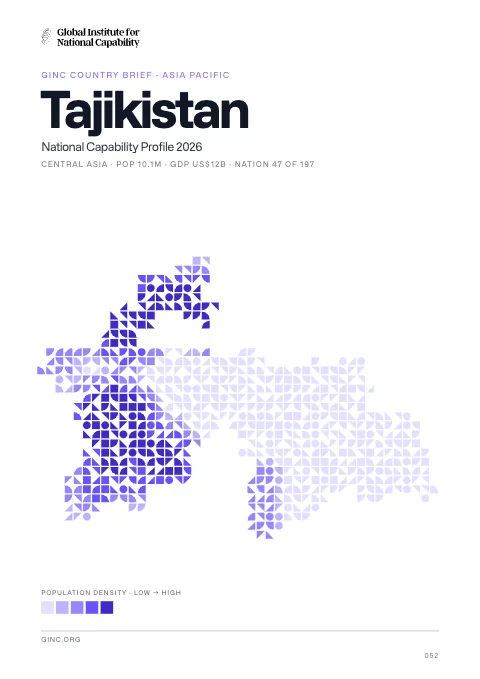
Tajikistan is a landlocked republic in Central Asia, home to 8.1 million people, with its capital at Dushanbe.
Contents
12 chapters
Foundations
01–03
At a glance
- Area
- 143.1Kkm²#96 World#6 C. Asia
- Population
- 8.1M#96 World#4 C. Asia
- GDP (market)
- $8.5B
- GDP (PPP)
- $19.2B#136 World#5 C. Asia
- GDP per capita
- $2.3K#189 World#6 C. Asia
The whole brief
Tajikistan National Capability Profile 2026
Foundations · Chapter 01
Historical Context
🇹🇯 Tajikistan’s understanding the origins and evolution of the modern nation
BackgroundBack to top ↑
The Tajik people came under Russian rule in the 1860s and 1870s, but Russia's hold on Central Asia weakened following the Revolution of 1917. Bands of indigenous guerrillas (called "basmachi") fiercely contested Bolshevik control of the area, which was not fully reestablished until 1925. Tajikistan was first created as an autonomous republic within Uzbekistan in 1924, but the USSR designated Tajikistan a separate republic in 1929 and transferred to it much of present-day Sughd province. Ethnic Uzbeks form a substantial minority in Tajikistan. Tajikistan became independent in 1991 following the breakup of the Soviet Union, and experienced a civil war between regional factions from 1992 to 1997. Tajikistan endured several domestic security incidents during 2010-12, including armed conflict between government forces and local strongmen in the Rasht Valley and between government forces and criminal groups in Gorno-Badakhshan Autonomous Oblast. The country remains the poorest in the former Soviet sphere. Tajikistan became a member of the World Trade Organization in March 2013. However, its economy continues to face major challenges, including dependence on remittances from Tajikistanis working in Russia, pervasive corruption, and the major role narcotrafficking plays in the country's informal economy.
IndependenceBack to top ↑
9 September 1991 (from the Soviet Union)
National holidayBack to top ↑
Independence Day (or National Day), 9 September (1991)
Foundations · Chapter 02
Geography
🇹🇯 Tajikistan’s territory, resources and strategic position
Location and areaBack to top ↑
Central Asia, west of China, south of Kyrgyzstan
39 00 N, 71 00 E
Asia
slightly smaller than Wisconsin
0 km (landlocked)
none (landlocked)
Terrain and resourcesBack to top ↑
Pamir and Alay Mountains dominate landscape; western Fergana Valley in north, Kofarnihon and Vakhsh Valleys in southwest
hydropower, some petroleum, uranium, mercury, brown coal, lead, zinc, antimony, tungsten, silver, gold
7,421 sq km (2009)
Settlement and hazardsBack to top ↑
earthquakes; floods
landlocked; mountainous region dominated by the Trans-Alay Range in the north and the Pamirs in the southeast; highest point, Qullai Ismoili Somoni (formerly Communism Peak), was the tallest mountain in the former USSR
OtherBack to top ↑
21.91 cu km (2011)
inadequate sanitation facilities; increasing levels of soil salinity; industrial pollution; excessive pesticides
Foundations · Chapter 03
Environment
🇹🇯 Tajikistan’s environmental conditions, resources and national resilience
ClimateBack to top ↑
midlatitude continental, hot summers, mild winters; semiarid to polar in Pamir Mountains
Emissions and pollutionBack to top ↑
Water, waste and foodBack to top ↑
Resources and agreementsBack to top ↑
GINC Capability Domains · Chapter 04
Critical Technology
🇹🇯 Tajikistan’s technology frontiers and the pursuit of national advantage
Two counts are set side by side for 2015–2024: on the left, the papers researchers in Tajikistan published; on the right, the patent families that began there and were filed in more than one country. First by capability group, then group by group with each group’s capabilities. The badge on a card is the nation’s place among all nations. Papers are from GINC Research Analytics, patent families from GINC Patents.
Research by capability group
#101 WorldPapers published, 2015–2024
164
69
48
42
23
20
18
17
16
0
Patents by capability group
International patent families, 2015–2024
No international patent families on record for 2015–2024.
Advanced Materials & ManufacturingBack to top ↑
Research
#82 WorldPapers published, 2015–2024
Patents
International patent families, 2015–2024
No international patent families on record for 2015–2024.
Energy TechnologiesBack to top ↑
Research
#86 WorldPapers published, 2015–2024
Patents
International patent families, 2015–2024
No international patent families on record for 2015–2024.
Semiconductors & Advanced ComputingBack to top ↑
Research
#90 WorldPapers published, 2015–2024
No research topic: Semiconductor Design & EDA · Advanced Semiconductor Fabrication · Semiconductor Equipment & Materials · Advanced Packaging & Heterogeneous Integration
Patents
International patent families, 2015–2024
No international patent families on record for 2015–2024.
Artificial IntelligenceBack to top ↑
Research
#128 WorldPapers published, 2015–2024
Patents
International patent families, 2015–2024
No international patent families on record for 2015–2024.
Quantum TechnologiesBack to top ↑
Research
#88 WorldPapers published, 2015–2024
Patents
International patent families, 2015–2024
No international patent families on record for 2015–2024.
Connectivity, Cyber & Trust TechnologiesBack to top ↑
Research
#116 WorldPapers published, 2015–2024
Patents
International patent families, 2015–2024
No international patent families on record for 2015–2024.
Sensing, Timing & NavigationBack to top ↑
Research
#92 WorldPapers published, 2015–2024
Patents
International patent families, 2015–2024
No international patent families on record for 2015–2024.
Robotics & Autonomous SystemsBack to top ↑
Research
#117 WorldPapers published, 2015–2024
No research topic: Human-Machine Interfaces
Patents
International patent families, 2015–2024
No international patent families on record for 2015–2024.
Biotechnology & Health TechnologiesBack to top ↑
Research
#135 WorldPapers published, 2015–2024
Patents
International patent families, 2015–2024
No international patent families on record for 2015–2024.
Medicine and BioTech
Clinical research and life-science invention, drawn from the same series that drive the metric pages. Each card opens the full cross-country comparison.
Space TechnologiesBack to top ↑
- Space Launch & Reusable Systems
- Advanced Propulsion & Hypersonic Systems
- Satellite & Constellation Technologies
GINC Capability Domains · Chapter 05
Strategic Infrastructure
🇹🇯 Tajikistan’s energy, connectivity and the material foundations of capability
Resource InfrastructureBack to top ↑
553 bbl/day (2013 est.)
0 bbl/day (2013 est.)
0 bbl/day (2013 est.)
12 million bbl (1 January 2013 est.)
400 bbl/day
20,090 bbl/day (2013 est.)
500 bbl/day (2013 est.)
20,090 bbl/day (2013 est.)
3.928 million cu m (2013 est.)
3.928 million cu m (2013 est.)
0 cu m (2013 est.)
0 cu m (2013 est.)
5.663 billion cu m (1 January 2013 est.)
gas 549 km; oil 38 km (2013)
Agriculture & Food InfrastructureBack to top ↑
- Irrigation & Agricultural Water
- Livestock & Veterinary
- Fisheries & Aquaculture
- Storage, Cold Chain & Markets
Energy InfrastructureBack to top ↑
- Thermal Generation
- Nuclear Generation
- Nuclear Fuel Cycle & Radioactive Waste
- Hydropower
- Renewable Generation
- Transmission & Distribution
- System Control & Dispatch
- Storage & Fuel Supply
4.476 million kW (2013 est.)
17.09 billion kWh (2013 est.)
16.09 billion kWh (2013 est.)
1 billion kWh (2013 est.)
300.5 million kWh (2012 est.)
9% of total installed capacity (2013 est.)
0% of total installed capacity (2013 est.)
91% of total installed capacity (2013 est.)
0% of total installed capacity (2013 est.)
2.618 million Mt (2013 est.)
Water, Sanitation & Waste InfrastructureBack to top ↑
- Dams, Reservoirs & Flood Defence
- Water Supply & Treatment
- Bulk Water Transfer & Desalination
- Wastewater & Sanitation
- Solid Waste & Recycling
Advanced ManufacturingBack to top ↑
- Materials & Inputs
- Chemicals & Hazardous Process Industry
- Production Systems
- Supply Chain & Ecosystem
- Workforce & Innovation
Transport InfrastructureBack to top ↑
- Seaports & Terminals
- Air Infrastructure
- Air Navigation & Traffic Management
- Inland Waterways & Ferries
- Rail Infrastructure
- Roads & Bridges
- Logistics, Multimodal & Border Infrastructure
- Postal & Parcel
24 (2013)
200 km (along Vakhsh River) (2011)
Communications & Digital InfrastructureBack to top ↑
- Subsea Cables & International Gateways
- Core & Backbone Networks
- Mobile & Wireless Networks
- Spectrum & Broadcasting
- Data Centres, Compute & Cloud
- Data Resources
- AI Tools & Applications
393,000 (2012)
6.528 million (2012)
700,000 (2009)
6,258 (2012)
.tj
Financial InfrastructureBack to top ↑
- Currency & Reserves
- Payments & Settlement Systems
- Markets, Exchanges & Depositories
- Banks, Insurers & Systemic Institutions
Social InfrastructureBack to top ↑
- Health Infrastructure
- Public Health & Laboratories
- Medical Supply & Stockpiles
- Education & Skills Infrastructure
- Research & Scientific Facilities
- Housing, Community & Social Services
- Government & Public Administration
- Cultural, Community & Recreational Infrastructure
- Justice & Corrections
- Emergency Services & Civil Protection
- Hydrometeorology & Early Warning
Space, Aerospace & Defence InfrastructureBack to top ↑
GINC Capability Domains · Chapter 06
National Security
🇹🇯 Tajikistan’s force, intelligence and the defence of the nation
Disputes and terrorismBack to top ↑
in 2006, China and Tajikistan pledged to commence demarcation of the revised boundary agreed to in the delimitation of 2002; talks continue with Uzbekistan to delimit border and remove minefields; disputes in Isfara Valley delay delimitation with Kyrgyzstan
Force Generation & MobilisationBack to top ↑
Ground Forces, Air and Air Defense Forces, Mobile Forces (2013)
18-27 years of age for compulsory or voluntary military service; 2-year conscript service obligation; males required to undergo compulsory military training between ages 16 and 55; males can enroll in military schools from at least age 15 (2012)
Forces under arms
Active-duty strength on the Correlates of War series, which reaches back to 1816 and so carries a nation’s whole record of mobilisation rather than its present establishment. The card opens the full cross-country comparison.
Intelligence & AssessmentBack to top ↑
- Imagery & Geospatial Intelligence
- Signals & Cyber Intelligence
- Technical & Measurement Intelligence
- Open-Source & Financial Intelligence
- Human Intelligence & Counterintelligence
- All-Source Analysis & Warning
Joint Command, Projection & SustainmentBack to top ↑
- Command, Control & Communications
- Strategic Lift & Mobility
- Expeditionary & Peace Operations
- Operational Sustainment & War Reserves
- Defence Industrial Mobilisation
- CBRN Defence
Land PowerBack to top ↑
- Combined Arms Manoeuvre
- Land Fires
- Battlefield Aviation & Uncrewed Systems
- Special Operations & Irregular Warfare
Maritime PowerBack to top ↑
- Maritime Security & Constabulary
- Sea Denial & Undersea Warfare
- Sea Control
- Amphibious & Expeditionary Operations
Air PowerBack to top ↑
- Air Sovereignty & Policing
- Control of the Air
- Air Strike & Interdiction
- Airborne ISR, Early Warning & Battle Management
Strategic Strike & Missile DefenceBack to top ↑
Space OperationsBack to top ↑
Cyber & Electromagnetic OperationsBack to top ↑
Nuclear DeterrenceBack to top ↑
GINC Capability Domains · Chapter 07
Human Capital
🇹🇯 Tajikistan’s population, health and the skills that sustain capability
DemographyBack to top ↑
8,051,512 (July 2014 est.)
1.75% (2014 est.)
24.99 births/1,000 population (2014 est.)
6.28 deaths/1,000 population (2014 est.)
2.76 children born/woman (2014 est.)
22.8
27.9% (2012)
Migration and urbanisationBack to top ↑
-1.17 migrant(s)/1,000 population (2014 est.)
DUSHANBE (capital) 739,000 (2011)
Welfare and equityBack to top ↑
35.6% (2013 est.)
32.6 (2006)//34.7 (1998)
DisplacementBack to top ↑
Early Childhood DevelopmentBack to top ↑
15% (2007)
Foundational EducationBack to top ↑
3.9% of GDP (2011)
Advanced EducationBack to top ↑
Technical & Vocational SkillsBack to top ↑
Digital & AI CompetenceBack to top ↑
Generative AI adoption
Modelled share of working-age adults using generative AI, from Microsoft telemetry scaled to each country’s 15–64 population. A measure of how fast a workforce is absorbing the technology rather than of how much of it a nation builds. The card opens the full cross-country comparison.
Lifelong Learning & ReskillingBack to top ↑
Research Talent & Knowledge CreationBack to top ↑
Population HealthBack to top ↑
65 deaths/100,000 live births (2010)
8.6% (2008)
0.3% (2012 est.)
11,900 (2012 est.)
500 (2012 est.)
Health System CapabilityBack to top ↑
5.8% of GDP (2011)
1.9 physicians/1,000 population (2011)
5.5 beds/1,000 population (2011)
GINC Capability Domains · Chapter 08
Governance and Integrity
🇹🇯 Tajikistan’s institutions, law and the integrity of the state
State structureBack to top ↑
republic
2 provinces (viloyatho, singular - viloyat), 1 autonomous province* (viloyati mukhtor), 1 capital region** (viloyati poytakht), and 1 area referred to as Districts Under Republic Administration***; Dushanbe**, Khatlon (Qurghonteppa), Kuhistoni Badakhshon [Gorno-Badakhshan]* (Khorugh), Nohiyahoi Tobei Jumhuri***, Sughd (Khujand)
several previous; latest adopted 6 November 1994; amended 1999, 2003 (2009)
18 years of age; universal
Political Institutions & Civic ParticipationBack to top ↑
- Electoral Management & Integrity
- Legislature & Deliberative Institutions
- Citizen Participation & Civic Space
bicameral Supreme Assembly or Majlisi Oli consists of the National Assembly (upper chamber) or Majlisi Milli (34 seats; 25 members selected by local deputies, 8 appointed by the president; 1 seat reserved for the former president; members serve five-year terms) and the Assembly of Representatives (lower chamber) or Majlisi Namoyandagon (63 seats; 41 members elected through constituencies, 22 members elected through party selection; members serve five-year terms)
Agrarian Party of Tajikistan or APT [Amir QARAQULOV]//Communist Party of Tajikistan or CPT [Shodi SHABDOLOV]//Democratic Party of Tajikistan [Saidjafar ISMONOV]//Islamic Revival Party of Tajikistan or IRPT [Muhiddin KABIRI]//Party of Economic Reform of Tajikistan or PERT [Olimjon BOBOEV]//People's Democratic Party of Tajikistan or PDPT [Emomali RAHMON]//Social Democratic Party of Tajikistan or SDPT [Rahmatullo ZOYIROV]//Socialist Party of Tajikistan or SPT [Abduhalim GHAFOROV]
influential religious leader Akbar TURAJONZODA//unregistered Youth Party of Tajikistan [Izzat AMON]//unregistered opposition group Guruhi-24 (Group-24) [Umarali QUVVATOV]//Vatandor (Patriot) Movement [Dodojon ATOVULLOEV]//unregistered presidential candidate of Union of Reformist Forces of Tajikistan Oynihol BOBONAZAROVA//unregistered New Tajikistan party [Zayd SAIDOV]
Justice System & Fundamental RightsBack to top ↑
- Judicial Independence & Court Capability
- Access to Justice & Legal Services
- Fundamental Rights Protection
- Human Rights Institutions & Equality Bodies
civil law system
has not submitted an ICJ jurisdiction declaration; accepts ICCt jurisdiction
Internal Security & OrderBack to top ↑
major transit country for Afghan narcotics bound for Russian and, to a lesser extent, Western European markets; limited illicit cultivation of opium poppy for domestic consumption; Tajikistan seizes roughly 80% of all drugs captured in Central Asia and stands third worldwide in seizures of opiates (heroin and raw opium); significant consumer of opiates
Regulatory Governance & Strategic ControlsBack to top ↑
- Regulatory Quality & Better Regulation
- Regulatory Delivery & Independent Regulators
- Strategic Controls & Economic Security Administration
Government Effectiveness & Public AdministrationBack to top ↑
- Centre of Government & Policy Coordination
- Civil Service & Public Workforce
- Digital Government & Service Delivery
- Legal Identity & Civil Registration
- Statistical & Data Capability
Public Integrity & Anti-CorruptionBack to top ↑
Transparency, Oversight & AccountabilityBack to top ↑
- Right to Information & Open Government
- Independent Oversight & Supreme Audit
- Independent Media & Journalist Safety
National Resilience & Crisis ManagementBack to top ↑
GINC Capability Domains · Chapter 09
Information and Influence
🇹🇯 Tajikistan’s identity, media and the projection of influence
Identity and cultureBack to top ↑
Tajik (official), Russian widely used in government and business
Sunni Muslim 85%, Shia Muslim 5%, other 10% (2003 est.)
Tajik 79.9%, Uzbek 15.3%, Russian 1.1%, Kyrgyz 1.1%, other 2.6% (2000 census)
crown surmounted by seven, five-pointed stars
three horizontal stripes of red (top), a wider stripe of white, and green; a gold crown surmounted by seven gold, five-pointed stars is located in the center of the white stripe; red represents the sun, victory, and the unity of the nation, white stands for purity, cotton, and mountain snows, while green is the color of Islam and the bounty of nature; the crown symbolizes the Tajik people; the seven stars signify the Tajik magic number "seven" - a symbol of perfection and the embodiment of happiness
Diplomatic Statecraft & Global NetworksBack to top ↑
- Diplomatic Network & Consular Reach
- Multilateral Leadership & Norm Setting
- Agenda-Setting & Convening
- Mediation & Crisis Diplomacy
ADB, CICA, CIS, CSTO, EAEC, EAPC, EBRD, ECO, FAO, G-77, GCTU, IAEA, IBRD, ICAO, ICC (NGOs), ICRM, IDA, IDB, IFAD, IFC, IFRCS, ILO, IMF, Interpol, IOC, IOM, IPU, ISO (correspondent), ITSO, ITU, MIGA, MINUSMA, NAM (observer), OIC, OPCW, OSCE, PFP, SCO, UN, UNCTAD, UNESCO, UNIDO, UNWTO, UPU, WCO, WFTU (NGOs), WHO, WIPO, WMO, WTO
Alliances & Security CooperationBack to top ↑
Development Cooperation & Global AssistanceBack to top ↑
Culture, Language & Education DiplomacyBack to top ↑
- Cultural & Language Institutes
- Creative Industries & Cultural Export Reach
- Heritage & Cultural Institutions
- Education Diplomacy & Alumni Networks
- Sports & Major Events
Diaspora & Global CommunitiesBack to top ↑
Information Environment & Strategic CommunicationBack to top ↑
- Strategic Communications & Public Diplomacy
- International Media & Broadcasting
- Information Defence & Counter-Interference
state-run TV broadcaster transmits nationally on 4 stations and regionally on 4 stations; 11 independent TV stations broadcast locally and regionally; some households are able to receive Russian and other foreign stations via cable and satellite; state-run radio broadcaster operates Radio Tajikistan, Voice of Dushanbe, and several regional stations; a small number of independent radio stations (2010)
GINC Capability Domains · Chapter 10
Financial Strength
🇹🇯 Tajikistan’s fiscal depth, reserves and the capacity to act
Monetary & Currency CapabilityBack to top ↑
- Monetary Policy & Price Stability
- Exchange Rate & External Account Management
- Currency Issuance & Digital Money
3.7% (2013 est.)//5.8% (2012 est.)
Tajikistani somoni (TJS) per US dollar -//4.76 (2013 est.)//4.76 (2012 est.)//4.379 (2010 est.)//4.1428 (2009)//3.4563 (2008)
4.8% (31 December 2013 est.)//6.5% (31 December 2012 est.)
22% (31 December 2013 est.)//17.13% (31 December 2012 est.)
$1.044 billion (31 December 2013 est.)//$1.191 billion (31 December 2012 est.)
$2.033 billion (31 December 2013 est.)//$1.555 billion (31 December 2012 est.)
Fiscal Capacity & Public FinanceBack to top ↑
- Revenue Mobilisation & Tax Administration
- Public Expenditure & Budget Management
- Sovereign Debt & Treasury Management
- Public Investment Management
28.5% of GDP (2013 est.)
0% of GDP (2013 est.)
6.5% of GDP//NA%
calendar year
Financial System Depth & AccessBack to top ↑
- Banking System Capacity
- Capital Markets Depth & Development
- Long-Term & Institutional Capital
- Financial Inclusion & Household Access
- Development & Policy Finance
$1.611 billion (31 December 2013 est.)//$1.196 billion (31 December 2012 est.)
$NA//$NA//$NA
12.4% of GDP (2013 est.)//17.8% of GDP (2012 est.)//10% of GDP (2011 est.)
Financial Regulation & IntegrityBack to top ↑
- Prudential Regulation & Supervision
- Financial Integrity & Illicit Finance Control
- Market Conduct & Consumer Protection
- Payment & Market Infrastructure Oversight
Financial Stability & Crisis ManagementBack to top ↑
- Macroprudential & Systemic Oversight
- Crisis Management, Resolution & Deposit Insurance
- External Liquidity & Financial Safety Nets
Sovereign Capital & External Financial PowerBack to top ↑
- Official Reserves Management
- Sovereign Wealth & Public Asset Management
- Currency Internationalisation & Reserve Status
- Capital Account & Flow Management
- International Financial Centre Capability
$1.072 billion (31 December 2013 est.)//$972 million (31 December 2012 est.)
$2.162 billion (31 December 2013 est.)//$3.439 billion (31 December 2012 est.)
GINC Capability Domains · Chapter 11
Production and Innovation
🇹🇯 Tajikistan’s output, industry and the engine of prosperity
Economic Output & ProductivityBack to top ↑
Tajikistan has one of the lowest per capita GDPs among the 15 former Soviet republics. The 1992-1997 civil war severely damaged an already weak economic infrastructure and caused a sharp decline in industrial and agricultural production. Because of a lack of employment opportunities in Tajikistan, more than one million Tajik citizens work abroad - roughly 90% in Russia - supporting families in Tajikistan through remittances. Less than 7% of the land area is arable and cotton is the most important crop. Until 2008, cotton production was closely monitored and controlled by the government. In the wake of the National Bank of Tajikistan's admission in December 2007 that it had directed the AgroInvestBank to improperly lend money to politically connected investors in the cotton sector, the IMF canceled its stand-by assistance program in Tajikistan. As part of the Tajik government’s subsequent reforms, over a half billion dollars in farmer debt has been forgiven. In 2008 Tajikistan passed new law authorizing farmers to decide for themselves what crops to grow, and this has resulted in a gradual decrease in cotton output. Tajikistan imports approximately 60% of its food, most of which comes by rail. Uzbekistan closed one of the rail lines into Tajikistan in late 2011, hampering the transit of goods to and from the southern part of the country. As a result, food and fuel prices increased to the highest levels since 2002. Mineral resources include silver, gold, uranium, and tungsten. Industry consists mainly of small obsolete factories in food processing and light industry, substantial hydropower facilities, and a large aluminum plant - currently operating below 25% of capacity. Electricity output expanded with the completion of the Sangtuda-1 hydropower dam - finished in 2009 with Russian investment. The smaller Sangtuda-2 hydropower dam, built with Iranian investment, began operating in 2012 at a limited capacity. The Tajik government is tens of millions of dollars in arrears for both Sangtuda dams, and Sangtuda-2 has been closed for “maintenance” since January 2014. The government is pinning its drive for energy independence on completion of the Roghun dam, which is scheduled for mid-2014. In 2010, the government began a coerced sale of shares in the Roghun enterprise to its population, ultimately raising over $180 million before stopping under intense criticism from international donors, but the dam is likely to cost billions of dollars. The World Bank funded two feasibility studies (technical-economic, and social-environmental) for the dam. If built according to plan, Roghun will be the tallest dam in the world, will operate year around, and will significantly expand Tajikistan’s electricity output. In 2013, the Tajik government finalized an agreement to import one million tons of fuel and oil products from Russia each year, at reduced prices. Tajikistan's economic situation remains fragile due to uneven implementation of structural reforms, corruption, weak governance, seasonal power shortages, and its large external debt burden.
$19.2 billion (2013 est.)//$17.88 billion (2012 est.)//$16.63 billion (2011 est.)
7.4% (2013 est.)//7.5% (2012 est.)//7.4% (2011 est.)
$2,300 (2013 est.)//$2,200 (2012 est.)//$2,100 (2011 est.)
$8.513 billion (2013 est.)
Labour & EmploymentBack to top ↑
- Employment & Labour Force Participation
- Labour Market Institutions & Wage Setting
- Employment Services & Skills Matching
- Labour Adjustment, Transition & Formalisation
2.209 million (2013 est.)
2.5% (2013 est.)//2.5% (2012 est.)
Industrial & Sectoral BaseBack to top ↑
- Manufacturing & Advanced Industry
- Foundational & Process Industries
- Agrifood & Primary Production
- Services Economy
cotton, grain, fruits, grapes, vegetables; cattle, sheep, goats
aluminum, cement, vegetable oil
3.9% (2013 est.)
Structural Transformation & ComplexityBack to top ↑
Business Dynamism & EntrepreneurshipBack to top ↑
- Entrepreneurship & Firm Creation
- Risk Capital & Scale-Up Finance
- Firm Growth, Exit & Renewal
- Competition & Market Contestability
Innovation & CommercialisationBack to top ↑
- Business Innovation Capability
- Research Commercialisation & Knowledge Transfer
- Intellectual Property & Intangible Assets
- Innovation Ecosystems & Clusters
Technology Adoption & DiffusionBack to top ↑
GINC Capability Domains · Chapter 12
Trade and Investment
🇹🇯 Tajikistan’s markets, capital and the terms of global exchange
Overall tradeBack to top ↑
$1.69B of exports to 85 partners and $6.32B of imports from 66 in 2024, a deficit of $4.63B.
- Exports
- $1.69B85 partners
- Imports
- $6.32B66 partners
- Balance
- −$4.63Bdeficit
- Total trade
- $8.01B2024
ExportsBack to top ↑
Where its exports go
The largest partners in 2024, with each one's share of the nation's exports.
| Partner | Value | Share | |
|---|---|---|---|
| China | $343M | 20% | |
| Switzerland | $343M | 20% | |
| Turkey | $247M | 15% | |
| Kazakhstan | $218M | 13% | |
| Uzbekistan | $145M | 8.6% | |
| France | $113M | 6.7% | |
| Belgium | $110M | 6.5% | |
| Italy | $63.4M | 3.8% | |
| Taiwan | $28.9M | 1.7% | |
| Bulgaria | $17.2M | 1.0% | |
| Spain | $10.1M | 0.6% | |
| India | $8.04M | 0.5% | |
| South Korea | $6.01M | 0.4% | |
| United States | $4.32M | 0.3% | |
| Germany | $3.20M | 0.2% | |
| Poland | $2.88M | 0.2% | |
| Pakistan | $2.58M | 0.2% | |
| South Africa | $2.45M | 0.1% | |
| Croatia | $2.18M | 0.1% | |
| Egypt | $2.08M | 0.1% |
What it exports
The largest categories in 2024.
| Category | Value | Share | |
|---|---|---|---|
| Ores slag and ash | $468M | 28% | |
| Pearls, precious stones, metals, coins | $348M | 21% | |
| Base metals not specified elsewhere, cermets | $288M | 17% | |
| Aluminum | $244M | 14% | |
| Cotton | $66.1M | 3.9% | |
| Copper | $57.2M | 3.4% | |
| Mineral fuels, oils, distillation products | $47.8M | 2.8% | |
| Edible fruits, nuts, peel of citrus fruit, melons | $30.9M | 1.8% | |
| Miscellaneous chemical products | $27.7M | 1.6% | |
| Articles of apparel, not knit or crocheted | $18.5M | 1.1% | |
| Beverages, spirits and vinegar | $13.0M | 0.8% | |
| Salt, sulphur, earth, stone, plaster, lime and cement | $12.6M | 0.7% | |
| Raw hides and skins (other than furskins) and leather | $9.20M | 0.5% | |
| Iron and steel | $8.08M | 0.5% | |
| Oil seed, oleaginous fruits, grain, seed, fruits | $6.87M | 0.4% |
ImportsBack to top ↑
Where its imports come from
The largest partners in 2024, with each one's share of the nation's imports.
| Partner | Value | Share | |
|---|---|---|---|
| China | $3.51B | 56% | |
| Kazakhstan | $996M | 16% | |
| Uzbekistan | $381M | 6.0% | |
| Turkey | $373M | 5.9% | |
| Switzerland | $366M | 5.8% | |
| South Korea | $189M | 3.0% | |
| United States | $55.1M | 0.9% | |
| Italy | $54.1M | 0.9% | |
| Germany | $52.1M | 0.8% | |
| India | $40.1M | 0.6% | |
| Georgia | $33.8M | 0.5% | |
| Poland | $25.8M | 0.4% | |
| Lithuania | $21.4M | 0.3% | |
| Netherlands | $21.2M | 0.3% | |
| Austria | $20.9M | 0.3% | |
| Czech Republic | $19.8M | 0.3% | |
| Pakistan | $19.2M | 0.3% | |
| France | $15.1M | 0.2% | |
| Ukraine | $14.1M | 0.2% | |
| Latvia | $14.1M | 0.2% |
What it imports
The largest categories in 2024.
| Category | Value | Share | |
|---|---|---|---|
| Vehicles other than railway, tramway | $893M | 14% | |
| Machinery, nuclear reactors, boilers | $661M | 10% | |
| Electrical, electronic equipment | $423M | 6.7% | |
| Pearls, precious stones, metals, coins | $392M | 6.2% | |
| Cereals | $290M | 4.6% | |
| Articles of apparel, knit or crocheted | $283M | 4.5% | |
| Footwear, gaiters and the like | $251M | 4.0% | |
| Iron and steel | $234M | 3.7% | |
| Mineral fuels, oils, distillation products | $216M | 3.4% | |
| Articles of apparel, not knit or crocheted | $203M | 3.2% | |
| Plastics | $195M | 3.1% | |
| Articles of iron or steel | $159M | 2.5% | |
| Furniture, lighting signs, prefabricated buildings | $146M | 2.3% | |
| Other made textile articles, sets, worn clothing | $117M | 1.9% | |
| Ceramic products | $107M | 1.7% |
In a list, the bar runs to the largest in that list. The line is each figure’s history from 2000, drawn to its own peak: it shows the shape of the years, and the value shows the size.
External balanceBack to top ↑
-$330 million (2013 est.)//-$246.2 million (2012 est.)
Trade Facilitation & LogisticsBack to top ↑
Trade Policy & Market AccessBack to top ↑
- Trade Policy & Negotiation Capability
- Market Access & Agreements Network
- Trade Law & Enforcement
- Standards, Conformity & Quality Infrastructure
Digital & Services TradeBack to top ↑
- Services Trade Capability
- Digital Trade & E-Commerce
- Data Flows & Digital Trade Governance
- Tourism & Visitor Economy
Investment Attraction & ProjectionBack to top ↑
- Investment Attraction & Facilitation
- Investment Absorption & Linkages
- Outward Investment & Global Corporate Presence
$2.272 billion (31 December 2013 est.)
$NA (31 December 2010 est.)//$16.3 billion (31 December 2009 est.)
Export Capability & SophisticationBack to top ↑
$1.163 billion (2013 est.)//$826.6 million (2012 est.)
Turkey 40.7%, Russia 10.6%, Iran 9.9%, Afghanistan 8.7%, China 7.4%, Kazakhstan 7.4%, Switzerland 6.6% (2012 est.)
aluminum, electricity, cotton, fruits, vegetable oil, textiles
Global Value Chain PositionBack to top ↑
- Value Chain Participation & Integration
- Value Chain Position & Upgrading
- Regional Integration & Hub Anchoring
Economic Leverage & DependenceBack to top ↑
- Strategic Supply Security
- Concentration Risk & Revenue Stabilisation
- Economic Leverage & Coercion Resistance
$4.121 billion (2013 est.)//$3.778 billion (2012 est.)
Russia 22%, Kazakhstan 15.2%, China 14.5%, Lithuania 4.7%, Kyrgyzstan 4.4%, Turkey 4.4%, Iran 4.3% (2012 est.)
petroleum products, aluminum oxide, machinery and equipment, foodstuffs
Tajikistan · you are in
Historical Context
Foundations
GINC Capability Domains
Find in this brief · Tajikistan