
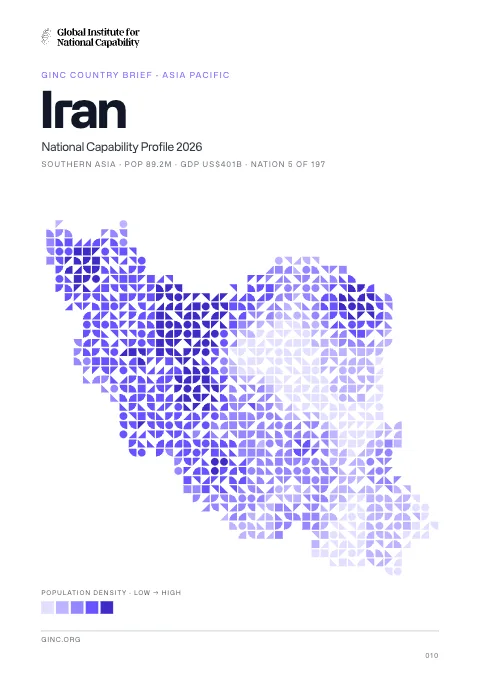
Iran
Iran is a theocratic republic in the Middle East, home to 81 million people, with its capital at Tehran, and the world’s 18th-largest country by area.
Contents
12 chapters
Foundations
01–03
At a glance
- Area
- 1.6Mkm²#18 World#2 Middle East
- Population
- 80.8M#18 World#2 Middle East
- GDP (market)
- $412B
- GDP (PPP)
- $987.1B#18 World#2 Middle East
- GDP per capita
- $12.8K#104 World#10 Middle East
The whole brief
Iran National Capability Profile 2026
Foundations · Chapter 01
Historical Context
🇮🇷 Iran’s understanding the origins and evolution of the modern nation
BackgroundBack to top ↑
Known as Persia until 1935, Iran became an Islamic republic in 1979 after the ruling monarchy was overthrown and Shah Mohammad Reza PAHLAVI was forced into exile. Conservative clerical forces led by Ayatollah Ruhollah KHOMEINI established a theocratic system of government with ultimate political authority vested in a learned religious scholar referred to commonly as the Supreme Leader who, according to the constitution, is accountable only to the Assembly of Experts - a popularly elected 86-member body of clerics. US-Iranian relations became strained when a group of Iranian students seized the US Embassy in Tehran in November 1979 and held embassy personnel hostages until mid-January 1981. The US cut off diplomatic relations with Iran in April 1980. During the period 1980-88, Iran fought a bloody, indecisive war with Iraq that eventually expanded into the Persian Gulf and led to clashes between US Navy and Iranian military forces. Iran has been designated a state sponsor of terrorism for its activities in Lebanon and elsewhere in the world and remains subject to US, UN, and EU economic sanctions and export controls because of its continued involvement in terrorism and concerns over possible military dimensions of its nuclear program. Following the election of reformer Hojjat ol-Eslam Mohammad KHATAMI as president in 1997 and a reformist Majles (legislature) in 2000, a campaign to foster political reform in response to popular dissatisfaction was initiated. The movement floundered as conservative politicians, supported by the Supreme Leader, unelected institutions of authority like the Council of Guardians, and the security services reversed and blocked reform measures while increasing security repression. Starting with nationwide municipal elections in 2003 and continuing through Majles elections in 2004, conservatives reestablished control over Iran's elected government institutions, which culminated with the August 2005 inauguration of hardliner Mahmud AHMADI-NEJAD as president. His controversial reelection in June 2009 sparked nationwide protests over allegations of electoral fraud. These protests were quickly suppressed, and the political opposition that arouse as a consequence of AHMADI-NEJAD's election was repressed. Deteriorating economic conditions due primarily to government mismanagement and international sanctions prompted at least two major economically based protests in July and October 2012, but Iran's internal security situation remained stable. President AHMADI-NEJAD's independent streak angered regime establishment figures, including the Supreme Leader, leading to conservative opposition to his agenda for the last year of his presidency, and an alienation of his political supporters. In June 2013 Iranians elected a moderate conservative cleric, Dr. Hasan Fereidun RUHANI to the presidency. He is a long-time senior member in the regime, but has made promises of reforming society and Iran's foreign policy. The UN Security Council has passed a number of resolutions calling for Iran to suspend its uranium enrichment and reprocessing activities and comply with its IAEA obligations and responsibilities, but in November 2013 the five permanent members, plus Germany, (P5+1) signed a joint plan with Iran to provide the country with incremental relief from international pressure for positive steps toward transparency of their nuclear program.
IndependenceBack to top ↑
1 April 1979 (Islamic Republic of Iran proclaimed); notable earlier dates: 16 January 1979 (Shah Reza PAHLAVI flees Iran to escape popular political revolt against his rule); 12 December 1925 (modern Iran established under the PAHLAVI Dynasty); 1905-1907 (constitutional revolution resulting in establishment of a parliament); A.D. 1501 (Iran reunified under the Safavid Dynasty)
National holidayBack to top ↑
Republic Day, 1 April (1979)
Foundations · Chapter 02
Geography
🇮🇷 Iran’s territory, resources and strategic position
Location and areaBack to top ↑
Middle East, bordering the Gulf of Oman, the Persian Gulf, and the Caspian Sea, between Iraq and Pakistan
32 00 N, 53 00 E
Middle East
almost two and a half times the size of Teas; slightly smaller than Alaska
2,440 km; note - Iran also borders the Caspian Sea (740 km)
Terrain and resourcesBack to top ↑
rugged, mountainous rim; high, central basin with deserts, mountains; small, discontinuous plains along both coasts
petroleum, natural gas, coal, chromium, copper, iron ore, lead, manganese, zinc, sulfur
87,000 sq km (2009)
Settlement and hazardsBack to top ↑
periodic droughts, floods; dust storms, sandstorms; earthquakes
strategic location on the Persian Gulf and Strait of Hormuz, which are vital maritime pathways for crude oil transport
OtherBack to top ↑
137 cu km (2011)
air pollution, especially in urban areas, from vehicle emissions, refinery operations, and industrial effluents; deforestation; overgrazing; desertification; oil pollution in the Persian Gulf; wetland losses from drought; soil degradation (salination); inadequate supplies of potable water; water pollution from raw sewage and industrial waste; urbanization
Foundations · Chapter 03
Environment
🇮🇷 Iran’s environmental conditions, resources and national resilience
ClimateBack to top ↑
mostly arid or semiarid, subtropical along Caspian coast
Emissions and pollutionBack to top ↑
Water, waste and foodBack to top ↑
Resources and agreementsBack to top ↑
GINC Capability Domains · Chapter 04
Critical Technology
🇮🇷 Iran’s technology frontiers and the pursuit of national advantage
Two counts are set side by side for 2015–2024: on the left, the papers researchers in Iran published; on the right, the patent families that began there and were filed in more than one country. First by capability group, then group by group with each group’s capabilities. The badge on a card is the nation’s place among all nations. Papers are from GINC Research Analytics, patent families from GINC Patents.
Research by capability group
#14 WorldPapers published, 2015–2024
6,831
6,335
3,209
2,869
2,449
1,607
1,381
1,107
536
68
Patents by capability group
#40 WorldInternational patent families, 2015–2024
Advanced Materials & ManufacturingBack to top ↑
Research
#14 WorldPapers published, 2015–2024
Patents
#37 WorldInternational patent families, 2015–2024
Energy TechnologiesBack to top ↑
Research
#17 WorldPapers published, 2015–2024
Patents
#39 WorldInternational patent families, 2015–2024
Semiconductors & Advanced ComputingBack to top ↑
Research
#23 WorldPapers published, 2015–2024
No research topic: Semiconductor Design & EDA · Advanced Semiconductor Fabrication · Semiconductor Equipment & Materials · Advanced Packaging & Heterogeneous Integration
Patents
#46 WorldInternational patent families, 2015–2024
Artificial IntelligenceBack to top ↑
Research
#19 WorldPapers published, 2015–2024
Patents
#36 WorldInternational patent families, 2015–2024
Quantum TechnologiesBack to top ↑
Research
#20 WorldPapers published, 2015–2024
Patents
#33 WorldInternational patent families, 2015–2024
Connectivity, Cyber & Trust TechnologiesBack to top ↑
Research
#21 WorldPapers published, 2015–2024
Patents
#47 WorldInternational patent families, 2015–2024
Sensing, Timing & NavigationBack to top ↑
Research
#14 WorldPapers published, 2015–2024
Patents
#43 WorldInternational patent families, 2015–2024
Robotics & Autonomous SystemsBack to top ↑
Research
#17 WorldPapers published, 2015–2024
No research topic: Human-Machine Interfaces
Patents
#36 WorldInternational patent families, 2015–2024
Biotechnology & Health TechnologiesBack to top ↑
Research
#16 WorldPapers published, 2015–2024
Patents
#41 WorldInternational patent families, 2015–2024
Medicine and BioTech
Clinical research and life-science invention, drawn from the same series that drive the metric pages. Each card opens the full cross-country comparison.
Space TechnologiesBack to top ↑
Research
#16 WorldPapers published, 2015–2024
Patents
#29 WorldInternational patent families, 2015–2024
GINC Capability Domains · Chapter 05
Strategic Infrastructure
🇮🇷 Iran’s energy, connectivity and the material foundations of capability
Resource InfrastructureBack to top ↑
3.594 million bbl/day (2012 est.)
2.445 million bbl/day (2011 est.)
15,600 bbl/day (2010 est.)
154.6 billion bbl (1 January 2013 est.)
1.718 million bbl/day (2011 est.)
1.709 million bbl/day (2012 est.)
330,800 bbl/day (2010 est.)
180,400 bbl/day (2010 est.)
162.6 billion cu m (2012 est.)
144.6 billion cu m (2010 est.)
9.05 billion cu m (2011 est.)
10.59 billion cu m (2011 est.)
33.61 trillion cu m (1 January 2013 est.)
condensate 7 km; condensate/gas 973 km; gas 20,794 km; liquid petroleum gas 570 km; oil 8,625 km; refined products 7,937 km (2013)
Agriculture & Food InfrastructureBack to top ↑
- Irrigation & Agricultural Water
- Livestock & Veterinary
- Fisheries & Aquaculture
- Storage, Cold Chain & Markets
Energy InfrastructureBack to top ↑
- Thermal Generation
- Nuclear Generation
- Nuclear Fuel Cycle & Radioactive Waste
- Hydropower
- Renewable Generation
- Transmission & Distribution
- System Control & Dispatch
- Storage & Fuel Supply
62.09 million kW (2010 est.)
239.7 billion kWh (2011 est.)
199.8 billion kWh (2011 est.)
6.707 billion kWh (2010 est.)
3.015 billion kWh (2010 est.)
86.2% of total installed capacity (2010 est.)
0% of total installed capacity (2010 est.)
13.7% of total installed capacity (2010 est.)
0.2% of total installed capacity (2010 est.)
624.9 million Mt (2011 est.)
Water, Sanitation & Waste InfrastructureBack to top ↑
- Dams, Reservoirs & Flood Defence
- Water Supply & Treatment
- Bulk Water Transfer & Desalination
- Wastewater & Sanitation
- Solid Waste & Recycling
Advanced ManufacturingBack to top ↑
- Materials & Inputs
- Chemicals & Hazardous Process Industry
- Production Systems
- Supply Chain & Ecosystem
- Workforce & Innovation
Transport InfrastructureBack to top ↑
- Seaports & Terminals
- Air Infrastructure
- Air Navigation & Traffic Management
- Inland Waterways & Ferries
- Rail Infrastructure
- Roads & Bridges
- Logistics, Multimodal & Border Infrastructure
- Postal & Parcel
319 (2013)
26 (2013)
850 km (on Karun River; some navigation on Lake Urmia) (2012)
Communications & Digital InfrastructureBack to top ↑
- Subsea Cables & International Gateways
- Core & Backbone Networks
- Mobile & Wireless Networks
- Spectrum & Broadcasting
- Data Centres, Compute & Cloud
- Data Resources
- AI Tools & Applications
28.76 million (2012)
58.16 million (2012)
8.214 million (2009)
197,804 (2012)
.ir
Financial InfrastructureBack to top ↑
- Currency & Reserves
- Payments & Settlement Systems
- Markets, Exchanges & Depositories
- Banks, Insurers & Systemic Institutions
Social InfrastructureBack to top ↑
- Health Infrastructure
- Public Health & Laboratories
- Medical Supply & Stockpiles
- Education & Skills Infrastructure
- Research & Scientific Facilities
- Housing, Community & Social Services
- Government & Public Administration
- Cultural, Community & Recreational Infrastructure
- Justice & Corrections
- Emergency Services & Civil Protection
- Hydrometeorology & Early Warning
Space, Aerospace & Defence InfrastructureBack to top ↑
GINC Capability Domains · Chapter 06
National Security
🇮🇷 Iran’s force, intelligence and the defence of the nation
Disputes and terrorismBack to top ↑
Iran protests Afghanistan's limiting flow of dammed Helmand River tributaries during drought; Iraq's lack of a maritime boundary with Iran prompts jurisdiction disputes beyond the mouth of the Shatt al Arab in the Persian Gulf; Iran and UAE dispute Tunb Islands and Abu Musa Island, which are occupied by Iran; Azerbaijan, Kazakhstan, and Russia ratified Caspian seabed delimitation treaties based on equidistance, while Iran continues to insist on a one-fifth slice of the sea; Afghan and Iranian commissioners have discussed boundary monument densification and resurvey
Force Generation & MobilisationBack to top ↑
Islamic Republic of Iran Regular Forces (Artesh): Ground Forces, Navy, Air Force (IRIAF), Khatemolanbia Air Defense Headquarters; Islamic Revolutionary Guard Corps (Sepah-e Pasdaran-e Enqelab-e Eslami, IRGC): Ground Resistance Forces, Navy, Aerospace Force, Quds Force (special operations); Law Enforcement Forces (2011)
18 years of age for compulsory military service; 16 years of age for volunteers; 17 years of age for Law Enforcement Forces; 15 years of age for Basij Forces (Popular Mobilization Army); conscript military service obligation is 18 months; women exempt from military service (2012)
Forces under arms
Active-duty strength on the Correlates of War series, which reaches back to 1816 and so carries a nation’s whole record of mobilisation rather than its present establishment. The card opens the full cross-country comparison.
Intelligence & AssessmentBack to top ↑
- Imagery & Geospatial Intelligence
- Signals & Cyber Intelligence
- Technical & Measurement Intelligence
- Open-Source & Financial Intelligence
- Human Intelligence & Counterintelligence
- All-Source Analysis & Warning
Joint Command, Projection & SustainmentBack to top ↑
- Command, Control & Communications
- Strategic Lift & Mobility
- Expeditionary & Peace Operations
- Operational Sustainment & War Reserves
- Defence Industrial Mobilisation
- CBRN Defence
Land PowerBack to top ↑
- Combined Arms Manoeuvre
- Land Fires
- Battlefield Aviation & Uncrewed Systems
- Special Operations & Irregular Warfare
Maritime PowerBack to top ↑
- Maritime Security & Constabulary
- Sea Denial & Undersea Warfare
- Sea Control
- Amphibious & Expeditionary Operations
Air PowerBack to top ↑
- Air Sovereignty & Policing
- Control of the Air
- Air Strike & Interdiction
- Airborne ISR, Early Warning & Battle Management
Strategic Strike & Missile DefenceBack to top ↑
Space OperationsBack to top ↑
Cyber & Electromagnetic OperationsBack to top ↑
Nuclear DeterrenceBack to top ↑
GINC Capability Domains · Chapter 07
Human Capital
🇮🇷 Iran’s population, health and the skills that sustain capability
DemographyBack to top ↑
80,840,713 (July 2014 est.)
1.22% (2014 est.)
18.23 births/1,000 population (2014 est.)
5.94 deaths/1,000 population (2014 est.)
1.85 children born/woman (2014 est.)
73.3% (2002)
Migration and urbanisationBack to top ↑
-0.08 migrant(s)/1,000 population (2014 est.)
TEHRAN (capital) 7.304 million; Mashhad 2.713 million; Esfahan 1.781 million; Karaj 1.635 million; Tabriz 1.509 million; Shiraz 1.321 million (2011)
Welfare and equityBack to top ↑
18.7% (2007 est.)
44.5 (2006)
DisplacementBack to top ↑
Early Childhood DevelopmentBack to top ↑
4.6% (2004)
Foundational EducationBack to top ↑
3.7% of GDP (2012)
Advanced EducationBack to top ↑
Technical & Vocational SkillsBack to top ↑
Digital & AI CompetenceBack to top ↑
Generative AI adoption
Modelled share of working-age adults using generative AI, from Microsoft telemetry scaled to each country’s 15–64 population. A measure of how fast a workforce is absorbing the technology rather than of how much of it a nation builds. The card opens the full cross-country comparison.
Lifelong Learning & ReskillingBack to top ↑
Research Talent & Knowledge CreationBack to top ↑
Population HealthBack to top ↑
21 deaths/100,000 live births (2010)
19.4% (2008)
0.2% (2012 est.)
70,900 (2012 est.)
4,600 (2012 est.)
Health System CapabilityBack to top ↑
6% of GDP (2011)
0.89 physicians/1,000 population (2005)
1.7 beds/1,000 population (2009)
GINC Capability Domains · Chapter 08
Governance and Integrity
🇮🇷 Iran’s institutions, law and the integrity of the state
State structureBack to top ↑
theocratic republic
31 provinces (ostanha, singular - ostan); Alborz, Ardabil, Azarbayjan-e Gharbi (West Azerbaijan), Azarbayjan-e Sharqi (East Azerbaijan), Bushehr, Chahar Mahal va Bakhtiari, Esfahan, Fars, Gilan, Golestan, Hamadan, Hormozgan, Ilam, Kerman, Kermanshah, Khorasan-e Jonubi (South Khorasan), Khorasan-e Razavi (Razavi Khorasan), Khorasan-e Shomali (North Khorasan), Khuzestan, Kohgiluyeh va Bowyer Ahmad, Kordestan, Lorestan, Markazi, Mazandaran, Qazvin, Qom, Semnan, Sistan va Baluchestan, Tehran, Yazd, Zanjan
previous 1906; latest adopted 24 October 1979, effective 3 December 1979; amended 1989 (2013)
18 years of age; universal
Political Institutions & Civic ParticipationBack to top ↑
- Electoral Management & Integrity
- Legislature & Deliberative Institutions
- Citizen Participation & Civic Space
unicameral Islamic Consultative Assembly or Majles-e Shura-ye Eslami or Majles (290 seats; members elected by popular vote from single and multimember districts to serve four-year terms)
Justice System & Fundamental RightsBack to top ↑
- Judicial Independence & Court Capability
- Access to Justice & Legal Services
- Fundamental Rights Protection
- Human Rights Institutions & Equality Bodies
religious legal system based on secular and Islamic law
has not submitted an ICJ jurisdiction declaration; non-party state to the ICCt
Internal Security & OrderBack to top ↑
despite substantial interdiction efforts and considerable control measures along the border with Afghanistan, Iran remains one of the primary transshipment routes for Southwest Asian heroin to Europe; suffers one of the highest opiate addiction rates in the world, and has an increasing problem with synthetic drugs; lacks anti-money laundering laws; has reached out to neighboring countries to share counter-drug intelligence
Regulatory Governance & Strategic ControlsBack to top ↑
- Regulatory Quality & Better Regulation
- Regulatory Delivery & Independent Regulators
- Strategic Controls & Economic Security Administration
Government Effectiveness & Public AdministrationBack to top ↑
- Centre of Government & Policy Coordination
- Civil Service & Public Workforce
- Digital Government & Service Delivery
- Legal Identity & Civil Registration
- Statistical & Data Capability
Public Integrity & Anti-CorruptionBack to top ↑
Transparency, Oversight & AccountabilityBack to top ↑
- Right to Information & Open Government
- Independent Oversight & Supreme Audit
- Independent Media & Journalist Safety
National Resilience & Crisis ManagementBack to top ↑
GINC Capability Domains · Chapter 09
Information and Influence
🇮🇷 Iran’s identity, media and the projection of influence
Identity and cultureBack to top ↑
Persian (official) 53%, Azeri Turkic and Turkic dialects 18%, Kurdish 10%, Gilaki and Mazandarani 7%, Luri 6%, Balochi 2%, Arabic 2%, other 2%
Muslim (official) 99.4% (Shia 90-95%, Sunni 5-10%), other (includes Zoroastrian, Jewish, and Christian) 0.3%, unspecified 0.4% (2011 est.)
Persian 61%, Azeri 16%, Kurd 10%, Lur 6%, Baloch 2%, Arab 2%, Turkmen and Turkic tribes 2%, other 1%
lion
three equal horizontal bands of green (top), white, and red; the national emblem (a stylized representation of the word Allah in the shape of a tulip, a symbol of martyrdom) in red is centered in the white band; ALLAH AKBAR (God is Great) in white Arabic script is repeated 11 times along the bottom edge of the green band and 11 times along the top edge of the red band; green is the color of Islam and also represents growth, white symbolizes honesty and peace, red stands for bravery and martyrdom
Diplomatic Statecraft & Global NetworksBack to top ↑
- Diplomatic Network & Consular Reach
- Multilateral Leadership & Norm Setting
- Agenda-Setting & Convening
- Mediation & Crisis Diplomacy
CICA, CP, D-8, ECO, FAO, G-15, G-24, G-77, IAEA, IBRD, ICAO, ICC (national committees), ICRM, IDA, IDB, IFAD, IFC, IFRCS, IHO, ILO, IMF, IMO, IMSO, Interpol, IOC, IOM, IPU, ISO, ITSO, ITU, MIGA, NAM, OIC, OPCW, OPEC, PCA, SAARC (observer), SCO (observer), UN, UNAMID, UNCTAD, UNESCO, UNHCR, UNIDO, UNITAR, UNWTO, UPU, WCO, WFTU (NGOs), WHO, WIPO, WMO, WTO (observer)
none; note - Iran has an Interests Section in the Pakistani Embassy; address: Iranian Interests Section, Pakistani Embassy, 2209 Wisconsin Avenue NW, Washington, DC 20007; telephone: [1] (202) 965-4990; FAX [1] (202) 965-1073
none; note - the US Interests Section is located in the Embassy of Switzerland No. 39 Shahid Mousavi (Golestan 5th), Pasdaran Ave., Tehran, Iran; telephone [98] 21 2254 2178/2256 5273; FAX [98] 21 2258 0432
Alliances & Security CooperationBack to top ↑
Development Cooperation & Global AssistanceBack to top ↑
Culture, Language & Education DiplomacyBack to top ↑
- Cultural & Language Institutes
- Creative Industries & Cultural Export Reach
- Heritage & Cultural Institutions
- Education Diplomacy & Alumni Networks
- Sports & Major Events
Diaspora & Global CommunitiesBack to top ↑
Information Environment & Strategic CommunicationBack to top ↑
- Strategic Communications & Public Diplomacy
- International Media & Broadcasting
- Information Defence & Counter-Interference
state-run broadcast media with no private, independent broadcasters; Islamic Republic of Iran Broadcasting (IRIB), the state-run TV broadcaster, operates 5 nationwide channels, a news channel, about 30 provincial channels, and several international channels; about 20 foreign Persian-language TV stations broadcasting on satellite TV are capable of being seen in Iran; satellite dishes are illegal and, while their use had been tolerated, authorities began confiscating satellite dishes following the unrest stemming from the 2009 presidential election; IRIB operates 8 nationwide radio networks, a number of provincial stations, and an external service; most major international broadcasters transmit to Iran (2009)
GINC Capability Domains · Chapter 10
Financial Strength
🇮🇷 Iran’s fiscal depth, reserves and the capacity to act
Monetary & Currency CapabilityBack to top ↑
- Monetary Policy & Price Stability
- Exchange Rate & External Account Management
- Currency Issuance & Digital Money
42.3% (2013 est.)//30.5% (2012 est.)
Iranian rials (IRR) per US dollar -//18,517.2 (2013 est.)//12,175.5 (2012 est.)//10,254.18 (2010 est.)//9,864.3 (2009)//9,142.8 (2008)
NA%
12% (2013 est.)//11% (31 December 2012 est.)
$26.3 billion (31 December 2013 est.)//$42.91 billion (31 December 2012 est.)
$65.02 billion (31 December 2013 est.)//$104.6 billion (31 December 2012 est.)
Fiscal Capacity & Public FinanceBack to top ↑
- Revenue Mobilisation & Tax Administration
- Public Expenditure & Budget Management
- Sovereign Debt & Treasury Management
- Public Investment Management
11.6% of GDP (2013 est.)
-4.5% of GDP (2013 est.)
18.7% of GDP (2013 est.)//18.6% of GDP (2012 est.)
21 March - 20 March
Financial System Depth & AccessBack to top ↑
- Banking System Capacity
- Capital Markets Depth & Development
- Long-Term & Institutional Capital
- Financial Inclusion & Household Access
- Development & Policy Finance
$42.32 billion (31 December 2013 est.)//$77.74 billion (31 December 2012 est.)
$NA (31 December 2013 est.)//$140.8 billion (31 December 2012)//$107.2 billion (31 December 2011 est.)
30.3% of GDP (2013 est.)//30.3% of GDP (2012 est.)//36.6% of GDP (2011 est.)
Financial Regulation & IntegrityBack to top ↑
- Prudential Regulation & Supervision
- Financial Integrity & Illicit Finance Control
- Market Conduct & Consumer Protection
- Payment & Market Infrastructure Oversight
Financial Stability & Crisis ManagementBack to top ↑
- Macroprudential & Systemic Oversight
- Crisis Management, Resolution & Deposit Insurance
- External Liquidity & Financial Safety Nets
Sovereign Capital & External Financial PowerBack to top ↑
- Official Reserves Management
- Sovereign Wealth & Public Asset Management
- Currency Internationalisation & Reserve Status
- Capital Account & Flow Management
- International Financial Centre Capability
$68.06 billion (31 December 2013 est.)//$74.06 billion (31 December 2012 est.)
$15.64 billion (2013 est.)//$17.25 billion (31 December 2012 est.)
GINC Capability Domains · Chapter 11
Production and Innovation
🇮🇷 Iran’s output, industry and the engine of prosperity
Economic Output & ProductivityBack to top ↑
Iran's economy is marked by statist policies, an inefficient state sector, and reliance on oil, a major source of government revenues. Price controls, subsidies, and other distortions weigh down the economy, undermining the potential for private-sector-led growth. Private sector activity is typically limited to small-scale workshops, farming, some manufacturing, and services. Significant informal market activity flourishes and corruption is widespread. New fiscal and monetary constraints on Tehran, following the expansion of international sanctions in 2012 against Iran's Central Bank and oil exports, significantly reduced Iran's oil revenue, forced government spending cuts, and fueled a 60% currency depreciation. Economic growth turned negative in 2012 and 2013, for the first time in two decades. Iran continues to suffer from double-digit unemployment and underemployment. Lack of job opportunities has convinced many educated Iranian youth to seek jobs overseas, resulting in a significant "brain drain." However, the election of President Hasan RUHANI in June 2013 brought about widespread expectations of economic improvements and greater international engagement among the Iranian public, and early in Ruhani's term the country saw a strengthened national currency and a historic boost to market values at the Tehran Stock Exchange.
$987.1 billion (2013 est.)//$1.002 trillion (2012 est.)//$1.021 trillion (2011 est.)
-1.5% (2013 est.)//-1.9% (2012 est.)//3% (2011 est.)
$12,800 (2013 est.)//$13,200 (2012 est.)//$13,600 (2011 est.)
$411.9 billion (2013 est.)
Labour & EmploymentBack to top ↑
- Employment & Labour Force Participation
- Labour Market Institutions & Wage Setting
- Employment Services & Skills Matching
- Labour Adjustment, Transition & Formalisation
27.72 million
16% (2013 est.)//15.5% (2012 est.)
Industrial & Sectoral BaseBack to top ↑
- Manufacturing & Advanced Industry
- Foundational & Process Industries
- Agrifood & Primary Production
- Services Economy
wheat, rice, other grains, sugar beets, sugarcane, fruits, nuts, cotton; dairy products, wool; caviar
petroleum, petrochemicals, fertilizers, caustic soda, textiles, cement and other construction materials, food processing (particularly sugar refining and vegetable oil production), ferrous and non-ferrous metal fabrication, armaments
-5.2% (2013 est.)
Structural Transformation & ComplexityBack to top ↑
Business Dynamism & EntrepreneurshipBack to top ↑
- Entrepreneurship & Firm Creation
- Risk Capital & Scale-Up Finance
- Firm Growth, Exit & Renewal
- Competition & Market Contestability
Innovation & CommercialisationBack to top ↑
- Business Innovation Capability
- Research Commercialisation & Knowledge Transfer
- Intellectual Property & Intangible Assets
- Innovation Ecosystems & Clusters
Technology Adoption & DiffusionBack to top ↑
GINC Capability Domains · Chapter 12
Trade and Investment
🇮🇷 Iran’s markets, capital and the terms of global exchange
Overall tradeBack to top ↑
$13.3B of exports to 116 partners and $22.6B of imports from 88 in 2024, a deficit of $9.32B.
- Exports
- $13.3B116 partners
- Imports
- $22.6B88 partners
- Balance
- −$9.32Bdeficit
- Total trade
- $35.9B2024
ExportsBack to top ↑
Where its exports go
The largest partners in 2024, with each one's share of the nation's exports.
| Partner | Value | Share | |
|---|---|---|---|
| China | $4.44B | 33% | |
| Turkey | $2.45B | 18% | |
| Pakistan | $1.20B | 9.0% | |
| India | $1.06B | 8.0% | |
| Azerbaijan | $633M | 4.8% | |
| Armenia | $629M | 4.7% | |
| Uzbekistan | $333M | 2.5% | |
| Kuwait | $328M | 2.5% | |
| Georgia | $284M | 2.1% | |
| Germany | $238M | 1.8% | |
| Kazakhstan | $217M | 1.6% | |
| Italy | $191M | 1.4% | |
| Qatar | $146M | 1.1% | |
| Spain | $99.1M | 0.7% | |
| Bulgaria | $83.5M | 0.6% | |
| Thailand | $73.1M | 0.6% | |
| Romania | $55.0M | 0.4% | |
| Netherlands | $52.4M | 0.4% | |
| France | $52.2M | 0.4% | |
| Lebanon | $50.2M | 0.4% |
What it exports
The largest categories in 2024.
| Category | Value | Share | |
|---|---|---|---|
| Plastics | $2.29B | 17% | |
| Edible fruits, nuts, peel of citrus fruit, melons | $1.34B | 10% | |
| Mineral fuels, oils, distillation products | $1.26B | 9.5% | |
| Organic chemicals | $1.26B | 9.5% | |
| Ores slag and ash | $1.26B | 9.5% | |
| Iron and steel | $1.07B | 8.1% | |
| Aluminum | $665M | 5.0% | |
| Copper | $618M | 4.7% | |
| Salt, sulphur, earth, stone, plaster, lime and cement | $439M | 3.3% | |
| Zinc | $341M | 2.6% | |
| Edible vegetables and certain roots and tubers | $205M | 1.5% | |
| Dairy products, eggs, honey, edible products | $183M | 1.4% | |
| Vegetable, fruit, nut food preparations | $182M | 1.4% | |
| Inorganic chemicals, precious metal compound, isotope | $177M | 1.3% | |
| Machinery, nuclear reactors, boilers | $169M | 1.3% |
ImportsBack to top ↑
Where its imports come from
The largest partners in 2024, with each one's share of the nation's imports.
| Partner | Value | Share | |
|---|---|---|---|
| China | $8.94B | 40% | |
| Turkey | $3.10B | 14% | |
| Brazil | $3.00B | 13% | |
| Germany | $1.30B | 5.7% | |
| India | $1.25B | 5.5% | |
| Italy | $553M | 2.4% | |
| Malaysia | $534M | 2.4% | |
| Netherlands | $460M | 2.0% | |
| France | $277M | 1.2% | |
| Canada | $274M | 1.2% | |
| Switzerland | $216M | 1.0% | |
| Belgium | $216M | 1.0% | |
| Indonesia | $206M | 0.9% | |
| Spain | $195M | 0.9% | |
| Australia | $163M | 0.7% | |
| South Korea | $158M | 0.7% | |
| Bulgaria | $145M | 0.6% | |
| Thailand | $134M | 0.6% | |
| Romania | $128M | 0.6% | |
| Kazakhstan | $123M | 0.5% |
What it imports
The largest categories in 2024.
| Category | Value | Share | |
|---|---|---|---|
| Machinery, nuclear reactors, boilers | $3.42B | 15% | |
| Vehicles other than railway, tramway | $1.94B | 8.6% | |
| Cereals | $1.91B | 8.4% | |
| Electrical, electronic equipment | $1.47B | 6.5% | |
| Oil seed, oleaginous fruits, grain, seed, fruits | $1.43B | 6.3% | |
| Residues, wastes of food industry, animal fodder | $1.20B | 5.3% | |
| Optical, photo, technical, medical apparatus | $1.12B | 5.0% | |
| Pharmaceutical products | $880M | 3.9% | |
| Plastics | $720M | 3.2% | |
| Animal, vegetable fats and oils, cleavage products | $624M | 2.8% | |
| Pearls, precious stones, metals, coins | $512M | 2.3% | |
| Sugars and sugar confectionery | $455M | 2.0% | |
| Manmade filaments | $408M | 1.8% | |
| Iron and steel | $376M | 1.7% | |
| Articles of iron or steel | $362M | 1.6% |
In a list, the bar runs to the largest in that list. The line is each figure’s history from 2000, drawn to its own peak: it shows the shape of the years, and the value shows the size.
External balanceBack to top ↑
-$8.659 billion (2013 est.)//-$9.333 billion (2012 est.)
Trade Facilitation & LogisticsBack to top ↑
Trade Policy & Market AccessBack to top ↑
- Trade Policy & Negotiation Capability
- Market Access & Agreements Network
- Trade Law & Enforcement
- Standards, Conformity & Quality Infrastructure
Digital & Services TradeBack to top ↑
- Services Trade Capability
- Digital Trade & E-Commerce
- Data Flows & Digital Trade Governance
- Tourism & Visitor Economy
Investment Attraction & ProjectionBack to top ↑
- Investment Attraction & Facilitation
- Investment Absorption & Linkages
- Outward Investment & Global Corporate Presence
$41.45 billion (31 December 2013 est.)//$37.31 billion (31 December 2012 est.)
$3.645 billion (31 December 2013 est.)//$3.345 billion (31 December 2012 est.)
Export Capability & SophisticationBack to top ↑
$61.22 billion (2013 est.)//$67.04 billion (2012 est.)
China 22.1%, India 11.9%, Turkey 10.6%, South Korea 7.6%, Japan 7.1% (2012)
petroleum 80%, chemical and petrochemical products, fruits and nuts, carpets
Global Value Chain PositionBack to top ↑
- Value Chain Participation & Integration
- Value Chain Position & Upgrading
- Regional Integration & Hub Anchoring
Economic Leverage & DependenceBack to top ↑
- Strategic Supply Security
- Concentration Risk & Revenue Stabilisation
- Economic Leverage & Coercion Resistance
$64.42 billion (2013 est.)//$70.03 billion (2012 est.)
UAE 33.2%, China 13.8%, Turkey 11.8%, South Korea 7.4% (2012)
industrial supplies, capital goods, foodstuffs and other consumer goods, technical services
Iran · you are in
Historical Context
Foundations
GINC Capability Domains
Find in this brief · Iran