
Hungary
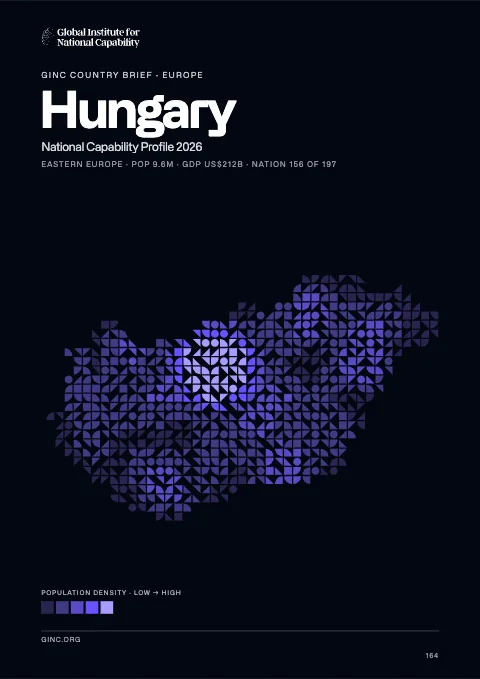
Hungary is a landlocked parliamentary democracy in Europe, home to 9.9 million people, with its capital at Budapest.
Contents
12 chapters
Foundations
01–03
At a glance
- Area
- 93Kkm²#110 World#15 Europe
- Population
- 9.9M#89 World#13 Europe
- GDP (market)
- $131B
- GDP (PPP)
- $196.6B#56 World#18 Europe
- GDP per capita
- $19.8K#71 World#34 Europe
The whole brief
Hungary National Capability Profile 2026
Foundations · Chapter 01
Historical Context
🇭🇺 Hungary’s understanding the origins and evolution of the modern nation
BackgroundBack to top ↑
Hungary became a Christian kingdom in A.D. 1000 and for many centuries served as a bulwark against Ottoman Turkish expansion in Europe. The kingdom eventually became part of the polyglot Austro-Hungarian Empire, which collapsed during World War I. The country fell under communist rule following World War II. In 1956, a revolt and an announced withdrawal from the Warsaw Pact were met with a massive military intervention by Moscow. Under the leadership of Janos KADAR in 1968, Hungary began liberalizing its economy, introducing so-called "Goulash Communism." Hungary held its first multiparty elections in 1990 and initiated a free market economy. It joined NATO in 1999 and the EU five years later. In 2011, Hungary assumed the six-month rotating presidency of the EU for the first time.
IndependenceBack to top ↑
16 November 1918 (republic proclaimed); notable earlier dates: 25 December 1000 (crowning of King STEPHEN I, traditional founding date); 30 March 1867 (Austro-Hungarian dual monarchy established)
National holidayBack to top ↑
Saint Stephen's Day, 20 August; note - commemorates the date when his remains were transferred to Buda (now Budapest)
Foundations · Chapter 02
Geography
🇭🇺 Hungary’s territory, resources and strategic position
Location and areaBack to top ↑
Central Europe, northwest of Romania
47 00 N, 20 00 E
Europe
slightly smaller than Indiana
0 km (landlocked)
none (landlocked)
Terrain and resourcesBack to top ↑
mostly flat to rolling plains; hills and low mountains on the Slovakian border
bauxite, coal, natural gas, fertile soils, arable land
1,409 sq km (2007)
Settlement and hazardsBack to top ↑
landlocked; strategic location astride main land routes between Western Europe and Balkan Peninsula as well as between Ukraine and Mediterranean basin; the north-south flowing Duna (Danube) and Tisza Rivers divide the country into three large regions
OtherBack to top ↑
104 cu km (2011)
the upgrading of Hungary's standards in waste management, energy efficiency, and air, soil, and water pollution to meet EU requirements will require large investments
Foundations · Chapter 03
Environment
🇭🇺 Hungary’s environmental conditions, resources and national resilience
ClimateBack to top ↑
temperate; cold, cloudy, humid winters; warm summers
Emissions and pollutionBack to top ↑
Water, waste and foodBack to top ↑
Resources and agreementsBack to top ↑
GINC Capability Domains · Chapter 04
Critical Technology
🇭🇺 Hungary’s technology frontiers and the pursuit of national advantage
Two counts are set side by side for 2015–2024: on the left, the papers researchers in Hungary published; on the right, the patent families that began there and were filed in more than one country. First by capability group, then group by group with each group’s capabilities. The badge on a card is the nation’s place among all nations. Papers are from GINC Research Analytics, patent families from GINC Patents.
Research by capability group
#52 WorldPapers published, 2015–2024
1,090
909
823
528
369
294
244
159
123
6
Patents by capability group
#42 WorldInternational patent families, 2015–2024
146
81
62
61
48
37
24
13
6
3
Advanced Materials & ManufacturingBack to top ↑
Research
#55 WorldPapers published, 2015–2024
Patents
#46 WorldInternational patent families, 2015–2024
Energy TechnologiesBack to top ↑
Research
#62 WorldPapers published, 2015–2024
Patents
#35 WorldInternational patent families, 2015–2024
Semiconductors & Advanced ComputingBack to top ↑
Research
#47 WorldPapers published, 2015–2024
No research topic: Semiconductor Design & EDA · Advanced Semiconductor Fabrication · Semiconductor Equipment & Materials · Advanced Packaging & Heterogeneous Integration
Patents
#37 WorldInternational patent families, 2015–2024
Artificial IntelligenceBack to top ↑
Research
#58 WorldPapers published, 2015–2024
Patents
#39 WorldInternational patent families, 2015–2024
Quantum TechnologiesBack to top ↑
Research
#33 WorldPapers published, 2015–2024
Patents
#27 WorldInternational patent families, 2015–2024
Connectivity, Cyber & Trust TechnologiesBack to top ↑
Research
#56 WorldPapers published, 2015–2024
Patents
#42 WorldInternational patent families, 2015–2024
Sensing, Timing & NavigationBack to top ↑
Research
#61 WorldPapers published, 2015–2024
Patents
#46 WorldInternational patent families, 2015–2024
Robotics & Autonomous SystemsBack to top ↑
Research
#41 WorldPapers published, 2015–2024
No research topic: Human-Machine Interfaces
Patents
#35 WorldInternational patent families, 2015–2024
Biotechnology & Health TechnologiesBack to top ↑
Research
#52 WorldPapers published, 2015–2024
Patents
#34 WorldInternational patent families, 2015–2024
Medicine and BioTech
Clinical research and life-science invention, drawn from the same series that drive the metric pages. Each card opens the full cross-country comparison.
Space TechnologiesBack to top ↑
Research
#58 WorldPapers published, 2015–2024
Patents
#41 WorldInternational patent families, 2015–2024
GINC Capability Domains · Chapter 05
Strategic Infrastructure
🇭🇺 Hungary’s energy, connectivity and the material foundations of capability
Resource InfrastructureBack to top ↑
27,990 bbl/day (2012 est.)
0 bbl/day (2010 est.)
114,800 bbl/day (2010 est.)
27.32 million bbl (1 January 2013 est.)
177,500 bbl/day (2010 est.)
141,100 bbl/day (2011 est.)
59,110 bbl/day (2010 est.)
171,600 bbl/day (2010 est.)
2.462 billion cu m (2012 est.)
11.9 billion cu m (2012 est.)
2.837 billion cu m (2012 est.)
10.18 billion cu m (2012 est.)
8.098 billion cu m (1 January 2013 est.)
gas 19,028 km; oil 1,007 km; refined products 842 km (2013)
Agriculture & Food InfrastructureBack to top ↑
- Irrigation & Agricultural Water
- Livestock & Veterinary
- Fisheries & Aquaculture
- Storage, Cold Chain & Markets
Energy InfrastructureBack to top ↑
- Thermal Generation
- Nuclear Generation
- Nuclear Fuel Cycle & Radioactive Waste
- Hydropower
- Renewable Generation
- Transmission & Distribution
- System Control & Dispatch
- Storage & Fuel Supply
9.9 million kW (2011 est.)
34.28 billion kWh (2012 est.)
36.13 billion kWh (2012 est.)
9 billion kWh (2012 est.)
16.97 billion kWh (2012 est.)
72% of total installed capacity (2011 est.)
20% of total installed capacity (2011 est.)
1% of total installed capacity (2011 est.)
7% of total installed capacity (2011 est.)
49.56 million Mt (2011 est.)
Water, Sanitation & Waste InfrastructureBack to top ↑
- Dams, Reservoirs & Flood Defence
- Water Supply & Treatment
- Bulk Water Transfer & Desalination
- Wastewater & Sanitation
- Solid Waste & Recycling
Advanced ManufacturingBack to top ↑
- Materials & Inputs
- Chemicals & Hazardous Process Industry
- Production Systems
- Supply Chain & Ecosystem
- Workforce & Innovation
Transport InfrastructureBack to top ↑
- Seaports & Terminals
- Air Infrastructure
- Air Navigation & Traffic Management
- Inland Waterways & Ferries
- Rail Infrastructure
- Roads & Bridges
- Logistics, Multimodal & Border Infrastructure
- Postal & Parcel
41 (2013)
3 (2013)
1,622 km (most on Danube River) (2011)
Budapest, Dunaujvaros, Gyor-Gonyu, Csepel, Baja, Mohacs
Communications & Digital InfrastructureBack to top ↑
- Subsea Cables & International Gateways
- Core & Backbone Networks
- Mobile & Wireless Networks
- Spectrum & Broadcasting
- Data Centres, Compute & Cloud
- Data Resources
- AI Tools & Applications
2.96 million (2012)
11.58 million (2012)
6.176 million (2009)
3.145 million (2012)
.hu
Financial InfrastructureBack to top ↑
- Currency & Reserves
- Payments & Settlement Systems
- Markets, Exchanges & Depositories
- Banks, Insurers & Systemic Institutions
Social InfrastructureBack to top ↑
- Health Infrastructure
- Public Health & Laboratories
- Medical Supply & Stockpiles
- Education & Skills Infrastructure
- Research & Scientific Facilities
- Housing, Community & Social Services
- Government & Public Administration
- Cultural, Community & Recreational Infrastructure
- Justice & Corrections
- Emergency Services & Civil Protection
- Hydrometeorology & Early Warning
Space, Aerospace & Defence InfrastructureBack to top ↑
GINC Capability Domains · Chapter 06
National Security
🇭🇺 Hungary’s force, intelligence and the defence of the nation
Disputes and terrorismBack to top ↑
bilateral government, legal, technical and economic working group negotiations continue in 2006 with Slovakia over Hungary's failure to complete its portion of the Gabcikovo-Nagymaros hydroelectric dam project along the Danube; as a member state that forms part of the EU's external border, Hungary has implemented the strict Schengen border rules
Force Generation & MobilisationBack to top ↑
Hungarian Defense Forces: Land Forces, Hungarian Air Force (Magyar Legiero, ML) (2011)
18-25 years of age for voluntary military service; no conscription; 6-month service obligation (2012)
0.83% of GDP (2012)//0.99% of GDP (2011)//0.83% of GDP (2010)
Forces under arms
Active-duty strength on the Correlates of War series, which reaches back to 1816 and so carries a nation’s whole record of mobilisation rather than its present establishment. The card opens the full cross-country comparison.
Intelligence & AssessmentBack to top ↑
- Imagery & Geospatial Intelligence
- Signals & Cyber Intelligence
- Technical & Measurement Intelligence
- Open-Source & Financial Intelligence
- Human Intelligence & Counterintelligence
- All-Source Analysis & Warning
Joint Command, Projection & SustainmentBack to top ↑
- Command, Control & Communications
- Strategic Lift & Mobility
- Expeditionary & Peace Operations
- Operational Sustainment & War Reserves
- Defence Industrial Mobilisation
- CBRN Defence
Land PowerBack to top ↑
- Combined Arms Manoeuvre
- Land Fires
- Battlefield Aviation & Uncrewed Systems
- Special Operations & Irregular Warfare
Maritime PowerBack to top ↑
- Maritime Security & Constabulary
- Sea Denial & Undersea Warfare
- Sea Control
- Amphibious & Expeditionary Operations
Air PowerBack to top ↑
- Air Sovereignty & Policing
- Control of the Air
- Air Strike & Interdiction
- Airborne ISR, Early Warning & Battle Management
Strategic Strike & Missile DefenceBack to top ↑
Space OperationsBack to top ↑
Cyber & Electromagnetic OperationsBack to top ↑
Nuclear DeterrenceBack to top ↑
GINC Capability Domains · Chapter 07
Human Capital
🇭🇺 Hungary’s population, health and the skills that sustain capability
DemographyBack to top ↑
9,919,128 (July 2014 est.)
-0.21% (2014 est.)
9.26 births/1,000 population (2014 est.)
12.72 deaths/1,000 population (2014 est.)
1.42 children born/woman (2014 est.)
28.3 (2011 est.)
Migration and urbanisationBack to top ↑
1.34 migrant(s)/1,000 population (2014 est.)
BUDAPEST (capital) 1.737 million (2011)
Welfare and equityBack to top ↑
14% (2012)
24.7 (2009)//24.4 (1998)
DisplacementBack to top ↑
Early Childhood DevelopmentBack to top ↑
Foundational EducationBack to top ↑
4.9% of GDP (2010)
Advanced EducationBack to top ↑
Technical & Vocational SkillsBack to top ↑
Digital & AI CompetenceBack to top ↑
Generative AI adoption
Modelled share of working-age adults using generative AI, from Microsoft telemetry scaled to each country’s 15–64 population. A measure of how fast a workforce is absorbing the technology rather than of how much of it a nation builds. The card opens the full cross-country comparison.
Lifelong Learning & ReskillingBack to top ↑
Research Talent & Knowledge CreationBack to top ↑
Population HealthBack to top ↑
21 deaths/100,000 live births (2010)
27.6% (2008)
less than 0.1% (2009 est.)
3,000 (2009 est.)
fewer than 200 (2009 est.)
Health System CapabilityBack to top ↑
7.7% of GDP (2011)
3.41 physicians/1,000 population (2010)
7.2 beds/1,000 population (2010)
GINC Capability Domains · Chapter 08
Governance and Integrity
🇭🇺 Hungary’s institutions, law and the integrity of the state
State structureBack to top ↑
parliamentary democracy
19 counties (megyek, singular - megye), 23 urban counties (singular - megyei varos), and 1 capital city (fovaros)
previous 1949 (heavily amended in 1989 following collapse of communism); latest approved 18 April 2011, signed 25 April 2011, effective 1 January 2012; amended several times, last in 2013 (2013)
18 years of age, 16 if married; universal
Political Institutions & Civic ParticipationBack to top ↑
- Electoral Management & Integrity
- Legislature & Deliberative Institutions
- Citizen Participation & Civic Space
unicameral National Assembly or Orszaggyules (199 seats; 106 single-round, single-member district vote, 93 nationwide party list vote; members serve four-year terms)
Christian Democratic People's Party or KDNP [Zsolt SEMJEN]//Democratic Coalition or DK [Ferenc GYURCSANY]//Dialogue for Hungary or PM [Benedek JAVOR, Timea SZABO, co-chairs]//Fidesz-Hungarian Civic Alliance or Fidesz [Viktor ORBAN, chairman]//Hungarian Liberal Party or MLP [Gabor FODOR]//Hungarian Socialist Party or MSZP [Attila MESTERHAZY]//Movement for a Better Hungary or Jobbik [Gabor VONA]//Politics Can Be Different or LMP [Andras SCHIFFER, Bernadett SZEL]//Together or Egyutt [Gordon BAJNAI]//Unity [a coalition of MSZP, Egyutt, DK, PM, and MLP]
Air Work Group (works to reduce air pollution in towns and cities)//Danube Circle (protests the building of the Gabchikovo-Nagymaros dam)//Fourth Republic (Negyedik Koztarsasag) or 4K! (anti-Orban, pro-democracy Facebook movement emerged from a Facebook group, One Million for Freedom of the Press or "Milla")//Green Future (protests the impact of lead contamination of local factory on health of the people)//Hungarian Civil Liberties Union (Tarsasag a Szabadsagjogokert) or TASZ (freedom of expression, information privacy)//Hungarian Helsinki Committee (asylum seekers' rights, human rights in law enforcement and the judicial system)//Szolidaritas ("Solidarity," formed in October 2011 by three trade unions and an NGO - anti-Orban government)//"Egyutt 2014-Parbeszed Magyarorszagert" ("Together 2014-Dialogue for Hungary," a political electoral alliance bringing together Milla, Szolidaritas, and "Haza es Haladas," an association headed by former PM Gordon BAJNAI, to contest Fidesz and Viktor ORBAN in the 2014 parliamentary elections)//Civil Osszefogas Forum ("Civil Unity Forum," nominally independent organization that serves as the steering committee for the pro-government mass organization Bekemenet (Peace March), supporting ORBAN government's policies)//
Justice System & Fundamental RightsBack to top ↑
- Judicial Independence & Court Capability
- Access to Justice & Legal Services
- Fundamental Rights Protection
- Human Rights Institutions & Equality Bodies
civil legal system influenced by the German model
accepts compulsory ICJ jurisdiction with reservations; accepts ICCt jurisdiction
Internal Security & OrderBack to top ↑
transshipment point for Southwest Asian heroin and cannabis and for South American cocaine destined for Western Europe; limited producer of precursor chemicals, particularly for amphetamine and methamphetamine; efforts to counter money laundering, related to organized crime and drug trafficking are improving but remain vulnerable; significant consumer of ecstasy
Regulatory Governance & Strategic ControlsBack to top ↑
- Regulatory Quality & Better Regulation
- Regulatory Delivery & Independent Regulators
- Strategic Controls & Economic Security Administration
Government Effectiveness & Public AdministrationBack to top ↑
- Centre of Government & Policy Coordination
- Civil Service & Public Workforce
- Digital Government & Service Delivery
- Legal Identity & Civil Registration
- Statistical & Data Capability
Public Integrity & Anti-CorruptionBack to top ↑
Transparency, Oversight & AccountabilityBack to top ↑
- Right to Information & Open Government
- Independent Oversight & Supreme Audit
- Independent Media & Journalist Safety
National Resilience & Crisis ManagementBack to top ↑
GINC Capability Domains · Chapter 09
Information and Influence
🇭🇺 Hungary’s identity, media and the projection of influence
Identity and cultureBack to top ↑
Hungarian 84.6%, other or unspecified 16.4% (2011 est.)
Roman Catholic 37.2%, Calvinist 11.6%, Lutheran 2.2%, Greek Catholic 1.8%, other 1.9%, none 18.2%, unspecified 27.2% (2011 est.)
Hungarian 92.3%, Roma 1.9%, other or unknown 5.8% (2001 census)
Holy Crown of Hungary (Crown of Saint Stephen); turul (falcon)
three equal horizontal bands of red (top), white, and green; the flag dates to the national movement of the 18th and 19th centuries, and fuses the medieval colors of the Hungarian coat of arms with the revolutionary tricolor form of the French flag; folklore attributes virtues to the colors: red for strength, white for faithfulness, and green for hope; alternatively, the red is seen as being for the blood spilled in defense of the land, white for freedom, and green for the pasturelands that make up so much of the country
Diplomatic Statecraft & Global NetworksBack to top ↑
- Diplomatic Network & Consular Reach
- Multilateral Leadership & Norm Setting
- Agenda-Setting & Convening
- Mediation & Crisis Diplomacy
Australia Group, BIS, CD, CE, CEI, CERN, EAPC, EBRD, EIB, ESA (cooperating state), EU, FAO, G-9, IAEA, IBRD, ICAO, ICC (national committees), ICRM, IDA, IEA, IFAD, IFC, IFRCS, ILO, IMF, IMO, IMSO, Interpol, IOC, IOM, IPU, ISO, ITSO, ITU, ITUC (NGOs), MIGA, MINURSO, NATO, NEA, NSG, OAS (observer), OECD, OIF (observer), OPCW, OSCE, PCA, Schengen Convention, SELEC, UN, UNCTAD, UNESCO, UNFICYP, UNHCR, UNIDO, UNIFIL, UNWTO, UPU, WCO, WFTU (NGOs), WHO, WIPO, WMO, WTO, ZC
Alliances & Security CooperationBack to top ↑
Development Cooperation & Global AssistanceBack to top ↑
Culture, Language & Education DiplomacyBack to top ↑
- Cultural & Language Institutes
- Creative Industries & Cultural Export Reach
- Heritage & Cultural Institutions
- Education Diplomacy & Alumni Networks
- Sports & Major Events
Diaspora & Global CommunitiesBack to top ↑
Information Environment & Strategic CommunicationBack to top ↑
- Strategic Communications & Public Diplomacy
- International Media & Broadcasting
- Information Defence & Counter-Interference
mixed system of state-supported public service broadcast media and private broadcasters; the 3 publicly owned TV channels and the 2 main privately owned TV stations are the major national broadcasters; a large number of special interest channels; highly developed market for satellite and cable TV services with about two-thirds of viewers utilizing their services; 3 state-supported public-service radio networks and 2 major national commercial stations; a large number of local stations including commercial, public service, nonprofit, and community radio stations; digital transition postponed to the end of 2014 (2007)
GINC Capability Domains · Chapter 10
Financial Strength
🇭🇺 Hungary’s fiscal depth, reserves and the capacity to act
Monetary & Currency CapabilityBack to top ↑
- Monetary Policy & Price Stability
- Exchange Rate & External Account Management
- Currency Issuance & Digital Money
1.9% (2013 est.)//5.7% (2012 est.)
forints (HUF) per US dollar -//227.8 (2013 est.)//225.1 (2012 est.)//207.94 (2010 est.)//202.34 (2009)//171.8 (2008)
5.75% (19 December 2012)//7% (31 December 2011)
6.5% (31 December 2013 est.)//9.02% (31 December 2012 est.)
$34.75 billion (31 December 2013 est.)//$33.03 billion (31 December 2012 est.)
$67.47 billion (31 December 2013 est.)//$68.7 billion (31 December 2012 est.)
Fiscal Capacity & Public FinanceBack to top ↑
- Revenue Mobilisation & Tax Administration
- Public Expenditure & Budget Management
- Sovereign Debt & Treasury Management
- Public Investment Management
47.7% of GDP (2013 est.)
-2.9% of GDP
79.8% of GDP (2013 est.)//79.3% of GDP (2012 est.)
calendar year
Financial System Depth & AccessBack to top ↑
- Banking System Capacity
- Capital Markets Depth & Development
- Long-Term & Institutional Capital
- Financial Inclusion & Household Access
- Development & Policy Finance
$77.79 billion (31 December 2013 est.)//$87.27 billion (31 December 2012 est.)
$22.9 billion (31 December 2012 est.)//$22.8 billion (31 December 2011)//$27.71 billion (31 December 2010 est.)
17.1% of GDP (2013 est.)//19.3% of GDP (2012 est.)//20.4% of GDP (2011 est.)
Financial Regulation & IntegrityBack to top ↑
- Prudential Regulation & Supervision
- Financial Integrity & Illicit Finance Control
- Market Conduct & Consumer Protection
- Payment & Market Infrastructure Oversight
Financial Stability & Crisis ManagementBack to top ↑
- Macroprudential & Systemic Oversight
- Crisis Management, Resolution & Deposit Insurance
- External Liquidity & Financial Safety Nets
Sovereign Capital & External Financial PowerBack to top ↑
- Official Reserves Management
- Sovereign Wealth & Public Asset Management
- Currency Internationalisation & Reserve Status
- Capital Account & Flow Management
- International Financial Centre Capability
$38.49 billion (31 December 2013 est.)//$44.67 billion (31 December 2012 est.)
$170.3 billion (31 December 2013 est.)//$169.3 billion (31 December 2012 est.)
GINC Capability Domains · Chapter 11
Production and Innovation
🇭🇺 Hungary’s output, industry and the engine of prosperity
Economic Output & ProductivityBack to top ↑
Hungary has made the transition from a centrally planned to a market economy, with a per capita income nearly two-thirds that of the EU-28 average. In late 2008, Hungary's impending inability to service its short-term debt - brought on by the global financial crisis - led Budapest to obtain an IMF/EU/World Bank-arranged financial assistance package worth over $25 billion. The global economic downturn, declining exports, and low domestic consumption and fixed asset accumulation, dampened by government austerity measures, resulted in a severe economic contraction in 2009. In 2010 the new government implemented a number of changes including cutting business and personal income taxes, but imposed "crisis taxes" on financial institutions, energy and telecom companies, and retailers. The IMF/EU bail-out program lapsed at the end of the year and was replaced by Post Program Monitoring and Article IV Consultations on overall economic and fiscal processes. At the end of 2011 the government turned to the IMF and the EU to obtain financial backstop to support its efforts to refinance foreign currency debt and bond obligations in 2012 and beyond, but Budapest's rejection of EU and IMF economic policy recommendations led to a breakdown in talks with the lenders in late 2012. Global demand for high yield has since helped Hungary to obtain funds on international markets. Hungary’s progress reducing its deficit to under 3% of GDP led the European Commission in 2013 to permit Hungary for the first time since joining the EU in 2004 to exit the Excessive Deficit Procedure.
$196.6 billion (2013 est.)//$196.3 billion (2012 est.)//$199.8 billion (2011 est.)
0.2% (2013 est.)//-1.7% (2012 est.)//1.6% (2011 est.)
$19,800 (2013 est.)//$19,800 (2012 est.)//$20,000 (2011 est.)
$130.6 billion (2013 est.)
Labour & EmploymentBack to top ↑
- Employment & Labour Force Participation
- Labour Market Institutions & Wage Setting
- Employment Services & Skills Matching
- Labour Adjustment, Transition & Formalisation
4.263 million (2013 est.)
10.5% (2013 est.)//10.7% (2012 est.)
Industrial & Sectoral BaseBack to top ↑
- Manufacturing & Advanced Industry
- Foundational & Process Industries
- Agrifood & Primary Production
- Services Economy
wheat, corn, sunflower seed, potatoes, sugar beets; pigs, cattle, poultry, dairy products
mining, metallurgy, construction materials, processed foods, textiles, chemicals (especially pharmaceuticals), motor vehicles
1.8% (2013 est.)
Structural Transformation & ComplexityBack to top ↑
Business Dynamism & EntrepreneurshipBack to top ↑
- Entrepreneurship & Firm Creation
- Risk Capital & Scale-Up Finance
- Firm Growth, Exit & Renewal
- Competition & Market Contestability
Innovation & CommercialisationBack to top ↑
- Business Innovation Capability
- Research Commercialisation & Knowledge Transfer
- Intellectual Property & Intangible Assets
- Innovation Ecosystems & Clusters
Technology Adoption & DiffusionBack to top ↑
GINC Capability Domains · Chapter 12
Trade and Investment
🇭🇺 Hungary’s markets, capital and the terms of global exchange
Overall tradeBack to top ↑
$152B of exports to 203 partners and $146B of imports from 190 in 2024, a surplus of $5.57B.
- Exports
- $152B203 partners
- Imports
- $146B190 partners
- Balance
- +$5.57Bsurplus
- Total trade
- $298B2024
ExportsBack to top ↑
Where its exports go
The largest partners in 2024, with each one's share of the nation's exports.
| Partner | Value | Share | |
|---|---|---|---|
| Germany | $35.5B | 23% | |
| United States | $11.5B | 7.6% | |
| Romania | $9.00B | 5.9% | |
| Italy | $7.58B | 5.0% | |
| Slovakia | $6.78B | 4.5% | |
| France | $6.57B | 4.3% | |
| Poland | $6.48B | 4.3% | |
| United Kingdom | $6.42B | 4.2% | |
| Czech Republic | $5.42B | 3.6% | |
| Austria | $5.24B | 3.5% | |
| Netherlands | $4.23B | 2.8% | |
| Spain | $3.90B | 2.6% | |
| China | $3.20B | 2.1% | |
| Croatia | $3.02B | 2.0% | |
| Turkey | $2.76B | 1.8% | |
| Belgium | $2.73B | 1.8% | |
| Mexico | $2.05B | 1.3% | |
| Ukraine | $1.97B | 1.3% | |
| Serbia | $1.96B | 1.3% | |
| Switzerland | $1.72B | 1.1% |
What it exports
The largest categories in 2024.
| Category | Value | Share | |
|---|---|---|---|
| Electrical, electronic equipment | $36.3B | 24% | |
| Vehicles other than railway, tramway | $25.3B | 17% | |
| Machinery, nuclear reactors, boilers | $23.9B | 16% | |
| Pharmaceutical products | $11.4B | 7.5% | |
| Plastics | $5.55B | 3.7% | |
| Optical, photo, technical, medical apparatus | $5.16B | 3.4% | |
| Mineral fuels, oils, distillation products | $3.88B | 2.6% | |
| Rubbers | $3.08B | 2.0% | |
| Cereals | $1.79B | 1.2% | |
| Organic chemicals | $1.77B | 1.2% | |
| Paper and paperboard, articles of pulp, paper and board | $1.74B | 1.1% | |
| Furniture, lighting signs, prefabricated buildings | $1.63B | 1.1% | |
| Articles of iron or steel | $1.63B | 1.1% | |
| Residues, wastes of food industry, animal fodder | $1.60B | 1.1% | |
| Toys, games, sports requisites | $1.55B | 1.0% |
ImportsBack to top ↑
Where its imports come from
The largest partners in 2024, with each one's share of the nation's imports.
| Partner | Value | Share | |
|---|---|---|---|
| Germany | $32.8B | 22% | |
| China | $10.4B | 7.1% | |
| Poland | $8.79B | 6.0% | |
| Slovakia | $8.69B | 5.9% | |
| Austria | $8.43B | 5.8% | |
| Czech Republic | $8.25B | 5.6% | |
| Netherlands | $7.14B | 4.9% | |
| Italy | $5.81B | 4.0% | |
| South Korea | $5.81B | 4.0% | |
| Russia | $5.53B | 3.8% | |
| France | $4.43B | 3.0% | |
| Romania | $3.95B | 2.7% | |
| Belgium | $3.38B | 2.3% | |
| United States | $2.83B | 1.9% | |
| Spain | $2.42B | 1.7% | |
| Slovenia | $2.31B | 1.6% | |
| Serbia | $2.20B | 1.5% | |
| Hong Kong | $1.92B | 1.3% | |
| Turkey | $1.76B | 1.2% | |
| United Kingdom | $1.55B | 1.1% |
What it imports
The largest categories in 2024.
| Category | Value | Share | |
|---|---|---|---|
| Electrical, electronic equipment | $30.1B | 21% | |
| Machinery, nuclear reactors, boilers | $20.7B | 14% | |
| Vehicles other than railway, tramway | $14.0B | 9.6% | |
| Mineral fuels, oils, distillation products | $13.4B | 9.2% | |
| Pharmaceutical products | $8.00B | 5.5% | |
| Plastics | $6.65B | 4.5% | |
| Optical, photo, technical, medical apparatus | $3.37B | 2.3% | |
| Miscellaneous chemical products | $3.33B | 2.3% | |
| Articles of iron or steel | $3.06B | 2.1% | |
| Iron and steel | $2.70B | 1.8% | |
| Aluminum | $2.68B | 1.8% | |
| Aircraft, spacecraft | $2.50B | 1.7% | |
| Rubbers | $2.24B | 1.5% | |
| Paper and paperboard, articles of pulp, paper and board | $1.81B | 1.2% | |
| Organic chemicals | $1.74B | 1.2% |
In a list, the bar runs to the largest in that list. The line is each figure’s history from 2000, drawn to its own peak: it shows the shape of the years, and the value shows the size.
External balanceBack to top ↑
$1.722 billion (2013 est.)//$2.087 billion (2012 est.)
Trade Facilitation & LogisticsBack to top ↑
Trade Policy & Market AccessBack to top ↑
- Trade Policy & Negotiation Capability
- Market Access & Agreements Network
- Trade Law & Enforcement
- Standards, Conformity & Quality Infrastructure
Digital & Services TradeBack to top ↑
- Services Trade Capability
- Digital Trade & E-Commerce
- Data Flows & Digital Trade Governance
- Tourism & Visitor Economy
Investment Attraction & ProjectionBack to top ↑
- Investment Attraction & Facilitation
- Investment Absorption & Linkages
- Outward Investment & Global Corporate Presence
$112 billion (31 December 2013 est.)//$107 billion (31 December 2012 est.)
$45.95 billion (31 December 2013 est.)//$41.82 billion (31 December 2012 est.)
Export Capability & SophisticationBack to top ↑
$92.98 billion (2013 est.)//$90.23 billion (2012 est.)
Germany 25.6%, Romania 6.2%, Slovakia 6.1%, Austria 6%, Italy 4.8%, France 4.8%, UK 4.2% (2012)
machinery and equipment 53.5%, other manufactures 31.2%, food products 8.7%, raw materials 3.4%, fuels and electricity 3.9% (2012)
Global Value Chain PositionBack to top ↑
- Value Chain Participation & Integration
- Value Chain Position & Upgrading
- Regional Integration & Hub Anchoring
Economic Leverage & DependenceBack to top ↑
- Strategic Supply Security
- Concentration Risk & Revenue Stabilisation
- Economic Leverage & Coercion Resistance
$89.52 billion (2013 est.)//$87.37 billion (2012 est.)
Germany 25.1%, Russia 8.8%, China 7.4%, Austria 7.1%, Slovakia 5.6%, Poland 4.8%, Italy 4.5%, Netherlands 4.2% (2012)
machinery and equipment 45.4%, other manufactures 34.3%, fuels and electricity 12.6%, food products 5.3%, raw materials 2.5% (2012)
Hungary · you are in
Historical Context
Foundations
GINC Capability Domains
Find in this brief · Hungary