
San Marino
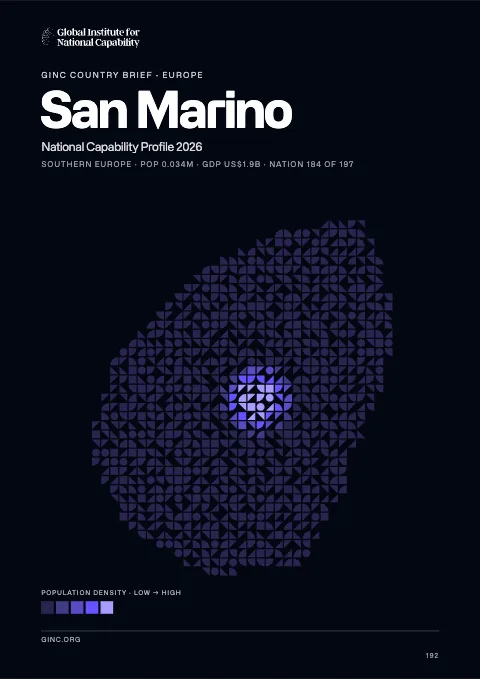
San Marino is a landlocked republic in Europe, home to 33,000 people, with its capital at San Marino.
Contents
12 chapters
Foundations
01–03
At a glance
- Area
- 61km²#225 World#49 Europe
- Population
- 32.7K#214 World#46 Europe
- GDP (market)
- $1.9B
- GDP (PPP)
- $1.3B#200 World#48 Europe
- GDP per capita
- $NA
The whole brief
San Marino National Capability Profile 2026
Foundations · Chapter 01
Historical Context
🇸🇲 San Marino’s understanding the origins and evolution of the modern nation
BackgroundBack to top ↑
Geographically the third smallest state in Europe (after the Holy See and Monaco), San Marino also claims to be the world's oldest republic. According to tradition, it was founded by a Christian stonemason named MARINUS in A.D. 301. San Marino's foreign policy is aligned with that of the European Union, although it is not a member; social and political trends in the republic track closely with those of its larger neighbor, Italy.
IndependenceBack to top ↑
3 September 301
National holidayBack to top ↑
Founding of the Republic, 3 September (A.D. 301)
Foundations · Chapter 02
Geography
🇸🇲 San Marino’s territory, resources and strategic position
Location and areaBack to top ↑
Southern Europe, an enclave in central Italy
43 46 N, 12 25 E
Europe
about one third times the size of Washington, DC
0 km (landlocked)
none (landlocked)
Terrain and resourcesBack to top ↑
rugged mountains
building stone
NA
Settlement and hazardsBack to top ↑
NA
landlocked; smallest independent state in Europe after the Holy See and Monaco; dominated by the Apennines
OtherBack to top ↑
air pollution; urbanization decreasing rural farmlands
Foundations · Chapter 03
Environment
🇸🇲 San Marino’s environmental conditions, resources and national resilience
ClimateBack to top ↑
Mediterranean; mild to cool winters; warm, sunny summers
Emissions and pollutionBack to top ↑
Resources and agreementsBack to top ↑
GINC Capability Domains · Chapter 04
Critical Technology
🇸🇲 San Marino’s technology frontiers and the pursuit of national advantage
Two counts are set side by side for 2015–2024: on the left, the papers researchers in San Marino published; on the right, the patent families that began there and were filed in more than one country. First by capability group, then group by group with each group’s capabilities. The badge on a card is the nation’s place among all nations. Papers are from GINC Research Analytics, patent families from GINC Patents.
Research by capability group
#194 WorldPapers published, 2015–2024
Patents by capability group
#90 WorldInternational patent families, 2015–2024
Advanced Materials & ManufacturingBack to top ↑
Research
#143 WorldPapers published, 2015–2024
Patents
#67 WorldInternational patent families, 2015–2024
Energy TechnologiesBack to top ↑
- Batteries & Energy Storage
- Hydrogen, Ammonia & Sustainable Fuels
- Next-Generation Solar & Renewables
- Advanced Nuclear & Fusion
- Directed Energy Technologies
Semiconductors & Advanced ComputingBack to top ↑
- Semiconductor Design & EDA
- Advanced Semiconductor Fabrication
- Semiconductor Equipment & Materials
- Advanced Packaging & Heterogeneous Integration
- Compound & Power Semiconductors
- High-Performance & AI Computing
Artificial IntelligenceBack to top ↑
Research
Papers published, 2015–2024
No papers on record for 2015–2024.
Patents
#89 WorldInternational patent families, 2015–2024
Quantum TechnologiesBack to top ↑
Connectivity, Cyber & Trust TechnologiesBack to top ↑
- Advanced Optical Communication & Photonics
- Advanced Wireless Communication
- Resilient & Infrastructure-Independent Networks
- Protective Cybersecurity Technologies
- Privacy, Identity & Trust Technologies
Sensing, Timing & NavigationBack to top ↑
Research
#159 WorldPapers published, 2015–2024
Patents
International patent families, 2015–2024
No international patent families on record for 2015–2024.
Robotics & Autonomous SystemsBack to top ↑
Research
Papers published, 2015–2024
No papers on record for 2015–2024.
No research topic: Human-Machine Interfaces
Patents
#71 WorldInternational patent families, 2015–2024
Biotechnology & Health TechnologiesBack to top ↑
Research
#196 WorldPapers published, 2015–2024
Patents
#78 WorldInternational patent families, 2015–2024
Medicine and BioTech
Clinical research and life-science invention, drawn from the same series that drive the metric pages. Each card opens the full cross-country comparison.
Space TechnologiesBack to top ↑
- Space Launch & Reusable Systems
- Advanced Propulsion & Hypersonic Systems
- Satellite & Constellation Technologies
GINC Capability Domains · Chapter 05
Strategic Infrastructure
🇸🇲 San Marino’s energy, connectivity and the material foundations of capability
Resource InfrastructureBack to top ↑
Agriculture & Food InfrastructureBack to top ↑
- Irrigation & Agricultural Water
- Livestock & Veterinary
- Fisheries & Aquaculture
- Storage, Cold Chain & Markets
Energy InfrastructureBack to top ↑
- Thermal Generation
- Nuclear Generation
- Nuclear Fuel Cycle & Radioactive Waste
- Hydropower
- Renewable Generation
- Transmission & Distribution
- System Control & Dispatch
- Storage & Fuel Supply
Water, Sanitation & Waste InfrastructureBack to top ↑
- Dams, Reservoirs & Flood Defence
- Water Supply & Treatment
- Bulk Water Transfer & Desalination
- Wastewater & Sanitation
- Solid Waste & Recycling
Advanced ManufacturingBack to top ↑
- Materials & Inputs
- Chemicals & Hazardous Process Industry
- Production Systems
- Supply Chain & Ecosystem
- Workforce & Innovation
Transport InfrastructureBack to top ↑
- Seaports & Terminals
- Air Infrastructure
- Air Navigation & Traffic Management
- Inland Waterways & Ferries
- Rail Infrastructure
- Roads & Bridges
- Logistics, Multimodal & Border Infrastructure
- Postal & Parcel
Communications & Digital InfrastructureBack to top ↑
- Subsea Cables & International Gateways
- Core & Backbone Networks
- Mobile & Wireless Networks
- Spectrum & Broadcasting
- Data Centres, Compute & Cloud
- Data Resources
- AI Tools & Applications
18,700 (2012)
36,000 (2011)
17,000 (2009)
11,015 (2012)
.sm
Financial InfrastructureBack to top ↑
- Currency & Reserves
- Payments & Settlement Systems
- Markets, Exchanges & Depositories
- Banks, Insurers & Systemic Institutions
Social InfrastructureBack to top ↑
- Health Infrastructure
- Public Health & Laboratories
- Medical Supply & Stockpiles
- Education & Skills Infrastructure
- Research & Scientific Facilities
- Housing, Community & Social Services
- Government & Public Administration
- Cultural, Community & Recreational Infrastructure
- Justice & Corrections
- Emergency Services & Civil Protection
- Hydrometeorology & Early Warning
Space, Aerospace & Defence InfrastructureBack to top ↑
GINC Capability Domains · Chapter 06
National Security
🇸🇲 San Marino’s force, intelligence and the defence of the nation
Disputes and terrorismBack to top ↑
none
Force Generation & MobilisationBack to top ↑
no regular military forces; voluntary Military Corps (Corpi Militari) performs ceremonial duties and limited police support functions (2010)
18 is the legal minimum age for voluntary military service; no conscription; government has the authority to call up all San Marino citizens from 16-60 years of age to service in the military (2012)
defense is the responsibility of Italy
Forces under arms
Active-duty strength on the Correlates of War series, which reaches back to 1816 and so carries a nation’s whole record of mobilisation rather than its present establishment. The card opens the full cross-country comparison.
Intelligence & AssessmentBack to top ↑
- Imagery & Geospatial Intelligence
- Signals & Cyber Intelligence
- Technical & Measurement Intelligence
- Open-Source & Financial Intelligence
- Human Intelligence & Counterintelligence
- All-Source Analysis & Warning
Joint Command, Projection & SustainmentBack to top ↑
- Command, Control & Communications
- Strategic Lift & Mobility
- Expeditionary & Peace Operations
- Operational Sustainment & War Reserves
- Defence Industrial Mobilisation
- CBRN Defence
Land PowerBack to top ↑
- Combined Arms Manoeuvre
- Land Fires
- Battlefield Aviation & Uncrewed Systems
- Special Operations & Irregular Warfare
Maritime PowerBack to top ↑
- Maritime Security & Constabulary
- Sea Denial & Undersea Warfare
- Sea Control
- Amphibious & Expeditionary Operations
Air PowerBack to top ↑
- Air Sovereignty & Policing
- Control of the Air
- Air Strike & Interdiction
- Airborne ISR, Early Warning & Battle Management
Strategic Strike & Missile DefenceBack to top ↑
Space OperationsBack to top ↑
Cyber & Electromagnetic OperationsBack to top ↑
Nuclear DeterrenceBack to top ↑
GINC Capability Domains · Chapter 07
Human Capital
🇸🇲 San Marino’s population, health and the skills that sustain capability
DemographyBack to top ↑
32,742 (July 2014 est.)
0.87% (2014 est.)
8.7 births/1,000 population (2014 est.)
8.31 deaths/1,000 population (2014 est.)
1.49 children born/woman (2014 est.)
Migration and urbanisationBack to top ↑
8.31 migrant(s)/1,000 population (2014 est.)
Welfare and equityBack to top ↑
NA%
Early Childhood DevelopmentBack to top ↑
Foundational EducationBack to top ↑
NA
Advanced EducationBack to top ↑
Technical & Vocational SkillsBack to top ↑
Digital & AI CompetenceBack to top ↑
Lifelong Learning & ReskillingBack to top ↑
Research Talent & Knowledge CreationBack to top ↑
Population HealthBack to top ↑
NA
NA
NA
Health System CapabilityBack to top ↑
7.2% of GDP (2010)
4.88 physicians/1,000 population (2011)
3.9 beds/1,000 population (2011)
GINC Capability Domains · Chapter 08
Governance and Integrity
🇸🇲 San Marino’s institutions, law and the integrity of the state
State structureBack to top ↑
republic
9 municipalities (castelli, singular - castello); Acquaviva, Borgo Maggiore, Chiesanuova, Domagnano, Faetano, Fiorentino, Montegiardino, San Marino Citta, Serravalle
consists of several legislative instruments, chief among them the Statutes (Leges Statuti) of 1600 and the Declaration of Citizen Rights of 1974; latter document amended 2000, 2002 (2013)
18 years of age; universal
Political Institutions & Civic ParticipationBack to top ↑
- Electoral Management & Integrity
- Legislature & Deliberative Institutions
- Citizen Participation & Civic Space
unicameral Grand and General Council or Consiglio Grande e Generale (60 seats; members elected by popular vote to serve five-year terms)
NA
Justice System & Fundamental RightsBack to top ↑
- Judicial Independence & Court Capability
- Access to Justice & Legal Services
- Fundamental Rights Protection
- Human Rights Institutions & Equality Bodies
civil law system with Italian civil law influences
has not submitted an ICJ jurisdiction declaration; accepts ICCt jurisdiction
Internal Security & OrderBack to top ↑
Regulatory Governance & Strategic ControlsBack to top ↑
- Regulatory Quality & Better Regulation
- Regulatory Delivery & Independent Regulators
- Strategic Controls & Economic Security Administration
Government Effectiveness & Public AdministrationBack to top ↑
- Centre of Government & Policy Coordination
- Civil Service & Public Workforce
- Digital Government & Service Delivery
- Legal Identity & Civil Registration
- Statistical & Data Capability
Public Integrity & Anti-CorruptionBack to top ↑
Transparency, Oversight & AccountabilityBack to top ↑
- Right to Information & Open Government
- Independent Oversight & Supreme Audit
- Independent Media & Journalist Safety
National Resilience & Crisis ManagementBack to top ↑
GINC Capability Domains · Chapter 09
Information and Influence
🇸🇲 San Marino’s identity, media and the projection of influence
Identity and cultureBack to top ↑
Italian
Roman Catholic
Sammarinese, Italian
three peaks each displaying a tower
two equal horizontal bands of white (top) and light blue with the national coat of arms superimposed in the center; the main colors derive from the shield of the coat of arms, which features three white towers on three peaks on a blue field; the towers represent three castles built on San Marino's highest feature, Mount Titano: Guaita, Cesta, and Montale; the coat of arms is flanked by a wreath, below a crown and above a scroll bearing the word LIBERTAS (Liberty); the white and blue colors are also said to stand for peace and liberty respectively
Diplomatic Statecraft & Global NetworksBack to top ↑
- Diplomatic Network & Consular Reach
- Multilateral Leadership & Norm Setting
- Agenda-Setting & Convening
- Mediation & Crisis Diplomacy
CE, FAO, IAEA, IBRD, ICAO, ICC (NGOs), ICRM, IDA, IFRCS, ILO, IMF, IMO, Interpol, IOC, IOM (observer), IPU, ITU, ITUC (NGOs), LAIA (observer), OPCW, OSCE, Schengen Convention (de facto member), UN, UNCTAD, UNESCO, Union Latina, UNWTO, UPU, WHO, WIPO
the US does not have an embassy in San Marino; the ambassador to Italy is accredited to San Marino
Alliances & Security CooperationBack to top ↑
Development Cooperation & Global AssistanceBack to top ↑
Culture, Language & Education DiplomacyBack to top ↑
- Cultural & Language Institutes
- Creative Industries & Cultural Export Reach
- Heritage & Cultural Institutions
- Education Diplomacy & Alumni Networks
- Sports & Major Events
Diaspora & Global CommunitiesBack to top ↑
Information Environment & Strategic CommunicationBack to top ↑
- Strategic Communications & Public Diplomacy
- International Media & Broadcasting
- Information Defence & Counter-Interference
state-owned public broadcaster operates 1 TV station and 3 radio stations; receives radio and TV broadcasts from Italy (2012)
GINC Capability Domains · Chapter 10
Financial Strength
🇸🇲 San Marino’s fiscal depth, reserves and the capacity to act
Monetary & Currency CapabilityBack to top ↑
- Monetary Policy & Price Stability
- Exchange Rate & External Account Management
- Currency Issuance & Digital Money
2.8% (2012 est.)//2% (2011)
euros (EUR) per US dollar -//0.7634 (2012 est.)//0.7752 (2011 est.)//0.755 (2010 est.)//0.7198 (2009 est.)//0.6827 (2008 est.)
5.92% (31 December 2011 est.)//5.38% (31 December 2010 est.)
//$1.326 billion (31 December 2007)
$4.584 billion (31 December 2007)//$4.584 billion
Fiscal Capacity & Public FinanceBack to top ↑
- Revenue Mobilisation & Tax Administration
- Public Expenditure & Budget Management
- Sovereign Debt & Treasury Management
- Public Investment Management
35.8% of GDP (2011)
-2.9% of GDP (2012 est.)
25.8% of GDP (2013 est.)//20.3% of GDP (2012 est.)
calendar year
Financial System Depth & AccessBack to top ↑
- Banking System Capacity
- Capital Markets Depth & Development
- Long-Term & Institutional Capital
- Financial Inclusion & Household Access
- Development & Policy Finance
$8.822 billion (30 September 2010)//$8.008 billion (31 December 2009)
$NA
Financial Regulation & IntegrityBack to top ↑
- Prudential Regulation & Supervision
- Financial Integrity & Illicit Finance Control
- Market Conduct & Consumer Protection
- Payment & Market Infrastructure Oversight
Financial Stability & Crisis ManagementBack to top ↑
- Macroprudential & Systemic Oversight
- Crisis Management, Resolution & Deposit Insurance
- External Liquidity & Financial Safety Nets
Sovereign Capital & External Financial PowerBack to top ↑
- Official Reserves Management
- Sovereign Wealth & Public Asset Management
- Currency Internationalisation & Reserve Status
- Capital Account & Flow Management
- International Financial Centre Capability
$308.6 million (2012 est.)//$341.9 million (2011)
$NA
GINC Capability Domains · Chapter 11
Production and Innovation
🇸🇲 San Marino’s output, industry and the engine of prosperity
Economic Output & ProductivityBack to top ↑
San Marino's economy relies heavily on tourism, the banking industry and the manufacture and export of ceramics, clothing, fabrics, furniture, paints, spirits, tiles, and wine. The manufacturing and financial sectors account for more than half of San Marino's GDP. The per capita level of output and standard of living are comparable to those of the most prosperous regions of Italy. The economy benefits from foreign investment due to its relatively low corporate taxes and low taxes on interest earnings. The income tax rate is also very low, about one-third the average EU level. San Marino does not issue public debt securities; when necessary, it finances deficits by drawing down central bank deposits. San Marino's economy has been contracting since 2008, largely due to weakened demand from Italy - which accounts for nearly 90% of its export market - and financial sector consolidation. Difficulties in the banking sector, the recent global economic downturn, and the sizeable decline in tax revenues have contributed to negative real GDP growth. The government has adopted measures to counter the economic downturn, including subsidized credit to businesses and is seeking to shift its growth model away from a reliance on bank and tax secrecy. San Marino continues to work towards harmonizing its fiscal laws with EU and international standards. In September 2009, the OECD removed San Marino from its list of tax havens that have yet to fully adopt global tax standards, and in 2010 San Marino signed Tax Information Exchange Agreements with most major countries. In 2013 San Marino's Government signed a Double Taxation Agreement with Italy, but a referendum on EU membership failed to reach the quorum needed to bring it to a vote.
$1.306 billion (2013 est.)//$1.353 billion (2012 est.)//$1.409 billion (2011 est.)
-3.5% (2013 est.)//-4% (2012 est.)//-2.5% (2011 est.)
$NA (2013 est.)//$55,000 (2012 est.)//$60,800 (2011 est.)
$1.866 billion (2013 est.)
Labour & EmploymentBack to top ↑
- Employment & Labour Force Participation
- Labour Market Institutions & Wage Setting
- Employment Services & Skills Matching
- Labour Adjustment, Transition & Formalisation
21,960 (September 2013)
7% (2012)//5.5% (2011)
Industrial & Sectoral BaseBack to top ↑
- Manufacturing & Advanced Industry
- Foundational & Process Industries
- Agrifood & Primary Production
- Services Economy
wheat, grapes, corn, olives; cattle, pigs, horses, beef, cheese, hides
tourism, banking, textiles, electronics, ceramics, cement, wine
-1.1% (2012 est.)
Structural Transformation & ComplexityBack to top ↑
Business Dynamism & EntrepreneurshipBack to top ↑
- Entrepreneurship & Firm Creation
- Risk Capital & Scale-Up Finance
- Firm Growth, Exit & Renewal
- Competition & Market Contestability
Innovation & CommercialisationBack to top ↑
- Business Innovation Capability
- Research Commercialisation & Knowledge Transfer
- Intellectual Property & Intangible Assets
- Innovation Ecosystems & Clusters
Technology Adoption & DiffusionBack to top ↑
GINC Capability Domains · Chapter 12
Trade and Investment
🇸🇲 San Marino’s markets, capital and the terms of global exchange
Overall tradeBack to top ↑
$234M of exports to 96 partners and $396M of imports from 58 in 2024, a deficit of $162M.
- Exports
- $234M96 partners
- Imports
- $396M58 partners
- Balance
- −$162Mdeficit
- Total trade
- $630M2024
ExportsBack to top ↑
Where its exports go
The largest partners in 2024, with each one's share of the nation's exports.
| Partner | Value | Share | |
|---|---|---|---|
| Romania | $26.4M | 11% | |
| United States | $23.2M | 9.9% | |
| Austria | $21.8M | 9.3% | |
| Germany | $16.1M | 6.9% | |
| France | $14.5M | 6.2% | |
| Brazil | $13.5M | 5.8% | |
| United Kingdom | $12.6M | 5.4% | |
| Poland | $10.9M | 4.7% | |
| Spain | $10.6M | 4.5% | |
| Saudi Arabia | $8.46M | 3.6% | |
| China | $5.38M | 2.3% | |
| South Korea | $4.89M | 2.1% | |
| Greece | $4.35M | 1.9% | |
| Turkey | $4.20M | 1.8% | |
| Netherlands | $3.96M | 1.7% | |
| Slovenia | $3.84M | 1.6% | |
| Bulgaria | $3.48M | 1.5% | |
| Ukraine | $2.80M | 1.2% | |
| Czech Republic | $2.41M | 1.0% | |
| Morocco | $2.19M | 0.9% |
What it exports
The largest categories in 2024.
| Category | Value | Share | |
|---|---|---|---|
| Machinery, nuclear reactors, boilers | $87.2M | 37% | |
| Miscellaneous edible preparations | $27.6M | 12% | |
| Pharmaceutical products | $17.3M | 7.4% | |
| Plastics | $8.15M | 3.5% | |
| Furniture, lighting signs, prefabricated buildings | $6.58M | 2.8% | |
| Aluminum | $6.39M | 2.7% | |
| Essential oils, perfumes, cosmetics, toiletries | $5.83M | 2.5% | |
| Paper and paperboard, articles of pulp, paper and board | $5.37M | 2.3% | |
| Wool, animal hair, horsehair yarn and fabric | $4.92M | 2.1% | |
| Residues, wastes of food industry, animal fodder | $4.85M | 2.1% | |
| Electrical, electronic equipment | $4.29M | 1.8% | |
| Manmade filaments | $3.99M | 1.7% | |
| Cotton | $3.65M | 1.6% | |
| Articles of apparel, not knit or crocheted | $3.54M | 1.5% | |
| Miscellaneous chemical products | $3.36M | 1.4% |
ImportsBack to top ↑
Where its imports come from
The largest partners in 2024, with each one's share of the nation's imports.
| Partner | Value | Share | |
|---|---|---|---|
| Germany | $108M | 27% | |
| Italy | $48.4M | 12% | |
| Spain | $30.5M | 7.7% | |
| Romania | $28.7M | 7.2% | |
| France | $28.4M | 7.2% | |
| Poland | $27.9M | 7.1% | |
| Netherlands | $27.1M | 6.8% | |
| Belgium | $15.0M | 3.8% | |
| Austria | $12.2M | 3.1% | |
| Slovenia | $11.6M | 2.9% | |
| China | $11.4M | 2.9% | |
| Norway | $7.38M | 1.9% | |
| Bosnia and Herzegovina | $5.05M | 1.3% | |
| Switzerland | $4.40M | 1.1% | |
| India | $3.25M | 0.8% | |
| Czech Republic | $3.09M | 0.8% | |
| United Kingdom | $2.64M | 0.7% | |
| Denmark | $2.53M | 0.6% | |
| Sweden | $2.24M | 0.6% | |
| Bulgaria | $2.22M | 0.6% |
What it imports
The largest categories in 2024.
| Category | Value | Share | |
|---|---|---|---|
| Mineral fuels, oils, distillation products | $50.2M | 13% | |
| Vehicles other than railway, tramway | $49.1M | 12% | |
| Articles of apparel, not knit or crocheted | $39.9M | 10% | |
| Articles of apparel, knit or crocheted | $30.1M | 7.6% | |
| Footwear, gaiters and the like | $23.4M | 5.9% | |
| Plastics | $22.7M | 5.7% | |
| Aluminum | $21.3M | 5.4% | |
| Residues, wastes of food industry, animal fodder | $20.1M | 5.1% | |
| Aircraft, spacecraft | $19.0M | 4.8% | |
| Paper and paperboard, articles of pulp, paper and board | $15.1M | 3.8% | |
| Electrical, electronic equipment | $13.4M | 3.4% | |
| Machinery, nuclear reactors, boilers | $10.5M | 2.6% | |
| Cocoa and cocoa preparations | $7.55M | 1.9% | |
| Pearls, precious stones, metals, coins | $5.83M | 1.5% | |
| Toys, games, sports requisites | $5.38M | 1.4% |
In a list, the bar runs to the largest in that list. The line is each figure’s history from 2000, drawn to its own peak: it shows the shape of the years, and the value shows the size.
Trade Facilitation & LogisticsBack to top ↑
Trade Policy & Market AccessBack to top ↑
- Trade Policy & Negotiation Capability
- Market Access & Agreements Network
- Trade Law & Enforcement
- Standards, Conformity & Quality Infrastructure
Digital & Services TradeBack to top ↑
- Services Trade Capability
- Digital Trade & E-Commerce
- Data Flows & Digital Trade Governance
- Tourism & Visitor Economy
Investment Attraction & ProjectionBack to top ↑
- Investment Attraction & Facilitation
- Investment Absorption & Linkages
- Outward Investment & Global Corporate Presence
Export Capability & SophisticationBack to top ↑
$3.827 billion (2011 est.)//$2.576 billion (2010 est.)
Italy 82.3% (2012 est.)
building stone, lime, wood, chestnuts, wheat, wine, baked goods, hides, ceramics
Global Value Chain PositionBack to top ↑
- Value Chain Participation & Integration
- Value Chain Position & Upgrading
- Regional Integration & Hub Anchoring
Economic Leverage & DependenceBack to top ↑
- Strategic Supply Security
- Concentration Risk & Revenue Stabilisation
- Economic Leverage & Coercion Resistance
$2.551 billion (2011 est.)//$2.132 billion (2010 est.)
Italy 81.8% (2012 est.)
wide variety of consumer manufactures, food, energy
San Marino · you are in
Historical Context
Foundations
GINC Capability Domains
Find in this brief · San Marino