
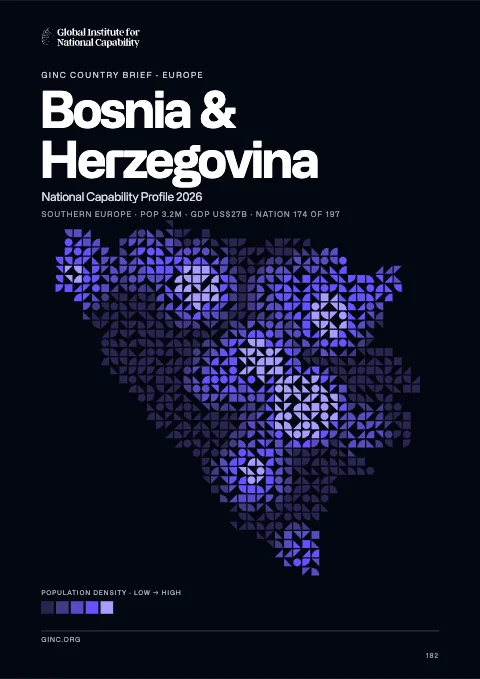
Bosnia and Herzegovina
Bosnia and Herzegovina is an emerging federal democratic republic in Europe, home to 3.9 million people, with its capital at Sarajevo.
Contents
12 chapters
Foundations
01–03
At a glance
- Area
- 51.2Kkm²#128 World#25 Europe
- Population
- 3.9M#128 World#26 Europe
- GDP (market)
- $18.9B
- GDP (PPP)
- $32.2B#111 World#30 Europe
- GDP per capita
- $8.3K#132 World#44 Europe
The whole brief
Bosnia and Herzegovina National Capability Profile 2026
Foundations · Chapter 01
Historical Context
🇧🇦 Bosnia and Herzegovina’s understanding the origins and evolution of the modern nation
BackgroundBack to top ↑
Bosnia and Herzegovina declared sovereignty in October 1991 and independence from the former Yugoslavia on 3 March 1992 after a referendum boycotted by ethnic Serbs. The Bosnian Serbs - supported by neighboring Serbia and Montenegro - responded with armed resistance aimed at partitioning the republic along ethnic lines and joining Serb-held areas to form a "Greater Serbia." In March 1994, Bosniaks and Croats reduced the number of warring factions from three to two by signing an agreement creating a joint Bosniak/Croat Federation of Bosnia and Herzegovina. On 21 November 1995, in Dayton, Ohio, the warring parties initialed a peace agreement that ended three years of interethnic civil strife (the final agreement was signed in Paris on 14 December 1995). The Dayton Peace Accords retained Bosnia and Herzegovina's international boundaries and created a multi-ethnic and democratic government charged with conducting foreign, diplomatic, and fiscal policy. Also recognized was a second tier of government composed of two entities roughly equal in size: the Bosniak/Bosnian Croat Federation of Bosnia and Herzegovina and the Bosnian Serb-led Republika Srpska (RS). The Federation and RS governments are responsible for overseeing most government functions. Additionally, the Dayton Accords established the Office of the High Representative (OHR) to oversee the implementation of the civilian aspects of the agreement. The Peace Implementation Council (PIC) at its conference in Bonn in 1997 also gave the High Representative the authority to impose legislation and remove officials, the so-called "Bonn Powers." An original NATO-led international peacekeeping force (IFOR) of 60,000 troops assembled in 1995 was succeeded over time by a smaller, NATO-led Stabilization Force (SFOR). In 2004, European Union peacekeeping troops (EUFOR) replaced SFOR. Currently EUFOR deploys around 600 troops in theater in a policing capacity.
IndependenceBack to top ↑
1 March 1992 (from Yugoslavia; referendum for independence completed on 1 March 1992; independence declared on 3 March 1992)
National holidayBack to top ↑
National Day (Statehood Day), 25 November (1943); note - observed only in the Federation of Bosnia and Herzegovina entity
Foundations · Chapter 02
Geography
🇧🇦 Bosnia and Herzegovina’s territory, resources and strategic position
Location and areaBack to top ↑
Southeastern Europe, bordering the Adriatic Sea and Croatia
44 00 N, 18 00 E
Europe
slightly smaller than West Virginia
20 km
no data available
Terrain and resourcesBack to top ↑
mountains and valleys
coal, iron ore, bauxite, copper, lead, zinc, chromite, cobalt, manganese, nickel, clay, gypsum, salt, sand, timber, hydropower
30 sq km (2003)
Settlement and hazardsBack to top ↑
destructive earthquakes
within Bosnia and Herzegovina's recognized borders, the country is divided into a joint Bosniak/Croat Federation (about 51% of the territory) and the Bosnian Serb-led Republika Srpska or RS (about 49% of the territory); the region called Herzegovina is contiguous to Croatia and Montenegro, and traditionally has been settled by an ethnic Croat majority in the west and an ethnic Serb majority in the east
OtherBack to top ↑
37.5 cu km (2011)
air pollution from metallurgical plants; sites for disposing of urban waste are limited; water shortages and destruction of infrastructure because of the 1992-95 civil strife; deforestation
Foundations · Chapter 03
Environment
🇧🇦 Bosnia and Herzegovina’s environmental conditions, resources and national resilience
ClimateBack to top ↑
hot summers and cold winters; areas of high elevation have short, cool summers and long, severe winters; mild, rainy winters along coast
Emissions and pollutionBack to top ↑
Water, waste and foodBack to top ↑
Resources and agreementsBack to top ↑
GINC Capability Domains · Chapter 04
Critical Technology
🇧🇦 Bosnia and Herzegovina’s technology frontiers and the pursuit of national advantage
Two counts are set side by side for 2015–2024: on the left, the papers researchers in Bosnia and Herzegovina published; on the right, the patent families that began there and were filed in more than one country. First by capability group, then group by group with each group’s capabilities. The badge on a card is the nation’s place among all nations. Papers are from GINC Research Analytics, patent families from GINC Patents.
Research by capability group
#93 WorldPapers published, 2015–2024
248
106
78
73
48
30
18
15
4
0
Patents by capability group
#90 WorldInternational patent families, 2015–2024
Advanced Materials & ManufacturingBack to top ↑
Research
#95 WorldPapers published, 2015–2024
Patents
International patent families, 2015–2024
No international patent families on record for 2015–2024.
Energy TechnologiesBack to top ↑
Research
#113 WorldPapers published, 2015–2024
Patents
#82 WorldInternational patent families, 2015–2024
Semiconductors & Advanced ComputingBack to top ↑
Research
#113 WorldPapers published, 2015–2024
No research topic: Semiconductor Design & EDA · Advanced Semiconductor Fabrication · Semiconductor Equipment & Materials · Advanced Packaging & Heterogeneous Integration
Patents
International patent families, 2015–2024
No international patent families on record for 2015–2024.
Artificial IntelligenceBack to top ↑
Research
#86 WorldPapers published, 2015–2024
Patents
#89 WorldInternational patent families, 2015–2024
Quantum TechnologiesBack to top ↑
Research
#77 WorldPapers published, 2015–2024
Patents
International patent families, 2015–2024
No international patent families on record for 2015–2024.
Connectivity, Cyber & Trust TechnologiesBack to top ↑
Research
#94 WorldPapers published, 2015–2024
Patents
#93 WorldInternational patent families, 2015–2024
Sensing, Timing & NavigationBack to top ↑
Research
#96 WorldPapers published, 2015–2024
Patents
#68 WorldInternational patent families, 2015–2024
Robotics & Autonomous SystemsBack to top ↑
Research
#78 WorldPapers published, 2015–2024
No research topic: Human-Machine Interfaces
Patents
#79 WorldInternational patent families, 2015–2024
Biotechnology & Health TechnologiesBack to top ↑
Research
#111 WorldPapers published, 2015–2024
Patents
International patent families, 2015–2024
No international patent families on record for 2015–2024.
Medicine and BioTech
Clinical research and life-science invention, drawn from the same series that drive the metric pages. Each card opens the full cross-country comparison.
Space TechnologiesBack to top ↑
Research
Papers published, 2015–2024
No papers on record for 2015–2024.
Patents
#44 WorldInternational patent families, 2015–2024
GINC Capability Domains · Chapter 05
Strategic Infrastructure
🇧🇦 Bosnia and Herzegovina’s energy, connectivity and the material foundations of capability
Resource InfrastructureBack to top ↑
0 bbl/day (2012 est.)
0 bbl/day (2012 est.)
22,140 bbl/day (2010 est.)
0 bbl (1 January 2013 est.)
22,430 bbl/day (2010 est.)
27,540 bbl/day (2011 est.)
10,460 bbl/day (2010 est.)
16,330 bbl/day (2010 est.)
0 cu m (2013 est.)
256.9 million cu m (2013 est.)
0 cu m (2013 est.)
256.9 million cu m (2013 est.)
0 cu m (1 January 2013 est.)
gas 147 km; oil 9 km (2013)
Agriculture & Food InfrastructureBack to top ↑
- Irrigation & Agricultural Water
- Livestock & Veterinary
- Fisheries & Aquaculture
- Storage, Cold Chain & Markets
Energy InfrastructureBack to top ↑
- Thermal Generation
- Nuclear Generation
- Nuclear Fuel Cycle & Radioactive Waste
- Hydropower
- Renewable Generation
- Transmission & Distribution
- System Control & Dispatch
- Storage & Fuel Supply
3.963 million kW (2012 est.)
12.93 billion kWh (2012 est.)
12.62 billion kWh (2012 est.)
1.569 billion kWh (2012 est.)
1.245 billion kWh (2012 est.)
43.3% of total installed capacity (2012 est.)
0% of total installed capacity (2012 est.)
53.2% of total installed capacity (2012 est.)
3.5% of total installed capacity (2012 est.)
22.2 million Mt (2011 est.)
Water, Sanitation & Waste InfrastructureBack to top ↑
- Dams, Reservoirs & Flood Defence
- Water Supply & Treatment
- Bulk Water Transfer & Desalination
- Wastewater & Sanitation
- Solid Waste & Recycling
Advanced ManufacturingBack to top ↑
- Materials & Inputs
- Chemicals & Hazardous Process Industry
- Production Systems
- Supply Chain & Ecosystem
- Workforce & Innovation
Transport InfrastructureBack to top ↑
- Seaports & Terminals
- Air Infrastructure
- Air Navigation & Traffic Management
- Inland Waterways & Ferries
- Rail Infrastructure
- Roads & Bridges
- Logistics, Multimodal & Border Infrastructure
- Postal & Parcel
24 (2013)
6 (2013)
(Sava River on northern border; open to shipping but use limited) (2011)
Communications & Digital InfrastructureBack to top ↑
- Subsea Cables & International Gateways
- Core & Backbone Networks
- Mobile & Wireless Networks
- Spectrum & Broadcasting
- Data Centres, Compute & Cloud
- Data Resources
- AI Tools & Applications
878,000 (2012)
3.35 million (2012)
1.422 million (2009)
155,252 (2012)
.ba
Financial InfrastructureBack to top ↑
- Currency & Reserves
- Payments & Settlement Systems
- Markets, Exchanges & Depositories
- Banks, Insurers & Systemic Institutions
Social InfrastructureBack to top ↑
- Health Infrastructure
- Public Health & Laboratories
- Medical Supply & Stockpiles
- Education & Skills Infrastructure
- Research & Scientific Facilities
- Housing, Community & Social Services
- Government & Public Administration
- Cultural, Community & Recreational Infrastructure
- Justice & Corrections
- Emergency Services & Civil Protection
- Hydrometeorology & Early Warning
Space, Aerospace & Defence InfrastructureBack to top ↑
GINC Capability Domains · Chapter 06
National Security
🇧🇦 Bosnia and Herzegovina’s force, intelligence and the defence of the nation
Disputes and terrorismBack to top ↑
Serbia delimited about half of the boundary with Bosnia and Herzegovina, but sections along the Drina River remain in dispute
Force Generation & MobilisationBack to top ↑
Armed Forces of Bosnia and Herzegovina (AFBiH): Army of Bosnia and Herzegovina, Air and Air Defense Forces of Bosnia and Herzegovina (Zrakoplovstvo i Protuzracna Obrana, ZPO) (2013)
18 years of age for voluntary military service; mandatory retirement at age 35 or after 15 years of service (2013)
1.35% of GDP (2012)//1.15% of GDP (2011)//1.35% of GDP (2010)
Forces under arms
Active-duty strength on the Correlates of War series, which reaches back to 1816 and so carries a nation’s whole record of mobilisation rather than its present establishment. The card opens the full cross-country comparison.
Intelligence & AssessmentBack to top ↑
- Imagery & Geospatial Intelligence
- Signals & Cyber Intelligence
- Technical & Measurement Intelligence
- Open-Source & Financial Intelligence
- Human Intelligence & Counterintelligence
- All-Source Analysis & Warning
Joint Command, Projection & SustainmentBack to top ↑
- Command, Control & Communications
- Strategic Lift & Mobility
- Expeditionary & Peace Operations
- Operational Sustainment & War Reserves
- Defence Industrial Mobilisation
- CBRN Defence
Land PowerBack to top ↑
- Combined Arms Manoeuvre
- Land Fires
- Battlefield Aviation & Uncrewed Systems
- Special Operations & Irregular Warfare
Maritime PowerBack to top ↑
- Maritime Security & Constabulary
- Sea Denial & Undersea Warfare
- Sea Control
- Amphibious & Expeditionary Operations
Air PowerBack to top ↑
- Air Sovereignty & Policing
- Control of the Air
- Air Strike & Interdiction
- Airborne ISR, Early Warning & Battle Management
Strategic Strike & Missile DefenceBack to top ↑
Space OperationsBack to top ↑
Cyber & Electromagnetic OperationsBack to top ↑
Nuclear DeterrenceBack to top ↑
GINC Capability Domains · Chapter 07
Human Capital
🇧🇦 Bosnia and Herzegovina’s population, health and the skills that sustain capability
DemographyBack to top ↑
3,871,643 (July 2014 est.)
-0.11% (2014 est.)
8.89 births/1,000 population (2014 est.)
9.64 deaths/1,000 population (2014 est.)
1.26 children born/woman (2014 est.)
26.3 (2011 est.)
45.8% (2012)
Migration and urbanisationBack to top ↑
-0.38 migrant(s)/1,000 population (2014 est.)
SARAJEVO (capital) 389,000 (2011)
Welfare and equityBack to top ↑
18.6% (2007 est.)
36.2 (2007)
DisplacementBack to top ↑
Early Childhood DevelopmentBack to top ↑
1.5% (2012)
Foundational EducationBack to top ↑
NA
Advanced EducationBack to top ↑
Technical & Vocational SkillsBack to top ↑
Digital & AI CompetenceBack to top ↑
Generative AI adoption
Modelled share of working-age adults using generative AI, from Microsoft telemetry scaled to each country’s 15–64 population. A measure of how fast a workforce is absorbing the technology rather than of how much of it a nation builds. The card opens the full cross-country comparison.
Lifelong Learning & ReskillingBack to top ↑
Research Talent & Knowledge CreationBack to top ↑
Population HealthBack to top ↑
8 deaths/100,000 live births (2010)
26.5% (2008)
less than 0.1% (2007 est.)
900 (2007 est.)
100 (2001 est.)
Health System CapabilityBack to top ↑
10.2% of GDP (2011)
1.69 physicians/1,000 population (2010)
3.5 beds/1,000 population (2010)
GINC Capability Domains · Chapter 08
Governance and Integrity
🇧🇦 Bosnia and Herzegovina’s institutions, law and the integrity of the state
State structureBack to top ↑
emerging federal democratic republic
2 first-order administrative divisions and 1 internationally supervised district* - the Bosniak/Croat Federation of Bosnia and Herzegovina (Federacija Bosne i Hercegovine), the Bosnian Serb-led Republika Srpska, Brcko District (Brcko Distrikt)*; note - Brcko District is in northeastern Bosnia and is a self-governing administrative unit under the sovereignty of Bosnia and Herzegovina and formally held in condominium between the two entities
14 December 1995 (constitution included as part of the Dayton Peace Accords); amended several times, last in 2003; note - each of the entities has its own constitution (2011)
18 years of age, 16 if employed; universal
Political Institutions & Civic ParticipationBack to top ↑
- Electoral Management & Integrity
- Legislature & Deliberative Institutions
- Citizen Participation & Civic Space
bicameral Parliamentary Assembly or Skupstina consists of the House of Peoples or Dom Naroda (15 seats, 5 Bosniak, 5 Croat, 5 Serb; members designated by the Bosniak/Croat Federation's House of Peoples and the Republika Srpska's National Assembly to serve four-year terms); and the state-level House of Representatives or Predstavnicki Dom (42 seats, 28 seats allocated for the Federation of Bosnia and Herzegovina and 14 seats for the Republika Srpska; members elected by popular vote on the basis of proportional representation to serve four-year terms); note - Bosnia's election law specifies four-year terms for the state and first-order administrative division entity legislatures
Activist Democratic Party or A-SDA//Alliance for a Better Future of BiH or SBB BiH [Fahrudin RADONCIC]//Alliance of Independent Social Democrats or SNSD [Milorad DODIK]//Bosnian Party or BOSS [Mirnes AJANOVIC]//Bosnian Patriotic Party or BPS [Sefer HALILOVIC]//Civic Democratic Party or GDS [Ibrahim SPAHIC]//Croat Peasants' Party-New Croat Initiative or HSS-NHI [Ante COLAK]//Croatian Christian Democratic Union of Bosnia and Herzegovina or HKDU [Ivan MUSA]//Croatian Democratic Union of Bosnia and Herzegovina or HDZ-BiH [Dragan COVIC]//Croatian Democratic Union 1990 or HDZ-1990 [Martin RAGUZ]//Croatian Party of Rights of Bosnia and Herzegovina or HSP BiH [Zvonko JURISIC]//Democratic National Union or DNZ [Rifat DOLIC]//Democratic Peoples' Alliance or DNS [Marko PAVIC]//Liberal Democratic Party or LDS [Amir HUSARIC]//Nasa Stranka or NS [Denis GRATZ]//National Democratic Party or NDS//New Socialist Party or NSP [Zdravko KRSMANOVIC]//Party for Bosnia and Herzegovina or SBiH [Amer JERLAGIC]//Party of Democratic Action or SDA [Sulejman TIHIC]//Party of Democratic Progress or PDP [Mladen IVANIC]//Party of Justice and Trust or SPP [Zivko BUDIMIR]//People's Democratic Movement or NDP [Dragan CAVIC and Krsto JANDRIC] (unification of the Democratic Party or DP and the People's Democratic Party or NDS)//'People's' Party of Work for Progress or NSRzB [Mladen IVANKOVIC-LIJANOVIC]//Serb Democratic Party or SDS [Mladen BOSIC]//Serb Radical Party of the Republika Srpska or SRS-RS [Milanko MIHAJLICA]//Serb Radical Party-Dr. Vojislav Seselj or SRS-VS [Dejan SANTIC]//Social Democratic Party of BiH or SDP BiH [Zlatko LAGUMDZIJA]//Social Democratic Union or SDU [Miro LAZOVIC]//Socialist Party of Republika Srpska or SPRS [Petar DJOKIC]
Justice System & Fundamental RightsBack to top ↑
- Judicial Independence & Court Capability
- Access to Justice & Legal Services
- Fundamental Rights Protection
- Human Rights Institutions & Equality Bodies
civil law system; Constitutional Court review of legislative acts
has not submitted an ICJ jurisdiction declaration; accepts ICCt jurisdiction
Internal Security & OrderBack to top ↑
increasingly a transit point for heroin being trafficked to Western Europe; minor transit point for marijuana; remains highly vulnerable to money-laundering activity given a primarily cash-based and unregulated economy, weak law enforcement, and instances of corruption
Regulatory Governance & Strategic ControlsBack to top ↑
- Regulatory Quality & Better Regulation
- Regulatory Delivery & Independent Regulators
- Strategic Controls & Economic Security Administration
Government Effectiveness & Public AdministrationBack to top ↑
- Centre of Government & Policy Coordination
- Civil Service & Public Workforce
- Digital Government & Service Delivery
- Legal Identity & Civil Registration
- Statistical & Data Capability
Public Integrity & Anti-CorruptionBack to top ↑
Transparency, Oversight & AccountabilityBack to top ↑
- Right to Information & Open Government
- Independent Oversight & Supreme Audit
- Independent Media & Journalist Safety
National Resilience & Crisis ManagementBack to top ↑
GINC Capability Domains · Chapter 09
Information and Influence
🇧🇦 Bosnia and Herzegovina’s identity, media and the projection of influence
Identity and cultureBack to top ↑
Bosnian (official), Croatian (official), Serbian (official)
Muslim 40%, Orthodox 31%, Roman Catholic 15%, other 14%
Bosniak 48%, Serb 37.1%, Croat 14.3%, other 0.6% (2000)
golden lily
a wide medium blue vertical band on the fly side with a yellow isosceles triangle abutting the band and the top of the flag; the remainder of the flag is medium blue with seven full five-pointed white stars and two half stars top and bottom along the hypotenuse of the triangle; the triangle approximates the shape of the country and its three points stand for the constituent peoples - Bosniaks, Croats, and Serbs; the stars represent Europe and are meant to be continuous (thus the half stars at top and bottom); the colors (white, blue, and yellow) are often associated with neutrality and peace, and traditionally are linked with Bosnia
Diplomatic Statecraft & Global NetworksBack to top ↑
- Diplomatic Network & Consular Reach
- Multilateral Leadership & Norm Setting
- Agenda-Setting & Convening
- Mediation & Crisis Diplomacy
BIS, CD, CE, CEI, EAPC, EBRD, FAO, G-77, IAEA, IBRD, ICAO, ICC (NGOs), ICRM, IDA, IFAD, IFC, IFRCS, ILO, IMF, IMO, IMSO, Interpol, IOC, IOM, IPU, ISO, ITSO, ITU, ITUC (NGOs), MIGA, MONUSCO, NAM (observer), OAS (observer), OIC (observer), OIF (observer), OPCW, OSCE, PFP, SELEC, UN, UNCTAD, UNESCO, UNIDO, UNWTO, UPU, WCO, WHO, WIPO, WMO, WTO (observer)
Alliances & Security CooperationBack to top ↑
Development Cooperation & Global AssistanceBack to top ↑
Culture, Language & Education DiplomacyBack to top ↑
- Cultural & Language Institutes
- Creative Industries & Cultural Export Reach
- Heritage & Cultural Institutions
- Education Diplomacy & Alumni Networks
- Sports & Major Events
Diaspora & Global CommunitiesBack to top ↑
Information Environment & Strategic CommunicationBack to top ↑
- Strategic Communications & Public Diplomacy
- International Media & Broadcasting
- Information Defence & Counter-Interference
3 public TV broadcasters: Radio and TV of Bosnia and Herzegovina, Federation TV (operating 2 networks), and Republika Srpska Radio-TV; a local commercial network of 5 TV stations; 3 private, near-national TV stations and dozens of small independent TV stations broadcasting; 3 large public radio broadcasters and many private radio stations (2010)
GINC Capability Domains · Chapter 10
Financial Strength
🇧🇦 Bosnia and Herzegovina’s fiscal depth, reserves and the capacity to act
Monetary & Currency CapabilityBack to top ↑
- Monetary Policy & Price Stability
- Exchange Rate & External Account Management
- Currency Issuance & Digital Money
0.2% (2013 est.)//1.8% (2012 est.)
konvertibilna markas (BAM) per US dollar -//1.42 (2013 est.)//1.52 (2012 est.)//1.4767 (2010 est.)//1.4079 (2009)//1.3083 (2008)
6.73% (31 December 2013 est.)//6.8% (31 December 2012 est.)
$4.493 billion (31 December 2013 est.)//$4.122 billion (31 December 2012 est.)
$10.8 billion (31 December 2013 est.)//$10.21 billion (31 December 2012 est.)
Fiscal Capacity & Public FinanceBack to top ↑
- Revenue Mobilisation & Tax Administration
- Public Expenditure & Budget Management
- Sovereign Debt & Treasury Management
- Public Investment Management
40.8% of GDP (2013 est.)
1% of GDP (2013 est.)
45.9% of GDP (2013 est.)//42.9% of GDP (2012 est.)
calendar year
Financial System Depth & AccessBack to top ↑
- Banking System Capacity
- Capital Markets Depth & Development
- Long-Term & Institutional Capital
- Financial Inclusion & Household Access
- Development & Policy Finance
$11 billion (31 December 2013 est.)//$10.82 billion (31 December 2012 est.)
$NA
8.6% of GDP (2013 est.)//6.3% of GDP (2012 est.)//6.4% of GDP (2011 est.)
Financial Regulation & IntegrityBack to top ↑
- Prudential Regulation & Supervision
- Financial Integrity & Illicit Finance Control
- Market Conduct & Consumer Protection
- Payment & Market Infrastructure Oversight
Financial Stability & Crisis ManagementBack to top ↑
- Macroprudential & Systemic Oversight
- Crisis Management, Resolution & Deposit Insurance
- External Liquidity & Financial Safety Nets
Sovereign Capital & External Financial PowerBack to top ↑
- Official Reserves Management
- Sovereign Wealth & Public Asset Management
- Currency Internationalisation & Reserve Status
- Capital Account & Flow Management
- International Financial Centre Capability
$5.002 billion (31 January 2014 est.)//$4.852 billion (31 January 2013 est.)
$11.14 billion (31 December 2013 est.)//$10.81 billion (31 December 2012 est.)
GINC Capability Domains · Chapter 11
Production and Innovation
🇧🇦 Bosnia and Herzegovina’s output, industry and the engine of prosperity
Economic Output & ProductivityBack to top ↑
Bosnia has a transitional economy with limited market reforms. The economy relies heavily on the export of metals, energy, textiles and furniture as well as on remittances and foreign aid. A highly decentralized government hampers economic policy coordination and reform, while excessive bureaucracy and a segmented market discourage foreign investment. The interethnic warfare in Bosnia and Herzegovina caused production to plummet by 80% from 1992 to 1995 and unemployment to soar. With an uneasy peace in place, output recovered in 1996-99 but slowed in 2000-02 and picked up again during 2003-08, when GDP growth exceeded 5% per year. However, the country declined in 2009 reflecting local effects of the global economic crisis. GDP growth contracted again in 2012, but posted a small gain in 2013. Foreign banks, primarily from Austria and Italy, now control most of the banking sector. The konvertibilna marka (convertible mark or BAM) - the national currency introduced in 1998 - is pegged to the euro, and confidence in the currency and the banking sector has remained stable. Bosnia's private sector is growing slowly, but foreign investment has dropped sharply since 2007. Government spending - including transfer payments - remains high, at roughly 40% of GDP, because of redundant government offices at the state, entity and municipal level. Privatization of state enterprises has been slow, particularly in the Federation, where political division between ethnically-based political parties makes agreement on economic policy more difficult. High unemployment remains the most serious macroeconomic problem. Successful implementation of a value-added tax in 2006 provided a steady source of revenue for the government and helped rein in gray-market activity. National-level statistics have also improved over time but a large share of economic activity remains unofficial and unrecorded. Bosnia and Herzegovina became a full member of the Central European Free Trade Agreement in September 2007. Bosnia and Herzegovina's top economic priorities are: acceleration of integration into the EU; strengthening the fiscal system; public administration reform; World Trade Organization (WTO) membership; and securing economic growth by fostering a dynamic, competitive private sector. In 2009, Bosnia and Herzegovina was granted an International Monetary Fund (IMF) stand-by arrangement, necessitated by sharply increased social spending and a fiscal crisis exacerbated by the global economic downturn. Disbursement of IMF aid was suspended in 2011 after a parliamentary deadlock left Bosnia without a state-level government for over a year. The IMF concluded a new stand-by arrangement with Bosnia in October 2012 which aims to improve national policy coordination, continue fiscal contraction, improve crisis preparedness, and create an environment conducive to private sector development.
$32.16 billion (2013 est.)//$31.9 billion (2012 est.)//$32.26 billion (2011 est.)
0.8% (2013 est.)//-1.1% (2012 est.)//1% (2011 est.)
$8,300 (2013 est.)//$8,200 (2012 est.)//$8,300 (2011 est.)
$18.87 billion (2013 est.)
Labour & EmploymentBack to top ↑
- Employment & Labour Force Participation
- Labour Market Institutions & Wage Setting
- Employment Services & Skills Matching
- Labour Adjustment, Transition & Formalisation
1.49 million (2012 est.)
44.3% (2013 est.)//44.1% (2012 est.)
Industrial & Sectoral BaseBack to top ↑
- Manufacturing & Advanced Industry
- Foundational & Process Industries
- Agrifood & Primary Production
- Services Economy
wheat, corn, fruits, vegetables; livestock
steel, coal, iron ore, lead, zinc, manganese, bauxite, aluminum, motor vehicle assembly, textiles, tobacco products, wooden furniture, ammunition, domestic appliances, oil refining
11.7% (2013 est.)
Structural Transformation & ComplexityBack to top ↑
Business Dynamism & EntrepreneurshipBack to top ↑
- Entrepreneurship & Firm Creation
- Risk Capital & Scale-Up Finance
- Firm Growth, Exit & Renewal
- Competition & Market Contestability
Innovation & CommercialisationBack to top ↑
- Business Innovation Capability
- Research Commercialisation & Knowledge Transfer
- Intellectual Property & Intangible Assets
- Innovation Ecosystems & Clusters
Technology Adoption & DiffusionBack to top ↑
GINC Capability Domains · Chapter 12
Trade and Investment
🇧🇦 Bosnia and Herzegovina’s markets, capital and the terms of global exchange
Overall tradeBack to top ↑
$9.35B of exports to 155 partners and $16.4B of imports from 204 in 2024, a deficit of $7.03B.
- Exports
- $9.35B155 partners
- Imports
- $16.4B204 partners
- Balance
- −$7.03Bdeficit
- Total trade
- $25.7B2024
ExportsBack to top ↑
Where its exports go
The largest partners in 2024, with each one's share of the nation's exports.
| Partner | Value | Share | |
|---|---|---|---|
| Germany | $1.33B | 14% | |
| Croatia | $1.32B | 14% | |
| Serbia | $1.07B | 11% | |
| Austria | $914M | 9.8% | |
| Slovenia | $810M | 8.7% | |
| Italy | $688M | 7.4% | |
| Montenegro | $289M | 3.1% | |
| Turkey | $233M | 2.5% | |
| France | $233M | 2.5% | |
| Czech Republic | $220M | 2.3% | |
| Netherlands | $210M | 2.3% | |
| United States | $189M | 2.0% | |
| Switzerland | $169M | 1.8% | |
| Hungary | $156M | 1.7% | |
| Poland | $147M | 1.6% | |
| United Kingdom | $118M | 1.3% | |
| Romania | $108M | 1.2% | |
| North Macedonia | $105M | 1.1% | |
| Slovakia | $99.4M | 1.1% | |
| China | $88.3M | 0.9% |
What it exports
The largest categories in 2024.
| Category | Value | Share | |
|---|---|---|---|
| Electrical, electronic equipment | $896M | 9.6% | |
| Machinery, nuclear reactors, boilers | $792M | 8.5% | |
| Furniture, lighting signs, prefabricated buildings | $635M | 6.8% | |
| Articles of iron or steel | $609M | 6.5% | |
| Mineral fuels, oils, distillation products | $593M | 6.3% | |
| Footwear, gaiters and the like | $522M | 5.6% | |
| Wood and articles of wood, wood charcoal | $497M | 5.3% | |
| Aluminum | $463M | 5.0% | |
| Inorganic chemicals, precious metal compound, isotope | $441M | 4.7% | |
| Plastics | $421M | 4.5% | |
| Vehicles other than railway, tramway | $338M | 3.6% | |
| Iron and steel | $270M | 2.9% | |
| Arms and ammunition, parts and accessories | $259M | 2.8% | |
| Articles of apparel, not knit or crocheted | $258M | 2.8% | |
| Paper and paperboard, articles of pulp, paper and board | $225M | 2.4% |
ImportsBack to top ↑
Where its imports come from
The largest partners in 2024, with each one's share of the nation's imports.
| Partner | Value | Share | |
|---|---|---|---|
| Italy | $2.04B | 12% | |
| Germany | $1.84B | 11% | |
| Serbia | $1.79B | 11% | |
| China | $1.52B | 9.3% | |
| Croatia | $1.36B | 8.3% | |
| Turkey | $962M | 5.9% | |
| Slovenia | $680M | 4.2% | |
| Austria | $603M | 3.7% | |
| Poland | $529M | 3.2% | |
| Hungary | $408M | 2.5% | |
| United States | $349M | 2.1% | |
| France | $305M | 1.9% | |
| Czech Republic | $296M | 1.8% | |
| Netherlands | $257M | 1.6% | |
| Spain | $237M | 1.4% | |
| Bulgaria | $198M | 1.2% | |
| Russia | $184M | 1.1% | |
| Greece | $174M | 1.1% | |
| Brazil | $165M | 1.0% | |
| Romania | $160M | 1.0% |
What it imports
The largest categories in 2024.
| Category | Value | Share | |
|---|---|---|---|
| Mineral fuels, oils, distillation products | $1.98B | 12% | |
| Machinery, nuclear reactors, boilers | $1.47B | 9.0% | |
| Vehicles other than railway, tramway | $1.36B | 8.3% | |
| Electrical, electronic equipment | $1.06B | 6.5% | |
| Plastics | $871M | 5.3% | |
| Iron and steel | $597M | 3.6% | |
| Pharmaceutical products | $553M | 3.4% | |
| Articles of iron or steel | $421M | 2.6% | |
| Aluminum | $412M | 2.5% | |
| Copper | $397M | 2.4% | |
| Beverages, spirits and vinegar | $329M | 2.0% | |
| Meat and edible meat offal | $326M | 2.0% | |
| Articles of apparel, knit or crocheted | $305M | 1.9% | |
| Paper and paperboard, articles of pulp, paper and board | $292M | 1.8% | |
| Miscellaneous edible preparations | $276M | 1.7% |
In a list, the bar runs to the largest in that list. The line is each figure’s history from 2000, drawn to its own peak: it shows the shape of the years, and the value shows the size.
External balanceBack to top ↑
-$939.5 million (2013 est.)//$1.639 billion (2012 est.)
Trade Facilitation & LogisticsBack to top ↑
Trade Policy & Market AccessBack to top ↑
- Trade Policy & Negotiation Capability
- Market Access & Agreements Network
- Trade Law & Enforcement
- Standards, Conformity & Quality Infrastructure
Digital & Services TradeBack to top ↑
- Services Trade Capability
- Digital Trade & E-Commerce
- Data Flows & Digital Trade Governance
- Tourism & Visitor Economy
Investment Attraction & ProjectionBack to top ↑
- Investment Attraction & Facilitation
- Investment Absorption & Linkages
- Outward Investment & Global Corporate Presence
$7.721 billion//$7.58 billion
Export Capability & SophisticationBack to top ↑
$5.687 billion (2013 est.)//$5.161 billion (2012 est.)
Germany 15.6%, Croatia 14.2%, Italy 12.1%, Serbia 9.1%, Austria 8.2%, Slovenia 8.1% (2012 est.)
metals, clothing, wood products
Global Value Chain PositionBack to top ↑
- Value Chain Participation & Integration
- Value Chain Position & Upgrading
- Regional Integration & Hub Anchoring
Economic Leverage & DependenceBack to top ↑
- Strategic Supply Security
- Concentration Risk & Revenue Stabilisation
- Economic Leverage & Coercion Resistance
$10.3 billion (2013 est.)//$10.02 billion (2012 est.)
Germany 11.4%, Russian Federation 9.9%, Serbia 9.8%, Italy 9.7%, China 6%, Slovenia 5%, Croatia 12.8% (2012 est.)
machinery and equipment, chemicals, fuels, foodstuffs
Bosnia and Herzegovina · you are in
Historical Context
Foundations
GINC Capability Domains
Find in this brief · Bosnia and Herzegovina