
Montenegro
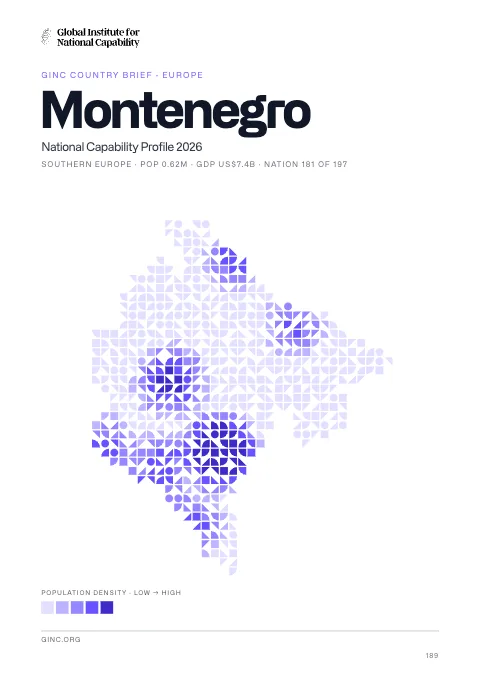
Montenegro is a republic in Europe, home to 650,000 people, with its capital at Podgorica.
Contents
12 chapters
Foundations
01–03
At a glance
- Area
- 13.8Kkm²#161 World#36 Europe
- Population
- 650K#167 World#36 Europe
- GDP (market)
- $4.5B
- GDP (PPP)
- $7.4B#158 World#39 Europe
- GDP per capita
- $11.9K#108 World#40 Europe
The whole brief
Montenegro National Capability Profile 2026
Foundations · Chapter 01
Historical Context
🇲🇪 Montenegro’s understanding the origins and evolution of the modern nation
BackgroundBack to top ↑
The use of the name Crna Gora or Black Mountain (Montenegro) began in the 13th century in reference to a highland region in the Serbian province of Zeta. The later medieval state of Zeta maintained its existence until 1496 when Montenegro finally fell under Ottoman rule. Over subsequent centuries Montenegro managed to maintain a level of autonomy within the Ottoman Empire. From the 16th to 19th centuries, Montenegro was a theocracy ruled by a series of bishop princes; in 1852, it transformed into a secular principality. Montenegro was recognized as an independent sovereign principality at the Congress of Berlin in 1878. After World War I, during which Montenegro fought on the side of the Allies, Montenegro was absorbed by the Kingdom of Serbs, Croats, and Slovenes, which became the Kingdom of Yugoslavia in 1929; at the conclusion of World War II, it became a constituent republic of the Socialist Federal Republic of Yugoslavia. When the latter dissolved in 1992, Montenegro federated with Serbia, creating the Federal Republic of Yugoslavia and, after 2003, shifting to a looser State Union of Serbia and Montenegro. In May 2006, Montenegro invoked its right under the Constitutional Charter of Serbia and Montenegro to hold a referendum on independence from the state union. The vote for severing ties with Serbia barely exceeded 55% - the threshold set by the EU - allowing Montenegro to formally restore its independence on 3 June 2006.
IndependenceBack to top ↑
3 June 2006 (from the State Union of Serbia and Montenegro)
National holidayBack to top ↑
National Day, 13 July (1878)
Foundations · Chapter 02
Geography
🇲🇪 Montenegro’s territory, resources and strategic position
Location and areaBack to top ↑
Southeastern Europe, between the Adriatic Sea and Serbia
42 30 N, 19 18 E
Europe
slightly smaller than Connecticut
293.5 km
Terrain and resourcesBack to top ↑
highly indented coastline with narrow coastal plain backed by rugged high limestone mountains and plateaus
bauxite, hydroelectricity
24.12 sq km (2010)
Settlement and hazardsBack to top ↑
destructive earthquakes
strategic location along the Adriatic coast
OtherBack to top ↑
pollution of coastal waters from sewage outlets, especially in tourist-related areas such as Kotor
Foundations · Chapter 03
Environment
🇲🇪 Montenegro’s environmental conditions, resources and national resilience
ClimateBack to top ↑
Mediterranean climate, hot dry summers and autumns and relatively cold winters with heavy snowfalls inland
Emissions and pollutionBack to top ↑
Resources and agreementsBack to top ↑
GINC Capability Domains · Chapter 04
Critical Technology
🇲🇪 Montenegro’s technology frontiers and the pursuit of national advantage
Two counts are set side by side for 2015–2024: on the left, the papers researchers in Montenegro published; on the right, the patent families that began there and were filed in more than one country. First by capability group, then group by group with each group’s capabilities. The badge on a card is the nation’s place among all nations. Papers are from GINC Research Analytics, patent families from GINC Patents.
Research by capability group
#120 WorldPapers published, 2015–2024
Patents by capability group
#95 WorldInternational patent families, 2015–2024
Advanced Materials & ManufacturingBack to top ↑
Research
#108 WorldPapers published, 2015–2024
Patents
International patent families, 2015–2024
No international patent families on record for 2015–2024.
Energy TechnologiesBack to top ↑
Research
#107 WorldPapers published, 2015–2024
Patents
#69 WorldInternational patent families, 2015–2024
Semiconductors & Advanced ComputingBack to top ↑
Research
#101 WorldPapers published, 2015–2024
No research topic: Semiconductor Design & EDA · Advanced Semiconductor Fabrication · Semiconductor Equipment & Materials · Advanced Packaging & Heterogeneous Integration
Patents
International patent families, 2015–2024
No international patent families on record for 2015–2024.
Artificial IntelligenceBack to top ↑
Research
#116 WorldPapers published, 2015–2024
Patents
#89 WorldInternational patent families, 2015–2024
Quantum TechnologiesBack to top ↑
Research
#111 WorldPapers published, 2015–2024
Patents
International patent families, 2015–2024
No international patent families on record for 2015–2024.
Connectivity, Cyber & Trust TechnologiesBack to top ↑
Research
#112 WorldPapers published, 2015–2024
Patents
#93 WorldInternational patent families, 2015–2024
Sensing, Timing & NavigationBack to top ↑
Research
#76 WorldPapers published, 2015–2024
Patents
International patent families, 2015–2024
No international patent families on record for 2015–2024.
Robotics & Autonomous SystemsBack to top ↑
Research
#112 WorldPapers published, 2015–2024
No research topic: Human-Machine Interfaces
Patents
#85 WorldInternational patent families, 2015–2024
Biotechnology & Health TechnologiesBack to top ↑
Research
#163 WorldPapers published, 2015–2024
Patents
International patent families, 2015–2024
No international patent families on record for 2015–2024.
Medicine and BioTech
Clinical research and life-science invention, drawn from the same series that drive the metric pages. Each card opens the full cross-country comparison.
Space TechnologiesBack to top ↑
Research
#95 WorldPapers published, 2015–2024
Patents
International patent families, 2015–2024
No international patent families on record for 2015–2024.
GINC Capability Domains · Chapter 05
Strategic Infrastructure
🇲🇪 Montenegro’s energy, connectivity and the material foundations of capability
Resource InfrastructureBack to top ↑
0 bbl/day (2012 est.)
0 bbl/day (2010 est.)
0 bbl/day (2010 est.)
0 bbl (1 January 2012 est.)
0 bbl/day (2010 est.)
4,446 bbl/day (2011 est.)
369 bbl/day (2010 est.)
3,300 bbl/day (2010 est.)
0 cu m (2011 est.)
0 cu m (2010 est.)
0 cu m (2011 est.)
0 cu m (2011 est.)
0 cu m (1 January 2013 est.)
Agriculture & Food InfrastructureBack to top ↑
- Irrigation & Agricultural Water
- Livestock & Veterinary
- Fisheries & Aquaculture
- Storage, Cold Chain & Markets
Energy InfrastructureBack to top ↑
- Thermal Generation
- Nuclear Generation
- Nuclear Fuel Cycle & Radioactive Waste
- Hydropower
- Renewable Generation
- Transmission & Distribution
- System Control & Dispatch
- Storage & Fuel Supply
868,000 kW (2010 est.)
3.945 billion kWh (2010 est.)
3.279 billion kWh (2010 est.)
730 million kWh (2010 est.)
732 million kWh (2010 est.)
24.2% of total installed capacity (2010 est.)
0% of total installed capacity (2010 est.)
75.8% of total installed capacity (2010 est.)
0% of total installed capacity (2010 est.)
2.166 million Mt (2011 est.)
Water, Sanitation & Waste InfrastructureBack to top ↑
- Dams, Reservoirs & Flood Defence
- Water Supply & Treatment
- Bulk Water Transfer & Desalination
- Wastewater & Sanitation
- Solid Waste & Recycling
Advanced ManufacturingBack to top ↑
- Materials & Inputs
- Chemicals & Hazardous Process Industry
- Production Systems
- Supply Chain & Ecosystem
- Workforce & Innovation
Transport InfrastructureBack to top ↑
- Seaports & Terminals
- Air Infrastructure
- Air Navigation & Traffic Management
- Inland Waterways & Ferries
- Rail Infrastructure
- Roads & Bridges
- Logistics, Multimodal & Border Infrastructure
- Postal & Parcel
5 (2013)
1 (2012)
Communications & Digital InfrastructureBack to top ↑
- Subsea Cables & International Gateways
- Core & Backbone Networks
- Mobile & Wireless Networks
- Spectrum & Broadcasting
- Data Centres, Compute & Cloud
- Data Resources
- AI Tools & Applications
163,000 (2012)
1.126 million (2012)
280,000 (2009)
10,088 (2012)
.me
Financial InfrastructureBack to top ↑
- Currency & Reserves
- Payments & Settlement Systems
- Markets, Exchanges & Depositories
- Banks, Insurers & Systemic Institutions
Social InfrastructureBack to top ↑
- Health Infrastructure
- Public Health & Laboratories
- Medical Supply & Stockpiles
- Education & Skills Infrastructure
- Research & Scientific Facilities
- Housing, Community & Social Services
- Government & Public Administration
- Cultural, Community & Recreational Infrastructure
- Justice & Corrections
- Emergency Services & Civil Protection
- Hydrometeorology & Early Warning
Space, Aerospace & Defence InfrastructureBack to top ↑
GINC Capability Domains · Chapter 06
National Security
🇲🇪 Montenegro’s force, intelligence and the defence of the nation
Disputes and terrorismBack to top ↑
none
Force Generation & MobilisationBack to top ↑
Armed Forces of the Republic of Montenegro: Army of Montenegro (includes Montenegrin Navy (Mornarica Crne Gore, MCG)), Air Force (2011)
18 is the legal minimum age for voluntary military service; no conscription (2012)
1.87% of GDP (2012)//1.95% of GDP (2011)//1.87% of GDP (2010)
Forces under arms
Active-duty strength on the Correlates of War series, which reaches back to 1816 and so carries a nation’s whole record of mobilisation rather than its present establishment. The card opens the full cross-country comparison.
Intelligence & AssessmentBack to top ↑
- Imagery & Geospatial Intelligence
- Signals & Cyber Intelligence
- Technical & Measurement Intelligence
- Open-Source & Financial Intelligence
- Human Intelligence & Counterintelligence
- All-Source Analysis & Warning
Joint Command, Projection & SustainmentBack to top ↑
- Command, Control & Communications
- Strategic Lift & Mobility
- Expeditionary & Peace Operations
- Operational Sustainment & War Reserves
- Defence Industrial Mobilisation
- CBRN Defence
Land PowerBack to top ↑
- Combined Arms Manoeuvre
- Land Fires
- Battlefield Aviation & Uncrewed Systems
- Special Operations & Irregular Warfare
Maritime PowerBack to top ↑
- Maritime Security & Constabulary
- Sea Denial & Undersea Warfare
- Sea Control
- Amphibious & Expeditionary Operations
Air PowerBack to top ↑
- Air Sovereignty & Policing
- Control of the Air
- Air Strike & Interdiction
- Airborne ISR, Early Warning & Battle Management
Strategic Strike & Missile DefenceBack to top ↑
Space OperationsBack to top ↑
Cyber & Electromagnetic OperationsBack to top ↑
Nuclear DeterrenceBack to top ↑
GINC Capability Domains · Chapter 07
Human Capital
🇲🇪 Montenegro’s population, health and the skills that sustain capability
DemographyBack to top ↑
650,036 (July 2014 est.)
-0.49% (2014 est.)
10.59 births/1,000 population (2014 est.)
9.3 deaths/1,000 population (2014 est.)
26.3 (2010 est.)
39.4% (2005/06)
Migration and urbanisationBack to top ↑
PODGORICA (capital) 156,000 (2011)
Welfare and equityBack to top ↑
6.6% (2010 est.)
24.3 (2010)//30 (2003)
DisplacementBack to top ↑
Early Childhood DevelopmentBack to top ↑
2.2% (2006)
Foundational EducationBack to top ↑
NA
Advanced EducationBack to top ↑
Technical & Vocational SkillsBack to top ↑
Digital & AI CompetenceBack to top ↑
Lifelong Learning & ReskillingBack to top ↑
Research Talent & Knowledge CreationBack to top ↑
Population HealthBack to top ↑
8 deaths/100,000 live births (2010)
22.5% (2008)
Health System CapabilityBack to top ↑
9.3% of GDP (2011)
2.03 physicians/1,000 population (2010)
4 beds/1,000 population (2010)
GINC Capability Domains · Chapter 08
Governance and Integrity
🇲🇪 Montenegro’s institutions, law and the integrity of the state
State structureBack to top ↑
republic
23 municipalities (opstine, singular - opstina); Andrijevica, Bar, Berane, Bijelo Polje, Budva, Cetinje, Danilovgrad, Gusinje, Herceg Novi, Kolasin, Kotor, Mojkovac, Niksic, Petnijica, Plav, Pljevlja, Pluzine, Podgorica, Rozaje, Savnik, Tivat, Ulcinj, Zabljak
several previous; latest adopted 22 October 2007; note - in early 2013, Montenegro's parliamentary constitutional committee began debate on proposed amendments (2013)
18 years of age; universal
Political Institutions & Civic ParticipationBack to top ↑
- Electoral Management & Integrity
- Legislature & Deliberative Institutions
- Citizen Participation & Civic Space
unicameral Assembly (81 seats; members elected by direct vote to serve four-year terms)
Albanian Coalition (includes Democratic League in Montenegro or DSCG [Mehmed BARDHI], Democratic Party [Fatmir DJEKA], and Albanian Alternative or AA [Djerdj DAMAJ])//Bosniak Party or BS [Rafet HUSOVIC]//Coalition for European Montenegro (bloc) [Milo DJUKANOVIC] (includes Democratic Party of Socialists or DPS [Milo DJUKANOVIC], Liberal Party of Montenegro or LP [Andrija POPOCVIC], and the Social Democratic Party or SDP [Ranko KRIVOKAPIC])//Coalition FORCA for Unity (includes FORCA [Nazif CUNGU] and Civic Initiative [Vaselj Sinistaj])//Croatian Civic Initiative or HGI [Marija VUCINOVIC]//Democratic Center or DC [Goran BATRICEVIC]//Democratic Front (bloc) [Miodrag LEKIC] (includes New Serb Democracy or NOVA [Andrija MANDIC] and Movement for Change or PZP [Nebojsa MEDOJEVIC], a splinter faction of the Socialist People's Party or SNP)//Democratic Union of Albanians or DUA [Mehmet ZENKA]//Just Montenegro [Rade BOJOVIC]//Positive Montenegro [Darko PAJOVIC]//Serbian National Alliance (bloc)(includes Party of Serb Radicals or SSR, Democratic Serb Party or DSS [Ranko KADIC], and the Serbian National Council)//Serbian Unity (bloc) (includes Serbian People's Party or NS [Predrag POPOVIC], the Serb List or SL, the Serbian Homeland Party, the Serbian Radical Party, and the Democratic Centre of Boka or DCB [Dejan COROVIC])//Socialist People's Party or SNP [Srdan MILIC]//Together (bloc) (includes Pensioners' Party [Vojo VULETIC], Disabled and Social Justice, and the Yugoslav Communist Party of Montenegro or JKPCG)
NA
Justice System & Fundamental RightsBack to top ↑
- Judicial Independence & Court Capability
- Access to Justice & Legal Services
- Fundamental Rights Protection
- Human Rights Institutions & Equality Bodies
civil law
has not submitted an ICJ jurisdiction declaration; accepts ICC jurisdiction
Internal Security & OrderBack to top ↑
Regulatory Governance & Strategic ControlsBack to top ↑
- Regulatory Quality & Better Regulation
- Regulatory Delivery & Independent Regulators
- Strategic Controls & Economic Security Administration
Government Effectiveness & Public AdministrationBack to top ↑
- Centre of Government & Policy Coordination
- Civil Service & Public Workforce
- Digital Government & Service Delivery
- Legal Identity & Civil Registration
- Statistical & Data Capability
Public Integrity & Anti-CorruptionBack to top ↑
Transparency, Oversight & AccountabilityBack to top ↑
- Right to Information & Open Government
- Independent Oversight & Supreme Audit
- Independent Media & Journalist Safety
National Resilience & Crisis ManagementBack to top ↑
GINC Capability Domains · Chapter 09
Information and Influence
🇲🇪 Montenegro’s identity, media and the projection of influence
Identity and cultureBack to top ↑
Serbian 42.9%, Montenegrin (official) 37%, Bosnian 5.3%, Albanian 5.3%, Serbo-Croat 2%, other 3.5%, unspecified 4% (2011 est.)
Orthodox 72.1%, Muslim 19.1%, Catholic 3.4%, atheist 1.2%, other 1.5%, unspecified 2.6% (2011 est.)
Montenegrin 45%, Serbian 28.7%, Bosniak 8.7%, Albanian 4.9%, Muslim 3.3%, Roma 1%, Croat 1%, other 2.6%, unspecified 4.9% (2011 est.)
double-headed eagle
a red field bordered by a narrow golden-yellow stripe with the Montenegrin coat of arms centered; the arms consist of a double-headed golden eagle - symbolizing the unity of church and state - surmounted by a crown; the eagle holds a golden scepter in its right claw and a blue orb in its left; the breast shield over the eagle shows a golden lion passant on a green field in front of a blue sky; the lion is symbol of episcopal authority and harkens back to the three and a half centuries that Montenegro was ruled as a theocracy
Diplomatic Statecraft & Global NetworksBack to top ↑
- Diplomatic Network & Consular Reach
- Multilateral Leadership & Norm Setting
- Agenda-Setting & Convening
- Mediation & Crisis Diplomacy
CE, CEI, EAPC, EBRD, FAO, IAEA, IBRD, ICAO, ICC (NGOs), ICRM, IDA, IFC, IFRCS, IHO (pending member), ILO, IMF, IMO, IMSO, Interpol, IOC, IOM, IPU, ISO (correspondent), ITSO, ITU, ITUC (NGOs), MIGA, NAM (observer), OIF (observer), OPCW, OSCE, PCA, PFP, SELEC, UN, UNCTAD, UNESCO, UNHCR, UNIDO, UNMIL, UNWTO, UPU, WCO, WHO, WIPO, WMO, WTO
Alliances & Security CooperationBack to top ↑
Development Cooperation & Global AssistanceBack to top ↑
Culture, Language & Education DiplomacyBack to top ↑
- Cultural & Language Institutes
- Creative Industries & Cultural Export Reach
- Heritage & Cultural Institutions
- Education Diplomacy & Alumni Networks
- Sports & Major Events
Diaspora & Global CommunitiesBack to top ↑
Information Environment & Strategic CommunicationBack to top ↑
- Strategic Communications & Public Diplomacy
- International Media & Broadcasting
- Information Defence & Counter-Interference
state-funded national radio-TV broadcaster operates 2 terrestrial TV networks, 1 satellite TV channel, and 2 radio networks; 4 public TV stations and some 20 private TV stations; 14 local public radio stations and more than 40 private radio stations (2007)
GINC Capability Domains · Chapter 10
Financial Strength
🇲🇪 Montenegro’s fiscal depth, reserves and the capacity to act
Monetary & Currency CapabilityBack to top ↑
- Monetary Policy & Price Stability
- Exchange Rate & External Account Management
- Currency Issuance & Digital Money
4% (2012)//3% (2011)
euros (EUR) per US dollar -//0.7634 (2013 est.)//0.7752 (2012 est.)//0.755 (2010 est.)//0.7198 (2009 est.)//0.6827 (2008 est.)
9.69% (31 December 2011 est.)//9.53% (31 December 2010 est.)
$749 million (31 December 2011 est.)//$783.3 million (31 December 2010 est.)
$1.982 billion (31 December 2011 est.)//$2.01 billion (31 December 2010 est.)
Fiscal Capacity & Public FinanceBack to top ↑
- Revenue Mobilisation & Tax Administration
- Public Expenditure & Budget Management
- Sovereign Debt & Treasury Management
- Public Investment Management
37.2% of GDP (2012 est.)
2.2% of GDP (2012 est.)
52.1% of GDP (2012 est.)//45% of GDP (2011 est.)
calendar year
Financial System Depth & AccessBack to top ↑
- Banking System Capacity
- Capital Markets Depth & Development
- Long-Term & Institutional Capital
- Financial Inclusion & Household Access
- Development & Policy Finance
$3.29 billion (31 December 2009)//$3.771 billion (31 December 2008)
$3.827 billion (31 December 2012 est.)//$3.322 billion (31 December 2011)//$3.604 billion (31 December 2010 est.)
Financial Regulation & IntegrityBack to top ↑
- Prudential Regulation & Supervision
- Financial Integrity & Illicit Finance Control
- Market Conduct & Consumer Protection
- Payment & Market Infrastructure Oversight
Financial Stability & Crisis ManagementBack to top ↑
- Macroprudential & Systemic Oversight
- Crisis Management, Resolution & Deposit Insurance
- External Liquidity & Financial Safety Nets
Sovereign Capital & External Financial PowerBack to top ↑
- Official Reserves Management
- Sovereign Wealth & Public Asset Management
- Currency Internationalisation & Reserve Status
- Capital Account & Flow Management
- International Financial Centre Capability
$400 million (31 December 2011)
$1.7 billion (2012 est.)//$1.2 billion (2011 est.)
GINC Capability Domains · Chapter 11
Production and Innovation
🇲🇪 Montenegro’s output, industry and the engine of prosperity
Economic Output & ProductivityBack to top ↑
Montenegro's economy is slowly transitioning to a market system, but the state sector remains large and additional institutional changes are needed. The economy relies heavily on foreign tourism and the export of refined metals. Unprofitable state-owned enterprises, especially the Podgorica Aluminum Kombine, the country’s largest exporter, weigh heavily on public finances. During the MILOSEVIC era, Montenegro severed its economy from Serbia, maintained its own central bank, adopted the Deutsche Mark, then shifted to the euro - rather than the Yugoslav dinar - as official currency, collected customs tariffs, and managed its own budget. The 2006 dissolution of the loose political union between Serbia and Montenegro led to separate memberships in several international financial institutions, such as the European Bank for Reconstruction and Development. In January 2007, Montenegro joined the World Bank and IMF. Montenegro became the 156th member of World Trade Organization in December 2011. The European Council (EC) granted candidate country status to Montenegro at the December 2010 session. Montenegro began negotiations to join the EC in June, 2012, having met the conditions set down by the European Council, which called on Montenegro to take steps to fight corruption and organized crime. Unemployment and disparities in regional development, especially in the north, remain key political and economic problems. The global financial crisis had a significant negative impact on the economy, due to a credit crunch, a decline in the real estate sector, and a fall in aluminum exports. The Government of Montenegro increased value added tax (VAT) from 17% in 2012 to 19% in 2013 and raised income tax rates from 9% to 15% for those earning over €480 a month. In 2013, the government also retrenched by freezing pensions and limiting salary increases for public enterprises and members of the parliament.
$7.429 billion (2013 est.)//$7.318 billion (2012 est.)//$7.358 billion (2011 est.)
1.5% (2013 est.)//-0.5% (2012 est.)//3.2% (2011 est.)
$11,900 (2013 est.)//$11,800 (2012 est.)//$11,900 (2011 est.)
$4.518 billion (2013 est.)
Labour & EmploymentBack to top ↑
- Employment & Labour Force Participation
- Labour Market Institutions & Wage Setting
- Employment Services & Skills Matching
- Labour Adjustment, Transition & Formalisation
251,300 (2011 est.)
19.1% (2012 est.)//11.5% (2011 est.)
Industrial & Sectoral BaseBack to top ↑
- Manufacturing & Advanced Industry
- Foundational & Process Industries
- Agrifood & Primary Production
- Services Economy
tobacco, potatoes, citrus fruits, olives, grapes; sheep
steelmaking, aluminum, agricultural processing, consumer goods, tourism
Structural Transformation & ComplexityBack to top ↑
Business Dynamism & EntrepreneurshipBack to top ↑
- Entrepreneurship & Firm Creation
- Risk Capital & Scale-Up Finance
- Firm Growth, Exit & Renewal
- Competition & Market Contestability
Innovation & CommercialisationBack to top ↑
- Business Innovation Capability
- Research Commercialisation & Knowledge Transfer
- Intellectual Property & Intangible Assets
- Innovation Ecosystems & Clusters
Technology Adoption & DiffusionBack to top ↑
GINC Capability Domains · Chapter 12
Trade and Investment
🇲🇪 Montenegro’s markets, capital and the terms of global exchange
Overall tradeBack to top ↑
$1.18B of exports to 135 partners and $4.96B of imports from 174 in 2024, a deficit of $3.77B.
- Exports
- $1.18B135 partners
- Imports
- $4.96B174 partners
- Balance
- −$3.77Bdeficit
- Total trade
- $6.14B2024
ExportsBack to top ↑
Where its exports go
The largest partners in 2024, with each one's share of the nation's exports.
| Partner | Value | Share | |
|---|---|---|---|
| Italy | $277M | 23% | |
| Serbia | $198M | 17% | |
| South Korea | $94.9M | 8.0% | |
| Bosnia and Herzegovina | $62.7M | 5.3% | |
| Switzerland | $43.3M | 3.7% | |
| Spain | $42.5M | 3.6% | |
| China | $41.9M | 3.5% | |
| Germany | $37.7M | 3.2% | |
| Sweden | $36.6M | 3.1% | |
| Slovenia | $36.0M | 3.0% | |
| Turkey | $36.0M | 3.0% | |
| Albania | $32.1M | 2.7% | |
| Poland | $28.9M | 2.4% | |
| Ukraine | $23.7M | 2.0% | |
| Luxembourg | $17.0M | 1.4% | |
| Czech Republic | $15.9M | 1.3% | |
| North Macedonia | $15.7M | 1.3% | |
| Latvia | $14.3M | 1.2% | |
| Croatia | $11.7M | 1.0% | |
| United States | $11.2M | 0.9% |
What it exports
The largest categories in 2024.
| Category | Value | Share | |
|---|---|---|---|
| Mineral fuels, oils, distillation products | $397M | 34% | |
| Ores slag and ash | $201M | 17% | |
| Aluminum | $107M | 9.1% | |
| Beverages, spirits and vinegar | $60.9M | 5.2% | |
| Pharmaceutical products | $48.3M | 4.1% | |
| Aircraft, spacecraft | $41.4M | 3.5% | |
| Machinery, nuclear reactors, boilers | $37.7M | 3.2% | |
| Wood and articles of wood, wood charcoal | $35.8M | 3.0% | |
| Meat and edible meat offal | $33.6M | 2.8% | |
| Vehicles other than railway, tramway | $21.5M | 1.8% | |
| Iron and steel | $21.2M | 1.8% | |
| Electrical, electronic equipment | $19.2M | 1.6% | |
| Explosives, pyrotechnics, matches, pyrophorics | $11.9M | 1.0% | |
| Copper | $11.2M | 1.0% | |
| Articles of apparel, not knit or crocheted | $10.6M | 0.9% |
ImportsBack to top ↑
Where its imports come from
The largest partners in 2024, with each one's share of the nation's imports.
| Partner | Value | Share | |
|---|---|---|---|
| Serbia | $973M | 20% | |
| China | $537M | 11% | |
| Germany | $426M | 8.6% | |
| Croatia | $296M | 6.0% | |
| Bosnia and Herzegovina | $289M | 5.8% | |
| Italy | $285M | 5.7% | |
| Greece | $265M | 5.4% | |
| Turkey | $204M | 4.1% | |
| Poland | $134M | 2.7% | |
| France | $112M | 2.3% | |
| Slovenia | $99.1M | 2.0% | |
| Netherlands | $94.0M | 1.9% | |
| Albania | $92.3M | 1.9% | |
| Spain | $81.2M | 1.6% | |
| Switzerland | $79.9M | 1.6% | |
| Hungary | $67.7M | 1.4% | |
| Austria | $64.0M | 1.3% | |
| United States | $59.4M | 1.2% | |
| Czech Republic | $52.3M | 1.1% | |
| North Macedonia | $51.7M | 1.0% |
What it imports
The largest categories in 2024.
| Category | Value | Share | |
|---|---|---|---|
| Vehicles other than railway, tramway | $510M | 10% | |
| Mineral fuels, oils, distillation products | $497M | 10% | |
| Machinery, nuclear reactors, boilers | $405M | 8.2% | |
| Electrical, electronic equipment | $316M | 6.4% | |
| Pharmaceutical products | $261M | 5.3% | |
| Meat and edible meat offal | $163M | 3.3% | |
| Aluminum | $153M | 3.1% | |
| Plastics | $141M | 2.8% | |
| Beverages, spirits and vinegar | $136M | 2.7% | |
| Furniture, lighting signs, prefabricated buildings | $134M | 2.7% | |
| Articles of iron or steel | $128M | 2.6% | |
| Articles of apparel, not knit or crocheted | $101M | 2.0% | |
| Miscellaneous edible preparations | $92.1M | 1.9% | |
| Dairy products, eggs, honey, edible products | $86.6M | 1.7% | |
| Cereal, flour, starch, milk preparations and products | $85.9M | 1.7% |
In a list, the bar runs to the largest in that list. The line is each figure’s history from 2000, drawn to its own peak: it shows the shape of the years, and the value shows the size.
External balanceBack to top ↑
-$1.938 billion (2012 est.)//-$1.927 billion (2011 est.)
Trade Facilitation & LogisticsBack to top ↑
Trade Policy & Market AccessBack to top ↑
- Trade Policy & Negotiation Capability
- Market Access & Agreements Network
- Trade Law & Enforcement
- Standards, Conformity & Quality Infrastructure
Digital & Services TradeBack to top ↑
- Services Trade Capability
- Digital Trade & E-Commerce
- Data Flows & Digital Trade Governance
- Tourism & Visitor Economy
Investment Attraction & ProjectionBack to top ↑
- Investment Attraction & Facilitation
- Investment Absorption & Linkages
- Outward Investment & Global Corporate Presence
Export Capability & SophisticationBack to top ↑
$489.2 million (2012 est.)//$640 million (2011 est.)
Croatia 22.7%, Serbia 22.7%, Slovenia 7.8% (2012 est.)
Global Value Chain PositionBack to top ↑
- Value Chain Participation & Integration
- Value Chain Position & Upgrading
- Regional Integration & Hub Anchoring
Economic Leverage & DependenceBack to top ↑
- Strategic Supply Security
- Concentration Risk & Revenue Stabilisation
- Economic Leverage & Coercion Resistance
$2.4 billion (2012 est.)//$2.5 billion (2011 est.)
Serbia 29.3%, Greece 8.7%, China 7.1% (2012 est.)
Montenegro · you are in
Historical Context
Foundations
GINC Capability Domains
Find in this brief · Montenegro