
Serbia
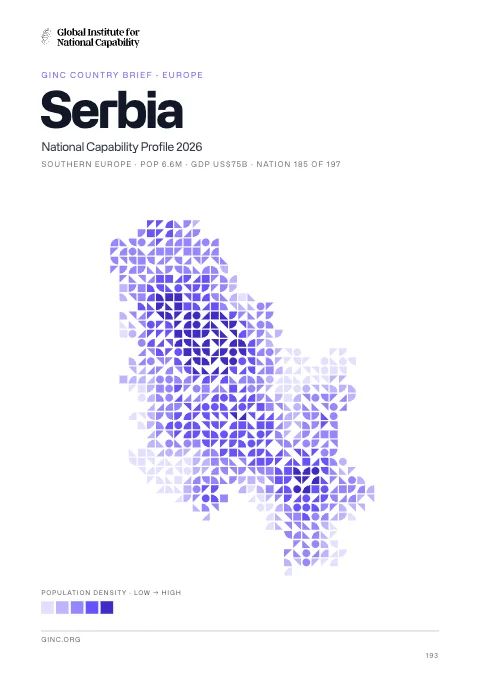
Serbia is a landlocked republic in Europe, home to 7.2 million people, with its capital at Belgrade.
Contents
12 chapters
Foundations
01–03
At a glance
- Area
- 77.5Kkm²#117 World#19 Europe
- Population
- 7.2M#100 World#18 Europe
- GDP (market)
- $43.7B
- GDP (PPP)
- $80.5B#80 World#24 Europe
- GDP per capita
- $11.1K#113 World#41 Europe
The whole brief
Serbia National Capability Profile 2026
Foundations · Chapter 01
Historical Context
🇷🇸 Serbia’s understanding the origins and evolution of the modern nation
BackgroundBack to top ↑
The Kingdom of Serbs, Croats, and Slovenes was formed in 1918; its name was changed to Yugoslavia in 1929. Communist Partisans resisted the Axis occupation and division of Yugoslavia from 1941 to 1945 and fought nationalist opponents and collaborators as well. The military and political movement headed by Josip Broz "TITO" (Partisans) took full control of Yugoslavia when their domestic rivals and the occupiers were defeated in 1945. Although communists, TITO and his successors (Tito died in 1980) managed to steer their own path between the Warsaw Pact nations and the West for the next four and a half decades. In 1989, Slobodan MILOSEVIC became president of the Republic of Serbia and his ultranationalist calls for Serbian domination led to the violent breakup of Yugoslavia along ethnic lines. In 1991, Croatia, Slovenia, and Macedonia declared independence, followed by Bosnia in 1992. The remaining republics of Serbia and Montenegro declared a new Federal Republic of Yugoslavia (FRY) in April 1992 and under MILOSEVIC's leadership, Serbia led various military campaigns to unite ethnic Serbs in neighboring republics into a "Greater Serbia." These actions were ultimately unsuccessful and, after international intervention, led to the signing of the Dayton Peace Accords in 1995. MILOSEVIC retained control over Serbia and eventually became president of the FRY in 1997. In 1998, an ethnic Albanian insurgency in the formerly autonomous Serbian province of Kosovo provoked a Serbian counterinsurgency campaign that resulted in massacres and massive expulsions of ethnic Albanians living in Kosovo. The MILOSEVIC government's rejection of a proposed international settlement led to NATO's bombing of Serbia in the spring of 1999. Serbian military and police forces withdrew from Kosovo in June 1999, and the UN Security Council authorized an interim UN administration and a NATO-led security force in Kosovo. FRY elections in late 2000 led to the ouster of MILOSEVIC and the installation of democratic government. In 2003, the FRY became the State Union of Serbia and Montenegro, a loose federation of the two republics. Widespread violence predominantly targeting ethnic Serbs in Kosovo in March 2004 let to more intense calls to address Kosovo's status, and the UN began facilitating status talks in 2006. In June 2006, Montenegro seceded from the federation and declared itself an independent nation. Serbia subsequently gave notice that it was the successor state to the union of Serbia and Montenegro. In February 2008, after nearly two years of inconclusive negotiations, Kosovo declared itself independent of Serbia - an action Serbia refuses to recognize. At Serbia's request, the UN General Assembly (UNGA) in October 2008 sought an advisory opinion from the International Court of Justice (ICJ) on whether Kosovo's unilateral declaration of independence was in accordance with international law. In a ruling considered unfavorable to Serbia, the ICJ issued an advisory opinion in July 2010 stating that international law did not prohibit declarations of independence. In late 2010, Serbia agreed to an EU-drafted UNGA Resolution acknowledging the ICJ's decision and calling for a new round of talks between Serbia and Kosovo, this time on practical issues rather than Kosovo's status. The EU-moderated Belgrade-Pristina dialogue began in March 2011 and was raised to the level of prime ministers in October 2012. Serbia and Kosovo signed the first agreement of principles governing the normalization of relations between the two countries in April 2013 and are in the process of implementing its provisions.
IndependenceBack to top ↑
5 June 2006 (from Serbia and Montenegro)
National holidayBack to top ↑
National Day, 15 February
Foundations · Chapter 02
Geography
🇷🇸 Serbia’s territory, resources and strategic position
Location and areaBack to top ↑
Southeastern Europe, between Macedonia and Hungary
44 00 N, 21 00 E
Europe
slightly smaller than South Carolina
0 km (landlocked)
none (landlocked)
Terrain and resourcesBack to top ↑
extremely varied; to the north, rich fertile plains; to the east, limestone ranges and basins; to the southeast, ancient mountains and hills
oil, gas, coal, iron ore, copper, zinc, antimony, chromite, gold, silver, magnesium, pyrite, limestone, marble, salt, arable land
919.6 sq km (2011)
Settlement and hazardsBack to top ↑
destructive earthquakes
controls one of the major land routes from Western Europe to Turkey and the Near East
OtherBack to top ↑
162.2 cu km (note - includes Kosovo) (2011)
air pollution around Belgrade and other industrial cities; water pollution from industrial wastes dumped into the Sava which flows into the Danube
Foundations · Chapter 03
Environment
🇷🇸 Serbia’s environmental conditions, resources and national resilience
ClimateBack to top ↑
in the north, continental climate (cold winters and hot, humid summers with well-distributed rainfall); in other parts, continental and Mediterranean climate (relatively cold winters with heavy snowfall and hot, dry summers and autumns)
Emissions and pollutionBack to top ↑
Water, waste and foodBack to top ↑
Resources and agreementsBack to top ↑
GINC Capability Domains · Chapter 04
Critical Technology
🇷🇸 Serbia’s technology frontiers and the pursuit of national advantage
Two counts are set side by side for 2015–2024: on the left, the papers researchers in Serbia published; on the right, the patent families that began there and were filed in more than one country. First by capability group, then group by group with each group’s capabilities. The badge on a card is the nation’s place among all nations. Papers are from GINC Research Analytics, patent families from GINC Patents.
Research by capability group
#64 WorldPapers published, 2015–2024
826
533
344
264
199
144
127
60
56
3
Patents by capability group
#67 WorldInternational patent families, 2015–2024
Advanced Materials & ManufacturingBack to top ↑
Research
#61 WorldPapers published, 2015–2024
Patents
#71 WorldInternational patent families, 2015–2024
Energy TechnologiesBack to top ↑
Research
#76 WorldPapers published, 2015–2024
Patents
#64 WorldInternational patent families, 2015–2024
Semiconductors & Advanced ComputingBack to top ↑
Research
#65 WorldPapers published, 2015–2024
No research topic: Semiconductor Design & EDA · Advanced Semiconductor Fabrication · Semiconductor Equipment & Materials · Advanced Packaging & Heterogeneous Integration
Patents
#69 WorldInternational patent families, 2015–2024
Artificial IntelligenceBack to top ↑
Research
#62 WorldPapers published, 2015–2024
Patents
#60 WorldInternational patent families, 2015–2024
Quantum TechnologiesBack to top ↑
Research
#69 WorldPapers published, 2015–2024
Patents
International patent families, 2015–2024
No international patent families on record for 2015–2024.
Connectivity, Cyber & Trust TechnologiesBack to top ↑
Research
#66 WorldPapers published, 2015–2024
Patents
#65 WorldInternational patent families, 2015–2024
Sensing, Timing & NavigationBack to top ↑
Research
#59 WorldPapers published, 2015–2024
Patents
#48 WorldInternational patent families, 2015–2024
Robotics & Autonomous SystemsBack to top ↑
Research
#59 WorldPapers published, 2015–2024
No research topic: Human-Machine Interfaces
Patents
#59 WorldInternational patent families, 2015–2024
Biotechnology & Health TechnologiesBack to top ↑
Research
#68 WorldPapers published, 2015–2024
Patents
#69 WorldInternational patent families, 2015–2024
Medicine and BioTech
Clinical research and life-science invention, drawn from the same series that drive the metric pages. Each card opens the full cross-country comparison.
Space TechnologiesBack to top ↑
Research
#70 WorldPapers published, 2015–2024
Patents
#53 WorldInternational patent families, 2015–2024
GINC Capability Domains · Chapter 05
Strategic Infrastructure
🇷🇸 Serbia’s energy, connectivity and the material foundations of capability
Resource InfrastructureBack to top ↑
24,500 bbl/day (2013 est.)
0 bbl/day (2013 est.)
33,330 bbl/day (2013 est.)
77.5 million bbl (1 January 2013 est.)
65,720 bbl/day (2013 est.)
72,770 bbl/day (2013 est.)
16,060 bbl/day (2013 est.)
31,120 bbl/day (2013 est.)
484.7 million cu m (2013 est.)
2.827 billion cu m (2013 est.)
0 cu m (2013 est.)
2.45 billion cu m (2013 est.)
48.14 billion cu m (1 January 2013 est.)
Agriculture & Food InfrastructureBack to top ↑
- Irrigation & Agricultural Water
- Livestock & Veterinary
- Fisheries & Aquaculture
- Storage, Cold Chain & Markets
Energy InfrastructureBack to top ↑
- Thermal Generation
- Nuclear Generation
- Nuclear Fuel Cycle & Radioactive Waste
- Hydropower
- Renewable Generation
- Transmission & Distribution
- System Control & Dispatch
- Storage & Fuel Supply
7.379 million kW (2013 est.)
37.65 billion kWh (2013 est.)
28.04 billion kWh (2013 est.)
5.707 billion kWh (2013 est.)
5.835 billion kWh (2013 est.)
57.5% of total installed capacity (2013 est.)
0% of total installed capacity (2013 est.)
39% of total installed capacity (2013 est.)
3.5% of total installed capacity (2013 est.)
62 million Mt (2013 est.)
Water, Sanitation & Waste InfrastructureBack to top ↑
- Dams, Reservoirs & Flood Defence
- Water Supply & Treatment
- Bulk Water Transfer & Desalination
- Wastewater & Sanitation
- Solid Waste & Recycling
Advanced ManufacturingBack to top ↑
- Materials & Inputs
- Chemicals & Hazardous Process Industry
- Production Systems
- Supply Chain & Ecosystem
- Workforce & Innovation
Transport InfrastructureBack to top ↑
- Seaports & Terminals
- Air Infrastructure
- Air Navigation & Traffic Management
- Inland Waterways & Ferries
- Rail Infrastructure
- Roads & Bridges
- Logistics, Multimodal & Border Infrastructure
- Postal & Parcel
26 (2013)
2 (2012)
587 km (primarily on the Danube and Sava rivers) (2009)
Communications & Digital InfrastructureBack to top ↑
- Subsea Cables & International Gateways
- Core & Backbone Networks
- Mobile & Wireless Networks
- Spectrum & Broadcasting
- Data Centres, Compute & Cloud
- Data Resources
- AI Tools & Applications
2.977 million (2012)
9.138 million (2012)
4.107 million (2009)
1.102 million (2012)
.rs
Financial InfrastructureBack to top ↑
- Currency & Reserves
- Payments & Settlement Systems
- Markets, Exchanges & Depositories
- Banks, Insurers & Systemic Institutions
Social InfrastructureBack to top ↑
- Health Infrastructure
- Public Health & Laboratories
- Medical Supply & Stockpiles
- Education & Skills Infrastructure
- Research & Scientific Facilities
- Housing, Community & Social Services
- Government & Public Administration
- Cultural, Community & Recreational Infrastructure
- Justice & Corrections
- Emergency Services & Civil Protection
- Hydrometeorology & Early Warning
Space, Aerospace & Defence InfrastructureBack to top ↑
GINC Capability Domains · Chapter 06
National Security
🇷🇸 Serbia’s force, intelligence and the defence of the nation
Disputes and terrorismBack to top ↑
Serbia with several other states protest the US and other states' recognition of Kosovo's declaration of its status as a sovereign and independent state in February 2008; ethnic Serbian municipalities along Kosovo's northern border challenge final status of Kosovo-Serbia boundary; several thousand NATO-led Kosovo Force peacekeepers under United Nations Interim Administration Mission in Kosovo authority continue to keep the peace within Kosovo between the ethnic Albanian majority and the Serb minority in Kosovo; Serbia delimited about half of the boundary with Bosnia and Herzegovina, but sections along the Drina River remain in dispute
Force Generation & MobilisationBack to top ↑
Serbian Armed Forces (Vojska Srbije, VS): Land Forces Command (includes Riverine Component, consisting of a river flotilla on the Danube), Air and Air Defense Forces Command (2012)
18 years of age for voluntary military service; conscription abolished December 2010; reserve obligation to age 60 for men and age 50 for women (2013)
2.21% of GDP (2012)//2.28% of GDP (2011)//2.21% of GDP (2010)
Forces under arms
Active-duty strength on the Correlates of War series, which reaches back to 1816 and so carries a nation’s whole record of mobilisation rather than its present establishment. The card opens the full cross-country comparison.
Intelligence & AssessmentBack to top ↑
- Imagery & Geospatial Intelligence
- Signals & Cyber Intelligence
- Technical & Measurement Intelligence
- Open-Source & Financial Intelligence
- Human Intelligence & Counterintelligence
- All-Source Analysis & Warning
Joint Command, Projection & SustainmentBack to top ↑
- Command, Control & Communications
- Strategic Lift & Mobility
- Expeditionary & Peace Operations
- Operational Sustainment & War Reserves
- Defence Industrial Mobilisation
- CBRN Defence
Land PowerBack to top ↑
- Combined Arms Manoeuvre
- Land Fires
- Battlefield Aviation & Uncrewed Systems
- Special Operations & Irregular Warfare
Maritime PowerBack to top ↑
- Maritime Security & Constabulary
- Sea Denial & Undersea Warfare
- Sea Control
- Amphibious & Expeditionary Operations
Air PowerBack to top ↑
- Air Sovereignty & Policing
- Control of the Air
- Air Strike & Interdiction
- Airborne ISR, Early Warning & Battle Management
Strategic Strike & Missile DefenceBack to top ↑
Space OperationsBack to top ↑
Cyber & Electromagnetic OperationsBack to top ↑
Nuclear DeterrenceBack to top ↑
GINC Capability Domains · Chapter 07
Human Capital
🇷🇸 Serbia’s population, health and the skills that sustain capability
DemographyBack to top ↑
7,209,764
-0.46% (2014 est.)
9.13 births/1,000 population (2014 est.)
13.71 deaths/1,000 population (2014 est.)
1.42 children born/woman (2014 est.)
27.5 (2011 est.)
60.8% (2010)
Migration and urbanisationBack to top ↑
0 migrant(s)/1,000 population (2014 est.)
BELGRADE (capital) 1.135 million (2011)
Welfare and equityBack to top ↑
9.1% (2013 est.)
38 (2013 est.)//28.2 (2008 est.)
DisplacementBack to top ↑
Early Childhood DevelopmentBack to top ↑
1.6% (2010)
Foundational EducationBack to top ↑
4.8% of GDP (2011)
Advanced EducationBack to top ↑
Technical & Vocational SkillsBack to top ↑
Digital & AI CompetenceBack to top ↑
Generative AI adoption
Modelled share of working-age adults using generative AI, from Microsoft telemetry scaled to each country’s 15–64 population. A measure of how fast a workforce is absorbing the technology rather than of how much of it a nation builds. The card opens the full cross-country comparison.
Lifelong Learning & ReskillingBack to top ↑
Research Talent & Knowledge CreationBack to top ↑
Population HealthBack to top ↑
12 deaths/100,000 live births (2010)
24.8% (2008)
0.1% (2009 est.)
6,400 (2009 est.)
fewer than 100 (2009 est.)
Health System CapabilityBack to top ↑
10.4% of GDP (2011)
2.11 physicians/1,000 population (2009)
5.4 beds/1,000 population (2009)
GINC Capability Domains · Chapter 08
Governance and Integrity
🇷🇸 Serbia’s institutions, law and the integrity of the state
State structureBack to top ↑
republic
122 municipalities (opstine, singular - opstina) and 23 cities (gradovi, singular - grad)
many previous; latest approved by referendum 28-29 October 2006, adopted 30 September 2006, effective 8 November 2006 (2011)
18 years of age, 16 if employed; universal
Political Institutions & Civic ParticipationBack to top ↑
- Electoral Management & Integrity
- Legislature & Deliberative Institutions
- Citizen Participation & Civic Space
unicameral National Assembly (250 seats; deputies elected according to party lists to serve four-year terms)
Alliance of Vojvodina Hungarians or SVM [Istvan PASZTOR]//Boris Tadic Coalition [Boris TADIC] (includes New Democratic Party-Greens or NDS-Z [Boris TADIC], League of Social Democrats of Vojvodina or LSV [Nenad CANAK], Together for Serbia or ZSS [Dusan PETROVIC], Democratic Alliance of Vojvodina Hungarians or VMDK [Aron CSONKA], Together for Vojvodina [Olena PAPUGA], Democratic Left of Roma or DLR [Jovan DAMJANOVIC])//Democratic Party of Serbia or DSS [Aleksandar Popovic]//Enough of That [Sasa RADULOVIC]//Party for Democratic Action or PDD [Riza HALIMI]//Party of Democratic Action of the Sandzak or SDA [Sulejman UGLJANIN]//Serbian Radical Party or SRS [Vojislav SESELJ]//SNS-led Coalition/A Future We Believe In [Aleksandar VUCIC] (includes Serbian Progressive Party or SNS [Aleksandar VUCIC], Social Democratic Party of Serbia or SDPS [Rasim LJAJIC], New Serbia or NS [Velimir ILIC], Movement of Socialists or PS [Aleksandar VULIN], and Serbian Renewal Movement or SPO [Vuk DRASKOVIC])//United Regions of Serbia [Mladan DINKIC]//With Democratic Party for Democratic Serbia/Democratic Party or DS [Dragan DJILAS]//SPS/PUPS/JS [Ivica DACIC] (includes Socialist Party of Serbia or SPS [Ivica DACIC], Party of United Pensioners of Serbia or PUPS [Jovan KRKOBABIC], United Serbia or JS [Dragan "Palma" MARKOVIC])//LDP-led Coalition [Cedomir JOVANOVIC] (includes Liberal Democratic Party of LDP [Cedomir JOVANOVIC], Bosniak Democratic Union of Sandzak or BDZS [Esad DZUDZEVIC], Social Democratic Union of SDU [Zarko KORAC])
1389 (Serbian nationalist movement)//Dveri - Movement for the Life of Serbia [Bosko OBRADOVIC]//Obraz (Orthodox clero-fascist organization)//SNP NASI (Serbian National Movement NASI)
Justice System & Fundamental RightsBack to top ↑
- Judicial Independence & Court Capability
- Access to Justice & Legal Services
- Fundamental Rights Protection
- Human Rights Institutions & Equality Bodies
civil law system
has not submitted an ICJ jurisdiction declaration; accepts ICCt jurisdiction
Internal Security & OrderBack to top ↑
transshipment point for Southwest Asian heroin moving to Western Europe on the Balkan route; economy vulnerable to money laundering
Regulatory Governance & Strategic ControlsBack to top ↑
- Regulatory Quality & Better Regulation
- Regulatory Delivery & Independent Regulators
- Strategic Controls & Economic Security Administration
Government Effectiveness & Public AdministrationBack to top ↑
- Centre of Government & Policy Coordination
- Civil Service & Public Workforce
- Digital Government & Service Delivery
- Legal Identity & Civil Registration
- Statistical & Data Capability
Public Integrity & Anti-CorruptionBack to top ↑
Transparency, Oversight & AccountabilityBack to top ↑
- Right to Information & Open Government
- Independent Oversight & Supreme Audit
- Independent Media & Journalist Safety
National Resilience & Crisis ManagementBack to top ↑
GINC Capability Domains · Chapter 09
Information and Influence
🇷🇸 Serbia’s identity, media and the projection of influence
Identity and cultureBack to top ↑
Serbian (official) 88.1%, Hungarian 3.4%, Bosnian 1.9%, Romany 1.4%, other 3.4%, undeclared or unknown 1.8%
Serbian Orthodox 84.6%, Catholic 5%, Muslim 3.1%, Protestant 1%, atheist 1.1%, other 0.8%, undeclared or unknown 4.5% (2011 est.)
Serb 83.3%, Hungarian 3.5%, Romany 2.1%, Bosniak 2%, other 5.7%, undeclared or unknown 3.4% (2011 est.)
double-headed eagle
three equal horizontal stripes of red (top), blue, and white - the Pan-Slav colors representing freedom and revolutionary ideals; charged with the coat of arms of Serbia shifted slightly to the hoist side; the principal field of the coat of arms represents the Serbian state and displays a white two-headed eagle on a red shield; a smaller red shield on the eagle represents the Serbian nation, and is divided into four quarters by a white cross; interpretations vary as to the meaning and origin of the white, curved symbols resembling firesteels or Cyrillic "C's" in each quarter; a royal crown surmounts the coat of arms
Diplomatic Statecraft & Global NetworksBack to top ↑
- Diplomatic Network & Consular Reach
- Multilateral Leadership & Norm Setting
- Agenda-Setting & Convening
- Mediation & Crisis Diplomacy
BIS, BSEC, CD, CE, CEI, EAPC, EBRD, EU (candidate country), FAO, G-9, IAEA, IBRD, ICAO, ICC (national committees), ICRM, IDA, IFC, IFRCS, IHO, ILO, IMF, IMO, IMSO, Interpol, IOC, IOM, IPU, ISO, ITSO, ITU, ITUC (NGOs), MIGA, MONUSCO, NAM (observer), OAS (observer), OIF (observer), OPCW, OSCE, PCA, PFP, SELEC, UN, UNCTAD, UNESCO, UNFICYP, UNHCR, UNIDO, UNIFIL, UNMIL, UNOCI, UNWTO, UPU, WCO, WHO, WIPO, WMO, WTO (observer)
Alliances & Security CooperationBack to top ↑
Development Cooperation & Global AssistanceBack to top ↑
Culture, Language & Education DiplomacyBack to top ↑
- Cultural & Language Institutes
- Creative Industries & Cultural Export Reach
- Heritage & Cultural Institutions
- Education Diplomacy & Alumni Networks
- Sports & Major Events
Diaspora & Global CommunitiesBack to top ↑
Information Environment & Strategic CommunicationBack to top ↑
GINC Capability Domains · Chapter 10
Financial Strength
🇷🇸 Serbia’s fiscal depth, reserves and the capacity to act
Monetary & Currency CapabilityBack to top ↑
- Monetary Policy & Price Stability
- Exchange Rate & External Account Management
- Currency Issuance & Digital Money
2.2% (2013 est.)//12.2% (2012 est.)
Serbian dinars (RSD) per US dollar -//85.67 (2013 est.)//87.992 (2012 est.)//77.729 (2010 est.)//67.634 (2009)//62.9 (2008)
9.5% (18 March 2014)//11.75% (6 February 2013)
13.85% (31 December 2013 est.)//14.99% (31 December 2012 est.)
$4.626 billion (31 December 2013 est.)//$3.595 billion (31 December 2012 est.)
$20.47 billion (31 December 2013 est.)//$19.12 billion (31 December 2012 est.)
Fiscal Capacity & Public FinanceBack to top ↑
- Revenue Mobilisation & Tax Administration
- Public Expenditure & Budget Management
- Sovereign Debt & Treasury Management
- Public Investment Management
40% of GDP (2013 est.)
-4.9% of GDP (2013 est.)
61.2% of GDP (2013 est.)//59.3% of GDP (2012 est.)
Financial System Depth & AccessBack to top ↑
- Banking System Capacity
- Capital Markets Depth & Development
- Long-Term & Institutional Capital
- Financial Inclusion & Household Access
- Development & Policy Finance
$25.48 billion (31 December 2013 est.)//$26.26 billion (31 December 2012 est.)
$9.199 billion (31 December 2013 est.)//$7.451 billion (31 December 2012)//$8.365 billion (31 December 2011 est.)
26.7% of GDP (2013 est.)//28.3% of GDP (2012 est.)//22.6% of GDP (2011 est.)
Financial Regulation & IntegrityBack to top ↑
- Prudential Regulation & Supervision
- Financial Integrity & Illicit Finance Control
- Market Conduct & Consumer Protection
- Payment & Market Infrastructure Oversight
Financial Stability & Crisis ManagementBack to top ↑
- Macroprudential & Systemic Oversight
- Crisis Management, Resolution & Deposit Insurance
- External Liquidity & Financial Safety Nets
Sovereign Capital & External Financial PowerBack to top ↑
- Official Reserves Management
- Sovereign Wealth & Public Asset Management
- Currency Internationalisation & Reserve Status
- Capital Account & Flow Management
- International Financial Centre Capability
$15.87 billion (31 December 2013 est.)//$14.4 billion (31 December 2012 est.)
$33.6 billion (31 December 2013 est.)//$33.42 billion (31 December 2012 est.)
GINC Capability Domains · Chapter 11
Production and Innovation
🇷🇸 Serbia’s output, industry and the engine of prosperity
Economic Output & ProductivityBack to top ↑
Serbia has a transitional economy largely dominated by market forces, but the state sector remains significant in certain areas and many institutional reforms are needed. The economy relies on manufacturing and exports, driven largely by foreign investment. MILOSEVIC-era mismanagement of the economy, an extended period of international economic sanctions, civil war, and the damage to Yugoslavia's infrastructure and industry during the NATO airstrikes in 1999 left the economy only half the size it was in 1990. After the ousting of former Federal Yugoslav President MILOSEVIC in September 2000, the Democratic Opposition of Serbia (DOS) coalition government implemented stabilization measures and embarked on a market reform program. After renewing its membership in the IMF in December 2000, Serbia continued to reintegrate into the international community by rejoining the World Bank (IBRD) and the European Bank for Reconstruction and Development (EBRD). Serbia has made progress in trade liberalization and enterprise restructuring and privatization, but many large enterprises - including the power utilities, telecommunications company, natural gas company, and others - remain in state hands. Serbia has made some progress towards EU membership, signing a Stabilization and Association Agreement with Brussels in May 2008, and with full implementation of the Interim Trade Agreement with the EU in February 2010, gained candidate status in March 2012. In January 2014, Serbia's EU accession talks officially opened. Serbia's negotiations with the World Trade Organization are advanced, with the country's complete ban on the trade and cultivation of agricultural biotechnology products representing the primary remaining obstacle to accession. Serbia's program with the IMF was frozen in early 2012 because the 2012 budget approved by parliament deviated from the program parameters; the arrangement is now void. However, an IMF mission visited Serbia in February 2014 to initiate discussions with Serbian authorities on a possible new IMF arrangement and these talks will continue following the formation of the new government. High unemployment and stagnant household incomes are ongoing political and economic problems. Structural economic reforms needed to ensure the country's long-term prosperity have largely stalled since the onset of the global financial crisis. Growing budget deficits constrain the use of stimulus efforts to revive the economy and contribute to growing concern of a public debt crisis, given that Serbia's total public debt as a share of GDP doubled between 2008 and 2013. Serbia's concerns about inflation and exchange-rate stability may preclude the use of expansionary monetary policy. During the recent election campaign, the victorious SNS party promised comprehensive economic reform during the first half of 2014 to address issues with the fiscal deficit, state-owned enterprises, the labor market, construction permits, bankruptcy and privatization, and other areas. Major challenges ahead include: high unemployment rates and the need for job creation; high government expenditures for salaries, pensions, healthcare, and unemployment benefits; a growing need for new government borrowing; rising public and private foreign debt; attracting new foreign direct investment; and getting the IMF program back on track. Other serious longer-term challenges include an inefficient judicial system, high levels of corruption, and an aging population. Factors favorable to Serbia's economic growth include its strategic location, a relatively inexpensive and skilled labor force, and free trade agreements with the EU, Russia, Turkey, and countries that are members of the Central European Free Trade Agreement (CEFTA).
$80.47 billion (2013 est.)//$78.89 billion (2012 est.)//$80.3 billion (2011 est.)
2% (2013 est.)//-1.7% (2012 est.)//1.6% (2011 est.)
$11,100 (2013 est.)//$10,900 (2012 est.)//$11,100 (2011 est.)
$43.68 billion (2013 est.)
Labour & EmploymentBack to top ↑
- Employment & Labour Force Participation
- Labour Market Institutions & Wage Setting
- Employment Services & Skills Matching
- Labour Adjustment, Transition & Formalisation
1.703 million (2013 est.)
20.1% (2013 est.)//22.4% (2012 est.)
Industrial & Sectoral BaseBack to top ↑
- Manufacturing & Advanced Industry
- Foundational & Process Industries
- Agrifood & Primary Production
- Services Economy
wheat, maize, sunflower, sugar beets, fruits (raspberries, apples, sour cherries), vegetables (tomatoes, peppers, potatoes), beef, pork, and meat products, milk and dairy products, grapes/wine
automobiles, base metals, furniture, food processing, machinery, chemicals, sugar, tires, clothes, pharmaceuticals
5.5% (2013 est.)
Structural Transformation & ComplexityBack to top ↑
Business Dynamism & EntrepreneurshipBack to top ↑
- Entrepreneurship & Firm Creation
- Risk Capital & Scale-Up Finance
- Firm Growth, Exit & Renewal
- Competition & Market Contestability
Innovation & CommercialisationBack to top ↑
- Business Innovation Capability
- Research Commercialisation & Knowledge Transfer
- Intellectual Property & Intangible Assets
- Innovation Ecosystems & Clusters
Technology Adoption & DiffusionBack to top ↑
GINC Capability Domains · Chapter 12
Trade and Investment
🇷🇸 Serbia’s markets, capital and the terms of global exchange
Overall tradeBack to top ↑
$34.7B of exports to 183 partners and $39.9B of imports from 213 in 2024, a deficit of $5.15B.
- Exports
- $34.7B183 partners
- Imports
- $39.9B213 partners
- Balance
- −$5.15Bdeficit
- Total trade
- $74.6B2024
ExportsBack to top ↑
Where its exports go
The largest partners in 2024, with each one's share of the nation's exports.
| Partner | Value | Share | |
|---|---|---|---|
| Germany | $5.07B | 15% | |
| Hungary | $2.20B | 6.3% | |
| China | $2.08B | 6.0% | |
| Bosnia and Herzegovina | $1.79B | 5.2% | |
| Italy | $1.74B | 5.0% | |
| Romania | $1.65B | 4.7% | |
| Czech Republic | $1.37B | 3.9% | |
| Turkey | $1.21B | 3.5% | |
| Bulgaria | $1.13B | 3.3% | |
| Croatia | $1.08B | 3.1% | |
| France | $1.02B | 2.9% | |
| Poland | $1.01B | 2.9% | |
| Montenegro | $973M | 2.8% | |
| Russia | $962M | 2.8% | |
| North Macedonia | $931M | 2.7% | |
| Austria | $901M | 2.6% | |
| Slovenia | $858M | 2.5% | |
| Slovakia | $824M | 2.4% | |
| United States | $758M | 2.2% | |
| United Kingdom | $584M | 1.7% |
What it exports
The largest categories in 2024.
| Category | Value | Share | |
|---|---|---|---|
| Electrical, electronic equipment | $5.50B | 16% | |
| Machinery, nuclear reactors, boilers | $2.77B | 8.0% | |
| Ores slag and ash | $1.87B | 5.4% | |
| Mineral fuels, oils, distillation products | $1.87B | 5.4% | |
| Copper | $1.66B | 4.8% | |
| Rubbers | $1.53B | 4.4% | |
| Plastics | $1.42B | 4.1% | |
| Vehicles other than railway, tramway | $1.28B | 3.7% | |
| Furniture, lighting signs, prefabricated buildings | $1.14B | 3.3% | |
| Cereals | $1.05B | 3.0% | |
| Tobacco and manufactures tobacco substitutes | $970M | 2.8% | |
| Edible fruits, nuts, peel of citrus fruit, melons | $806M | 2.3% | |
| Paper and paperboard, articles of pulp, paper and board | $784M | 2.3% | |
| Articles of iron or steel | $780M | 2.2% | |
| Iron and steel | $751M | 2.2% |
ImportsBack to top ↑
Where its imports come from
The largest partners in 2024, with each one's share of the nation's imports.
| Partner | Value | Share | |
|---|---|---|---|
| Germany | $4.75B | 12% | |
| China | $4.31B | 11% | |
| Italy | $2.77B | 6.9% | |
| Turkey | $2.37B | 6.0% | |
| Hungary | $1.96B | 4.9% | |
| Poland | $1.51B | 3.8% | |
| Russia | $1.32B | 3.3% | |
| Croatia | $1.13B | 2.8% | |
| Slovenia | $1.11B | 2.8% | |
| Bosnia and Herzegovina | $1.07B | 2.7% | |
| Romania | $1.05B | 2.6% | |
| Czech Republic | $1.04B | 2.6% | |
| Austria | $1.03B | 2.6% | |
| France | $991M | 2.5% | |
| Bulgaria | $900M | 2.3% | |
| North Macedonia | $841M | 2.1% | |
| Netherlands | $755M | 1.9% | |
| United States | $692M | 1.7% | |
| Belgium | $689M | 1.7% | |
| Spain | $689M | 1.7% |
What it imports
The largest categories in 2024.
| Category | Value | Share | |
|---|---|---|---|
| Mineral fuels, oils, distillation products | $4.86B | 12% | |
| Electrical, electronic equipment | $4.34B | 11% | |
| Machinery, nuclear reactors, boilers | $4.28B | 11% | |
| Vehicles other than railway, tramway | $2.45B | 6.1% | |
| Plastics | $2.36B | 5.9% | |
| Pharmaceutical products | $1.81B | 4.5% | |
| Articles of iron or steel | $1.10B | 2.8% | |
| Iron and steel | $1.06B | 2.7% | |
| Aluminum | $956M | 2.4% | |
| Paper and paperboard, articles of pulp, paper and board | $877M | 2.2% | |
| Rubbers | $739M | 1.9% | |
| Optical, photo, technical, medical apparatus | $728M | 1.8% | |
| Copper | $615M | 1.5% | |
| Ores slag and ash | $498M | 1.2% | |
| Essential oils, perfumes, cosmetics, toiletries | $487M | 1.2% |
In a list, the bar runs to the largest in that list. The line is each figure’s history from 2000, drawn to its own peak: it shows the shape of the years, and the value shows the size.
External balanceBack to top ↑
-$1.807 billion (2013 est.)//-$4.012 billion (2012 est.)
Trade Facilitation & LogisticsBack to top ↑
Trade Policy & Market AccessBack to top ↑
- Trade Policy & Negotiation Capability
- Market Access & Agreements Network
- Trade Law & Enforcement
- Standards, Conformity & Quality Infrastructure
Digital & Services TradeBack to top ↑
- Services Trade Capability
- Digital Trade & E-Commerce
- Data Flows & Digital Trade Governance
- Tourism & Visitor Economy
Investment Attraction & ProjectionBack to top ↑
- Investment Attraction & Facilitation
- Investment Absorption & Linkages
- Outward Investment & Global Corporate Presence
$26.41 billion (31 December 2009 est.)//$11.95 billion (2006 est.)
$NA
Export Capability & SophisticationBack to top ↑
$14.61 billion (2013 est.)//$11.35 billion (2012 est.)
iron and steel, rubber, clothes, wheat, fruit and vegetables, nonferrous metals, electric appliances, metal products, weapons and ammunition, automobiles
Global Value Chain PositionBack to top ↑
- Value Chain Participation & Integration
- Value Chain Position & Upgrading
- Regional Integration & Hub Anchoring
Economic Leverage & DependenceBack to top ↑
- Strategic Supply Security
- Concentration Risk & Revenue Stabilisation
- Economic Leverage & Coercion Resistance
$20.54 billion (2013 est.)//$19.01 billion (2012 est.)
Serbia · you are in
Historical Context
Foundations
GINC Capability Domains
Find in this brief · Serbia