
Bulgaria
Bulgaria is a parliamentary democracy in Europe, home to 6.9 million people, with its capital at Sofia.
Contents
12 chapters
Foundations
01–03
At a glance
- Area
- 110.9Kkm²#105 World#13 Europe
- Population
- 6.9M#102 World#19 Europe
- GDP (market)
- $53.7B
- GDP (PPP)
- $104.6B#73 World#23 Europe
- GDP per capita
- $14.4K#94 World#38 Europe
The whole brief
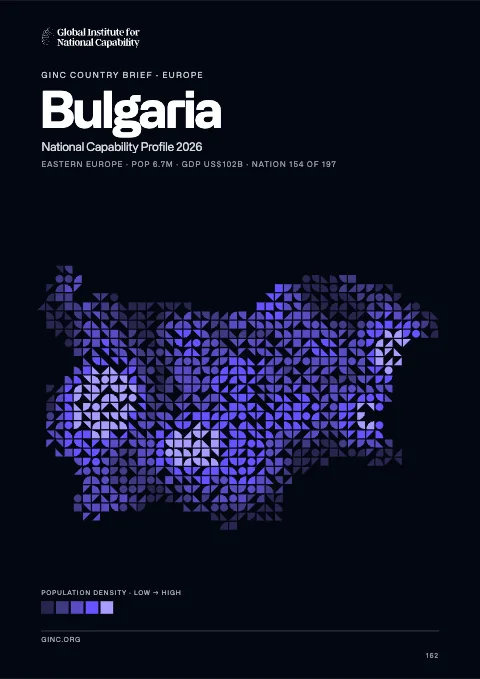
Bulgaria National Capability Profile 2026
Foundations · Chapter 01
Historical Context
🇧🇬 Bulgaria’s understanding the origins and evolution of the modern nation
BackgroundBack to top ↑
The Bulgars, a Central Asian Turkic tribe, merged with the local Slavic inhabitants in the late 7th century to form the first Bulgarian state. In succeeding centuries, Bulgaria struggled with the Byzantine Empire to assert its place in the Balkans, but by the end of the 14th century the country was overrun by the Ottoman Turks. Northern Bulgaria attained autonomy in 1878 and all of Bulgaria became independent from the Ottoman Empire in 1908. Having fought on the losing side in both World Wars, Bulgaria fell within the Soviet sphere of influence and became a People's Republic in 1946. Communist domination ended in 1990, when Bulgaria held its first multiparty election since World War II and began the contentious process of moving toward political democracy and a market economy while combating inflation, unemployment, corruption, and crime. The country joined NATO in 2004 and the EU in 2007.
IndependenceBack to top ↑
3 March 1878 (as an autonomous principality within the Ottoman Empire); 22 September 1908 (complete independence from the Ottoman Empire)
National holidayBack to top ↑
Liberation Day, 3 March (1878)
Foundations · Chapter 02
Geography
🇧🇬 Bulgaria’s territory, resources and strategic position
Location and areaBack to top ↑
Southeastern Europe, bordering the Black Sea, between Romania and Turkey
43 00 N, 25 00 E
Europe
slightly larger than Tennessee
354 km
Terrain and resourcesBack to top ↑
mostly mountains with lowlands in north and southeast
bauxite, copper, lead, zinc, coal, timber, arable land
1,046 sq km (2007)
Settlement and hazardsBack to top ↑
earthquakes; landslides
strategic location near Turkish Straits; controls key land routes from Europe to Middle East and Asia
OtherBack to top ↑
21.3 cu km (2011)
air pollution from industrial emissions; rivers polluted from raw sewage, heavy metals, detergents; deforestation; forest damage from air pollution and resulting acid rain; soil contamination from heavy metals from metallurgical plants and industrial wastes
Foundations · Chapter 03
Environment
🇧🇬 Bulgaria’s environmental conditions, resources and national resilience
ClimateBack to top ↑
temperate; cold, damp winters; hot, dry summers
Emissions and pollutionBack to top ↑
Water, waste and foodBack to top ↑
Resources and agreementsBack to top ↑
GINC Capability Domains · Chapter 04
Critical Technology
🇧🇬 Bulgaria’s technology frontiers and the pursuit of national advantage
Two counts are set side by side for 2015–2024: on the left, the papers researchers in Bulgaria published; on the right, the patent families that began there and were filed in more than one country. First by capability group, then group by group with each group’s capabilities. The badge on a card is the nation’s place among all nations. Papers are from GINC Research Analytics, patent families from GINC Patents.
Research by capability group
#61 WorldPapers published, 2015–2024
690
688
373
287
229
210
163
129
80
2
Patents by capability group
#56 WorldInternational patent families, 2015–2024
Advanced Materials & ManufacturingBack to top ↑
Research
#59 WorldPapers published, 2015–2024
Patents
#58 WorldInternational patent families, 2015–2024
Energy TechnologiesBack to top ↑
Research
#55 WorldPapers published, 2015–2024
Patents
#48 WorldInternational patent families, 2015–2024
Semiconductors & Advanced ComputingBack to top ↑
Research
#58 WorldPapers published, 2015–2024
No research topic: Semiconductor Design & EDA · Advanced Semiconductor Fabrication · Semiconductor Equipment & Materials · Advanced Packaging & Heterogeneous Integration
Patents
#54 WorldInternational patent families, 2015–2024
Artificial IntelligenceBack to top ↑
Research
#69 WorldPapers published, 2015–2024
Patents
#56 WorldInternational patent families, 2015–2024
Quantum TechnologiesBack to top ↑
Research
#52 WorldPapers published, 2015–2024
Patents
International patent families, 2015–2024
No international patent families on record for 2015–2024.
Connectivity, Cyber & Trust TechnologiesBack to top ↑
Research
#65 WorldPapers published, 2015–2024
Patents
#54 WorldInternational patent families, 2015–2024
Sensing, Timing & NavigationBack to top ↑
Research
#55 WorldPapers published, 2015–2024
Patents
#59 WorldInternational patent families, 2015–2024
Robotics & Autonomous SystemsBack to top ↑
Research
#65 WorldPapers published, 2015–2024
No research topic: Human-Machine Interfaces
Patents
#56 WorldInternational patent families, 2015–2024
Biotechnology & Health TechnologiesBack to top ↑
Research
#73 WorldPapers published, 2015–2024
Patents
#57 WorldInternational patent families, 2015–2024
Medicine and BioTech
Clinical research and life-science invention, drawn from the same series that drive the metric pages. Each card opens the full cross-country comparison.
Space TechnologiesBack to top ↑
Research
#79 WorldPapers published, 2015–2024
Patents
#33 WorldInternational patent families, 2015–2024
GINC Capability Domains · Chapter 05
Strategic Infrastructure
🇧🇬 Bulgaria’s energy, connectivity and the material foundations of capability
Resource InfrastructureBack to top ↑
3,384 bbl/day (2012 est.)
0 bbl/day (2012 est.)
124,700 bbl/day (2010 est.)
15 million bbl (1 January 2013 est.)
128,500 bbl/day (2010 est.)
112,700 bbl/day (2011 est.)
73,740 bbl/day (2010 est.)
50,130 bbl/day (2010 est.)
410 million cu m (2011 est.)
2.54 billion cu m (2010 est.)
0 cu m (2011 est.)
2.64 billion cu m (2011 est.)
5.663 billion cu m (1 January 2013 est.)
gas 2,887 km; oil 346 km; refined products 378 km (2013)
Agriculture & Food InfrastructureBack to top ↑
- Irrigation & Agricultural Water
- Livestock & Veterinary
- Fisheries & Aquaculture
- Storage, Cold Chain & Markets
Energy InfrastructureBack to top ↑
- Thermal Generation
- Nuclear Generation
- Nuclear Fuel Cycle & Radioactive Waste
- Hydropower
- Renewable Generation
- Transmission & Distribution
- System Control & Dispatch
- Storage & Fuel Supply
10.01 million kW (2010 est.)
43.39 billion kWh (2010 est.)
30.46 billion kWh (2010 est.)
12.11 billion kWh (2011 est.)
1.45 billion kWh (2011 est.)
45.7% of total installed capacity (2010 est.)
19% of total installed capacity (2010 est.)
21.8% of total installed capacity (2010 est.)
4.8% of total installed capacity (2010 est.)
52.44 million Mt (2011 est.)
Water, Sanitation & Waste InfrastructureBack to top ↑
- Dams, Reservoirs & Flood Defence
- Water Supply & Treatment
- Bulk Water Transfer & Desalination
- Wastewater & Sanitation
- Solid Waste & Recycling
Advanced ManufacturingBack to top ↑
- Materials & Inputs
- Chemicals & Hazardous Process Industry
- Production Systems
- Supply Chain & Ecosystem
- Workforce & Innovation
Transport InfrastructureBack to top ↑
- Seaports & Terminals
- Air Infrastructure
- Air Navigation & Traffic Management
- Inland Waterways & Ferries
- Rail Infrastructure
- Roads & Bridges
- Logistics, Multimodal & Border Infrastructure
- Postal & Parcel
68 (2013)
1 (2013)
470 km (2009)
Communications & Digital InfrastructureBack to top ↑
- Subsea Cables & International Gateways
- Core & Backbone Networks
- Mobile & Wireless Networks
- Spectrum & Broadcasting
- Data Centres, Compute & Cloud
- Data Resources
- AI Tools & Applications
2.253 million (2012)
10.78 million (2012)
3.395 million (2009)
976,277 (2012)
.bg
Financial InfrastructureBack to top ↑
- Currency & Reserves
- Payments & Settlement Systems
- Markets, Exchanges & Depositories
- Banks, Insurers & Systemic Institutions
Social InfrastructureBack to top ↑
- Health Infrastructure
- Public Health & Laboratories
- Medical Supply & Stockpiles
- Education & Skills Infrastructure
- Research & Scientific Facilities
- Housing, Community & Social Services
- Government & Public Administration
- Cultural, Community & Recreational Infrastructure
- Justice & Corrections
- Emergency Services & Civil Protection
- Hydrometeorology & Early Warning
Space, Aerospace & Defence InfrastructureBack to top ↑
GINC Capability Domains · Chapter 06
National Security
🇧🇬 Bulgaria’s force, intelligence and the defence of the nation
Disputes and terrorismBack to top ↑
none
Force Generation & MobilisationBack to top ↑
Bulgarian Armed Forces: Ground Forces, Naval Forces, Bulgarian Air Forces (Bulgarski Voennovazdyshni Sily, BVVS) (2011)
18-27 years of age for voluntary military service; conscription ended in January 2008; service obligation 6-9 months (2012)
1.46% of GDP (2012)//1.55% of GDP (2011)//1.46% of GDP (2010)
Forces under arms
Active-duty strength on the Correlates of War series, which reaches back to 1816 and so carries a nation’s whole record of mobilisation rather than its present establishment. The card opens the full cross-country comparison.
Intelligence & AssessmentBack to top ↑
- Imagery & Geospatial Intelligence
- Signals & Cyber Intelligence
- Technical & Measurement Intelligence
- Open-Source & Financial Intelligence
- Human Intelligence & Counterintelligence
- All-Source Analysis & Warning
Joint Command, Projection & SustainmentBack to top ↑
- Command, Control & Communications
- Strategic Lift & Mobility
- Expeditionary & Peace Operations
- Operational Sustainment & War Reserves
- Defence Industrial Mobilisation
- CBRN Defence
Land PowerBack to top ↑
- Combined Arms Manoeuvre
- Land Fires
- Battlefield Aviation & Uncrewed Systems
- Special Operations & Irregular Warfare
Maritime PowerBack to top ↑
- Maritime Security & Constabulary
- Sea Denial & Undersea Warfare
- Sea Control
- Amphibious & Expeditionary Operations
Air PowerBack to top ↑
- Air Sovereignty & Policing
- Control of the Air
- Air Strike & Interdiction
- Airborne ISR, Early Warning & Battle Management
Strategic Strike & Missile DefenceBack to top ↑
Space OperationsBack to top ↑
Cyber & Electromagnetic OperationsBack to top ↑
Nuclear DeterrenceBack to top ↑
GINC Capability Domains · Chapter 07
Human Capital
🇧🇬 Bulgaria’s population, health and the skills that sustain capability
DemographyBack to top ↑
6,924,716 (July 2014 est.)
-0.83% (2014 est.)
8.92 births/1,000 population (2014 est.)
14.3 deaths/1,000 population (2014 est.)
1.44 children born/woman (2014 est.)
26.3 (2011 est.)
69.2%
Migration and urbanisationBack to top ↑
-2.89 migrant(s)/1,000 population (2014 est.)
SOFIA (capital) 1.174 million (2011)
Welfare and equityBack to top ↑
21.8% (2008)
45.3 (2007)//26 (2001)
Early Childhood DevelopmentBack to top ↑
1.6% (2004)
Foundational EducationBack to top ↑
4.1% of GDP (2010)
Advanced EducationBack to top ↑
Technical & Vocational SkillsBack to top ↑
Digital & AI CompetenceBack to top ↑
Generative AI adoption
Modelled share of working-age adults using generative AI, from Microsoft telemetry scaled to each country’s 15–64 population. A measure of how fast a workforce is absorbing the technology rather than of how much of it a nation builds. The card opens the full cross-country comparison.
Lifelong Learning & ReskillingBack to top ↑
Research Talent & Knowledge CreationBack to top ↑
Population HealthBack to top ↑
11 deaths/100,000 live births (2010)
23.7% (2008)
0.1% (2009 est.)
3,800 (2009 est.)
fewer than 200 (2009 est.)
Health System CapabilityBack to top ↑
7.6% of GDP (2010)
3.76 physicians/1,000 population (2010)
6.5 beds/1,000 population (2010)
GINC Capability Domains · Chapter 08
Governance and Integrity
🇧🇬 Bulgaria’s institutions, law and the integrity of the state
State structureBack to top ↑
parliamentary democracy
28 provinces (oblasti, singular - oblast); Blagoevgrad, Burgas, Dobrich, Gabrovo, Khaskovo, Kurdzhali, Kyustendil, Lovech, Montana, Pazardzhik, Pernik, Pleven, Plovdiv, Razgrad, Ruse, Shumen, Silistra, Sliven, Smolyan, Sofiya (Sofia), Sofiya-Grad (Sofia City), Stara Zagora, Turgovishte, Varna, Veliko Turnovo, Vidin, Vratsa, Yambol
several previous; latest drafted between late 1990 and early 1991, adopted 12 July 1991; amended several times, last in 2007 (2007)
18 years of age; universal
Political Institutions & Civic ParticipationBack to top ↑
- Electoral Management & Integrity
- Legislature & Deliberative Institutions
- Citizen Participation & Civic Space
unicameral National Assembly or Narodno Sabranie (240 seats; members elected by popular vote to serve four-year terms)
Attack (Ataka) [Volen Nikolov SIDEROV]//Bulgarian Socialist Party or BSP [Sergei STANISHEV]//Bulgaria of the Citizens [Meglena KUNEVA]//Citizens for the European Development of Bulgaria or GERB [Boyko BORISOV]//Coalition for Bulgaria or CfB [Sergei STANISHEV] (coalition of parties dominated by BSP)//Democrats for a Strong Bulgaria or DSB [Radan KANEV]//Internal Macedonian Revolutionary Organization or IMRO [Krasimir KARAKACHANOV]//Movement for Rights and Freedoms or MRF [Lyutvi MESTAN]//National Front for the Salvation of Bulgaria or NFSB [Valeri SIMEONOV]//National Movement for Stability and Progress or NDSV [Hristina HRISTOVA] (formerly National Movement Simeon II or NMS2)//Order, Law, and Justice or RZS [Yane YANEV]//Union of Democratic Forces or UDF [Bozhidar LUKARSKI]
Confederation of Independent Trade Unions of Bulgaria or CITUB//Podkrepa Labor Confederation
Justice System & Fundamental RightsBack to top ↑
- Judicial Independence & Court Capability
- Access to Justice & Legal Services
- Fundamental Rights Protection
- Human Rights Institutions & Equality Bodies
civil law
accepts compulsory ICJ jurisdiction with reservations; accepts ICCt jurisdiction
Internal Security & OrderBack to top ↑
major European transshipment point for Southwest Asian heroin and, to a lesser degree, South American cocaine for the European market; limited producer of precursor chemicals; vulnerable to money laundering because of corruption, organized crime; some money laundering of drug-related proceeds through financial institutions (2008)
Regulatory Governance & Strategic ControlsBack to top ↑
- Regulatory Quality & Better Regulation
- Regulatory Delivery & Independent Regulators
- Strategic Controls & Economic Security Administration
Government Effectiveness & Public AdministrationBack to top ↑
- Centre of Government & Policy Coordination
- Civil Service & Public Workforce
- Digital Government & Service Delivery
- Legal Identity & Civil Registration
- Statistical & Data Capability
Public Integrity & Anti-CorruptionBack to top ↑
Transparency, Oversight & AccountabilityBack to top ↑
- Right to Information & Open Government
- Independent Oversight & Supreme Audit
- Independent Media & Journalist Safety
National Resilience & Crisis ManagementBack to top ↑
GINC Capability Domains · Chapter 09
Information and Influence
🇧🇬 Bulgaria’s identity, media and the projection of influence
Identity and cultureBack to top ↑
Bulgarian (official) 76.8%, Turkish 8.2%, Roma 3.8%, other 0.7%, unspecified 10.5% (2011 est.)
Eastern Orthodox 59.4%, Muslim 7.8%, other (including Catholic, Protestant, Armenian Apostolic Orthodox, and Jewish) 1.7%, none 3.7%, unspecified 27.4% (2011 est.)
Bulgarian 76.9%, Turkish 8%, Roma 4.4%, other 0.7% (including Russian, Armenian, and Vlach), other (unknown) 10% (2011 est.)
lion
three equal horizontal bands of white (top), green, and red; the pan-Slavic white-blue-red colors were modified by substituting a green band (representing freedom) for the blue
Diplomatic Statecraft & Global NetworksBack to top ↑
- Diplomatic Network & Consular Reach
- Multilateral Leadership & Norm Setting
- Agenda-Setting & Convening
- Mediation & Crisis Diplomacy
Australia Group, BIS, BSEC, CD, CE, CEI, CERN, EAPC, EBRD, EIB, EU, FAO, G- 9, IAEA, IBRD, ICAO, ICC (national committees), ICRM, IDA, IFC, IFRCS, IHO (pending member), ILO, IMF, IMO, IMSO, Interpol, IOC, IOM, IPU, ISO, ITSO, ITU, ITUC (NGOs), MIGA, NATO, NSG, OAS (observer), OIF, OPCW, OSCE, PCA, SELEC, UN, UNCTAD, UNESCO, UNHCR, UNIDO, UNMIL, UNWTO, UPU, WCO, WFTU (NGOs), WHO, WIPO, WMO, WTO, ZC
Alliances & Security CooperationBack to top ↑
Development Cooperation & Global AssistanceBack to top ↑
Culture, Language & Education DiplomacyBack to top ↑
- Cultural & Language Institutes
- Creative Industries & Cultural Export Reach
- Heritage & Cultural Institutions
- Education Diplomacy & Alumni Networks
- Sports & Major Events
Diaspora & Global CommunitiesBack to top ↑
Information Environment & Strategic CommunicationBack to top ↑
- Strategic Communications & Public Diplomacy
- International Media & Broadcasting
- Information Defence & Counter-Interference
4 national terrestrial TV stations with 1 state-owned and 3 privately owned; a vast array of TV stations are available from cable and satellite TV providers; state-owned national radio broadcasts over 3 networks; large number of private radio stations broadcasting, especially in urban areas (2010)
GINC Capability Domains · Chapter 10
Financial Strength
🇧🇬 Bulgaria’s fiscal depth, reserves and the capacity to act
Monetary & Currency CapabilityBack to top ↑
- Monetary Policy & Price Stability
- Exchange Rate & External Account Management
- Currency Issuance & Digital Money
1.5% (2013 est.)//3% (2012 est.)
leva (BGN) per US dollar -//1.478 (2013 est.)//1.5221 (2012 est.)//1.4774 (2010 est.)//1.404 (2009)//1.3171 (2008)
$NA (31 December 2012 est.)//0.22% (31 December 2011 est.)
9.1% (31 December 2013 est.)//9.72% (31 December 2012 est.)
$17.55 billion (31 December 2013 est.)//$15.51 billion (31 December 2012 est.)
$45.84 billion (31 December 2013 est.)//$41.53 billion (31 December 2012 est.)
Fiscal Capacity & Public FinanceBack to top ↑
- Revenue Mobilisation & Tax Administration
- Public Expenditure & Budget Management
- Sovereign Debt & Treasury Management
- Public Investment Management
35% of GDP (2013 est.)
-2.4% of GDP (2013 est.)
18.4% of GDP (2013 est.)//16.3% of GDP (2012 est.)//defined by the EU's Maastricht Treaty as consolidated general government gross debt at nominal value, outstanding at the end of the year in the following categories of government liabilities: currency and deposits, securities other than shares excluding financial derivatives, and loans; general government sector comprises the subsectors: central government, state government, local government, and social security funds
calendar year
Financial System Depth & AccessBack to top ↑
- Banking System Capacity
- Capital Markets Depth & Development
- Long-Term & Institutional Capital
- Financial Inclusion & Household Access
- Development & Policy Finance
$37.6 billion (31 December 2013 est.)//$37.12 billion (31 December 2012 est.)
$6.666 billion (31 December 2012 est.)//$8.253 billion (31 December 2011)//$7.276 billion (31 December 2010 est.)
23.5% of GDP (2013 est.)//22.5% of GDP (2012 est.)//22% of GDP (2011 est.)
Financial Regulation & IntegrityBack to top ↑
- Prudential Regulation & Supervision
- Financial Integrity & Illicit Finance Control
- Market Conduct & Consumer Protection
- Payment & Market Infrastructure Oversight
Financial Stability & Crisis ManagementBack to top ↑
- Macroprudential & Systemic Oversight
- Crisis Management, Resolution & Deposit Insurance
- External Liquidity & Financial Safety Nets
Sovereign Capital & External Financial PowerBack to top ↑
- Official Reserves Management
- Sovereign Wealth & Public Asset Management
- Currency Internationalisation & Reserve Status
- Capital Account & Flow Management
- International Financial Centre Capability
$20.69 billion (31 December 2013 est.)//$20.5 billion (31 December 2012 est.)
$37.85 billion (31 December 2013 est.)//$36.52 billion (31 December 2012 est.)
GINC Capability Domains · Chapter 11
Production and Innovation
🇧🇬 Bulgaria’s output, industry and the engine of prosperity
Economic Output & ProductivityBack to top ↑
Bulgaria, a former Communist country that entered the EU on 1 January 2007, averaged more than 6% annual growth from 2004 to 2008, driven by significant amounts of bank lending, consumption, and foreign direct investment. Successive governments have demonstrated a commitment to economic reforms and responsible fiscal planning, but the global downturn sharply reduced domestic demand, exports, capital inflows, and industrial production. GDP contracted by 5.5% in 2009, and has been slow to recover in the years since. Despite having a favorable investment regime, including low, flat corporate income taxes, significant challenges remain. Corruption in public administration, a weak judiciary, and the presence of organized crime continue to hamper the country's investment climate and economic prospects.
$104.6 billion (2013 est.)//$104.1 billion (2012 est.)//$103.3 billion (2011 est.)
0.5% (2013 est.)//0.8% (2012 est.)//1.8% (2011 est.)
$14,400 (2013 est.)//$14,300 (2012 est.)//$14,100 (2011 est.)
$53.7 billion (2013 est.)
Labour & EmploymentBack to top ↑
- Employment & Labour Force Participation
- Labour Market Institutions & Wage Setting
- Employment Services & Skills Matching
- Labour Adjustment, Transition & Formalisation
2.551 million (2013 est.)
11.6% (2013 est.)//11.1% (2012 est.)
Industrial & Sectoral BaseBack to top ↑
- Manufacturing & Advanced Industry
- Foundational & Process Industries
- Agrifood & Primary Production
- Services Economy
vegetables, fruits, tobacco, wine, wheat, barley, sunflowers, sugar beets; livestock
electricity, gas, water; food, beverages, tobacco; machinery and equipment, base metals, chemical products, coke, refined petroleum, nuclear fuel
1% (2013 est.)
Structural Transformation & ComplexityBack to top ↑
Business Dynamism & EntrepreneurshipBack to top ↑
- Entrepreneurship & Firm Creation
- Risk Capital & Scale-Up Finance
- Firm Growth, Exit & Renewal
- Competition & Market Contestability
Innovation & CommercialisationBack to top ↑
- Business Innovation Capability
- Research Commercialisation & Knowledge Transfer
- Intellectual Property & Intangible Assets
- Innovation Ecosystems & Clusters
Technology Adoption & DiffusionBack to top ↑
GINC Capability Domains · Chapter 12
Trade and Investment
🇧🇬 Bulgaria’s markets, capital and the terms of global exchange
Overall tradeBack to top ↑
$50.9B of exports to 205 partners and $52.3B of imports from 218 in 2024, a deficit of $1.36B.
- Exports
- $50.9B205 partners
- Imports
- $52.3B218 partners
- Balance
- −$1.36Bdeficit
- Total trade
- $103B2024
ExportsBack to top ↑
Where its exports go
The largest partners in 2024, with each one's share of the nation's exports.
| Partner | Value | Share | |
|---|---|---|---|
| Germany | $7.35B | 14% | |
| Romania | $6.03B | 12% | |
| Italy | $3.48B | 6.8% | |
| Turkey | $3.20B | 6.3% | |
| Poland | $3.04B | 6.0% | |
| Greece | $2.71B | 5.3% | |
| France | $1.65B | 3.2% | |
| United States | $1.47B | 2.9% | |
| Czech Republic | $1.29B | 2.5% | |
| China | $1.18B | 2.3% | |
| Belgium | $1.05B | 2.1% | |
| Spain | $962M | 1.9% | |
| United Kingdom | $953M | 1.9% | |
| Serbia | $900M | 1.8% | |
| Netherlands | $873M | 1.7% | |
| Egypt | $843M | 1.7% | |
| Austria | $783M | 1.5% | |
| North Macedonia | $697M | 1.4% | |
| Hungary | $674M | 1.3% | |
| Gibraltar | $592M | 1.2% |
What it exports
The largest categories in 2024.
| Category | Value | Share | |
|---|---|---|---|
| Mineral fuels, oils, distillation products | $5.57B | 11% | |
| Electrical, electronic equipment | $5.00B | 9.8% | |
| Copper | $4.79B | 9.4% | |
| Machinery, nuclear reactors, boilers | $3.63B | 7.1% | |
| Arms and ammunition, parts and accessories | $2.91B | 5.7% | |
| Cereals | $1.89B | 3.7% | |
| Vehicles other than railway, tramway | $1.65B | 3.2% | |
| Ores slag and ash | $1.63B | 3.2% | |
| Plastics | $1.48B | 2.9% | |
| Pharmaceutical products | $1.36B | 2.7% | |
| Optical, photo, technical, medical apparatus | $1.31B | 2.6% | |
| Articles of apparel, not knit or crocheted | $961M | 1.9% | |
| Iron and steel | $903M | 1.8% | |
| Glass and glassware | $902M | 1.8% | |
| Articles of apparel, knit or crocheted | $866M | 1.7% |
ImportsBack to top ↑
Where its imports come from
The largest partners in 2024, with each one's share of the nation's imports.
| Partner | Value | Share | |
|---|---|---|---|
| China | $5.61B | 11% | |
| Germany | $5.16B | 9.9% | |
| Turkey | $4.51B | 8.6% | |
| Italy | $2.78B | 5.3% | |
| Romania | $2.45B | 4.7% | |
| Greece | $1.76B | 3.4% | |
| Poland | $1.66B | 3.2% | |
| Kazakhstan | $1.56B | 3.0% | |
| Netherlands | $1.27B | 2.4% | |
| Ukraine | $1.26B | 2.4% | |
| France | $1.21B | 2.3% | |
| Serbia | $1.13B | 2.2% | |
| Czech Republic | $1.11B | 2.1% | |
| Hungary | $1.08B | 2.1% | |
| United States | $926M | 1.8% | |
| Spain | $909M | 1.7% | |
| Austria | $785M | 1.5% | |
| Iraq | $764M | 1.5% | |
| Switzerland | $712M | 1.4% | |
| United Kingdom | $705M | 1.3% |
What it imports
The largest categories in 2024.
| Category | Value | Share | |
|---|---|---|---|
| Mineral fuels, oils, distillation products | $6.48B | 12% | |
| Electrical, electronic equipment | $5.79B | 11% | |
| Machinery, nuclear reactors, boilers | $5.10B | 9.7% | |
| Vehicles other than railway, tramway | $3.49B | 6.7% | |
| Ores slag and ash | $2.96B | 5.7% | |
| Pharmaceutical products | $2.20B | 4.2% | |
| Plastics | $2.17B | 4.2% | |
| Iron and steel | $1.66B | 3.2% | |
| Copper | $1.36B | 2.6% | |
| Articles of iron or steel | $996M | 1.9% | |
| Optical, photo, technical, medical apparatus | $926M | 1.8% | |
| Aluminum | $797M | 1.5% | |
| Furniture, lighting signs, prefabricated buildings | $721M | 1.4% | |
| Paper and paperboard, articles of pulp, paper and board | $699M | 1.3% | |
| Animal, vegetable fats and oils, cleavage products | $673M | 1.3% |
In a list, the bar runs to the largest in that list. The line is each figure’s history from 2000, drawn to its own peak: it shows the shape of the years, and the value shows the size.
External balanceBack to top ↑
-$182.3 million (2013 est.)//-$669.5 million (2012 est.)
Trade Facilitation & LogisticsBack to top ↑
Trade Policy & Market AccessBack to top ↑
- Trade Policy & Negotiation Capability
- Market Access & Agreements Network
- Trade Law & Enforcement
- Standards, Conformity & Quality Infrastructure
Digital & Services TradeBack to top ↑
- Services Trade Capability
- Digital Trade & E-Commerce
- Data Flows & Digital Trade Governance
- Tourism & Visitor Economy
Investment Attraction & ProjectionBack to top ↑
- Investment Attraction & Facilitation
- Investment Absorption & Linkages
- Outward Investment & Global Corporate Presence
$54.21 billion (31 December 2013 est.)//$52.21 billion (31 December 2012 est.)
$1.939 billion (31 December 2013 est.)//$1.82 billion (31 December 2012 est.)
Export Capability & SophisticationBack to top ↑
$27.9 billion (2013 est.)//$26.7 billion (2012 est.)
Germany 10.4%, Turkey 9.1%, Italy 8.7%, Romania 8.2%, Greece 7.3%, France 4% (2012)
clothing, footwear, iron and steel, machinery and equipment, fuels
Global Value Chain PositionBack to top ↑
- Value Chain Participation & Integration
- Value Chain Position & Upgrading
- Regional Integration & Hub Anchoring
Economic Leverage & DependenceBack to top ↑
- Strategic Supply Security
- Concentration Risk & Revenue Stabilisation
- Economic Leverage & Coercion Resistance
$32.88 billion (2013 est.)//$31.15 billion (2012 est.)
Russia 20.9%, Germany 11.3%, Italy 6.7%, Romania 6.6%, Greece 6.1%, Turkey 4.6%, Spain 4.5% (2012)
machinery and equipment; metals and ores; chemicals and plastics; fuels, minerals, and raw materials
Bulgaria · you are in
Historical Context
Foundations
GINC Capability Domains
Find in this brief · Bulgaria