
Iraq
Iraq is a parliamentary democracy in the Middle East, home to 33 million people, with its capital at Baghdad.
Contents
12 chapters
Foundations
01–03
At a glance
- Area
- 438.3Kkm²#59 World#5 Middle East
- Population
- 32.6M#39 World#3 Middle East
- GDP (market)
- $222B
- GDP (PPP)
- $249.4B#51 World#6 Middle East
- GDP per capita
- $7.1K#142 World#12 Middle East
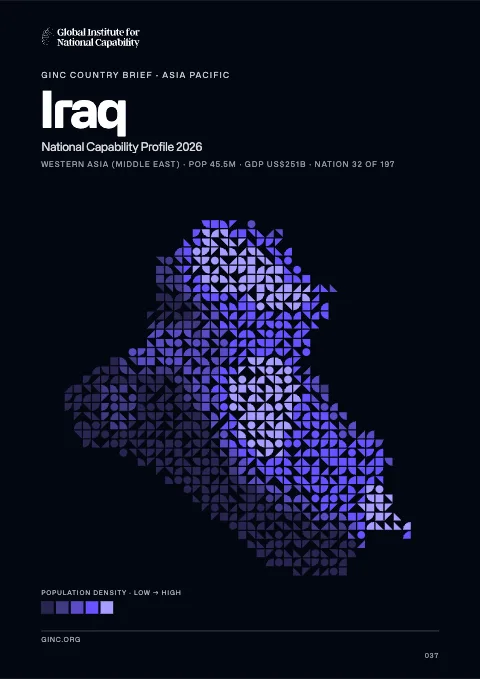
The whole brief
Iraq National Capability Profile 2026
Foundations · Chapter 01
Historical Context
🇮🇶 Iraq’s understanding the origins and evolution of the modern nation
BackgroundBack to top ↑
Formerly part of the Ottoman Empire, Iraq was occupied by Britain during the course of World War I; in 1920, it was declared a League of Nations mandate under UK administration. In stages over the next dozen years, Iraq attained its independence as a kingdom in 1932. A "republic" was proclaimed in 1958, but in actuality a series of strongmen ruled the country until 2003. The last was SADDAM Husayn. Territorial disputes with Iran led to an inconclusive and costly eight-year war (1980-88). In August 1990, Iraq seized Kuwait but was expelled by US-led, UN coalition forces during the Gulf War of January-February 1991. Following Kuwait's liberation, the UN Security Council (UNSC) required Iraq to scrap all weapons of mass destruction and long-range missiles and to allow UN verification inspections. Continued Iraqi noncompliance with UNSC resolutions over a period of 12 years led to the US-led invasion of Iraq in March 2003 and the ouster of the SADDAM Husayn regime. US forces remained in Iraq under a UNSC mandate through 2009 and under a bilateral security agreement thereafter, helping to provide security and to train and mentor Iraqi security forces. In October 2005, Iraqis approved a constitution in a national referendum and, pursuant to this document, elected a 275-member Council of Representatives (COR) in December 2005. The COR approved most cabinet ministers in May 2006, marking the transition to Iraq's first constitutional government in nearly a half century. In January 2009 and April 2013, Iraq held elections for provincial councils in all governorates except for the three governorates comprising the Kurdistan Regional Government and Kirkuk Governorate. Iraq held a national legislative election in March 2010 - choosing 325 legislators in an expanded COR - and, after nine months of deadlock the COR approved the new government in December 2010. Nearly nine years after the start of the Second Gulf War in Iraq, US military operations there ended in mid-December 2011.
IndependenceBack to top ↑
3 October 1932 (from League of Nations mandate under British administration); note - on 28 June 2004 the Coalition Provisional Authority transferred sovereignty to the Iraqi Interim Government
National holidayBack to top ↑
Republic Day, July 14 (1958); note - the Government of Iraq has yet to declare an official national holiday but still observes Republic Day
Foundations · Chapter 02
Geography
🇮🇶 Iraq’s territory, resources and strategic position
Location and areaBack to top ↑
Middle East, bordering the Persian Gulf, between Iran and Kuwait
33 00 N, 44 00 E
Middle East
slightly more than three times the size of New York state
58 km
Terrain and resourcesBack to top ↑
mostly broad plains; reedy marshes along Iranian border in south with large flooded areas; mountains along borders with Iran and Turkey
petroleum, natural gas, phosphates, sulfur
35,250 sq km (2003)
Settlement and hazardsBack to top ↑
dust storms; sandstorms; floods
strategic location on Shatt al Arab waterway and at the head of the Persian Gulf
OtherBack to top ↑
89.86 cu km (2011)
government water control projects have drained most of the inhabited marsh areas east of An Nasiriyah by drying up or diverting the feeder streams and rivers; a once sizable population of Marsh Arabs, who inhabited these areas for thousands of years, has been displaced; furthermore, the destruction of the natural habitat poses serious threats to the area's wildlife populations; inadequate supplies of potable water; development of the Tigris and Euphrates rivers system contingent upon agreements with upstream riparian Turkey; air and water pollution; soil degradation (salination) and erosion; desertification
Foundations · Chapter 03
Environment
🇮🇶 Iraq’s environmental conditions, resources and national resilience
ClimateBack to top ↑
mostly desert; mild to cool winters with dry, hot, cloudless summers; northern mountainous regions along Iranian and Turkish borders experience cold winters with occasionally heavy snows that melt in early spring, sometimes causing extensive flooding in central and southern Iraq
Emissions and pollutionBack to top ↑
Water, waste and foodBack to top ↑
Resources and agreementsBack to top ↑
GINC Capability Domains · Chapter 04
Critical Technology
🇮🇶 Iraq’s technology frontiers and the pursuit of national advantage
Two counts are set side by side for 2015–2024: on the left, the papers researchers in Iraq published; on the right, the patent families that began there and were filed in more than one country. First by capability group, then group by group with each group’s capabilities. The badge on a card is the nation’s place among all nations. Papers are from GINC Research Analytics, patent families from GINC Patents.
Research by capability group
#42 WorldPapers published, 2015–2024
3,507
1,061
1,042
712
679
406
234
154
152
3
Patents by capability group
#106 WorldInternational patent families, 2015–2024
Advanced Materials & ManufacturingBack to top ↑
Research
#49 WorldPapers published, 2015–2024
Patents
International patent families, 2015–2024
No international patent families on record for 2015–2024.
Energy TechnologiesBack to top ↑
Research
#44 WorldPapers published, 2015–2024
Patents
#84 WorldInternational patent families, 2015–2024
Semiconductors & Advanced ComputingBack to top ↑
Research
#48 WorldPapers published, 2015–2024
No research topic: Semiconductor Design & EDA · Advanced Semiconductor Fabrication · Semiconductor Equipment & Materials · Advanced Packaging & Heterogeneous Integration
Patents
#69 WorldInternational patent families, 2015–2024
Artificial IntelligenceBack to top ↑
Research
#31 WorldPapers published, 2015–2024
Patents
International patent families, 2015–2024
No international patent families on record for 2015–2024.
Quantum TechnologiesBack to top ↑
Research
#50 WorldPapers published, 2015–2024
Patents
International patent families, 2015–2024
No international patent families on record for 2015–2024.
Connectivity, Cyber & Trust TechnologiesBack to top ↑
Research
#28 WorldPapers published, 2015–2024
Patents
International patent families, 2015–2024
No international patent families on record for 2015–2024.
Sensing, Timing & NavigationBack to top ↑
Research
#48 WorldPapers published, 2015–2024
Patents
International patent families, 2015–2024
No international patent families on record for 2015–2024.
Robotics & Autonomous SystemsBack to top ↑
Research
#44 WorldPapers published, 2015–2024
No research topic: Human-Machine Interfaces
Patents
International patent families, 2015–2024
No international patent families on record for 2015–2024.
Biotechnology & Health TechnologiesBack to top ↑
Research
#57 WorldPapers published, 2015–2024
Patents
#84 WorldInternational patent families, 2015–2024
Medicine and BioTech
Clinical research and life-science invention, drawn from the same series that drive the metric pages. Each card opens the full cross-country comparison.
Space TechnologiesBack to top ↑
Research
#70 WorldPapers published, 2015–2024
Patents
International patent families, 2015–2024
No international patent families on record for 2015–2024.
GINC Capability Domains · Chapter 05
Strategic Infrastructure
🇮🇶 Iraq’s energy, connectivity and the material foundations of capability
Resource InfrastructureBack to top ↑
2.979 million bbl/day (2013 est.)
2.39 million bbl/day (2013 est.)
0 bbl/day (2013 est.)
141.4 billion bbl (1 January 2013 est.)
492,800 bbl/day (2010 est.)
818,000 bbl/day (2011 est.)
3,832 bbl/day (2010 est.)
172,600 bbl/day (2010 est.)
880 million cu m (2011 est.)
1.3 billion cu m (2010 est.)
0 cu m (2011 est.)
0 cu m (2011 est.)
3.158 trillion cu m (1 January 2013 est.)
gas 2,455 km; liquid petroleum gas 913 km; oil 5,432 km; refined products 1,637 km (2013)
Agriculture & Food InfrastructureBack to top ↑
- Irrigation & Agricultural Water
- Livestock & Veterinary
- Fisheries & Aquaculture
- Storage, Cold Chain & Markets
Energy InfrastructureBack to top ↑
- Thermal Generation
- Nuclear Generation
- Nuclear Fuel Cycle & Radioactive Waste
- Hydropower
- Renewable Generation
- Transmission & Distribution
- System Control & Dispatch
- Storage & Fuel Supply
11.2 million kW (2013 est.)
62.3 billion kWh (2013 est.)
53.41 billion kWh (2013 est.)
0 kWh (2013 est.)
9.802 billion kWh (2013 est.)
92% of total installed capacity (2013 est.)
0% of total installed capacity (2013 est.)
7.6% of total installed capacity (2013 est.)
0% of total installed capacity (2013 est.)
139.4 million Mt (2011 est.)
Water, Sanitation & Waste InfrastructureBack to top ↑
- Dams, Reservoirs & Flood Defence
- Water Supply & Treatment
- Bulk Water Transfer & Desalination
- Wastewater & Sanitation
- Solid Waste & Recycling
Advanced ManufacturingBack to top ↑
- Materials & Inputs
- Chemicals & Hazardous Process Industry
- Production Systems
- Supply Chain & Ecosystem
- Workforce & Innovation
Transport InfrastructureBack to top ↑
- Seaports & Terminals
- Air Infrastructure
- Air Navigation & Traffic Management
- Inland Waterways & Ferries
- Rail Infrastructure
- Roads & Bridges
- Logistics, Multimodal & Border Infrastructure
- Postal & Parcel
102 (2013)
16 (2013)
5,279 km (the Euphrates River (2,815 km), Tigris River (1,899 km), and Third River (565 km) are the principal waterways) (2012)
Communications & Digital InfrastructureBack to top ↑
- Subsea Cables & International Gateways
- Core & Backbone Networks
- Mobile & Wireless Networks
- Spectrum & Broadcasting
- Data Centres, Compute & Cloud
- Data Resources
- AI Tools & Applications
1.87 million (2012)
26.76 million (2012)
325,900 (2009)
26 (2012)
.iq
Financial InfrastructureBack to top ↑
- Currency & Reserves
- Payments & Settlement Systems
- Markets, Exchanges & Depositories
- Banks, Insurers & Systemic Institutions
Social InfrastructureBack to top ↑
- Health Infrastructure
- Public Health & Laboratories
- Medical Supply & Stockpiles
- Education & Skills Infrastructure
- Research & Scientific Facilities
- Housing, Community & Social Services
- Government & Public Administration
- Cultural, Community & Recreational Infrastructure
- Justice & Corrections
- Emergency Services & Civil Protection
- Hydrometeorology & Early Warning
Space, Aerospace & Defence InfrastructureBack to top ↑
GINC Capability Domains · Chapter 06
National Security
🇮🇶 Iraq’s force, intelligence and the defence of the nation
Disputes and terrorismBack to top ↑
Iraq's lack of a maritime boundary with Iran prompts jurisdiction disputes beyond the mouth of the Shatt al Arab in the Persian Gulf; Turkey has expressed concern over the autonomous status of Kurds in Iraq
Force Generation & MobilisationBack to top ↑
Counterterrorism Service Forces: Counterterrorism Command; Iraqi Special Operations Forces (ISOF); Ministry of Defense Forces: Iraqi Army (includes Army Aviation Directorate, former National Guard Iraqi Intervention Forces, and Strategic Infrastructure Battalions), Iraqi Navy (former Iraqi Coastal Defense Force, includes Iraq Marine Force), Iraqi Air Force (Al-Quwwat al-Jawwiya al-Iraqiya) (2011)
18-40 years of age for voluntary military service; no conscription (2013)
2.88% of GDP (2012)//3.27% of GDP (2011)//2.88% of GDP (2010)
Forces under arms
Active-duty strength on the Correlates of War series, which reaches back to 1816 and so carries a nation’s whole record of mobilisation rather than its present establishment. The card opens the full cross-country comparison.
Intelligence & AssessmentBack to top ↑
- Imagery & Geospatial Intelligence
- Signals & Cyber Intelligence
- Technical & Measurement Intelligence
- Open-Source & Financial Intelligence
- Human Intelligence & Counterintelligence
- All-Source Analysis & Warning
Joint Command, Projection & SustainmentBack to top ↑
- Command, Control & Communications
- Strategic Lift & Mobility
- Expeditionary & Peace Operations
- Operational Sustainment & War Reserves
- Defence Industrial Mobilisation
- CBRN Defence
Land PowerBack to top ↑
- Combined Arms Manoeuvre
- Land Fires
- Battlefield Aviation & Uncrewed Systems
- Special Operations & Irregular Warfare
Maritime PowerBack to top ↑
- Maritime Security & Constabulary
- Sea Denial & Undersea Warfare
- Sea Control
- Amphibious & Expeditionary Operations
Air PowerBack to top ↑
- Air Sovereignty & Policing
- Control of the Air
- Air Strike & Interdiction
- Airborne ISR, Early Warning & Battle Management
Strategic Strike & Missile DefenceBack to top ↑
Space OperationsBack to top ↑
Cyber & Electromagnetic OperationsBack to top ↑
Nuclear DeterrenceBack to top ↑
GINC Capability Domains · Chapter 07
Human Capital
🇮🇶 Iraq’s population, health and the skills that sustain capability
DemographyBack to top ↑
32,585,692 (July 2014 est.)
2.23% (2014 est.)
26.85 births/1,000 population (2014 est.)
4.57 deaths/1,000 population (2014 est.)
3.41 children born/woman (2014 est.)
51.2% (2011)
Migration and urbanisationBack to top ↑
0 migrant(s)/1,000 population (2014 est.)
BAGHDAD (capital) 6.036 million; Mosul 1.494 million; Erbil 1.039 million; Basra 942,000; As Sulaymaniyah 867,000; Najaf 779,000 (2011)
Welfare and equityBack to top ↑
25% (2008 est.)
DisplacementBack to top ↑
Early Childhood DevelopmentBack to top ↑
7.1% (2006)
Foundational EducationBack to top ↑
NA
Advanced EducationBack to top ↑
Technical & Vocational SkillsBack to top ↑
Digital & AI CompetenceBack to top ↑
Generative AI adoption
Modelled share of working-age adults using generative AI, from Microsoft telemetry scaled to each country’s 15–64 population. A measure of how fast a workforce is absorbing the technology rather than of how much of it a nation builds. The card opens the full cross-country comparison.
Lifelong Learning & ReskillingBack to top ↑
Research Talent & Knowledge CreationBack to top ↑
Population HealthBack to top ↑
63 deaths/100,000 live births (2010)
27% (2008)
less than 0.1% (2001 est.)
fewer than 500 (2003 est.)
NA
Health System CapabilityBack to top ↑
8.3% of GDP (2011)
0.61 physicians/1,000 population (2010)
1.3 beds/1,000 population (2010)
GINC Capability Domains · Chapter 08
Governance and Integrity
🇮🇶 Iraq’s institutions, law and the integrity of the state
State structureBack to top ↑
parliamentary democracy
18 governorates (muhafazat, singular - muhafazah (Arabic); parezgakan, singular - parezga (Kurdish)) and 1 region*; Al Anbar; Al Basrah; Al Muthanna; Al Qadisiyah (Ad Diwaniyah); An Najaf; Arbil (Erbil) (Arabic), Hewler (Kurdish); As Sulaymaniyah (Arabic), Slemani (Kurdish); Babil; Baghdad; Dahuk (Arabic), Dihok (Kurdish); Dhi Qar; Diyala; Karbala'; Kirkuk; Kurdistan Regional Government*; Maysan; Ninawa; Salah ad Din; Wasit
several previous; latest adopted by referendum 15 October 2005 (2013)
18 years of age; universal
Political Institutions & Civic ParticipationBack to top ↑
- Electoral Management & Integrity
- Legislature & Deliberative Institutions
- Citizen Participation & Civic Space
unicameral Council of Representatives (325 seats consisting of 317 members elected by an optional open-list and representing a specific governorate, proportional representation system and 8 seats reserved for minorities; members serve 4-year terms); note - Iraq's Constitution calls for the establishment of an upper house, the Federation Council
Badr Organization [Hadi al-AMIRI]//Da'wa Party (Islamic) [Prime Minister Nuri al-MALIKI]//Da'wa Tanzim [Hashim al-MUSAWI branch]//Da-wa Tanzim [Abd al-Karim al-ANZI branch]//Fadilah Party [Hasan al-SHAMMARI and Ammar TUAMA]//Goran (Change) List (also known as the Movement for Change) [Nushirwan MUSTAFA]//Iraqi Covenant Gathering [Ahmad Abd al-Ghafur al-SAMARRAI]//Iraqi Constitutional Party [Jawad al-BULANI]//Iraqi Front for National Dialogue [Deputy Prime Minister Salih al-MUTLAQ]//Iraqi Islamic Party or IIP [Usama al-TIKRITI]//Iraqi Justice and Reform Movement [Shaykh Abdallah al-YAWR]//Iraqi National Accord or INA [Ayad ALLAWI]//Iraqi National Alliance [Ibrahim al-JAFARI]//Iraqi National Congress or INC [Ahmad CHALABI]//Iraqi National Movement (see Iraqi National Accord)//Iraqi Unity Alliance [Nauaf Saud ZAID]//Islamic Supreme Council of Iraq or ISCI [Ammar al-HAKIM]//Kurdistan Alliance//Kurdistan Democratic Party or KDP [Kurdistan Regional Government President Masud BARZANI]//Kurdistan Islamic Group (also called Islamic Group of Kurdistan) [Ali BAPIR]//Kurdistan Islamic Union [ Mohammed FARAI]//Future National Gathering [Finance Minister Rafi al-ISSAWI]//National Iraqiyun Gathering [Usama al-NUJAYFI]//National Movement for Reform and Development [Jamal al-KARBULI]//National Reform Trend (part of the National Iraqi Alliance) [former Prime Minister Ibrahim al-JAFARI]//Patriotic Union of Kurdistan or PUK [President Jalal TALABANI]//Sadrist Trend [Muqtada al-SADR]//Sahawa al-Iraq [Ahmad al-RISHAWI]//State of Law Coalition [Nouri al-MALIKI]//United Coalition [Usama al-NUJAYFI]
Sunni militias//Shia militias, some associated with political parties
Justice System & Fundamental RightsBack to top ↑
- Judicial Independence & Court Capability
- Access to Justice & Legal Services
- Fundamental Rights Protection
- Human Rights Institutions & Equality Bodies
mixed legal system of civil and Islamic law
has not submitted an ICJ jurisdiction declaration; non-party state to the ICCt
Internal Security & OrderBack to top ↑
Regulatory Governance & Strategic ControlsBack to top ↑
- Regulatory Quality & Better Regulation
- Regulatory Delivery & Independent Regulators
- Strategic Controls & Economic Security Administration
Government Effectiveness & Public AdministrationBack to top ↑
- Centre of Government & Policy Coordination
- Civil Service & Public Workforce
- Digital Government & Service Delivery
- Legal Identity & Civil Registration
- Statistical & Data Capability
Public Integrity & Anti-CorruptionBack to top ↑
Transparency, Oversight & AccountabilityBack to top ↑
- Right to Information & Open Government
- Independent Oversight & Supreme Audit
- Independent Media & Journalist Safety
National Resilience & Crisis ManagementBack to top ↑
GINC Capability Domains · Chapter 09
Information and Influence
🇮🇶 Iraq’s identity, media and the projection of influence
Identity and cultureBack to top ↑
Arabic (official), Kurdish (official), Turkmen (a Turkish dialect) and Assyrian (Neo-Aramaic) are official in areas where they constitute a majority of the population), Armenian
Muslim (official) 99% (Shia 60%-65%, Sunni 32%-37%), Christian 0.8%, Hindu note: while there has been voluntary relocation of many Christian families to northern Iraq, recent reporting indicates that the overall Christian population may have dropped by as much as 50 percent since the fall of the Saddam HUSSEIN regime in 2003, with many fleeing to Syria, Jordan, and Lebanon (2010 est.)
Arab 75%-80%, Kurdish 15%-20%, Turkoman, Assyrian, or other 5%
golden eagle
three equal horizontal bands of red (top), white, and black; the Takbir (Arabic expression meaning "God is great") in green Arabic script is centered in the white band; the band colors derive from the Arab Liberation flag and represent oppression (black), overcome through bloody struggle (red), to be replaced by a bright future (white); the Council of Representatives approved this flag in 2008 as a compromise temporary replacement for the Ba'athist Saddam-era flag
Diplomatic Statecraft & Global NetworksBack to top ↑
- Diplomatic Network & Consular Reach
- Multilateral Leadership & Norm Setting
- Agenda-Setting & Convening
- Mediation & Crisis Diplomacy
ABEDA, AFESD, AMF, CAEU, CICA, EITI (candidate country), FAO, G-77, IAEA, IBRD, ICAO, ICRM, IDA, IDB, IFAD, IFC, IFRCS, ILO, IMF, IMO, IMSO, Interpol, IOC, IPU, ISO, ITSO, ITU, LAS, MIGA, NAM, OAPEC, OIC, OPCW, OPEC, PCA, UN, UNCTAD, UNESCO, UNIDO, UNWTO, UPU, WCO, WFTU (NGOs), WHO, WIPO, WMO, WTO (observer)
Alliances & Security CooperationBack to top ↑
Development Cooperation & Global AssistanceBack to top ↑
Culture, Language & Education DiplomacyBack to top ↑
- Cultural & Language Institutes
- Creative Industries & Cultural Export Reach
- Heritage & Cultural Institutions
- Education Diplomacy & Alumni Networks
- Sports & Major Events
Diaspora & Global CommunitiesBack to top ↑
Information Environment & Strategic CommunicationBack to top ↑
- Strategic Communications & Public Diplomacy
- International Media & Broadcasting
- Information Defence & Counter-Interference
the number of private radio and TV stations has increased rapidly since 2003; government-owned TV and radio stations are operated by the publicly funded Iraqi Public Broadcasting Service; private broadcast media are mostly linked to political, ethnic, or religious groups; satellite TV is available to an estimated 70% of viewers and many of the broadcasters are based abroad; transmissions of multiple international radio broadcasters are accessible (2007)
GINC Capability Domains · Chapter 10
Financial Strength
🇮🇶 Iraq’s fiscal depth, reserves and the capacity to act
Monetary & Currency CapabilityBack to top ↑
- Monetary Policy & Price Stability
- Exchange Rate & External Account Management
- Currency Issuance & Digital Money
2% (2013 est.)//6.1% (2012 est.)
Iraqi dinars (IQD) per US dollar -//1,166 (2013 est.)//1,166.17 (2012 est.)//1,170 (2010 est.)//1,170 (2009)//1,176 (2008)
6% (December 2012)//6% (December 2011)
6% (31 December 2013 est.)//6% (31 December 2012 est.)
$62.33 billion (31 December 2013 est.)//$54.68 billion (31 December 2012 est.)
$74.81 billion (31 December 2013 est.)//$64.74 billion (31 December 2012 est.)
Fiscal Capacity & Public FinanceBack to top ↑
- Revenue Mobilisation & Tax Administration
- Public Expenditure & Budget Management
- Sovereign Debt & Treasury Management
- Public Investment Management
44.9% of GDP (2013 est.)
0.9% of GDP (2013 est.)
calendar year
Financial System Depth & AccessBack to top ↑
- Banking System Capacity
- Capital Markets Depth & Development
- Long-Term & Institutional Capital
- Financial Inclusion & Household Access
- Development & Policy Finance
$-3.902 million (31 December 2013 est.)//$-3.981 million (31 December 2012 est.)
$4 billion (9 December 2011)//$2.6 billion (31 July 2010)//$2 billion (31 July 2009 est.)
Financial Regulation & IntegrityBack to top ↑
- Prudential Regulation & Supervision
- Financial Integrity & Illicit Finance Control
- Market Conduct & Consumer Protection
- Payment & Market Infrastructure Oversight
Financial Stability & Crisis ManagementBack to top ↑
- Macroprudential & Systemic Oversight
- Crisis Management, Resolution & Deposit Insurance
- External Liquidity & Financial Safety Nets
Sovereign Capital & External Financial PowerBack to top ↑
- Official Reserves Management
- Sovereign Wealth & Public Asset Management
- Currency Internationalisation & Reserve Status
- Capital Account & Flow Management
- International Financial Centre Capability
$71.24 billion (31 December 2013 est.)//$70.33 billion (31 December 2012 est.)
$59.49 billion (31 December 2013 est.)//$60.2 billion (31 December 2012 est.)
GINC Capability Domains · Chapter 11
Production and Innovation
🇮🇶 Iraq’s output, industry and the engine of prosperity
Economic Output & ProductivityBack to top ↑
An improving security environment and foreign investment are helping to spur economic activity, particularly in the energy, construction, and retail sectors. Broader economic development, long-term fiscal health, and sustained improvements in the overall standard of living still depend on the central government passing major policy reforms. Iraq's largely state-run economy is dominated by the oil sector, which provides more than 90% of government revenue and 80% of foreign exchange earnings. Iraq in 2012 boosted oil exports to a 30-year high of 2.6 million barrels per day, a significant increase from Iraq's average of 2.2 million in 2011. Government revenues increased as global oil prices remained persistently high for much of 2012. Iraq's contracts with major oil companies have the potential to further expand oil exports and revenues, but Iraq will need to make significant upgrades to its oil processing, pipeline, and export infrastructure to enable these deals to reach their economic potential. The Iraqi Kurdistan Region's (IKR) autonomous Kurdistan Regional Government (KRG) passed its own oil law in 2007, and has directly signed about 50 contracts to develop IKR energy reserves. The federal government has disputed the legal authority of the KRG to conclude most of these contracts, some of which are also in areas with unresolved administrative boundaries in dispute between the federal and regional government. Iraq is making slow progress enacting laws and developing the institutions needed to implement economic policy, and political reforms are still needed to assuage investors' concerns regarding the uncertain business climate, which may have been harmed by the November 2012 standoff between Baghdad and Erbil and the removal of the Central Bank Governor in October 2012. The government of Iraq is eager to attract additional foreign direct investment, but it faces a number of obstacles including a tenuous political system and concerns about security and societal stability. Rampant corruption, outdated infrastructure, insufficient essential services, skilled labor shortages, and antiquated commercial laws stifle investment and continue to constrain growth of private, nonoil sectors. Iraq is considering a package of laws to establish a modern legal framework for the oil sector and a mechanism to equitably divide oil revenues within the nation, although these reforms are still under contentious and sporadic negotiation. Under the Iraqi Constitution, some competencies relevant to the overall investment climate are either shared by the federal government and the regions or are devolved entirely to the regions. Investment in the IKR operates within the framework of the Kurdistan Region Investment Law (Law 4 of 2006) and the Kurdistan Board of Investment, which is designed to provide incentives to help economic development in areas under the authority of the KRG. Inflation has remained under control since 2006 as security improved. However, Iraqi leaders remain hard pressed to translate macroeconomic gains into an improved standard of living for the Iraqi populace. Unemployment remains a problem throughout the country despite a bloated public sector. Encouraging private enterprise through deregulation would make it easier for Iraqi citizens and foreign investors to start new businesses. Rooting out corruption and implementing reforms - such as restructuring banks and developing the private sector - would be important steps in this direction.
$249.4 billion (2013 est.)//$239.3 billion (2012 est.)//$220.7 billion (2011 est.)
4.2% (2013 est.)//8.4% (2012 est.)//8.6% (2011 est.)
$7,100 (2013 est.)//$7,100 (2012 est.)//$6,800 (2011 est.)
$221.8 billion (2013 est.)
Labour & EmploymentBack to top ↑
- Employment & Labour Force Participation
- Labour Market Institutions & Wage Setting
- Employment Services & Skills Matching
- Labour Adjustment, Transition & Formalisation
8.9 million (2010 est.)
16% (2012 est.)//15% (2010 est.)
Industrial & Sectoral BaseBack to top ↑
- Manufacturing & Advanced Industry
- Foundational & Process Industries
- Agrifood & Primary Production
- Services Economy
wheat, barley, rice, vegetables, dates, cotton; cattle, sheep, poultry
petroleum, chemicals, textiles, leather, construction materials, food processing, fertilizer, metal fabrication/processing
6.9% (2013 est.)
Structural Transformation & ComplexityBack to top ↑
Business Dynamism & EntrepreneurshipBack to top ↑
- Entrepreneurship & Firm Creation
- Risk Capital & Scale-Up Finance
- Firm Growth, Exit & Renewal
- Competition & Market Contestability
Innovation & CommercialisationBack to top ↑
- Business Innovation Capability
- Research Commercialisation & Knowledge Transfer
- Intellectual Property & Intangible Assets
- Innovation Ecosystems & Clusters
Technology Adoption & DiffusionBack to top ↑
GINC Capability Domains · Chapter 12
Trade and Investment
🇮🇶 Iraq’s markets, capital and the terms of global exchange
Overall tradeBack to top ↑
$109B of exports to 93 partners and $51.8B of imports from 96 in 2024, a surplus of $57.4B.
- Exports
- $109B93 partners
- Imports
- $51.8B96 partners
- Balance
- +$57.4Bsurplus
- Total trade
- $161B2024
ExportsBack to top ↑
Where its exports go
The largest partners in 2024, with each one's share of the nation's exports.
| Partner | Value | Share | |
|---|---|---|---|
| China | $38.3B | 35% | |
| India | $29.9B | 27% | |
| South Korea | $9.03B | 8.3% | |
| United States | $7.66B | 7.0% | |
| Greece | $5.41B | 5.0% | |
| Netherlands | $4.20B | 3.8% | |
| Italy | $2.69B | 2.5% | |
| France | $2.12B | 1.9% | |
| Germany | $1.84B | 1.7% | |
| Turkey | $1.83B | 1.7% | |
| Singapore | $1.48B | 1.4% | |
| Spain | $1.20B | 1.1% | |
| Bulgaria | $764M | 0.7% | |
| Serbia | $613M | 0.6% | |
| Philippines | $475M | 0.4% | |
| Taiwan | $409M | 0.4% | |
| Egypt | $284M | 0.3% | |
| Pakistan | $253M | 0.2% | |
| Malaysia | $225M | 0.2% | |
| Austria | $145M | 0.1% |
What it exports
The largest categories in 2024.
| Category | Value | Share | |
|---|---|---|---|
| Mineral fuels, oils, distillation products | $109B | 99% | |
| Edible fruits, nuts, peel of citrus fruit, melons | $105M | <0.1% | |
| Ships, boats, and other floating structures | $92.2M | <0.1% | |
| Animal, vegetable fats and oils, cleavage products | $79.3M | <0.1% | |
| Pulp of wood, fibrous cellulosic material, waste | $66.7M | <0.1% | |
| Aluminum | $51.5M | <0.1% | |
| Copper | $32.9M | <0.1% | |
| Machinery, nuclear reactors, boilers | $28.9M | <0.1% | |
| Plastics | $14.9M | <0.1% | |
| Raw hides and skins (other than furskins) and leather | $14.5M | <0.1% | |
| Oil seed, oleaginous fruits, grain, seed, fruits | $13.8M | <0.1% | |
| Printed books, newspapers, pictures | $13.6M | <0.1% | |
| Beverages, spirits and vinegar | $11.0M | <0.1% | |
| Edible vegetables and certain roots and tubers | $9.17M | <0.1% | |
| Vegetable, fruit, nut food preparations | $8.79M | <0.1% |
ImportsBack to top ↑
Where its imports come from
The largest partners in 2024, with each one's share of the nation's imports.
| Partner | Value | Share | |
|---|---|---|---|
| China | $16.0B | 31% | |
| Turkey | $13.0B | 25% | |
| India | $3.26B | 6.3% | |
| Brazil | $1.91B | 3.7% | |
| Saudi Arabia | $1.73B | 3.3% | |
| United States | $1.59B | 3.1% | |
| Germany | $1.41B | 2.7% | |
| South Korea | $1.25B | 2.4% | |
| Thailand | $1.16B | 2.2% | |
| Italy | $1.04B | 2.0% | |
| Japan | $891M | 1.7% | |
| Kuwait | $831M | 1.6% | |
| Egypt | $815M | 1.6% | |
| United Kingdom | $646M | 1.2% | |
| Netherlands | $638M | 1.2% | |
| France | $456M | 0.9% | |
| Indonesia | $351M | 0.7% | |
| Malaysia | $315M | 0.6% | |
| Ukraine | $304M | 0.6% | |
| Poland | $263M | 0.5% |
What it imports
The largest categories in 2024.
| Category | Value | Share | |
|---|---|---|---|
| Machinery, nuclear reactors, boilers | $6.40B | 12% | |
| Vehicles other than railway, tramway | $5.09B | 9.8% | |
| Electrical, electronic equipment | $4.26B | 8.2% | |
| Cereals | $2.18B | 4.2% | |
| Articles of iron or steel | $2.10B | 4.1% | |
| Plastics | $1.85B | 3.6% | |
| Pharmaceutical products | $1.57B | 3.0% | |
| Furniture, lighting signs, prefabricated buildings | $1.52B | 2.9% | |
| Meat and edible meat offal | $1.43B | 2.8% | |
| Pearls, precious stones, metals, coins | $1.14B | 2.2% | |
| Iron and steel | $1.11B | 2.2% | |
| Cereal, flour, starch, milk preparations and products | $1.08B | 2.1% | |
| Edible fruits, nuts, peel of citrus fruit, melons | $964M | 1.9% | |
| Paper and paperboard, articles of pulp, paper and board | $894M | 1.7% | |
| Articles of apparel, knit or crocheted | $891M | 1.7% |
In a list, the bar runs to the largest in that list. The line is each figure’s history from 2000, drawn to its own peak: it shows the shape of the years, and the value shows the size.
External balanceBack to top ↑
$12.85 billion (2013 est.)//$29.54 billion (2012 est.)
Trade Facilitation & LogisticsBack to top ↑
Trade Policy & Market AccessBack to top ↑
- Trade Policy & Negotiation Capability
- Market Access & Agreements Network
- Trade Law & Enforcement
- Standards, Conformity & Quality Infrastructure
Digital & Services TradeBack to top ↑
- Services Trade Capability
- Digital Trade & E-Commerce
- Data Flows & Digital Trade Governance
- Tourism & Visitor Economy
Investment Attraction & ProjectionBack to top ↑
- Investment Attraction & Facilitation
- Investment Absorption & Linkages
- Outward Investment & Global Corporate Presence
Export Capability & SophisticationBack to top ↑
$91.99 billion (2013 est.)//$94.21 billion (2012 est.)
US 21.1%, India 20.2%, China 13.6%, South Korea 11%, Canada 4.7%, Italy 4.4%, Spain 4.2% (2012)
crude oil 84%, crude materials excluding fuels, food and live animals
Global Value Chain PositionBack to top ↑
- Value Chain Participation & Integration
- Value Chain Position & Upgrading
- Regional Integration & Hub Anchoring
Economic Leverage & DependenceBack to top ↑
- Strategic Supply Security
- Concentration Risk & Revenue Stabilisation
- Economic Leverage & Coercion Resistance
$66.61 billion (2013 est.)//$50.16 billion (2012 est.)
Turkey 27.5%, Syria 16.2%, China 12.5%, US 5.2%, South Korea 4.7% (2012)
food, medicine, manufactures
Iraq · you are in
Historical Context
Foundations
GINC Capability Domains
Find in this brief · Iraq