
China
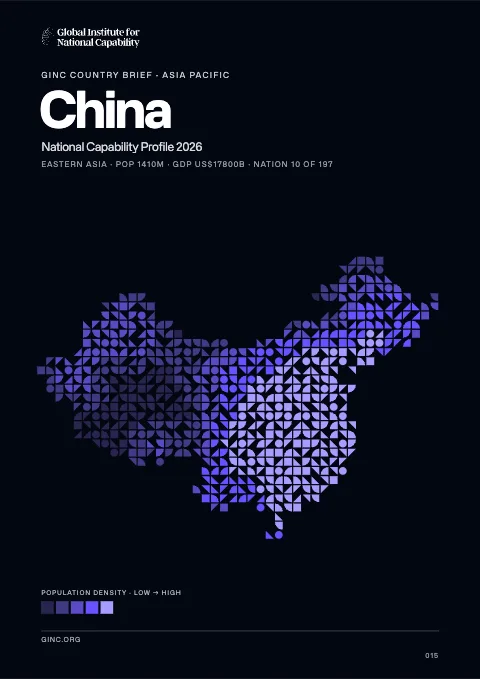
China is a communist party-led state in the Asia-Pacific, home to 1.4 billion people, with its capital at Beijing, and the world’s 4th-largest country by area.
Contents
12 chapters
Foundations
01–03
At a glance
- Area
- 9.6Mkm²#4 World#1 APAC
- Population
- 1.4B#2 World#1 APAC
- Life expectancy
- 78.7yrs#71 World#22 APAC
- GDP (market)
- $18.7T
- GDP (PPP)
- $33.6T#1 World#1 APAC
- GDP per capita
- $23.8K#96 World#10 APAC
The whole brief
China National Capability Profile 2026
Foundations · Chapter 01
Historical Context
🇨🇳 China's understanding the origins and evolution of the modern nation
BackgroundBack to top ↑
China's historical civilization dates to at least the 13th century B.C., first under the Shang (to 1046 B.C.) and then the Zhou (1046-221 B.C.) dynasties. The imperial era of China began in 221 B.C. under the Qin Dynasty and lasted until the fall of the Qing Dynasty in 1912. During this period, China alternated between periods of unity and disunity under a succession of imperial dynasties. In the 19th century, the Qing Dynasty suffered heavily from overextension by territorial conquest, insolvency, civil war, imperialism, military defeats, and foreign expropriation of ports and infrastructure. It collapsed following the Revolution of 1911, and China became a republic under SUN Yat-sen of the Kuomintang (KMT or Nationalist) Party. However, the republic was beset by division, warlordism, and continued foreign intervention. In the late 1920s, a civil war erupted between the ruling KMT-controlled government, led by CHIANG Kai-shek, and the Chinese Communist Party (CCP). Japan occupied much of northeastern China in the early 1930s, and then launched a full-scale invasion of the country in 1937. The resulting eight years of warfare devastated the country and cost up to 20 million Chinese lives by the time of Japan’s defeat in 1945. The Nationalist-Communist civil war continued with renewed intensity after the end of World War II and culminated with a CCP victory in 1949, under the leadership of MAO Zedong.
MAO and the CCP established an autocratic socialist system that, while ensuring the PRC's sovereignty, imposed strict controls over everyday life and launched agricultural, economic, political, and social policies -- such as the Great Leap Forward (1958-1962) and the Cultural Revolution (1966-1976) -- that cost the lives of millions of people. MAO died in 1976. Beginning in 1978, leaders DENG Xiaoping, JIANG Zemin, and HU Jintao focused on market-oriented economic development and opening up the country to foreign trade, while maintaining the rule of the CCP. Since the change, China has been among the world’s fastest growing economies, with real gross domestic product averaging over 9% growth annually through 2021, lifting an estimated 800 million people out of poverty and dramatically improving overall living standards. By 2011, the PRC’s economy was the second largest in the world. Current leader XI Jinping has continued these policies but has also maintained tight political controls. Over the past decade, China has increased its global outreach, including military deployments, participation in international organizations, and a global connectivity plan in 2013 called the "Belt and Road Initiative" (BRI). Many nations have signed on to BRI agreements to attract PRC investment, but others have expressed concerns about such issues as the opaque nature of the projects, financing, and potentially unsustainable debt obligations. XI Jinping assumed the positions of General Secretary of the Chinese Communist Party and Chairman of the Central Military Commission in 2012 and President in 2013. In 2018, the PRC’s National People’s Congress passed an amendment abolishing presidential term limits, which allowed XI to gain a third five-year term in 2023.
IndependenceBack to top ↑
1 October 1949 (People's Republic of China established); notable earlier dates: 221 B.C. (unification under the Qin Dynasty); 1 January 1912 (Qing Dynasty replaced by the Republic of China)
National holidayBack to top ↑
National Day (anniversary of the founding of the People's Republic of China), 1 October (1949)
Foundations · Chapter 02
Geography
🇨🇳 China's territory, resources and strategic position
Location and areaBack to top ↑
Eastern Asia, bordering the East China Sea, Korea Bay, Yellow Sea, and South China Sea, between North Korea and Vietnam
35 00 N, 105 00 E
Asia
slightly smaller than the US
14,500 km
Terrain and resourcesBack to top ↑
mostly mountains, high plateaus, deserts in west; plains, deltas, and hills in east
coal, iron ore, helium, petroleum, natural gas, arsenic, bismuth, cobalt, cadmium, ferrosilicon, gallium, germanium, hafnium, indium, lithium, mercury, tantalum, tellurium, tin, titanium, tungsten, antimony, manganese, magnesium, molybdenum, selenium, strontium, vanadium, magnetite, aluminum, lead, zinc, rare earth elements, uranium, hydropower potential (world's largest), arable land
690,070 sq km (2012)
WaterBack to top ↑
Yangtze - 6,300 km; Huang He - 5,464 km; Amur river source (shared with Mongolia and Russia [m]) - 4,444 km; Lancang Jiang (Mekong) river source (shared with Burma, Laos, Thailand, Cambodia, and Vietnam [m]) - 4,350 km; Yarlung Zangbo Jiang (Brahmaputra) river source (shared with India and Bangladesh [m]) - 3,969 km; Yin-tu Ho (Indus) river source (shared with India and Pakistan [m]) - 3,610 km; Nu Jiang (Salween) river source (shared with Thailand and Burma [m]) - 3,060 km; Irrawaddy river source (shared with Burma [m]) - 2,809 km; Zhu Jiang (Pearl) (shared with Vietnam [s]) - 2,200 km; Yuan Jiang (Red river) source (shared with Vietnam [m]) - 1,149 km
note: [s] after country name indicates river source; [m] after country name indicates river mouth
North China Aquifer System (Huang Huai Hai Plain), Song-Liao Plain, Tarim Basin
Settlement and hazardsBack to top ↑
overwhelming majority of the population is found in the eastern half of the country; the west, with its vast mountainous and desert areas, remains sparsely populated; though ranked first in the world in total population, overall density is less than that of many Asian and European countries; high population density is found along the Yangtze and Yellow River valleys, the Xi Jiang River delta, the Sichuan Basin (around Chengdu), in and around Beijing, and the industrial area around Shenyang
frequent typhoons (about five per year along southern and eastern coasts); damaging floods; tsunamis; earthquakes; droughts; land subsidence
volcanism: China contains some historically active volcanoes including Changbaishan (also known as Baitoushan, Baegdu, or P'aektu-san), Hainan Dao, and Kunlun although most have been relatively inactive in recent centuries
note 1: world's fourth largest country (after Russia, Canada, and the US) and largest country situated entirely in Asia; Mount Everest, on the border with Nepal, is the world's tallest peak above sea level
note 2: the largest cave chamber in the world is the Miao Room, in the Gebihe cave system at China's Ziyun Getu He Chuandong National Park, which encloses about 10.78 million cu m (380.7 million cu ft); the world's largest sinkhole is the Xiaoxhai Tiankeng sinkhole in Chongqing Municipality, which is 660 m deep, with a volume of 130 million cu m
Foundations · Chapter 03
Environment
🇨🇳 China's environmental conditions, resources and national resilience
ClimateBack to top ↑
extremely diverse; tropical in south to subarctic in north
Conditions and issuesBack to top ↑
air pollution and acid rain from reliance on coal; carbon dioxide emissions from the burning of fossil fuels; water shortages, particularly in the north; water pollution from untreated wastes; coastal destruction due to land reclamation, industrial development, and aquaculture; deforestation and habitat destruction; poor land management leading to soil erosion, landslides, floods, droughts, dust storms, and desertification; trade in endangered species
Emissions and pollutionBack to top ↑
41.4 micrograms per cubic meter (2019 est.)
Water, waste and foodBack to top ↑
2.84 trillion cubic meters (2022 est.)
Resources and agreementsBack to top ↑
GINC Capability Domains · Chapter 04
Critical Technology
🇨🇳 China's technology frontiers and the pursuit of national advantage
Two counts are set side by side for 2015–2024: on the left, the papers researchers in China published; on the right, the patent families that began there and were filed in more than one country. First by capability group, then group by group with each group’s capabilities. The badge on a card is the nation’s place among all nations. Papers are from GINC Research Analytics, patent families from GINC Patents.
Research by capability group
#1 WorldPapers published, 2015–2024
115,716
84,573
82,710
56,999
44,578
25,113
18,044
16,043
14,679
1,078
Patents by capability group
#3 WorldInternational patent families, 2015–2024
107,573
51,360
34,331
32,810
26,145
22,694
14,182
12,517
2,346
785
Advanced Materials & ManufacturingBack to top ↑
Research
#1 WorldPapers published, 2015–2024
Patents
#3 WorldInternational patent families, 2015–2024
Energy TechnologiesBack to top ↑
Research
#1 WorldPapers published, 2015–2024
Patents
#2 WorldInternational patent families, 2015–2024
Semiconductors & Advanced ComputingBack to top ↑
Research
#2 WorldPapers published, 2015–2024
No research topic: Semiconductor Design & EDA · Advanced Semiconductor Fabrication · Semiconductor Equipment & Materials · Advanced Packaging & Heterogeneous Integration
Patents
#4 WorldInternational patent families, 2015–2024
Artificial IntelligenceBack to top ↑
Research
#1 WorldPapers published, 2015–2024
Patents
#2 WorldInternational patent families, 2015–2024
Quantum TechnologiesBack to top ↑
Research
#1 WorldPapers published, 2015–2024
Patents
#3 WorldInternational patent families, 2015–2024
Connectivity, Cyber & Trust TechnologiesBack to top ↑
Research
#1 WorldPapers published, 2015–2024
Patents
#1 WorldInternational patent families, 2015–2024
Sensing, Timing & NavigationBack to top ↑
Research
#1 WorldPapers published, 2015–2024
Patents
#3 WorldInternational patent families, 2015–2024
Robotics & Autonomous SystemsBack to top ↑
Research
#1 WorldPapers published, 2015–2024
28,481
24,494
4,024
No research topic: Human-Machine Interfaces
Patents
#3 WorldInternational patent families, 2015–2024
Biotechnology & Health TechnologiesBack to top ↑
Research
#2 WorldPapers published, 2015–2024
Patents
#2 WorldInternational patent families, 2015–2024
Medicine and BioTech
Clinical research and life-science invention, drawn from the same series that drive the metric pages. Each card opens the full cross-country comparison.
Space TechnologiesBack to top ↑
Research
#2 WorldPapers published, 2015–2024
Patents
#2 WorldInternational patent families, 2015–2024
China National Space Administration (CNSA; established in 1993); Administration for Science, Technology, and Industry for National Defense (SASTIND; subordinate to the Ministry of Industry and Information Technology); People’s Liberation Army (PLA) Aerospace Force (2025)
Jiuquan Launch Center (Inner Mongolia); Xichang Launch Center (Sichuan); Wenchang Launch Center (Hainan; Wenchang includes a commercial launch pad, the Hainan Commercial Space Launch Site, which became operational in December 2024); Taiyuan Launch Center (Shanxi); Eastern Spaceport (Shandong; a coastal spaceport designed to facilitate maritime launches) (2025)
considered one of the world’s leading space powers, with a comprehensive and ambitious space program; can manufacture and operate the full spectrum of space launch vehicles (SLVs) and spacecraft, including human-crewed, lunar/inter-planetary/asteroid probes, satellites (communications, remote sensing, navigational, scientific, etc.), space stations, and reusable space transportation; has an astronaut/taikonaut program; researches and develops a range of space-related capabilities, including advanced telecommunications, optics, spacecraft components, and satellite payloads; participates in international space programs and co-leads (with Australia and Japan) the Global Earth Observation System of Systems; has signed agreements with more than 45 national space agencies, including those of Brazil, Canada, France, and Russia, as well several international organizations; has also cooperated with ESA; two state-owned aerospace enterprises dominate space industry, but a substantial commercial space sector includes launch services (2025)
1960s - began launching rockets and initiated satellite and satellite launch vehicle (SLV) programs
1970 - launched first communications satellite (Dongfanghong I)
2003 - first manned space flight; launched first satellite for global navigational system (Beidou)
2011 - placed temporary space station (Tiangong-1) into Earth orbit
2013 - first unmanned lunar landing mission (Chang'e-3); placed a second temporary space station (Tiangong-2) in Earth orbit
2017 - employed a communications satellite (Micius) to perform the world’s first quantum-encrypted virtual teleconference between Beijing and Vienna
2019 - landed a rover vehicle (Chang’e-4) on the far side of the Moon
2021 - landed a probe and operated a rover vehicle on Mars; signed agreement with Russia to set up an international manned lunar research station; announced intent to send a manned mission to Mars by 2033
2022 - completed construction of a permanent manned space station (Tiangong) in Earth orbit
2024 - successful landing and return of robotic spacecraft/probe (Chang'e-6) from the far side the Moon; first launch of "Thousand Sails" commercial communications satellite constellation project
2025 - launched asteroid sample return mission probe (Tianwen-2); launched world's first quantum communications microsatellite (Jinan-1)
GINC Capability Domains · Chapter 05
Strategic Infrastructure
🇨🇳 China's energy, connectivity and the material foundations of capability
Resource InfrastructureBack to top ↑
Agriculture & Food InfrastructureBack to top ↑
- Irrigation & Agricultural Water
- Livestock & Veterinary
- Fisheries & Aquaculture
- Storage, Cold Chain & Markets
Energy InfrastructureBack to top ↑
- Thermal Generation
- Nuclear Generation
- Nuclear Fuel Cycle & Radioactive Waste
- Hydropower
- Renewable Generation
- Transmission & Distribution
- System Control & Dispatch
- Storage & Fuel Supply
Water, Sanitation & Waste InfrastructureBack to top ↑
- Dams, Reservoirs & Flood Defence
- Water Supply & Treatment
- Bulk Water Transfer & Desalination
- Wastewater & Sanitation
- Solid Waste & Recycling
Advanced ManufacturingBack to top ↑
- Materials & Inputs
- Chemicals & Hazardous Process Industry
- Production Systems
- Supply Chain & Ecosystem
- Workforce & Innovation
Transport InfrastructureBack to top ↑
- Seaports & Terminals
- Air Infrastructure
- Air Navigation & Traffic Management
- Inland Waterways & Ferries
- Rail Infrastructure
- Roads & Bridges
- Logistics, Multimodal & Border Infrastructure
- Postal & Parcel
552 (2025)
120 (2025)
B
Communications & Digital InfrastructureBack to top ↑
- Subsea Cables & International Gateways
- Core & Backbone Networks
- Mobile & Wireless Networks
- Spectrum & Broadcasting
- Data Centres, Compute & Cloud
- Data Resources
- AI Tools & Applications
.cn
Financial InfrastructureBack to top ↑
- Currency & Reserves
- Payments & Settlement Systems
- Markets, Exchanges & Depositories
- Banks, Insurers & Systemic Institutions
Social InfrastructureBack to top ↑
- Health Infrastructure
- Public Health & Laboratories
- Medical Supply & Stockpiles
- Education & Skills Infrastructure
- Research & Scientific Facilities
- Housing, Community & Social Services
- Government & Public Administration
- Cultural, Community & Recreational Infrastructure
- Justice & Corrections
- Emergency Services & Civil Protection
- Hydrometeorology & Early Warning
Space, Aerospace & Defence InfrastructureBack to top ↑
GINC Capability Domains · Chapter 06
National Security
🇨🇳 China's force, intelligence and the defence of the nation
Force Generation & MobilisationBack to top ↑
People's Liberation Army (PLA): Ground Forces or People's Liberation Army Army (PLAA), Navy (PLAN, includes Marine Corps (PLANMC)), Air Force (PLAAF), Rocket Force (PLARF), Aerospace Force (ASF), Cyberspace Force (CSF), Information Support Force (ISF), Joint Logistics Support Force (JLSF); People's Armed Police (PAP, includes Coast Guard, Border Defense Force, Internal Security Forces); PLA Reserve Force (2025)
note 2: the PLA (established 1927) is the military arm of the ruling Chinese Communist Party (CCP), which oversees the PLA through its Central Military Commission (CMC); the CMC is China’s top military decision making body
approximately 2 million active-duty PLA (950,000-1 million Ground; 250,000 Navy, including about 50,000 Marines; 350-400,000 Air Force; 120,000 Rocket Forces; 150-175,000 other forces) (2025)
18-26 years of age depending on education level for men and women for both volunteer and selective compulsory military service; 24-month service obligation (2025)
the People's Liberation Army (PLA) is the world’s largest military; the PLA's primary responsibility is external security but it also has some domestic security duties; China’s stated defense policy includes safeguarding sovereignty, security, and development interests while emphasizing a greater global role for the PLA; the PLA conducts air, counterspace, cyber, electronic warfare, joint, land, maritime, missile, nuclear, and space operations; it trains regularly, including multinational and multiservice exercises, deploys overseas, and participates in international peacekeeping missions
the PRC's internal security forces consist primarily of the Ministry of Public Security (MPS), the Ministry of State Security (MSS), the People’s Armed Police (PAP), and the militia; the PLA support the internal security forces as necessary:
--the MPS controls the civilian national police, which serves as the first-line force for public order; its primary mission is domestic law enforcement and maintaining order, including anti-rioting and anti-terrorism
--the MSS is the PRC’s main civilian intelligence and counterintelligence service
--the PAP is a paramilitary component (or adjunct) of the PLA; its primary missions include internal security, maintaining public order, maritime security, and assisting the PLA in times of war; the China Coast Guard (CCG) administratively falls under the PAP and has a variety of missions, such as maritime sovereignty enforcement, surveillance, resource protection, anti-smuggling, and general law enforcement; it is the largest maritime law enforcement fleet in the world
--the militia is an armed reserve of civilians which serves as an auxiliary and reserve force for the PLA upon mobilization, although it is distinct from the PLA’s reserve forces; militia units are organized around towns, villages, urban sub-districts, and enterprises, and vary widely in composition and mission; they have dual civilian-military command structures; a key component of the militia are the local maritime forces, commonly referred to as the People’s Armed Forces Maritime Militia (PAFMM); the PAFMM consists of mariners (and their vessels) who receive training, equipment, and other forms of support from the Navy and CCG (although the PAFMM remains separate from both) to perform tasks such as maritime patrolling, surveillance and reconnaissance, emergency/disaster response, transportation, search and rescue, and auxiliary tasks in support of naval operations in wartime; the PAFMM’s tasks are often conducted in conjunction or coordination with the Navy and the CCG; it has been used to assert Beijing's maritime claims in the Sea of Japan and South China Sea (2025)
Forces under arms
Active-duty strength on the Correlates of War series, which reaches back to 1816 and so carries a nation’s whole record of mobilisation rather than its present establishment. The card opens the full cross-country comparison.
Intelligence & AssessmentBack to top ↑
- Imagery & Geospatial Intelligence
- Signals & Cyber Intelligence
- Technical & Measurement Intelligence
- Open-Source & Financial Intelligence
- Human Intelligence & Counterintelligence
- All-Source Analysis & Warning
Joint Command, Projection & SustainmentBack to top ↑
- Command, Control & Communications
- Strategic Lift & Mobility
- Expeditionary & Peace Operations
- Operational Sustainment & War Reserves
- Defence Industrial Mobilisation
- CBRN Defence
the PLA is mostly equipped with domestically produced armaments with smaller amounts of imported weaponry, largely from Russia; China has one of the world's largest defense-industrial sectors and is capable of producing advanced weapons systems across all military domains (2025)
475 Lebanon (UNIFIL); 1,050 South Sudan (UNMISS); 280 Sudan/South Sudan (UNISFA); has also established a base in Djibouti with approximately 400 marines, plus naval and support personnel (2025)
Land PowerBack to top ↑
- Combined Arms Manoeuvre
- Land Fires
- Battlefield Aviation & Uncrewed Systems
- Special Operations & Irregular Warfare
Maritime PowerBack to top ↑
- Maritime Security & Constabulary
- Sea Denial & Undersea Warfare
- Sea Control
- Amphibious & Expeditionary Operations
Air PowerBack to top ↑
- Air Sovereignty & Policing
- Control of the Air
- Air Strike & Interdiction
- Airborne ISR, Early Warning & Battle Management
Strategic Strike & Missile DefenceBack to top ↑
Space OperationsBack to top ↑
Cyber & Electromagnetic OperationsBack to top ↑
Nuclear DeterrenceBack to top ↑
GINC Capability Domains · Chapter 07
Human Capital
🇨🇳 China's population, health and the skills that sustain capability
DemographyBack to top ↑
-0.08% (2025 est.)
7.28 births/1,000 population (2025 est.)
7.97 deaths/1,000 population (2025 est.)
1.2 children born/woman (2025 est.)
0.57 (2025 est.)
69.5% (2021 est.)
in October 2015, the Chinese Government announced that it would change its rules to allow all couples to have two children, loosening a 1979 mandate that restricted many couples to one child; the new policy was implemented on 1 January 2016 to address China’s rapidly aging population and future economic needs
Migration and urbanisationBack to top ↑
-0.11 migrant(s)/1,000 population (2025 est.)
29.211 million Shanghai, 21.766 million BEIJING (capital), 17.341 million Chongqing, 14.284 million Guangzhou, 14.239 million Tianjin, 13.073 million Shenzhen (2023)
Welfare and equityBack to top ↑
0% (2020 est.)
DisplacementBack to top ↑
Early Childhood DevelopmentBack to top ↑
2.4% (2013)
Foundational EducationBack to top ↑
Advanced EducationBack to top ↑
Technical & Vocational SkillsBack to top ↑
Digital & AI CompetenceBack to top ↑
Generative AI adoption
Modelled share of working-age adults using generative AI, from Microsoft telemetry scaled to each country’s 15–64 population. A measure of how fast a workforce is absorbing the technology rather than of how much of it a nation builds. The card opens the full cross-country comparison.
Lifelong Learning & ReskillingBack to top ↑
Research Talent & Knowledge CreationBack to top ↑
Population HealthBack to top ↑
16 deaths/100,000 live births (2023 est.)
6.2% (2016)
Health System CapabilityBack to top ↑
3.11 physicians/1,000 population (2022)
5 beds/1,000 population (2020 est.)
GINC Capability Domains · Chapter 08
Governance and Integrity
🇨🇳 China's institutions, law and the integrity of the state
State structureBack to top ↑
communist party-led state
23 provinces (sheng, singular and plural), 5 autonomous regions (zizhiqu, singular and plural), 4 municipalities (shi, singular and plural), and two special administrative regions (tebie xingzhengqu, singular and plural)
provinces: Anhui, Fujian, Gansu, Guangdong, Guizhou, Hainan, Hebei, Heilongjiang, Henan, Hubei, Hunan, Jiangsu, Jiangxi, Jilin, Liaoning, Qinghai, Shaanxi, Shandong, Shanxi, Sichuan, Yunnan, Zhejiang; (see note on Taiwan)
autonomous regions: Guangxi, Nei Mongol (Inner Mongolia), Ningxia, Xinjiang Uyghur, Xizang (Tibet)
municipalities: Beijing, Chongqing, Shanghai, Tianjin
special administrative regions: Hong Kong, Macau
18 years of age; universal
Political Institutions & Civic ParticipationBack to top ↑
- Electoral Management & Integrity
- Legislature & Deliberative Institutions
- Citizen Participation & Civic Space
2023: XI Jinping reelected president; National People's Congress vote - 2,952 (unanimously); HAN Zheng elected vice president with 2,952 votes; LI Qiang elected premier with 2,936 votes
2018: XI Jinping reelected president; National People's Congress vote - 2,970 (unanimously); WANG Qishan elected vice president with 2,969 votes
Chinese Communist Party or CCP
Justice System & Fundamental RightsBack to top ↑
- Judicial Independence & Court Capability
- Access to Justice & Legal Services
- Fundamental Rights Protection
- Human Rights Institutions & Equality Bodies
civil law influenced by Soviet and continental European civil law systems; legislature retains power to interpret statutes
has not submitted an ICJ jurisdiction declaration; non-party state to the ICCt
Internal Security & OrderBack to top ↑
major illicit drug-producing and/or drug-transit country
major precursor-chemical producer (2025)
Regulatory Governance & Strategic ControlsBack to top ↑
- Regulatory Quality & Better Regulation
- Regulatory Delivery & Independent Regulators
- Strategic Controls & Economic Security Administration
Government Effectiveness & Public AdministrationBack to top ↑
- Centre of Government & Policy Coordination
- Civil Service & Public Workforce
- Digital Government & Service Delivery
- Legal Identity & Civil Registration
- Statistical & Data Capability
Public Integrity & Anti-CorruptionBack to top ↑
Transparency, Oversight & AccountabilityBack to top ↑
- Right to Information & Open Government
- Independent Oversight & Supreme Audit
- Independent Media & Journalist Safety
National Resilience & Crisis ManagementBack to top ↑
GINC Capability Domains · Chapter 09
Information and Influence
🇨🇳 China's identity, media and the projection of influence
Identity and cultureBack to top ↑
folk religion 21.9%, Buddhist 18.2%, Christian 5.1%, Muslim 1.8%, Hindu < 0.1%, Jewish < 0.1%, other 0.7% (includes Daoist (Taoist)), unaffiliated 52.1% (2021 est.)
Han Chinese 91.1%, ethnic minorities 8.9% (includes Zhang, Hui, Manchu, Uighur, Miao, Yi, Tujia, Tibetan, Mongol, Dong, Buyei, Yao, Bai, Korean, Hani, Li, Kazakh, Dai, and other nationalities) (2021 est.)
dragon, giant panda
description: red with a large five-pointed yellow star and four smaller ones in the upper-left corner; the small stars are arranged in a vertical arc around the large one
meaning: red represents revolution; the stars symbolize the four social classes -- the working class, the peasantry, the urban petty bourgeoisie, and the national bourgeoisie (capitalists) -- united under the Communist Party of China
red, yellow
Diplomatic Statecraft & Global NetworksBack to top ↑
- Diplomatic Network & Consular Reach
- Multilateral Leadership & Norm Setting
- Agenda-Setting & Convening
- Mediation & Crisis Diplomacy
Diplomatic representation from China
China maintains resident diplomatic missions in 176 countries across 7 world regions.
Diplomatic representation in China
177 countries maintain a resident diplomatic mission in China.
ADB, AfDB (nonregional member), APEC, Arctic Council (observer), ARF, ASEAN (dialogue partner), BIS, BRICS, CDB, CICA, EAS, FAO, FATF, G-20, G-24 (observer), G-5, G-77, IADB, IAEA, IBRD, ICAO, ICC (national committees), ICRM, IDA, IFAD, IFC, IFRCS, IHO, ILO, IMF, IMO, IMSO, Interpol, IOC, IOM (observer), IPU, ISO, ITSO, ITU, LAIA (observer), MIGA, MINURSO, MONUSCO, NAM (observer), NSG, OAS (observer), OPCW, Pacific Alliance (observer), PCA, PIF (partner), SAARC (observer), SCO, SICA (observer), UN, UNAMID, UNCTAD, UNESCO, UNFICYP, UNHCR, UNHRC, UNIDO, UNIFIL, UNISFA, UNMIL, UNMISS, UNOCI, UNOOSA, UN Security Council (permanent), UNTSO, UNWTO, UPU, WCO, WHO, WIPO, WMO, WTO, ZC
Alliances & Security CooperationBack to top ↑
Development Cooperation & Global AssistanceBack to top ↑
Culture, Language & Education DiplomacyBack to top ↑
- Cultural & Language Institutes
- Creative Industries & Cultural Export Reach
- Heritage & Cultural Institutions
- Education Diplomacy & Alumni Networks
- Sports & Major Events
Imperial Palaces of the Ming and Qing Dynasties (c); Mausoleum of the First Qin Emperor (c); The Great Wall (c); Summer Palace, an Imperial Garden in Beijing (c); Jiuzhaigou Valley Scenic and Historic Interest Area (n); Historic Ensemble of the Potala Palace, Lhasa (c); Ancient Ancient City of Ping Yao (c); Historic Center of Macau (c); Historic Monuments of Dengfeng in “The Centre of Heaven and Earth” (c); The Grand Canal (c); Mount Huangshan (m); Mogao Caves (c); Mount Taishan (m); Peking Man Site at Zhoukoudian(c); Huanglong Scenic and Historic Interest Area (n);Wulingyuan Scenic and Historic Interest Area (n); Ancient Building Complex in the Wudang Mountains (c); Mountain Resort and its Outlying Temples, Chengde (c); Temple and Cemetery of Confucius and the Kong Family Mansion in Qufu (c); Lushan National Park (c); Mount Emei Scenic Area, including Leshan Giant Buddha Scenic Area (m); Classical Gardens of Suzhou (c); Old Town of Lijiang (c); Temple of Heaven: an Imperial Sacrificial Altar in Beijing (c); Dazu Rock Carvings (c); Mount Wuyi (m); Ancient Villages in Southern Anhui – Xidi and Hongcun (c); Imperial Tombs of the Ming and Qing Dynasties (c); Longmen Grottoes (c); Mount Qingcheng and the Dujiangyan Irrigation System (c); Yungang Grottoes (c); Three Parallel Rivers of Yunnan Protected Areas (n); Capital Cities and Tombs of the Ancient Koguryo Kingdom (c); Sichuan Giant Panda Sanctuaries - Wolong, Mt. Siguniang, and Jiajin Mountains (c); Yin Xu (c); Kaiping Diaolou and Villages (c); South China Karst (n); Fujian Tulou (c); Mount Sanqingshan National Park (n); Mount Wutai (c); China Danxia (n); West Lake Cultural Landscape of Hangzhou (c); Chengjiang Fossil Site (n); Site of Xanadu (c); Cultural Landscape of Honghe Hani Rice Terraces(c); Xinjiang Tianshan (n); Silk Roads: the Routes Network of Chang'an-Tianshan Corridor (c); Tusi Sites (c); Hubei Shennongjia (n); Zuojiang Huashan Rock Art Cultural Landscape (c); Kulangsu, a Historic International Settlement (c); Qinghai Hoh Xil (n); Fanjingshan (n); Archaeological Ruins of Liangzhu City (c); Migratory Bird Sanctuaries along the Coast of Yellow Sea-Bohai Gulf of China (n); Quanzhou: Emporium of the World in Song-Yuan China (c); Cultural Landscape of Old Tea Forests of the Jingmai Mountain in Pu’er (c); Badain Jaran Desert - Towers of Sand and Lakes (n); Beijing Central Axis: A Building Ensemble Exhibiting the Ideal Order of the Chinese Capital (c); Xixia Imperial Tombs (c)
Diaspora & Global CommunitiesBack to top ↑
Information Environment & Strategic CommunicationBack to top ↑
- Strategic Communications & Public Diplomacy
- International Media & Broadcasting
- Information Defence & Counter-Interference
all broadcast media are owned by, or affiliated with, the Chinese Communist Party (CCP) or a government agency; no privately owned TV or radio stations; state-run Chinese Central TV, provincial, and municipal stations offer more than 2,000 channels; the Central Propaganda Department and local (provincial, municipal) officials direct news reporting and approve all programming; foreign-made TV programs must be approved/censored prior to broadcast; widespread use of online platforms (Bilibili, Tencent Video, iQiyi, etc) to access domestic and international films and TV shows; Cyberspace Administration of China (CAC) regulates video platforms (2022)
GINC Capability Domains · Chapter 10
Financial Strength
🇨🇳 China's fiscal depth, reserves and the capacity to act
Monetary & Currency CapabilityBack to top ↑
- Monetary Policy & Price Stability
- Exchange Rate & External Account Management
- Currency Issuance & Digital Money
Fiscal Capacity & Public FinanceBack to top ↑
- Revenue Mobilisation & Tax Administration
- Public Expenditure & Budget Management
- Sovereign Debt & Treasury Management
- Public Investment Management
7.6% (of GDP) (2023 est.)
Financial System Depth & AccessBack to top ↑
- Banking System Capacity
- Capital Markets Depth & Development
- Long-Term & Institutional Capital
- Financial Inclusion & Household Access
- Development & Policy Finance
Financial Regulation & IntegrityBack to top ↑
- Prudential Regulation & Supervision
- Financial Integrity & Illicit Finance Control
- Market Conduct & Consumer Protection
- Payment & Market Infrastructure Oversight
Financial Stability & Crisis ManagementBack to top ↑
- Macroprudential & Systemic Oversight
- Crisis Management, Resolution & Deposit Insurance
- External Liquidity & Financial Safety Nets
Sovereign Capital & External Financial PowerBack to top ↑
- Official Reserves Management
- Sovereign Wealth & Public Asset Management
- Currency Internationalisation & Reserve Status
- Capital Account & Flow Management
- International Financial Centre Capability
GINC Capability Domains · Chapter 11
Production and Innovation
🇨🇳 China's output, industry and the engine of prosperity
Economic Output & ProductivityBack to top ↑
world’s second-largest economy by nominal GDP; global leader in exports and manufacturing; historically strong growth slowing; challenges of aging workforce, weak productivity, rising youth unemployment, struggling property sector, and public debt; state-sponsored economic controls and infrastructure investments
$18.744 trillion (2024 est.)
Labour & EmploymentBack to top ↑
- Employment & Labour Force Participation
- Labour Market Institutions & Wage Setting
- Employment Services & Skills Matching
- Labour Adjustment, Transition & Formalisation
773.88 million (2024 est.)
Industrial & Sectoral BaseBack to top ↑
- Manufacturing & Advanced Industry
- Foundational & Process Industries
- Agrifood & Primary Production
- Services Economy
maize, rice, vegetables, wheat, sugarcane, potatoes, cucumbers/gherkins, tomatoes, watermelons, pork (2023)
world leader in gross value of industrial output; mining and ore processing, iron, steel, aluminum, and other metals, coal; machine building; armaments; textiles and apparel; petroleum; cement; chemicals; fertilizer; consumer products (including footwear, toys, and electronics); food processing; transportation equipment, including automobiles, railcars and locomotives, ships, aircraft; telecommunications equipment, commercial space launch vehicles, satellites
5.3% (2024 est.)
Structural Transformation & ComplexityBack to top ↑
Business Dynamism & EntrepreneurshipBack to top ↑
- Entrepreneurship & Firm Creation
- Risk Capital & Scale-Up Finance
- Firm Growth, Exit & Renewal
- Competition & Market Contestability
Innovation & CommercialisationBack to top ↑
- Business Innovation Capability
- Research Commercialisation & Knowledge Transfer
- Intellectual Property & Intangible Assets
- Innovation Ecosystems & Clusters
Technology Adoption & DiffusionBack to top ↑
GINC Capability Domains · Chapter 12
Trade and Investment
🇨🇳 China's markets, capital and the terms of global exchange
Overall tradeBack to top ↑
$3.59T of exports to 208 partners and $2.16T of imports from 206 in 2024, a surplus of $1.43T.
- Exports
- $3.59T208 partners
- Imports
- $2.16T206 partners
- Balance
- +$1.43Tsurplus
- Total trade
- $5.75T2024
ExportsBack to top ↑
Where its exports go
The largest partners in 2024, with each one's share of the nation's exports.
| Partner | Value | Share | |
|---|---|---|---|
| United States | $449B | 12% | |
| Hong Kong | $277B | 7.7% | |
| Japan | $163B | 4.6% | |
| Germany | $161B | 4.5% | |
| Vietnam | $159B | 4.4% | |
| South Korea | $139B | 3.9% | |
| India | $122B | 3.4% | |
| Russia | $114B | 3.2% | |
| Mexico | $114B | 3.2% | |
| United Kingdom | $96.9B | 2.7% | |
| Thailand | $84.1B | 2.3% | |
| Taiwan | $77.3B | 2.2% | |
| France | $76.9B | 2.1% | |
| Australia | $75.2B | 2.1% | |
| Indonesia | $75.0B | 2.1% | |
| Brazil | $71.0B | 2.0% | |
| Malaysia | $70.0B | 1.9% | |
| United Arab Emirates | $64.7B | 1.8% | |
| Canada | $57.9B | 1.6% | |
| Netherlands | $57.5B | 1.6% |
What it exports
The largest categories in 2024.
| Category | Value | Share | |
|---|---|---|---|
| Electrical, electronic equipment | $1.07T | 30% | |
| Machinery, nuclear reactors, boilers | $630B | 18% | |
| Vehicles other than railway, tramway | $206B | 5.7% | |
| Plastics | $139B | 3.9% | |
| Furniture, lighting signs, prefabricated buildings | $104B | 2.9% | |
| Articles of iron or steel | $101B | 2.8% | |
| Organic chemicals | $101B | 2.8% | |
| Toys, games, sports requisites | $85.8B | 2.4% | |
| Optical, photo, technical, medical apparatus | $84.7B | 2.4% | |
| Iron and steel | $70.7B | 2.0% | |
| Articles of apparel, knit or crocheted | $70.7B | 2.0% | |
| Articles of apparel, not knit or crocheted | $60.9B | 1.7% | |
| Footwear, gaiters and the like | $50.3B | 1.4% | |
| Mineral fuels, oils, distillation products | $41.8B | 1.2% | |
| Rubbers | $37.9B | 1.1% |
ImportsBack to top ↑
Where its imports come from
The largest partners in 2024, with each one's share of the nation's imports.
| Partner | Value | Share | |
|---|---|---|---|
| South Korea | $155B | 7.2% | |
| United States | $155B | 7.2% | |
| Japan | $138B | 6.4% | |
| Australia | $132B | 6.1% | |
| Russia | $130B | 6.0% | |
| Taiwan | $105B | 4.9% | |
| Brazil | $98.3B | 4.6% | |
| Vietnam | $94.0B | 4.4% | |
| Germany | $92.5B | 4.3% | |
| Malaysia | $87.3B | 4.0% | |
| Indonesia | $68.0B | 3.1% | |
| Saudi Arabia | $58.1B | 2.7% | |
| Switzerland | $46.6B | 2.2% | |
| Thailand | $40.7B | 1.9% | |
| Singapore | $39.4B | 1.8% | |
| Iraq | $38.3B | 1.8% | |
| Chile | $37.9B | 1.8% | |
| United Arab Emirates | $36.3B | 1.7% | |
| Hong Kong | $31.8B | 1.5% | |
| Oman | $30.9B | 1.4% |
What it imports
The largest categories in 2024.
| Category | Value | Share | |
|---|---|---|---|
| Mineral fuels, oils, distillation products | $481B | 22% | |
| Electrical, electronic equipment | $355B | 16% | |
| Ores slag and ash | $230B | 11% | |
| Machinery, nuclear reactors, boilers | $186B | 8.6% | |
| Pearls, precious stones, metals, coins | $88.3B | 4.1% | |
| Copper | $64.6B | 3.0% | |
| Plastics | $63.5B | 2.9% | |
| Optical, photo, technical, medical apparatus | $62.3B | 2.9% | |
| Vehicles other than railway, tramway | $57.3B | 2.7% | |
| Oil seed, oleaginous fruits, grain, seed, fruits | $55.5B | 2.6% | |
| Organic chemicals | $46.0B | 2.1% | |
| Pharmaceutical products | $41.8B | 1.9% | |
| Iron and steel | $30.1B | 1.4% | |
| Meat and edible meat offal | $21.4B | 1.0% | |
| Pulp of wood, fibrous cellulosic material, waste | $21.0B | 1.0% |
In a list, the bar runs to the largest in that list. The line is each figure’s history from 2000, drawn to its own peak: it shows the shape of the years, and the value shows the size.
External balanceBack to top ↑
Trade Facilitation & LogisticsBack to top ↑
Trade Policy & Market AccessBack to top ↑
- Trade Policy & Negotiation Capability
- Market Access & Agreements Network
- Trade Law & Enforcement
- Standards, Conformity & Quality Infrastructure
Digital & Services TradeBack to top ↑
- Services Trade Capability
- Digital Trade & E-Commerce
- Data Flows & Digital Trade Governance
- Tourism & Visitor Economy
Investment Attraction & ProjectionBack to top ↑
- Investment Attraction & Facilitation
- Investment Absorption & Linkages
- Outward Investment & Global Corporate Presence
Export Capability & SophisticationBack to top ↑
USA 13%, Hong Kong 8%, Japan 5%, Germany 5%, S. Korea 4% (2023)
broadcasting equipment, computers, integrated circuits, garments, machine parts (2023)
Global Value Chain PositionBack to top ↑
- Value Chain Participation & Integration
- Value Chain Position & Upgrading
- Regional Integration & Hub Anchoring
Economic Leverage & DependenceBack to top ↑
- Strategic Supply Security
- Concentration Risk & Revenue Stabilisation
- Economic Leverage & Coercion Resistance
S. Korea 7%, USA 7%, Japan 6%, Australia 6%, Russia 6% (2023)
crude petroleum, integrated circuits, iron ore, gold, natural gas (2023)
China · you are in
Historical Context
Foundations
GINC Capability Domains
Find in this brief · China