
Mexico
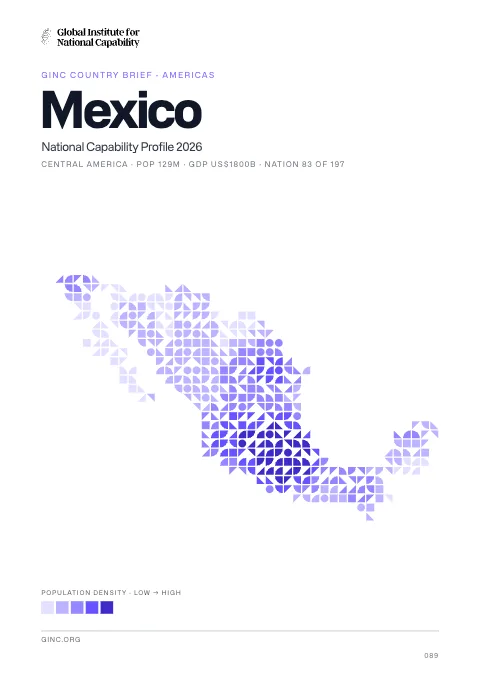
Mexico is a federal republic in North America, home to 120 million people, with its capital at Mexico City, and the world’s 14th-largest country by area.
Contents
12 chapters
Foundations
01–03
At a glance
- Area
- 2Mkm²#14 World#3 N. America
- Population
- 120.3M#11 World#1 N. America
- GDP (market)
- $1.3T
- GDP (PPP)
- $1.8T#10 World#1 N. America
- GDP per capita
- $15.6K#89 World#5 N. America
The whole brief
Mexico National Capability Profile 2026
Foundations · Chapter 01
Historical Context
🇲🇽 Mexico’s understanding the origins and evolution of the modern nation
BackgroundBack to top ↑
The site of several advanced Amerindian civilizations - including the Olmec, Toltec, Teotihuacan, Zapotec, Maya, and Aztec - Mexico was conquered and colonized by Spain in the early 16th century. Administered as the Viceroyalty of New Spain for three centuries, it achieved its independence early in the 19th century. The global financial crisis beginning in late 2008 caused a massive economic downturn the following year, although growth returned quickly in 2010. Ongoing economic and social concerns include low real wages, underemployment for a large segment of the population, inequitable income distribution, and few advancement opportunities for the largely indigenous population in the impoverished southern states. The elections held in 2000 marked the first time since the 1910 Mexican Revolution that an opposition candidate - Vicente FOX of the National Action Party (PAN) - defeated the party in government, the Institutional Revolutionary Party (PRI). He was succeeded in 2006 by another PAN candidate Felipe CALDERON, but Enrique PENA NIETO regained the presidency for the PRI in 2012. Since 2007, Mexico's powerful drug-trafficking organizations have engaged in bloody feuding, resulting in tens of thousands of drug-related homicides.
IndependenceBack to top ↑
16 September 1810 (declared); 27 September 1821 (recognized by Spain)
National holidayBack to top ↑
Independence Day, 16 September (1810)
Foundations · Chapter 02
Geography
🇲🇽 Mexico’s territory, resources and strategic position
Location and areaBack to top ↑
North America, bordering the Caribbean Sea and the Gulf of Mexico, between Belize and the United States and bordering the North Pacific Ocean, between Guatemala and the United States
23 00 N, 102 00 W
North America
slightly less than three times the size of Texas
9,330 km
Terrain and resourcesBack to top ↑
high, rugged mountains; low coastal plains; high plateaus; desert
petroleum, silver, copper, gold, lead, zinc, natural gas, timber
64,600 sq km (2009)
Settlement and hazardsBack to top ↑
tsunamis along the Pacific coast, volcanoes and destructive earthquakes in the center and south, and hurricanes on the Pacific, Gulf of Mexico, and Caribbean coasts
strategic location on southern border of US; corn (maize), one of the world's major grain crops, is thought to have originated in Mexico
OtherBack to top ↑
457.2 cu km (2011)
scarcity of hazardous waste disposal facilities; rural to urban migration; natural freshwater resources scarce and polluted in north, inaccessible and poor quality in center and extreme southeast; raw sewage and industrial effluents polluting rivers in urban areas; deforestation; widespread erosion; desertification; deteriorating agricultural lands; serious air and water pollution in the national capital and urban centers along US-Mexico border; land subsidence in Valley of Mexico caused by groundwater depletion
Foundations · Chapter 03
Environment
🇲🇽 Mexico’s environmental conditions, resources and national resilience
ClimateBack to top ↑
varies from tropical to desert
Emissions and pollutionBack to top ↑
Water, waste and foodBack to top ↑
Resources and agreementsBack to top ↑
GINC Capability Domains · Chapter 04
Critical Technology
🇲🇽 Mexico’s technology frontiers and the pursuit of national advantage
Two counts are set side by side for 2015–2024: on the left, the papers researchers in Mexico published; on the right, the patent families that began there and were filed in more than one country. First by capability group, then group by group with each group’s capabilities. The badge on a card is the nation’s place among all nations. Papers are from GINC Research Analytics, patent families from GINC Patents.
Research by capability group
#34 WorldPapers published, 2015–2024
2,711
1,962
1,667
1,215
1,150
400
338
298
260
19
Patents by capability group
#36 WorldInternational patent families, 2015–2024
152
103
86
57
50
46
22
19
7
0
Advanced Materials & ManufacturingBack to top ↑
Research
#35 WorldPapers published, 2015–2024
Patents
#34 WorldInternational patent families, 2015–2024
Energy TechnologiesBack to top ↑
Research
#31 WorldPapers published, 2015–2024
Patents
#34 WorldInternational patent families, 2015–2024
Semiconductors & Advanced ComputingBack to top ↑
Research
#33 WorldPapers published, 2015–2024
No research topic: Semiconductor Design & EDA · Advanced Semiconductor Fabrication · Semiconductor Equipment & Materials · Advanced Packaging & Heterogeneous Integration
Patents
#42 WorldInternational patent families, 2015–2024
Artificial IntelligenceBack to top ↑
Research
#36 WorldPapers published, 2015–2024
Patents
#43 WorldInternational patent families, 2015–2024
Quantum TechnologiesBack to top ↑
Research
#32 WorldPapers published, 2015–2024
Patents
International patent families, 2015–2024
No international patent families on record for 2015–2024.
Connectivity, Cyber & Trust TechnologiesBack to top ↑
Research
#53 WorldPapers published, 2015–2024
Patents
#40 WorldInternational patent families, 2015–2024
Sensing, Timing & NavigationBack to top ↑
Research
#45 WorldPapers published, 2015–2024
Patents
#38 WorldInternational patent families, 2015–2024
Robotics & Autonomous SystemsBack to top ↑
Research
#24 WorldPapers published, 2015–2024
No research topic: Human-Machine Interfaces
Patents
#40 WorldInternational patent families, 2015–2024
Biotechnology & Health TechnologiesBack to top ↑
Research
#34 WorldPapers published, 2015–2024
Patents
#33 WorldInternational patent families, 2015–2024
Medicine and BioTech
Clinical research and life-science invention, drawn from the same series that drive the metric pages. Each card opens the full cross-country comparison.
Space TechnologiesBack to top ↑
Research
#38 WorldPapers published, 2015–2024
Patents
#33 WorldInternational patent families, 2015–2024
GINC Capability Domains · Chapter 05
Strategic Infrastructure
🇲🇽 Mexico’s energy, connectivity and the material foundations of capability
Resource InfrastructureBack to top ↑
2.936 million bbl/day (2012 est.)
1.46 million bbl/day (2010 est.)
0 bbl/day (2010 est.)
10.26 billion bbl (1 January 2013 est.)
1.364 million bbl/day (2010 est.)
2.133 million bbl/day (2011 est.)
189,100 bbl/day (2010 est.)
607,400 bbl/day (2010 est.)
53.96 billion cu m (2012 est.)
59.15 billion cu m (2011 est.)
11 million cu m (2012 est.)
17.24 billion cu m (2012 est.)
487.7 billion cu m (1 January 2013 est.)
gas 18,074 km; liquid petroleum 2,102 km; oil 8,775 km; oil/gas/water 369 km; refined products 7,565 km; water 123 km (2013)
Agriculture & Food InfrastructureBack to top ↑
- Irrigation & Agricultural Water
- Livestock & Veterinary
- Fisheries & Aquaculture
- Storage, Cold Chain & Markets
Energy InfrastructureBack to top ↑
- Thermal Generation
- Nuclear Generation
- Nuclear Fuel Cycle & Radioactive Waste
- Hydropower
- Renewable Generation
- Transmission & Distribution
- System Control & Dispatch
- Storage & Fuel Supply
62 million kW (2010 est.)
296 billion kWh (2012 est.)
212.3 billion kWh (2010 est.)
1.286 billion kWh (2012 est.)
603 million kWh (2012 est.)
76.2% of total installed capacity (2010 est.)
2.2% of total installed capacity (2010 est.)
18.3% of total installed capacity (2010 est.)
3.3% of total installed capacity (2010 est.)
462.3 million Mt (2011 est.)
Water, Sanitation & Waste InfrastructureBack to top ↑
- Dams, Reservoirs & Flood Defence
- Water Supply & Treatment
- Bulk Water Transfer & Desalination
- Wastewater & Sanitation
- Solid Waste & Recycling
Advanced ManufacturingBack to top ↑
- Materials & Inputs
- Chemicals & Hazardous Process Industry
- Production Systems
- Supply Chain & Ecosystem
- Workforce & Innovation
Transport InfrastructureBack to top ↑
- Seaports & Terminals
- Air Infrastructure
- Air Navigation & Traffic Management
- Inland Waterways & Ferries
- Rail Infrastructure
- Roads & Bridges
- Logistics, Multimodal & Border Infrastructure
- Postal & Parcel
1,714 (2013)
1 (2013)
2,900 km (navigable rivers and coastal canals mostly connected with ports on the country's east coast) (2012)
Communications & Digital InfrastructureBack to top ↑
- Subsea Cables & International Gateways
- Core & Backbone Networks
- Mobile & Wireless Networks
- Spectrum & Broadcasting
- Data Centres, Compute & Cloud
- Data Resources
- AI Tools & Applications
20.22 million (2012)
100.786 million (2012)
31.02 million (2009)
16.233 million (2012)
.mx
Financial InfrastructureBack to top ↑
- Currency & Reserves
- Payments & Settlement Systems
- Markets, Exchanges & Depositories
- Banks, Insurers & Systemic Institutions
Social InfrastructureBack to top ↑
- Health Infrastructure
- Public Health & Laboratories
- Medical Supply & Stockpiles
- Education & Skills Infrastructure
- Research & Scientific Facilities
- Housing, Community & Social Services
- Government & Public Administration
- Cultural, Community & Recreational Infrastructure
- Justice & Corrections
- Emergency Services & Civil Protection
- Hydrometeorology & Early Warning
Space, Aerospace & Defence InfrastructureBack to top ↑
GINC Capability Domains · Chapter 06
National Security
🇲🇽 Mexico’s force, intelligence and the defence of the nation
Disputes and terrorismBack to top ↑
abundant rainfall in recent years along much of the Mexico-US border region has ameliorated periodically strained water-sharing arrangements; the US has intensified security measures to monitor and control legal and illegal personnel, transport, and commodities across its border with Mexico; Mexico must deal with thousands of impoverished Guatemalans and other Central Americans who cross the porous border looking for work in Mexico and the United States; Belize and Mexico are working to solve minor border demarcation discrepancies arising from inaccuracies in the 1898 border treaty
Force Generation & MobilisationBack to top ↑
Secretariat of National Defense (Secretaria de Defensa Nacional, Sedena): Army (Ejercito), Mexican Air Force (Fuerza Aerea Mexicana, FAM); Secretariat of the Navy (Secretaria de Marina, Semar): Mexican Navy (Armada de Mexico (ARM); includes Naval Air Force (FAN), Mexican Naval Infantry Corps (Cuerpo de Infanteria de Marina, Mexmar or CIM)) (2013)
18 years of age for compulsory military service, conscript service obligation is 12 months; 16 years of age with consent for voluntary enlistment; conscripts serve only in the Army; Navy and Air Force service is all voluntary; women are eligible for voluntary military service; cadets enrolled in military schools from the age of 15 are considered members of the armed forces (2012)
0.59% of GDP (2012)//0.56% of GDP (2011)//0.59% of GDP (2010)
Forces under arms
Active-duty strength on the Correlates of War series, which reaches back to 1816 and so carries a nation’s whole record of mobilisation rather than its present establishment. The card opens the full cross-country comparison.
Intelligence & AssessmentBack to top ↑
- Imagery & Geospatial Intelligence
- Signals & Cyber Intelligence
- Technical & Measurement Intelligence
- Open-Source & Financial Intelligence
- Human Intelligence & Counterintelligence
- All-Source Analysis & Warning
Joint Command, Projection & SustainmentBack to top ↑
- Command, Control & Communications
- Strategic Lift & Mobility
- Expeditionary & Peace Operations
- Operational Sustainment & War Reserves
- Defence Industrial Mobilisation
- CBRN Defence
Land PowerBack to top ↑
- Combined Arms Manoeuvre
- Land Fires
- Battlefield Aviation & Uncrewed Systems
- Special Operations & Irregular Warfare
Maritime PowerBack to top ↑
- Maritime Security & Constabulary
- Sea Denial & Undersea Warfare
- Sea Control
- Amphibious & Expeditionary Operations
Air PowerBack to top ↑
- Air Sovereignty & Policing
- Control of the Air
- Air Strike & Interdiction
- Airborne ISR, Early Warning & Battle Management
Strategic Strike & Missile DefenceBack to top ↑
Space OperationsBack to top ↑
Cyber & Electromagnetic OperationsBack to top ↑
Nuclear DeterrenceBack to top ↑
GINC Capability Domains · Chapter 07
Human Capital
🇲🇽 Mexico’s population, health and the skills that sustain capability
DemographyBack to top ↑
120,286,655 (July 2014 est.)
1.21% (2014 est.)
19.02 births/1,000 population (2014 est.)
5.24 deaths/1,000 population (2014 est.)
2.29 children born/woman (2014 est.)
21.3
70.9% (2006)
Migration and urbanisationBack to top ↑
-1.64 migrant(s)/1,000 population (2014 est.)
MEXICO CITY (capital) 20.446 million; Guadalajara 4.525 million; Monterrey 4.213 million; Puebla 2.335 million; Tijuana 1.82 million; Toluca de Lerdo 1.748 million (2011)
Welfare and equityBack to top ↑
52.3%
48.3 (2008)//53.1 (1998)
DisplacementBack to top ↑
Early Childhood DevelopmentBack to top ↑
2.8% (2012)
Foundational EducationBack to top ↑
5.1% of GDP (2009)
Advanced EducationBack to top ↑
Technical & Vocational SkillsBack to top ↑
Digital & AI CompetenceBack to top ↑
Generative AI adoption
Modelled share of working-age adults using generative AI, from Microsoft telemetry scaled to each country’s 15–64 population. A measure of how fast a workforce is absorbing the technology rather than of how much of it a nation builds. The card opens the full cross-country comparison.
Lifelong Learning & ReskillingBack to top ↑
Research Talent & Knowledge CreationBack to top ↑
Population HealthBack to top ↑
50 deaths/100,000 live births (2010)
32.1% (2008)
0.2% (2012 est.)
174,300 (2012 est.)
NA
Health System CapabilityBack to top ↑
6.4% of GDP (2009)
1.96 physicians/1,000 population (2009)
1.7 beds/1,000 population (2010)
GINC Capability Domains · Chapter 08
Governance and Integrity
🇲🇽 Mexico’s institutions, law and the integrity of the state
State structureBack to top ↑
federal republic
31 states (estados, singular - estado) and 1 federal district* (distrito federal); Aguascalientes, Baja California, Baja California Sur, Campeche, Chiapas, Chihuahua, Coahuila de Zaragoza, Colima, Distrito Federal*, Durango, Guanajuato, Guerrero, Hidalgo, Jalisco, Mexico, Michoacan de Ocampo, Morelos, Nayarit, Nuevo Leon, Oaxaca, Puebla, Queretaro de Arteaga, Quintana Roo, San Luis Potosi, Sinaloa, Sonora, Tabasco, Tamaulipas, Tlaxcala, Veracruz de Ignacio de la Llave (Veracruz), Yucatan, Zacatecas
several previous; latest approved 5 February 1917; amended many times, last in 2014 (2014)
18 years of age; universal and compulsory
Political Institutions & Civic ParticipationBack to top ↑
- Electoral Management & Integrity
- Legislature & Deliberative Institutions
- Citizen Participation & Civic Space
bicameral National Congress or Congreso de la Union consists of the Senate or Camara de Senadores (128 seats; 96 members elected by popular vote to serve six-year terms, and 32 seats allocated on the basis of each party's popular vote) and the Chamber of Deputies or Camara de Diputados (500 seats; 300 members are elected by popular vote; remaining 200 members are allocated on the basis of each party's popular vote; members to serve three-year terms)
Citizen's Movement (Movimiento Ciudadano) [Dante DELGADO Rannaoro]//Institutional Revolutionary Party (Partido Revolucionario Institucional) or PRI [Cesar CAMACHO Quiroz]//Labor Party (Partido del Trabajo) or PT [Alberto ANAYA Gutierrez]//Mexican Green Ecological Party (Partido Verde Ecologista de Mexico) or PVEM [vacant]//National Action Party (Partido Accion Nacional) or PAN [Gustavo MADERO Munoz]//New Alliance Party (Partido Nueva Alianza) or PNA/PANAL [Luis CASTRO Obregon]//Party of the Democratic Revolution (Partido de la Revolucion Democratica) or PRD [Jesus ZAMBRANO Grijalva]
Businessmen's Coordinating Council or CCE//Confederation of Employers of the Mexican Republic or COPARMEX//Confederation of Industrial Chambers or CONCAMIN//Confederation of Mexican Workers or CTM//Confederation of National Chambers of Commerce or CONCANACO//Coordinator for Foreign Trade Business Organizations or COECE//Federation of Unions Providing Goods and Services or FESEBES//National Chamber of Transformation Industries or CANACINTRA//National Confederation of Popular Organizations or CNOP//National Coordinator for Education Workers or CNTE//National Peasant Confederation or CNC//National Small Business Chamber or CANACOPE//National Syndicate of Education Workers or SNTE//National Union of Workers or UNT//Popular Assembly of the People of Oaxaca or APPO//Roman Catholic Church
Justice System & Fundamental RightsBack to top ↑
- Judicial Independence & Court Capability
- Access to Justice & Legal Services
- Fundamental Rights Protection
- Human Rights Institutions & Equality Bodies
civil law system with US constitutional law influence; judicial review of legislative acts
accepts compulsory ICJ jurisdiction with reservations; accepts ICCt jurisdiction
Internal Security & OrderBack to top ↑
major drug-producing and transit nation; world's second largest opium poppy cultivator; opium poppy cultivation in 2009 rose 31% over 2008 to 19,500 hectares yielding a potential production of 50 metric tons of pure heroin, or 125 metric tons of "black tar" heroin, the dominant form of Mexican heroin in the western United States; marijuana cultivation increased 45% to 17,500 hectares in 2009; government conducts the largest independent illicit-crop eradication program in the world; continues as the primary transshipment country for US-bound cocaine from South America, with an estimated 95% of annual cocaine movements toward the US stopping in Mexico; major drug syndicates control the majority of drug trafficking throughout the country; producer and distributor of ecstasy; significant money-laundering center; major supplier of heroin and largest foreign supplier of marijuana and methamphetamine to the US market (2007)
Regulatory Governance & Strategic ControlsBack to top ↑
- Regulatory Quality & Better Regulation
- Regulatory Delivery & Independent Regulators
- Strategic Controls & Economic Security Administration
Government Effectiveness & Public AdministrationBack to top ↑
- Centre of Government & Policy Coordination
- Civil Service & Public Workforce
- Digital Government & Service Delivery
- Legal Identity & Civil Registration
- Statistical & Data Capability
Public Integrity & Anti-CorruptionBack to top ↑
Transparency, Oversight & AccountabilityBack to top ↑
- Right to Information & Open Government
- Independent Oversight & Supreme Audit
- Independent Media & Journalist Safety
National Resilience & Crisis ManagementBack to top ↑
GINC Capability Domains · Chapter 09
Information and Influence
🇲🇽 Mexico’s identity, media and the projection of influence
Identity and cultureBack to top ↑
Spanish only 92.7%, Spanish and indigenous languages 5.7%, indigenous only 0.8%, unspecified 0.8%
Roman Catholic 82.7%, Pentecostal 1.6%, Jehovah's Witnesses 1.4%, other Evangelical Churches 5%, other 1.9%, none 4.7%, unspecified 2.7% (2010 est.)
mestizo (Amerindian-Spanish) 60%, Amerindian or predominantly Amerindian 30%, white 9%, other 1%
golden eagle
three equal vertical bands of green (hoist side), white, and red; Mexico's coat of arms (an eagle with a snake in its beak perched on a cactus) is centered in the white band; green signifies hope, joy, and love; white represents peace and honesty; red stands for hardiness, bravery, strength, and valor; the coat of arms is derived from a legend that the wandering Aztec people were to settle at a location where they would see an eagle on a cactus eating a snake; the city they founded, Tenochtitlan, is now Mexico City
Diplomatic Statecraft & Global NetworksBack to top ↑
- Diplomatic Network & Consular Reach
- Multilateral Leadership & Norm Setting
- Agenda-Setting & Convening
- Mediation & Crisis Diplomacy
APEC, BCIE, BIS, CAN (observer), Caricom (observer), CD, CDB, CE (observer), CELAC, CSN (observer), EBRD, FAO, FATF, G-20, G-3, G-15, G-24, IADB, IAEA, IBRD, ICAO, ICC (national committees), ICRM, IDA, IFAD, IFC, IFRCS, IHO, ILO, IMF, IMO, IMSO, Interpol, IOC, IOM, IPU, ISO, ITSO, ITU, ITUC (NGOs), LAES, LAIA, MIGA, NAFTA, NAM (observer), NEA, OAS, OECD, OPANAL, OPCW, Pacific Alliance, Paris Club (associate), PCA, SICA (observer), UN, UNASUR (observer), UNCTAD, UNESCO, UNHCR, UNIDO, Union Latina (observer), UNWTO, UPU, WCO, WFTU (NGOs), WHO, WIPO, WMO, WTO
Alliances & Security CooperationBack to top ↑
Development Cooperation & Global AssistanceBack to top ↑
Culture, Language & Education DiplomacyBack to top ↑
- Cultural & Language Institutes
- Creative Industries & Cultural Export Reach
- Heritage & Cultural Institutions
- Education Diplomacy & Alumni Networks
- Sports & Major Events
Diaspora & Global CommunitiesBack to top ↑
Information Environment & Strategic CommunicationBack to top ↑
- Strategic Communications & Public Diplomacy
- International Media & Broadcasting
- Information Defence & Counter-Interference
many TV stations and more than 1,400 radio stations with most privately owned; the Televisa group once had a virtual monopoly in TV broadcasting, but new broadcasting groups and foreign satellite and cable operators are now available (2012)
GINC Capability Domains · Chapter 10
Financial Strength
🇲🇽 Mexico’s fiscal depth, reserves and the capacity to act
Monetary & Currency CapabilityBack to top ↑
- Monetary Policy & Price Stability
- Exchange Rate & External Account Management
- Currency Issuance & Digital Money
4% (2013 est.)//3.6% (2012 est.)
Mexican pesos (MXN) per US dollar -//12.76 (2013 est.)//13.17 (2012 est.)//12.636 (2010 est.)//13.514 (2009)//11.016 (2008)
4.5% (31 December 2012 est.)//4.5% (31 December 2011 est.)
4.7% (31 December 2013 est.)//4.73% (31 December 2012 est.)
$174.2 billion (31 December 2012 est.)//$170.5 billion (31 December 2011 est.)
$713 billion (31 December 2013 est.)//$671.8 billion (31 December 2012 est.)
Fiscal Capacity & Public FinanceBack to top ↑
- Revenue Mobilisation & Tax Administration
- Public Expenditure & Budget Management
- Sovereign Debt & Treasury Management
- Public Investment Management
21.9% of GDP (2013 est.)
-2.5% of GDP (2013 est.)
37.7% of GDP (2013 est.)//35.8% of GDP (2012 est.)
calendar year
Financial System Depth & AccessBack to top ↑
- Banking System Capacity
- Capital Markets Depth & Development
- Long-Term & Institutional Capital
- Financial Inclusion & Household Access
- Development & Policy Finance
$444.6 billion (31 December 2013 est.)//$404.4 billion (31 December 2012 est.)
$525.1 billion (31 December 2012 est.)//$408.7 billion (31 December 2011)//$NA (31 December 2010 est.)
21% of GDP (2013 est.)//21.3% of GDP (2012 est.)//21.2% of GDP (2011 est.)
Financial Regulation & IntegrityBack to top ↑
- Prudential Regulation & Supervision
- Financial Integrity & Illicit Finance Control
- Market Conduct & Consumer Protection
- Payment & Market Infrastructure Oversight
Financial Stability & Crisis ManagementBack to top ↑
- Macroprudential & Systemic Oversight
- Crisis Management, Resolution & Deposit Insurance
- External Liquidity & Financial Safety Nets
Sovereign Capital & External Financial PowerBack to top ↑
- Official Reserves Management
- Sovereign Wealth & Public Asset Management
- Currency Internationalisation & Reserve Status
- Capital Account & Flow Management
- International Financial Centre Capability
$167.1 billion (31 December 2013 est.)//$149.2 billion (31 December 2012 est.)
$354.9 billion (31 December 2013 est.)//$286.4 billion (31 December 2012 est.)
GINC Capability Domains · Chapter 11
Production and Innovation
🇲🇽 Mexico’s output, industry and the engine of prosperity
Economic Output & ProductivityBack to top ↑
Mexico's $1.3 trillion economy has become increasingly oriented toward manufacturing in the 20 years since the North American Free Trade Agreement (NAFTA) entered into force. Per capita income is roughly one-third that of the US; income distribution remains highly unequal. Mexico has become the United States' second-largest export market and third-largest source of imports. In 2013, two-way merchandise trade reached nearly $507 billion. Mexico has free trade agreements with over 50 countries including Guatemala, Honduras, El Salvador, the European Free Trade Area, and Japan - putting more than 90% of trade under free trade agreements. In 2012 Mexico formally joined the Trans-Pacific Partnership negotiations and formed the Pacific Alliance with Peru, Colombia and Chile. Mexico's current government, led by President Enrique PENA NIETO, emphasized economic reforms during its first year in office, passing education, energy, financial, fiscal and telecommunications reform legislation. The three-party "Pact for Mexico" reform agenda aims to improve competitiveness and economic growth across the Mexican economy.
$1.845 trillion (2013 est.)//$1.823 trillion (2012 est.)//$1.76 trillion (2011 est.)
1.2% (2013 est.)//3.6% (2012 est.)//4% (2011 est.)
$15,600 (2013 est.)//$15,600 (2012 est.)//$15,200 (2011 est.)
$1.327 trillion (2013 est.)
Labour & EmploymentBack to top ↑
- Employment & Labour Force Participation
- Labour Market Institutions & Wage Setting
- Employment Services & Skills Matching
- Labour Adjustment, Transition & Formalisation
51.48 million (2013 est.)
4.9% (2013 est.)//5.3% (2012 est.)
Industrial & Sectoral BaseBack to top ↑
- Manufacturing & Advanced Industry
- Foundational & Process Industries
- Agrifood & Primary Production
- Services Economy
corn, wheat, soybeans, rice, beans, cotton, coffee, fruit, tomatoes; beef, poultry, dairy products; wood products
food and beverages, tobacco, chemicals, iron and steel, petroleum, mining, textiles, clothing, motor vehicles, consumer durables, tourism
3.5% (2013 est.)
Structural Transformation & ComplexityBack to top ↑
Business Dynamism & EntrepreneurshipBack to top ↑
- Entrepreneurship & Firm Creation
- Risk Capital & Scale-Up Finance
- Firm Growth, Exit & Renewal
- Competition & Market Contestability
Innovation & CommercialisationBack to top ↑
- Business Innovation Capability
- Research Commercialisation & Knowledge Transfer
- Intellectual Property & Intangible Assets
- Innovation Ecosystems & Clusters
Technology Adoption & DiffusionBack to top ↑
GINC Capability Domains · Chapter 12
Trade and Investment
🇲🇽 Mexico’s markets, capital and the terms of global exchange
Overall tradeBack to top ↑
$645B of exports to 149 partners and $551B of imports from 145 in 2024, a surplus of $93.9B.
- Exports
- $645B149 partners
- Imports
- $551B145 partners
- Balance
- +$93.9Bsurplus
- Total trade
- $1.20T2024
ExportsBack to top ↑
Where its exports go
The largest partners in 2024, with each one's share of the nation's exports.
| Partner | Value | Share | |
|---|---|---|---|
| United States | $491B | 76% | |
| Canada | $32.0B | 5.0% | |
| China | $12.8B | 2.0% | |
| Germany | $9.86B | 1.5% | |
| South Korea | $7.37B | 1.1% | |
| Taiwan | $7.09B | 1.1% | |
| Spain | $6.39B | 1.0% | |
| United Kingdom | $6.13B | 0.9% | |
| Brazil | $5.91B | 0.9% | |
| Japan | $5.51B | 0.9% | |
| Singapore | $3.99B | 0.6% | |
| India | $3.89B | 0.6% | |
| Guatemala | $3.32B | 0.5% | |
| Colombia | $3.20B | 0.5% | |
| Australia | $3.02B | 0.5% | |
| France | $3.00B | 0.5% | |
| Switzerland | $2.89B | 0.4% | |
| Belgium | $2.16B | 0.3% | |
| Netherlands | $1.94B | 0.3% | |
| Chile | $1.93B | 0.3% |
What it exports
The largest categories in 2024.
| Category | Value | Share | |
|---|---|---|---|
| Vehicles other than railway, tramway | $162B | 25% | |
| Machinery, nuclear reactors, boilers | $124B | 19% | |
| Electrical, electronic equipment | $113B | 18% | |
| Optical, photo, technical, medical apparatus | $36.7B | 5.7% | |
| Mineral fuels, oils, distillation products | $32.0B | 5.0% | |
| Beverages, spirits and vinegar | $14.4B | 2.2% | |
| Furniture, lighting signs, prefabricated buildings | $14.0B | 2.2% | |
| Plastics | $11.4B | 1.8% | |
| Edible vegetables and certain roots and tubers | $11.2B | 1.7% | |
| Pearls, precious stones, metals, coins | $11.1B | 1.7% | |
| Edible fruits, nuts, peel of citrus fruit, melons | $11.1B | 1.7% | |
| Articles of iron or steel | $9.51B | 1.5% | |
| Ores slag and ash | $7.95B | 1.2% | |
| Rubbers | $5.62B | 0.9% | |
| Cereal, flour, starch, milk preparations and products | $3.67B | 0.6% |
ImportsBack to top ↑
Where its imports come from
The largest partners in 2024, with each one's share of the nation's imports.
| Partner | Value | Share | |
|---|---|---|---|
| United States | $237B | 43% | |
| China | $114B | 21% | |
| Germany | $19.4B | 3.5% | |
| South Korea | $19.3B | 3.5% | |
| Japan | $16.1B | 2.9% | |
| Taiwan | $15.6B | 2.8% | |
| Vietnam | $13.2B | 2.4% | |
| Malaysia | $11.6B | 2.1% | |
| Canada | $9.27B | 1.7% | |
| Thailand | $9.04B | 1.6% | |
| Italy | $7.92B | 1.4% | |
| Brazil | $7.85B | 1.4% | |
| India | $7.53B | 1.4% | |
| Spain | $6.12B | 1.1% | |
| France | $4.31B | 0.8% | |
| Ireland | $3.35B | 0.6% | |
| Philippines | $3.26B | 0.6% | |
| Indonesia | $2.94B | 0.5% | |
| Switzerland | $2.31B | 0.4% | |
| United Kingdom | $2.25B | 0.4% |
What it imports
The largest categories in 2024.
| Category | Value | Share | |
|---|---|---|---|
| Electrical, electronic equipment | $124B | 23% | |
| Machinery, nuclear reactors, boilers | $103B | 19% | |
| Vehicles other than railway, tramway | $60.8B | 11% | |
| Plastics | $32.0B | 5.8% | |
| Mineral fuels, oils, distillation products | $30.0B | 5.4% | |
| Optical, photo, technical, medical apparatus | $17.6B | 3.2% | |
| Iron and steel | $14.8B | 2.7% | |
| Articles of iron or steel | $10.9B | 2.0% | |
| Aluminum | $10.1B | 1.8% | |
| Organic chemicals | $8.81B | 1.6% | |
| Rubbers | $8.43B | 1.5% | |
| Pharmaceutical products | $8.32B | 1.5% | |
| Meat and edible meat offal | $7.09B | 1.3% | |
| Paper and paperboard, articles of pulp, paper and board | $6.69B | 1.2% | |
| Miscellaneous chemical products | $6.40B | 1.2% |
In a list, the bar runs to the largest in that list. The line is each figure’s history from 2000, drawn to its own peak: it shows the shape of the years, and the value shows the size.
External balanceBack to top ↑
-$14.18 billion (2013 est.)//-$11.84 billion (2012 est.)
Trade Facilitation & LogisticsBack to top ↑
Trade Policy & Market AccessBack to top ↑
- Trade Policy & Negotiation Capability
- Market Access & Agreements Network
- Trade Law & Enforcement
- Standards, Conformity & Quality Infrastructure
Digital & Services TradeBack to top ↑
- Services Trade Capability
- Digital Trade & E-Commerce
- Data Flows & Digital Trade Governance
- Tourism & Visitor Economy
Investment Attraction & ProjectionBack to top ↑
- Investment Attraction & Facilitation
- Investment Absorption & Linkages
- Outward Investment & Global Corporate Presence
$435.3 billion (31 December 2013 est.)//$400.9 billion (31 December 2012 est.)
$141.2 billion (31 December 2013 est.)//$133 billion (31 December 2012 est.)
Export Capability & SophisticationBack to top ↑
$370.9 billion (2013 est.)//$349.6 billion (2012 est.)
US 78% (2012)
manufactured goods, oil and oil products, silver, fruits, vegetables, coffee, cotton
Global Value Chain PositionBack to top ↑
- Value Chain Participation & Integration
- Value Chain Position & Upgrading
- Regional Integration & Hub Anchoring
Economic Leverage & DependenceBack to top ↑
- Strategic Supply Security
- Concentration Risk & Revenue Stabilisation
- Economic Leverage & Coercion Resistance
$370.7 billion (2013 est.)//$350.9 billion (2012 est.)
US 49.9%, China 15.4%, Japan 4.8% (2012)
metalworking machines, steel mill products, agricultural machinery, electrical equipment, car parts for assembly, repair parts for motor vehicles, aircraft, and aircraft parts
Mexico · you are in
Historical Context
Foundations
GINC Capability Domains
Find in this brief · Mexico