
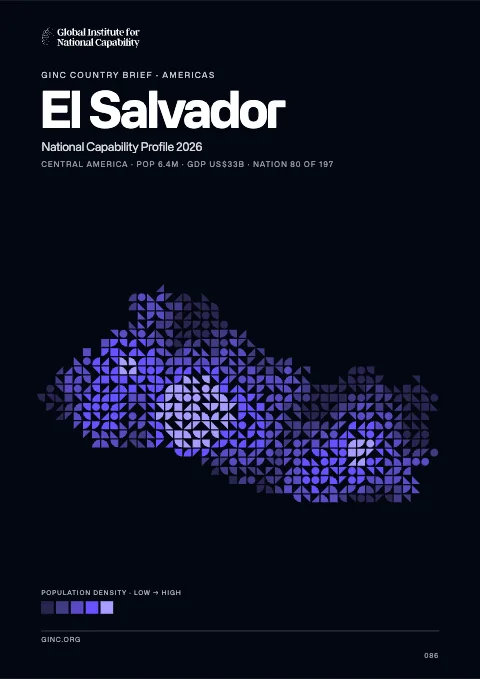
El Salvador
El Salvador is a republic in Central America and the Caribbean, home to 6.1 million people, with its capital at San Salvador.
Contents
12 chapters
Foundations
01–03
At a glance
- Area
- 21Kkm²#152 World#10 C. America
- Population
- 6.1M#108 World#6 C. America
- GDP (market)
- $24.7B
- GDP (PPP)
- $47.5B#98 World#7 C. America
- GDP per capita
- $7.5K#139 World#27 C. America
The whole brief
El Salvador National Capability Profile 2026
Foundations · Chapter 01
Historical Context
🇸🇻 El Salvador’s understanding the origins and evolution of the modern nation
BackgroundBack to top ↑
El Salvador achieved independence from Spain in 1821 and from the Central American Federation in 1839. A 12-year civil war, which cost about 75,000 lives, was brought to a close in 1992 when the government and leftist rebels signed a treaty that provided for military and political reforms.
IndependenceBack to top ↑
15 September 1821 (from Spain)
National holidayBack to top ↑
Independence Day, 15 September (1821)
Foundations · Chapter 02
Geography
🇸🇻 El Salvador’s territory, resources and strategic position
Location and areaBack to top ↑
Central America, bordering the North Pacific Ocean, between Guatemala and Honduras
13 50 N, 88 55 W
Central America and the Caribbean
slightly smaller than Massachusetts
307 km
Terrain and resourcesBack to top ↑
mostly mountains with narrow coastal belt and central plateau
hydropower, geothermal power, petroleum, arable land
449.9 sq km (2003)
Settlement and hazardsBack to top ↑
known as the Land of Volcanoes; frequent and sometimes destructive earthquakes and volcanic activity; extremely susceptible to hurricanes
smallest Central American country and only one without a coastline on Caribbean Sea
OtherBack to top ↑
25.23 cu km (2011)
deforestation; soil erosion; water pollution; contamination of soils from disposal of toxic wastes
Foundations · Chapter 03
Environment
🇸🇻 El Salvador’s environmental conditions, resources and national resilience
ClimateBack to top ↑
tropical; rainy season (May to October); dry season (November to April); tropical on coast; temperate in uplands
Emissions and pollutionBack to top ↑
Water, waste and foodBack to top ↑
Resources and agreementsBack to top ↑
GINC Capability Domains · Chapter 04
Critical Technology
🇸🇻 El Salvador’s technology frontiers and the pursuit of national advantage
Two counts are set side by side for 2015–2024: on the left, the papers researchers in El Salvador published; on the right, the patent families that began there and were filed in more than one country. First by capability group, then group by group with each group’s capabilities. The badge on a card is the nation’s place among all nations. Papers are from GINC Research Analytics, patent families from GINC Patents.
Research by capability group
#149 WorldPapers published, 2015–2024
Patents by capability group
#124 WorldInternational patent families, 2015–2024
Advanced Materials & ManufacturingBack to top ↑
Research
#137 WorldPapers published, 2015–2024
Patents
International patent families, 2015–2024
No international patent families on record for 2015–2024.
Energy TechnologiesBack to top ↑
Research
#152 WorldPapers published, 2015–2024
Patents
International patent families, 2015–2024
No international patent families on record for 2015–2024.
Semiconductors & Advanced ComputingBack to top ↑
- Semiconductor Design & EDA
- Advanced Semiconductor Fabrication
- Semiconductor Equipment & Materials
- Advanced Packaging & Heterogeneous Integration
- Compound & Power Semiconductors
- High-Performance & AI Computing
Artificial IntelligenceBack to top ↑
Research
#147 WorldPapers published, 2015–2024
Patents
#89 WorldInternational patent families, 2015–2024
Quantum TechnologiesBack to top ↑
Connectivity, Cyber & Trust TechnologiesBack to top ↑
Research
#118 WorldPapers published, 2015–2024
Patents
International patent families, 2015–2024
No international patent families on record for 2015–2024.
Sensing, Timing & NavigationBack to top ↑
Research
#159 WorldPapers published, 2015–2024
Patents
International patent families, 2015–2024
No international patent families on record for 2015–2024.
Robotics & Autonomous SystemsBack to top ↑
Research
#105 WorldPapers published, 2015–2024
No research topic: Human-Machine Interfaces
Patents
#85 WorldInternational patent families, 2015–2024
Biotechnology & Health TechnologiesBack to top ↑
Research
#169 WorldPapers published, 2015–2024
Patents
International patent families, 2015–2024
No international patent families on record for 2015–2024.
Medicine and BioTech
Clinical research and life-science invention, drawn from the same series that drive the metric pages. Each card opens the full cross-country comparison.
Space TechnologiesBack to top ↑
- Space Launch & Reusable Systems
- Advanced Propulsion & Hypersonic Systems
- Satellite & Constellation Technologies
GINC Capability Domains · Chapter 05
Strategic Infrastructure
🇸🇻 El Salvador’s energy, connectivity and the material foundations of capability
Resource InfrastructureBack to top ↑
0 bbl/day (2011 est.)
0 bbl/day (2010 est.)
16,160 bbl/day (2010 est.)
0 bbl (1 January 2013 est.)
16,620 bbl/day (2010 est.)
44,040 bbl/day (2011 est.)
2,425 bbl/day (2010 est.)
29,020 bbl/day (2010 est.)
0 cu m (2011 est.)
0 cu m (2010 est.)
0 cu m (2011 est.)
0 cu m (2011 est.)
0 cu m (1 January 2013 est.)
Agriculture & Food InfrastructureBack to top ↑
- Irrigation & Agricultural Water
- Livestock & Veterinary
- Fisheries & Aquaculture
- Storage, Cold Chain & Markets
Energy InfrastructureBack to top ↑
- Thermal Generation
- Nuclear Generation
- Nuclear Fuel Cycle & Radioactive Waste
- Hydropower
- Renewable Generation
- Transmission & Distribution
- System Control & Dispatch
- Storage & Fuel Supply
1.491 million kW (2010 est.)
5.728 billion kWh (2011 est.)
5.756 billion kWh (2011 est.)
101.6 million kWh (2011 est.)
251 million kWh (2011 est.)
52.6% of total installed capacity (2010 est.)
0% of total installed capacity (2010 est.)
31.6% of total installed capacity (2010 est.)
15.7% of total installed capacity (2010 est.)
6.713 million Mt (2011 est.)
Water, Sanitation & Waste InfrastructureBack to top ↑
- Dams, Reservoirs & Flood Defence
- Water Supply & Treatment
- Bulk Water Transfer & Desalination
- Wastewater & Sanitation
- Solid Waste & Recycling
Advanced ManufacturingBack to top ↑
- Materials & Inputs
- Chemicals & Hazardous Process Industry
- Production Systems
- Supply Chain & Ecosystem
- Workforce & Innovation
Transport InfrastructureBack to top ↑
- Seaports & Terminals
- Air Infrastructure
- Air Navigation & Traffic Management
- Inland Waterways & Ferries
- Rail Infrastructure
- Roads & Bridges
- Logistics, Multimodal & Border Infrastructure
- Postal & Parcel
68 (2013)
2 (2013)
(Rio Lempa is partially navigable for small craft) (2011)
Communications & Digital InfrastructureBack to top ↑
- Subsea Cables & International Gateways
- Core & Backbone Networks
- Mobile & Wireless Networks
- Spectrum & Broadcasting
- Data Centres, Compute & Cloud
- Data Resources
- AI Tools & Applications
1.06 million (2012)
8.65 million (2012)
746,000 (2009)
24,070 (2012)
.sv
Financial InfrastructureBack to top ↑
- Currency & Reserves
- Payments & Settlement Systems
- Markets, Exchanges & Depositories
- Banks, Insurers & Systemic Institutions
Social InfrastructureBack to top ↑
- Health Infrastructure
- Public Health & Laboratories
- Medical Supply & Stockpiles
- Education & Skills Infrastructure
- Research & Scientific Facilities
- Housing, Community & Social Services
- Government & Public Administration
- Cultural, Community & Recreational Infrastructure
- Justice & Corrections
- Emergency Services & Civil Protection
- Hydrometeorology & Early Warning
Space, Aerospace & Defence InfrastructureBack to top ↑
GINC Capability Domains · Chapter 06
National Security
🇸🇻 El Salvador’s force, intelligence and the defence of the nation
Disputes and terrorismBack to top ↑
International Court of Justice (ICJ) ruled on the delimitation of "bolsones" (disputed areas) along the El Salvador-Honduras boundary, in 1992, with final agreement by the parties in 2006 after an Organization of American States survey and a further ICJ ruling in 2003; the 1992 ICJ ruling advised a tripartite resolution to a maritime boundary in the Gulf of Fonseca advocating Honduran access to the Pacific; El Salvador continues to claim tiny Conejo Island, not identified in the ICJ decision, off Honduras in the Gulf of Fonseca
Force Generation & MobilisationBack to top ↑
Salvadoran Armed Forces (Fuerza Armada de El Salvador, FAES): Salvadoran Army (Ejercito de El Salvador, ES), Salvadoran Navy (Fuerza Naval de El Slavador, FNES), Salvadoran Air Force (Fuerza Aerea Salvadorena, FAS) (2013)
18 years of age for selective compulsory military service; 16-22 years of age for voluntary male or female service; service obligation is 12 months, with 11 months for officers and NCOs (2012)
0.99% of GDP (2012)//1.11% of GDP (2011)//0.99% of GDP (2010)
Forces under arms
Active-duty strength on the Correlates of War series, which reaches back to 1816 and so carries a nation’s whole record of mobilisation rather than its present establishment. The card opens the full cross-country comparison.
Intelligence & AssessmentBack to top ↑
- Imagery & Geospatial Intelligence
- Signals & Cyber Intelligence
- Technical & Measurement Intelligence
- Open-Source & Financial Intelligence
- Human Intelligence & Counterintelligence
- All-Source Analysis & Warning
Joint Command, Projection & SustainmentBack to top ↑
- Command, Control & Communications
- Strategic Lift & Mobility
- Expeditionary & Peace Operations
- Operational Sustainment & War Reserves
- Defence Industrial Mobilisation
- CBRN Defence
Land PowerBack to top ↑
- Combined Arms Manoeuvre
- Land Fires
- Battlefield Aviation & Uncrewed Systems
- Special Operations & Irregular Warfare
Maritime PowerBack to top ↑
- Maritime Security & Constabulary
- Sea Denial & Undersea Warfare
- Sea Control
- Amphibious & Expeditionary Operations
Air PowerBack to top ↑
- Air Sovereignty & Policing
- Control of the Air
- Air Strike & Interdiction
- Airborne ISR, Early Warning & Battle Management
Strategic Strike & Missile DefenceBack to top ↑
Space OperationsBack to top ↑
Cyber & Electromagnetic OperationsBack to top ↑
Nuclear DeterrenceBack to top ↑
GINC Capability Domains · Chapter 07
Human Capital
🇸🇻 El Salvador’s population, health and the skills that sustain capability
DemographyBack to top ↑
6,125,512 (July 2014 est.)
El Salvador is the smallest and most densely populated country in Central America. It is well into its demographic transition, experiencing slower population growth, a decline in its number of youths, and the gradual aging of its population. The increased use of family planning has substantially lowered El Salvador's fertility rate, from approximately 6 children per woman in the 1970s to replacement level today. A 2008 national family planning survey showed that female sterilization remained the most common contraception method in El Salvador - its sterilization rate is among the highest in Latin America and the Caribbean - but that the use of injectable contraceptives is growing. Fertility differences between rich and poor and urban and rural women are narrowing.//Salvadorans fled during the 1979 to 1992 civil war mainly to the United States but also to Canada and to neighboring Mexico, Guatemala, Honduras, Nicaragua, and Costa Rica. Emigration to the United States increased again in the 1990s and 2000s as a result of deteriorating economic conditions, natural disasters (Hurricane Mitch in 1998 and earthquakes in 2001), and family reunification. At least 20% of El Salvador's population lives abroad. The remittances they send home account for close to 20% of GDP, are the second largest source of external income after exports, and have helped reduce poverty.
0.27% (2014 est.)
16.79 births/1,000 population (2014 est.)
5.67 deaths/1,000 population (2014 est.)
1.95 children born/woman (2014 est.)
20.8
72.5%
Migration and urbanisationBack to top ↑
-8.44 migrant(s)/1,000 population (2014 est.)
SAN SALVADOR (capital) 1.605 million (2011)
Welfare and equityBack to top ↑
36.5% (2010 est.)
46.9 (2007)//52.5 (2001)
Early Childhood DevelopmentBack to top ↑
6.6% (2008)
Foundational EducationBack to top ↑
3.4% of GDP (2011)
Advanced EducationBack to top ↑
Technical & Vocational SkillsBack to top ↑
Digital & AI CompetenceBack to top ↑
Generative AI adoption
Modelled share of working-age adults using generative AI, from Microsoft telemetry scaled to each country’s 15–64 population. A measure of how fast a workforce is absorbing the technology rather than of how much of it a nation builds. The card opens the full cross-country comparison.
Lifelong Learning & ReskillingBack to top ↑
Research Talent & Knowledge CreationBack to top ↑
Population HealthBack to top ↑
81 deaths/100,000 live births (2010)
25.8% (2008)
0.6% (2012 est.)
24,900 (2012 est.)
1,000 (2012 est.)
Health System CapabilityBack to top ↑
6.8% of GDP (2011)
1.6 physicians/1,000 population (2008)
1 beds/1,000 population (2011)
GINC Capability Domains · Chapter 08
Governance and Integrity
🇸🇻 El Salvador’s institutions, law and the integrity of the state
State structureBack to top ↑
republic
14 departments (departamentos, singular - departamento); Ahuachapan, Cabanas, Chalatenango, Cuscatlan, La Libertad, La Paz, La Union, Morazan, San Miguel, San Salvador, San Vicente, Santa Ana, Sonsonate, Usulutan
many previous; latest drafted 16 December 1983, enacted 23 December 1983; amended many times, last in 2009 (2012)
18 years of age; universal
Political Institutions & Civic ParticipationBack to top ↑
- Electoral Management & Integrity
- Legislature & Deliberative Institutions
- Citizen Participation & Civic Space
unicameral Legislative Assembly or Asamblea Legislativa (84 seats; members elected by direct, popular vote to serve three-year terms)
Democratic Change (Cambio Democratico) or CD [Douglas AVILES] (formerly United Democratic Center or CDU)//Farabundo Marti National Liberation Front or FMLN [Medardo GONZALEZ]//Great Alliance for National Unity or GANA [Jose Andres ROVIRA Caneles]//National Coalition (Concertation Nacional) or CN [Manuel RODRIGUEZ] (formerly the National Conciliation Party or PCN)//Nationalist Republican Alliance or ARENA [Jorge VELADO]//Party of Hope or PES [Rodolfo Antonio PARKER Soto] (formerly the Christian Democratic Party or PCD)//Unidos por El Salvador [Manuel Rigoberto SOTO Lazo]
Justice System & Fundamental RightsBack to top ↑
- Judicial Independence & Court Capability
- Access to Justice & Legal Services
- Fundamental Rights Protection
- Human Rights Institutions & Equality Bodies
civil law system with minor common law influence; judicial review of legislative acts in the Supreme Court
has not submitted an ICJ jurisdiction declaration; non-party state to the ICCt
Internal Security & OrderBack to top ↑
transshipment point for cocaine; small amounts of marijuana produced for local consumption; significant use of cocaine
Regulatory Governance & Strategic ControlsBack to top ↑
- Regulatory Quality & Better Regulation
- Regulatory Delivery & Independent Regulators
- Strategic Controls & Economic Security Administration
Government Effectiveness & Public AdministrationBack to top ↑
- Centre of Government & Policy Coordination
- Civil Service & Public Workforce
- Digital Government & Service Delivery
- Legal Identity & Civil Registration
- Statistical & Data Capability
Public Integrity & Anti-CorruptionBack to top ↑
Transparency, Oversight & AccountabilityBack to top ↑
- Right to Information & Open Government
- Independent Oversight & Supreme Audit
- Independent Media & Journalist Safety
National Resilience & Crisis ManagementBack to top ↑
GINC Capability Domains · Chapter 09
Information and Influence
🇸🇻 El Salvador’s identity, media and the projection of influence
Identity and cultureBack to top ↑
Spanish (official), Nahua (among some Amerindians)
Roman Catholic 57.1%, Protestant 21.2%, Jehovah's Witnesses 1.9%, Mormon 0.7%, other religions 2.3%, none 16.8% (2003 est.)
mestizo 86.3%, white 12.7%, Amerindian 1% (2007 census)
turquoise-browed motmot (bird)
three equal horizontal bands of blue (top), white, and blue with the national coat of arms centered in the white band; the coat of arms features a round emblem encircled by the words REPUBLICA DE EL SALVADOR EN LA AMERICA CENTRAL; the banner is based on the former blue-white-blue flag of the Federal Republic of Central America; the blue bands symbolize the Pacific Ocean and the Caribbean Sea, while the white band represents the land between the two bodies of water, as well as peace and prosperity
Diplomatic Statecraft & Global NetworksBack to top ↑
- Diplomatic Network & Consular Reach
- Multilateral Leadership & Norm Setting
- Agenda-Setting & Convening
- Mediation & Crisis Diplomacy
BCIE, CACM, CD, CELAC, FAO, G-11, G-77, IADB, IAEA, IBRD, ICAO, ICC (national committees), ICRM, IDA, IFAD, IFC, IFRCS, ILO, IMF, IMO, Interpol, IOC, IOM, IPU, ISO (correspondent), ITSO, ITU, ITUC (NGOs), LAES, LAIA (observer), MIGA, MINURSO, NAM (observer), OAS, OPANAL, OPCW, Pacific Alliance (observer), PCA, SICA, UN, UNCTAD, UNESCO, UNIDO, UNIFIL, Union Latina, UNMIL, UNMISS, UNOCI, UNWTO, UPU, WCO, WFTU (NGOs), WHO, WIPO, WMO, WTO
Alliances & Security CooperationBack to top ↑
Development Cooperation & Global AssistanceBack to top ↑
Culture, Language & Education DiplomacyBack to top ↑
- Cultural & Language Institutes
- Creative Industries & Cultural Export Reach
- Heritage & Cultural Institutions
- Education Diplomacy & Alumni Networks
- Sports & Major Events
Diaspora & Global CommunitiesBack to top ↑
Information Environment & Strategic CommunicationBack to top ↑
- Strategic Communications & Public Diplomacy
- International Media & Broadcasting
- Information Defence & Counter-Interference
multiple privately owned national terrestrial TV networks, supplemented by cable TV networks that carry international channels; hundreds of commercial radio broadcast stations and 1 government-owned radio broadcast station (2007)
GINC Capability Domains · Chapter 10
Financial Strength
🇸🇻 El Salvador’s fiscal depth, reserves and the capacity to act
Monetary & Currency CapabilityBack to top ↑
- Monetary Policy & Price Stability
- Exchange Rate & External Account Management
- Currency Issuance & Digital Money
0.9% (2013 est.)//1.8% (2012 est.)
$NA (31 December 2013 est.)//5.6% (31 December 2012 est.)
$2.914 billion (31 December 2013 est.)//$2.796 billion (31 December 2012 est.)
$10.12 billion (31 December 2013 est.)//$9.847 billion (31 December 2012 est.)
Fiscal Capacity & Public FinanceBack to top ↑
- Revenue Mobilisation & Tax Administration
- Public Expenditure & Budget Management
- Sovereign Debt & Treasury Management
- Public Investment Management
19% of GDP (2013 est.)
-4% of GDP (2013 est.)
62% of GDP (2013 est.)//59.2% of GDP (2012 est.)
calendar year
Financial System Depth & AccessBack to top ↑
- Banking System Capacity
- Capital Markets Depth & Development
- Long-Term & Institutional Capital
- Financial Inclusion & Household Access
- Development & Policy Finance
$11.16 billion (31 December 2013 est.)//$10.51 billion (31 December 2012 est.)
$10.74 billion (31 December 2012 est.)//$5.474 billion (31 December 2011)//$NA (31 December 2010 est.)
9% of GDP (2013 est.)//8.9% of GDP (2012 est.)//9.3% of GDP (2011 est.)
Financial Regulation & IntegrityBack to top ↑
- Prudential Regulation & Supervision
- Financial Integrity & Illicit Finance Control
- Market Conduct & Consumer Protection
- Payment & Market Infrastructure Oversight
Financial Stability & Crisis ManagementBack to top ↑
- Macroprudential & Systemic Oversight
- Crisis Management, Resolution & Deposit Insurance
- External Liquidity & Financial Safety Nets
Sovereign Capital & External Financial PowerBack to top ↑
- Official Reserves Management
- Sovereign Wealth & Public Asset Management
- Currency Internationalisation & Reserve Status
- Capital Account & Flow Management
- International Financial Centre Capability
$2.855 billion (31 December 2013 est.)//$3.176 billion (31 December 2012 est.)
$14.44 billion (31 December 2013 est.)//$13.56 billion (31 December 2012 est.)
GINC Capability Domains · Chapter 11
Production and Innovation
🇸🇻 El Salvador’s output, industry and the engine of prosperity
Economic Output & ProductivityBack to top ↑
The smallest country in Central America geographically, El Salvador has the fourth largest economy in the region. With the global recession, real GDP contracted in 2009 and economic growth has since remained low, averaging less than 2% from 2010 to 2013. Remittances accounted for 16% of GDP in 2013 and were received by about a third of all households. In 2006, El Salvador was the first country to ratify the Dominican Republic-Central American Free Trade Agreement (CAFTA-DR), which has bolstered the export of processed foods, sugar, and ethanol, and supported investment in the apparel sector amid increased Asian competition. The Salvadoran Government maintained fiscal discipline during post-war reconstruction and reconstruction following earthquakes in 2001 and hurricanes in 1998 and 2005, but El Salvador's external debt has been growing over the last several years, amounting to some 57% of GDP in 2013. In September 2013, El Salvador was awarded a $277 million second compact with the Millennium Challenge Corporation (MCC) - a United States Government agency aimed at stimulating economic growth and reducing poverty - to improve El Salvador's competitiveness and productivity in international markets.
$47.47 billion (2013 est.)//$46.72 billion (2012 est.)//$45.84 billion (2011 est.)
1.6% (2013 est.)//1.9% (2012 est.)//2.2% (2011 est.)
$7,500 (2013 est.)//$7,400 (2012 est.)//$7,300 (2011 est.)
$24.67 billion (2013 est.)
Labour & EmploymentBack to top ↑
- Employment & Labour Force Participation
- Labour Market Institutions & Wage Setting
- Employment Services & Skills Matching
- Labour Adjustment, Transition & Formalisation
2.738 million (2013 est.)
6.3% (2013 est.)//6.1% (2012 est.)
Industrial & Sectoral BaseBack to top ↑
- Manufacturing & Advanced Industry
- Foundational & Process Industries
- Agrifood & Primary Production
- Services Economy
coffee, sugar, corn, rice, beans, oilseed, cotton, sorghum; beef, dairy products
food processing, beverages, petroleum, chemicals, fertilizer, textiles, furniture, light metals
2.1% (2013 est.)
Structural Transformation & ComplexityBack to top ↑
Business Dynamism & EntrepreneurshipBack to top ↑
- Entrepreneurship & Firm Creation
- Risk Capital & Scale-Up Finance
- Firm Growth, Exit & Renewal
- Competition & Market Contestability
Innovation & CommercialisationBack to top ↑
- Business Innovation Capability
- Research Commercialisation & Knowledge Transfer
- Intellectual Property & Intangible Assets
- Innovation Ecosystems & Clusters
Technology Adoption & DiffusionBack to top ↑
GINC Capability Domains · Chapter 12
Trade and Investment
🇸🇻 El Salvador’s markets, capital and the terms of global exchange
Overall tradeBack to top ↑
$6.70B of exports to 142 partners and $16.4B of imports from 183 in 2024, a deficit of $9.69B.
- Exports
- $6.70B142 partners
- Imports
- $16.4B183 partners
- Balance
- −$9.69Bdeficit
- Total trade
- $23.1B2024
ExportsBack to top ↑
Where its exports go
The largest partners in 2024, with each one's share of the nation's exports.
| Partner | Value | Share | |
|---|---|---|---|
| United States | $2.22B | 33% | |
| Guatemala | $1.24B | 18% | |
| Honduras | $965M | 14% | |
| Nicaragua | $578M | 8.6% | |
| Costa Rica | $310M | 4.6% | |
| Mexico | $281M | 4.2% | |
| Dominican Republic | $140M | 2.1% | |
| Panama | $123M | 1.8% | |
| Germany | $78.5M | 1.2% | |
| Spain | $77.1M | 1.2% | |
| Canada | $65.2M | 1.0% | |
| China | $64.3M | 1.0% | |
| South Korea | $63.5M | 0.9% | |
| Italy | $43.6M | 0.7% | |
| Peru | $30.5M | 0.5% | |
| Belgium | $29.3M | 0.4% | |
| Netherlands | $26.5M | 0.4% | |
| Colombia | $24.9M | 0.4% | |
| United Kingdom | $24.6M | 0.4% | |
| Hong Kong | $23.4M | 0.3% |
What it exports
The largest categories in 2024.
| Category | Value | Share | |
|---|---|---|---|
| Articles of apparel, knit or crocheted | $1.56B | 23% | |
| Plastics | $545M | 8.1% | |
| Electrical, electronic equipment | $509M | 7.6% | |
| Paper and paperboard, articles of pulp, paper and board | $379M | 5.7% | |
| Sugars and sugar confectionery | $354M | 5.3% | |
| Mineral fuels, oils, distillation products | $276M | 4.1% | |
| Cereal, flour, starch, milk preparations and products | $230M | 3.4% | |
| Pharmaceutical products | $208M | 3.1% | |
| Beverages, spirits and vinegar | $186M | 2.8% | |
| Iron and steel | $162M | 2.4% | |
| Coffee, tea, mate and spices | $152M | 2.3% | |
| Miscellaneous edible preparations | $134M | 2.0% | |
| Knitted or crocheted fabric | $126M | 1.9% | |
| Articles of apparel, not knit or crocheted | $115M | 1.7% | |
| Meat, fish and seafood preparations | $109M | 1.6% |
ImportsBack to top ↑
Where its imports come from
The largest partners in 2024, with each one's share of the nation's imports.
| Partner | Value | Share | |
|---|---|---|---|
| United States | $4.42B | 27% | |
| China | $2.74B | 17% | |
| Guatemala | $1.69B | 10% | |
| Mexico | $1.36B | 8.3% | |
| Honduras | $759M | 4.6% | |
| Nicaragua | $488M | 3.0% | |
| Costa Rica | $457M | 2.8% | |
| France | $336M | 2.0% | |
| South Korea | $290M | 1.8% | |
| Japan | $288M | 1.8% | |
| Brazil | $277M | 1.7% | |
| Germany | $251M | 1.5% | |
| Colombia | $235M | 1.4% | |
| India | $220M | 1.3% | |
| Spain | $199M | 1.2% | |
| Thailand | $175M | 1.1% | |
| Trinidad and Tobago | $172M | 1.1% | |
| Vietnam | $161M | 1.0% | |
| Canada | $146M | 0.9% | |
| Italy | $142M | 0.9% |
What it imports
The largest categories in 2024.
| Category | Value | Share | |
|---|---|---|---|
| Mineral fuels, oils, distillation products | $2.44B | 15% | |
| Electrical, electronic equipment | $1.20B | 7.3% | |
| Machinery, nuclear reactors, boilers | $1.15B | 7.0% | |
| Vehicles other than railway, tramway | $1.10B | 6.7% | |
| Plastics | $977M | 6.0% | |
| Pharmaceutical products | $630M | 3.8% | |
| Iron and steel | $506M | 3.1% | |
| Miscellaneous edible preparations | $490M | 3.0% | |
| Paper and paperboard, articles of pulp, paper and board | $400M | 2.4% | |
| Articles of apparel, knit or crocheted | $359M | 2.2% | |
| Meat and edible meat offal | $338M | 2.1% | |
| Cereals | $338M | 2.1% | |
| Dairy products, eggs, honey, edible products | $324M | 2.0% | |
| Articles of iron or steel | $312M | 1.9% | |
| Essential oils, perfumes, cosmetics, toiletries | $302M | 1.8% |
In a list, the bar runs to the largest in that list. The line is each figure’s history from 2000, drawn to its own peak: it shows the shape of the years, and the value shows the size.
External balanceBack to top ↑
-$1.331 billion (2013 est.)//-$1.257 billion (2012 est.)
Trade Facilitation & LogisticsBack to top ↑
Trade Policy & Market AccessBack to top ↑
- Trade Policy & Negotiation Capability
- Market Access & Agreements Network
- Trade Law & Enforcement
- Standards, Conformity & Quality Infrastructure
Digital & Services TradeBack to top ↑
- Services Trade Capability
- Digital Trade & E-Commerce
- Data Flows & Digital Trade Governance
- Tourism & Visitor Economy
Investment Attraction & ProjectionBack to top ↑
- Investment Attraction & Facilitation
- Investment Absorption & Linkages
- Outward Investment & Global Corporate Presence
$8.879 billion (31 December 2013 est.)//$8.635 billion (31 December 2012 est.)
$5.7 million (31 December 2013 est.)//$5.7 million (31 December 2012 est.)
Export Capability & SophisticationBack to top ↑
$5.112 billion (2013 est.)//$5.447 billion (2012 est.)
US 47.3%, Guatemala 13.8%, Honduras 9.6%, Nicaragua 5.4% (2012)
offshore assembly exports, coffee, sugar, textiles and apparel, gold, ethanol, chemicals, electricity, iron and steel manufactures
Global Value Chain PositionBack to top ↑
- Value Chain Participation & Integration
- Value Chain Position & Upgrading
- Regional Integration & Hub Anchoring
Economic Leverage & DependenceBack to top ↑
- Strategic Supply Security
- Concentration Risk & Revenue Stabilisation
- Economic Leverage & Coercion Resistance
$10.03 billion (2013 est.)//$9.912 billion (2012 est.)
US 35.4%, Guatemala 12.7%, Mexico 7%, China 5.6%, Germany 4.2% (2012)
raw materials, consumer goods, capital goods, fuels, foodstuffs, petroleum, electricity
El Salvador · you are in
Historical Context
Foundations
GINC Capability Domains
Find in this brief · El Salvador