
Mozambique
Mozambique is a republic in Africa, home to 25 million people, with its capital at Maputo.
Contents
12 chapters
Foundations
01–03
At a glance
- Area
- 799.4Kkm²#35 World#16 Africa
- Population
- 24.7M#50 World#13 Africa
- GDP (market)
- $14.7B
- GDP (PPP)
- $28.2B#116 World#20 Africa
- GDP per capita
- $1.2K#214 World#44 Africa
The whole brief
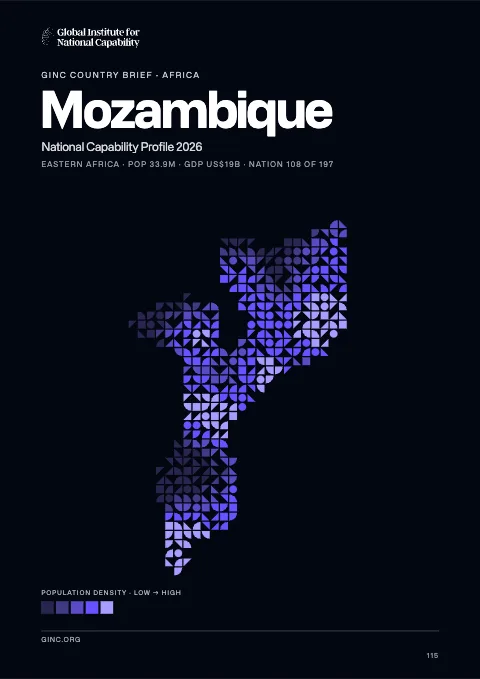
Mozambique National Capability Profile 2026
Foundations · Chapter 01
Historical Context
🇲🇿 Mozambique’s understanding the origins and evolution of the modern nation
BackgroundBack to top ↑
Almost five centuries as a Portuguese colony came to a close with independence in 1975. Large-scale emigration, economic dependence on South Africa, a severe drought, and a prolonged civil war hindered the country's development until the mid 1990s. The ruling Front for the Liberation of Mozambique (Frelimo) party formally abandoned Marxism in 1989, and a new constitution the following year provided for multiparty elections and a free market economy. A UN-negotiated peace agreement between Frelimo and rebel Mozambique National Resistance (Renamo) forces ended the fighting in 1992. In December 2004, Mozambique underwent a delicate transition as Joaquim CHISSANO stepped down after 18 years in office. His elected successor, Armando Emilio GUEBUZA, promised to continue the sound economic policies that have encouraged foreign investment. President GUEBUZA was reelected to a second term in October 2009. However, the elections were flawed by voter fraud, questionable disqualification of candidates, and Frelimo use of government resources during the campaign. As a result, Freedom House removed Mozambique from its list of electoral democracies.
IndependenceBack to top ↑
25 June 1975 (from Portugal)
National holidayBack to top ↑
Independence Day, 25 June (1975)
Foundations · Chapter 02
Geography
🇲🇿 Mozambique’s territory, resources and strategic position
Location and areaBack to top ↑
Southeastern Africa, bordering the Mozambique Channel, between South Africa and Tanzania
18 15 S, 35 00 E
Africa
slightly less than twice the size of California
2,470 km
Terrain and resourcesBack to top ↑
mostly coastal lowlands, uplands in center, high plateaus in northwest, mountains in west
coal, titanium, natural gas, hydropower, tantalum, graphite
1,181 sq km (2003)
Settlement and hazardsBack to top ↑
severe droughts; devastating cyclones and floods in central and southern provinces
the Zambezi flows through the north-central and most fertile part of the country
OtherBack to top ↑
217.1 cu km (2011)
a long civil war and recurrent drought in the hinterlands have resulted in increased migration of the population to urban and coastal areas with adverse environmental consequences; desertification; pollution of surface and coastal waters; elephant poaching for ivory is a problem
Foundations · Chapter 03
Environment
🇲🇿 Mozambique’s environmental conditions, resources and national resilience
ClimateBack to top ↑
tropical to subtropical
Emissions and pollutionBack to top ↑
Water, waste and foodBack to top ↑
Resources and agreementsBack to top ↑
GINC Capability Domains · Chapter 04
Critical Technology
🇲🇿 Mozambique’s technology frontiers and the pursuit of national advantage
Two counts are set side by side for 2015–2024: on the left, the papers researchers in Mozambique published; on the right, the patent families that began there and were filed in more than one country. First by capability group, then group by group with each group’s capabilities. The badge on a card is the nation’s place among all nations. Papers are from GINC Research Analytics, patent families from GINC Patents.
Research by capability group
#123 WorldPapers published, 2015–2024
Patents by capability group
International patent families, 2015–2024
No international patent families on record for 2015–2024.
Advanced Materials & ManufacturingBack to top ↑
Research
#130 WorldPapers published, 2015–2024
Patents
International patent families, 2015–2024
No international patent families on record for 2015–2024.
Energy TechnologiesBack to top ↑
Research
#142 WorldPapers published, 2015–2024
Patents
International patent families, 2015–2024
No international patent families on record for 2015–2024.
Semiconductors & Advanced ComputingBack to top ↑
- Semiconductor Design & EDA
- Advanced Semiconductor Fabrication
- Semiconductor Equipment & Materials
- Advanced Packaging & Heterogeneous Integration
- Compound & Power Semiconductors
- High-Performance & AI Computing
Artificial IntelligenceBack to top ↑
Research
#140 WorldPapers published, 2015–2024
Patents
International patent families, 2015–2024
No international patent families on record for 2015–2024.
Quantum TechnologiesBack to top ↑
Research
#111 WorldPapers published, 2015–2024
Patents
International patent families, 2015–2024
No international patent families on record for 2015–2024.
Connectivity, Cyber & Trust TechnologiesBack to top ↑
Research
#132 WorldPapers published, 2015–2024
Patents
International patent families, 2015–2024
No international patent families on record for 2015–2024.
Sensing, Timing & NavigationBack to top ↑
Research
#107 WorldPapers published, 2015–2024
Patents
International patent families, 2015–2024
No international patent families on record for 2015–2024.
Robotics & Autonomous SystemsBack to top ↑
Research
#134 WorldPapers published, 2015–2024
No research topic: Human-Machine Interfaces
Patents
International patent families, 2015–2024
No international patent families on record for 2015–2024.
Biotechnology & Health TechnologiesBack to top ↑
Research
#93 WorldPapers published, 2015–2024
Patents
International patent families, 2015–2024
No international patent families on record for 2015–2024.
Medicine and BioTech
Clinical research and life-science invention, drawn from the same series that drive the metric pages. Each card opens the full cross-country comparison.
Space TechnologiesBack to top ↑
Research
#95 WorldPapers published, 2015–2024
Patents
International patent families, 2015–2024
No international patent families on record for 2015–2024.
GINC Capability Domains · Chapter 05
Strategic Infrastructure
🇲🇿 Mozambique’s energy, connectivity and the material foundations of capability
Resource InfrastructureBack to top ↑
20 bbl/day (2012 est.)
0 bbl/day (2010 est.)
0 bbl/day (2010 est.)
0 bbl (1 January 2013 est.)
992 bbl/day (2010 est.)
19,580 bbl/day (2011 est.)
953 bbl/day (2010 est.)
16,140 bbl/day (2010 est.)
3.82 billion cu m (2011 est.)
80 million cu m (2010 est.)
3.3 billion cu m (2011 est.)
0 cu m (2011 est.)
127.4 billion cu m (1 January 2013 est.)
gas 972 km; refined products 278 km (2013)
Agriculture & Food InfrastructureBack to top ↑
- Irrigation & Agricultural Water
- Livestock & Veterinary
- Fisheries & Aquaculture
- Storage, Cold Chain & Markets
Energy InfrastructureBack to top ↑
- Thermal Generation
- Nuclear Generation
- Nuclear Fuel Cycle & Radioactive Waste
- Hydropower
- Renewable Generation
- Transmission & Distribution
- System Control & Dispatch
- Storage & Fuel Supply
2.428 million kW (2010 est.)
14.83 billion kWh (2012 est.)
10.19 billion kWh (2012 est.)
9.462 billion kWh (2012 est.)
8.537 billion kWh (2012 est.)
0.1% of total installed capacity (2012 est.)
0% of total installed capacity (2012 est.)
99.9% of total installed capacity (2012 est.)
0% of total installed capacity (2012 est.)
3.426 million Mt (2011 est.)
Water, Sanitation & Waste InfrastructureBack to top ↑
- Dams, Reservoirs & Flood Defence
- Water Supply & Treatment
- Bulk Water Transfer & Desalination
- Wastewater & Sanitation
- Solid Waste & Recycling
Advanced ManufacturingBack to top ↑
- Materials & Inputs
- Chemicals & Hazardous Process Industry
- Production Systems
- Supply Chain & Ecosystem
- Workforce & Innovation
Transport InfrastructureBack to top ↑
- Seaports & Terminals
- Air Infrastructure
- Air Navigation & Traffic Management
- Inland Waterways & Ferries
- Rail Infrastructure
- Roads & Bridges
- Logistics, Multimodal & Border Infrastructure
- Postal & Parcel
98 (2013)
460 km (Zambezi River navigable to Tete and along Cahora Bassa Lake) (2010)
Communications & Digital InfrastructureBack to top ↑
- Subsea Cables & International Gateways
- Core & Backbone Networks
- Mobile & Wireless Networks
- Spectrum & Broadcasting
- Data Centres, Compute & Cloud
- Data Resources
- AI Tools & Applications
88,100 (2012)
8.108 million (2012)
613,600 (2009)
89,737 (2012)
.mz
Financial InfrastructureBack to top ↑
- Currency & Reserves
- Payments & Settlement Systems
- Markets, Exchanges & Depositories
- Banks, Insurers & Systemic Institutions
Social InfrastructureBack to top ↑
- Health Infrastructure
- Public Health & Laboratories
- Medical Supply & Stockpiles
- Education & Skills Infrastructure
- Research & Scientific Facilities
- Housing, Community & Social Services
- Government & Public Administration
- Cultural, Community & Recreational Infrastructure
- Justice & Corrections
- Emergency Services & Civil Protection
- Hydrometeorology & Early Warning
Space, Aerospace & Defence InfrastructureBack to top ↑
GINC Capability Domains · Chapter 06
National Security
🇲🇿 Mozambique’s force, intelligence and the defence of the nation
Disputes and terrorismBack to top ↑
South Africa has placed military units to assist police operations along the border of Lesotho, Zimbabwe, and Mozambique to control smuggling, poaching, and illegal migration
Force Generation & MobilisationBack to top ↑
Mozambique Armed Defense Forces (Forcas Armadas de Defesa de Mocambique, FADM): Mozambique Army, Mozambique Navy (Marinha de Guerra de Mocambique, MGM), Mozambique Air Force (Forca Aerea de Mocambique, FAM) (2012)
registration for military service is mandatory for all males and females at 18 years of age; 18-35 years of age for selective compulsory military service; 18 years of age for voluntary service; 2-year service obligation; women may serve as officers or enlisted (2012)
Forces under arms
Active-duty strength on the Correlates of War series, which reaches back to 1816 and so carries a nation’s whole record of mobilisation rather than its present establishment. The card opens the full cross-country comparison.
Intelligence & AssessmentBack to top ↑
- Imagery & Geospatial Intelligence
- Signals & Cyber Intelligence
- Technical & Measurement Intelligence
- Open-Source & Financial Intelligence
- Human Intelligence & Counterintelligence
- All-Source Analysis & Warning
Joint Command, Projection & SustainmentBack to top ↑
- Command, Control & Communications
- Strategic Lift & Mobility
- Expeditionary & Peace Operations
- Operational Sustainment & War Reserves
- Defence Industrial Mobilisation
- CBRN Defence
Land PowerBack to top ↑
- Combined Arms Manoeuvre
- Land Fires
- Battlefield Aviation & Uncrewed Systems
- Special Operations & Irregular Warfare
Maritime PowerBack to top ↑
- Maritime Security & Constabulary
- Sea Denial & Undersea Warfare
- Sea Control
- Amphibious & Expeditionary Operations
Air PowerBack to top ↑
- Air Sovereignty & Policing
- Control of the Air
- Air Strike & Interdiction
- Airborne ISR, Early Warning & Battle Management
Strategic Strike & Missile DefenceBack to top ↑
Space OperationsBack to top ↑
Cyber & Electromagnetic OperationsBack to top ↑
Nuclear DeterrenceBack to top ↑
GINC Capability Domains · Chapter 07
Human Capital
🇲🇿 Mozambique’s population, health and the skills that sustain capability
DemographyBack to top ↑
24,692,144
2.45% (2014 est.)
38.83 births/1,000 population (2014 est.)
12.34 deaths/1,000 population (2014 est.)
5.27 children born/woman (2014 est.)
18.9//median age at first birth among women 25-29 (2011 est.)
11.6% (2011)
Migration and urbanisationBack to top ↑
-2.02 migrant(s)/1,000 population (2014 est.)
MAPUTO (capital) 1.15 million; Matola 790,000 (2011)
Welfare and equityBack to top ↑
52% (2009 est.)
45.6 (2008)//47.3 (2002)
Early Childhood DevelopmentBack to top ↑
15.6% (2011)
Foundational EducationBack to top ↑
5% of GDP (2006)
Advanced EducationBack to top ↑
Technical & Vocational SkillsBack to top ↑
Digital & AI CompetenceBack to top ↑
Generative AI adoption
Modelled share of working-age adults using generative AI, from Microsoft telemetry scaled to each country’s 15–64 population. A measure of how fast a workforce is absorbing the technology rather than of how much of it a nation builds. The card opens the full cross-country comparison.
Lifelong Learning & ReskillingBack to top ↑
Research Talent & Knowledge CreationBack to top ↑
Population HealthBack to top ↑
490 deaths/100,000 live births (2010)
4.9% (2008)
11.1% (2012 est.)
1,554,700 (2012 est.)
76,800 (2012 est.)
Health System CapabilityBack to top ↑
6.6% of GDP (2011)
0.03 physicians/1,000 population (2008)
0.7 beds/1,000 population (2011)
GINC Capability Domains · Chapter 08
Governance and Integrity
🇲🇿 Mozambique’s institutions, law and the integrity of the state
State structureBack to top ↑
republic
10 provinces (provincias, singular - provincia), 1 city (cidade)*; Cabo Delgado, Gaza, Inhambane, Manica, Maputo, Cidade de Maputo*, Nampula, Niassa, Sofala, Tete, Zambezia
previous 1975, 1990; latest adopted 16 November 2004, effective 21 December 2004; note - draft amendments planned for parliamentary review in late 2013 (2013)
18 years of age; universal
Political Institutions & Civic ParticipationBack to top ↑
- Electoral Management & Integrity
- Legislature & Deliberative Institutions
- Citizen Participation & Civic Space
unicameral Assembly of the Republic or Assembleia da Republica (250 seats; members directly elected by popular vote to serve five-year terms)
Democratic Movement of Mozambique (Movimento Democratico de Mocambique) or MDM [Daviz SIMANGO]//Front for the Liberation of Mozambique (Frente de Liberatacao de Mocambique) or FRELIMO [Armando Emilio GUEBUZA]//Mozambique National Resistance (Resistencia Nacional Mocambicana) or RENAMO [Afonso DHLAKAMA]
Mozambican League of Human Rights (Liga Mocambicana dos Direitos Humanos) or LDH [Alice MABOTE, president]
Justice System & Fundamental RightsBack to top ↑
- Judicial Independence & Court Capability
- Access to Justice & Legal Services
- Fundamental Rights Protection
- Human Rights Institutions & Equality Bodies
mixed legal system of Portuguese civil law, and customary law; note - in rural, predominately Muslim villages with no formal legal system, Islamic law may be applied
has not submitted an ICJ jurisdiction declaration; non-party state to the ICCt
Internal Security & OrderBack to top ↑
southern African transit point for South Asian hashish and heroin, and South American cocaine probably destined for the European and South African markets; producer of cannabis (for local consumption) and methaqualone (for export to South Africa); corruption and poor regulatory capability make the banking system vulnerable to money laundering, but the lack of a well-developed financial infrastructure limits the country's utility as a money-laundering center
Regulatory Governance & Strategic ControlsBack to top ↑
- Regulatory Quality & Better Regulation
- Regulatory Delivery & Independent Regulators
- Strategic Controls & Economic Security Administration
Government Effectiveness & Public AdministrationBack to top ↑
- Centre of Government & Policy Coordination
- Civil Service & Public Workforce
- Digital Government & Service Delivery
- Legal Identity & Civil Registration
- Statistical & Data Capability
Public Integrity & Anti-CorruptionBack to top ↑
Transparency, Oversight & AccountabilityBack to top ↑
- Right to Information & Open Government
- Independent Oversight & Supreme Audit
- Independent Media & Journalist Safety
National Resilience & Crisis ManagementBack to top ↑
GINC Capability Domains · Chapter 09
Information and Influence
🇲🇿 Mozambique’s identity, media and the projection of influence
Identity and cultureBack to top ↑
Emakhuwa 25.3%, Portuguese (official) 10.7%, Xichangana 10.3%, Cisena 7.5%, Elomwe 7%, Echuwabo 5.1%, other Mozambican languages 30.1%, other 4% (1997 census)
Roman Catholic 28.4%, Muslim 17.9%, Zionist Christian 15.5%, Protestant 12.2% (includes Pentecostal 10.9% and Anglican 1.3%), other 6.7%, none 18.7%, unspecified 0.7% (2007 est.)
African 99.66% (Makhuwa, Tsonga, Lomwe, Sena, and others), Europeans 0.06%, Euro-Africans 0.2%, Indians 0.08%
three equal horizontal bands of green (top), black, and yellow with a red isosceles triangle based on the hoist side; the black band is edged in white; centered in the triangle is a yellow five-pointed star bearing a crossed rifle and hoe in black superimposed on an open white book; green represents the riches of the land, white peace, black the African continent, yellow the country's minerals, and red the struggle for independence; the rifle symbolizes defense and vigilance, the hoe refers to the country's agriculture, the open book stresses the importance of education, and the star represents Marxism and internationalism
Diplomatic Statecraft & Global NetworksBack to top ↑
- Diplomatic Network & Consular Reach
- Multilateral Leadership & Norm Setting
- Agenda-Setting & Convening
- Mediation & Crisis Diplomacy
ACP, AfDB, AU, C, CD, CPLP, EITI (compliant country), FAO, G-77, IAEA, IBRD, ICAO, ICC (NGOs), ICRM, IDA, IDB, IFAD, IFC, IFRCS, IHO, ILO, IMF, IMO, IMSO, Interpol, IOC, IOM, IPU, ISO (correspondent), ITSO, ITU, ITUC (NGOs), MIGA, NAM, OIC, OIF (observer), OPCW, SADC, UN, UNCTAD, UNESCO, UNHCR, UNIDO, Union Latina, UNISFA, UNWTO, UPU, WCO, WFTU (NGOs), WHO, WIPO, WMO, WTO
Alliances & Security CooperationBack to top ↑
Development Cooperation & Global AssistanceBack to top ↑
Culture, Language & Education DiplomacyBack to top ↑
- Cultural & Language Institutes
- Creative Industries & Cultural Export Reach
- Heritage & Cultural Institutions
- Education Diplomacy & Alumni Networks
- Sports & Major Events
Diaspora & Global CommunitiesBack to top ↑
Information Environment & Strategic CommunicationBack to top ↑
- Strategic Communications & Public Diplomacy
- International Media & Broadcasting
- Information Defence & Counter-Interference
1 state-run TV station supplemented by private TV station; Portuguese state TV's African service, RTP Africa, and Brazilian-owned TV Miramar are available; state-run radio provides nearly 100% territorial coverage and broadcasts in multiple languages; a number of privately owned and community-operated stations; transmissions of multiple international broadcasters are available (2007)
GINC Capability Domains · Chapter 10
Financial Strength
🇲🇿 Mozambique’s fiscal depth, reserves and the capacity to act
Monetary & Currency CapabilityBack to top ↑
- Monetary Policy & Price Stability
- Exchange Rate & External Account Management
- Currency Issuance & Digital Money
4.4% (2013 est.)//2.1% (2012 est.)
meticais (MZM) per US dollar -//30 (2013 est.)//28.383 (2012 est.)//33.96 (2010 est.)//26.28 (2009)//24.125 (2008)
9.5% (17 January 2013 est.)//3.25% (31 December 2010 est.)
15.6% (31 December 2013 est.)//16.81% (31 December 2012 est.)
$4.665 billion (31 December 2013 est.)//$4.335 billion (31 December 2012 est.)
$6.856 billion (31 December 2013 est.)//$6.242 billion (31 December 2012 est.)
Fiscal Capacity & Public FinanceBack to top ↑
- Revenue Mobilisation & Tax Administration
- Public Expenditure & Budget Management
- Sovereign Debt & Treasury Management
- Public Investment Management
32.8% of GDP (2013 est.)
-8.8% of GDP (2013 est.)
46.7% of GDP (2013 est.)//42.2% of GDP (2012 est.)
calendar year
Financial System Depth & AccessBack to top ↑
- Banking System Capacity
- Capital Markets Depth & Development
- Long-Term & Institutional Capital
- Financial Inclusion & Household Access
- Development & Policy Finance
$4.438 billion (31 December 2013 est.)//$3.951 billion (31 December 2012 est.)
$NA
-5.6% of GDP (2013 est.)//-4.6% of GDP (2012 est.)//0.8% of GDP (2011 est.)
Financial Regulation & IntegrityBack to top ↑
- Prudential Regulation & Supervision
- Financial Integrity & Illicit Finance Control
- Market Conduct & Consumer Protection
- Payment & Market Infrastructure Oversight
Financial Stability & Crisis ManagementBack to top ↑
- Macroprudential & Systemic Oversight
- Crisis Management, Resolution & Deposit Insurance
- External Liquidity & Financial Safety Nets
Sovereign Capital & External Financial PowerBack to top ↑
- Official Reserves Management
- Sovereign Wealth & Public Asset Management
- Currency Internationalisation & Reserve Status
- Capital Account & Flow Management
- International Financial Centre Capability
$2.99 billion (31 December 2013 est.)//$2.77 billion (31 December 2012 est.)
$6.276 billion (31 December 2013 est.)//$4.7 billion (31 December 2012 est.)
GINC Capability Domains · Chapter 11
Production and Innovation
🇲🇿 Mozambique’s output, industry and the engine of prosperity
Economic Output & ProductivityBack to top ↑
At independence in 1975, Mozambique was one of the world's poorest countries. Socialist mismanagement and a brutal civil war from 1977-92 exacerbated the situation. In 1987, the government embarked on a series of macroeconomic reforms designed to stabilize the economy. These steps, combined with donor assistance and with political stability since the multi-party elections in 1994, have led to dramatic improvements in the country's growth rate. Fiscal reforms, including the introduction of a value-added tax and reform of the customs service, have improved the government's revenue collection abilities. In spite of these gains, Mozambique remained dependent upon foreign assistance for 40% of its 2012 annual budget and over half the population remained below the poverty line. Subsistence agriculture continues to employ the vast majority of the country's work force and smallholder agricultural productivity and productivity growth is weak. A substantial trade imbalance persists although aluminum production from the Mozal smelter has significantly boosted export earnings in recent years. In 2012, The Mozambican government took over Portugal's last remaining share in the Cahora Bassa Hydroelectricity Company (HCB), a signficant contributor to the Southern African Power Pool. The government has plans to expand the Cahora Bassa Dam and build additional dams to increase its electricity exports and fulfill the needs of its burgeoning domestic industries. Mozambique's once substantial foreign debt has been reduced through forgiveness and rescheduling under the IMF's Heavily Indebted Poor Countries (HIPC) and Enhanced HIPC initiatives, and is now at a manageable level. In July 2007, the US government's Millennium Challenge Corporation (MCC) signed a $506.9 million Compact with Mozambique. Compact projects will end in September 2013 and are focusing on improving sanitation, roads, agriculture, and the business regulation environment in an effort to spur economic growth in the four northern provinces of the country. Citizens rioted in September 2010, after fuel, water, electricity, and bread price increases were announced. In an attempt to lessen the negative impact on people, the government implemented subsidies, decreased taxes and tariffs, and instituted other fiscal measures. Mozambique grew at an average annual rate of 6%-8% in the decade up to 2013, one of Africa's strongest performances. Mozambique's ability to attract large investment projects in natural resources is expected to fuel continued high growth in coming years. Revenues from these vast resources, including natural gas, coal, titanium and hydroelectric capacity, could overtake donor assistance within five years.
$28.15 billion (2013 est.)//$26.31 billion (2012 est.)//$24.49 billion (2011 est.)
7% (2013 est.)//7.4% (2012 est.)//7.3% (2011 est.)
$1,200 (2013 est.)//$1,200 (2012 est.)//$1,100 (2011 est.)
$14.67 billion (2013 est.)
Labour & EmploymentBack to top ↑
- Employment & Labour Force Participation
- Labour Market Institutions & Wage Setting
- Employment Services & Skills Matching
- Labour Adjustment, Transition & Formalisation
10.55 million (2013 est.)
17% (2007 est.)//21% (1997 est.)
Industrial & Sectoral BaseBack to top ↑
- Manufacturing & Advanced Industry
- Foundational & Process Industries
- Agrifood & Primary Production
- Services Economy
cotton, cashew nuts, sugarcane, tea, cassava (manioc, tapioca), corn, coconuts, sisal, citrus and tropical fruits, potatoes, sunflowers; beef, poultry
aluminum, petroleum products, chemicals (fertilizer, soap, paints), textiles, cement, glass, asbestos, tobacco, food, beverages
8% (2013 est.)
Structural Transformation & ComplexityBack to top ↑
Business Dynamism & EntrepreneurshipBack to top ↑
- Entrepreneurship & Firm Creation
- Risk Capital & Scale-Up Finance
- Firm Growth, Exit & Renewal
- Competition & Market Contestability
Innovation & CommercialisationBack to top ↑
- Business Innovation Capability
- Research Commercialisation & Knowledge Transfer
- Intellectual Property & Intangible Assets
- Innovation Ecosystems & Clusters
Technology Adoption & DiffusionBack to top ↑
GINC Capability Domains · Chapter 12
Trade and Investment
🇲🇿 Mozambique’s markets, capital and the terms of global exchange
Overall tradeBack to top ↑
$14.0B of exports to 144 partners and $15.6B of imports from 206 in 2024, a deficit of $1.60B.
- Exports
- $14.0B144 partners
- Imports
- $15.6B206 partners
- Balance
- −$1.60Bdeficit
- Total trade
- $29.5B2024
ExportsBack to top ↑
Where its exports go
The largest partners in 2024, with each one's share of the nation's exports.
| Partner | Value | Share | |
|---|---|---|---|
| India | $2.53B | 18% | |
| China | $2.36B | 17% | |
| Singapore | $1.26B | 9.1% | |
| South Africa | $1.09B | 7.8% | |
| South Korea | $1.04B | 7.5% | |
| Italy | $461M | 3.3% | |
| Zimbabwe | $414M | 3.0% | |
| Thailand | $366M | 2.6% | |
| Uganda | $356M | 2.5% | |
| United Kingdom | $355M | 2.5% | |
| Vietnam | $351M | 2.5% | |
| Netherlands | $310M | 2.2% | |
| Malaysia | $304M | 2.2% | |
| Poland | $276M | 2.0% | |
| Zambia | $234M | 1.7% | |
| United States | $230M | 1.6% | |
| Germany | $193M | 1.4% | |
| United Arab Emirates | $179M | 1.3% | |
| Spain | $177M | 1.3% | |
| Switzerland | $156M | 1.1% |
What it exports
The largest categories in 2024.
| Category | Value | Share | |
|---|---|---|---|
| Mineral fuels, oils, distillation products | $7.58B | 54% | |
| Aluminum | $2.10B | 15% | |
| Ores slag and ash | $1.11B | 7.9% | |
| Pearls, precious stones, metals, coins | $777M | 5.6% | |
| Edible vegetables and certain roots and tubers | $400M | 2.9% | |
| Oil seed, oleaginous fruits, grain, seed, fruits | $341M | 2.4% | |
| Tobacco and manufactures tobacco substitutes | $233M | 1.7% | |
| Salt, sulphur, earth, stone, plaster, lime and cement | $204M | 1.5% | |
| Edible fruits, nuts, peel of citrus fruit, melons | $190M | 1.4% | |
| Animal, vegetable fats and oils, cleavage products | $148M | 1.1% | |
| Iron and steel | $98.7M | 0.7% | |
| Wood and articles of wood, wood charcoal | $81.6M | 0.6% | |
| Copper | $64.2M | 0.5% | |
| Sugars and sugar confectionery | $63.0M | 0.5% | |
| Fish, crustaceans, molluscs, aquatics invertebrates | $48.3M | 0.3% |
ImportsBack to top ↑
Where its imports come from
The largest partners in 2024, with each one's share of the nation's imports.
| Partner | Value | Share | |
|---|---|---|---|
| South Africa | $6.45B | 41% | |
| China | $2.34B | 15% | |
| India | $743M | 4.8% | |
| Australia | $616M | 4.0% | |
| United Arab Emirates | $520M | 3.3% | |
| Oman | $509M | 3.3% | |
| Singapore | $436M | 2.8% | |
| Malaysia | $415M | 2.7% | |
| Portugal | $290M | 1.9% | |
| Zimbabwe | $248M | 1.6% | |
| Thailand | $190M | 1.2% | |
| Japan | $167M | 1.1% | |
| United States | $166M | 1.1% | |
| Russia | $165M | 1.1% | |
| Argentina | $156M | 1.0% | |
| Italy | $139M | 0.9% | |
| Bahrain | $124M | 0.8% | |
| Pakistan | $118M | 0.8% | |
| Vietnam | $108M | 0.7% | |
| Hong Kong | $100M | 0.6% |
What it imports
The largest categories in 2024.
| Category | Value | Share | |
|---|---|---|---|
| Ores slag and ash | $2.78B | 18% | |
| Mineral fuels, oils, distillation products | $2.25B | 14% | |
| Iron and steel | $1.37B | 8.8% | |
| Machinery, nuclear reactors, boilers | $1.12B | 7.2% | |
| Cereals | $773M | 5.0% | |
| Electrical, electronic equipment | $721M | 4.6% | |
| Inorganic chemicals, precious metal compound, isotope | $702M | 4.5% | |
| Vehicles other than railway, tramway | $618M | 4.0% | |
| Animal, vegetable fats and oils, cleavage products | $614M | 3.9% | |
| Plastics | $337M | 2.2% | |
| Articles of iron or steel | $262M | 1.7% | |
| Fertilizers | $242M | 1.6% | |
| Pharmaceutical products | $224M | 1.4% | |
| Optical, photo, technical, medical apparatus | $152M | 1.0% | |
| Furniture, lighting signs, prefabricated buildings | $152M | 1.0% |
In a list, the bar runs to the largest in that list. The line is each figure’s history from 2000, drawn to its own peak: it shows the shape of the years, and the value shows the size.
External balanceBack to top ↑
-$5.884 billion (2013 est.)//-$5.168 billion (2012 est.)
Trade Facilitation & LogisticsBack to top ↑
Trade Policy & Market AccessBack to top ↑
- Trade Policy & Negotiation Capability
- Market Access & Agreements Network
- Trade Law & Enforcement
- Standards, Conformity & Quality Infrastructure
Digital & Services TradeBack to top ↑
- Services Trade Capability
- Digital Trade & E-Commerce
- Data Flows & Digital Trade Governance
- Tourism & Visitor Economy
Investment Attraction & ProjectionBack to top ↑
- Investment Attraction & Facilitation
- Investment Absorption & Linkages
- Outward Investment & Global Corporate Presence
Export Capability & SophisticationBack to top ↑
$3.92 billion (2013 est.)//$3.47 billion (2012 est.)
South Africa 31.3%, Belgium 12.8%, China 9%, Italy 7.9%, Spain 6.2%, India 5.8% (2012)
aluminum, prawns, cashews, cotton, sugar, citrus, timber; bulk electricity
Global Value Chain PositionBack to top ↑
- Value Chain Participation & Integration
- Value Chain Position & Upgrading
- Regional Integration & Hub Anchoring
Economic Leverage & DependenceBack to top ↑
- Strategic Supply Security
- Concentration Risk & Revenue Stabilisation
- Economic Leverage & Coercion Resistance
$7.068 billion (2013 est.)//$6.168 billion (2012 est.)
South Africa 30.5%, China 12.3%, India 11.6%, US 5.1%, Portugal 4.8%, Australia 4.5% (2012)
machinery and equipment, vehicles, fuel, chemicals, metal products, foodstuffs, textiles
Mozambique · you are in
Historical Context
Foundations
GINC Capability Domains
Find in this brief · Mozambique