
Algeria
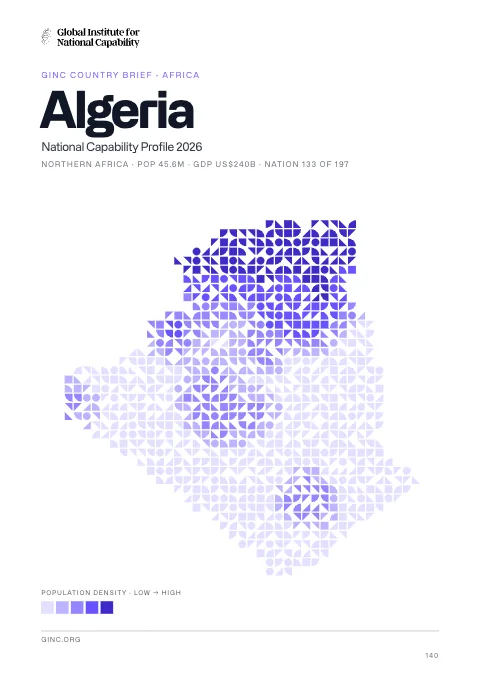
Algeria is a republic in Africa, home to 39 million people, with its capital at Algiers, and the world’s 10th-largest country by area.
Contents
12 chapters
Foundations
01–03
At a glance
- Area
- 2.4Mkm²#10 World#1 Africa
- Population
- 38.8M#33 World#8 Africa
- GDP (market)
- $216B
- GDP (PPP)
- $284.7B#46 World#4 Africa
- GDP per capita
- $7.5K#138 World#11 Africa
The whole brief
Algeria National Capability Profile 2026
Foundations · Chapter 01
Historical Context
🇩🇿 Algeria’s understanding the origins and evolution of the modern nation
BackgroundBack to top ↑
After more than a century of rule by France, Algerians fought through much of the 1950s to achieve independence in 1962. Algeria's primary political party, the National Liberation Front (FLN), was established in 1954 as part of the struggle for independence and has largely dominated politics since. The Government of Algeria in 1988 instituted a multi-party system in response to public unrest, but the surprising first round success of the Islamic Salvation Front (FIS) in the December 1991 balloting led the Algerian army to intervene and postpone the second round of elections to prevent what the secular elite feared would be an extremist-led government from assuming power. The army began a crackdown on the FIS that spurred FIS supporters to begin attacking government targets. Fighting escalated into an insurgency, which saw intense violence from 1992-98, resulting in over 100,000 deaths - many attributed to indiscriminate massacres of villagers by extremists. The government gained the upper hand by the late-1990s, and FIS's armed wing, the Islamic Salvation Army, disbanded in January 2000. Abdelaziz BOUTEFLIKA, with the backing of the military, won the presidency in 1999 in an election widely viewed as fraudulent. He was reelected to a second term in 2004 and overwhelmingly won a third term in 2009, after the government amended the constitution in 2008 to remove presidential term limits. Longstanding problems continue to face BOUTEFLIKA, including large-scale unemployment, a shortage of housing, unreliable electrical and water supplies, government inefficiencies and corruption, and the continuing activities of extremist militants. The Salafist Group for Preaching and Combat (GSPC) in 2006 merged with al-Qa'ida to form al-Qa'ida in the Lands of the Islamic Maghreb, which has launched an ongoing series of kidnappings and bombings targeting the Algerian Government and Western interests. The government in 2011 introduced some political reforms in response to the Arab Spring, including lifting the 19-year-old state of emergency restrictions and increasing women's quotas for elected assemblies. Parliamentary elections in May 2012 and municipal and provincial elections in November 2012 saw continued dominance by the FLN, with Islamist opposition parties performing poorly. Political protest activity in the country remained low in 2013, but small, sometimes violent socioeconomic demonstrations by disparate groups continued to be a common occurrence. Parliament in 2014 is expected to revise the constitution.
IndependenceBack to top ↑
5 July 1962 (from France)
National holidayBack to top ↑
Revolution Day, 1 November (1954)
Foundations · Chapter 02
Geography
🇩🇿 Algeria’s territory, resources and strategic position
Location and areaBack to top ↑
Northern Africa, bordering the Mediterranean Sea, between Morocco and Tunisia
28 00 N, 3 00 E
Africa
slightly less than 3.5 times the size of Texas
998 km
Terrain and resourcesBack to top ↑
mostly high plateau and desert; some mountains; narrow, discontinuous coastal plain
petroleum, natural gas, iron ore, phosphates, uranium, lead, zinc
5,694 sq km (2003)
Settlement and hazardsBack to top ↑
mountainous areas subject to severe earthquakes; mudslides and floods in rainy season
largest country in Africa
OtherBack to top ↑
11.67 cu km (2011)
soil erosion from overgrazing and other poor farming practices; desertification; dumping of raw sewage, petroleum refining wastes, and other industrial effluents is leading to the pollution of rivers and coastal waters; Mediterranean Sea, in particular, becoming polluted from oil wastes, soil erosion, and fertilizer runoff; inadequate supplies of potable water
Foundations · Chapter 03
Environment
🇩🇿 Algeria’s environmental conditions, resources and national resilience
ClimateBack to top ↑
arid to semiarid; mild, wet winters with hot, dry summers along coast; drier with cold winters and hot summers on high plateau; sirocco is a hot, dust/sand-laden wind especially common in summer
Emissions and pollutionBack to top ↑
Water, waste and foodBack to top ↑
Resources and agreementsBack to top ↑
GINC Capability Domains · Chapter 04
Critical Technology
🇩🇿 Algeria’s technology frontiers and the pursuit of national advantage
Two counts are set side by side for 2015–2024: on the left, the papers researchers in Algeria published; on the right, the patent families that began there and were filed in more than one country. First by capability group, then group by group with each group’s capabilities. The badge on a card is the nation’s place among all nations. Papers are from GINC Research Analytics, patent families from GINC Patents.
Research by capability group
#48 WorldPapers published, 2015–2024
2,050
1,221
959
859
634
330
264
86
84
10
Patents by capability group
#89 WorldInternational patent families, 2015–2024
Advanced Materials & ManufacturingBack to top ↑
Research
#47 WorldPapers published, 2015–2024
Patents
#85 WorldInternational patent families, 2015–2024
Energy TechnologiesBack to top ↑
Research
#40 WorldPapers published, 2015–2024
Patents
#71 WorldInternational patent families, 2015–2024
Semiconductors & Advanced ComputingBack to top ↑
Research
#34 WorldPapers published, 2015–2024
No research topic: Semiconductor Design & EDA · Advanced Semiconductor Fabrication · Semiconductor Equipment & Materials · Advanced Packaging & Heterogeneous Integration
Patents
International patent families, 2015–2024
No international patent families on record for 2015–2024.
Artificial IntelligenceBack to top ↑
Research
#45 WorldPapers published, 2015–2024
Patents
#89 WorldInternational patent families, 2015–2024
Quantum TechnologiesBack to top ↑
Research
#59 WorldPapers published, 2015–2024
Patents
#36 WorldInternational patent families, 2015–2024
Connectivity, Cyber & Trust TechnologiesBack to top ↑
Research
#39 WorldPapers published, 2015–2024
Patents
#93 WorldInternational patent families, 2015–2024
Sensing, Timing & NavigationBack to top ↑
Research
#42 WorldPapers published, 2015–2024
Patents
International patent families, 2015–2024
No international patent families on record for 2015–2024.
Robotics & Autonomous SystemsBack to top ↑
Research
#40 WorldPapers published, 2015–2024
No research topic: Human-Machine Interfaces
Patents
#85 WorldInternational patent families, 2015–2024
Biotechnology & Health TechnologiesBack to top ↑
Research
#109 WorldPapers published, 2015–2024
Patents
#94 WorldInternational patent families, 2015–2024
Medicine and BioTech
Clinical research and life-science invention, drawn from the same series that drive the metric pages. Each card opens the full cross-country comparison.
Space TechnologiesBack to top ↑
Research
#50 WorldPapers published, 2015–2024
Patents
#53 WorldInternational patent families, 2015–2024
GINC Capability Domains · Chapter 05
Strategic Infrastructure
🇩🇿 Algeria’s energy, connectivity and the material foundations of capability
Resource InfrastructureBack to top ↑
1.875 million bbl/day (2012 est.)
1.097 million bbl/day (2010 est.)
6,400 bbl/day (2010 est.)
12.2 billion bbl (1 January 2013 est.)
571,400 bbl/day (2010 est.)
316,400 bbl/day (2011 est.)
471,900 bbl/day (2010 est.)
17,270 bbl/day (2010 est.)
82.76 billion cu m (2011 est.)
28.82 billion cu m (2010 est.)
52.02 billion cu m (2011 est.)
0 cu m (2011 est.)
4.504 trillion cu m (1 January 2013 est.)
condensate 2,600 km; gas 16,415 km; liquid petroleum gas 3,447 km; oil 7,036 km; refined products 144 km (2013)
Agriculture & Food InfrastructureBack to top ↑
- Irrigation & Agricultural Water
- Livestock & Veterinary
- Fisheries & Aquaculture
- Storage, Cold Chain & Markets
Energy InfrastructureBack to top ↑
- Thermal Generation
- Nuclear Generation
- Nuclear Fuel Cycle & Radioactive Waste
- Hydropower
- Renewable Generation
- Transmission & Distribution
- System Control & Dispatch
- Storage & Fuel Supply
11.33 million kW (2010 est.)
46.25 billion kWh (2011 est.)
33.68 billion kWh (2010 est.)
803 million kWh (2010 est.)
736 million kWh (2010 est.)
97.5% of total installed capacity (2010 est.)
0% of total installed capacity (2010 est.)
2.5% of total installed capacity (2010 est.)
0% of total installed capacity (2010 est.)
117.2 million Mt (2011 est.)
Water, Sanitation & Waste InfrastructureBack to top ↑
- Dams, Reservoirs & Flood Defence
- Water Supply & Treatment
- Bulk Water Transfer & Desalination
- Wastewater & Sanitation
- Solid Waste & Recycling
Advanced ManufacturingBack to top ↑
- Materials & Inputs
- Chemicals & Hazardous Process Industry
- Production Systems
- Supply Chain & Ecosystem
- Workforce & Innovation
Transport InfrastructureBack to top ↑
- Seaports & Terminals
- Air Infrastructure
- Air Navigation & Traffic Management
- Inland Waterways & Ferries
- Rail Infrastructure
- Roads & Bridges
- Logistics, Multimodal & Border Infrastructure
- Postal & Parcel
157 (2013)
3 (2013)
Communications & Digital InfrastructureBack to top ↑
- Subsea Cables & International Gateways
- Core & Backbone Networks
- Mobile & Wireless Networks
- Spectrum & Broadcasting
- Data Centres, Compute & Cloud
- Data Resources
- AI Tools & Applications
3.2 million (2012)
37.692 million (2012)
4.7 million (2009)
676 (2012)
.dz
Financial InfrastructureBack to top ↑
- Currency & Reserves
- Payments & Settlement Systems
- Markets, Exchanges & Depositories
- Banks, Insurers & Systemic Institutions
Social InfrastructureBack to top ↑
- Health Infrastructure
- Public Health & Laboratories
- Medical Supply & Stockpiles
- Education & Skills Infrastructure
- Research & Scientific Facilities
- Housing, Community & Social Services
- Government & Public Administration
- Cultural, Community & Recreational Infrastructure
- Justice & Corrections
- Emergency Services & Civil Protection
- Hydrometeorology & Early Warning
Space, Aerospace & Defence InfrastructureBack to top ↑
GINC Capability Domains · Chapter 06
National Security
🇩🇿 Algeria’s force, intelligence and the defence of the nation
Disputes and terrorismBack to top ↑
Algeria and many other states reject Moroccan administration of Western Sahara; the Polisario Front, exiled in Algeria, represents the Sahrawi Arab Democratic Republic; Algeria's border with Morocco remains an irritant to bilateral relations, each nation accusing the other of harboring militants and arms smuggling; dormant disputes include Libyan claims of about 32,000 sq km still reflected on its maps of southeastern Algeria and the National Liberation Front's (FLN) assertions of a claim to Chirac Pastures in southeastern Morocco
Force Generation & MobilisationBack to top ↑
People's National Army (Armee Nationale Populaire, ANP), Land Forces (Forces Terrestres, FT), Navy of the Republic of Algeria (Marine de la Republique Algerienne, MRA), Air Force (Al-Quwwat al-Jawwiya al-Jaza'eriya, QJJ), Territorial Air Defense Force (2009)
17 is the legal minimum age for voluntary military service; 19-30 years of age for compulsory service; conscript service obligation is 18 months (6 months basic training, 12 months civil projects) (2012)
4.48% of GDP (2012)//4.36% of GDP (2011)//4.48% of GDP (2010)
Forces under arms
Active-duty strength on the Correlates of War series, which reaches back to 1816 and so carries a nation’s whole record of mobilisation rather than its present establishment. The card opens the full cross-country comparison.
Intelligence & AssessmentBack to top ↑
- Imagery & Geospatial Intelligence
- Signals & Cyber Intelligence
- Technical & Measurement Intelligence
- Open-Source & Financial Intelligence
- Human Intelligence & Counterintelligence
- All-Source Analysis & Warning
Joint Command, Projection & SustainmentBack to top ↑
- Command, Control & Communications
- Strategic Lift & Mobility
- Expeditionary & Peace Operations
- Operational Sustainment & War Reserves
- Defence Industrial Mobilisation
- CBRN Defence
Land PowerBack to top ↑
- Combined Arms Manoeuvre
- Land Fires
- Battlefield Aviation & Uncrewed Systems
- Special Operations & Irregular Warfare
Maritime PowerBack to top ↑
- Maritime Security & Constabulary
- Sea Denial & Undersea Warfare
- Sea Control
- Amphibious & Expeditionary Operations
Air PowerBack to top ↑
- Air Sovereignty & Policing
- Control of the Air
- Air Strike & Interdiction
- Airborne ISR, Early Warning & Battle Management
Strategic Strike & Missile DefenceBack to top ↑
Space OperationsBack to top ↑
Cyber & Electromagnetic OperationsBack to top ↑
Nuclear DeterrenceBack to top ↑
GINC Capability Domains · Chapter 07
Human Capital
🇩🇿 Algeria’s population, health and the skills that sustain capability
DemographyBack to top ↑
38,813,722 (July 2014 est.)
1.88% (2014 est.)
23.99 births/1,000 population (2014 est.)
4.31 deaths/1,000 population (2014 est.)
2.78 children born/woman (2014 est.)
61.4% (2006)
Migration and urbanisationBack to top ↑
-0.93 migrant(s)/1,000 population (2014 est.)
ALGIERS (capital) 2.916 million; Oran 783,000 (2011)
Welfare and equityBack to top ↑
23% (2006 est.)
35.3 (1995)
DisplacementBack to top ↑
Early Childhood DevelopmentBack to top ↑
3.7% (2005)
Foundational EducationBack to top ↑
4.3% of GDP (2008)
Advanced EducationBack to top ↑
Technical & Vocational SkillsBack to top ↑
Digital & AI CompetenceBack to top ↑
Generative AI adoption
Modelled share of working-age adults using generative AI, from Microsoft telemetry scaled to each country’s 15–64 population. A measure of how fast a workforce is absorbing the technology rather than of how much of it a nation builds. The card opens the full cross-country comparison.
Lifelong Learning & ReskillingBack to top ↑
Research Talent & Knowledge CreationBack to top ↑
Population HealthBack to top ↑
97 deaths/100,000 live births (2010)
16% (2008)
0.1%; note - no country specific models provided (2009 est.)
18,000 (2009 est.)
fewer than 1,000 (2009 est.)
Health System CapabilityBack to top ↑
3.9% of GDP (2011)
1.21 physicians/1,000 population (2007)
1.7 beds/1,000 population (2004)
GINC Capability Domains · Chapter 08
Governance and Integrity
🇩🇿 Algeria’s institutions, law and the integrity of the state
State structureBack to top ↑
republic
48 provinces (wilayas, singular - wilaya); Adrar, Ain Defla, Ain Temouchent, Alger, Annaba, Batna, Bechar, Bejaia, Biskra, Blida, Bordj Bou Arreridj, Bouira, Boumerdes, Chlef, Constantine, Djelfa, El Bayadh, El Oued, El Tarf, Ghardaia, Guelma, Illizi, Jijel, Khenchela, Laghouat, Mascara, Medea, Mila, Mostaganem, M'Sila, Naama, Oran, Ouargla, Oum el Bouaghi, Relizane, Saida, Setif, Sidi Bel Abbes, Skikda, Souk Ahras, Tamanrasset, Tebessa, Tiaret, Tindouf, Tipaza, Tissemsilt, Tizi Ouzou, Tlemcen
adopted 8 September 1963; amended several times, last in 2008 (2013)
18 years of age; universal
Political Institutions & Civic ParticipationBack to top ↑
- Electoral Management & Integrity
- Legislature & Deliberative Institutions
- Citizen Participation & Civic Space
bicameral Parliament consists of the Council of the Nation (upper house; 144 seats; one-third of the members appointed by the president, two-thirds elected by indirect vote to serve six-year terms; the constitution requires half the Council to be renewed every three years) and the National People's Assembly (lower house; 462 seats; members elected by popular vote to serve five-year terms)
Algerian National Front or FNA [Moussa TOUATI]; Algerian Popular Movement or MPA [Amara BENYOUNES]; Algerian Rally [Ali ZAGHDOUD]; Algeria's Hope Rally or TAJ [Amar GHOUL]; Dignity or El Karama [Mohamed BENHAMOU]; Front for Change or FC [Abdelmadjid MENASRA]; Front for Justice and Development or El Adala [Abdallah DJABALLAH]; Future Front or El Mostakbel [Abdelaziz BELAID]; Green Algeria Alliance or AAV (includes Movement for National Reform, Islamic Renaissance Movement, and Movement of the Society of Peace or Hamas); Islamic Renaissance Movement or EnNahda Movement [Mohamed DHOUIBI]; Movement of the Society of Peace or MSP [Abderrazak MOKRI]; National Democratic Rally (Rassemblement National Democratique) or RND [Bensalah ABDELKADER]; National Liberation Front or FLN [Amar SAIDANI]; National Party for Solidarity and Development or PNSD; National Reform Movement or Islah [Djahid YOUNSI] (see Green Algeria Alliance); New Dawn Party or PFJ; New Generation or Jil Jadid [Soufiane DJILALI]; New Light Party [Bedreddine BELBAZ]; Oath of 1954 or Ahd 54 [Ali Fawzi REBAINE]; Party of Justice and Liberty [Mohammed SAID]; Rally for Culture and Democracy or RCD [Mohcine BELABBAS]; Socialist Forces Front or FFS [Mustafa BOUCHACHI]; Workers Party or PT [Louisa HANOUNE]
The Algerian Human Rights League or LADDH [Noureddine BENISSAD]; SOS Disparus [Nacera DUTOUR]; Youth Action Rally or RAJ
Justice System & Fundamental RightsBack to top ↑
- Judicial Independence & Court Capability
- Access to Justice & Legal Services
- Fundamental Rights Protection
- Human Rights Institutions & Equality Bodies
mixed legal system of French civil law and Islamic law; judicial review of legislative acts in ad hoc Constitutional Council composed of various public officials including several Supreme Court justices
has not submitted an ICJ jurisdiction declaration; non-party state to the ICCt
Internal Security & OrderBack to top ↑
Regulatory Governance & Strategic ControlsBack to top ↑
- Regulatory Quality & Better Regulation
- Regulatory Delivery & Independent Regulators
- Strategic Controls & Economic Security Administration
Government Effectiveness & Public AdministrationBack to top ↑
- Centre of Government & Policy Coordination
- Civil Service & Public Workforce
- Digital Government & Service Delivery
- Legal Identity & Civil Registration
- Statistical & Data Capability
Public Integrity & Anti-CorruptionBack to top ↑
Transparency, Oversight & AccountabilityBack to top ↑
- Right to Information & Open Government
- Independent Oversight & Supreme Audit
- Independent Media & Journalist Safety
National Resilience & Crisis ManagementBack to top ↑
GINC Capability Domains · Chapter 09
Information and Influence
🇩🇿 Algeria’s identity, media and the projection of influence
Identity and cultureBack to top ↑
Arabic (official), French (lingua franca), Berber dialects: Kabylie Berber (Tamazight), Chaouia Berber (Tachawit), Mzab Berber, Tuareg Berber (Tamahaq)
Muslim (official; predominantly Sunni) 99%, other (includes Christian and Jewish)
Arab-Berber 99%, European less than 1%
star and crescent; fennec fox
two equal vertical bands of green (hoist side) and white; a red, five-pointed star within a red crescent centered over the two-color boundary; the colors represent Islam (green), purity and peace (white), and liberty (red); the crescent and star are also Islamic symbols, but the crescent is more closed than those of other Muslim countries because the Algerians believe the long crescent horns bring happiness
Diplomatic Statecraft & Global NetworksBack to top ↑
- Diplomatic Network & Consular Reach
- Multilateral Leadership & Norm Setting
- Agenda-Setting & Convening
- Mediation & Crisis Diplomacy
ABEDA, AfDB, AFESD, AMF, AMU, AU, BIS, CAEU, CD, FAO, G-15, G-24, G-77, IAEA, IBRD, ICAO, ICC (national committees), ICRM, IDA, IDB, IFAD, IFC, IFRCS, IHO, ILO, IMF, IMO, IMSO, Interpol, IOC, IOM, IPU, ISO, ITSO, ITU, ITUC (NGOs), LAS, MIGA, MONUSCO, NAM, OAPEC, OAS (observer), OIC, OPCW, OPEC, OSCE (partner), UN, UNCTAD, UNESCO, UNHCR, UNIDO, UNITAR, UNWTO, UPU, WCO, WHO, WIPO, WMO, WTO (observer)
Alliances & Security CooperationBack to top ↑
Development Cooperation & Global AssistanceBack to top ↑
Culture, Language & Education DiplomacyBack to top ↑
- Cultural & Language Institutes
- Creative Industries & Cultural Export Reach
- Heritage & Cultural Institutions
- Education Diplomacy & Alumni Networks
- Sports & Major Events
Diaspora & Global CommunitiesBack to top ↑
Information Environment & Strategic CommunicationBack to top ↑
- Strategic Communications & Public Diplomacy
- International Media & Broadcasting
- Information Defence & Counter-Interference
state-run Radio-Television Algerienne operates the broadcast media and carries programming in Arabic, Berber dialects, and French; use of satellite dishes is widespread, providing easy access to European and Arab satellite stations; state-run radio operates several national networks and roughly 40 regional radio stations (2007)
GINC Capability Domains · Chapter 10
Financial Strength
🇩🇿 Algeria’s fiscal depth, reserves and the capacity to act
Monetary & Currency CapabilityBack to top ↑
- Monetary Policy & Price Stability
- Exchange Rate & External Account Management
- Currency Issuance & Digital Money
3.9% (2013 est.)//8.9% (2012 est.)
Algerian dinars (DZD) per US dollar -//78.77 (2013 est.)//77.536 (2012 est.)//74.386 (2010 est.)//72.65 (2009)//63.25 (2008)
4% (31 December 2010 est.)//4% (31 December 2009 est.)
8% (31 December 2013 est.)//8% (31 December 2012 est.)
$92.91 billion (31 December 2013 est.)//$98.36 billion (31 December 2012 est.)
$140.2 billion (31 December 2013 est.)//$141 billion (31 December 2012 est.)
Fiscal Capacity & Public FinanceBack to top ↑
- Revenue Mobilisation & Tax Administration
- Public Expenditure & Budget Management
- Sovereign Debt & Treasury Management
- Public Investment Management
37.3% of GDP (2013 est.)
-2.3% of GDP (2013 est.)
13.2% of GDP (2013 est.)//8.3% of GDP (2012 est.)
calendar year
Financial System Depth & AccessBack to top ↑
- Banking System Capacity
- Capital Markets Depth & Development
- Long-Term & Institutional Capital
- Financial Inclusion & Household Access
- Development & Policy Finance
$-4.337 billion (31 December 2013 est.)//$-4.363 billion (31 December 2012 est.)
$NA
45.5% of GDP (2013 est.)//44.4% of GDP (2012 est.)//47.7% of GDP (2011 est.)
Financial Regulation & IntegrityBack to top ↑
- Prudential Regulation & Supervision
- Financial Integrity & Illicit Finance Control
- Market Conduct & Consumer Protection
- Payment & Market Infrastructure Oversight
Financial Stability & Crisis ManagementBack to top ↑
- Macroprudential & Systemic Oversight
- Crisis Management, Resolution & Deposit Insurance
- External Liquidity & Financial Safety Nets
Sovereign Capital & External Financial PowerBack to top ↑
- Official Reserves Management
- Sovereign Wealth & Public Asset Management
- Currency Internationalisation & Reserve Status
- Capital Account & Flow Management
- International Financial Centre Capability
$192.5 billion (31 December 2013 est.)//$191.6 billion (31 December 2012 est.)
$5.278 billion (31 December 2013 est.)//$5.639 billion (31 December 2012 est.)
GINC Capability Domains · Chapter 11
Production and Innovation
🇩🇿 Algeria’s output, industry and the engine of prosperity
Economic Output & ProductivityBack to top ↑
Algeria's economy remains dominated by the state, a legacy of the country's socialist postindependence development model. In recent years the Algerian Government has halted the privatization of state-owned industries and imposed restrictions on imports and foreign involvement in its economy. Hydrocarbons have long been the backbone of the economy, accounting for roughly 60% of budget revenues, 30% of GDP, and over 95% of export earnings. Algeria has the 10th-largest reserves of natural gas in the world and is the sixth-largest gas exporter. It ranks 16th in oil reserves. Strong revenues from hydrocarbon exports have brought Algeria relative macroeconomic stability, with foreign currency reserves approaching $200 billion and a large budget stabilization fund available for tapping. In addition, Algeria's external debt is extremely low at about 2% of GDP. However, Algeria has struggled to develop non-hydrocarbon industries because of heavy regulation and an emphasis on state-driven growth. The government's efforts have done little to reduce high youth unemployment rates or to address housing shortages. A wave of economic protests in February and March 2011 prompted the Algerian Government to offer more than $23 billion in public grants and retroactive salary and benefit increases, moves which continue to weigh on public finances. Long-term economic challenges include diversifying the economy away from its reliance on hydrocarbon exports, bolstering the private sector, attracting foreign investment, and providing adequate jobs for younger Algerians.
$284.7 billion (2013 est.)//$276.2 billion (2012 est.)//$267.4 billion (2011 est.)
3.1% (2013 est.)//3.3% (2012 est.)//2.6% (2011 est.)
$7,500 (2013 est.)//$7,400 (2012 est.)//$7,300 (2011 est.)
$215.7 billion (2013 est.)
Labour & EmploymentBack to top ↑
- Employment & Labour Force Participation
- Labour Market Institutions & Wage Setting
- Employment Services & Skills Matching
- Labour Adjustment, Transition & Formalisation
11.15 million (2013 est.)
10.3% (2013 est.)//10.7% (2012 est.)
Industrial & Sectoral BaseBack to top ↑
- Manufacturing & Advanced Industry
- Foundational & Process Industries
- Agrifood & Primary Production
- Services Economy
wheat, barley, oats, grapes, olives, citrus, fruits; sheep, cattle
petroleum, natural gas, light industries, mining, electrical, petrochemical, food processing
2.5% (2013 est.)
Structural Transformation & ComplexityBack to top ↑
Business Dynamism & EntrepreneurshipBack to top ↑
- Entrepreneurship & Firm Creation
- Risk Capital & Scale-Up Finance
- Firm Growth, Exit & Renewal
- Competition & Market Contestability
Innovation & CommercialisationBack to top ↑
- Business Innovation Capability
- Research Commercialisation & Knowledge Transfer
- Intellectual Property & Intangible Assets
- Innovation Ecosystems & Clusters
Technology Adoption & DiffusionBack to top ↑
GINC Capability Domains · Chapter 12
Trade and Investment
🇩🇿 Algeria’s markets, capital and the terms of global exchange
Overall tradeBack to top ↑
$48.2B of exports to 115 partners and $43.6B of imports from 103 in 2024, a surplus of $4.51B.
- Exports
- $48.2B115 partners
- Imports
- $43.6B103 partners
- Balance
- +$4.51Bsurplus
- Total trade
- $91.8B2024
ExportsBack to top ↑
Where its exports go
The largest partners in 2024, with each one's share of the nation's exports.
| Partner | Value | Share | |
|---|---|---|---|
| Italy | $11.8B | 24% | |
| France | $6.92B | 14% | |
| Spain | $6.01B | 12% | |
| South Korea | $3.63B | 7.5% | |
| United States | $2.51B | 5.2% | |
| Tunisia | $1.95B | 4.0% | |
| Netherlands | $1.62B | 3.4% | |
| United Kingdom | $1.60B | 3.3% | |
| Turkey | $1.47B | 3.1% | |
| Brazil | $1.47B | 3.0% | |
| Germany | $1.28B | 2.7% | |
| Portugal | $1.26B | 2.6% | |
| India | $1.00B | 2.1% | |
| China | $800M | 1.7% | |
| Lithuania | $727M | 1.5% | |
| Indonesia | $598M | 1.2% | |
| Belgium | $528M | 1.1% | |
| Greece | $265M | 0.6% | |
| Singapore | $211M | 0.4% | |
| Croatia | $182M | 0.4% |
What it exports
The largest categories in 2024.
| Category | Value | Share | |
|---|---|---|---|
| Mineral fuels, oils, distillation products | $43.7B | 91% | |
| Fertilizers | $1.05B | 2.2% | |
| Inorganic chemicals, precious metal compound, isotope | $1.04B | 2.2% | |
| Iron and steel | $718M | 1.5% | |
| Salt, sulphur, earth, stone, plaster, lime and cement | $590M | 1.2% | |
| Edible fruits, nuts, peel of citrus fruit, melons | $171M | 0.4% | |
| Sugars and sugar confectionery | $106M | 0.2% | |
| Copper | $92.9M | 0.2% | |
| Machinery, nuclear reactors, boilers | $80.8M | 0.2% | |
| Glass and glassware | $59.0M | 0.1% | |
| Plastics | $52.8M | 0.1% | |
| Paper and paperboard, articles of pulp, paper and board | $51.1M | 0.1% | |
| Articles of iron or steel | $37.8M | <0.1% | |
| Organic chemicals | $37.6M | <0.1% | |
| Ores slag and ash | $29.3M | <0.1% |
ImportsBack to top ↑
Where its imports come from
The largest partners in 2024, with each one's share of the nation's imports.
| Partner | Value | Share | |
|---|---|---|---|
| China | $11.7B | 27% | |
| France | $5.17B | 12% | |
| Italy | $2.93B | 6.7% | |
| Turkey | $2.87B | 6.6% | |
| Brazil | $2.57B | 5.9% | |
| Germany | $2.22B | 5.1% | |
| Saudi Arabia | $1.08B | 2.5% | |
| Egypt | $995M | 2.3% | |
| United States | $987M | 2.3% | |
| Canada | $959M | 2.2% | |
| India | $944M | 2.2% | |
| Argentina | $851M | 1.9% | |
| Spain | $824M | 1.9% | |
| Netherlands | $763M | 1.7% | |
| Belgium | $709M | 1.6% | |
| Poland | $694M | 1.6% | |
| Bulgaria | $565M | 1.3% | |
| Tunisia | $545M | 1.2% | |
| New Zealand | $520M | 1.2% | |
| Portugal | $502M | 1.1% |
What it imports
The largest categories in 2024.
| Category | Value | Share | |
|---|---|---|---|
| Machinery, nuclear reactors, boilers | $6.76B | 15% | |
| Vehicles other than railway, tramway | $3.93B | 9.0% | |
| Cereals | $3.08B | 7.1% | |
| Plastics | $2.97B | 6.8% | |
| Electrical, electronic equipment | $2.88B | 6.6% | |
| Dairy products, eggs, honey, edible products | $1.51B | 3.5% | |
| Pharmaceutical products | $1.45B | 3.3% | |
| Articles of iron or steel | $1.35B | 3.1% | |
| Iron and steel | $1.23B | 2.8% | |
| Sugars and sugar confectionery | $1.09B | 2.5% | |
| Optical, photo, technical, medical apparatus | $954M | 2.2% | |
| Oil seed, oleaginous fruits, grain, seed, fruits | $935M | 2.1% | |
| Ores slag and ash | $861M | 2.0% | |
| Animal, vegetable fats and oils, cleavage products | $802M | 1.8% | |
| Paper and paperboard, articles of pulp, paper and board | $709M | 1.6% |
In a list, the bar runs to the largest in that list. The line is each figure’s history from 2000, drawn to its own peak: it shows the shape of the years, and the value shows the size.
External balanceBack to top ↑
$6.697 billion (2013 est.)//$12.3 billion (2012 est.)
Trade Facilitation & LogisticsBack to top ↑
Trade Policy & Market AccessBack to top ↑
- Trade Policy & Negotiation Capability
- Market Access & Agreements Network
- Trade Law & Enforcement
- Standards, Conformity & Quality Infrastructure
Digital & Services TradeBack to top ↑
- Services Trade Capability
- Digital Trade & E-Commerce
- Data Flows & Digital Trade Governance
- Tourism & Visitor Economy
Investment Attraction & ProjectionBack to top ↑
- Investment Attraction & Facilitation
- Investment Absorption & Linkages
- Outward Investment & Global Corporate Presence
$25.02 billion (31 December 2013 est.)//$23.26 billion (31 December 2012 est.)
$2.433 billion (31 December 2013 est.)//$2.133 billion (31 December 2012 est.)
Export Capability & SophisticationBack to top ↑
$68.25 billion (2013 est.)//$71.74 billion (2012 est.)
Italy 16%, US 15%, Spain 10.9%, France 8.5%, Netherlands 7.3%, Canada 7.1%, UK 5.1%, Brazil 4.7% (2012)
petroleum, natural gas, and petroleum products 97%
Global Value Chain PositionBack to top ↑
- Value Chain Participation & Integration
- Value Chain Position & Upgrading
- Regional Integration & Hub Anchoring
Economic Leverage & DependenceBack to top ↑
- Strategic Supply Security
- Concentration Risk & Revenue Stabilisation
- Economic Leverage & Coercion Resistance
$55.02 billion (2013 est.)//$51.57 billion (2012 est.)
France 12.8%, China 11.8%, Italy 10.3%, Spain 8.6%, Germany 5.2% (2012)
capital goods, foodstuffs, consumer goods
Algeria · you are in
Historical Context
Foundations
GINC Capability Domains
Find in this brief · Algeria