
Tunisia
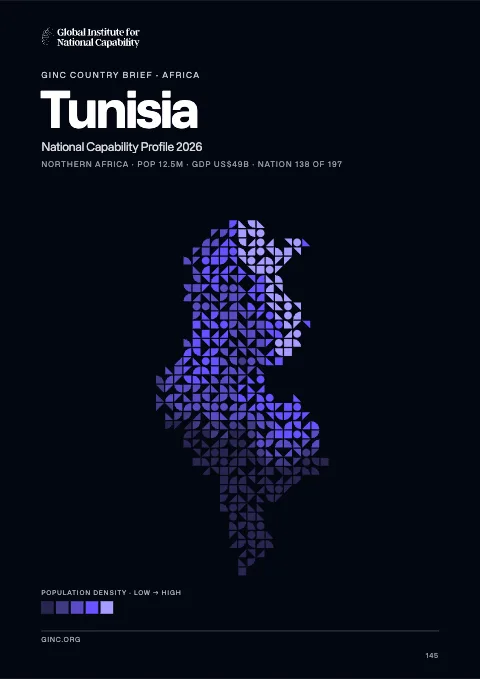
Tunisia is a republic in Africa, home to 11 million people, with its capital at Tunis.
Contents
12 chapters
Foundations
01–03
At a glance
- Area
- 163.6Kkm²#93 World#36 Africa
- Population
- 10.9M#78 World#29 Africa
- GDP (market)
- $48.4B
- GDP (PPP)
- $108.4B#71 World#8 Africa
- GDP per capita
- $9.9K#121 World#8 Africa
The whole brief
Tunisia National Capability Profile 2026
Foundations · Chapter 01
Historical Context
🇹🇳 Tunisia’s understanding the origins and evolution of the modern nation
BackgroundBack to top ↑
Rivalry between French and Italian interests in Tunisia culminated in a French invasion in 1881 and the creation of a protectorate. Agitation for independence in the decades following World War I was finally successful in getting the French to recognize Tunisia as an independent state in 1956. The country's first president, Habib BOURGUIBA, established a strict one-party state. He dominated the country for 31 years, repressing Islamic fundamentalism and establishing rights for women unmatched by any other Arab nation. In November 1987, BOURGUIBA was removed from office and replaced by Zine el Abidine BEN ALI in a bloodless coup. Street protests that began in Tunis in December 2010 over high unemployment, corruption, widespread poverty, and high food prices escalated in January 2011, culminating in rioting that led to hundreds of deaths. On 14 January 2011, the same day BEN ALI dismissed the government, he fled the country, and by late January 2011, a "national unity government" was formed. Elections for the new Constituent Assembly were held in late October 2011, and in December, it elected human rights activist Moncef MARZOUKI as interim president. The Assembly began drafting a new constitution in February 2012 and, after several iterations and a months-long political crisis that stalled the transition, ratified the document in January 2014. Presidential and parliamentary elections for a permanent government could be held by the end of 2014.
IndependenceBack to top ↑
20 March 1956 (from France)
National holidayBack to top ↑
Independence Day, 20 March (1956); Revolution and Youth Day, 14 January (2011)
Foundations · Chapter 02
Geography
🇹🇳 Tunisia’s territory, resources and strategic position
Location and areaBack to top ↑
Northern Africa, bordering the Mediterranean Sea, between Algeria and Libya
34 00 N, 9 00 E
Africa
slightly larger than Georgia
1,148 km
Terrain and resourcesBack to top ↑
mountains in north; hot, dry central plain; semiarid south merges into the Sahara
petroleum, phosphates, iron ore, lead, zinc, salt
3,970 sq km (2003)
Settlement and hazardsBack to top ↑
NA
strategic location in central Mediterranean; Malta and Tunisia are discussing the commercial exploitation of the continental shelf between their countries, particularly for oil exploration
OtherBack to top ↑
4.6 cu km (2011)
toxic and hazardous waste disposal is ineffective and poses health risks; water pollution from raw sewage; limited natural freshwater resources; deforestation; overgrazing; soil erosion; desertification
Foundations · Chapter 03
Environment
🇹🇳 Tunisia’s environmental conditions, resources and national resilience
ClimateBack to top ↑
temperate in north with mild, rainy winters and hot, dry summers; desert in south
Emissions and pollutionBack to top ↑
Water, waste and foodBack to top ↑
Resources and agreementsBack to top ↑
GINC Capability Domains · Chapter 04
Critical Technology
🇹🇳 Tunisia’s technology frontiers and the pursuit of national advantage
Two counts are set side by side for 2015–2024: on the left, the papers researchers in Tunisia published; on the right, the patent families that began there and were filed in more than one country. First by capability group, then group by group with each group’s capabilities. The badge on a card is the nation’s place among all nations. Papers are from GINC Research Analytics, patent families from GINC Patents.
Research by capability group
#51 WorldPapers published, 2015–2024
1,878
1,224
683
608
527
233
205
169
57
1
Patents by capability group
#84 WorldInternational patent families, 2015–2024
Advanced Materials & ManufacturingBack to top ↑
Research
#46 WorldPapers published, 2015–2024
Patents
#85 WorldInternational patent families, 2015–2024
Energy TechnologiesBack to top ↑
Research
#49 WorldPapers published, 2015–2024
Patents
#84 WorldInternational patent families, 2015–2024
Semiconductors & Advanced ComputingBack to top ↑
Research
#45 WorldPapers published, 2015–2024
No research topic: Semiconductor Design & EDA · Advanced Semiconductor Fabrication · Semiconductor Equipment & Materials · Advanced Packaging & Heterogeneous Integration
Patents
International patent families, 2015–2024
No international patent families on record for 2015–2024.
Artificial IntelligenceBack to top ↑
Research
#47 WorldPapers published, 2015–2024
Patents
#78 WorldInternational patent families, 2015–2024
Quantum TechnologiesBack to top ↑
Research
#66 WorldPapers published, 2015–2024
Patents
International patent families, 2015–2024
No international patent families on record for 2015–2024.
Connectivity, Cyber & Trust TechnologiesBack to top ↑
Research
#42 WorldPapers published, 2015–2024
Patents
#71 WorldInternational patent families, 2015–2024
Sensing, Timing & NavigationBack to top ↑
Research
#52 WorldPapers published, 2015–2024
Patents
International patent families, 2015–2024
No international patent families on record for 2015–2024.
Robotics & Autonomous SystemsBack to top ↑
Research
#45 WorldPapers published, 2015–2024
No research topic: Human-Machine Interfaces
Patents
#85 WorldInternational patent families, 2015–2024
Biotechnology & Health TechnologiesBack to top ↑
Research
#72 WorldPapers published, 2015–2024
Patents
#84 WorldInternational patent families, 2015–2024
Medicine and BioTech
Clinical research and life-science invention, drawn from the same series that drive the metric pages. Each card opens the full cross-country comparison.
Space TechnologiesBack to top ↑
Research
#95 WorldPapers published, 2015–2024
Patents
International patent families, 2015–2024
No international patent families on record for 2015–2024.
GINC Capability Domains · Chapter 05
Strategic Infrastructure
🇹🇳 Tunisia’s energy, connectivity and the material foundations of capability
Resource InfrastructureBack to top ↑
68,310 bbl/day (2012 est.)
77,980 bbl/day (2010 est.)
3,680 bbl/day (2010 est.)
425 million bbl (1 January 2013 est.)
11,170 bbl/day (2010 est.)
88,380 bbl/day (2011 est.)
3,391 bbl/day (2010 est.)
80,980 bbl/day (2010 est.)
1.93 billion cu m (2011 est.)
3.28 billion cu m (2010 est.)
0 cu m (2011 est.)
1.78 billion cu m (2011 est.)
65.13 billion cu m (1 January 2013 est.)
condensate 68 km; gas 3,111 km; oil 1,381 km; refined products 453 km (2013)
Agriculture & Food InfrastructureBack to top ↑
- Irrigation & Agricultural Water
- Livestock & Veterinary
- Fisheries & Aquaculture
- Storage, Cold Chain & Markets
Energy InfrastructureBack to top ↑
- Thermal Generation
- Nuclear Generation
- Nuclear Fuel Cycle & Radioactive Waste
- Hydropower
- Renewable Generation
- Transmission & Distribution
- System Control & Dispatch
- Storage & Fuel Supply
3.652 million kW (2010 est.)
15.14 billion kWh (2010 est.)
13.29 billion kWh (2010 est.)
0 kWh (2010 est.)
19 million kWh (2010 est.)
96.8% of total installed capacity (2010 est.)
0% of total installed capacity (2010 est.)
1.7% of total installed capacity (2010 est.)
1.5% of total installed capacity (2010 est.)
20.52 million Mt (2011 est.)
Water, Sanitation & Waste InfrastructureBack to top ↑
- Dams, Reservoirs & Flood Defence
- Water Supply & Treatment
- Bulk Water Transfer & Desalination
- Wastewater & Sanitation
- Solid Waste & Recycling
Advanced ManufacturingBack to top ↑
- Materials & Inputs
- Chemicals & Hazardous Process Industry
- Production Systems
- Supply Chain & Ecosystem
- Workforce & Innovation
Transport InfrastructureBack to top ↑
- Seaports & Terminals
- Air Infrastructure
- Air Navigation & Traffic Management
- Inland Waterways & Ferries
- Rail Infrastructure
- Roads & Bridges
- Logistics, Multimodal & Border Infrastructure
- Postal & Parcel
29 (2013)
Communications & Digital InfrastructureBack to top ↑
- Subsea Cables & International Gateways
- Core & Backbone Networks
- Mobile & Wireless Networks
- Spectrum & Broadcasting
- Data Centres, Compute & Cloud
- Data Resources
- AI Tools & Applications
1.105 million (2012)
12.84 million (2012)
3.5 million (2009)
576 (2012)
.tn
Financial InfrastructureBack to top ↑
- Currency & Reserves
- Payments & Settlement Systems
- Markets, Exchanges & Depositories
- Banks, Insurers & Systemic Institutions
Social InfrastructureBack to top ↑
- Health Infrastructure
- Public Health & Laboratories
- Medical Supply & Stockpiles
- Education & Skills Infrastructure
- Research & Scientific Facilities
- Housing, Community & Social Services
- Government & Public Administration
- Cultural, Community & Recreational Infrastructure
- Justice & Corrections
- Emergency Services & Civil Protection
- Hydrometeorology & Early Warning
Space, Aerospace & Defence InfrastructureBack to top ↑
GINC Capability Domains · Chapter 06
National Security
🇹🇳 Tunisia’s force, intelligence and the defence of the nation
Disputes and terrorismBack to top ↑
none
Force Generation & MobilisationBack to top ↑
Tunisian Armed Forces (Forces Armees Tunisiens, FAT): Tunisian Army (includes Tunisian Air Defense Force), Tunisian Navy, Republic of Tunisia Air Force (Al-Quwwat al-Jawwiya al-Jamahiriyah At'Tunisia) (2012)
20-23 years of age for compulsory service, one year service obligation; 18-23 years of age for voluntary service; Tunisian nationality required (2012)
1.55% of GDP (2012)//1.34% of GDP (2011)//1.55% of GDP (2010)
Forces under arms
Active-duty strength on the Correlates of War series, which reaches back to 1816 and so carries a nation’s whole record of mobilisation rather than its present establishment. The card opens the full cross-country comparison.
Intelligence & AssessmentBack to top ↑
- Imagery & Geospatial Intelligence
- Signals & Cyber Intelligence
- Technical & Measurement Intelligence
- Open-Source & Financial Intelligence
- Human Intelligence & Counterintelligence
- All-Source Analysis & Warning
Joint Command, Projection & SustainmentBack to top ↑
- Command, Control & Communications
- Strategic Lift & Mobility
- Expeditionary & Peace Operations
- Operational Sustainment & War Reserves
- Defence Industrial Mobilisation
- CBRN Defence
Land PowerBack to top ↑
- Combined Arms Manoeuvre
- Land Fires
- Battlefield Aviation & Uncrewed Systems
- Special Operations & Irregular Warfare
Maritime PowerBack to top ↑
- Maritime Security & Constabulary
- Sea Denial & Undersea Warfare
- Sea Control
- Amphibious & Expeditionary Operations
Air PowerBack to top ↑
- Air Sovereignty & Policing
- Control of the Air
- Air Strike & Interdiction
- Airborne ISR, Early Warning & Battle Management
Strategic Strike & Missile DefenceBack to top ↑
Space OperationsBack to top ↑
Cyber & Electromagnetic OperationsBack to top ↑
Nuclear DeterrenceBack to top ↑
GINC Capability Domains · Chapter 07
Human Capital
🇹🇳 Tunisia’s population, health and the skills that sustain capability
DemographyBack to top ↑
10,937,521 (July 2014 est.)
0.92% (2014 est.)
16.9 births/1,000 population (2014 est.)
5.94 deaths/1,000 population (2014 est.)
2 children born/woman (2014 est.)
63% (2012)
Migration and urbanisationBack to top ↑
-1.74 migrant(s)/1,000 population (2014 est.)
TUNIS (capital) 790,000 (2011)
Welfare and equityBack to top ↑
3.8% (2005 est.)
40 (2005 est.)//41.7 (1995 est.)
Early Childhood DevelopmentBack to top ↑
3.3% (2006)
Foundational EducationBack to top ↑
6.2% of GDP (2012)
Advanced EducationBack to top ↑
Technical & Vocational SkillsBack to top ↑
Digital & AI CompetenceBack to top ↑
Generative AI adoption
Modelled share of working-age adults using generative AI, from Microsoft telemetry scaled to each country’s 15–64 population. A measure of how fast a workforce is absorbing the technology rather than of how much of it a nation builds. The card opens the full cross-country comparison.
Lifelong Learning & ReskillingBack to top ↑
Research Talent & Knowledge CreationBack to top ↑
Population HealthBack to top ↑
56 deaths/100,000 live births (2010)
22.3% (2008)
0.1% (2012 est.)
2,300 (2012 est.)
100 (2012 est.)
Health System CapabilityBack to top ↑
6.2% of GDP (2011)
1.22 physicians/1,000 population (2010)
2.1 beds/1,000 population (2010)
GINC Capability Domains · Chapter 08
Governance and Integrity
🇹🇳 Tunisia’s institutions, law and the integrity of the state
State structureBack to top ↑
republic
24 governorates (wilayat, singular - wilayah); Beja (Bajah), Ben Arous (Bin 'Arus), Bizerte (Banzart), Gabes (Qabis), Gafsa (Qafsah), Jendouba (Jundubah), Kairouan (Al Qayrawan), Kasserine (Al Qasrayn), Kebili (Qibili), Kef (Al Kaf), L'Ariana (Aryanah), Mahdia (Al Mahdiyah), Manouba (Manubah), Medenine (Madanin), Monastir (Al Munastir), Nabeul (Nabul), Sfax (Safaqis), Sidi Bouzid (Sidi Bu Zayd), Siliana (Silyanah), Sousse (Susah), Tataouine (Tatawin), Tozeur (Tawzar), Tunis, Zaghouan (Zaghwan)
several previous; latest approved by Constituent Assembly 26 January 2014 (2014)
18 years of age; universal except for active government security forces (including the police and the military), people with mental disabilities, people who have served more than three months in prison (criminal cases only), and people given a suspended sentence of more than six months
Political Institutions & Civic ParticipationBack to top ↑
- Electoral Management & Integrity
- Legislature & Deliberative Institutions
- Citizen Participation & Civic Space
unicameral Constituent Assembly (217 seats); note - the legislative role of the Constituent Assembly remains unclear
Afek Tounes [Emna MINF]//Alliance for Tunisia (a coalition of Tunisia's Call [Beji Caid ESSEBSI], Republican Party [Maya JRIBI and Najib CHBBI],Democratic Path [Ahmed BRAHIM])//al-Nahda (The Renaissance) [Rachid GHANNOUCHI]//Congress Party for the Republic or CPR [Moncef MARZOUKI]//Democratic Forum for Labor and Liberties or FDTL (Ettakatol) [Mustapha Ben JAAFAR]//Democratic Modernist Pole or PDM (a coalition)//Democratic Socialist Movement or MDS//Et-Tajdid Movement [Ahmed IBRAHIM]//Green Party for Progress or PVP [Mongi KHAMASSI]//Liberal Social Party or PSL [Mondher THABET]//Movement of Socialist Democrats or MDS [Ismail BOULAHYA]//Popular Petition (Aridha Chaabia) [Hachemi HAMDI]//Popular Unity Party or PUP [Mohamed BOUCHIHA]//Progressive Democratic Party or PDP [Maya JERIBI]//The Initiative [Kamel MORJANE] (formerly the Constitutional Democratic Rally or RCD)//Tunisian Workers' Communist Party or PCOT [Hamma HAMMAMI]//Unionist Democratic Union or UDU [Ahmed INOUBLI]
18 October Group [collective leadership]; Tunisian League for Human Rights or LTDH [Mokhtar TRIFI]; Tunisian General Labor Union or UGTT [Hassine ABASSI]
Justice System & Fundamental RightsBack to top ↑
- Judicial Independence & Court Capability
- Access to Justice & Legal Services
- Fundamental Rights Protection
- Human Rights Institutions & Equality Bodies
mixed legal system of civil law, based on the French civil code, and Islamic law; some judicial review of legislative acts in the Supreme Court in joint session
has not submitted an ICJ jurisdiction declaration; non-party state to the ICCt
Internal Security & OrderBack to top ↑
Regulatory Governance & Strategic ControlsBack to top ↑
- Regulatory Quality & Better Regulation
- Regulatory Delivery & Independent Regulators
- Strategic Controls & Economic Security Administration
Government Effectiveness & Public AdministrationBack to top ↑
- Centre of Government & Policy Coordination
- Civil Service & Public Workforce
- Digital Government & Service Delivery
- Legal Identity & Civil Registration
- Statistical & Data Capability
Public Integrity & Anti-CorruptionBack to top ↑
Transparency, Oversight & AccountabilityBack to top ↑
- Right to Information & Open Government
- Independent Oversight & Supreme Audit
- Independent Media & Journalist Safety
National Resilience & Crisis ManagementBack to top ↑
GINC Capability Domains · Chapter 09
Information and Influence
🇹🇳 Tunisia’s identity, media and the projection of influence
Identity and cultureBack to top ↑
Arabic (official, one of the languages of commerce), French (commerce), Berber (Tamazight)
Muslim (official; Sunni) 99.1%, other (includes Christian, Jewish, Shia Muslim, and Baha'i) 1%
Arab 98%, European 1%, Jewish and other 1%
encircled red star and crescent
red with a white disk in the center bearing a red crescent nearly encircling a red five-pointed star; resembles the Ottoman flag (red banner with white crescent and star) and recalls Tunisia's history as part of the Ottoman Empire; red represents the blood shed by martyrs in the struggle against oppression, white stands for peace; the crescent and star are traditional symbols of Islam
Diplomatic Statecraft & Global NetworksBack to top ↑
- Diplomatic Network & Consular Reach
- Multilateral Leadership & Norm Setting
- Agenda-Setting & Convening
- Mediation & Crisis Diplomacy
ABEDA, AfDB, AFESD, AMF, AMU, AU, BSEC (observer), CD, EBRD, FAO, G-11, G-77, IAEA, IBRD, ICAO, ICC (national committees), ICRM, IDA, IDB, IFAD, IFC, IFRCS, IHO, ILO, IMF, IMO, IMSO, Interpol, IOC, IOM, IPU, ISO, ITSO, ITU, ITUC (NGOs), LAS, MIGA, MONUSCO, NAM, OAPEC, OAS (observer), OIC, OIF, OPCW, OSCE (partner), UN, UNCTAD, UNESCO, UNHCR, UNIDO, UNOCI, UNWTO, UPU, WCO, WFTU (NGOs), WHO, WIPO, WMO, WTO
Alliances & Security CooperationBack to top ↑
Development Cooperation & Global AssistanceBack to top ↑
Culture, Language & Education DiplomacyBack to top ↑
- Cultural & Language Institutes
- Creative Industries & Cultural Export Reach
- Heritage & Cultural Institutions
- Education Diplomacy & Alumni Networks
- Sports & Major Events
Diaspora & Global CommunitiesBack to top ↑
Information Environment & Strategic CommunicationBack to top ↑
- Strategic Communications & Public Diplomacy
- International Media & Broadcasting
- Information Defence & Counter-Interference
broadcast media is mainly government-controlled; the state-run Tunisian Radio and Television Establishment (ERTT) operates 2 national TV networks, several national radio networks, and a number of regional radio stations; 1 TV and 3 radio stations are privately owned and report domestic news stories directly from the official Tunisian news agency; the state retains control of broadcast facilities and transmitters through L'Office National de la Telediffusion; Tunisians also have access to Egyptian, pan-Arab, and European satellite TV channels (2007)
GINC Capability Domains · Chapter 10
Financial Strength
🇹🇳 Tunisia’s fiscal depth, reserves and the capacity to act
Monetary & Currency CapabilityBack to top ↑
- Monetary Policy & Price Stability
- Exchange Rate & External Account Management
- Currency Issuance & Digital Money
6.1% (2013 est.)//5.6% (2012 est.)
Tunisian dinars (TND) per US dollar -//1.638 (2013 est.)//1.5619 (2012 est.)//1.4314 (2010 est.)//1.3503 (2009)//1.211 (2008)
5.75% (31 December 2010 est.)
7.31% (31 December 2012 est.)//6.76% (31 December 2011 est.)
$13.08 billion (31 December 2013 est.)//$13.44 billion (31 December 2012 est.)
$29.8 billion (31 December 2013 est.)//$30.72 billion (31 December 2012 est.)
Fiscal Capacity & Public FinanceBack to top ↑
- Revenue Mobilisation & Tax Administration
- Public Expenditure & Budget Management
- Sovereign Debt & Treasury Management
- Public Investment Management
25.1% of GDP (2013 est.)
-7.5% of GDP (2013 est.)
51.1% of GDP (2013 est.)//46.1% of GDP (2012 est.)
calendar year
Financial System Depth & AccessBack to top ↑
- Banking System Capacity
- Capital Markets Depth & Development
- Long-Term & Institutional Capital
- Financial Inclusion & Household Access
- Development & Policy Finance
$35.59 billion (31 December 2013 est.)//$36.09 billion (31 December 2012 est.)
$8.887 billion (31 December 2012 est.)//$9.662 billion (31 December 2011)//$10.68 billion (31 December 2010 est.)
26.1% of GDP (2013 est.)//25.4% of GDP (2012 est.)//24.1% of GDP (2011 est.)
Financial Regulation & IntegrityBack to top ↑
- Prudential Regulation & Supervision
- Financial Integrity & Illicit Finance Control
- Market Conduct & Consumer Protection
- Payment & Market Infrastructure Oversight
Financial Stability & Crisis ManagementBack to top ↑
- Macroprudential & Systemic Oversight
- Crisis Management, Resolution & Deposit Insurance
- External Liquidity & Financial Safety Nets
Sovereign Capital & External Financial PowerBack to top ↑
- Official Reserves Management
- Sovereign Wealth & Public Asset Management
- Currency Internationalisation & Reserve Status
- Capital Account & Flow Management
- International Financial Centre Capability
$8.113 billion (31 December 2013 est.)//$8.36 billion (31 December 2012 est.)
$26.95 billion (31 December 2013 est.)//$24.6 billion (31 December 2012 est.)
GINC Capability Domains · Chapter 11
Production and Innovation
🇹🇳 Tunisia’s output, industry and the engine of prosperity
Economic Output & ProductivityBack to top ↑
Tunisia's diverse, market-oriented economy has long been cited as a success story in Africa and the Middle East, but it faces an array of challenges during the country's ongoing political transition. Following an ill-fated experiment with socialist economic policies in the 1960s, Tunisia embarked on a successful strategy focused on bolstering exports, foreign investment, and tourism, all of which have become central to the country's economy. Key exports now include textiles and apparel, food products, petroleum products, chemicals, and phosphates, with about 80% of exports bound for Tunisia's main economic partner, the European Union. Tunisia's liberal strategy, coupled with investments in education and infrastructure, fueled decades of 4-5% annual GDP growth and improving living standards. Former President (1987-2011) Zine el Abidine BEN ALI continued these policies, but as his reign wore on cronyism and corruption stymied economic performance and unemployment rose among the country's growing ranks of university graduates. These grievances contributed to the January 2011 overthrow of BEN ALI, sending Tunisia's economy into a tailspin as tourism and investment declined sharply. During 2012 and 2013, the Tunisian Government’s focus on the political transition led to a neglect of the economy that resulted in several downgrades of Tunisia’s credit rating. As the economy recovers, Tunisia's government faces challenges reassuring businesses and investors, bringing budget and current account deficits under control, shoring up the country's financial system, bringing down high unemployment, and reducing economic disparities between the more developed coastal region and the impoverished interior.
$108.4 billion (2013 est.)//$105.4 billion (2012 est.)//$101.8 billion (2011 est.)
2.8% (2013 est.)//3.6% (2012 est.)//-1.9% (2011 est.)
$9,900 (2013 est.)//$9,800 (2012 est.)//$9,500 (2011 est.)
$48.38 billion (2013 est.)
Labour & EmploymentBack to top ↑
- Employment & Labour Force Participation
- Labour Market Institutions & Wage Setting
- Employment Services & Skills Matching
- Labour Adjustment, Transition & Formalisation
3.974 million (2013 est.)
17.2% (2013 est.)//17.4% (2012 est.)
Industrial & Sectoral BaseBack to top ↑
- Manufacturing & Advanced Industry
- Foundational & Process Industries
- Agrifood & Primary Production
- Services Economy
olives, olive oil, grain, tomatoes, citrus fruit, sugar beets, dates, almonds; beef, dairy products
petroleum, mining (particularly phosphate, iron ore), tourism, textiles, footwear, agribusiness, beverages
3% (2013 est.)
Structural Transformation & ComplexityBack to top ↑
Business Dynamism & EntrepreneurshipBack to top ↑
- Entrepreneurship & Firm Creation
- Risk Capital & Scale-Up Finance
- Firm Growth, Exit & Renewal
- Competition & Market Contestability
Innovation & CommercialisationBack to top ↑
- Business Innovation Capability
- Research Commercialisation & Knowledge Transfer
- Intellectual Property & Intangible Assets
- Innovation Ecosystems & Clusters
Technology Adoption & DiffusionBack to top ↑
GINC Capability Domains · Chapter 12
Trade and Investment
🇹🇳 Tunisia’s markets, capital and the terms of global exchange
Overall tradeBack to top ↑
$22.7B of exports to 168 partners and $25.6B of imports from 176 in 2024, a deficit of $2.86B.
- Exports
- $22.7B168 partners
- Imports
- $25.6B176 partners
- Balance
- −$2.86Bdeficit
- Total trade
- $48.3B2024
ExportsBack to top ↑
Where its exports go
The largest partners in 2024, with each one's share of the nation's exports.
| Partner | Value | Share | |
|---|---|---|---|
| France | $5.17B | 23% | |
| Italy | $3.70B | 16% | |
| Germany | $3.00B | 13% | |
| United States | $1.11B | 4.9% | |
| Spain | $1.09B | 4.8% | |
| Libya | $789M | 3.5% | |
| United Kingdom | $650M | 2.9% | |
| Algeria | $545M | 2.4% | |
| China | $446M | 2.0% | |
| Poland | $433M | 1.9% | |
| Morocco | $377M | 1.7% | |
| Turkey | $347M | 1.5% | |
| Netherlands | $345M | 1.5% | |
| Czech Republic | $321M | 1.4% | |
| Slovakia | $297M | 1.3% | |
| Austria | $272M | 1.2% | |
| Belgium | $272M | 1.2% | |
| Switzerland | $269M | 1.2% | |
| Canada | $233M | 1.0% | |
| India | $170M | 0.7% |
What it exports
The largest categories in 2024.
| Category | Value | Share | |
|---|---|---|---|
| Electrical, electronic equipment | $5.81B | 26% | |
| Articles of apparel, not knit or crocheted | $2.60B | 11% | |
| Animal, vegetable fats and oils, cleavage products | $1.76B | 7.7% | |
| Mineral fuels, oils, distillation products | $1.20B | 5.3% | |
| Machinery, nuclear reactors, boilers | $1.14B | 5.0% | |
| Articles of apparel, knit or crocheted | $1.12B | 4.9% | |
| Optical, photo, technical, medical apparatus | $969M | 4.3% | |
| Plastics | $873M | 3.8% | |
| Vehicles other than railway, tramway | $804M | 3.5% | |
| Footwear, gaiters and the like | $773M | 3.4% | |
| Edible fruits, nuts, peel of citrus fruit, melons | $427M | 1.9% | |
| Articles of iron or steel | $369M | 1.6% | |
| Inorganic chemicals, precious metal compound, isotope | $367M | 1.6% | |
| Other made textile articles, sets, worn clothing | $346M | 1.5% | |
| Salt, sulphur, earth, stone, plaster, lime and cement | $317M | 1.4% |
ImportsBack to top ↑
Where its imports come from
The largest partners in 2024, with each one's share of the nation's imports.
| Partner | Value | Share | |
|---|---|---|---|
| Italy | $3.18B | 12% | |
| France | $3.05B | 12% | |
| China | $2.90B | 11% | |
| Algeria | $1.95B | 7.6% | |
| Germany | $1.87B | 7.3% | |
| Russia | $1.75B | 6.9% | |
| Turkey | $1.22B | 4.8% | |
| Spain | $1.01B | 4.0% | |
| United States | $641M | 2.5% | |
| India | $618M | 2.4% | |
| Greece | $443M | 1.7% | |
| Brazil | $439M | 1.7% | |
| Egypt | $390M | 1.5% | |
| Ukraine | $366M | 1.4% | |
| Belgium | $340M | 1.3% | |
| Saudi Arabia | $291M | 1.1% | |
| Switzerland | $287M | 1.1% | |
| Azerbaijan | $280M | 1.1% | |
| Netherlands | $272M | 1.1% | |
| United Kingdom | $258M | 1.0% |
What it imports
The largest categories in 2024.
| Category | Value | Share | |
|---|---|---|---|
| Mineral fuels, oils, distillation products | $4.60B | 18% | |
| Electrical, electronic equipment | $3.00B | 12% | |
| Machinery, nuclear reactors, boilers | $1.97B | 7.7% | |
| Vehicles other than railway, tramway | $1.74B | 6.8% | |
| Plastics | $1.65B | 6.4% | |
| Cereals | $1.07B | 4.2% | |
| Iron and steel | $740M | 2.9% | |
| Pharmaceutical products | $625M | 2.4% | |
| Copper | $572M | 2.2% | |
| Cotton | $565M | 2.2% | |
| Optical, photo, technical, medical apparatus | $508M | 2.0% | |
| Articles of iron or steel | $400M | 1.6% | |
| Aircraft, spacecraft | $394M | 1.5% | |
| Paper and paperboard, articles of pulp, paper and board | $365M | 1.4% | |
| Aluminum | $315M | 1.2% |
In a list, the bar runs to the largest in that list. The line is each figure’s history from 2000, drawn to its own peak: it shows the shape of the years, and the value shows the size.
External balanceBack to top ↑
-$4.556 billion (2013 est.)//-$3.773 billion (2012 est.)
Trade Facilitation & LogisticsBack to top ↑
Trade Policy & Market AccessBack to top ↑
- Trade Policy & Negotiation Capability
- Market Access & Agreements Network
- Trade Law & Enforcement
- Standards, Conformity & Quality Infrastructure
Digital & Services TradeBack to top ↑
- Services Trade Capability
- Digital Trade & E-Commerce
- Data Flows & Digital Trade Governance
- Tourism & Visitor Economy
Investment Attraction & ProjectionBack to top ↑
- Investment Attraction & Facilitation
- Investment Absorption & Linkages
- Outward Investment & Global Corporate Presence
$34.64 billion (31 December 2013 est.)//$33.4 billion (31 December 2012 est.)
$295 million (31 December 2013 est.)//$285 million (31 December 2012 est.)
Export Capability & SophisticationBack to top ↑
$17.46 billion (2013 est.)//$17.07 billion (2012 est.)
France 26.2%, Italy 16%, Germany 9.4%, Libya 7.6%, US 4.3% (2012)
clothing, semi-finished goods and textiles, agricultural products, mechanical goods, phosphates and chemicals, hydrocarbons, electrical equipment
Global Value Chain PositionBack to top ↑
- Value Chain Participation & Integration
- Value Chain Position & Upgrading
- Regional Integration & Hub Anchoring
Economic Leverage & DependenceBack to top ↑
- Strategic Supply Security
- Concentration Risk & Revenue Stabilisation
- Economic Leverage & Coercion Resistance
$24.95 billion (2013 est.)//$23.1 billion (2012 est.)
France 19.8%, Italy 16.7%, Germany 7.3%, China 6%, Spain 5.3%, Algeria 4.4% (2012)
textiles, machinery and equipment, hydrocarbons, chemicals, foodstuffs
Tunisia · you are in
Historical Context
Foundations
GINC Capability Domains
Find in this brief · Tunisia