
Angola
Angola is a republic in Africa, home to 19 million people, with its capital at Luanda.
Contents
12 chapters
Foundations
01–03
At a glance
- Area
- 1.2Mkm²#23 World#7 Africa
- Population
- 19.1M#58 World#17 Africa
- GDP (market)
- $124B
- GDP (PPP)
- $131.8B#66 World#6 Africa
- GDP per capita
- $6.3K#148 World#13 Africa
The whole brief
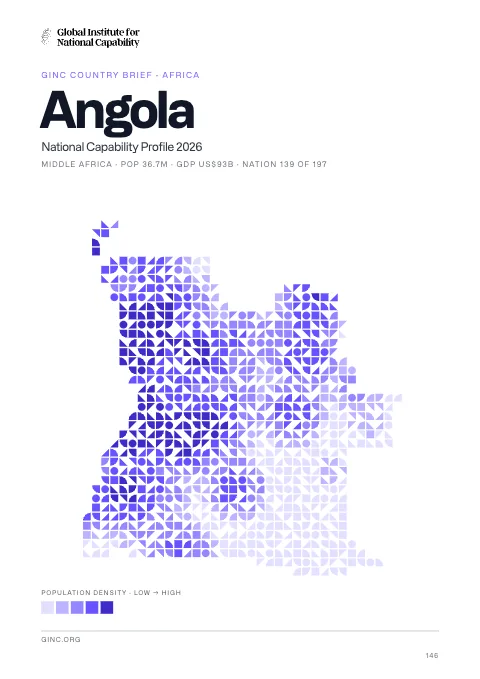
Angola National Capability Profile 2026
Foundations · Chapter 01
Historical Context
🇦🇴 Angola’s understanding the origins and evolution of the modern nation
BackgroundBack to top ↑
Angola is still rebuilding its country since the end of a 27-year civil war in 2002. Fighting between the Popular Movement for the Liberation of Angola (MPLA), led by Jose Eduardo DOS SANTOS, and the National Union for the Total Independence of Angola (UNITA), led by Jonas SAVIMBI, followed independence from Portugal in 1975. Peace seemed imminent in 1992 when Angola held national elections, but fighting picked up again in 1993. Up to 1.5 million lives may have been lost - and 4 million people displaced - during the more than a quarter century of fighting. SAVIMBI's death in 2002 ended UNITA's insurgency and cemented the MPLA's hold on power. President DOS SANTOS pushed through a new constitution in 2010; elections held in 2012 saw him installed as president.
IndependenceBack to top ↑
11 November 1975 (from Portugal)
National holidayBack to top ↑
Independence Day, 11 November (1975)
Foundations · Chapter 02
Geography
🇦🇴 Angola’s territory, resources and strategic position
Location and areaBack to top ↑
Southern Africa, bordering the South Atlantic Ocean, between Namibia and Democratic Republic of the Congo
12 30 S, 18 30 E
Africa
slightly less than twice the size of Texas
1,600 km
Terrain and resourcesBack to top ↑
narrow coastal plain rises abruptly to vast interior plateau
petroleum, diamonds, iron ore, phosphates, copper, feldspar, gold, bauxite, uranium
855.3 sq km (2005)
Settlement and hazardsBack to top ↑
locally heavy rainfall causes periodic flooding on the plateau
the province of Cabinda is an exclave, separated from the rest of the country by the Democratic Republic of the Congo
OtherBack to top ↑
148 cu km (2011)
overuse of pastures and subsequent soil erosion attributable to population pressures; desertification; deforestation of tropical rain forest, in response to both international demand for tropical timber and to domestic use as fuel, resulting in loss of biodiversity; soil erosion contributing to water pollution and siltation of rivers and dams; inadequate supplies of potable water
Foundations · Chapter 03
Environment
🇦🇴 Angola’s environmental conditions, resources and national resilience
ClimateBack to top ↑
semiarid in south and along coast to Luanda; north has cool, dry season (May to October) and hot, rainy season (November to April)
Emissions and pollutionBack to top ↑
Water, waste and foodBack to top ↑
Resources and agreementsBack to top ↑
GINC Capability Domains · Chapter 04
Critical Technology
🇦🇴 Angola’s technology frontiers and the pursuit of national advantage
Two counts are set side by side for 2015–2024: on the left, the papers researchers in Angola published; on the right, the patent families that began there and were filed in more than one country. First by capability group, then group by group with each group’s capabilities. The badge on a card is the nation’s place among all nations. Papers are from GINC Research Analytics, patent families from GINC Patents.
Research by capability group
#170 WorldPapers published, 2015–2024
Patents by capability group
International patent families, 2015–2024
No international patent families on record for 2015–2024.
Advanced Materials & ManufacturingBack to top ↑
Research
#160 WorldPapers published, 2015–2024
Patents
International patent families, 2015–2024
No international patent families on record for 2015–2024.
Energy TechnologiesBack to top ↑
Research
#152 WorldPapers published, 2015–2024
Patents
International patent families, 2015–2024
No international patent families on record for 2015–2024.
Semiconductors & Advanced ComputingBack to top ↑
- Semiconductor Design & EDA
- Advanced Semiconductor Fabrication
- Semiconductor Equipment & Materials
- Advanced Packaging & Heterogeneous Integration
- Compound & Power Semiconductors
- High-Performance & AI Computing
Artificial IntelligenceBack to top ↑
Research
#172 WorldPapers published, 2015–2024
Patents
International patent families, 2015–2024
No international patent families on record for 2015–2024.
Quantum TechnologiesBack to top ↑
Research
#134 WorldPapers published, 2015–2024
Patents
International patent families, 2015–2024
No international patent families on record for 2015–2024.
Connectivity, Cyber & Trust TechnologiesBack to top ↑
- Advanced Optical Communication & Photonics
- Advanced Wireless Communication
- Resilient & Infrastructure-Independent Networks
- Protective Cybersecurity Technologies
- Privacy, Identity & Trust Technologies
Sensing, Timing & NavigationBack to top ↑
Research
#147 WorldPapers published, 2015–2024
Patents
International patent families, 2015–2024
No international patent families on record for 2015–2024.
Robotics & Autonomous SystemsBack to top ↑
Research
#149 WorldPapers published, 2015–2024
No research topic: Human-Machine Interfaces
Patents
International patent families, 2015–2024
No international patent families on record for 2015–2024.
Biotechnology & Health TechnologiesBack to top ↑
Research
#158 WorldPapers published, 2015–2024
Patents
International patent families, 2015–2024
No international patent families on record for 2015–2024.
Medicine and BioTech
Clinical research and life-science invention, drawn from the same series that drive the metric pages. Each card opens the full cross-country comparison.
Space TechnologiesBack to top ↑
- Space Launch & Reusable Systems
- Advanced Propulsion & Hypersonic Systems
- Satellite & Constellation Technologies
GINC Capability Domains · Chapter 05
Strategic Infrastructure
🇦🇴 Angola’s energy, connectivity and the material foundations of capability
Resource InfrastructureBack to top ↑
1.872 million bbl/day (2012 est.)
1.928 million bbl/day (2010 est.)
0 bbl/day (2010 est.)
10.47 billion bbl (1 January 2013 est.)
38,760 bbl/day (2010 est.)
79,430 bbl/day (2011 est.)
17,750 bbl/day (2010 est.)
55,740 bbl/day (2010 est.)
752 million cu m (2011 est.)
733 million cu m (2010 est.)
0 cu m (2011 est.)
0 cu m (2011 est.)
366 billion cu m (1 January 2013 est.)
gas 352 km; liquid petroleum gas 85 km; oil 1,065 km; oil/gas/water 5 km (2013)
Agriculture & Food InfrastructureBack to top ↑
- Irrigation & Agricultural Water
- Livestock & Veterinary
- Fisheries & Aquaculture
- Storage, Cold Chain & Markets
Energy InfrastructureBack to top ↑
- Thermal Generation
- Nuclear Generation
- Nuclear Fuel Cycle & Radioactive Waste
- Hydropower
- Renewable Generation
- Transmission & Distribution
- System Control & Dispatch
- Storage & Fuel Supply
1.155 million kW (2010 est.)
5.118 billion kWh (2010 est.)
4.592 billion kWh (2010 est.)
0 kWh (2012 est.)
0 kWh (2012 est.)
56.9% of total installed capacity (2010 est.)
0% of total installed capacity (2010 est.)
43.1% of total installed capacity (2010 est.)
0% of total installed capacity (2010 est.)
26.97 million Mt (2011 est.)
Water, Sanitation & Waste InfrastructureBack to top ↑
- Dams, Reservoirs & Flood Defence
- Water Supply & Treatment
- Bulk Water Transfer & Desalination
- Wastewater & Sanitation
- Solid Waste & Recycling
Advanced ManufacturingBack to top ↑
- Materials & Inputs
- Chemicals & Hazardous Process Industry
- Production Systems
- Supply Chain & Ecosystem
- Workforce & Innovation
Transport InfrastructureBack to top ↑
- Seaports & Terminals
- Air Infrastructure
- Air Navigation & Traffic Management
- Inland Waterways & Ferries
- Rail Infrastructure
- Roads & Bridges
- Logistics, Multimodal & Border Infrastructure
- Postal & Parcel
176 (2013)
1 (2013)
1,300 km (2011)
Communications & Digital InfrastructureBack to top ↑
- Subsea Cables & International Gateways
- Core & Backbone Networks
- Mobile & Wireless Networks
- Spectrum & Broadcasting
- Data Centres, Compute & Cloud
- Data Resources
- AI Tools & Applications
303,000 (2012)
9.8 million (2012)
606,700 (2009)
20,703 (2012)
.ao
Financial InfrastructureBack to top ↑
- Currency & Reserves
- Payments & Settlement Systems
- Markets, Exchanges & Depositories
- Banks, Insurers & Systemic Institutions
Social InfrastructureBack to top ↑
- Health Infrastructure
- Public Health & Laboratories
- Medical Supply & Stockpiles
- Education & Skills Infrastructure
- Research & Scientific Facilities
- Housing, Community & Social Services
- Government & Public Administration
- Cultural, Community & Recreational Infrastructure
- Justice & Corrections
- Emergency Services & Civil Protection
- Hydrometeorology & Early Warning
Space, Aerospace & Defence InfrastructureBack to top ↑
GINC Capability Domains · Chapter 06
National Security
🇦🇴 Angola’s force, intelligence and the defence of the nation
Disputes and terrorismBack to top ↑
Democratic Republic of Congo accuses Angola of shifting monuments
Force Generation & MobilisationBack to top ↑
Angolan Armed Forces (Forcas Armadas Angolanas, FAA): Army, Navy (Marinha de Guerra Angola, MGA), Angolan National Air Force (Forca Aerea Nacional Angolana, FANA; under operational control of the Army) (2012)
20-45 years of age for compulsory male and 18-45 years for voluntary male military service (registration at age 18 is mandatory); 20-45 years of age for voluntary female service; conscript service obligation - 2 years; Angolan citizenship required; the Navy (MGA) is entirely staffed with volunteers (2013)
3.63% of GDP (2012)//3.5% of GDP (2011)//3.63% of GDP (2010)
Forces under arms
Active-duty strength on the Correlates of War series, which reaches back to 1816 and so carries a nation’s whole record of mobilisation rather than its present establishment. The card opens the full cross-country comparison.
Intelligence & AssessmentBack to top ↑
- Imagery & Geospatial Intelligence
- Signals & Cyber Intelligence
- Technical & Measurement Intelligence
- Open-Source & Financial Intelligence
- Human Intelligence & Counterintelligence
- All-Source Analysis & Warning
Joint Command, Projection & SustainmentBack to top ↑
- Command, Control & Communications
- Strategic Lift & Mobility
- Expeditionary & Peace Operations
- Operational Sustainment & War Reserves
- Defence Industrial Mobilisation
- CBRN Defence
Land PowerBack to top ↑
- Combined Arms Manoeuvre
- Land Fires
- Battlefield Aviation & Uncrewed Systems
- Special Operations & Irregular Warfare
Maritime PowerBack to top ↑
- Maritime Security & Constabulary
- Sea Denial & Undersea Warfare
- Sea Control
- Amphibious & Expeditionary Operations
Air PowerBack to top ↑
- Air Sovereignty & Policing
- Control of the Air
- Air Strike & Interdiction
- Airborne ISR, Early Warning & Battle Management
Strategic Strike & Missile DefenceBack to top ↑
Space OperationsBack to top ↑
Cyber & Electromagnetic OperationsBack to top ↑
Nuclear DeterrenceBack to top ↑
GINC Capability Domains · Chapter 07
Human Capital
🇦🇴 Angola’s population, health and the skills that sustain capability
DemographyBack to top ↑
19,088,106 (July 2014 est.)
2.78% (2014 est.)
38.97 births/1,000 population (2014 est.)
11.67 deaths/1,000 population (2014 est.)
5.43 children born/woman (2014 est.)
18 (2008-09 est.)
17.7% (2009)
Migration and urbanisationBack to top ↑
0.47 migrant(s)/1,000 population (2014 est.)
LUANDA (capital) 5.068 million; Huambo 1.098 million (2011)
Welfare and equityBack to top ↑
40.5% (2006 est.)
DisplacementBack to top ↑
Early Childhood DevelopmentBack to top ↑
15.6% (2007)
Foundational EducationBack to top ↑
3.5% of GDP (2010)
Advanced EducationBack to top ↑
Technical & Vocational SkillsBack to top ↑
Digital & AI CompetenceBack to top ↑
Generative AI adoption
Modelled share of working-age adults using generative AI, from Microsoft telemetry scaled to each country’s 15–64 population. A measure of how fast a workforce is absorbing the technology rather than of how much of it a nation builds. The card opens the full cross-country comparison.
Lifelong Learning & ReskillingBack to top ↑
Research Talent & Knowledge CreationBack to top ↑
Population HealthBack to top ↑
450 deaths/100,000 live births (2010)
6.4% (2008)
2.3% (2012 est.)
248,800 (2012 est.)
12,600 (2012 est.)
Health System CapabilityBack to top ↑
3.5% of GDP (2011)
0.17 physicians/1,000 population (2009)
0.8 beds/1,000 population (2005)
GINC Capability Domains · Chapter 08
Governance and Integrity
🇦🇴 Angola’s institutions, law and the integrity of the state
State structureBack to top ↑
republic; multiparty presidential regime
18 provinces (provincias, singular - provincia); Bengo, Benguela, Bie, Cabinda, Cunene, Huambo, Huila, Kwando Kubango, Kwanza Norte, Kwanza Sul, Luanda, Lunda Norte, Lunda Sul, Malanje, Moxico, Namibe, Uige, Zaire
previous 1975, 1992; latest adopted 5 February 2010 (2013)
18 years of age; universal
Political Institutions & Civic ParticipationBack to top ↑
- Electoral Management & Integrity
- Legislature & Deliberative Institutions
- Citizen Participation & Civic Space
unicameral National Assembly or Assembleia Nacional (220 seats; members elected by proportional vote to serve five-year terms)
Broad Convergence for the Salvation of Angola Electoral Coalition or CASA-CE [Abel CHIVUKUVUKU]//National Front for the Liberation of Angola or FNLA [Lucas NGONDA]//National Union for the Total Independence of Angola or UNITA [Isaias SAMAKUVA] (largest opposition party)//Popular Movement for the Liberation of Angola or MPLA [Jose Eduardo DOS SANTOS] (ruling party in power since 1975)//Social Renewal Party or PRS [Eduardo KUANGANA]
Front for the Liberation of the Enclave of Cabinda or FLEC [N'zita Henriques TIAGO]
Justice System & Fundamental RightsBack to top ↑
- Judicial Independence & Court Capability
- Access to Justice & Legal Services
- Fundamental Rights Protection
- Human Rights Institutions & Equality Bodies
civil legal system based on Portuguese civil law; no judicial review of legislation
has not submitted an ICJ jurisdiction declaration; non-party state to the ICCt
Internal Security & OrderBack to top ↑
used as a transshipment point for cocaine destined for Western Europe and other African states, particularly South Africa
Regulatory Governance & Strategic ControlsBack to top ↑
- Regulatory Quality & Better Regulation
- Regulatory Delivery & Independent Regulators
- Strategic Controls & Economic Security Administration
Government Effectiveness & Public AdministrationBack to top ↑
- Centre of Government & Policy Coordination
- Civil Service & Public Workforce
- Digital Government & Service Delivery
- Legal Identity & Civil Registration
- Statistical & Data Capability
Public Integrity & Anti-CorruptionBack to top ↑
Transparency, Oversight & AccountabilityBack to top ↑
- Right to Information & Open Government
- Independent Oversight & Supreme Audit
- Independent Media & Journalist Safety
National Resilience & Crisis ManagementBack to top ↑
GINC Capability Domains · Chapter 09
Information and Influence
🇦🇴 Angola’s identity, media and the projection of influence
Identity and cultureBack to top ↑
Portuguese (official), Bantu and other African languages
indigenous beliefs 47%, Roman Catholic 38%, Protestant 15% (1998 est.)
Ovimbundu 37%, Kimbundu 25%, Bakongo 13%, mestico (mixed European and native African) 2%, European 1%, other 22%
Palanca Negra Gigante (giant black sable antelope)
two equal horizontal bands of red (top) and black with a centered yellow emblem consisting of a five-pointed star within half a cogwheel crossed by a machete (in the style of a hammer and sickle); red represents liberty, black the African continent, the symbols characterize workers and peasants
Diplomatic Statecraft & Global NetworksBack to top ↑
- Diplomatic Network & Consular Reach
- Multilateral Leadership & Norm Setting
- Agenda-Setting & Convening
- Mediation & Crisis Diplomacy
ACP, AfDB, AU, CPLP, FAO, G-77, IAEA, IBRD, ICAO, ICRM, IDA, IFAD, IFC, IFRCS, ILO, IMF, IMO, Interpol, IOC, IOM, IPU, ISO (correspondent), ITSO, ITU, ITUC (NGOs), MIGA, NAM, OAS (observer), OPEC, SADC, UN, UNCTAD, UNESCO, UNIDO, Union Latina, UNWTO, UPU, WCO, WFTU (NGOs), WHO, WIPO, WMO, WTO
Alliances & Security CooperationBack to top ↑
Development Cooperation & Global AssistanceBack to top ↑
Culture, Language & Education DiplomacyBack to top ↑
- Cultural & Language Institutes
- Creative Industries & Cultural Export Reach
- Heritage & Cultural Institutions
- Education Diplomacy & Alumni Networks
- Sports & Major Events
Diaspora & Global CommunitiesBack to top ↑
Information Environment & Strategic CommunicationBack to top ↑
- Strategic Communications & Public Diplomacy
- International Media & Broadcasting
- Information Defence & Counter-Interference
state controls all broadcast media with nationwide reach; state-owned Televisao Popular de Angola (TPA) provides terrestrial TV service on 2 channels; a third TPA channel is available via cable and satellite; TV subscription services are available; state-owned Radio Nacional de Angola (RNA) broadcasts on 5 stations; about a half dozen private radio stations broadcast locally (2008)
GINC Capability Domains · Chapter 10
Financial Strength
🇦🇴 Angola’s fiscal depth, reserves and the capacity to act
Monetary & Currency CapabilityBack to top ↑
- Monetary Policy & Price Stability
- Exchange Rate & External Account Management
- Currency Issuance & Digital Money
8.9% (2013 est.)//10.3% (2012 est.)
kwanza (AOA) per US dollar -//95.97 (2013 est.)//95.468 (2012 est.)//91.906 (2010 est.)//79.33 (2009)//75.023 (2008)
$NA (31 December 2010 est.)//30% (31 December 2009 est.)
15% (31 December 2013 est.)//16.81% (31 December 2012 est.)
$16.95 billion (31 December 2013 est.)//$13.31 billion (31 December 2012 est.)
$50.71 billion (31 December 2013 est.)//$40.34 billion (31 December 2012 est.)
Fiscal Capacity & Public FinanceBack to top ↑
- Revenue Mobilisation & Tax Administration
- Public Expenditure & Budget Management
- Sovereign Debt & Treasury Management
- Public Investment Management
42.5% of GDP (2013 est.)
3.4% of GDP (2013 est.)
14.7% of GDP (2013 est.)//17.2% of GDP (2012 est.)
calendar year
Financial System Depth & AccessBack to top ↑
- Banking System Capacity
- Capital Markets Depth & Development
- Long-Term & Institutional Capital
- Financial Inclusion & Household Access
- Development & Policy Finance
NA% (31 December 2013 est.)//$20.45 billion (31 December 2012 est.)
19.1% of GDP (2013 est.)//23.8% of GDP (2012 est.)//24% of GDP (2011 est.)
Financial Regulation & IntegrityBack to top ↑
- Prudential Regulation & Supervision
- Financial Integrity & Illicit Finance Control
- Market Conduct & Consumer Protection
- Payment & Market Infrastructure Oversight
Financial Stability & Crisis ManagementBack to top ↑
- Macroprudential & Systemic Oversight
- Crisis Management, Resolution & Deposit Insurance
- External Liquidity & Financial Safety Nets
Sovereign Capital & External Financial PowerBack to top ↑
- Official Reserves Management
- Sovereign Wealth & Public Asset Management
- Currency Internationalisation & Reserve Status
- Capital Account & Flow Management
- International Financial Centre Capability
$37.94 billion (31 December 2013 est.)//$33.41 billion (31 December 2012 est.)
$22.71 billion (31 December 2013 est.)//$21.85 billion (31 December 2012 est.)
GINC Capability Domains · Chapter 11
Production and Innovation
🇦🇴 Angola’s output, industry and the engine of prosperity
Economic Output & ProductivityBack to top ↑
Angola's high growth rate in recent years was driven by high international prices for its oil. Angola became a member of OPEC in late 2006 and its current assigned a production quota of 1.65 million barrels a day (bbl/day). Oil production and its supporting activities contribute about 85% of GDP. Diamond exports contribute an additional 5%. Subsistence agriculture provides the main livelihood for most of the people, but half of the country's food is still imported. Increased oil production supported growth averaging more than 17% per year from 2004 to 2008. A postwar reconstruction boom and resettlement of displaced persons has led to high rates of growth in construction and agriculture as well. Much of the country's infrastructure is still damaged or undeveloped from the 27-year-long civil war. Land mines left from the war still mar the countryside, even though peace was established after the death of rebel leader Jonas SAVIMBI in February 2002. Since 2005, the government has used billions of dollars in credit lines from China, Brazil, Portugal, Germany, Spain, and the EU to rebuild Angola's public infrastructure. The global recession that started in 2008 temporarily stalled economic growth. Lower prices for oil and diamonds during the global recession slowed GDP growth to 2.4% in 2009, and many construction projects stopped because Luanda accrued $9 billion in arrears to foreign construction companies when government revenue fell in 2008 and 2009. Angola abandoned its currency peg in 2009, and in November 2009 signed onto an IMF Stand-By Arrangement loan of $1.4 billion to rebuild international reserves. Consumer inflation declined from 325% in 2000 to about 10% in 2012. Higher oil prices have helped Angola turn a budget deficit of 8.6% of GDP in 2009 into an surplus of 12% of GDP in 2012. Corruption, especially in the extractive sectors, also is a major challenge.
$131.8 billion (2013 est.)//$124.8 billion (2012 est.)//$118.7 billion (2011 est.)
5.6% (2013 est.)//5.2% (2012 est.)//3.9% (2011 est.)
$6,300 (2013 est.)//$6,200 (2012 est.)//$6,000 (2011 est.)
$124 billion (2013 est.)
Labour & EmploymentBack to top ↑
- Employment & Labour Force Participation
- Labour Market Institutions & Wage Setting
- Employment Services & Skills Matching
- Labour Adjustment, Transition & Formalisation
9.018 million (2013 est.)
NA%
Industrial & Sectoral BaseBack to top ↑
- Manufacturing & Advanced Industry
- Foundational & Process Industries
- Agrifood & Primary Production
- Services Economy
bananas, sugarcane, coffee, sisal, corn, cotton, cassava (manioc, tapioca), tobacco, vegetables, plantains; livestock; forest products; fish
petroleum; diamonds, iron ore, phosphates, feldspar, bauxite, uranium, and gold; cement; basic metal products; fish processing; food processing, brewing, tobacco products, sugar; textiles; ship repair
5.5% (2013 est.)
Structural Transformation & ComplexityBack to top ↑
Business Dynamism & EntrepreneurshipBack to top ↑
- Entrepreneurship & Firm Creation
- Risk Capital & Scale-Up Finance
- Firm Growth, Exit & Renewal
- Competition & Market Contestability
Innovation & CommercialisationBack to top ↑
- Business Innovation Capability
- Research Commercialisation & Knowledge Transfer
- Intellectual Property & Intangible Assets
- Innovation Ecosystems & Clusters
Technology Adoption & DiffusionBack to top ↑
GINC Capability Domains · Chapter 12
Trade and Investment
🇦🇴 Angola’s markets, capital and the terms of global exchange
Overall tradeBack to top ↑
$41.9B of exports to 149 partners and $14.8B of imports from 192 in 2024, a surplus of $27.1B.
- Exports
- $41.9B149 partners
- Imports
- $14.8B192 partners
- Balance
- +$27.1Bsurplus
- Total trade
- $56.7B2024
ExportsBack to top ↑
Where its exports go
The largest partners in 2024, with each one's share of the nation's exports.
| Partner | Value | Share | |
|---|---|---|---|
| China | $15.8B | 38% | |
| India | $5.98B | 14% | |
| Spain | $2.73B | 6.5% | |
| United States | $2.61B | 6.2% | |
| France | $1.77B | 4.2% | |
| Indonesia | $1.71B | 4.1% | |
| United Arab Emirates | $1.24B | 3.0% | |
| Singapore | $1.19B | 2.8% | |
| Brazil | $991M | 2.4% | |
| South Africa | $825M | 2.0% | |
| Netherlands | $763M | 1.8% | |
| Canada | $729M | 1.7% | |
| United Kingdom | $703M | 1.7% | |
| Italy | $596M | 1.4% | |
| Belgium | $592M | 1.4% | |
| Thailand | $469M | 1.1% | |
| Malaysia | $419M | 1.0% | |
| Togo | $246M | 0.6% | |
| Vietnam | $240M | 0.6% | |
| Republic of the Congo | $216M | 0.5% |
What it exports
The largest categories in 2024.
| Category | Value | Share | |
|---|---|---|---|
| Mineral fuels, oils, distillation products | $34.8B | 83% | |
| Pearls, precious stones, metals, coins | $3.37B | 8.0% | |
| Ships, boats, and other floating structures | $2.71B | 6.5% | |
| Machinery, nuclear reactors, boilers | $202M | 0.5% | |
| Iron and steel | $90.1M | 0.2% | |
| Salt, sulphur, earth, stone, plaster, lime and cement | $86.4M | 0.2% | |
| Aircraft, spacecraft | $67.5M | 0.2% | |
| Aluminum | $45.5M | 0.1% | |
| Copper | $45.3M | 0.1% | |
| Optical, photo, technical, medical apparatus | $45.0M | 0.1% | |
| Articles of iron or steel | $41.8M | <0.1% | |
| Residues, wastes of food industry, animal fodder | $38.0M | <0.1% | |
| Fish, crustaceans, molluscs, aquatics invertebrates | $37.8M | <0.1% | |
| Electrical, electronic equipment | $36.4M | <0.1% | |
| Glass and glassware | $26.0M | <0.1% |
ImportsBack to top ↑
Where its imports come from
The largest partners in 2024, with each one's share of the nation's imports.
| Partner | Value | Share | |
|---|---|---|---|
| China | $2.43B | 16% | |
| Portugal | $1.29B | 8.8% | |
| United Kingdom | $1.08B | 7.3% | |
| India | $853M | 5.8% | |
| United States | $827M | 5.6% | |
| South Korea | $667M | 4.5% | |
| Belgium | $617M | 4.2% | |
| Italy | $577M | 3.9% | |
| France | $570M | 3.9% | |
| Brazil | $539M | 3.6% | |
| South Africa | $483M | 3.3% | |
| United Arab Emirates | $458M | 3.1% | |
| Singapore | $408M | 2.8% | |
| Germany | $343M | 2.3% | |
| Malaysia | $293M | 2.0% | |
| Norway | $265M | 1.8% | |
| Nigeria | $253M | 1.7% | |
| Netherlands | $205M | 1.4% | |
| Poland | $203M | 1.4% | |
| Indonesia | $200M | 1.4% |
What it imports
The largest categories in 2024.
| Category | Value | Share | |
|---|---|---|---|
| Mineral fuels, oils, distillation products | $2.74B | 19% | |
| Machinery, nuclear reactors, boilers | $2.59B | 18% | |
| Electrical, electronic equipment | $994M | 6.7% | |
| Articles of iron or steel | $964M | 6.5% | |
| Cereals | $923M | 6.3% | |
| Vehicles other than railway, tramway | $840M | 5.7% | |
| Plastics | $489M | 3.3% | |
| Optical, photo, technical, medical apparatus | $435M | 2.9% | |
| Meat and edible meat offal | $404M | 2.7% | |
| Animal, vegetable fats and oils, cleavage products | $301M | 2.0% | |
| Pharmaceutical products | $249M | 1.7% | |
| Miscellaneous articles of base metal | $220M | 1.5% | |
| Ships, boats, and other floating structures | $204M | 1.4% | |
| Iron and steel | $187M | 1.3% | |
| Printed books, newspapers, pictures | $187M | 1.3% |
In a list, the bar runs to the largest in that list. The line is each figure’s history from 2000, drawn to its own peak: it shows the shape of the years, and the value shows the size.
External balanceBack to top ↑
$10.69 billion (2013 est.)//$13.85 billion (2012 est.)
Trade Facilitation & LogisticsBack to top ↑
Trade Policy & Market AccessBack to top ↑
- Trade Policy & Negotiation Capability
- Market Access & Agreements Network
- Trade Law & Enforcement
- Standards, Conformity & Quality Infrastructure
Digital & Services TradeBack to top ↑
- Services Trade Capability
- Digital Trade & E-Commerce
- Data Flows & Digital Trade Governance
- Tourism & Visitor Economy
Investment Attraction & ProjectionBack to top ↑
- Investment Attraction & Facilitation
- Investment Absorption & Linkages
- Outward Investment & Global Corporate Presence
$17.15 billion (31 December 2012 est.)//$12.15 billion (31 December 2011 est.)
$12.87 billion (31 December 2013 est.)//$9.877 billion (31 December 2012 est.)
Export Capability & SophisticationBack to top ↑
$70.84 billion (2013 est.)//$71.09 billion (2012 est.)
China 46.3%, US 13.9%, India 10.1%, South Africa 4.2% (2012)
crude oil, diamonds, refined petroleum products, coffee, sisal, fish and fish products, timber, cotton
Global Value Chain PositionBack to top ↑
- Value Chain Participation & Integration
- Value Chain Position & Upgrading
- Regional Integration & Hub Anchoring
Economic Leverage & DependenceBack to top ↑
- Strategic Supply Security
- Concentration Risk & Revenue Stabilisation
- Economic Leverage & Coercion Resistance
$26.09 billion (2013 est.)//$23.72 billion (2012 est.)
China 20.9%, Portugal 19.5%, US 7.7%, South Africa 7.1%, Brazil 5.9% (2012)
machinery and electrical equipment, vehicles and spare parts; medicines, food, textiles, military goods
Angola · you are in
Historical Context
Foundations
GINC Capability Domains
Find in this brief · Angola