
Bolivia
Bolivia is a landlocked republic in South America, home to 11 million people, with its capital at La Paz.
Contents
12 chapters
Foundations
01–03
At a glance
- Area
- 1.1Mkm²#28 World#5 S. America
- Population
- 10.6M#81 World#8 S. America
- GDP (market)
- $30.8B
- GDP (PPP)
- $59.1B#91 World#8 S. America
- GDP per capita
- $5.5K#156 World#13 S. America
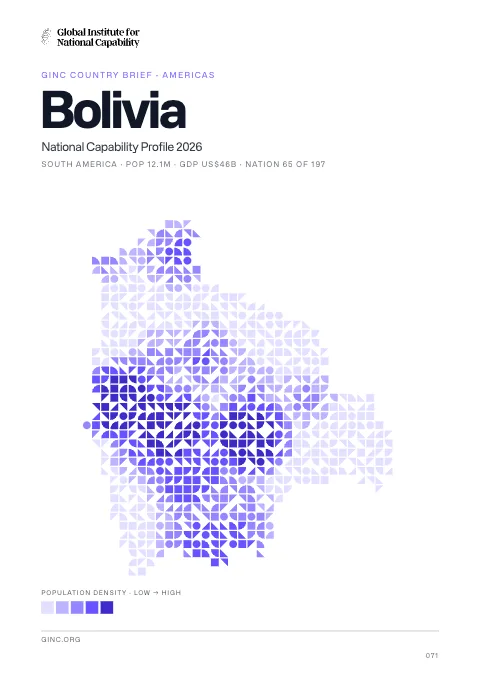
The whole brief
Bolivia National Capability Profile 2026
Foundations · Chapter 01
Historical Context
🇧🇴 Bolivia’s understanding the origins and evolution of the modern nation
BackgroundBack to top ↑
Bolivia, named after independence fighter Simon BOLIVAR, broke away from Spanish rule in 1825; much of its subsequent history has consisted of a series of nearly 200 coups and countercoups. Democratic civilian rule was established in 1982, but leaders have faced difficult problems of deep-seated poverty, social unrest, and illegal drug production. In December 2005, Bolivians elected Movement Toward Socialism leader Evo MORALES president - by the widest margin of any leader since the restoration of civilian rule in 1982 - after he ran on a promise to change the country's traditional political class and empower the nation's poor, indigenous majority. In December 2009, President MORALES easily won reelection, and his party took control of the legislative branch of the government, which will allow him to continue his process of change. In October 2011, the country held its first judicial elections to select judges for the four highest courts.
IndependenceBack to top ↑
6 August 1825 (from Spain)
National holidayBack to top ↑
Independence Day, 6 August (1825)
Foundations · Chapter 02
Geography
🇧🇴 Bolivia’s territory, resources and strategic position
Location and areaBack to top ↑
Central South America, southwest of Brazil
17 00 S, 65 00 W
South America
slightly less than three times the size of Montana
0 km (landlocked)
none (landlocked)
Terrain and resourcesBack to top ↑
rugged Andes Mountains with a highland plateau (Altiplano), hills, lowland plains of the Amazon Basin
tin, natural gas, petroleum, zinc, tungsten, antimony, silver, iron, lead, gold, timber, hydropower
1,282 sq km (2003)
Settlement and hazardsBack to top ↑
flooding in the northeast (March to April)
landlocked; shares control of Lago Titicaca, world's highest navigable lake (elevation 3,805 m), with Peru
OtherBack to top ↑
622.5 cu km (2011)
the clearing of land for agricultural purposes and the international demand for tropical timber are contributing to deforestation; soil erosion from overgrazing and poor cultivation methods (including slash-and-burn agriculture); desertification; loss of biodiversity; industrial pollution of water supplies used for drinking and irrigation
Foundations · Chapter 03
Environment
🇧🇴 Bolivia’s environmental conditions, resources and national resilience
ClimateBack to top ↑
varies with altitude; humid and tropical to cold and semiarid
Emissions and pollutionBack to top ↑
Water, waste and foodBack to top ↑
Resources and agreementsBack to top ↑
GINC Capability Domains · Chapter 04
Critical Technology
🇧🇴 Bolivia’s technology frontiers and the pursuit of national advantage
Two counts are set side by side for 2015–2024: on the left, the papers researchers in Bolivia published; on the right, the patent families that began there and were filed in more than one country. First by capability group, then group by group with each group’s capabilities. The badge on a card is the nation’s place among all nations. Papers are from GINC Research Analytics, patent families from GINC Patents.
Research by capability group
#134 WorldPapers published, 2015–2024
Patents by capability group
International patent families, 2015–2024
No international patent families on record for 2015–2024.
Advanced Materials & ManufacturingBack to top ↑
Research
#127 WorldPapers published, 2015–2024
Patents
International patent families, 2015–2024
No international patent families on record for 2015–2024.
Energy TechnologiesBack to top ↑
Research
#127 WorldPapers published, 2015–2024
Patents
International patent families, 2015–2024
No international patent families on record for 2015–2024.
Semiconductors & Advanced ComputingBack to top ↑
Research
#121 WorldPapers published, 2015–2024
No research topic: Semiconductor Design & EDA · Advanced Semiconductor Fabrication · Semiconductor Equipment & Materials · Advanced Packaging & Heterogeneous Integration
Patents
International patent families, 2015–2024
No international patent families on record for 2015–2024.
Artificial IntelligenceBack to top ↑
Research
#137 WorldPapers published, 2015–2024
Patents
International patent families, 2015–2024
No international patent families on record for 2015–2024.
Quantum TechnologiesBack to top ↑
Research
#111 WorldPapers published, 2015–2024
Patents
International patent families, 2015–2024
No international patent families on record for 2015–2024.
Connectivity, Cyber & Trust TechnologiesBack to top ↑
Research
#118 WorldPapers published, 2015–2024
Patents
International patent families, 2015–2024
No international patent families on record for 2015–2024.
Sensing, Timing & NavigationBack to top ↑
Research
#124 WorldPapers published, 2015–2024
Patents
International patent families, 2015–2024
No international patent families on record for 2015–2024.
Robotics & Autonomous SystemsBack to top ↑
Research
#110 WorldPapers published, 2015–2024
No research topic: Human-Machine Interfaces
Patents
International patent families, 2015–2024
No international patent families on record for 2015–2024.
Biotechnology & Health TechnologiesBack to top ↑
Research
#137 WorldPapers published, 2015–2024
Patents
International patent families, 2015–2024
No international patent families on record for 2015–2024.
Medicine and BioTech
Clinical research and life-science invention, drawn from the same series that drive the metric pages. Each card opens the full cross-country comparison.
Space TechnologiesBack to top ↑
Research
#79 WorldPapers published, 2015–2024
Patents
International patent families, 2015–2024
No international patent families on record for 2015–2024.
GINC Capability Domains · Chapter 05
Strategic Infrastructure
🇧🇴 Bolivia’s energy, connectivity and the material foundations of capability
Resource InfrastructureBack to top ↑
51,200 bbl/day (2013 est.)
60.71 bbl/day (2013 est.)
0 bbl/day (2013 est.)
209.8 million bbl (1 January 2013 est.)
40,000 bbl/day (2013 est.)
55,560 bbl/day (2013 est.)
0 bbl/day (2013 est.)
15,560 bbl/day (2013 est.)
54.37 billion cu m (2013 est.)
9.432 billion cu m (2013 est.)
44.94 billion cu m (2013 est.)
0 cu m (2013 est.)
281.5 billion cu m (1 January 2013 est.)
gas 5,457 km; liquid petroleum gas 51 km; oil 2,511 km; refined products 1,627 km (2013)
Agriculture & Food InfrastructureBack to top ↑
- Irrigation & Agricultural Water
- Livestock & Veterinary
- Fisheries & Aquaculture
- Storage, Cold Chain & Markets
Energy InfrastructureBack to top ↑
- Thermal Generation
- Nuclear Generation
- Nuclear Fuel Cycle & Radioactive Waste
- Hydropower
- Renewable Generation
- Transmission & Distribution
- System Control & Dispatch
- Storage & Fuel Supply
1.365 million kW (2012 est.)
7.375 billion kWh (2013 est.)
6.944 billion kWh (2012 est.)
0 kWh (2013 est.)
0 kWh (2013 est.)
63.6% of total installed capacity (2012 est.)
0% of total installed capacity (2012 est.)
34.9% of total installed capacity (2012 est.)
1.5% of total installed capacity (2012 est.)
13.98 million Mt (2011 est.)
Water, Sanitation & Waste InfrastructureBack to top ↑
- Dams, Reservoirs & Flood Defence
- Water Supply & Treatment
- Bulk Water Transfer & Desalination
- Wastewater & Sanitation
- Solid Waste & Recycling
Advanced ManufacturingBack to top ↑
- Materials & Inputs
- Chemicals & Hazardous Process Industry
- Production Systems
- Supply Chain & Ecosystem
- Workforce & Innovation
Transport InfrastructureBack to top ↑
- Seaports & Terminals
- Air Infrastructure
- Air Navigation & Traffic Management
- Inland Waterways & Ferries
- Rail Infrastructure
- Roads & Bridges
- Logistics, Multimodal & Border Infrastructure
- Postal & Parcel
855 (2013)
10,000 km (commercially navigable almost exclusively in the northern and eastern parts of the country) (2012)
Communications & Digital InfrastructureBack to top ↑
- Subsea Cables & International Gateways
- Core & Backbone Networks
- Mobile & Wireless Networks
- Spectrum & Broadcasting
- Data Centres, Compute & Cloud
- Data Resources
- AI Tools & Applications
880,600 (2012)
9.494 million (2012)
1.103 million (2009)
180,988 (2012)
.bo
Financial InfrastructureBack to top ↑
- Currency & Reserves
- Payments & Settlement Systems
- Markets, Exchanges & Depositories
- Banks, Insurers & Systemic Institutions
Social InfrastructureBack to top ↑
- Health Infrastructure
- Public Health & Laboratories
- Medical Supply & Stockpiles
- Education & Skills Infrastructure
- Research & Scientific Facilities
- Housing, Community & Social Services
- Government & Public Administration
- Cultural, Community & Recreational Infrastructure
- Justice & Corrections
- Emergency Services & Civil Protection
- Hydrometeorology & Early Warning
Space, Aerospace & Defence InfrastructureBack to top ↑
GINC Capability Domains · Chapter 06
National Security
🇧🇴 Bolivia’s force, intelligence and the defence of the nation
Disputes and terrorismBack to top ↑
Chile and Peru rebuff Bolivia's reactivated claim to restore the Atacama corridor, ceded to Chile in 1884, but Chile offers instead unrestricted but not sovereign maritime access through Chile for Bolivian natural gas; contraband smuggling, human trafficking, and illegal narcotic trafficking are problems in the porous areas of the border with Argentina
Force Generation & MobilisationBack to top ↑
Bolivian Armed Forces: Bolivian Army (Ejercito Boliviano, EB), Bolivian Naval Force (Fuerza Naval Boliviana, FNB; includes Marines), Bolivian Air Force (Fuerza Aerea Boliviana, FAB) (2013)
18-49 years of age for 12-month compulsory male and female military service; Bolivian citizenship required; 17 years of age for voluntary service; when annual number of volunteers falls short of goal, compulsory recruitment is effected, including conscription of boys as young as 14; 15-19 years of age for voluntary premilitary service, provides exemption from further military service (2013)
1.47% of GDP (2012)//1.47% of GDP (2011)//1.47% of GDP (2010)
Forces under arms
Active-duty strength on the Correlates of War series, which reaches back to 1816 and so carries a nation’s whole record of mobilisation rather than its present establishment. The card opens the full cross-country comparison.
Intelligence & AssessmentBack to top ↑
- Imagery & Geospatial Intelligence
- Signals & Cyber Intelligence
- Technical & Measurement Intelligence
- Open-Source & Financial Intelligence
- Human Intelligence & Counterintelligence
- All-Source Analysis & Warning
Joint Command, Projection & SustainmentBack to top ↑
- Command, Control & Communications
- Strategic Lift & Mobility
- Expeditionary & Peace Operations
- Operational Sustainment & War Reserves
- Defence Industrial Mobilisation
- CBRN Defence
Land PowerBack to top ↑
- Combined Arms Manoeuvre
- Land Fires
- Battlefield Aviation & Uncrewed Systems
- Special Operations & Irregular Warfare
Maritime PowerBack to top ↑
- Maritime Security & Constabulary
- Sea Denial & Undersea Warfare
- Sea Control
- Amphibious & Expeditionary Operations
Air PowerBack to top ↑
- Air Sovereignty & Policing
- Control of the Air
- Air Strike & Interdiction
- Airborne ISR, Early Warning & Battle Management
Strategic Strike & Missile DefenceBack to top ↑
Space OperationsBack to top ↑
Cyber & Electromagnetic OperationsBack to top ↑
Nuclear DeterrenceBack to top ↑
GINC Capability Domains · Chapter 07
Human Capital
🇧🇴 Bolivia’s population, health and the skills that sustain capability
DemographyBack to top ↑
10,631,486 (July 2014 est.)
Bolivia ranks at or near the bottom among Latin American countries in several areas of health and development, including poverty, education, fertility, malnutrition, mortality, and life expectancy. On the positive side, more children are being vaccinated and more pregnant women are getting prenatal care and having skilled health practitioners attend their births. Bolivia's income inequality is the highest in Latin America and one of the highest in the world. Public education is of poor quality, and educational opportunities are among the most unevenly distributed in Latin America, with girls and indigenous and rural children less likely to be literate or to complete primary school. The lack of access to education and family planning services helps to sustain Bolivia's high fertility rate - approximately three children per woman. Bolivia's lack of clean water and basic sanitation, especially in rural areas, contributes to health problems.//Almost 7% of Bolivia's population lives abroad, primarily to work in Argentina, Brazil, Spain, and the United States. In recent years, more restrictive immigration policies in Europe and the United States have increased the flow of Bolivian emigrants to neighboring Argentina and Brazil.
1.6% (2014 est.)
23.28 births/1,000 population (2014 est.)
6.59 deaths/1,000 population (2014 est.)
2.8 children born/woman (2014 est.)
21.2
60.5% (2008)
Migration and urbanisationBack to top ↑
-0.69 migrant(s)/1,000 population (2014 est.)
Santa Cruz 1.719 million; LA PAZ (capital) 1.715 million; Sucre (constitutional capital) 307,000 (2011)
Welfare and equityBack to top ↑
45%
47 (2011)//57.9 (1999)
Early Childhood DevelopmentBack to top ↑
4.5% (2008)
Foundational EducationBack to top ↑
6.9% of GDP (2011)
Advanced EducationBack to top ↑
Technical & Vocational SkillsBack to top ↑
Digital & AI CompetenceBack to top ↑
Generative AI adoption
Modelled share of working-age adults using generative AI, from Microsoft telemetry scaled to each country’s 15–64 population. A measure of how fast a workforce is absorbing the technology rather than of how much of it a nation builds. The card opens the full cross-country comparison.
Lifelong Learning & ReskillingBack to top ↑
Research Talent & Knowledge CreationBack to top ↑
Population HealthBack to top ↑
190 deaths/100,000 live births (2008)
17.9% (2008)
0.3% (2012 est.)
15,900 (2012 est.)
1,300 (2012 est.)
Health System CapabilityBack to top ↑
4.9% of GDP (2011)
1.22 physicians/1,000 population (2001)
1.1 beds/1,000 population (2011)
GINC Capability Domains · Chapter 08
Governance and Integrity
🇧🇴 Bolivia’s institutions, law and the integrity of the state
State structureBack to top ↑
republic; note - the new constitution defines Bolivia as a "Social Unitarian State"
9 departments (departamentos, singular - departamento); Beni, Chuquisaca, Cochabamba, La Paz, Oruro, Pando, Potosi, Santa Cruz, Tarija
many previous; latest drafted 6 August 2006 - 9 December 2008, approved by referendum 25 January 2009, effective 7 February 2009; amended 2013 (2013)
18 years of age, universal and compulsory
Political Institutions & Civic ParticipationBack to top ↑
- Electoral Management & Integrity
- Legislature & Deliberative Institutions
- Citizen Participation & Civic Space
bicameral Plurinational Legislative Assembly or Asamblea Legislativa Plurinacional consists of Chamber of Senators or Camara de Senadores (36 seats; members are elected by proportional representation from party lists to serve five-year terms) and Chamber of Deputies or Camara de Diputados (130 seats total; 70 uninominal deputies directly elected from a single district, 7 "special" indigenous deputies directly elected from non-contiguous indigenous districts, and 53 plurinominal deputies elected by proportional representation from party lists; all deputies serve five-year terms)
Bacada Indigena or BI//Bolivia-National Convergence or PPB-CN [Adrian OLIVA]//Fearless Movement or MSM [Juan DE GRANADO Cosio]//Movement Toward Socialism or MAS [Juan Evo MORALES Ayma]//National Unity or UN [Samuel DORIA MEDINA Arana]//People or Gente [Roman LOAYZA]//Social Alliance or AS [Rene JOAQUINO]//Social Democratic Movement or MDS [Ruben COSTAS]
Bolivian Workers Central or COB//Federation of Neighborhood Councils of El Alto or FEJUVE//Landless Movement or MST//National Coordinator for Change or CONALCAM//Sole Confederation of Campesino Workers of Bolivia or CSUTCB
Justice System & Fundamental RightsBack to top ↑
- Judicial Independence & Court Capability
- Access to Justice & Legal Services
- Fundamental Rights Protection
- Human Rights Institutions & Equality Bodies
civil law system with influences from Roman, Spanish, canon (religious), French, and indigenous law
has not submitted an ICJ jurisdiction declaration; accepts ICCt jurisdiction
Internal Security & OrderBack to top ↑
world's third-largest cultivator of coca (after Colombia and Peru) with an estimated 30,000 hectares under cultivation in 2011, a decrease of 13 percent over 2010; third largest producer of cocaine, estimated at 265 metric tons potential pure cocaine in 2011, a 29 percent increase over 2010; transit country for Peruvian and Colombian cocaine destined for Brazil, Argentina, Chile, Paraguay, and Europe; weak border controls; some money-laundering activity related to narcotics trade; major cocaine consumption (2013)
Regulatory Governance & Strategic ControlsBack to top ↑
- Regulatory Quality & Better Regulation
- Regulatory Delivery & Independent Regulators
- Strategic Controls & Economic Security Administration
Government Effectiveness & Public AdministrationBack to top ↑
- Centre of Government & Policy Coordination
- Civil Service & Public Workforce
- Digital Government & Service Delivery
- Legal Identity & Civil Registration
- Statistical & Data Capability
Public Integrity & Anti-CorruptionBack to top ↑
Transparency, Oversight & AccountabilityBack to top ↑
- Right to Information & Open Government
- Independent Oversight & Supreme Audit
- Independent Media & Journalist Safety
National Resilience & Crisis ManagementBack to top ↑
GINC Capability Domains · Chapter 09
Information and Influence
🇧🇴 Bolivia’s identity, media and the projection of influence
Identity and cultureBack to top ↑
Spanish (official) 60.7%, Quechua (official) 21.2%, Aymara (official) 14.6%, Guarani (official), foreign languages 2.4%, other 1.2%
Roman Catholic 95%, Protestant (Evangelical Methodist) 5%
Quechua 30%, mestizo (mixed white and Amerindian ancestry) 30%, Aymara 25%, white 15%
llama; Andean condor
three equal horizontal bands of red (top), yellow, and green with the coat of arms centered on the yellow band; red stands for bravery and the blood of national heroes, yellow for the nation's mineral resources, and green for the fertility of the land
Diplomatic Statecraft & Global NetworksBack to top ↑
- Diplomatic Network & Consular Reach
- Multilateral Leadership & Norm Setting
- Agenda-Setting & Convening
- Mediation & Crisis Diplomacy
CAN, CD, CELAC, FAO, G-77, IADB, IAEA, IBRD, ICAO, ICC (national committees), ICRM, IDA, IFAD, IFC, IFRCS, ILO, IMF, IMO, Interpol, IOC, IOM, IPU, ISO (correspondent), ITSO, ITU, LAES, LAIA, Mercosur (associate), MIGA, MINUSTAH, MONUSCO, NAM, OAS, OPANAL, OPCW, PCA, UN, UNASUR, UNCTAD, UNESCO, UNFICYP, UNIDO, Union Latina, UNISFA, UNMIL, UNMISS, UNOCI, UNWTO, UPU, WCO, WFTU (NGOs), WHO, WIPO, WMO, WTO
Alliances & Security CooperationBack to top ↑
Development Cooperation & Global AssistanceBack to top ↑
Culture, Language & Education DiplomacyBack to top ↑
- Cultural & Language Institutes
- Creative Industries & Cultural Export Reach
- Heritage & Cultural Institutions
- Education Diplomacy & Alumni Networks
- Sports & Major Events
Diaspora & Global CommunitiesBack to top ↑
Information Environment & Strategic CommunicationBack to top ↑
- Strategic Communications & Public Diplomacy
- International Media & Broadcasting
- Information Defence & Counter-Interference
large number of radio and TV stations broadcasting with private media outlets dominating; state-owned and private radio and TV stations generally operating freely, although both pro-government and anti-government groups have attacked media outlets in response to their reporting (2010)
GINC Capability Domains · Chapter 10
Financial Strength
🇧🇴 Bolivia’s fiscal depth, reserves and the capacity to act
Monetary & Currency CapabilityBack to top ↑
- Monetary Policy & Price Stability
- Exchange Rate & External Account Management
- Currency Issuance & Digital Money
6.5% (2013 est.)//4.5% (2012 est.)
bolivianos (BOB) per US dollar -//6.91 (2013 est.)//6.94 (2012 est.)//7.0167 (2010 est.)//7.07 (2009)//7.253 (2008)
4.5% (31 December 2013 est.)//4% (31 december 2012 est.)
11.41% (31 December 2013 est.)//10.6% (31 December 2012 est.)
$8.429 billion (31 December 2013 est.)//$7.434 billion (31 December 2012 est.)
$20.19 billion (31 December 2013 est.)//$17.4 billion (31 December 2012 est.)
Fiscal Capacity & Public FinanceBack to top ↑
- Revenue Mobilisation & Tax Administration
- Public Expenditure & Budget Management
- Sovereign Debt & Treasury Management
- Public Investment Management
48.8% of GDP (2013 est.)
0.1% of GDP (2013 est.)
36% of GDP (2013 est.)//32.6% of GDP (2012 est.)
calendar year
Financial System Depth & AccessBack to top ↑
- Banking System Capacity
- Capital Markets Depth & Development
- Long-Term & Institutional Capital
- Financial Inclusion & Household Access
- Development & Policy Finance
$12.45 billion (31 December 2013 est.)//$10.49 billion (31 December 2012 est.)
$9.684 billion (31 December 2013)//$7.689 billion (31 December 2012)//$6.089 billion (31 December 2011)
25.7% of GDP (2013 est.)//26% of GDP (2012 est.)//24.9% of GDP (2011 est.)
Financial Regulation & IntegrityBack to top ↑
- Prudential Regulation & Supervision
- Financial Integrity & Illicit Finance Control
- Market Conduct & Consumer Protection
- Payment & Market Infrastructure Oversight
Financial Stability & Crisis ManagementBack to top ↑
- Macroprudential & Systemic Oversight
- Crisis Management, Resolution & Deposit Insurance
- External Liquidity & Financial Safety Nets
Sovereign Capital & External Financial PowerBack to top ↑
- Official Reserves Management
- Sovereign Wealth & Public Asset Management
- Currency Internationalisation & Reserve Status
- Capital Account & Flow Management
- International Financial Centre Capability
$14.43 billion (31 December 2013 est.)//$13.93 billion (31 December 2012 est.)
$5.265 billion (31 December 2013 est.)//$4.196 billion (31 December 2012 est.)
GINC Capability Domains · Chapter 11
Production and Innovation
🇧🇴 Bolivia’s output, industry and the engine of prosperity
Economic Output & ProductivityBack to top ↑
Bolivia is a resource rich country with strong growth attributed to captive markets for natural gas exports. However, the country remains one of the least developed countries in Latin America because of state-oriented policies that deter investment and growth. Following a disastrous economic crisis during the early 1980s, reforms spurred private investment, stimulated economic growth, and cut poverty rates in the 1990s. The period 2003-05 was characterized by political instability, racial tensions, and violent protests against plans - subsequently abandoned - to export Bolivia's newly discovered natural gas reserves to large Northern Hemisphere markets. In 2005, the government passed a controversial hydrocarbons law that imposed significantly higher royalties and required foreign firms then operating under risk-sharing contracts to surrender all production to the state energy company in exchange for a predetermined service fee. The global recession slowed growth, but Bolivia recorded the highest growth rate in South America during 2009. High commodity prices since 2010 sustained rapid growth and large trade surpluses. However, a lack of foreign investment in the key sectors of mining and hydrocarbons, along with conflict among social groups pose challenges for the Bolivian economy.
$59.11 billion (2013 est.)//$55.35 billion (2012 est.)//$52.63 billion (2011 est.)
6.8% (2013 est.)//5.2% (2012 est.)//5.2% (2011 est.)
$5,500 (2013 est.)//$5,200 (2012 est.)//$4,900 (2011 est.)
$30.79 billion (2013 est.)
Labour & EmploymentBack to top ↑
- Employment & Labour Force Participation
- Labour Market Institutions & Wage Setting
- Employment Services & Skills Matching
- Labour Adjustment, Transition & Formalisation
4.922 million (2012 est.)
7.4% (2013 est.)//7.5% (2012 est.)
Industrial & Sectoral BaseBack to top ↑
- Manufacturing & Advanced Industry
- Foundational & Process Industries
- Agrifood & Primary Production
- Services Economy
quinoa, soybeans, coffee, coca, cotton, corn, sugarcane, rice, potatoes; Brazil nuts; timber
mining, smelting, petroleum, food and beverages, tobacco, handicrafts, clothing, jewelry
5.6% (2013 est.)
Structural Transformation & ComplexityBack to top ↑
Business Dynamism & EntrepreneurshipBack to top ↑
- Entrepreneurship & Firm Creation
- Risk Capital & Scale-Up Finance
- Firm Growth, Exit & Renewal
- Competition & Market Contestability
Innovation & CommercialisationBack to top ↑
- Business Innovation Capability
- Research Commercialisation & Knowledge Transfer
- Intellectual Property & Intangible Assets
- Innovation Ecosystems & Clusters
Technology Adoption & DiffusionBack to top ↑
GINC Capability Domains · Chapter 12
Trade and Investment
🇧🇴 Bolivia’s markets, capital and the terms of global exchange
Overall tradeBack to top ↑
$10.1B of exports to 138 partners and $9.53B of imports from 178 in 2024, a surplus of $556M.
- Exports
- $10.1B138 partners
- Imports
- $9.53B178 partners
- Balance
- +$556Msurplus
- Total trade
- $19.6B2024
ExportsBack to top ↑
Where its exports go
The largest partners in 2024, with each one's share of the nation's exports.
| Partner | Value | Share | |
|---|---|---|---|
| Brazil | $1.51B | 15% | |
| China | $1.40B | 14% | |
| Peru | $743M | 7.4% | |
| Argentina | $642M | 6.4% | |
| Japan | $605M | 6.0% | |
| South Korea | $570M | 5.7% | |
| Turkey | $492M | 4.9% | |
| United Arab Emirates | $484M | 4.8% | |
| Colombia | $482M | 4.8% | |
| India | $379M | 3.8% | |
| Belgium | $335M | 3.3% | |
| United States | $326M | 3.2% | |
| Ecuador | $300M | 3.0% | |
| Netherlands | $276M | 2.7% | |
| Canada | $252M | 2.5% | |
| Germany | $175M | 1.7% | |
| Chile | $156M | 1.5% | |
| Spain | $139M | 1.4% | |
| United Kingdom | $136M | 1.3% | |
| Australia | $89.5M | 0.9% |
What it exports
The largest categories in 2024.
| Category | Value | Share | |
|---|---|---|---|
| Ores slag and ash | $3.00B | 30% | |
| Mineral fuels, oils, distillation products | $1.77B | 18% | |
| Pearls, precious stones, metals, coins | $1.55B | 15% | |
| Residues, wastes of food industry, animal fodder | $705M | 7.0% | |
| Tin | $644M | 6.4% | |
| Animal, vegetable fats and oils, cleavage products | $537M | 5.3% | |
| Edible fruits, nuts, peel of citrus fruit, melons | $238M | 2.4% | |
| Meat and edible meat offal | $232M | 2.3% | |
| Oil seed, oleaginous fruits, grain, seed, fruits | $203M | 2.0% | |
| Fertilizers | $170M | 1.7% | |
| Wood and articles of wood, wood charcoal | $140M | 1.4% | |
| Salt, sulphur, earth, stone, plaster, lime and cement | $115M | 1.1% | |
| Cereals | $104M | 1.0% | |
| Aircraft, spacecraft | $70.8M | 0.7% | |
| Inorganic chemicals, precious metal compound, isotope | $69.0M | 0.7% |
ImportsBack to top ↑
Where its imports come from
The largest partners in 2024, with each one's share of the nation's imports.
| Partner | Value | Share | |
|---|---|---|---|
| China | $2.19B | 23% | |
| Brazil | $1.40B | 15% | |
| Chile | $883M | 9.3% | |
| United States | $808M | 8.5% | |
| Argentina | $793M | 8.3% | |
| Peru | $612M | 6.4% | |
| Belgium | $277M | 2.9% | |
| Japan | $193M | 2.0% | |
| Mexico | $186M | 2.0% | |
| India | $182M | 1.9% | |
| Turkey | $179M | 1.9% | |
| Netherlands | $155M | 1.6% | |
| Colombia | $130M | 1.4% | |
| Paraguay | $127M | 1.3% | |
| Switzerland | $127M | 1.3% | |
| Germany | $114M | 1.2% | |
| Spain | $110M | 1.2% | |
| Italy | $97.3M | 1.0% | |
| Sweden | $95.6M | 1.0% | |
| Uruguay | $87.2M | 0.9% |
What it imports
The largest categories in 2024.
| Category | Value | Share | |
|---|---|---|---|
| Mineral fuels, oils, distillation products | $2.15B | 23% | |
| Machinery, nuclear reactors, boilers | $1.22B | 13% | |
| Vehicles other than railway, tramway | $838M | 8.8% | |
| Electrical, electronic equipment | $542M | 5.7% | |
| Plastics | $537M | 5.6% | |
| Iron and steel | $321M | 3.4% | |
| Miscellaneous chemical products | $312M | 3.3% | |
| Pharmaceutical products | $248M | 2.6% | |
| Articles of iron or steel | $212M | 2.2% | |
| Miscellaneous edible preparations | $195M | 2.0% | |
| Rubbers | $185M | 1.9% | |
| Paper and paperboard, articles of pulp, paper and board | $172M | 1.8% | |
| Pearls, precious stones, metals, coins | $156M | 1.6% | |
| Optical, photo, technical, medical apparatus | $142M | 1.5% | |
| Essential oils, perfumes, cosmetics, toiletries | $141M | 1.5% |
In a list, the bar runs to the largest in that list. The line is each figure’s history from 2000, drawn to its own peak: it shows the shape of the years, and the value shows the size.
External balanceBack to top ↑
$1.012 billion (2013 est.)//$2.259 billion (2012 est.)
Trade Facilitation & LogisticsBack to top ↑
Trade Policy & Market AccessBack to top ↑
- Trade Policy & Negotiation Capability
- Market Access & Agreements Network
- Trade Law & Enforcement
- Standards, Conformity & Quality Infrastructure
Digital & Services TradeBack to top ↑
- Services Trade Capability
- Digital Trade & E-Commerce
- Data Flows & Digital Trade Governance
- Tourism & Visitor Economy
Investment Attraction & ProjectionBack to top ↑
- Investment Attraction & Facilitation
- Investment Absorption & Linkages
- Outward Investment & Global Corporate Presence
$10.56 billion (31 December 2013)//$8.809 billion (31 December 2012)
$0 (31 december 2013)//$0 (31 December 2012)
Export Capability & SophisticationBack to top ↑
$12.16 billion (2013 est.)//$11.77 billion (2012 est.)
Brazil 41.8%, US 18.4%, Argentina 7.3%, Peru 4.9% (2012)
natural gas, soybeans and soy products, crude petroleum, zinc ore, tin
Global Value Chain PositionBack to top ↑
- Value Chain Participation & Integration
- Value Chain Position & Upgrading
- Regional Integration & Hub Anchoring
Economic Leverage & DependenceBack to top ↑
- Strategic Supply Security
- Concentration Risk & Revenue Stabilisation
- Economic Leverage & Coercion Resistance
$9.282 billion (2013 est.)//$8.18 billion (2012 est.)
Chile 21.3%, Brazil 20.3%, Argentina 10.9%, US 10.1%, Peru 6.5%, Venezuela 6.2%, China 4.9% (2012)
petroleum products, plastics, paper, aircraft and aircraft parts, prepared foods, automobiles, insecticides
Bolivia · you are in
Historical Context
Foundations
GINC Capability Domains
Find in this brief · Bolivia