
Paraguay
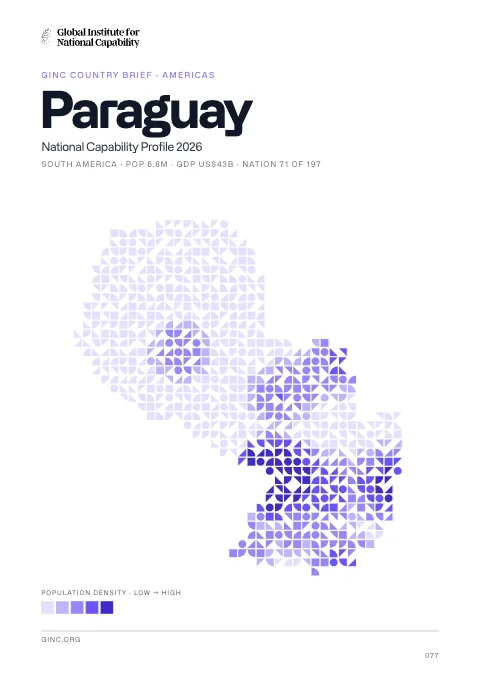
Paraguay is a landlocked constitutional republic in South America, home to 6.7 million people, with its capital at Asuncion.
Contents
12 chapters
Foundations
01–03
At a glance
- Area
- 406.8Kkm²#60 World#8 S. America
- Population
- 6.7M#104 World#9 S. America
- GDP (market)
- $30.6B
- GDP (PPP)
- $45.9B#99 World#10 S. America
- GDP per capita
- $6.8K#144 World#12 S. America
The whole brief
Paraguay National Capability Profile 2026
Foundations · Chapter 01
Historical Context
🇵🇾 Paraguay’s understanding the origins and evolution of the modern nation
BackgroundBack to top ↑
Paraguay achieved its independence from Spain in 1811. In the disastrous War of the Triple Alliance (1865-70) - between Paraguay and Argentina, Brazil, and Uruguay - Paraguay lost two-thirds of its adult males and much of its territory. The country stagnated economically for the next half century. Following the Chaco War of 1932-35 with Bolivia, Paraguay gained a large part of the Chaco lowland region. The 35-year military dictatorship of Alfredo STROESSNER ended in 1989, and, despite a marked increase in political infighting in recent years, Paraguay has held relatively free and regular presidential elections since the country's return to democracy.
IndependenceBack to top ↑
14 May 1811 (from Spain)
National holidayBack to top ↑
Independence Day, 14 May 1811 (observed 15 May)
Foundations · Chapter 02
Geography
🇵🇾 Paraguay’s territory, resources and strategic position
Location and areaBack to top ↑
Central South America, northeast of Argentina, southwest of Brazil
23 00 S, 58 00 W
South America
slightly smaller than California
0 km (landlocked)
none (landlocked)
Terrain and resourcesBack to top ↑
grassy plains and wooded hills east of Rio Paraguay; Gran Chaco region west of Rio Paraguay mostly low, marshy plain near the river, and dry forest and thorny scrub elsewhere
hydropower, timber, iron ore, manganese, limestone
670 sq km (2003)
Settlement and hazardsBack to top ↑
local flooding in southeast (early September to June); poorly drained plains may become boggy (early October to June)
landlocked; lies between Argentina, Bolivia, and Brazil; population concentrated in southern part of country
OtherBack to top ↑
336 cu km (2011)
deforestation; water pollution; inadequate means for waste disposal pose health risks for many urban residents; loss of wetlands
Foundations · Chapter 03
Environment
🇵🇾 Paraguay’s environmental conditions, resources and national resilience
ClimateBack to top ↑
subtropical to temperate; substantial rainfall in the eastern portions, becoming semiarid in the far west
Emissions and pollutionBack to top ↑
Water, waste and foodBack to top ↑
Resources and agreementsBack to top ↑
GINC Capability Domains · Chapter 04
Critical Technology
🇵🇾 Paraguay’s technology frontiers and the pursuit of national advantage
Two counts are set side by side for 2015–2024: on the left, the papers researchers in Paraguay published; on the right, the patent families that began there and were filed in more than one country. First by capability group, then group by group with each group’s capabilities. The badge on a card is the nation’s place among all nations. Papers are from GINC Research Analytics, patent families from GINC Patents.
Research by capability group
#131 WorldPapers published, 2015–2024
Patents by capability group
#110 WorldInternational patent families, 2015–2024
Advanced Materials & ManufacturingBack to top ↑
Research
#130 WorldPapers published, 2015–2024
Patents
International patent families, 2015–2024
No international patent families on record for 2015–2024.
Energy TechnologiesBack to top ↑
Research
#133 WorldPapers published, 2015–2024
Patents
#98 WorldInternational patent families, 2015–2024
Semiconductors & Advanced ComputingBack to top ↑
Research
#101 WorldPapers published, 2015–2024
No research topic: Semiconductor Design & EDA · Advanced Semiconductor Fabrication · Semiconductor Equipment & Materials · Advanced Packaging & Heterogeneous Integration
Patents
International patent families, 2015–2024
No international patent families on record for 2015–2024.
Artificial IntelligenceBack to top ↑
Research
#140 WorldPapers published, 2015–2024
Patents
International patent families, 2015–2024
No international patent families on record for 2015–2024.
Quantum TechnologiesBack to top ↑
Research
#100 WorldPapers published, 2015–2024
Patents
International patent families, 2015–2024
No international patent families on record for 2015–2024.
Connectivity, Cyber & Trust TechnologiesBack to top ↑
Research
#116 WorldPapers published, 2015–2024
Patents
International patent families, 2015–2024
No international patent families on record for 2015–2024.
Sensing, Timing & NavigationBack to top ↑
Research
#132 WorldPapers published, 2015–2024
Patents
International patent families, 2015–2024
No international patent families on record for 2015–2024.
Robotics & Autonomous SystemsBack to top ↑
Research
#119 WorldPapers published, 2015–2024
No research topic: Human-Machine Interfaces
Patents
#79 WorldInternational patent families, 2015–2024
Biotechnology & Health TechnologiesBack to top ↑
Research
#119 WorldPapers published, 2015–2024
Patents
International patent families, 2015–2024
No international patent families on record for 2015–2024.
Medicine and BioTech
Clinical research and life-science invention, drawn from the same series that drive the metric pages. Each card opens the full cross-country comparison.
Space TechnologiesBack to top ↑
- Space Launch & Reusable Systems
- Advanced Propulsion & Hypersonic Systems
- Satellite & Constellation Technologies
GINC Capability Domains · Chapter 05
Strategic Infrastructure
🇵🇾 Paraguay’s energy, connectivity and the material foundations of capability
Resource InfrastructureBack to top ↑
2,000 bbl/day (2012 est.)
0 bbl/day (2010 est.)
0 bbl/day (2010 est.)
0 bbl (1 January 2013 est.)
0 bbl/day (2010 est.)
26,820 bbl/day (2011 est.)
0 bbl/day (2010 est.)
31,290 bbl/day (2010 est.)
0 cu m (2011 est.)
0 cu m (2010 est.)
0 cu m (2011 est.)
0 cu m (2011 est.)
0 cu m (1 January 2013 est.)
Agriculture & Food InfrastructureBack to top ↑
- Irrigation & Agricultural Water
- Livestock & Veterinary
- Fisheries & Aquaculture
- Storage, Cold Chain & Markets
Energy InfrastructureBack to top ↑
- Thermal Generation
- Nuclear Generation
- Nuclear Fuel Cycle & Radioactive Waste
- Hydropower
- Renewable Generation
- Transmission & Distribution
- System Control & Dispatch
- Storage & Fuel Supply
8.816 million kW (2010 est.)
53.53 billion kWh (2010 est.)
6.778 billion kWh (2010 est.)
46.12 billion kWh (2011 est.)
0 kWh (2012 est.)
0.1% of total installed capacity (2010 est.)
0% of total installed capacity (2010 est.)
99.9% of total installed capacity (2010 est.)
0% of total installed capacity (2010 est.)
3.987 million Mt (2011 est.)
Water, Sanitation & Waste InfrastructureBack to top ↑
- Dams, Reservoirs & Flood Defence
- Water Supply & Treatment
- Bulk Water Transfer & Desalination
- Wastewater & Sanitation
- Solid Waste & Recycling
Advanced ManufacturingBack to top ↑
- Materials & Inputs
- Chemicals & Hazardous Process Industry
- Production Systems
- Supply Chain & Ecosystem
- Workforce & Innovation
Transport InfrastructureBack to top ↑
- Seaports & Terminals
- Air Infrastructure
- Air Navigation & Traffic Management
- Inland Waterways & Ferries
- Rail Infrastructure
- Roads & Bridges
- Logistics, Multimodal & Border Infrastructure
- Postal & Parcel
799 (2013)
3,100 km (primarily on the Paraguay and Paraná river systems) (2012)
Communications & Digital InfrastructureBack to top ↑
- Subsea Cables & International Gateways
- Core & Backbone Networks
- Mobile & Wireless Networks
- Spectrum & Broadcasting
- Data Centres, Compute & Cloud
- Data Resources
- AI Tools & Applications
376,000 (2012)
6.79 million (2012)
1.105 million (2009)
280,658 (2012)
.py
Financial InfrastructureBack to top ↑
- Currency & Reserves
- Payments & Settlement Systems
- Markets, Exchanges & Depositories
- Banks, Insurers & Systemic Institutions
Social InfrastructureBack to top ↑
- Health Infrastructure
- Public Health & Laboratories
- Medical Supply & Stockpiles
- Education & Skills Infrastructure
- Research & Scientific Facilities
- Housing, Community & Social Services
- Government & Public Administration
- Cultural, Community & Recreational Infrastructure
- Justice & Corrections
- Emergency Services & Civil Protection
- Hydrometeorology & Early Warning
Space, Aerospace & Defence InfrastructureBack to top ↑
GINC Capability Domains · Chapter 06
National Security
🇵🇾 Paraguay’s force, intelligence and the defence of the nation
Disputes and terrorismBack to top ↑
unruly region at convergence of Argentina-Brazil-Paraguay borders is locus of money laundering, smuggling, arms and illegal narcotics trafficking, and fundraising for extremist organizations
Force Generation & MobilisationBack to top ↑
Armed Forces Command (Commando de las Fuerzas Militares): Army, National Navy (Armada Nacional, includes Marine Corps, Naval Aviation, and Coast Guard), Paraguayan Air Force (Fuerza Aerea Paraguay, FAP), Logistics Command, War Materiel Directorate (2012)
18 years of age for compulsory and voluntary military service; conscript service obligation is 12 months for Army, 24 months for Navy; volunteers for the Air Force must be younger than 22 years of age with a secondary school diploma (2012)
1.66% of GDP (2012)//1.16% of GDP (2011)//1.66% of GDP (2010)
Forces under arms
Active-duty strength on the Correlates of War series, which reaches back to 1816 and so carries a nation’s whole record of mobilisation rather than its present establishment. The card opens the full cross-country comparison.
Intelligence & AssessmentBack to top ↑
- Imagery & Geospatial Intelligence
- Signals & Cyber Intelligence
- Technical & Measurement Intelligence
- Open-Source & Financial Intelligence
- Human Intelligence & Counterintelligence
- All-Source Analysis & Warning
Joint Command, Projection & SustainmentBack to top ↑
- Command, Control & Communications
- Strategic Lift & Mobility
- Expeditionary & Peace Operations
- Operational Sustainment & War Reserves
- Defence Industrial Mobilisation
- CBRN Defence
Land PowerBack to top ↑
- Combined Arms Manoeuvre
- Land Fires
- Battlefield Aviation & Uncrewed Systems
- Special Operations & Irregular Warfare
Maritime PowerBack to top ↑
- Maritime Security & Constabulary
- Sea Denial & Undersea Warfare
- Sea Control
- Amphibious & Expeditionary Operations
Air PowerBack to top ↑
- Air Sovereignty & Policing
- Control of the Air
- Air Strike & Interdiction
- Airborne ISR, Early Warning & Battle Management
Strategic Strike & Missile DefenceBack to top ↑
Space OperationsBack to top ↑
Cyber & Electromagnetic OperationsBack to top ↑
Nuclear DeterrenceBack to top ↑
GINC Capability Domains · Chapter 07
Human Capital
🇵🇾 Paraguay’s population, health and the skills that sustain capability
DemographyBack to top ↑
6,703,860 (July 2014 est.)
Paraguay falls below the Latin American average in several socioeconomic categories, including immunization rates, potable water, sanitation, and secondary school enrollment, and has greater rates of income inequality and child and maternal mortality. Paraguay's poverty rate has declined in recent years but remains high, especially in rural areas, with more than a third of the population below the poverty line. However, the well-being of the poor in many regions has improved in terms of housing quality and access to clean water, telephone service, and electricity. The fertility rate continues to drop, declining sharply from an average 4.3 births per woman in the late 1990s to about 2 in 2013, as a result of the greater educational attainment of women, increased use of contraception, and a desire for smaller families among young women.//Paraguay is a country of emigration; it has not attracted large numbers of immigrants because of political instability, civil wars, years of dictatorship, and the greater appeal of neighboring countries. Paraguay first tried to encourage immigration in 1870 in order to rebound from the heavy death toll it suffered during the War of the Triple Alliance, but it received few European and Middle Eastern immigrants. In the 20th century, limited numbers of immigrants arrived from Lebanon, Japan, South Korea, and China, as well as Mennonites from Canada, Russia, and Mexico. Large flows of Brazilian immigrants have been arriving since the 1960s, mainly to work in agriculture. Paraguayans continue to emigrate to Argentina, Brazil, Uruguay, the United States, Italy, Spain, and France.
1.19% (2014 est.)
16.66 births/1,000 population (2014 est.)
4.64 deaths/1,000 population (2014 est.)
1.96 children born/woman (2014 est.)
22.9
79.4%
Migration and urbanisationBack to top ↑
-0.08 migrant(s)/1,000 population (2014 est.)
ASUNCION (capital) 2.139 million (2011)
Welfare and equityBack to top ↑
34.7% (2010 est.)
53.2 (2009)//57.7 (1998)
Early Childhood DevelopmentBack to top ↑
3.4% (2005)
Foundational EducationBack to top ↑
4.8% of GDP (2011)
Advanced EducationBack to top ↑
Technical & Vocational SkillsBack to top ↑
Digital & AI CompetenceBack to top ↑
Generative AI adoption
Modelled share of working-age adults using generative AI, from Microsoft telemetry scaled to each country’s 15–64 population. A measure of how fast a workforce is absorbing the technology rather than of how much of it a nation builds. The card opens the full cross-country comparison.
Lifelong Learning & ReskillingBack to top ↑
Research Talent & Knowledge CreationBack to top ↑
Population HealthBack to top ↑
99 deaths/100,000 live births (2010)
17.9% (2008)
0.3% (2012 est.)
13,100 (2012 est.)
300 (2012 est.)
Health System CapabilityBack to top ↑
9.7% of GDP (2011)
1.11 physicians/1,000 population (2002)
1.3 beds/1,000 population (2011)
GINC Capability Domains · Chapter 08
Governance and Integrity
🇵🇾 Paraguay’s institutions, law and the integrity of the state
State structureBack to top ↑
constitutional republic
17 departments (departamentos, singular - departamento) and 1 capital city*; Alto Paraguay, Alto Parana, Amambay, Asuncion*, Boqueron, Caaguazu, Caazapa, Canindeyu, Central, Concepcion, Cordillera, Guaira, Itapua, Misiones, Neembucu, Paraguari, Presidente Hayes, San Pedro
several previous; latest approved and promulgated 20 June 1992; amended 2011 (2011)
18 years of age; universal and compulsory until the age of 75
Political Institutions & Civic ParticipationBack to top ↑
- Electoral Management & Integrity
- Legislature & Deliberative Institutions
- Citizen Participation & Civic Space
bicameral National Congress or Congreso Nacional consists of the Chamber of Senators or Camara de Senadores (45 seats; members elected by popular vote to serve five-year terms) and the Chamber of Deputies or Camara de Diputados (80 seats; members elected by popular vote to serve five-year terms)
Asociacion Nacional Republicana - Colorado Party or ANR [Lilian SAMANIEGO]//Avanza Pais coalition [Adolfo FERREIRO]//Broad Front coalition (Frente Guasu) or FG [Fernando Armindo LUGO Mendez]//Movimiento Union Nacional de Ciudadanos Eticos or UNACE [Jorge OVIEDO MATTO]//Patria Querida (Beloved Fatherland Party) or PPQ [Sebastian ACHA]//Partido del Movimiento al Socialismo or P-MAS [Camilo Ernesto SOARES Machado]//Partido Democratica Progresista or PDP [Desiree MASI]//Partido Encuentro Nacional or PEN [Fernando CAMACHO Paredes]//Partido Liberal Radical Autentico or PLRA [Miguel ABDON SAGUIER]//Partido Pais Solidario or PPS [Carlos Alberto FILIZZOLA Pallares]//Partido Popular Tekojoja [Sixto PEREIRA]
Ahorristas Estafados or AE//National Coordinating Board of Campesino Organizations or MCNOC [Luis AGUAYO]//National Federation of Campesinos or FNC [Odilon ESPINOLA]//National Workers Central or CNT [Secretary General Juan TORRALES]//Paraguayan Workers Confederation or CPT//Roman Catholic Church//Unitary Workers Central or CUT [Jorge Guzman ALVARENGA Malgarejo]
Justice System & Fundamental RightsBack to top ↑
- Judicial Independence & Court Capability
- Access to Justice & Legal Services
- Fundamental Rights Protection
- Human Rights Institutions & Equality Bodies
civil law system with influences from Argentine, Spanish, Roman, and French civil law models; judicial review of legislative acts in Supreme Court of Justice
accepts compulsory ICJ jurisdiction; accepts ICCt jurisdiction
Internal Security & OrderBack to top ↑
major illicit producer of cannabis, most or all of which is consumed in Brazil, Argentina, and Chile; transshipment country for Andean cocaine headed for Brazil, other Southern Cone markets, and Europe; weak border controls, extensive corruption and money-laundering activity, especially in the Tri-Border Area; weak anti-money-laundering laws and enforcement
Regulatory Governance & Strategic ControlsBack to top ↑
- Regulatory Quality & Better Regulation
- Regulatory Delivery & Independent Regulators
- Strategic Controls & Economic Security Administration
Government Effectiveness & Public AdministrationBack to top ↑
- Centre of Government & Policy Coordination
- Civil Service & Public Workforce
- Digital Government & Service Delivery
- Legal Identity & Civil Registration
- Statistical & Data Capability
Public Integrity & Anti-CorruptionBack to top ↑
Transparency, Oversight & AccountabilityBack to top ↑
- Right to Information & Open Government
- Independent Oversight & Supreme Audit
- Independent Media & Journalist Safety
National Resilience & Crisis ManagementBack to top ↑
GINC Capability Domains · Chapter 09
Information and Influence
🇵🇾 Paraguay’s identity, media and the projection of influence
Identity and cultureBack to top ↑
Spanish (official), Guarani (official)
Roman Catholic 89.6%, Protestant 6.2%, other Christian 1.1%, other or unspecified 1.9%, none 1.1% (2002 census)
mestizo (mixed Spanish and Amerindian) 95%, other 5%
lion
three equal, horizontal bands of red (top), white, and blue with an emblem centered in the white band; unusual flag in that the emblem is different on each side; the obverse (hoist side at the left) bears the national coat of arms (a yellow five-pointed star within a green wreath capped by the words REPUBLICA DEL PARAGUAY, all within two circles); the reverse (hoist side at the right) bears a circular seal of the treasury (a yellow lion below a red Cap of Liberty and the words PAZ Y JUSTICIA (Peace and Justice)); red symbolizes bravery and patriotism, white represents integrity and peace, and blue denotes liberty and generosity
Diplomatic Statecraft & Global NetworksBack to top ↑
- Diplomatic Network & Consular Reach
- Multilateral Leadership & Norm Setting
- Agenda-Setting & Convening
- Mediation & Crisis Diplomacy
CAN (associate), CD, CELAC, FAO, G-11, G-77, IADB, IAEA, IBRD, ICAO, ICRM, IDA, IFAD, IFC, IFRCS, ILO, IMF, IMO, Interpol, IOC, IOM, IPU, ISO (correspondent), ITSO, ITU, ITUC (NGOs), LAES, LAIA, Mercosur, MIGA, MINURSO, MINUSTAH, MONUSCO, NAM (observer), OAS, OPANAL, OPCW, Pacific Alliance (observer), PCA, UN, UNASUR, UNCTAD, UNESCO, UNFICYP, UNIDO, Union Latina, UNISFA, UNMIL, UNMISS, UNOCI, UNWTO, UPU, WCO, WHO, WIPO, WMO, WTO
Ambassador James H. THESSIN (since 8 September 2011)
Alliances & Security CooperationBack to top ↑
Development Cooperation & Global AssistanceBack to top ↑
Culture, Language & Education DiplomacyBack to top ↑
- Cultural & Language Institutes
- Creative Industries & Cultural Export Reach
- Heritage & Cultural Institutions
- Education Diplomacy & Alumni Networks
- Sports & Major Events
Diaspora & Global CommunitiesBack to top ↑
Information Environment & Strategic CommunicationBack to top ↑
- Strategic Communications & Public Diplomacy
- International Media & Broadcasting
- Information Defence & Counter-Interference
6 privately owned TV stations; about 75 commercial and community radio stations; 1 state-owned radio network (2010)
GINC Capability Domains · Chapter 10
Financial Strength
🇵🇾 Paraguay’s fiscal depth, reserves and the capacity to act
Monetary & Currency CapabilityBack to top ↑
- Monetary Policy & Price Stability
- Exchange Rate & External Account Management
- Currency Issuance & Digital Money
2.3% (2013 est.)//3.7% (2012 est.)
guarani (PYG) per US dollar -//4,315.1 (2013 est.)//4,424.9 (2012 est.)//4,735.5 (2010 est.)//4,965.4 (2009)//4,337.7 (2008)
5.5% (31 December 2012 est.)//6% (31 December 2011 est.)
28.9% (31 December 2013 est.)//29.1% (31 December 2012 est.)
$4.364 billion (31 December 2013 est.)//$4.135 billion (31 December 2012 est.)
$8.215 billion (31 December 2013 est.)//$7.637 billion (31 December 2012 est.)
Fiscal Capacity & Public FinanceBack to top ↑
- Revenue Mobilisation & Tax Administration
- Public Expenditure & Budget Management
- Sovereign Debt & Treasury Management
- Public Investment Management
18.9% of GDP (2013 est.)
-1.6% of GDP (2013 est.)
15.7% of GDP (2013 est.)//14.7% of GDP (2012 est.)
calendar year
Financial System Depth & AccessBack to top ↑
- Banking System Capacity
- Capital Markets Depth & Development
- Long-Term & Institutional Capital
- Financial Inclusion & Household Access
- Development & Policy Finance
$11 billion (31 December 2013 est.)//$9.747 billion (31 December 2012 est.)
$962.3 million (31 December 2012 est.)//$958.1 million (31 December 2011)//$NA (31 December 2010 est.)
Financial Regulation & IntegrityBack to top ↑
- Prudential Regulation & Supervision
- Financial Integrity & Illicit Finance Control
- Market Conduct & Consumer Protection
- Payment & Market Infrastructure Oversight
Financial Stability & Crisis ManagementBack to top ↑
- Macroprudential & Systemic Oversight
- Crisis Management, Resolution & Deposit Insurance
- External Liquidity & Financial Safety Nets
Sovereign Capital & External Financial PowerBack to top ↑
- Official Reserves Management
- Sovereign Wealth & Public Asset Management
- Currency Internationalisation & Reserve Status
- Capital Account & Flow Management
- International Financial Centre Capability
$6.336 billion (31 December 2013 est.)//$4.994 billion (31 December 2012 est.)
$7.013 billion (31 December 2013 est.)//$5.985 billion (31 December 2012 est.)
GINC Capability Domains · Chapter 11
Production and Innovation
🇵🇾 Paraguay’s output, industry and the engine of prosperity
Economic Output & ProductivityBack to top ↑
Landlocked Paraguay has a market economy distinguished by a large informal sector, featuring re-export of imported consumer goods to neighboring countries, as well as the activities of thousands of microenterprises and urban street vendors. A large percentage of the population, especially in rural areas, derives its living from agricultural activity, often on a subsistence basis. Because of the importance of the informal sector, accurate economic measures are difficult to obtain. On a per capita basis, real income has stagnated at 1980 levels. The economy grew rapidly between 2003 and 2008 as growing world demand for commodities combined with high prices and favorable weather to support Paraguay's commodity-based export expansion. Paraguay is the sixth largest soy producer in the world. Drought hit in 2008, reducing agricultural exports and slowing the economy even before the onset of the global recession. The economy fell 3.8% in 2009, as lower world demand and commodity prices caused exports to contract. The government reacted by introducing fiscal and monetary stimulus packages. Growth resumed at a 13% level in 2010, the highest in South America, but slowed in 2011-12 as the stimulus subsided and severe drought and outbreaks of foot-and-mouth disease led to a drop in beef and other agricultural exports. The economy took another leap in 2013, largely due to strong export growth. Political uncertainty, corruption, limited progress on structural reform, and deficient infrastructure are the main obstacles to long-term growth.
$45.9 billion (2013 est.)//$40.98 billion (2012 est.)//$41.49 billion (2011 est.)
12% (2013 est.)//-1.2% (2012 est.)//4.3% (2011 est.)
$6,800 (2013 est.)//$6,100 (2012 est.)//$6,300 (2011 est.)
$30.56 billion (2013 est.)
Labour & EmploymentBack to top ↑
- Employment & Labour Force Participation
- Labour Market Institutions & Wage Setting
- Employment Services & Skills Matching
- Labour Adjustment, Transition & Formalisation
3.19 million (2013 est.)
6.6% (2013 est.)//6.9% (2012 est.)
Industrial & Sectoral BaseBack to top ↑
- Manufacturing & Advanced Industry
- Foundational & Process Industries
- Agrifood & Primary Production
- Services Economy
cotton, sugarcane, soybeans, corn, wheat, tobacco, cassava (manioc, tapioca), fruits, vegetables; beef, pork, eggs, milk; timber
sugar, cement, textiles, beverages, wood products, steel, base metals, electric power
5.6% (2013 est.)
Structural Transformation & ComplexityBack to top ↑
Business Dynamism & EntrepreneurshipBack to top ↑
- Entrepreneurship & Firm Creation
- Risk Capital & Scale-Up Finance
- Firm Growth, Exit & Renewal
- Competition & Market Contestability
Innovation & CommercialisationBack to top ↑
- Business Innovation Capability
- Research Commercialisation & Knowledge Transfer
- Intellectual Property & Intangible Assets
- Innovation Ecosystems & Clusters
Technology Adoption & DiffusionBack to top ↑
GINC Capability Domains · Chapter 12
Trade and Investment
🇵🇾 Paraguay’s markets, capital and the terms of global exchange
Overall tradeBack to top ↑
$11.5B of exports to 150 partners and $17.5B of imports from 177 in 2024, a deficit of $6.06B.
- Exports
- $11.5B150 partners
- Imports
- $17.5B177 partners
- Balance
- −$6.06Bdeficit
- Total trade
- $29.0B2024
ExportsBack to top ↑
Where its exports go
The largest partners in 2024, with each one's share of the nation's exports.
| Partner | Value | Share | |
|---|---|---|---|
| Brazil | $3.53B | 31% | |
| Argentina | $3.41B | 30% | |
| Chile | $1.06B | 9.3% | |
| United States | $443M | 3.9% | |
| Peru | $252M | 2.2% | |
| Taiwan | $226M | 2.0% | |
| Russia | $207M | 1.8% | |
| Uruguay | $171M | 1.5% | |
| Netherlands | $168M | 1.5% | |
| Israel | $149M | 1.3% | |
| Bolivia | $127M | 1.1% | |
| India | $115M | 1.0% | |
| United Kingdom | $96.9M | 0.8% | |
| Hong Kong | $87.9M | 0.8% | |
| Bangladesh | $76.3M | 0.7% | |
| Spain | $73.6M | 0.6% | |
| Thailand | $68.6M | 0.6% | |
| Vietnam | $64.5M | 0.6% | |
| Germany | $63.3M | 0.6% | |
| Italy | $53.8M | 0.5% |
What it exports
The largest categories in 2024.
| Category | Value | Share | |
|---|---|---|---|
| Oil seed, oleaginous fruits, grain, seed, fruits | $3.50B | 31% | |
| Meat and edible meat offal | $1.78B | 16% | |
| Mineral fuels, oils, distillation products | $1.21B | 11% | |
| Cereals | $984M | 8.6% | |
| Residues, wastes of food industry, animal fodder | $830M | 7.2% | |
| Animal, vegetable fats and oils, cleavage products | $518M | 4.5% | |
| Electrical, electronic equipment | $378M | 3.3% | |
| Beverages, spirits and vinegar | $168M | 1.5% | |
| Aluminum | $166M | 1.4% | |
| Miscellaneous chemical products | $145M | 1.3% | |
| Pearls, precious stones, metals, coins | $135M | 1.2% | |
| Wood and articles of wood, wood charcoal | $107M | 0.9% | |
| Pharmaceutical products | $103M | 0.9% | |
| Plastics | $97.1M | 0.8% | |
| Other made textile articles, sets, worn clothing | $90.1M | 0.8% |
ImportsBack to top ↑
Where its imports come from
The largest partners in 2024, with each one's share of the nation's imports.
| Partner | Value | Share | |
|---|---|---|---|
| China | $5.63B | 32% | |
| Brazil | $4.14B | 24% | |
| Argentina | $1.20B | 6.9% | |
| United States | $1.18B | 6.7% | |
| Chile | $431M | 2.5% | |
| India | $431M | 2.5% | |
| Singapore | $413M | 2.4% | |
| Germany | $349M | 2.0% | |
| Japan | $304M | 1.7% | |
| Switzerland | $256M | 1.5% | |
| South Korea | $240M | 1.4% | |
| United Arab Emirates | $218M | 1.2% | |
| Vietnam | $184M | 1.0% | |
| Spain | $177M | 1.0% | |
| Mexico | $152M | 0.9% | |
| Italy | $138M | 0.8% | |
| France | $132M | 0.8% | |
| Russia | $132M | 0.8% | |
| Uruguay | $129M | 0.7% | |
| Thailand | $127M | 0.7% |
What it imports
The largest categories in 2024.
| Category | Value | Share | |
|---|---|---|---|
| Electrical, electronic equipment | $2.97B | 17% | |
| Mineral fuels, oils, distillation products | $2.32B | 13% | |
| Machinery, nuclear reactors, boilers | $2.15B | 12% | |
| Vehicles other than railway, tramway | $1.64B | 9.4% | |
| Fertilizers | $680M | 3.9% | |
| Plastics | $627M | 3.6% | |
| Miscellaneous chemical products | $605M | 3.5% | |
| Pharmaceutical products | $468M | 2.7% | |
| Rubbers | $427M | 2.4% | |
| Organic chemicals | $347M | 2.0% | |
| Essential oils, perfumes, cosmetics, toiletries | $343M | 2.0% | |
| Iron and steel | $336M | 1.9% | |
| Beverages, spirits and vinegar | $306M | 1.7% | |
| Paper and paperboard, articles of pulp, paper and board | $296M | 1.7% | |
| Toys, games, sports requisites | $234M | 1.3% |
In a list, the bar runs to the largest in that list. The line is each figure’s history from 2000, drawn to its own peak: it shows the shape of the years, and the value shows the size.
External balanceBack to top ↑
$1.376 billion (2013 est.)//$115.6 million (2012 est.)
Trade Facilitation & LogisticsBack to top ↑
Trade Policy & Market AccessBack to top ↑
- Trade Policy & Negotiation Capability
- Market Access & Agreements Network
- Trade Law & Enforcement
- Standards, Conformity & Quality Infrastructure
Digital & Services TradeBack to top ↑
- Services Trade Capability
- Digital Trade & E-Commerce
- Data Flows & Digital Trade Governance
- Tourism & Visitor Economy
Investment Attraction & ProjectionBack to top ↑
- Investment Attraction & Facilitation
- Investment Absorption & Linkages
- Outward Investment & Global Corporate Presence
$4.526 billion (31 December 2013 est.)//$4.145 billion (31 December 2012 est.)
$213.6 million (31 December 2013 est.)//$213.6 million (31 December 2012 est.)
Export Capability & SophisticationBack to top ↑
$14.7 billion (2013 est.)//$11.9 billion (2012 est.)
Uruguay 17.7%, Brazil 16.4%, Argentina 15.6%, Russia 12% (2012)
soybeans, feed, cotton, meat, edible oils, wood, leather
Global Value Chain PositionBack to top ↑
- Value Chain Participation & Integration
- Value Chain Position & Upgrading
- Regional Integration & Hub Anchoring
Economic Leverage & DependenceBack to top ↑
- Strategic Supply Security
- Concentration Risk & Revenue Stabilisation
- Economic Leverage & Coercion Resistance
$12.37 billion (2013 est.)//$11.06 billion (2012 est.)
Brazil 24.2%, China 19.5%, Argentina 18.3%, US 11.5% (2012)
road vehicles, consumer goods, tobacco, petroleum products, electrical machinery, tractors, chemicals, vehicle parts
Paraguay · you are in
Historical Context
Foundations
GINC Capability Domains
Find in this brief · Paraguay