
Syria
Syria is a republic in the Middle East, home to 18 million people, with its capital at Damascus.
Contents
12 chapters
Foundations
01–03
At a glance
- Area
- 185.2Kkm²#89 World#7 Middle East
- Population
- 18M#60 World#6 Middle East
- GDP (market)
- $64.7B
- GDP (PPP)
- $107.6B#72 World#9 Middle East
- GDP per capita
- $5.1K#160 World#16 Middle East
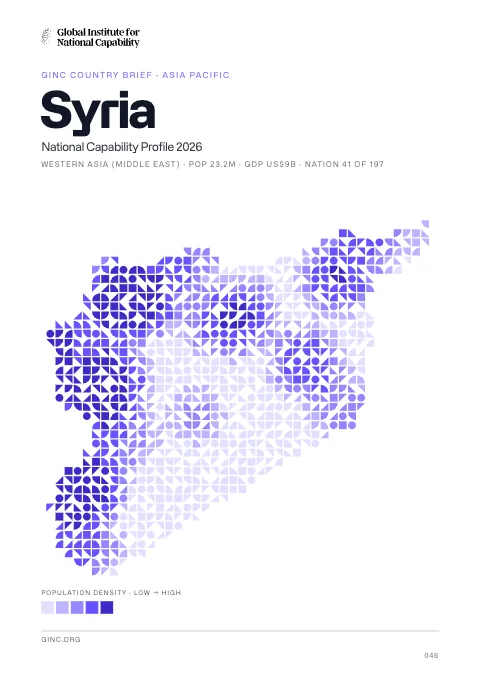
The whole brief
Syria National Capability Profile 2026
Foundations · Chapter 01
Historical Context
🇸🇾 Syria’s understanding the origins and evolution of the modern nation
BackgroundBack to top ↑
Following World War I, France acquired a mandate over the northern portion of the former Ottoman Empire province of Syria. The French administered the area as Syria until granting it independence in 1946. The new country lacked political stability, however, and experienced a series of military coups during its first decades. Syria united with Egypt in February 1958 to form the United Arab Republic. In September 1961, the two entities separated, and the Syrian Arab Republic was reestablished. In November 1970, Hafiz al-ASAD, a member of the socialist Ba'th Party and the minority Alawi sect, seized power in a bloodless coup and brought political stability to the country. In the 1967 Arab-Israeli War, Syria lost the Golan Heights to Israel. During the 1990s, Syria and Israel held occasional peace talks over its return. Following the death of President al-ASAD, his son, Bashar al-ASAD, was approved as president by popular referendum in July 2000. Syrian troops - stationed in Lebanon since 1976 in an ostensible peacekeeping role - were withdrawn in April 2005. During the July-August 2006 conflict between Israel and Hizballah, Syria placed its military forces on alert but did not intervene directly on behalf of its ally Hizballah. In May 2007 Bashar al-ASAD's second term as president was approved by popular referendum. Influenced by major uprisings that began elsewhere in the region, antigovernment protests broke out in the southern province of Dar'a in March 2011 with protesters calling for the repeal of the restrictive Emergency Law allowing arrests without charge, the legalization of political parties, and the removal of corrupt local officials. Since then demonstrations and unrest have spread to nearly every city in Syria, but the size and intensity of protests have fluctuated over time. The government responded to unrest with a mix of concessions - including the repeal of the Emergency Law and approving new laws permitting new political parties and liberalizing local and national elections - and force. However, the government's response has failed to meet opposition demands for ASAD to step down, and the government's ongoing security operations to quell unrest and widespread armed opposition activity have led to extended violent clashes between government forces and oppositionists. International pressure on the ASAD regime has intensified since late 2011, as the Arab League, EU, Turkey, and the United States have expanded economic sanctions against the regime. Lakhdar BRAHIMI, current Joint Special Representative of the United Nations and the League of Arab States on the Syrian crisis, in October 2012 began meeting with regional heads of state to assist in brokering a cease-fire. In December 2012, the National Coalition of Syrian Revolution and Opposition Forces was recognized by more than 130 countries as the sole legitimate representative of the Syrian people. Unrest persisted in 2013, and the death toll among Syrian Government forces, opposition forces, and civilians has topped 100,000. In January 2014, the Syrian Opposition Coalition and Syrian regime began peace talks at the UN sponsored Geneva II conference.
IndependenceBack to top ↑
17 April 1946 (from League of Nations mandate under French administration)
National holidayBack to top ↑
Independence Day, 17 April (1946)
Foundations · Chapter 02
Geography
🇸🇾 Syria’s territory, resources and strategic position
Location and areaBack to top ↑
Middle East, bordering the Mediterranean Sea, between Lebanon and Turkey
35 00 N, 38 00 E
Middle East
slightly more than 1.5 times the size of Pennsylvania
193 km
Terrain and resourcesBack to top ↑
primarily semiarid and desert plateau; narrow coastal plain; mountains in west
petroleum, phosphates, chrome and manganese ores, asphalt, iron ore, rock salt, marble, gypsum, hydropower
13,410 sq km (2010)
Settlement and hazardsBack to top ↑
dust storms, sandstorms
the capital of Damascus - located at an oasis fed by the Barada River - is thought to be one of the world's oldest continuously inhabited cities; there are 41 Israeli settlements and civilian land use sites in the Israeli-occupied Golan Heights (2010 est.)
OtherBack to top ↑
16.8 cu km (2011)
deforestation; overgrazing; soil erosion; desertification; water pollution from raw sewage and petroleum refining wastes; inadequate potable water
Foundations · Chapter 03
Environment
🇸🇾 Syria’s environmental conditions, resources and national resilience
ClimateBack to top ↑
mostly desert; hot, dry, sunny summers (June to August) and mild, rainy winters (December to February) along coast; cold weather with snow or sleet periodically in Damascus
Emissions and pollutionBack to top ↑
Water, waste and foodBack to top ↑
Resources and agreementsBack to top ↑
GINC Capability Domains · Chapter 04
Critical Technology
🇸🇾 Syria’s technology frontiers and the pursuit of national advantage
Two counts are set side by side for 2015–2024: on the left, the papers researchers in Syria published; on the right, the patent families that began there and were filed in more than one country. First by capability group, then group by group with each group’s capabilities. The badge on a card is the nation’s place among all nations. Papers are from GINC Research Analytics, patent families from GINC Patents.
Research by capability group
#115 WorldPapers published, 2015–2024
Patents by capability group
#100 WorldInternational patent families, 2015–2024
Advanced Materials & ManufacturingBack to top ↑
Research
#107 WorldPapers published, 2015–2024
Patents
#85 WorldInternational patent families, 2015–2024
Energy TechnologiesBack to top ↑
Research
#119 WorldPapers published, 2015–2024
Patents
#84 WorldInternational patent families, 2015–2024
Semiconductors & Advanced ComputingBack to top ↑
Research
#113 WorldPapers published, 2015–2024
No research topic: Semiconductor Design & EDA · Advanced Semiconductor Fabrication · Semiconductor Equipment & Materials · Advanced Packaging & Heterogeneous Integration
Patents
International patent families, 2015–2024
No international patent families on record for 2015–2024.
Artificial IntelligenceBack to top ↑
Research
#110 WorldPapers published, 2015–2024
Patents
International patent families, 2015–2024
No international patent families on record for 2015–2024.
Quantum TechnologiesBack to top ↑
Research
#111 WorldPapers published, 2015–2024
Patents
International patent families, 2015–2024
No international patent families on record for 2015–2024.
Connectivity, Cyber & Trust TechnologiesBack to top ↑
Research
#121 WorldPapers published, 2015–2024
Patents
#93 WorldInternational patent families, 2015–2024
Sensing, Timing & NavigationBack to top ↑
Research
#92 WorldPapers published, 2015–2024
Patents
International patent families, 2015–2024
No international patent families on record for 2015–2024.
Robotics & Autonomous SystemsBack to top ↑
Research
#87 WorldPapers published, 2015–2024
No research topic: Human-Machine Interfaces
Patents
#79 WorldInternational patent families, 2015–2024
Biotechnology & Health TechnologiesBack to top ↑
Research
#127 WorldPapers published, 2015–2024
Patents
International patent families, 2015–2024
No international patent families on record for 2015–2024.
Medicine and BioTech
Clinical research and life-science invention, drawn from the same series that drive the metric pages. Each card opens the full cross-country comparison.
Space TechnologiesBack to top ↑
Research
#95 WorldPapers published, 2015–2024
Patents
International patent families, 2015–2024
No international patent families on record for 2015–2024.
GINC Capability Domains · Chapter 05
Strategic Infrastructure
🇸🇾 Syria’s energy, connectivity and the material foundations of capability
Resource InfrastructureBack to top ↑
182,500 bbl/day (2012 est.)
152,400 bbl/day (2010 est.)
0 bbl/day (2010 est.)
2.5 billion bbl (1 January 2013 est.)
253,600 bbl/day (2010 est.)
258,800 bbl/day (2011 est.)
36,210 bbl/day (2010 est.)
104,800 bbl/day (2010 est.)
7.87 billion cu m (2011 est.)
9.63 billion cu m (2010 est.)
0 cu m (2011 est.)
250 million cu m (2011 est.)
240.7 billion cu m (1 January 2013 est.)
gas 3,170 km; oil 2,029 km (2013)
Agriculture & Food InfrastructureBack to top ↑
- Irrigation & Agricultural Water
- Livestock & Veterinary
- Fisheries & Aquaculture
- Storage, Cold Chain & Markets
Energy InfrastructureBack to top ↑
- Thermal Generation
- Nuclear Generation
- Nuclear Fuel Cycle & Radioactive Waste
- Hydropower
- Renewable Generation
- Transmission & Distribution
- System Control & Dispatch
- Storage & Fuel Supply
8.323 million kW (2010 est.)
43.76 billion kWh (2010 est.)
35.61 billion kWh (2010 est.)
1.043 billion kWh (2010 est.)
0 kWh (2012 est.)
89.2% of total installed capacity (2010 est.)
0% of total installed capacity (2010 est.)
10.8% of total installed capacity (2010 est.)
0% of total installed capacity (2010 est.)
63.14 million Mt (2011 est.)
Water, Sanitation & Waste InfrastructureBack to top ↑
- Dams, Reservoirs & Flood Defence
- Water Supply & Treatment
- Bulk Water Transfer & Desalination
- Wastewater & Sanitation
- Solid Waste & Recycling
Advanced ManufacturingBack to top ↑
- Materials & Inputs
- Chemicals & Hazardous Process Industry
- Production Systems
- Supply Chain & Ecosystem
- Workforce & Innovation
Transport InfrastructureBack to top ↑
- Seaports & Terminals
- Air Infrastructure
- Air Navigation & Traffic Management
- Inland Waterways & Ferries
- Rail Infrastructure
- Roads & Bridges
- Logistics, Multimodal & Border Infrastructure
- Postal & Parcel
90 (2013)
6 (2013)
900 km (navigable but not economically significant) (2011)
Communications & Digital InfrastructureBack to top ↑
- Subsea Cables & International Gateways
- Core & Backbone Networks
- Mobile & Wireless Networks
- Spectrum & Broadcasting
- Data Centres, Compute & Cloud
- Data Resources
- AI Tools & Applications
4.425 million (2012)
12.928 million (2012)
4.469 million (2009)
416 (2012)
.sy
Financial InfrastructureBack to top ↑
- Currency & Reserves
- Payments & Settlement Systems
- Markets, Exchanges & Depositories
- Banks, Insurers & Systemic Institutions
Social InfrastructureBack to top ↑
- Health Infrastructure
- Public Health & Laboratories
- Medical Supply & Stockpiles
- Education & Skills Infrastructure
- Research & Scientific Facilities
- Housing, Community & Social Services
- Government & Public Administration
- Cultural, Community & Recreational Infrastructure
- Justice & Corrections
- Emergency Services & Civil Protection
- Hydrometeorology & Early Warning
Space, Aerospace & Defence InfrastructureBack to top ↑
GINC Capability Domains · Chapter 06
National Security
🇸🇾 Syria’s force, intelligence and the defence of the nation
Disputes and terrorismBack to top ↑
Golan Heights is Israeli-occupied with the almost 1,000-strong UN Disengagement Observer Force patrolling a buffer zone since 1964; lacking a treaty or other documentation describing the boundary, portions of the Lebanon-Syria boundary are unclear with several sections in dispute; since 2000, Lebanon has claimed Shab'a Farms in the Golan Heights; 2004 Agreement and pending demarcation settles border dispute with Jordan
Force Generation & MobilisationBack to top ↑
Syrian Armed Forces: Land Forces, Naval Forces, Air Forces (includes Air Defense Forces) (2013)
18 years of age for compulsory and voluntary military service; conscript service obligation is 18 months; women are not conscripted but may volunteer to serve; re-enlistment obligation 5 years, with retirement after 15 years or age 40 (enlisted) or 20 years or age 45 (NCOs) (2012)
Forces under arms
Active-duty strength on the Correlates of War series, which reaches back to 1816 and so carries a nation’s whole record of mobilisation rather than its present establishment. The card opens the full cross-country comparison.
Intelligence & AssessmentBack to top ↑
- Imagery & Geospatial Intelligence
- Signals & Cyber Intelligence
- Technical & Measurement Intelligence
- Open-Source & Financial Intelligence
- Human Intelligence & Counterintelligence
- All-Source Analysis & Warning
Joint Command, Projection & SustainmentBack to top ↑
- Command, Control & Communications
- Strategic Lift & Mobility
- Expeditionary & Peace Operations
- Operational Sustainment & War Reserves
- Defence Industrial Mobilisation
- CBRN Defence
Land PowerBack to top ↑
- Combined Arms Manoeuvre
- Land Fires
- Battlefield Aviation & Uncrewed Systems
- Special Operations & Irregular Warfare
Maritime PowerBack to top ↑
- Maritime Security & Constabulary
- Sea Denial & Undersea Warfare
- Sea Control
- Amphibious & Expeditionary Operations
Air PowerBack to top ↑
- Air Sovereignty & Policing
- Control of the Air
- Air Strike & Interdiction
- Airborne ISR, Early Warning & Battle Management
Strategic Strike & Missile DefenceBack to top ↑
Space OperationsBack to top ↑
Cyber & Electromagnetic OperationsBack to top ↑
Nuclear DeterrenceBack to top ↑
GINC Capability Domains · Chapter 07
Human Capital
🇸🇾 Syria’s population, health and the skills that sustain capability
DemographyBack to top ↑
17,951,639
-9.73% (2014 est.)
22.76 births/1,000 population (2014 est.)
6.51 deaths/1,000 population (2014 est.)
2.68 children born/woman (2014 est.)
58.3% (2006)
Migration and urbanisationBack to top ↑
-113.51 migrant(s)/1,000 population (2014 est.)
Aleppo 3.164 million; DAMASCUS (capital) 2.65 million; Hims 1.369 million; Hamah 933,000 (2011)
Welfare and equityBack to top ↑
11.9% (2006 est.)
DisplacementBack to top ↑
Early Childhood DevelopmentBack to top ↑
10.1% (2009)
Foundational EducationBack to top ↑
5.1% of GDP (2009)
Advanced EducationBack to top ↑
Technical & Vocational SkillsBack to top ↑
Digital & AI CompetenceBack to top ↑
Generative AI adoption
Modelled share of working-age adults using generative AI, from Microsoft telemetry scaled to each country’s 15–64 population. A measure of how fast a workforce is absorbing the technology rather than of how much of it a nation builds. The card opens the full cross-country comparison.
Lifelong Learning & ReskillingBack to top ↑
Research Talent & Knowledge CreationBack to top ↑
Population HealthBack to top ↑
70 deaths/100,000 live births (2010)
27.1% (2008)
less than 0.1% (2001 est.)
fewer than 500 (2003 est.)
fewer than 200 (2003 est.)
Health System CapabilityBack to top ↑
3.7% of GDP (2011)
1.5 physicians/1,000 population (2008)
1.5 beds/1,000 population (2010)
GINC Capability Domains · Chapter 08
Governance and Integrity
🇸🇾 Syria’s institutions, law and the integrity of the state
State structureBack to top ↑
republic under an authoritarian regime
14 provinces (muhafazat, singular - muhafazah); Al Hasakah, Al Ladhiqiyah (Latakia), Al Qunaytirah, Ar Raqqah, As Suwayda', Dar'a, Dayr az Zawr, Dimashq (Damascus), Halab, Hamah, Hims (Homs), Idlib, Rif Dimashq (Damascus Countryside), Tartus
several previous; latest issued 15 February 2012, passed by referendum 26 February 2012 (2013)
18 years of age; universal
Political Institutions & Civic ParticipationBack to top ↑
- Electoral Management & Integrity
- Legislature & Deliberative Institutions
- Citizen Participation & Civic Space
unicameral People's Assembly or Majlis al-Shaab (250 seats; members elected by popular vote to serve four-year terms)
Free Syrian Army//Syrian Muslim Brotherhood or SMB [Muhammad Riyad al-SHAQFAH] (operates in exile in London)//Syrian Opposition Coalition or National Coalition of Syrian Revolutionary and Opposition Forces [al-Asi- al-JARBAL]
Justice System & Fundamental RightsBack to top ↑
- Judicial Independence & Court Capability
- Access to Justice & Legal Services
- Fundamental Rights Protection
- Human Rights Institutions & Equality Bodies
mixed legal system of civil and Islamic law (for family courts)
has not submitted an ICJ jurisdiction declaration; non-party state to the ICCt
Internal Security & OrderBack to top ↑
a transit point for opiates, hashish, and cocaine bound for regional and Western markets; weak anti-money-laundering controls and bank privatization may leave it vulnerable to money laundering
Regulatory Governance & Strategic ControlsBack to top ↑
- Regulatory Quality & Better Regulation
- Regulatory Delivery & Independent Regulators
- Strategic Controls & Economic Security Administration
Government Effectiveness & Public AdministrationBack to top ↑
- Centre of Government & Policy Coordination
- Civil Service & Public Workforce
- Digital Government & Service Delivery
- Legal Identity & Civil Registration
- Statistical & Data Capability
Public Integrity & Anti-CorruptionBack to top ↑
Transparency, Oversight & AccountabilityBack to top ↑
- Right to Information & Open Government
- Independent Oversight & Supreme Audit
- Independent Media & Journalist Safety
National Resilience & Crisis ManagementBack to top ↑
GINC Capability Domains · Chapter 09
Information and Influence
🇸🇾 Syria’s identity, media and the projection of influence
Identity and cultureBack to top ↑
Arabic (official), Kurdish, Armenian, Aramaic, Circassian (widely understood); French, English (somewhat understood)
Muslim 87% (official; includes Sunni 74% and Alawi, Ismaili, and Shia 13%), Christian (includes Orthodox, Uniate, and Nestorian) 10% (includes Orthodox, Uniate, and Nestorian), Druze 3%, Jewish (few remaining in Damascus and Aleppo)
Arab 90.3%, Kurds, Armenians, and other 9.7%
hawk
three equal horizontal bands of red (top), white, and black; two small, green, five-pointed stars in a horizontal line centered in the white band; the band colors derive from the Arab Liberation flag and represent oppression (black), overcome through bloody struggle (red), to be replaced by a bright future (white); identical to the former flag of the United Arab Republic (1958-1961) where the two stars represented the constituent states of Syria and Egypt; the current design dates to 1980
Diplomatic Statecraft & Global NetworksBack to top ↑
- Diplomatic Network & Consular Reach
- Multilateral Leadership & Norm Setting
- Agenda-Setting & Convening
- Mediation & Crisis Diplomacy
ABEDA, AFESD, AMF, CAEU, FAO, G-24, G-77, IAEA, IBRD, ICAO, ICC (national committees), ICRM, IDA, IDB, IFAD, IFC, IFRCS, IHO, ILO, IMF, IMO, Interpol, IOC, IPU, ISO, ITSO, ITU, MIGA, NAM, OAPEC, OIC, UN, UNCTAD, UNESCO, UNIDO, UNRWA, UNWTO, UPU, WCO, WFTU (NGOs), WHO, WIPO, WMO, WTO (observer)
Alliances & Security CooperationBack to top ↑
Development Cooperation & Global AssistanceBack to top ↑
Culture, Language & Education DiplomacyBack to top ↑
- Cultural & Language Institutes
- Creative Industries & Cultural Export Reach
- Heritage & Cultural Institutions
- Education Diplomacy & Alumni Networks
- Sports & Major Events
Diaspora & Global CommunitiesBack to top ↑
Information Environment & Strategic CommunicationBack to top ↑
- Strategic Communications & Public Diplomacy
- International Media & Broadcasting
- Information Defence & Counter-Interference
state-run TV and radio broadcast networks; state operates 2 TV networks and a satellite channel; roughly two-thirds of Syrian homes have a satellite dish providing access to foreign TV broadcasts; 3 state-run radio channels; first private radio station launched in 2005; private radio broadcasters prohibited from transmitting news or political content (2007)
GINC Capability Domains · Chapter 10
Financial Strength
🇸🇾 Syria’s fiscal depth, reserves and the capacity to act
Monetary & Currency CapabilityBack to top ↑
- Monetary Policy & Price Stability
- Exchange Rate & External Account Management
- Currency Issuance & Digital Money
59.1% (2013 est.)//36.9% (2012 est.)
Syrian pounds (SYP) per US dollar -//105.3 (2013 est.)//64.392 (2012 est.)//11.225 (2010 est.)//46.708 (2009)//46.5281 (2008)
0.75% (31 December 2013 est.)//5% (31 December 2012 est.)
10.5% (31 December 2013 est.)//11.7% (31 December 2012 est.)
$8.097 billion (31 December 2013 est.)//$16.78 billion (31 December 2012 est.)
$12.77 billion (31 December 2013 est.)//$27.11 billion (31 December 2012 est.)
Fiscal Capacity & Public FinanceBack to top ↑
- Revenue Mobilisation & Tax Administration
- Public Expenditure & Budget Management
- Sovereign Debt & Treasury Management
- Public Investment Management
3.7% of GDP (2013 est.)
-8% of GDP (2013 est.)
58.9% of GDP (2013 est.)//52.4% of GDP (2012 est.)
calendar year
Financial System Depth & AccessBack to top ↑
- Banking System Capacity
- Capital Markets Depth & Development
- Long-Term & Institutional Capital
- Financial Inclusion & Household Access
- Development & Policy Finance
$7.777 billion (31 December 2013 est.)//$17.41 billion (31 December 2012 est.)
$NA
5.4% of GDP (2013 est.)//12.8% of GDP (2012 est.)//15% of GDP (2011 est.)
Financial Regulation & IntegrityBack to top ↑
- Prudential Regulation & Supervision
- Financial Integrity & Illicit Finance Control
- Market Conduct & Consumer Protection
- Payment & Market Infrastructure Oversight
Financial Stability & Crisis ManagementBack to top ↑
- Macroprudential & Systemic Oversight
- Crisis Management, Resolution & Deposit Insurance
- External Liquidity & Financial Safety Nets
Sovereign Capital & External Financial PowerBack to top ↑
- Official Reserves Management
- Sovereign Wealth & Public Asset Management
- Currency Internationalisation & Reserve Status
- Capital Account & Flow Management
- International Financial Centre Capability
$1.895 billion (31 December 2013 est.)//$4.793 billion (31 December 2012 est.)
$9.796 billion (31 December 2013 est.)//$8.394 billion (31 December 2012 est.)
GINC Capability Domains · Chapter 11
Production and Innovation
🇸🇾 Syria’s output, industry and the engine of prosperity
Economic Output & ProductivityBack to top ↑
Despite modest economic growth and reform prior to the outbreak of unrest, Syria's economy continues to deteriorate amid the ongoing conflict that began in 2011. The economy further contracted in 2013 because of international sanctions, widespread infrastructure damage, reduced domestic consumption and production, and sharply rising inflation. The government has struggled to address the effects of economic decline, which include dwindling foreign exchange reserves, rising budget and trade deficits, and the decreasing value of the Syrian pound. The ongoing conflict and economic decline have created a humanitarian crisis, prompting widespread need for international aid. Prior to the unrest, Damascus began liberalizing economic policies, including cutting lending interest rates, opening private banks, consolidating multiple exchange rates, raising prices on some subsidized items, and establishing the Damascus Stock Exchange. The economy remains highly regulated by the government. Long-run economic constraints include foreign trade barriers, declining oil production, high unemployment, rising budget deficits, increasing pressure on water supplies caused by heavy use in agriculture, rapid population growth, industrial expansion, and water pollution.
$107.6 billion (2011 est.)//$110.1 billion (2010 est.)//$106.5 billion (2009 est.)
-2.3% (2011 est.)//3.4% (2010 est.)
$5,100 (2011 est.)//$5,100 (2010 est.)//$5,200 (2010 est.)
$64.7 billion (2011 est.)
Labour & EmploymentBack to top ↑
- Employment & Labour Force Participation
- Labour Market Institutions & Wage Setting
- Employment Services & Skills Matching
- Labour Adjustment, Transition & Formalisation
5.014 million (2013 est.)
17.8% (2013 est.)//18% (2012 est.)
Industrial & Sectoral BaseBack to top ↑
- Manufacturing & Advanced Industry
- Foundational & Process Industries
- Agrifood & Primary Production
- Services Economy
wheat, barley, cotton, lentils, chickpeas, olives, sugar beets; beef, mutton, eggs, poultry, milk
petroleum, textiles, food processing, beverages, tobacco, phosphate rock mining, cement, oil seeds crushing, automobile assembly
-20.6% (2013 est.)
Structural Transformation & ComplexityBack to top ↑
Business Dynamism & EntrepreneurshipBack to top ↑
- Entrepreneurship & Firm Creation
- Risk Capital & Scale-Up Finance
- Firm Growth, Exit & Renewal
- Competition & Market Contestability
Innovation & CommercialisationBack to top ↑
- Business Innovation Capability
- Research Commercialisation & Knowledge Transfer
- Intellectual Property & Intangible Assets
- Innovation Ecosystems & Clusters
Technology Adoption & DiffusionBack to top ↑
GINC Capability Domains · Chapter 12
Trade and Investment
🇸🇾 Syria’s markets, capital and the terms of global exchange
Overall tradeBack to top ↑
$1.11B of exports to 104 partners and $3.87B of imports from 78 in 2024, a deficit of $2.76B.
- Exports
- $1.11B104 partners
- Imports
- $3.87B78 partners
- Balance
- −$2.76Bdeficit
- Total trade
- $4.98B2024
ExportsBack to top ↑
Where its exports go
The largest partners in 2024, with each one's share of the nation's exports.
| Partner | Value | Share | |
|---|---|---|---|
| Turkey | $438M | 39% | |
| Saudi Arabia | $182M | 16% | |
| Lebanon | $134M | 12% | |
| India | $62.6M | 5.6% | |
| Kuwait | $51.1M | 4.6% | |
| Egypt | $47.1M | 4.2% | |
| Spain | $42.2M | 3.8% | |
| Serbia | $39.3M | 3.5% | |
| Germany | $16.4M | 1.5% | |
| Italy | $15.3M | 1.4% | |
| Bahrain | $11.1M | 1.0% | |
| United States | $10.4M | 0.9% | |
| Netherlands | $8.61M | 0.8% | |
| Qatar | $8.57M | 0.8% | |
| France | $6.25M | 0.6% | |
| Greece | $4.27M | 0.4% | |
| United Kingdom | $4.17M | 0.4% | |
| China | $2.79M | 0.3% | |
| Canada | $2.63M | 0.2% | |
| Sweden | $2.45M | 0.2% |
What it exports
The largest categories in 2024.
| Category | Value | Share | |
|---|---|---|---|
| Animal, vegetable fats and oils, cleavage products | $313M | 28% | |
| Edible fruits, nuts, peel of citrus fruit, melons | $125M | 11% | |
| Salt, sulphur, earth, stone, plaster, lime and cement | $90.7M | 8.1% | |
| Coffee, tea, mate and spices | $89.3M | 8.0% | |
| Edible vegetables and certain roots and tubers | $76.7M | 6.9% | |
| Vegetable, fruit, nut food preparations | $67.8M | 6.1% | |
| Cotton | $52.2M | 4.7% | |
| Live animals | $35.0M | 3.1% | |
| Oil seed, oleaginous fruits, grain, seed, fruits | $21.8M | 2.0% | |
| Cereals | $15.9M | 1.4% | |
| Dairy products, eggs, honey, edible products | $15.6M | 1.4% | |
| Soaps, lubricants, waxes, candles, modelling pastes | $15.4M | 1.4% | |
| Iron and steel | $15.3M | 1.4% | |
| Glass and glassware | $13.9M | 1.2% | |
| Wool, animal hair, horsehair yarn and fabric | $13.2M | 1.2% |
ImportsBack to top ↑
Where its imports come from
The largest partners in 2024, with each one's share of the nation's imports.
| Partner | Value | Share | |
|---|---|---|---|
| Turkey | $2.18B | 56% | |
| China | $386M | 10.0% | |
| Egypt | $327M | 8.5% | |
| Saudi Arabia | $149M | 3.8% | |
| Lebanon | $101M | 2.6% | |
| Brazil | $68.9M | 1.8% | |
| India | $65.3M | 1.7% | |
| Argentina | $63.0M | 1.6% | |
| Italy | $49.8M | 1.3% | |
| Sri Lanka | $45.1M | 1.2% | |
| Germany | $42.6M | 1.1% | |
| Spain | $41.0M | 1.1% | |
| Netherlands | $36.7M | 0.9% | |
| Malaysia | $33.6M | 0.9% | |
| France | $30.9M | 0.8% | |
| Thailand | $26.6M | 0.7% | |
| Morocco | $26.5M | 0.7% | |
| Armenia | $20.9M | 0.5% | |
| Indonesia | $18.0M | 0.5% | |
| South Korea | $14.6M | 0.4% |
What it imports
The largest categories in 2024.
| Category | Value | Share | |
|---|---|---|---|
| Plastics | $281M | 7.3% | |
| Coffee, tea, mate and spices | $204M | 5.3% | |
| Animal, vegetable fats and oils, cleavage products | $200M | 5.2% | |
| Mineral fuels, oils, distillation products | $195M | 5.0% | |
| Iron and steel | $195M | 5.0% | |
| Edible fruits, nuts, peel of citrus fruit, melons | $190M | 4.9% | |
| Cereals | $182M | 4.7% | |
| Machinery, nuclear reactors, boilers | $151M | 3.9% | |
| Residues, wastes of food industry, animal fodder | $141M | 3.6% | |
| Electrical, electronic equipment | $140M | 3.6% | |
| Sugars and sugar confectionery | $131M | 3.4% | |
| Milling products, malt, starches, inulin, wheat gluten | $124M | 3.2% | |
| Edible vegetables and certain roots and tubers | $101M | 2.6% | |
| Salt, sulphur, earth, stone, plaster, lime and cement | $93.5M | 2.4% | |
| Cereal, flour, starch, milk preparations and products | $80.2M | 2.1% |
In a list, the bar runs to the largest in that list. The line is each figure’s history from 2000, drawn to its own peak: it shows the shape of the years, and the value shows the size.
External balanceBack to top ↑
-$5.879 billion (2013 est.)//-$6.706 billion (2012 est.)
Trade Facilitation & LogisticsBack to top ↑
Trade Policy & Market AccessBack to top ↑
- Trade Policy & Negotiation Capability
- Market Access & Agreements Network
- Trade Law & Enforcement
- Standards, Conformity & Quality Infrastructure
Digital & Services TradeBack to top ↑
- Services Trade Capability
- Digital Trade & E-Commerce
- Data Flows & Digital Trade Governance
- Tourism & Visitor Economy
Investment Attraction & ProjectionBack to top ↑
- Investment Attraction & Facilitation
- Investment Absorption & Linkages
- Outward Investment & Global Corporate Presence
Export Capability & SophisticationBack to top ↑
$2.675 billion (2013 est.)//$3.876 billion (2012 est.)
Iraq 58.4%, Saudi Arabia 9.7%, Kuwait 6.4%, UAE 5.5%, Libya 4.1% (2012)
crude oil, minerals, petroleum products, fruits and vegetables, cotton fiber, textiles, clothing, meat and live animals, wheat
Global Value Chain PositionBack to top ↑
- Value Chain Participation & Integration
- Value Chain Position & Upgrading
- Regional Integration & Hub Anchoring
Economic Leverage & DependenceBack to top ↑
- Strategic Supply Security
- Concentration Risk & Revenue Stabilisation
- Economic Leverage & Coercion Resistance
$8.917 billion (2013 est.)//$10.78 billion (2012 est.)
Saudi Arabia 22.8%, UAE 11.2%, Iran 8.3%, China 7.3%, Iraq 6.8% (2012)
machinery and transport equipment, electric power machinery, food and livestock, metal and metal products, chemicals and chemical products, plastics, yarn, paper
Syria · you are in
Historical Context
Foundations
GINC Capability Domains
Find in this brief · Syria