
Venezuela
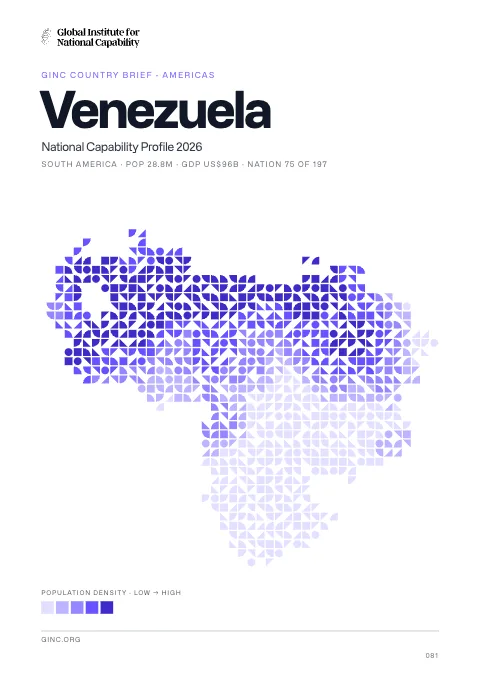
Venezuela is a federal republic in South America, home to 29 million people, with its capital at Caracas.
Contents
12 chapters
Foundations
01–03
At a glance
- Area
- 912.1Kkm²#33 World#6 S. America
- Population
- 28.9M#45 World#5 S. America
- GDP (market)
- $368B
- GDP (PPP)
- $407.4B#33 World#4 S. America
- GDP per capita
- $13.6K#100 World#5 S. America
The whole brief
Venezuela National Capability Profile 2026
Foundations · Chapter 01
Historical Context
🇻🇪 Venezuela’s understanding the origins and evolution of the modern nation
BackgroundBack to top ↑
Venezuela was one of three countries that emerged from the collapse of Gran Colombia in 1830 (the others being Ecuador and New Granada, which became Colombia). For most of the first half of the 20th century, Venezuela was ruled by generally benevolent military strongmen, who promoted the oil industry and allowed for some social reforms. Democratically elected governments have held sway since 1959. Hugo CHAVEZ, president from 1999 to 2013, sought to implement his "21st Century Socialism," which purported to alleviate social ills while at the same time attacking capitalist globalization and existing democratic institutions. His hand-picked successor, President Nicolas MADURO, continues CHAVEZ's socialist programs. Current concerns include: a weakening of democratic institutions, political polarization, a politicized military, rampant violent crime, overdependence on the petroleum industry with its price fluctuations, foreign exchange controls that discourage private-sector investment, high inflation, a decline in the quality of fundamental houman rights, and widespread scarcity of consumer goods.
IndependenceBack to top ↑
5 July 1811 (from Spain)
National holidayBack to top ↑
Independence Day, 5 July (1811)
Foundations · Chapter 02
Geography
🇻🇪 Venezuela’s territory, resources and strategic position
Location and areaBack to top ↑
Northern South America, bordering the Caribbean Sea and the North Atlantic Ocean, between Colombia and Guyana
8 00 N, 66 00 W
South America
almost six times the size of Georgia; slightly more than twice the size of California
2,800 km
Terrain and resourcesBack to top ↑
Andes Mountains and Maracaibo Lowlands in northwest; central plains (llanos); Guiana Highlands in southeast
petroleum, natural gas, iron ore, gold, bauxite, other minerals, hydropower, diamonds
10,550 sq km (2008)
Settlement and hazardsBack to top ↑
subject to floods, rockslides, mudslides; periodic droughts
on major sea and air routes linking North and South America; Angel Falls in the Guiana Highlands is the world's highest waterfall
OtherBack to top ↑
1,233 cu km (2011)
sewage pollution of Lago de Valencia; oil and urban pollution of Lago de Maracaibo; deforestation; soil degradation; urban and industrial pollution, especially along the Caribbean coast; threat to the rainforest ecosystem from irresponsible mining operations
Foundations · Chapter 03
Environment
🇻🇪 Venezuela’s environmental conditions, resources and national resilience
ClimateBack to top ↑
tropical; hot, humid; more moderate in highlands
Emissions and pollutionBack to top ↑
Water, waste and foodBack to top ↑
Resources and agreementsBack to top ↑
GINC Capability Domains · Chapter 04
Critical Technology
🇻🇪 Venezuela’s technology frontiers and the pursuit of national advantage
Two counts are set side by side for 2015–2024: on the left, the papers researchers in Venezuela published; on the right, the patent families that began there and were filed in more than one country. First by capability group, then group by group with each group’s capabilities. The badge on a card is the nation’s place among all nations. Papers are from GINC Research Analytics, patent families from GINC Patents.
Research by capability group
#103 WorldPapers published, 2015–2024
Patents by capability group
International patent families, 2015–2024
No international patent families on record for 2015–2024.
Advanced Materials & ManufacturingBack to top ↑
Research
#104 WorldPapers published, 2015–2024
Patents
International patent families, 2015–2024
No international patent families on record for 2015–2024.
Energy TechnologiesBack to top ↑
Research
#101 WorldPapers published, 2015–2024
Patents
International patent families, 2015–2024
No international patent families on record for 2015–2024.
Semiconductors & Advanced ComputingBack to top ↑
Research
#94 WorldPapers published, 2015–2024
No research topic: Semiconductor Design & EDA · Advanced Semiconductor Fabrication · Semiconductor Equipment & Materials · Advanced Packaging & Heterogeneous Integration
Patents
International patent families, 2015–2024
No international patent families on record for 2015–2024.
Artificial IntelligenceBack to top ↑
Research
#104 WorldPapers published, 2015–2024
Patents
International patent families, 2015–2024
No international patent families on record for 2015–2024.
Quantum TechnologiesBack to top ↑
Research
#129 WorldPapers published, 2015–2024
Patents
International patent families, 2015–2024
No international patent families on record for 2015–2024.
Connectivity, Cyber & Trust TechnologiesBack to top ↑
Research
#135 WorldPapers published, 2015–2024
Patents
International patent families, 2015–2024
No international patent families on record for 2015–2024.
Sensing, Timing & NavigationBack to top ↑
Research
#116 WorldPapers published, 2015–2024
Patents
International patent families, 2015–2024
No international patent families on record for 2015–2024.
Robotics & Autonomous SystemsBack to top ↑
Research
#81 WorldPapers published, 2015–2024
No research topic: Human-Machine Interfaces
Patents
International patent families, 2015–2024
No international patent families on record for 2015–2024.
Biotechnology & Health TechnologiesBack to top ↑
Research
#107 WorldPapers published, 2015–2024
Patents
International patent families, 2015–2024
No international patent families on record for 2015–2024.
Medicine and BioTech
Clinical research and life-science invention, drawn from the same series that drive the metric pages. Each card opens the full cross-country comparison.
Space TechnologiesBack to top ↑
Research
#61 WorldPapers published, 2015–2024
Patents
International patent families, 2015–2024
No international patent families on record for 2015–2024.
GINC Capability Domains · Chapter 05
Strategic Infrastructure
🇻🇪 Venezuela’s energy, connectivity and the material foundations of capability
Resource InfrastructureBack to top ↑
2.489 million bbl/day (2012 est.)
1.645 million bbl/day (2010 est.)
0 bbl/day (2010 est.)
297.6 billion bbl (1 January 2013 est.)
1.11 million bbl/day (2010 est.)
571,000 bbl/day (2011 est.)
638,000 bbl/day (2010 est.)
16,660 bbl/day (2011 est.)
25.28 billion cu m (2012 est.)
27.11 billion cu m (2010 est.)
0 cu m (2011 est.)
2.11 billion cu m (2011 est.)
5.524 trillion cu m (1 January 2013 est.)
extra heavy crude 981 km; gas 5,941 km; oil 7,588 km; refined products 1,778 km (2013)
Agriculture & Food InfrastructureBack to top ↑
- Irrigation & Agricultural Water
- Livestock & Veterinary
- Fisheries & Aquaculture
- Storage, Cold Chain & Markets
Energy InfrastructureBack to top ↑
- Thermal Generation
- Nuclear Generation
- Nuclear Fuel Cycle & Radioactive Waste
- Hydropower
- Renewable Generation
- Transmission & Distribution
- System Control & Dispatch
- Storage & Fuel Supply
27.5 million kW (2012 est.)
127.6 billion kWh (2012 est.)
85.05 billion kWh (2011 est.)
626 million kWh (2010 est.)
0 kWh (2010 est.)
35.7% of total installed capacity (2012 est.)
0% of total installed capacity (2012 est.)
64.3% of total installed capacity (2012 est.)
0% of total installed capacity (2012 est.)
182.7 million Mt (2011 est.)
Water, Sanitation & Waste InfrastructureBack to top ↑
- Dams, Reservoirs & Flood Defence
- Water Supply & Treatment
- Bulk Water Transfer & Desalination
- Wastewater & Sanitation
- Solid Waste & Recycling
Advanced ManufacturingBack to top ↑
- Materials & Inputs
- Chemicals & Hazardous Process Industry
- Production Systems
- Supply Chain & Ecosystem
- Workforce & Innovation
Transport InfrastructureBack to top ↑
- Seaports & Terminals
- Air Infrastructure
- Air Navigation & Traffic Management
- Inland Waterways & Ferries
- Rail Infrastructure
- Roads & Bridges
- Logistics, Multimodal & Border Infrastructure
- Postal & Parcel
444 (2013)
3 (2013)
7,100 km (the Orinoco River (400 km) and Lake de Maracaibo are navigable by oceangoing vessels) (2011)
the International Maritime Bureau reports the territorial and offshore waters in the Caribbean Sea as a significant risk for piracy and armed robbery against ships; numerous vessels, including commercial shipping and pleasure craft, have been attacked and hijacked both at anchor and while underway; crews have been robbed and stores or cargoes stolen
Communications & Digital InfrastructureBack to top ↑
- Subsea Cables & International Gateways
- Core & Backbone Networks
- Mobile & Wireless Networks
- Spectrum & Broadcasting
- Data Centres, Compute & Cloud
- Data Resources
- AI Tools & Applications
7.65 million (2012)
30.52 million (2012)
8.918 million (2009)
1.016 million (2012)
.ve
Financial InfrastructureBack to top ↑
- Currency & Reserves
- Payments & Settlement Systems
- Markets, Exchanges & Depositories
- Banks, Insurers & Systemic Institutions
Social InfrastructureBack to top ↑
- Health Infrastructure
- Public Health & Laboratories
- Medical Supply & Stockpiles
- Education & Skills Infrastructure
- Research & Scientific Facilities
- Housing, Community & Social Services
- Government & Public Administration
- Cultural, Community & Recreational Infrastructure
- Justice & Corrections
- Emergency Services & Civil Protection
- Hydrometeorology & Early Warning
Space, Aerospace & Defence InfrastructureBack to top ↑
GINC Capability Domains · Chapter 06
National Security
🇻🇪 Venezuela’s force, intelligence and the defence of the nation
Disputes and terrorismBack to top ↑
claims all of the area west of the Essequibo River in Guyana, preventing any discussion of a maritime boundary; Guyana has expressed its intention to join Barbados in asserting claims before the United Nations Convention on the Law of the Sea that Trinidad and Tobago's maritime boundary with Venezuela extends into their waters; dispute with Colombia over maritime boundary and Venezuelan administered Los Monjes islands near the Gulf of Venezuela; Colombian organized illegal narcotics and paramilitary activities penetrate Venezuela's shared border region; US, France, and the Netherlands recognize Venezuela's granting full effect to Aves Island, thereby claiming a Venezuelan Economic Exclusion Zone/continental shelf extending over a large portion of the eastern Caribbean Sea; Dominica, Saint Kitts and Nevis, Saint Lucia, and Saint Vincent and the Grenadines protest Venezuela's full effect claim
Force Generation & MobilisationBack to top ↑
Bolivarian National Armed Forces (Fuerza Armada Nacional Bolivariana, FANB): Bolivarian Army (Ejercito Bolivariano, EB), Bolivarian Navy (Armada Bolivariana, AB; includes Naval Infantry, Coast Guard, Naval Aviation), Bolivarian Military Aviation (Aviacion Militar Bolivariana, AMB; includes Air National Guard), Bolivarian National Guard (Guardia Nacional Bolivaria, GNB) (2013)
18-30 years of age for compulsory and voluntary military service; 30-month conscript service obligation; Navy requires 6th-grade education for enlisted personnel; all citizens of military service age (18-60 years old) are obligated to register for military service (2012)
1.05% of GDP (2012)//0.75% of GDP (2011)//1.05% of GDP (2010)
Forces under arms
Active-duty strength on the Correlates of War series, which reaches back to 1816 and so carries a nation’s whole record of mobilisation rather than its present establishment. The card opens the full cross-country comparison.
Intelligence & AssessmentBack to top ↑
- Imagery & Geospatial Intelligence
- Signals & Cyber Intelligence
- Technical & Measurement Intelligence
- Open-Source & Financial Intelligence
- Human Intelligence & Counterintelligence
- All-Source Analysis & Warning
Joint Command, Projection & SustainmentBack to top ↑
- Command, Control & Communications
- Strategic Lift & Mobility
- Expeditionary & Peace Operations
- Operational Sustainment & War Reserves
- Defence Industrial Mobilisation
- CBRN Defence
Land PowerBack to top ↑
- Combined Arms Manoeuvre
- Land Fires
- Battlefield Aviation & Uncrewed Systems
- Special Operations & Irregular Warfare
Maritime PowerBack to top ↑
- Maritime Security & Constabulary
- Sea Denial & Undersea Warfare
- Sea Control
- Amphibious & Expeditionary Operations
Air PowerBack to top ↑
- Air Sovereignty & Policing
- Control of the Air
- Air Strike & Interdiction
- Airborne ISR, Early Warning & Battle Management
Strategic Strike & Missile DefenceBack to top ↑
Space OperationsBack to top ↑
Cyber & Electromagnetic OperationsBack to top ↑
Nuclear DeterrenceBack to top ↑
GINC Capability Domains · Chapter 07
Human Capital
🇻🇪 Venezuela’s population, health and the skills that sustain capability
DemographyBack to top ↑
28,868,486 (July 2014 est.)
Social investment in Venezuela during the CHAVEZ administration reduced poverty from nearly 50 % in 1999 to about 27 % in 2011, increased school enrollment, substantially decreased infant and child mortality, and improved access to potable water and sanitation through social investment. "Missions" dedicated to education, nutrition, healthcare, and sanitation were funded through petroleum revenues. The sustainability of this progress remains questionable, however, as the continuation of these social programs depends on the prosperity of Venezuela's oil industry. In the long-term, education and health care spending may increase economic growth and reduce income inequality, but rising costs and the staffing of new health care jobs with foreigners are slowing development.//Since CHAVEZ came to power in 1999, more than one million predominantly middle- and upper-class Venezuelans are estimated to have emigrated. The brain drain is attributed to a repressive political system, lack of economic opportunities, steep inflation, a high crime rate, and corruption. Thousands of oil engineers emigrated to Canada, Colombia, and the United States following Chavez's firing of over 20,000 employees of the state-owned petroleum company during a 2002-2003 oil strike. Additionally, thousands of Venezuelans of European descent have taken up residence in their ancestral homelands. Nevertheless, Venezuela continues to attract immigrants from South America and southern Europe because of its lenient migration policy and the availability of education and health care. Venezuela also has been a fairly accommodating host to more than 200,000 Colombian refugees.
1.42% (2014 est.)
19.42 births/1,000 population (2014 est.)
5.27 deaths/1,000 population (2014 est.)
2.35 children born/woman (2014 est.)
Migration and urbanisationBack to top ↑
0 migrant(s)/1,000 population (2014 est.)
CARACAS (capital) 3.242 million; Maracaibo 2.31 million; Valencia 1.866 million; Barquisimeto 1.245 million; Maracay 1.115 million; Ciudad Guayana 799,000 (2011)
Welfare and equityBack to top ↑
31.6% (2011 est.)
39 (2011)//49.5 (1998)
DisplacementBack to top ↑
Early Childhood DevelopmentBack to top ↑
2.9% (2009)
Foundational EducationBack to top ↑
6.9% of GDP (2009)
Advanced EducationBack to top ↑
Technical & Vocational SkillsBack to top ↑
Digital & AI CompetenceBack to top ↑
Generative AI adoption
Modelled share of working-age adults using generative AI, from Microsoft telemetry scaled to each country’s 15–64 population. A measure of how fast a workforce is absorbing the technology rather than of how much of it a nation builds. The card opens the full cross-country comparison.
Lifelong Learning & ReskillingBack to top ↑
Research Talent & Knowledge CreationBack to top ↑
Population HealthBack to top ↑
92 deaths/100,000 live births (2010)
30.3% (2008)
0.6% (2012 est.)
107,900 (2012 est.)
3,800 (2012 est.)
Health System CapabilityBack to top ↑
5.2% of GDP (2011)
1.94 physicians/1,000 population (2001)
0.9 beds/1,000 population (2011)
GINC Capability Domains · Chapter 08
Governance and Integrity
🇻🇪 Venezuela’s institutions, law and the integrity of the state
State structureBack to top ↑
federal republic
23 states (estados, singular - estado), 1 capital district* (distrito capital), and 1 federal dependency** (dependencia federal); Amazonas, Anzoategui, Apure, Aragua, Barinas, Bolivar, Carabobo, Cojedes, Delta Amacuro, Dependencias Federales (Federal Dependencies)**, Distrito Capital (Capital District)*, Falcon, Guarico, Lara, Merida, Miranda, Monagas, Nueva Esparta, Portuguesa, Sucre, Tachira, Trujillo, Vargas, Yaracuy, Zulia
many previous; latest adopted 15 December 1999, effective 30 December 1999; amended 2009 (2013)
18 years of age; universal
Political Institutions & Civic ParticipationBack to top ↑
- Electoral Management & Integrity
- Legislature & Deliberative Institutions
- Citizen Participation & Civic Space
unicameral National Assembly or Asamblea Nacional (165 seats; members elected by popular vote on a proportional basis to serve five-year terms; three seats reserved for the indigenous peoples of Venezuela)
A New Time or UNT [Omar BARBOZA]//Brave People's Alliance or ABP [Antonio LEDEZMA]//Christian Democrats or COPEI [Roberto ENRIQUEZ]//Coalition of opposition parties -- The Democratic Unity Table or MUD [Ramon Guillermo AVELEDO]//Communist Party of Venezuela or PCV [Oscar FIGUERA]//Democratic Action or AD [Henry RAMOS ALLUP]//Fatherland for All or PPT [Rafael UZCATEGUI]//For Social Democracy or PODEMOS [Ismael GARCIA]//Justice First or PJ [Julio BORGES]//Movement Toward Socialism or MAS [Nicolas SOSA]//Popular Will or VP [Leopoldo LOPEZ]//Progressive Wave or AP [Henri FALCON]//The Radical Cause [Daniel SANTOLO]//United Socialist Party of Venezuela or PSUV [Nicolas MADURO]//Venezuelan Progressive Movement or MPV [Simon CALZADILLA]//Venezuela Project or PV [Henrique SALAS ROMER]
Bolivarian and Socialist Workers' Union (a ruling party labor union)//Confederacion Venezolana de Industriales or Coindustria (a conservative business group)//Consejos Comunales (pro-Chavez local cooperatives)//FEDECAMARAS (a conservative business group)//Union of Oil Workers of Venezuela or FUTPV//Venezuelan Confederation of Workers or CTV (opposition-oriented labor organization)//various civil society groups and human rights organizations
Justice System & Fundamental RightsBack to top ↑
- Judicial Independence & Court Capability
- Access to Justice & Legal Services
- Fundamental Rights Protection
- Human Rights Institutions & Equality Bodies
civil law system based on the Spanish civil code
has not submitted an ICJ jurisdiction declaration; state party to the ICCT
Internal Security & OrderBack to top ↑
small-scale illicit producer of opium and coca for the processing of opiates and coca derivatives; however, large quantities of cocaine, heroin, and marijuana transit the country from Colombia bound for US and Europe; significant narcotics-related money-laundering activity, especially along the border with Colombia and on Margarita Island; active eradication program primarily targeting opium; increasing signs of drug-related activities by Colombian insurgents on border
Regulatory Governance & Strategic ControlsBack to top ↑
- Regulatory Quality & Better Regulation
- Regulatory Delivery & Independent Regulators
- Strategic Controls & Economic Security Administration
Government Effectiveness & Public AdministrationBack to top ↑
- Centre of Government & Policy Coordination
- Civil Service & Public Workforce
- Digital Government & Service Delivery
- Legal Identity & Civil Registration
- Statistical & Data Capability
Public Integrity & Anti-CorruptionBack to top ↑
Transparency, Oversight & AccountabilityBack to top ↑
- Right to Information & Open Government
- Independent Oversight & Supreme Audit
- Independent Media & Journalist Safety
National Resilience & Crisis ManagementBack to top ↑
GINC Capability Domains · Chapter 09
Information and Influence
🇻🇪 Venezuela’s identity, media and the projection of influence
Identity and cultureBack to top ↑
Spanish (official), numerous indigenous dialects
nominally Roman Catholic 96%, Protestant 2%, other 2%
Spanish, Italian, Portuguese, Arab, German, African, indigenous people
troupial (bird)
three equal horizontal bands of yellow (top), blue, and red with the coat of arms on the hoist side of the yellow band and an arc of eight white five-pointed stars centered in the blue band; the flag retains the three equal horizontal bands and three main colors of the banner of Gran Colombia, the South American republic that broke up in 1830; yellow is interpreted as standing for the riches of the land, blue for the courage of its people, and red for the blood shed in attaining independence; the seven stars on the original flag represented the seven provinces in Venezuela that united in the war of independence; in 2006, then President Hugo CHAVEZ ordered an eighth star added to the star arc - a decision that sparked much controversy - to conform with the flag proclaimed by Simon Bolivar in 1827 and to represent the province of Guayana
Diplomatic Statecraft & Global NetworksBack to top ↑
- Diplomatic Network & Consular Reach
- Multilateral Leadership & Norm Setting
- Agenda-Setting & Convening
- Mediation & Crisis Diplomacy
Caricom (observer), CD, CDB, CELAC, FAO, G-15, G-24, G-77, IADB, IAEA, IBRD, ICAO, ICC (NGOs), ICCt, ICRM, IDA, IFAD, IFC, IFRCS, IHO, ILO, IMF, IMO, IMSO, Interpol, IOC, IOM, IPU, ITSO, ITU, ITUC (NGOs), LAES, LAIA, LAS (observer), Mercosur, MIGA, NAM, OAS, OPANAL, OPCW, OPEC, PCA, Petrocaribe, UN, UNASUR, UNCTAD, UNESCO, UNHCR, UNIDO, Union Latina, UNWTO, UPU, WCO, WFTU (NGOs), WHO, WIPO, WMO, WTO
Alliances & Security CooperationBack to top ↑
Development Cooperation & Global AssistanceBack to top ↑
Culture, Language & Education DiplomacyBack to top ↑
- Cultural & Language Institutes
- Creative Industries & Cultural Export Reach
- Heritage & Cultural Institutions
- Education Diplomacy & Alumni Networks
- Sports & Major Events
Diaspora & Global CommunitiesBack to top ↑
Information Environment & Strategic CommunicationBack to top ↑
- Strategic Communications & Public Diplomacy
- International Media & Broadcasting
- Information Defence & Counter-Interference
government supervises a mixture of state-run and private broadcast media; 13 public service networks, 61 privately owned TV networks, a privately owned news channel with limited national coverage, and a government-backed pan-American channel; state-run radio network includes roughly 65 news stations and another 30 stations targeted at specific audiences; state-sponsored community broadcasters include 235 radio stations and 44 TV stations; the number of private broadcast radio stations has been declining, but many still remain in operation (2014)
GINC Capability Domains · Chapter 10
Financial Strength
🇻🇪 Venezuela’s fiscal depth, reserves and the capacity to act
Monetary & Currency CapabilityBack to top ↑
- Monetary Policy & Price Stability
- Exchange Rate & External Account Management
- Currency Issuance & Digital Money
56.2% (2013 est.)//21.1% (2012 est.)
bolivars (VEB) per US dollar -//6.048 (2013 est.)//4.289 (2012 est.)//2.5821 (2010 est.)//2.147 (2009)//2.147 (2008)
29.5% (31 December 2010)//29.5% (31 December 2009)
18% (31 December 2013 est.)//16.38% (31 December 2012 est.)
$181.4 billion (31 December 2013 est.)//$162.7 billion (31 December 2012 est.)
$185.6 billion (31 December 2013 est.)//$166.7 billion (31 December 2012 est.)
Fiscal Capacity & Public FinanceBack to top ↑
- Revenue Mobilisation & Tax Administration
- Public Expenditure & Budget Management
- Sovereign Debt & Treasury Management
- Public Investment Management
28.1% of GDP (2013 est.)
-9.8% of GDP (2013 est.)
34.2% of GDP (2013 est.)//26.8% of GDP (2012 est.)
calendar year
Financial System Depth & AccessBack to top ↑
- Banking System Capacity
- Capital Markets Depth & Development
- Long-Term & Institutional Capital
- Financial Inclusion & Household Access
- Development & Policy Finance
$176.7 billion (31 December 2013 est.)//$160.1 billion (31 December 2012 est.)
$25.3 billion (31 December 2012 est.)//$5.143 billion (31 December 2011)//$3.991 billion (31 December 2011 est.)
23.8% of GDP (2013 est.)//28.9% of GDP (2012 est.)//30.8% of GDP (2011 est.)
Financial Regulation & IntegrityBack to top ↑
- Prudential Regulation & Supervision
- Financial Integrity & Illicit Finance Control
- Market Conduct & Consumer Protection
- Payment & Market Infrastructure Oversight
Financial Stability & Crisis ManagementBack to top ↑
- Macroprudential & Systemic Oversight
- Crisis Management, Resolution & Deposit Insurance
- External Liquidity & Financial Safety Nets
Sovereign Capital & External Financial PowerBack to top ↑
- Official Reserves Management
- Sovereign Wealth & Public Asset Management
- Currency Internationalisation & Reserve Status
- Capital Account & Flow Management
- International Financial Centre Capability
$21.15 billion (31 December 2013 est.)//$29.89 billion (31 December 2012 est.)
$74.87 billion (31 December 2013 est.)//$75.75 billion (31 December 2012 est.)
GINC Capability Domains · Chapter 11
Production and Innovation
🇻🇪 Venezuela’s output, industry and the engine of prosperity
Economic Output & ProductivityBack to top ↑
Venezuela remains highly dependent on oil revenues, which account for roughly 96% of export earnings, about 45% of budget revenues, and around 12% of GDP. Fueled by high oil prices, pre-election government spending helped spur GDP growth in 2012 to 5.6%. Government spending, minimum wage hikes, and improved access to domestic credit created an increase in consumption which combined with supply problems to cause higher inflation - roughly 20% in 2012 and rising to more than 56% in 2013. Former President Hugo CHAVEZ's efforts to increase the government's control of the economy by nationalizing firms in the agribusiness, financial, construction, oil, and steel sectors hurt the private investment environment, reduced productive capacity, and slowed non-petroleum exports. In 2013, Venezuela continued to wrestle with housing and electricity crises, and rolling food and goods shortages, resulting from the government's unorthodox economic policies. The budget deficit for the public sector reached 17% of GDP in 2012 and was trimmed to under 10% of GDP in 2013. The Venezuelan government has maintained a regime of strict currency exchange controls since 2003. Venezuelan law now sanctions a three-tiered exchange rate system, with rates based on the government's import priorities.
$407.4 billion (2013 est.)//$403.3 billion (2012 est.)//$381.9 billion (2011 est.)
1.6% (2013 est.)//5.6% (2012 est.)//4.2% (2011 est.)
$13,600 (2013 est.)//$13,700 (2012 est.)//$13,100 (2011 est.)
$367.5 billion (2013 est.)
Labour & EmploymentBack to top ↑
- Employment & Labour Force Participation
- Labour Market Institutions & Wage Setting
- Employment Services & Skills Matching
- Labour Adjustment, Transition & Formalisation
14.01 million (2013 est.)
7.9% (2013 est.)//7.8% (2012 est.)
Industrial & Sectoral BaseBack to top ↑
- Manufacturing & Advanced Industry
- Foundational & Process Industries
- Agrifood & Primary Production
- Services Economy
corn, sorghum, sugarcane, rice, bananas, vegetables, coffee; beef, pork, milk, eggs; fish
agricultural products, livestock, raw materials, machinery and equipment, transport equipment, construction materials, medical equipment, pharmaceuticals, chemicals, iron and steel products, crude oil and petroleum products
1% (2013 est.)
Structural Transformation & ComplexityBack to top ↑
Business Dynamism & EntrepreneurshipBack to top ↑
- Entrepreneurship & Firm Creation
- Risk Capital & Scale-Up Finance
- Firm Growth, Exit & Renewal
- Competition & Market Contestability
Innovation & CommercialisationBack to top ↑
- Business Innovation Capability
- Research Commercialisation & Knowledge Transfer
- Intellectual Property & Intangible Assets
- Innovation Ecosystems & Clusters
Technology Adoption & DiffusionBack to top ↑
GINC Capability Domains · Chapter 12
Trade and Investment
🇻🇪 Venezuela’s markets, capital and the terms of global exchange
Overall tradeBack to top ↑
$13.9B of exports to 112 partners and $13.7B of imports from 91 in 2024, a surplus of $279M.
- Exports
- $13.9B112 partners
- Imports
- $13.7B91 partners
- Balance
- +$279Msurplus
- Total trade
- $27.6B2024
ExportsBack to top ↑
Where its exports go
The largest partners in 2024, with each one's share of the nation's exports.
| Partner | Value | Share | |
|---|---|---|---|
| United States | $6.30B | 45% | |
| India | $2.04B | 15% | |
| China | $1.60B | 12% | |
| Spain | $1.45B | 10% | |
| Brazil | $472M | 3.4% | |
| Turkey | $356M | 2.6% | |
| Lebanon | $320M | 2.3% | |
| Italy | $296M | 2.1% | |
| Netherlands | $227M | 1.6% | |
| Colombia | $134M | 1.0% | |
| France | $92.6M | 0.7% | |
| Norway | $66.6M | 0.5% | |
| Poland | $53.9M | 0.4% | |
| Dominican Republic | $38.5M | 0.3% | |
| United Kingdom | $35.9M | 0.3% | |
| Germany | $35.3M | 0.3% | |
| Ecuador | $34.0M | 0.2% | |
| Malaysia | $27.7M | 0.2% | |
| Belgium | $26.9M | 0.2% | |
| Guatemala | $24.4M | 0.2% |
What it exports
The largest categories in 2024.
| Category | Value | Share | |
|---|---|---|---|
| Mineral fuels, oils, distillation products | $10.8B | 78% | |
| Iron and steel | $464M | 3.3% | |
| Organic chemicals | $448M | 3.2% | |
| Fish, crustaceans, molluscs, aquatics invertebrates | $360M | 2.6% | |
| Pearls, precious stones, metals, coins | $321M | 2.3% | |
| Aluminum | $318M | 2.3% | |
| Ores slag and ash | $297M | 2.1% | |
| Fertilizers | $212M | 1.5% | |
| Copper | $134M | 1.0% | |
| Cocoa and cocoa preparations | $108M | 0.8% | |
| Meat, fish and seafood preparations | $77.3M | 0.6% | |
| Beverages, spirits and vinegar | $73.9M | 0.5% | |
| Electrical, electronic equipment | $40.1M | 0.3% | |
| Wood and articles of wood, wood charcoal | $39.2M | 0.3% | |
| Inorganic chemicals, precious metal compound, isotope | $34.1M | 0.2% |
ImportsBack to top ↑
Where its imports come from
The largest partners in 2024, with each one's share of the nation's imports.
| Partner | Value | Share | |
|---|---|---|---|
| China | $4.80B | 35% | |
| United States | $4.13B | 30% | |
| Brazil | $1.20B | 8.8% | |
| Colombia | $1.00B | 7.3% | |
| Turkey | $307M | 2.2% | |
| Spain | $223M | 1.6% | |
| India | $217M | 1.6% | |
| Italy | $187M | 1.4% | |
| Canada | $180M | 1.3% | |
| Peru | $141M | 1.0% | |
| Germany | $122M | 0.9% | |
| Argentina | $118M | 0.9% | |
| Chile | $108M | 0.8% | |
| Belgium | $79.9M | 0.6% | |
| France | $75.7M | 0.6% | |
| Ecuador | $69.0M | 0.5% | |
| Japan | $67.9M | 0.5% | |
| Mexico | $63.1M | 0.5% | |
| Indonesia | $48.8M | 0.4% | |
| Netherlands | $42.9M | 0.3% |
What it imports
The largest categories in 2024.
| Category | Value | Share | |
|---|---|---|---|
| Mineral fuels, oils, distillation products | $2.35B | 17% | |
| Machinery, nuclear reactors, boilers | $1.42B | 10% | |
| Electrical, electronic equipment | $1.22B | 8.9% | |
| Vehicles other than railway, tramway | $1.08B | 7.9% | |
| Plastics | $702M | 5.1% | |
| Cereals | $700M | 5.1% | |
| Residues, wastes of food industry, animal fodder | $353M | 2.6% | |
| Sugars and sugar confectionery | $314M | 2.3% | |
| Cereal, flour, starch, milk preparations and products | $290M | 2.1% | |
| Animal, vegetable fats and oils, cleavage products | $289M | 2.1% | |
| Pharmaceutical products | $289M | 2.1% | |
| Articles of iron or steel | $243M | 1.8% | |
| Paper and paperboard, articles of pulp, paper and board | $222M | 1.6% | |
| Optical, photo, technical, medical apparatus | $219M | 1.6% | |
| Rubbers | $215M | 1.6% |
In a list, the bar runs to the largest in that list. The line is each figure’s history from 2000, drawn to its own peak: it shows the shape of the years, and the value shows the size.
External balanceBack to top ↑
$3.195 billion (2013 est.)//$11.02 billion (2012 est.)
Trade Facilitation & LogisticsBack to top ↑
Trade Policy & Market AccessBack to top ↑
- Trade Policy & Negotiation Capability
- Market Access & Agreements Network
- Trade Law & Enforcement
- Standards, Conformity & Quality Infrastructure
Digital & Services TradeBack to top ↑
- Services Trade Capability
- Digital Trade & E-Commerce
- Data Flows & Digital Trade Governance
- Tourism & Visitor Economy
Investment Attraction & ProjectionBack to top ↑
- Investment Attraction & Facilitation
- Investment Absorption & Linkages
- Outward Investment & Global Corporate Presence
$49.9 billion (31 December 2013 est.)//$47.4 billion (31 December 2012 est.)
$21.94 billion (31 December 2013 est.)//$21.25 billion (31 December 2012 est.)
Export Capability & SophisticationBack to top ↑
$91.78 billion (2013 est.)//$97.34 billion (2012 est.)
US 39.1%, China 14.3%, India 12%, Netherlands Antilles 7.8%, Cuba 4.6% (2012)
petroleum and petroleum products, bauxite and aluminum, minerals, chemicals, agricultural products
Global Value Chain PositionBack to top ↑
- Value Chain Participation & Integration
- Value Chain Position & Upgrading
- Regional Integration & Hub Anchoring
Economic Leverage & DependenceBack to top ↑
- Strategic Supply Security
- Concentration Risk & Revenue Stabilisation
- Economic Leverage & Coercion Resistance
$59.32 billion (2013 est.)//$59.31 billion (2012 est.)
US 31.7%, China 16.8%, Brazil 9.1%, Colombia 4.8% (2012)
agricultural products, livestock, raw materials, machinery and equipment, transport equipment, construction materials, medical equipment, petroleum products, pharmaceuticals, chemicals, iron and steel products
Venezuela · you are in
Historical Context
Foundations
GINC Capability Domains
Find in this brief · Venezuela