
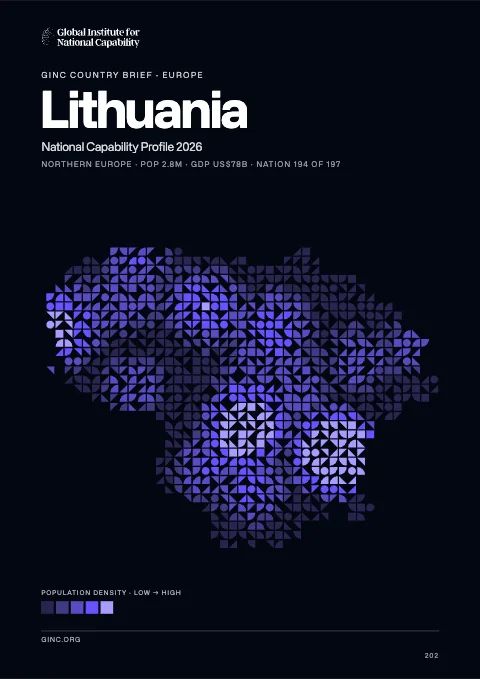
Lithuania
Lithuania is a parliamentary democracy in Europe, home to 3.5 million people, with its capital at Vilnius.
Contents
12 chapters
Foundations
01–03
At a glance
- Area
- 65.3Kkm²#123 World#21 Europe
- Population
- 3.5M#133 World#28 Europe
- GDP (market)
- $46.7B
- GDP (PPP)
- $67.4B#85 World#26 Europe
- GDP per capita
- $22.6K#65 World#31 Europe
The whole brief
Lithuania National Capability Profile 2026
Foundations · Chapter 01
Historical Context
🇱🇹 Lithuania’s understanding the origins and evolution of the modern nation
BackgroundBack to top ↑
Lithuanian lands were united under MINDAUGAS in 1236; over the next century, through alliances and conquest, Lithuania extended its territory to include most of present-day Belarus and Ukraine. By the end of the 14th century Lithuania was the largest state in Europe. An alliance with Poland in 1386 led the two countries into a union through the person of a common ruler. In 1569, Lithuania and Poland formally united into a single dual state, the Polish-Lithuanian Commonwealth. This entity survived until 1795 when its remnants were partitioned by surrounding countries. Lithuania regained its independence following World War I but was annexed by the USSR in 1940 - an action never recognized by the US and many other countries. On 11 March 1990, Lithuania became the first of the Soviet republics to declare its independence, but Moscow did not recognize this proclamation until September of 1991 (following the abortive coup in Moscow). The last Russian troops withdrew in 1993. Lithuania subsequently restructured its economy for integration into Western European institutions; it joined both NATO and the EU in the spring of 2004. In January 2014, Lithuania assumed a nonpermanent seat on the UN Security Council for the 2014-15 term.
IndependenceBack to top ↑
11 March 1990 (declared); 6 September 1991 (recognized by the Soviet Union); notable earlier dates: 6 July 1253 (coronation of MINDAUGAS, traditional founding date), 1 July 1569 (Polish-Lithuanian Commonwealth created)
National holidayBack to top ↑
Independence Day, 16 February (1918); note - 16 February 1918 was the date Lithuania declared its independence from Soviet Russia and established its statehood; 11 March 1990 was the date it declared its independence from the Soviet Union
Foundations · Chapter 02
Geography
🇱🇹 Lithuania’s territory, resources and strategic position
Location and areaBack to top ↑
Eastern Europe, bordering the Baltic Sea, between Latvia and Russia
56 00 N, 24 00 E
Europe
slightly larger than West Virginia
90 km
Terrain and resourcesBack to top ↑
lowland, many scattered small lakes, fertile soil
peat, arable land, amber
13.4 sq km (2007)
Settlement and hazardsBack to top ↑
NA
fertile central plains are separated by hilly uplands that are ancient glacial deposits
OtherBack to top ↑
24.9 cu km (2011)
contamination of soil and groundwater with petroleum products and chemicals at military bases
Foundations · Chapter 03
Environment
🇱🇹 Lithuania’s environmental conditions, resources and national resilience
ClimateBack to top ↑
transitional, between maritime and continental; wet, moderate winters and summers
Emissions and pollutionBack to top ↑
Water, waste and foodBack to top ↑
Resources and agreementsBack to top ↑
GINC Capability Domains · Chapter 04
Critical Technology
🇱🇹 Lithuania’s technology frontiers and the pursuit of national advantage
Two counts are set side by side for 2015–2024: on the left, the papers researchers in Lithuania published; on the right, the patent families that began there and were filed in more than one country. First by capability group, then group by group with each group’s capabilities. The badge on a card is the nation’s place among all nations. Papers are from GINC Research Analytics, patent families from GINC Patents.
Research by capability group
#80 WorldPapers published, 2015–2024
372
370
169
107
93
72
70
37
33
3
Patents by capability group
#45 WorldInternational patent families, 2015–2024
Advanced Materials & ManufacturingBack to top ↑
Research
#65 WorldPapers published, 2015–2024
Patents
#47 WorldInternational patent families, 2015–2024
Energy TechnologiesBack to top ↑
Research
#71 WorldPapers published, 2015–2024
Patents
#52 WorldInternational patent families, 2015–2024
Semiconductors & Advanced ComputingBack to top ↑
Research
#62 WorldPapers published, 2015–2024
No research topic: Semiconductor Design & EDA · Advanced Semiconductor Fabrication · Semiconductor Equipment & Materials · Advanced Packaging & Heterogeneous Integration
Patents
#41 WorldInternational patent families, 2015–2024
Artificial IntelligenceBack to top ↑
Research
#80 WorldPapers published, 2015–2024
Patents
#47 WorldInternational patent families, 2015–2024
Quantum TechnologiesBack to top ↑
Research
#76 WorldPapers published, 2015–2024
Patents
International patent families, 2015–2024
No international patent families on record for 2015–2024.
Connectivity, Cyber & Trust TechnologiesBack to top ↑
Research
#86 WorldPapers published, 2015–2024
Patents
#45 WorldInternational patent families, 2015–2024
Sensing, Timing & NavigationBack to top ↑
Research
#81 WorldPapers published, 2015–2024
Patents
#40 WorldInternational patent families, 2015–2024
Robotics & Autonomous SystemsBack to top ↑
Research
#80 WorldPapers published, 2015–2024
No research topic: Human-Machine Interfaces
Patents
#45 WorldInternational patent families, 2015–2024
Biotechnology & Health TechnologiesBack to top ↑
Research
#99 WorldPapers published, 2015–2024
Patents
#38 WorldInternational patent families, 2015–2024
Medicine and BioTech
Clinical research and life-science invention, drawn from the same series that drive the metric pages. Each card opens the full cross-country comparison.
Space TechnologiesBack to top ↑
Research
#70 WorldPapers published, 2015–2024
Patents
#44 WorldInternational patent families, 2015–2024
GINC Capability Domains · Chapter 05
Strategic Infrastructure
🇱🇹 Lithuania’s energy, connectivity and the material foundations of capability
Resource InfrastructureBack to top ↑
9,111 bbl/day (2012 est.)
2,181 bbl/day (2010 est.)
190,100 bbl/day (2010 est.)
12 million bbl (1 January 2013 est.)
197,400 bbl/day (2010 est.)
70,390 bbl/day (2011 est.)
155,000 bbl/day (2010 est.)
16,110 bbl/day (2010 est.)
0 cu m (2011 est.)
3.3 billion cu m (2012 est.)
0 cu m (2012 est.)
3.4 billion cu m (2011 est.)
0 cu m (1 January 2013 est.)
gas 1,921 km; refined products 121 km (2013)
Agriculture & Food InfrastructureBack to top ↑
- Irrigation & Agricultural Water
- Livestock & Veterinary
- Fisheries & Aquaculture
- Storage, Cold Chain & Markets
Energy InfrastructureBack to top ↑
- Thermal Generation
- Nuclear Generation
- Nuclear Fuel Cycle & Radioactive Waste
- Hydropower
- Renewable Generation
- Transmission & Distribution
- System Control & Dispatch
- Storage & Fuel Supply
3.82 million kW (2011 est.)
12.27 billion kWh (2012 est.)
10.3 billion kWh (2012 est.)
186 million kWh (2012 est.)
1.17 billion kWh (2012 est.)
70.6% of total installed capacity (2010 est.)
0% of total installed capacity (2010 est.)
3.2% of total installed capacity (2010 est.)
5% of total installed capacity (2010 est.)
16.05 million Mt (2011 est.)
Water, Sanitation & Waste InfrastructureBack to top ↑
- Dams, Reservoirs & Flood Defence
- Water Supply & Treatment
- Bulk Water Transfer & Desalination
- Wastewater & Sanitation
- Solid Waste & Recycling
Advanced ManufacturingBack to top ↑
- Materials & Inputs
- Chemicals & Hazardous Process Industry
- Production Systems
- Supply Chain & Ecosystem
- Workforce & Innovation
Transport InfrastructureBack to top ↑
- Seaports & Terminals
- Air Infrastructure
- Air Navigation & Traffic Management
- Inland Waterways & Ferries
- Rail Infrastructure
- Roads & Bridges
- Logistics, Multimodal & Border Infrastructure
- Postal & Parcel
61 (2013)
441 km (navigable year round) (2007)
Communications & Digital InfrastructureBack to top ↑
- Subsea Cables & International Gateways
- Core & Backbone Networks
- Mobile & Wireless Networks
- Spectrum & Broadcasting
- Data Centres, Compute & Cloud
- Data Resources
- AI Tools & Applications
667,300 (2012)
5 million (2012)
1.964 million (2009)
1.205 million (2012)
.lt
Financial InfrastructureBack to top ↑
- Currency & Reserves
- Payments & Settlement Systems
- Markets, Exchanges & Depositories
- Banks, Insurers & Systemic Institutions
Social InfrastructureBack to top ↑
- Health Infrastructure
- Public Health & Laboratories
- Medical Supply & Stockpiles
- Education & Skills Infrastructure
- Research & Scientific Facilities
- Housing, Community & Social Services
- Government & Public Administration
- Cultural, Community & Recreational Infrastructure
- Justice & Corrections
- Emergency Services & Civil Protection
- Hydrometeorology & Early Warning
Space, Aerospace & Defence InfrastructureBack to top ↑
GINC Capability Domains · Chapter 06
National Security
🇱🇹 Lithuania’s force, intelligence and the defence of the nation
Disputes and terrorismBack to top ↑
Lithuania and Russia committed to demarcating their boundary in 2006 in accordance with the land and maritime treaty ratified by Russia in May 2003 and by Lithuania in 1999; Lithuania operates a simplified transit regime for Russian nationals traveling from the Kaliningrad coastal exclave into Russia, while still conforming, as a EU member state having an external border with a non-EU member, to strict Schengen border rules; boundary demarcated with Latvia and Lithuania; as of January 2007, ground demarcation of the boundary with Belarus was complete and mapped with final ratification documents in preparation
Force Generation & MobilisationBack to top ↑
Lithuanian Armed Forces (Lietuvos Ginkluotosios Pajegos): Land Forces (Sausumos Pajegos), Naval Forces (Karines Juru Pajegos), Air Forces (Karines Oro Pajegos) (2013)
18 years of age for voluntary military service; service obligation 1 year; Lithuania converted to a professional military in the fall of 2008, although the decision continues under judicial review (2012)
0.97% of GDP (2012)//1.04% of GDP (2011)//0.97% of GDP (2010)
Forces under arms
Active-duty strength on the Correlates of War series, which reaches back to 1816 and so carries a nation’s whole record of mobilisation rather than its present establishment. The card opens the full cross-country comparison.
Intelligence & AssessmentBack to top ↑
- Imagery & Geospatial Intelligence
- Signals & Cyber Intelligence
- Technical & Measurement Intelligence
- Open-Source & Financial Intelligence
- Human Intelligence & Counterintelligence
- All-Source Analysis & Warning
Joint Command, Projection & SustainmentBack to top ↑
- Command, Control & Communications
- Strategic Lift & Mobility
- Expeditionary & Peace Operations
- Operational Sustainment & War Reserves
- Defence Industrial Mobilisation
- CBRN Defence
Land PowerBack to top ↑
- Combined Arms Manoeuvre
- Land Fires
- Battlefield Aviation & Uncrewed Systems
- Special Operations & Irregular Warfare
Maritime PowerBack to top ↑
- Maritime Security & Constabulary
- Sea Denial & Undersea Warfare
- Sea Control
- Amphibious & Expeditionary Operations
Air PowerBack to top ↑
- Air Sovereignty & Policing
- Control of the Air
- Air Strike & Interdiction
- Airborne ISR, Early Warning & Battle Management
Strategic Strike & Missile DefenceBack to top ↑
Space OperationsBack to top ↑
Cyber & Electromagnetic OperationsBack to top ↑
Nuclear DeterrenceBack to top ↑
GINC Capability Domains · Chapter 07
Human Capital
🇱🇹 Lithuania’s population, health and the skills that sustain capability
DemographyBack to top ↑
3,505,738
-0.29% (2014 est.)
9.36 births/1,000 population (2014 est.)
11.55 deaths/1,000 population (2014 est.)
1.29 children born/woman (2014 est.)
26.7 (2011 est.)
62.9%
Migration and urbanisationBack to top ↑
-0.73 migrant(s)/1,000 population (2014 est.)
VILNIUS (capital) 546,000 (2011)
Welfare and equityBack to top ↑
4% (2008)
35.5 (2009)//34 (1999)
DisplacementBack to top ↑
Early Childhood DevelopmentBack to top ↑
Foundational EducationBack to top ↑
5.4% of GDP (2010)
Advanced EducationBack to top ↑
Technical & Vocational SkillsBack to top ↑
Digital & AI CompetenceBack to top ↑
Generative AI adoption
Modelled share of working-age adults using generative AI, from Microsoft telemetry scaled to each country’s 15–64 population. A measure of how fast a workforce is absorbing the technology rather than of how much of it a nation builds. The card opens the full cross-country comparison.
Lifelong Learning & ReskillingBack to top ↑
Research Talent & Knowledge CreationBack to top ↑
Population HealthBack to top ↑
8 deaths/100,000 live births (2010)
27.6% (2008)
0.1% (2009 est.)
1,200 (2009 est.)
fewer than 100 (2009 est.)
Health System CapabilityBack to top ↑
7% of GDP (2010)
3.64 physicians/1,000 population (2010)
6.8 beds/1,000 population (2010)
GINC Capability Domains · Chapter 08
Governance and Integrity
🇱🇹 Lithuania’s institutions, law and the integrity of the state
State structureBack to top ↑
parliamentary democracy
60 municipalities (savivaldybe, singular - savivaldybe); Akmene, Alytaus Miestas, Alytus, Ankšciai, Birštono, Biržai, Druskininkai, Elektrénai, Ignalina, Jonava, Joniškis, Jurbarkas, Kaišiadorys, Kalvarijos, Kauno Miestas, Kaunas, Kazlu Rudos, Kedainiai, Kelme, Klaipedos Miestas, Klaipeda, Kretinga, Kupiškis, Lazdijai, Marijampole, Mažeikiai, Moletai, Neringa, Pagégiai, Pakruojis, Palangos Miestas, Panevežys, Pasvalys, Plunge, Prienai, Radviliškis, Raseiniai, Rietavo, Rokiškis, Šakiai, Šalcininkai, Šiauliu Miestas, Šiauliai, Šilale, Šilute, Širvintos, Skuodas, Švencionys, Taurage, Telšiai, Trakai, Ukmerge, Utena, Varena, Vilkaviškis, Vilniaus, Vilnius, Visaginas, Zarasai
several previous; latest adopted by referendum 25 October 1992, entered into force 2 November 1992; amended 2003 (2012)
18 years of age; universal
Political Institutions & Civic ParticipationBack to top ↑
- Electoral Management & Integrity
- Legislature & Deliberative Institutions
- Citizen Participation & Civic Space
unicameral Parliament or Seimas (141 seats; 71 members elected in single-member districts, 70 elected by proportional representation; members to serve four-year terms)
Christian Party or KP [Gediminas VAGNORIUS]//Civil Democracy Party or PDP [Algimantas MATULEVICIUS]//Democratic Labor and Unity Party or DDVP [Kristina BRAZAUSKIENE]//Electoral Action of Lithuanian Poles or LLRA [Valdemar TOMASEVSKI]//Emigrants Party or EP [Juozas MURAUSKAS]//Homeland Union-Lithuanian Christian Democrats or TS-LKD [Andrius KUBILIUS]//Labor Party or DP [Loreta GRAUZINIENE]//Liberal and Center Union or LCS [Arturas MELIANAS]//Liberal Movement or LS or LRLS [Eligijus MASIULIS]//Lithuanian People's Party or LLP [Kazimiera PRUNSKIENE]//Lithuanian People's Party or LZP [Joana SIMANAUSKIENE]//Lithuanian Russian Union or LRS [Sergejus DMITRIJEVAS]//Lithuanian Social Democratic Party or LSDP [Algirdas BUTKEVICIUS]//Nationalist Union or TS [Gintaras SONGAILA]//Order and Justice Party or TT [Rolandas PAKSAS]//Peasant and Greens Union or LVZS [Ramunas KARBAUSKIS]//Republican Party or RP [Valdemaras VALKIUNAS]//Russian Alliance or RA [Tamara LOCHANKINA]//Socialist People's Front or SLF [Algirdas PALECKIS]//Way of Courage or DK [Jonas VARKALA]//YES-Homeland Revival and Perspective or YES Union or TAIP Union or TAIP [Arturas ZUOKAS]//Young Lithuania Party or PJL [Stanislovas BUSKEVICIUS]
Justice System & Fundamental RightsBack to top ↑
- Judicial Independence & Court Capability
- Access to Justice & Legal Services
- Fundamental Rights Protection
- Human Rights Institutions & Equality Bodies
civil law system; legislative acts can be appealed to the constitutional court
has not submitted an ICJ jurisdiction declaration; accepts ICCt jurisdiction
Internal Security & OrderBack to top ↑
transshipment and destination point for cannabis, cocaine, ecstasy, and opiates from Southwest Asia, Latin America, Western Europe, and neighboring Baltic countries; growing production of high-quality amphetamines, but limited production of cannabis, methamphetamines; susceptible to money laundering despite changes to banking legislation
Regulatory Governance & Strategic ControlsBack to top ↑
- Regulatory Quality & Better Regulation
- Regulatory Delivery & Independent Regulators
- Strategic Controls & Economic Security Administration
Government Effectiveness & Public AdministrationBack to top ↑
- Centre of Government & Policy Coordination
- Civil Service & Public Workforce
- Digital Government & Service Delivery
- Legal Identity & Civil Registration
- Statistical & Data Capability
Public Integrity & Anti-CorruptionBack to top ↑
Transparency, Oversight & AccountabilityBack to top ↑
- Right to Information & Open Government
- Independent Oversight & Supreme Audit
- Independent Media & Journalist Safety
National Resilience & Crisis ManagementBack to top ↑
GINC Capability Domains · Chapter 09
Information and Influence
🇱🇹 Lithuania’s identity, media and the projection of influence
Identity and cultureBack to top ↑
Lithuanian (official) 82%, Russian 8%, Polish 5.6%, other 0.9%, unspecified 3.5% (2011 est.)
Roman Catholic 77.2%, Russian Orthodox 4.1%, Old Believer 0.8%, Evangelical Lutheran 0.6%, Evangelical Reformist 0.2%, other (including Sunni Muslim, Jewish, Greek Catholic, and Karaite) 0.8%, none 6.1%, unspecified 10.1% (2011 est.)
Lithuanian 84.1%, Polish 6.6%, Russian 5.8%, Belarusian 1.2%, other 1.1%, unspecified 1.2% (2011 est.)
mounted knight known as Vytis (the Chaser)
three equal horizontal bands of yellow (top), green, and red; yellow symbolizes golden fields, as well as the sun, light, and goodness; green represents the forests of the countryside, in addition to nature, freedom, and hope; red stands for courage and the blood spilled in defense of the homeland
Diplomatic Statecraft & Global NetworksBack to top ↑
- Diplomatic Network & Consular Reach
- Multilateral Leadership & Norm Setting
- Agenda-Setting & Convening
- Mediation & Crisis Diplomacy
Australia Group, BA, BIS, CBSS, CD, CE, EAPC, EBRD, EIB, EU, FAO, IAEA, IBRD, ICAO, ICC (national committees), ICRM, IDA, IFC, IFRCS, ILO, IMF, IMO, Interpol, IOC, IOM, IPU, ISO, ITU, ITUC (NGOs), MIGA, NATO, NIB, NSG, OAS (observer), OIF (observer), OPCW, OSCE, PCA, Schengen Convention, UN, UN Security Council (temporary), UNCTAD, UNESCO, UNIDO, UNWTO, UPU, WCO, WHO, WIPO, WMO, WTO
Alliances & Security CooperationBack to top ↑
Development Cooperation & Global AssistanceBack to top ↑
Culture, Language & Education DiplomacyBack to top ↑
- Cultural & Language Institutes
- Creative Industries & Cultural Export Reach
- Heritage & Cultural Institutions
- Education Diplomacy & Alumni Networks
- Sports & Major Events
Diaspora & Global CommunitiesBack to top ↑
Information Environment & Strategic CommunicationBack to top ↑
- Strategic Communications & Public Diplomacy
- International Media & Broadcasting
- Information Defence & Counter-Interference
public broadcaster operates 3 channels with the third channel - a satellite channel - introduced in 2007; various privately owned commercial TV broadcasters operate national and multiple regional channels; many privately owned local TV stations; multi-channel cable and satellite TV services available; publicly owned broadcaster operates 3 radio networks; many privately owned commercial broadcasters, many with repeater stations in various regions throughout the country (2007)
GINC Capability Domains · Chapter 10
Financial Strength
🇱🇹 Lithuania’s fiscal depth, reserves and the capacity to act
Monetary & Currency CapabilityBack to top ↑
- Monetary Policy & Price Stability
- Exchange Rate & External Account Management
- Currency Issuance & Digital Money
1.2% (2013 est.)//3.1% (2012 est.)
litai (LTL) per US dollar -//2.658 (2013 est.)//2.685 (2012 est.)//2.6063 (2010 est.)//2.4787 (2009)//2.3251 (2008)
3% (31 December 2010 est.)//2.06% (31 December 2009 est.)
4.5% (31 December 2013 est.)//5.28% (31 December 2012 est.)
$13.83 billion (31 December 2013 est.)//$13.77 billion (31 December 2012 est.)
$20.59 billion (31 December 2013 est.)//$20.58 billion (31 December 2012 est.)
Fiscal Capacity & Public FinanceBack to top ↑
- Revenue Mobilisation & Tax Administration
- Public Expenditure & Budget Management
- Sovereign Debt & Treasury Management
- Public Investment Management
31% of GDP (2013 est.)
-2% of GDP (2013 est.)
40.2% of GDP (2013 est.)//41% of GDP (2012 est.)
calendar year
Financial System Depth & AccessBack to top ↑
- Banking System Capacity
- Capital Markets Depth & Development
- Long-Term & Institutional Capital
- Financial Inclusion & Household Access
- Development & Policy Finance
$22.02 billion (31 December 2013 est.)//$22.69 billion (31 December 2012 est.)
$3.964 billion (31 December 2012 est.)//$4.075 billion (31 December 2011)//$5.661 billion (31 December 2010 est.)
16.5% of GDP (2013 est.)//17.2% of GDP (2012 est.)//18.9% of GDP (2011 est.)
Financial Regulation & IntegrityBack to top ↑
- Prudential Regulation & Supervision
- Financial Integrity & Illicit Finance Control
- Market Conduct & Consumer Protection
- Payment & Market Infrastructure Oversight
Financial Stability & Crisis ManagementBack to top ↑
- Macroprudential & Systemic Oversight
- Crisis Management, Resolution & Deposit Insurance
- External Liquidity & Financial Safety Nets
Sovereign Capital & External Financial PowerBack to top ↑
- Official Reserves Management
- Sovereign Wealth & Public Asset Management
- Currency Internationalisation & Reserve Status
- Capital Account & Flow Management
- International Financial Centre Capability
$10.37 billion (31 December 2013 est.)//$8.529 billion (31 December 2012 est.)
$29.55 billion (31 December 2013 est.)//$32.84 billion (31 December 2012 est.)
GINC Capability Domains · Chapter 11
Production and Innovation
🇱🇹 Lithuania’s output, industry and the engine of prosperity
Economic Output & ProductivityBack to top ↑
Lithuania gained membership in the World Trade Organization and joined the EU in May 2004. Despite its EU accession, Lithuania's trade with its Central and Eastern European neighbors, and Russia in particular, accounts for a significant share of total trade. Foreign investment and business support have helped in the transition from the old command economy to a market economy. The three former Soviet Baltic republics were among the hardest hit by the 2008-09 financial crisis. The government's efforts to attract foreign investment, to develop export markets, and to pursue broad economic reforms has been key to Lithuania's quick recovery from a deep recession, making Lithuania one of the fastest growing economies in the EU. Lithuania is committed to meeting the Maastricht criteria to join the euro zone, which the government expects to achieve by 2015. Under the Conservative Party's leadership, Lithuania raised the monthly minimum wage in January 2012 nearly 25% over 2011. In January 2013, the new Social Democrat-led government increased the minimum wage another 25% over January 2012. Despite government efforts, unemployment remains high.
$67.43 billion (2013 est.)//$65.19 billion (2012 est.)//$62.92 billion (2011 est.)
3.4% (2013 est.)//3.6% (2012 est.)//5.9% (2011 est.)
$22,600 (2013 est.)//$21,700 (2012 est.)//$20,800 (2011 est.)
$46.71 billion (2013 est.)
Labour & EmploymentBack to top ↑
- Employment & Labour Force Participation
- Labour Market Institutions & Wage Setting
- Employment Services & Skills Matching
- Labour Adjustment, Transition & Formalisation
1.452 million (2013 est.)
12.4% (2013 est.)//13.2% (2012 est.)
Industrial & Sectoral BaseBack to top ↑
- Manufacturing & Advanced Industry
- Foundational & Process Industries
- Agrifood & Primary Production
- Services Economy
grain, potatoes, sugar beets, flax, vegetables; beef, milk, eggs; fish
metal-cutting machine tools, electric motors, television sets, refrigerators and freezers, petroleum refining, shipbuilding (small ships), furniture, textiles, food processing, fertilizers, agricultural machinery, optical equipment, electronic components, computers, amber jewelry
2% (2013 est.)
Structural Transformation & ComplexityBack to top ↑
Business Dynamism & EntrepreneurshipBack to top ↑
- Entrepreneurship & Firm Creation
- Risk Capital & Scale-Up Finance
- Firm Growth, Exit & Renewal
- Competition & Market Contestability
Innovation & CommercialisationBack to top ↑
- Business Innovation Capability
- Research Commercialisation & Knowledge Transfer
- Intellectual Property & Intangible Assets
- Innovation Ecosystems & Clusters
Technology Adoption & DiffusionBack to top ↑
GINC Capability Domains · Chapter 12
Trade and Investment
🇱🇹 Lithuania’s markets, capital and the terms of global exchange
Overall tradeBack to top ↑
$37.2B of exports to 194 partners and $42.0B of imports from 174 in 2024, a deficit of $4.76B.
- Exports
- $37.2B194 partners
- Imports
- $42.0B174 partners
- Balance
- −$4.76Bdeficit
- Total trade
- $79.2B2024
ExportsBack to top ↑
Where its exports go
The largest partners in 2024, with each one's share of the nation's exports.
| Partner | Value | Share | |
|---|---|---|---|
| Latvia | $4.30B | 12% | |
| Poland | $3.18B | 8.6% | |
| Germany | $2.90B | 7.8% | |
| Netherlands | $2.36B | 6.3% | |
| United States | $2.09B | 5.6% | |
| United Kingdom | $1.67B | 4.5% | |
| Estonia | $1.42B | 3.8% | |
| Sweden | $1.41B | 3.8% | |
| Ukraine | $1.30B | 3.5% | |
| Norway | $1.14B | 3.1% | |
| Belarus | $1.13B | 3.0% | |
| Italy | $1.00B | 2.7% | |
| Denmark | $994M | 2.7% | |
| France | $974M | 2.6% | |
| Finland | $757M | 2.0% | |
| Russia | $688M | 1.9% | |
| Turkey | $670M | 1.8% | |
| Spain | $592M | 1.6% | |
| Nigeria | $565M | 1.5% | |
| Czech Republic | $476M | 1.3% |
What it exports
The largest categories in 2024.
| Category | Value | Share | |
|---|---|---|---|
| Mineral fuels, oils, distillation products | $5.17B | 14% | |
| Furniture, lighting signs, prefabricated buildings | $3.20B | 8.6% | |
| Plastics | $2.94B | 7.9% | |
| Electrical, electronic equipment | $2.46B | 6.6% | |
| Machinery, nuclear reactors, boilers | $1.89B | 5.1% | |
| Vehicles other than railway, tramway | $1.86B | 5.0% | |
| Cereals | $1.40B | 3.8% | |
| Wood and articles of wood, wood charcoal | $1.33B | 3.6% | |
| Optical, photo, technical, medical apparatus | $1.26B | 3.4% | |
| Pharmaceutical products | $1.14B | 3.1% | |
| Tobacco and manufactures tobacco substitutes | $848M | 2.3% | |
| Dairy products, eggs, honey, edible products | $843M | 2.3% | |
| Articles of iron or steel | $801M | 2.2% | |
| Fertilizers | $783M | 2.1% | |
| Iron and steel | $760M | 2.0% |
ImportsBack to top ↑
Where its imports come from
The largest partners in 2024, with each one's share of the nation's imports.
| Partner | Value | Share | |
|---|---|---|---|
| Poland | $5.80B | 14% | |
| Germany | $5.15B | 12% | |
| Latvia | $3.44B | 8.2% | |
| Saudi Arabia | $2.28B | 5.4% | |
| Netherlands | $2.13B | 5.1% | |
| China | $2.04B | 4.9% | |
| Sweden | $1.78B | 4.2% | |
| United States | $1.77B | 4.2% | |
| Norway | $1.67B | 4.0% | |
| Estonia | $1.60B | 3.8% | |
| Italy | $1.18B | 2.8% | |
| Belgium | $1.08B | 2.6% | |
| France | $1.06B | 2.5% | |
| Czech Republic | $1.04B | 2.5% | |
| Finland | $954M | 2.3% | |
| United Kingdom | $903M | 2.2% | |
| Denmark | $734M | 1.7% | |
| Algeria | $727M | 1.7% | |
| Spain | $557M | 1.3% | |
| Ukraine | $543M | 1.3% |
What it imports
The largest categories in 2024.
| Category | Value | Share | |
|---|---|---|---|
| Mineral fuels, oils, distillation products | $7.18B | 17% | |
| Vehicles other than railway, tramway | $4.40B | 10% | |
| Electrical, electronic equipment | $3.95B | 9.4% | |
| Machinery, nuclear reactors, boilers | $3.59B | 8.5% | |
| Plastics | $2.00B | 4.8% | |
| Pharmaceutical products | $1.90B | 4.5% | |
| Iron and steel | $1.00B | 2.4% | |
| Articles of iron or steel | $978M | 2.3% | |
| Optical, photo, technical, medical apparatus | $836M | 2.0% | |
| Wood and articles of wood, wood charcoal | $789M | 1.9% | |
| Organic chemicals | $716M | 1.7% | |
| Fish, crustaceans, molluscs, aquatics invertebrates | $710M | 1.7% | |
| Paper and paperboard, articles of pulp, paper and board | $670M | 1.6% | |
| Miscellaneous chemical products | $578M | 1.4% | |
| Furniture, lighting signs, prefabricated buildings | $537M | 1.3% |
In a list, the bar runs to the largest in that list. The line is each figure’s history from 2000, drawn to its own peak: it shows the shape of the years, and the value shows the size.
External balanceBack to top ↑
-$567 million (2013 est.)//-$231 million (2012 est.)
Trade Facilitation & LogisticsBack to top ↑
Trade Policy & Market AccessBack to top ↑
- Trade Policy & Negotiation Capability
- Market Access & Agreements Network
- Trade Law & Enforcement
- Standards, Conformity & Quality Infrastructure
Digital & Services TradeBack to top ↑
- Services Trade Capability
- Digital Trade & E-Commerce
- Data Flows & Digital Trade Governance
- Tourism & Visitor Economy
Investment Attraction & ProjectionBack to top ↑
- Investment Attraction & Facilitation
- Investment Absorption & Linkages
- Outward Investment & Global Corporate Presence
$16.57 billion (31 December 2013 est.)//$15.56 billion (31 December 2012 est.)
$3.029 billion (31 December 2013 est.)//$2.729 billion (31 December 2012 est.)
Export Capability & SophisticationBack to top ↑
$30.4 billion (2013 est.)//$28.76 billion (2012 est.)
Russia 19.8%, Latvia 9.9%, Estonia 7.5%, Poland 7.3%, Germany 7.1%, Belarus 5.1%, United Kingdom 4.9%, Netherlands 4.3% (2013 est.)
mineral products, machinery and equipment, chemicals, textiles , foodstuffs, plastics
Global Value Chain PositionBack to top ↑
- Value Chain Participation & Integration
- Value Chain Position & Upgrading
- Regional Integration & Hub Anchoring
Economic Leverage & DependenceBack to top ↑
- Strategic Supply Security
- Concentration Risk & Revenue Stabilisation
- Economic Leverage & Coercion Resistance
$32.52 billion (2013 est.)//$30.44 billion (2012 est.)
Russia 29.3%, Germany 10.3%, Poland 9.3%, Latvia 6.1% (2013 est.)
mineral products, machinery and equipment, transport equipment, chemicals, textiles and clothing, metals
Lithuania · you are in
Historical Context
Foundations
GINC Capability Domains
Find in this brief · Lithuania