
Belarus
Belarus is a landlocked republic in Europe, home to 9.6 million people, with its capital at Minsk.
Contents
12 chapters
Foundations
01–03
At a glance
- Area
- 207.6Kkm²#86 World#11 Europe
- Population
- 9.6M#92 World#15 Europe
- GDP (market)
- $69.2B
- GDP (PPP)
- $150.4B#62 World#21 Europe
- GDP per capita
- $16.1K#86 World#37 Europe
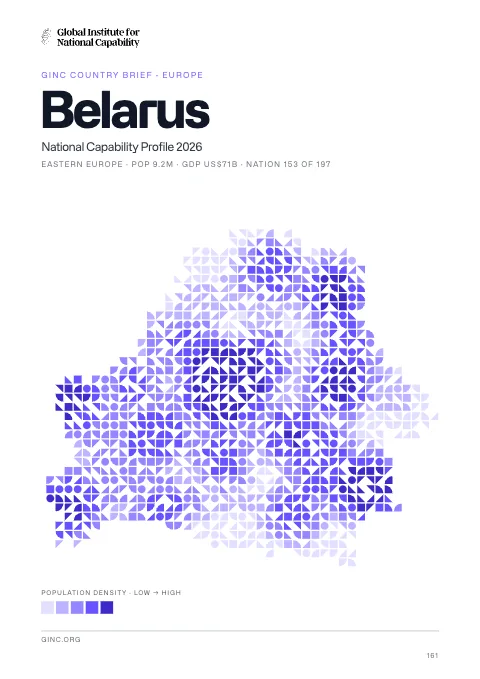
The whole brief
Belarus National Capability Profile 2026
Foundations · Chapter 01
Historical Context
🇧🇾 Belarus’ understanding the origins and evolution of the modern nation
BackgroundBack to top ↑
After seven decades as a constituent republic of the USSR, Belarus attained its independence in 1991. It has retained closer political and economic ties to Russia than have any of the other former Soviet republics. Belarus and Russia signed a treaty on a two-state union on 8 December 1999 envisioning greater political and economic integration. Although Belarus agreed to a framework to carry out the accord, serious implementation has yet to take place. Since his election in July 1994 as the country's first directly elected president, Aleksandr LUKASHENKO has steadily consolidated his power through authoritarian means and a centralized economic system. Government restrictions on freedom of speech and the press, peaceful assembly, and religion remain in place.
IndependenceBack to top ↑
25 August 1991 (from the Soviet Union)
National holidayBack to top ↑
Independence Day, 3 July (1944); note - 3 July 1944 was the date Minsk was liberated from German troops, 25 August 1991 was the date of independence from the Soviet Union
Foundations · Chapter 02
Geography
🇧🇾 Belarus’ territory, resources and strategic position
Location and areaBack to top ↑
Eastern Europe, east of Poland
53 00 N, 28 00 E
Europe
slightly smaller than Kansas
0 km (landlocked)
none (landlocked)
Terrain and resourcesBack to top ↑
generally flat and contains much marshland
timber, peat deposits, small quantities of oil and natural gas, granite, dolomitic limestone, marl, chalk, sand, gravel, clay
1,150 sq km (2003)
Settlement and hazardsBack to top ↑
NA
landlocked; glacial scouring accounts for the flatness of Belarusian terrain and for its 11,000 lakes
OtherBack to top ↑
58 cu km (2011)
soil pollution from pesticide use; southern part of the country contaminated with fallout from 1986 nuclear reactor accident at Chornobyl' in northern Ukraine
Foundations · Chapter 03
Environment
🇧🇾 Belarus’ environmental conditions, resources and national resilience
ClimateBack to top ↑
cold winters, cool and moist summers; transitional between continental and maritime
Emissions and pollutionBack to top ↑
Water, waste and foodBack to top ↑
Resources and agreementsBack to top ↑
GINC Capability Domains · Chapter 04
Critical Technology
🇧🇾 Belarus’ technology frontiers and the pursuit of national advantage
Two counts are set side by side for 2015–2024: on the left, the papers researchers in Belarus published; on the right, the patent families that began there and were filed in more than one country. First by capability group, then group by group with each group’s capabilities. The badge on a card is the nation’s place among all nations. Papers are from GINC Research Analytics, patent families from GINC Patents.
Research by capability group
#72 WorldPapers published, 2015–2024
874
263
220
151
85
77
74
67
56
4
Patents by capability group
#75 WorldInternational patent families, 2015–2024
Advanced Materials & ManufacturingBack to top ↑
Research
#54 WorldPapers published, 2015–2024
Patents
#71 WorldInternational patent families, 2015–2024
Energy TechnologiesBack to top ↑
Research
#63 WorldPapers published, 2015–2024
Patents
#84 WorldInternational patent families, 2015–2024
Semiconductors & Advanced ComputingBack to top ↑
Research
#56 WorldPapers published, 2015–2024
No research topic: Semiconductor Design & EDA · Advanced Semiconductor Fabrication · Semiconductor Equipment & Materials · Advanced Packaging & Heterogeneous Integration
Patents
#54 WorldInternational patent families, 2015–2024
Artificial IntelligenceBack to top ↑
Research
#85 WorldPapers published, 2015–2024
Patents
#71 WorldInternational patent families, 2015–2024
Quantum TechnologiesBack to top ↑
Research
#61 WorldPapers published, 2015–2024
Patents
International patent families, 2015–2024
No international patent families on record for 2015–2024.
Connectivity, Cyber & Trust TechnologiesBack to top ↑
Research
#90 WorldPapers published, 2015–2024
Patents
#65 WorldInternational patent families, 2015–2024
Sensing, Timing & NavigationBack to top ↑
Research
#72 WorldPapers published, 2015–2024
Patents
#65 WorldInternational patent families, 2015–2024
Robotics & Autonomous SystemsBack to top ↑
Research
#83 WorldPapers published, 2015–2024
No research topic: Human-Machine Interfaces
Patents
#76 WorldInternational patent families, 2015–2024
Biotechnology & Health TechnologiesBack to top ↑
Research
#82 WorldPapers published, 2015–2024
Patents
#94 WorldInternational patent families, 2015–2024
Medicine and BioTech
Clinical research and life-science invention, drawn from the same series that drive the metric pages. Each card opens the full cross-country comparison.
Space TechnologiesBack to top ↑
Research
#66 WorldPapers published, 2015–2024
Patents
#44 WorldInternational patent families, 2015–2024
GINC Capability Domains · Chapter 05
Strategic Infrastructure
🇧🇾 Belarus’ energy, connectivity and the material foundations of capability
Resource InfrastructureBack to top ↑
32,070 bbl/day (2012 est.)
0 bbl/day (2010 est.)
294,800 bbl/day (2010 est.)
198 million bbl (1 January 2013 est.)
346,000 bbl/day (2010 est.)
188,800 bbl/day (2011 est.)
224,200 bbl/day (2010 est.)
43,240 bbl/day (2010 est.)
220 million cu m (2011 est.)
21.82 billion cu m (2010 est.)
0 cu m (2011 est.)
21.02 billion cu m (2011 est.)
2.832 billion cu m (1 January 2013 est.)
gas 5,386 km; oil 1,589 km; refined products 1,730 km (2013)
Agriculture & Food InfrastructureBack to top ↑
- Irrigation & Agricultural Water
- Livestock & Veterinary
- Fisheries & Aquaculture
- Storage, Cold Chain & Markets
Energy InfrastructureBack to top ↑
- Thermal Generation
- Nuclear Generation
- Nuclear Fuel Cycle & Radioactive Waste
- Hydropower
- Renewable Generation
- Transmission & Distribution
- System Control & Dispatch
- Storage & Fuel Supply
8.032 million kW (2010 est.)
32.82 billion kWh (2010 est.)
31.74 billion kWh (2010 est.)
5.067 billion kWh (2010 est.)
7.767 billion kWh (2010 est.)
99.7% of total installed capacity (2010 est.)
0% of total installed capacity (2010 est.)
0.2% of total installed capacity (2010 est.)
0.1% of total installed capacity (2010 est.)
67.16 million Mt (2011 est.)
Water, Sanitation & Waste InfrastructureBack to top ↑
- Dams, Reservoirs & Flood Defence
- Water Supply & Treatment
- Bulk Water Transfer & Desalination
- Wastewater & Sanitation
- Solid Waste & Recycling
Advanced ManufacturingBack to top ↑
- Materials & Inputs
- Chemicals & Hazardous Process Industry
- Production Systems
- Supply Chain & Ecosystem
- Workforce & Innovation
Transport InfrastructureBack to top ↑
- Seaports & Terminals
- Air Infrastructure
- Air Navigation & Traffic Management
- Inland Waterways & Ferries
- Rail Infrastructure
- Roads & Bridges
- Logistics, Multimodal & Border Infrastructure
- Postal & Parcel
65 (2013)
1 (2013)
2,500 km (major rivers are the west-flowing Western Dvina and Neman rivers and the south-flowing Dnepr River and its tributaries, the Berezina, Sozh, and Pripyat rivers) (2011)
Communications & Digital InfrastructureBack to top ↑
- Subsea Cables & International Gateways
- Core & Backbone Networks
- Mobile & Wireless Networks
- Spectrum & Broadcasting
- Data Centres, Compute & Cloud
- Data Resources
- AI Tools & Applications
4.407 million (2012)
10.675 million (2012)
2.643 million (2009)
295,217 (2012)
.by
Financial InfrastructureBack to top ↑
- Currency & Reserves
- Payments & Settlement Systems
- Markets, Exchanges & Depositories
- Banks, Insurers & Systemic Institutions
Social InfrastructureBack to top ↑
- Health Infrastructure
- Public Health & Laboratories
- Medical Supply & Stockpiles
- Education & Skills Infrastructure
- Research & Scientific Facilities
- Housing, Community & Social Services
- Government & Public Administration
- Cultural, Community & Recreational Infrastructure
- Justice & Corrections
- Emergency Services & Civil Protection
- Hydrometeorology & Early Warning
Space, Aerospace & Defence InfrastructureBack to top ↑
GINC Capability Domains · Chapter 06
National Security
🇧🇾 Belarus’ force, intelligence and the defence of the nation
Disputes and terrorismBack to top ↑
boundary demarcated with Latvia and Lithuania; as a member state that forms part of the EU's external border, Poland has implemented strict Schengen border rules to restrict illegal immigration and trade along its border with Belarus
Force Generation & MobilisationBack to top ↑
Belarus Armed Forces: Land Force, Air and Air Defense Force, Special Operations Force (2013)
18-27 years of age for compulsory military service; conscript service obligation is 12-18 months, depending on academic qualifications; 17 year olds are eligible to become cadets at military higher education institutes, where they are classified as military personnel (2012)
1.2% of GDP (2012)//1.27% of GDP (2011)//1.2% of GDP (2010)
Forces under arms
Active-duty strength on the Correlates of War series, which reaches back to 1816 and so carries a nation’s whole record of mobilisation rather than its present establishment. The card opens the full cross-country comparison.
Intelligence & AssessmentBack to top ↑
- Imagery & Geospatial Intelligence
- Signals & Cyber Intelligence
- Technical & Measurement Intelligence
- Open-Source & Financial Intelligence
- Human Intelligence & Counterintelligence
- All-Source Analysis & Warning
Joint Command, Projection & SustainmentBack to top ↑
- Command, Control & Communications
- Strategic Lift & Mobility
- Expeditionary & Peace Operations
- Operational Sustainment & War Reserves
- Defence Industrial Mobilisation
- CBRN Defence
Land PowerBack to top ↑
- Combined Arms Manoeuvre
- Land Fires
- Battlefield Aviation & Uncrewed Systems
- Special Operations & Irregular Warfare
Maritime PowerBack to top ↑
- Maritime Security & Constabulary
- Sea Denial & Undersea Warfare
- Sea Control
- Amphibious & Expeditionary Operations
Air PowerBack to top ↑
- Air Sovereignty & Policing
- Control of the Air
- Air Strike & Interdiction
- Airborne ISR, Early Warning & Battle Management
Strategic Strike & Missile DefenceBack to top ↑
Space OperationsBack to top ↑
Cyber & Electromagnetic OperationsBack to top ↑
Nuclear DeterrenceBack to top ↑
GINC Capability Domains · Chapter 07
Human Capital
🇧🇾 Belarus’ population, health and the skills that sustain capability
DemographyBack to top ↑
9,608,058 (July 2014 est.)
-0.19% (2014 est.)
10.86 births/1,000 population (2014 est.)
13.51 deaths/1,000 population (2014 est.)
1.47 children born/woman (2014 est.)
25.1 (2011 est.)
72.6% (2005)
Migration and urbanisationBack to top ↑
0.78 migrant(s)/1,000 population (2014 est.)
MINSK (capital) 1.861 million (2011)
Welfare and equityBack to top ↑
27.1% (2003 est.)
27.2 (2008)//21.7 (1998)
DisplacementBack to top ↑
Early Childhood DevelopmentBack to top ↑
1.3% (2005)
Foundational EducationBack to top ↑
5.1% of GDP (2012)
Advanced EducationBack to top ↑
Technical & Vocational SkillsBack to top ↑
Digital & AI CompetenceBack to top ↑
Generative AI adoption
Modelled share of working-age adults using generative AI, from Microsoft telemetry scaled to each country’s 15–64 population. A measure of how fast a workforce is absorbing the technology rather than of how much of it a nation builds. The card opens the full cross-country comparison.
Lifelong Learning & ReskillingBack to top ↑
Research Talent & Knowledge CreationBack to top ↑
Population HealthBack to top ↑
4 deaths/100,000 live births (2010)
24.3% (2008)
0.4% (2012 est.)
23,200 (2012 est.)
1,200 (2012 est.)
Health System CapabilityBack to top ↑
5.3% of GDP (2011)
3.76 physicians/1,000 population (2011)
11.1 beds/1,000 population (2011)
GINC Capability Domains · Chapter 08
Governance and Integrity
🇧🇾 Belarus’ institutions, law and the integrity of the state
State structureBack to top ↑
republic in name, although in fact a dictatorship
6 provinces (voblastsi, singular - voblasts') and 1 municipality* (horad); Brest, Homyel' (Gomel), Horad Minsk* (Minsk City), Hrodna (Grodno), Mahilyow (Mogilev), Minsk, Vitsyebsk (Vitebsk)
several previous; latest drafted between late 1991 and early 1994, signed 15 March 1994; amended 1996, 2004 (2013)
18 years of age; universal
Political Institutions & Civic ParticipationBack to top ↑
- Electoral Management & Integrity
- Legislature & Deliberative Institutions
- Citizen Participation & Civic Space
bicameral national assembly or natsionalnoye sobraniye consists of the Council of the Republic or Sovet Respubliki (64 seats; 56 members elected by regional and Minsk city councils and 8 members appointed by the president, to serve four-year terms) and the Chamber of Representatives or Palata Predstaviteley (110 seats; members elected by popular vote to serve four-year terms); note - the US does not recognize the legitimacy of the national assembly
Assembly of Pro-Democratic NGOs [Sergey MATSKEVICH] (unregistered)//Belarusian Congress of Democratic Trade Unions [Aleksandr YAROSHUK]//Belarusian Association of Journalists [Zhana LITVINA]//Belarusian Helsinki Committee [Aleh HULAK]//Belarusian Independence Bloc (unregistered) and For Freedom movement [Aleksandr MILINKEVICH]//Belarusian Organization of Working Women [Irina ZHIKHAR]//BPF-Youth [Andrus KRECHKA] (unregistered)//Charter 97 [Andrey SANNIKOV] (unregistered)//Perspektiva small business association [Anatol SHUMCHENKO]//Nasha Vyasna ("Our Spring") human rights center [Ales BYALYATSKI] (unregistered)//"Tell the Truth" Movement [Vladimir NEKLYAYEV] (unregistered)//Women's Independent Democratic Movement [Ludmila PETINA]//Young Belarus (Malady Belarus) [Zmitser KASPYAROVICH] (unregistered)//Youth Front (Malady Front) [Zmitser DASHKEVICH] (unregistered)
Justice System & Fundamental RightsBack to top ↑
- Judicial Independence & Court Capability
- Access to Justice & Legal Services
- Fundamental Rights Protection
- Human Rights Institutions & Equality Bodies
civil law system; note - nearly all major codes (civil, civil procedure, criminal, criminal procedure, family and labor) have been revised and came into force in 1999 or 2000
has not submitted an ICJ jurisdiction declaration; non-party state to the ICCt
Internal Security & OrderBack to top ↑
limited cultivation of opium poppy and cannabis, mostly for the domestic market; transshipment point for illicit drugs to and via Russia, and to the Baltics and Western Europe; a small and lightly regulated financial center; anti-money-laundering legislation does not meet international standards and was weakened further when know-your-customer requirements were curtailed in 2008; few investigations or prosecutions of money-laundering activities (2008)
Regulatory Governance & Strategic ControlsBack to top ↑
- Regulatory Quality & Better Regulation
- Regulatory Delivery & Independent Regulators
- Strategic Controls & Economic Security Administration
Government Effectiveness & Public AdministrationBack to top ↑
- Centre of Government & Policy Coordination
- Civil Service & Public Workforce
- Digital Government & Service Delivery
- Legal Identity & Civil Registration
- Statistical & Data Capability
Public Integrity & Anti-CorruptionBack to top ↑
Transparency, Oversight & AccountabilityBack to top ↑
- Right to Information & Open Government
- Independent Oversight & Supreme Audit
- Independent Media & Journalist Safety
National Resilience & Crisis ManagementBack to top ↑
GINC Capability Domains · Chapter 09
Information and Influence
🇧🇾 Belarus’ identity, media and the projection of influence
Identity and cultureBack to top ↑
Belarusian (official) 23.4%, Russian (official) 70.2%, other 3.1% (includes small Polish- and Ukrainian-speaking minorities), unspecified 3.3% (2009 est.)
Eastern Orthodox 80%, other (including Roman Catholic, Protestant, Jewish, and Muslim) 20% (1997 est.)
Belarusian 83.7%, Russian 8.3%, Polish 3.1%, Ukrainian 1.7%, other 2.4%, unspecified 0.9% (2009 est.)
mounted knight known as Pahonia (the Chaser)
red horizontal band (top) and green horizontal band one-half the width of the red band; a white vertical stripe on the hoist side bears Belarusian national ornamentation in red; the red band color recalls past struggles from oppression, the green band represents hope and the many forests of the country
Diplomatic Statecraft & Global NetworksBack to top ↑
- Diplomatic Network & Consular Reach
- Multilateral Leadership & Norm Setting
- Agenda-Setting & Convening
- Mediation & Crisis Diplomacy
BSEC (observer), CBSS (observer), CEI, CIS, CSTO, EAEC, EAPC, EBRD, FAO, GCTU, IAEA, IBRD, ICAO, ICC (NGOs), ICRM, IDA, IFC, IFRCS, ILO, IMF, IMSO, Interpol, IOC, IOM, IPU, ISO, ITU, ITUC (NGOs), MIGA, NAM, NSG, OPCW, OSCE, PCA, PFP, SCO (dialogue member), UN, UNCTAD, UNESCO, UNIDO, UNIFIL, UNWTO, UPU, WCO, WFTU (NGOs), WHO, WIPO, WMO, WTO (observer), ZC
Alliances & Security CooperationBack to top ↑
Development Cooperation & Global AssistanceBack to top ↑
Culture, Language & Education DiplomacyBack to top ↑
- Cultural & Language Institutes
- Creative Industries & Cultural Export Reach
- Heritage & Cultural Institutions
- Education Diplomacy & Alumni Networks
- Sports & Major Events
Diaspora & Global CommunitiesBack to top ↑
Information Environment & Strategic CommunicationBack to top ↑
- Strategic Communications & Public Diplomacy
- International Media & Broadcasting
- Information Defence & Counter-Interference
4 state-controlled national TV channels; Polish and Russian TV broadcasts are available in some areas; state-run Belarusian Radio operates 3 national networks and an external service; Russian and Polish radio broadcasts are available (2007)
GINC Capability Domains · Chapter 10
Financial Strength
🇧🇾 Belarus’ fiscal depth, reserves and the capacity to act
Monetary & Currency CapabilityBack to top ↑
- Monetary Policy & Price Stability
- Exchange Rate & External Account Management
- Currency Issuance & Digital Money
19% (2013 est.)//59.1% (2012 est.)
Belarusian rubles (BYB/BYR) per US dollar -//8,950.7 (2013 est.)//8,336.9 (2012 est.)//2,978.5 (2010 est.)//2,789.49 (2009)//2,130 (2008)
10.5% (31 December 2010 est.)//13.5% (31 December 2009 est.)
10% (31 December 2013 est.)//19.49% (31 December 2012 est.)
NA% (31 December 2013 est.)//$4.018 billion (31 December 2012 est.)
$9.073 billion (31 December 2013 est.)//$7.655 billion (31 December 2012 est.)
Fiscal Capacity & Public FinanceBack to top ↑
- Revenue Mobilisation & Tax Administration
- Public Expenditure & Budget Management
- Sovereign Debt & Treasury Management
- Public Investment Management
38.5% of GDP (2013 est.)
-0.2% of GDP (2013 est.)
31.5% of GDP (2013 est.)//31.5% of GDP (2012 est.)
calendar year
Financial System Depth & AccessBack to top ↑
- Banking System Capacity
- Capital Markets Depth & Development
- Long-Term & Institutional Capital
- Financial Inclusion & Household Access
- Development & Policy Finance
$22.68 billion (31 December 2013 est.)//$19.82 billion (31 December 2012 est.)
$NA
24.8% of GDP (2013 est.)//31.8% of GDP (2012 est.)//29.2% of GDP (2011 est.)
Financial Regulation & IntegrityBack to top ↑
- Prudential Regulation & Supervision
- Financial Integrity & Illicit Finance Control
- Market Conduct & Consumer Protection
- Payment & Market Infrastructure Oversight
Financial Stability & Crisis ManagementBack to top ↑
- Macroprudential & Systemic Oversight
- Crisis Management, Resolution & Deposit Insurance
- External Liquidity & Financial Safety Nets
Sovereign Capital & External Financial PowerBack to top ↑
- Official Reserves Management
- Sovereign Wealth & Public Asset Management
- Currency Internationalisation & Reserve Status
- Capital Account & Flow Management
- International Financial Centre Capability
$4.513 billion (31 December 2013 est.)//$5.809 billion (31 December 2012 est.)
$1.204 billion (31 December 2013 est.)//$1.225 billion (31 December 2012 est.)
GINC Capability Domains · Chapter 11
Production and Innovation
🇧🇾 Belarus’ output, industry and the engine of prosperity
Economic Output & ProductivityBack to top ↑
As part of the former Soviet Union, Belarus had a relatively well-developed industrial base; it retained this industrial base - which is now outdated, energy inefficient, and dependent on subsidized Russian energy and preferential access to Russian markets - following the breakup of the USSR. The country also has a broad agricultural base which is inefficient and dependent on government subsidies. After an initial burst of capitalist reform from 1991-94, including privatization of state enterprises, creation of institutions of private property, and development of entrepreneurship, Belarus' economic development greatly slowed. About 80% of all industry remains in state hands, and foreign investment has been hindered by a climate hostile to business. A few banks, which had been privatized after independence, were renationalized. State banks account for 75% of the banking sector. Economic output, which had declined for several years following the collapse of the Soviet Union, revived in the mid-2000s thanks to the boom in oil prices. Belarus has only small reserves of crude oil, though it imports most of its crude oil and natural gas from Russia at prices substantially below the world market. Belarus exported refined oil products at market prices produced from Russian crude oil purchased at a steep discount. In late 2006, Russia began a process of rolling back its subsidies on oil and gas to Belarus. Tensions over Russian energy reached a peak in 2010, when Russia stopped the export of all subsidized oil to Belarus save for domestic needs. In December 2010, Russia and Belarus reached a deal to restart the export of discounted oil to Belarus. Little new foreign investment has occurred in recent years. In 2011, a financial crisis began, triggered by government directed salary hikes unsupported by commensurate productivity increases. The crisis was compounded by an increased cost in Russian energy inputs and an overvalued Belarusian ruble, and eventually led to a near three-fold devaluation of the Belarusian ruble in 2011. In November 2011, Belarus agreed to sell to Russia its remaining shares in Beltransgaz, the Belarusian natural gas pipeline operator, in exchange for reduced prices for Russian natural gas. Receiving more than half of a $3 billion loan from the Russian-dominated Eurasian Economic Community (EurAsEC) Bail-out Fund, a $1 billion loan from the Russian state-owned bank Sberbank, and the $2.5 billion sale of Beltranzgas to Russian state-owned Gazprom helped stabilize the situation in 2012; nevertheless, the Belarusian currency lost more than 60% of its value, as the rate of inflation reached new highs in 2011 and 2012, before calming in 2013. As of January 2014, the final tranche of the EurAsEC loan has been delayed, but in December 2013 Russia announced a new loan for Belarus of up to $2 billion for 2014. Notwithstanding foreign assistance, the Belarusian economy continues to struggle under the weight of high external debt servicing payments, a growing trade deficit, stagnant economic growth, and low foreign reserves.
$150.4 billion (2013 est.)//$147.3 billion (2012 est.)//$145 billion (2011 est.)
2.1% (2013 est.)//1.5% (2012 est.)//5.5% (2011 est.)
$16,100 (2013 est.)//$15,700 (2012 est.)//$15,400 (2011 est.)
$69.24 billion (2013 est.)
Labour & EmploymentBack to top ↑
- Employment & Labour Force Participation
- Labour Market Institutions & Wage Setting
- Employment Services & Skills Matching
- Labour Adjustment, Transition & Formalisation
5 million (2009)
1% (2009 est.)//1.6% (2005)
Industrial & Sectoral BaseBack to top ↑
- Manufacturing & Advanced Industry
- Foundational & Process Industries
- Agrifood & Primary Production
- Services Economy
grain, potatoes, vegetables, sugar beets, flax; beef, milk
metal-cutting machine tools, tractors, trucks, earthmovers, motorcycles, televisions, synthetic fibers, fertilizer, textiles, radios, refrigerators
1% (2013 est.)
Structural Transformation & ComplexityBack to top ↑
Business Dynamism & EntrepreneurshipBack to top ↑
- Entrepreneurship & Firm Creation
- Risk Capital & Scale-Up Finance
- Firm Growth, Exit & Renewal
- Competition & Market Contestability
Innovation & CommercialisationBack to top ↑
- Business Innovation Capability
- Research Commercialisation & Knowledge Transfer
- Intellectual Property & Intangible Assets
- Innovation Ecosystems & Clusters
Technology Adoption & DiffusionBack to top ↑
GINC Capability Domains · Chapter 12
Trade and Investment
🇧🇾 Belarus’ markets, capital and the terms of global exchange
Overall tradeBack to top ↑
$6.42B of exports to 113 partners and $16.5B of imports from 86 in 2024, a deficit of $10.1B.
- Exports
- $6.42B113 partners
- Imports
- $16.5B86 partners
- Balance
- −$10.1Bdeficit
- Total trade
- $22.9B2024
ExportsBack to top ↑
Where its exports go
The largest partners in 2024, with each one's share of the nation's exports.
| Partner | Value | Share | |
|---|---|---|---|
| China | $1.81B | 28% | |
| Kazakhstan | $745M | 12% | |
| Uzbekistan | $520M | 8.1% | |
| Poland | $510M | 7.9% | |
| Azerbaijan | $456M | 7.1% | |
| Turkey | $234M | 3.6% | |
| Lithuania | $210M | 3.3% | |
| Norway | $197M | 3.1% | |
| Germany | $166M | 2.6% | |
| Latvia | $156M | 2.4% | |
| Georgia | $141M | 2.2% | |
| Czech Republic | $125M | 1.9% | |
| Armenia | $90.5M | 1.4% | |
| Moldova | $88.2M | 1.4% | |
| Indonesia | $84.9M | 1.3% | |
| Serbia | $70.4M | 1.1% | |
| Kyrgyzstan | $61.0M | 0.9% | |
| Thailand | $60.5M | 0.9% | |
| Brazil | $53.9M | 0.8% | |
| Netherlands | $40.8M | 0.6% |
What it exports
The largest categories in 2024.
| Category | Value | Share | |
|---|---|---|---|
| Fertilizers | $1.17B | 18% | |
| Wood and articles of wood, wood charcoal | $691M | 11% | |
| Animal, vegetable fats and oils, cleavage products | $556M | 8.7% | |
| Meat and edible meat offal | $476M | 7.4% | |
| Dairy products, eggs, honey, edible products | $400M | 6.2% | |
| Vehicles other than railway, tramway | $321M | 5.0% | |
| Electrical, electronic equipment | $229M | 3.6% | |
| Furniture, lighting signs, prefabricated buildings | $222M | 3.5% | |
| Plastics | $210M | 3.3% | |
| Machinery, nuclear reactors, boilers | $187M | 2.9% | |
| Mineral fuels, oils, distillation products | $168M | 2.6% | |
| Railway, tramway locomotives, rolling stock, equipment | $106M | 1.6% | |
| Vegetable textile fibers not specified elsewhere, paper yarn, woven fabric | $104M | 1.6% | |
| Meat, fish and seafood preparations | $96.3M | 1.5% | |
| Glass and glassware | $91.0M | 1.4% |
ImportsBack to top ↑
Where its imports come from
The largest partners in 2024, with each one's share of the nation's imports.
| Partner | Value | Share | |
|---|---|---|---|
| China | $6.50B | 39% | |
| Poland | $2.36B | 14% | |
| Turkey | $1.61B | 9.8% | |
| Germany | $1.57B | 9.5% | |
| Lithuania | $1.13B | 6.9% | |
| Italy | $395M | 2.4% | |
| Estonia | $186M | 1.1% | |
| Netherlands | $185M | 1.1% | |
| Czech Republic | $182M | 1.1% | |
| France | $161M | 1.0% | |
| Uzbekistan | $157M | 0.9% | |
| Kazakhstan | $151M | 0.9% | |
| Latvia | $149M | 0.9% | |
| Hungary | $148M | 0.9% | |
| Armenia | $114M | 0.7% | |
| Switzerland | $110M | 0.7% | |
| Slovenia | $110M | 0.7% | |
| Austria | $104M | 0.6% | |
| Spain | $103M | 0.6% | |
| South Korea | $93.4M | 0.6% |
What it imports
The largest categories in 2024.
| Category | Value | Share | |
|---|---|---|---|
| Vehicles other than railway, tramway | $4.38B | 27% | |
| Machinery, nuclear reactors, boilers | $2.41B | 15% | |
| Electrical, electronic equipment | $1.39B | 8.4% | |
| Plastics | $797M | 4.8% | |
| Pharmaceutical products | $702M | 4.3% | |
| Optical, photo, technical, medical apparatus | $549M | 3.3% | |
| Knitted or crocheted fabric | $341M | 2.1% | |
| Tanning, dyeing extracts, tannins, derivatives, pigments | $321M | 1.9% | |
| Articles of iron or steel | $267M | 1.6% | |
| Edible fruits, nuts, peel of citrus fruit, melons | $230M | 1.4% | |
| Rubbers | $230M | 1.4% | |
| Miscellaneous chemical products | $225M | 1.4% | |
| Beverages, spirits and vinegar | $207M | 1.3% | |
| Essential oils, perfumes, cosmetics, toiletries | $205M | 1.2% | |
| Paper and paperboard, articles of pulp, paper and board | $178M | 1.1% |
In a list, the bar runs to the largest in that list. The line is each figure’s history from 2000, drawn to its own peak: it shows the shape of the years, and the value shows the size.
External balanceBack to top ↑
-$4.245 billion (2013 est.)//-$1.688 billion (2012 est.)
Trade Facilitation & LogisticsBack to top ↑
Trade Policy & Market AccessBack to top ↑
- Trade Policy & Negotiation Capability
- Market Access & Agreements Network
- Trade Law & Enforcement
- Standards, Conformity & Quality Infrastructure
Digital & Services TradeBack to top ↑
- Services Trade Capability
- Digital Trade & E-Commerce
- Data Flows & Digital Trade Governance
- Tourism & Visitor Economy
Investment Attraction & ProjectionBack to top ↑
- Investment Attraction & Facilitation
- Investment Absorption & Linkages
- Outward Investment & Global Corporate Presence
Export Capability & SophisticationBack to top ↑
$42.06 billion (2013 est.)//$45.57 billion (2012 est.)
Russia 35.4%, Netherlands 16.4%, Ukraine 12.1%, Latvia 7.1% (2012)
machinery and equipment, mineral products, chemicals, metals, textiles, foodstuffs
Global Value Chain PositionBack to top ↑
- Value Chain Participation & Integration
- Value Chain Position & Upgrading
- Regional Integration & Hub Anchoring
Economic Leverage & DependenceBack to top ↑
- Strategic Supply Security
- Concentration Risk & Revenue Stabilisation
- Economic Leverage & Coercion Resistance
$45.17 billion (2013 est.)//$45.01 billion (2012 est.)
Russia 59.4%, Germany 5.9%, China 5.1%, Ukraine 5% (2012)
mineral products, machinery and equipment, chemicals, foodstuffs, metals
Belarus · you are in
Historical Context
Foundations
GINC Capability Domains
Find in this brief · Belarus