
Mauritius
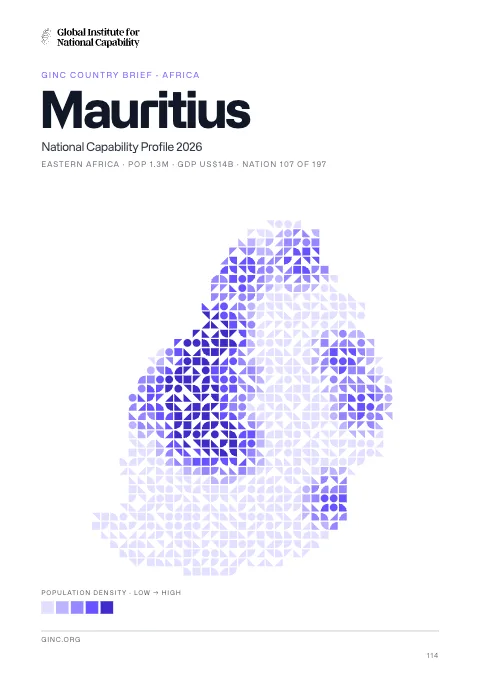
Mauritius is a parliamentary democracy in Africa, home to 1.3 million people, with its capital at Port Louis.
Contents
12 chapters
Foundations
01–03
At a glance
- Area
- 2Kkm²#179 World#53 Africa
- Population
- 1.3M#155 World#48 Africa
- GDP (market)
- $11.9B
- GDP (PPP)
- $21B#130 World#26 Africa
- GDP per capita
- $16.1K#87 World#5 Africa
The whole brief
Mauritius National Capability Profile 2026
Foundations · Chapter 01
Historical Context
🇲🇺 Mauritius’ understanding the origins and evolution of the modern nation
BackgroundBack to top ↑
Although known to Arab and Malay sailors as early as the 10th century, Mauritius was first explored by the Portuguese in the 16th century and subsequently settled by the Dutch - who named it in honor of Prince Maurits van NASSAU - in the 17th century. The French assumed control in 1715, developing the island into an important naval base overseeing Indian Ocean trade, and establishing a plantation economy of sugar cane. The British captured the island in 1810, during the Napoleonic Wars. Mauritius remained a strategically important British naval base, and later an air station, playing an important role during World War II for anti-submarine and convoy operations, as well as the collection of signals intelligence. Independence from the UK was attained in 1968. A stable democracy with regular free elections and a positive human rights record, the country has attracted considerable foreign investment and has earned one of Africa's highest per capita incomes.
IndependenceBack to top ↑
12 March 1968 (from the UK)
National holidayBack to top ↑
Independence Day, 12 March (1968)
Foundations · Chapter 02
Geography
🇲🇺 Mauritius’ territory, resources and strategic position
Location and areaBack to top ↑
Southern Africa, island in the Indian Ocean, about 800 km (500 mi) east of Madagascar
20 17 S, 57 33 E
Africa
almost 11 times the size of Washington, DC
0 km
177 km
measured from claimed archipelagic straight baselines
Terrain and resourcesBack to top ↑
small coastal plain rising to discontinuous mountains encircling central plateau
arable land, fish
212.2 sq km (2003)
Settlement and hazardsBack to top ↑
cyclones (November to April); almost completely surrounded by reefs that may pose maritime hazards
the main island, from which the country derives its name, is of volcanic origin and is almost entirely surrounded by coral reefs; former home of the dodo, a large flightless bird related to pigeons, driven to extinction by the end of the 17th century through a combination of hunting and the introduction of predatory species
OtherBack to top ↑
2.75 cu km (2011)
water pollution, degradation of coral reefs
Foundations · Chapter 03
Environment
🇲🇺 Mauritius’ environmental conditions, resources and national resilience
ClimateBack to top ↑
tropical, modified by southeast trade winds; warm, dry winter (May to November); hot, wet, humid summer (November to May)
Emissions and pollutionBack to top ↑
Water, waste and foodBack to top ↑
Resources and agreementsBack to top ↑
GINC Capability Domains · Chapter 04
Critical Technology
🇲🇺 Mauritius’ technology frontiers and the pursuit of national advantage
Two counts are set side by side for 2015–2024: on the left, the papers researchers in Mauritius published; on the right, the patent families that began there and were filed in more than one country. First by capability group, then group by group with each group’s capabilities. The badge on a card is the nation’s place among all nations. Papers are from GINC Research Analytics, patent families from GINC Patents.
Research by capability group
#127 WorldPapers published, 2015–2024
Patents by capability group
#74 WorldInternational patent families, 2015–2024
Advanced Materials & ManufacturingBack to top ↑
Research
#123 WorldPapers published, 2015–2024
Patents
#85 WorldInternational patent families, 2015–2024
Energy TechnologiesBack to top ↑
Research
#114 WorldPapers published, 2015–2024
Patents
#76 WorldInternational patent families, 2015–2024
Semiconductors & Advanced ComputingBack to top ↑
Research
#136 WorldPapers published, 2015–2024
No research topic: Semiconductor Design & EDA · Advanced Semiconductor Fabrication · Semiconductor Equipment & Materials · Advanced Packaging & Heterogeneous Integration
Patents
International patent families, 2015–2024
No international patent families on record for 2015–2024.
Artificial IntelligenceBack to top ↑
Research
#107 WorldPapers published, 2015–2024
Patents
#78 WorldInternational patent families, 2015–2024
Quantum TechnologiesBack to top ↑
Connectivity, Cyber & Trust TechnologiesBack to top ↑
Research
#100 WorldPapers published, 2015–2024
Patents
#58 WorldInternational patent families, 2015–2024
Sensing, Timing & NavigationBack to top ↑
Research
#147 WorldPapers published, 2015–2024
Patents
#70 WorldInternational patent families, 2015–2024
Robotics & Autonomous SystemsBack to top ↑
Research
#119 WorldPapers published, 2015–2024
No research topic: Human-Machine Interfaces
Patents
#73 WorldInternational patent families, 2015–2024
Biotechnology & Health TechnologiesBack to top ↑
Research
#206 WorldPapers published, 2015–2024
Patents
#72 WorldInternational patent families, 2015–2024
Medicine and BioTech
Clinical research and life-science invention, drawn from the same series that drive the metric pages. Each card opens the full cross-country comparison.
Space TechnologiesBack to top ↑
- Space Launch & Reusable Systems
- Advanced Propulsion & Hypersonic Systems
- Satellite & Constellation Technologies
GINC Capability Domains · Chapter 05
Strategic Infrastructure
🇲🇺 Mauritius’ energy, connectivity and the material foundations of capability
Resource InfrastructureBack to top ↑
0 bbl/day (2012 est.)
0 bbl/day (2010 est.)
0 bbl/day (2010 est.)
0 bbl (1 January 2013 est.)
0 bbl/day (2010 est.)
24,710 bbl/day (2011 est.)
0 bbl/day (2010 est.)
20,620 bbl/day (2010 est.)
0 cu m (2011 est.)
0 cu m (2010 est.)
0 cu m (2011 est.)
0 cu m (2011 est.)
0 cu m (1 January 2013 est.)
Agriculture & Food InfrastructureBack to top ↑
- Irrigation & Agricultural Water
- Livestock & Veterinary
- Fisheries & Aquaculture
- Storage, Cold Chain & Markets
Energy InfrastructureBack to top ↑
- Thermal Generation
- Nuclear Generation
- Nuclear Fuel Cycle & Radioactive Waste
- Hydropower
- Renewable Generation
- Transmission & Distribution
- System Control & Dispatch
- Storage & Fuel Supply
900,200 kW (2010 est.)
2.628 billion kWh (2011 est.)
2.358 billion kWh (2010 est.)
0 kWh (2012 est.)
0 kWh (2012 est.)
75.7% of total installed capacity (2010 est.)
0% of total installed capacity (2010 est.)
6.6% of total installed capacity (2010 est.)
17.8% of total installed capacity (2010 est.)
5.06 million Mt (2011 est.)
Water, Sanitation & Waste InfrastructureBack to top ↑
- Dams, Reservoirs & Flood Defence
- Water Supply & Treatment
- Bulk Water Transfer & Desalination
- Wastewater & Sanitation
- Solid Waste & Recycling
Advanced ManufacturingBack to top ↑
- Materials & Inputs
- Chemicals & Hazardous Process Industry
- Production Systems
- Supply Chain & Ecosystem
- Workforce & Innovation
Transport InfrastructureBack to top ↑
- Seaports & Terminals
- Air Infrastructure
- Air Navigation & Traffic Management
- Inland Waterways & Ferries
- Rail Infrastructure
- Roads & Bridges
- Logistics, Multimodal & Border Infrastructure
- Postal & Parcel
5 (2013)
Communications & Digital InfrastructureBack to top ↑
- Subsea Cables & International Gateways
- Core & Backbone Networks
- Mobile & Wireless Networks
- Spectrum & Broadcasting
- Data Centres, Compute & Cloud
- Data Resources
- AI Tools & Applications
349,100 (2012)
1.485 million (2012)
290,000 (2009)
51,139 (2012)
.mu
Financial InfrastructureBack to top ↑
- Currency & Reserves
- Payments & Settlement Systems
- Markets, Exchanges & Depositories
- Banks, Insurers & Systemic Institutions
Social InfrastructureBack to top ↑
- Health Infrastructure
- Public Health & Laboratories
- Medical Supply & Stockpiles
- Education & Skills Infrastructure
- Research & Scientific Facilities
- Housing, Community & Social Services
- Government & Public Administration
- Cultural, Community & Recreational Infrastructure
- Justice & Corrections
- Emergency Services & Civil Protection
- Hydrometeorology & Early Warning
Space, Aerospace & Defence InfrastructureBack to top ↑
GINC Capability Domains · Chapter 06
National Security
🇲🇺 Mauritius’ force, intelligence and the defence of the nation
Disputes and terrorismBack to top ↑
Mauritius and Seychelles claim the Chagos Islands; claims French-administered Tromelin Island
Force Generation & MobilisationBack to top ↑
no regular military forces; Mauritius Police Force, Special Mobile Force, National Coast Guard (2011)
0.19% of GDP (2012)//0.16% of GDP (2011)//0.19% of GDP (2010)
Forces under arms
Active-duty strength on the Correlates of War series, which reaches back to 1816 and so carries a nation’s whole record of mobilisation rather than its present establishment. The card opens the full cross-country comparison.
Intelligence & AssessmentBack to top ↑
- Imagery & Geospatial Intelligence
- Signals & Cyber Intelligence
- Technical & Measurement Intelligence
- Open-Source & Financial Intelligence
- Human Intelligence & Counterintelligence
- All-Source Analysis & Warning
Joint Command, Projection & SustainmentBack to top ↑
- Command, Control & Communications
- Strategic Lift & Mobility
- Expeditionary & Peace Operations
- Operational Sustainment & War Reserves
- Defence Industrial Mobilisation
- CBRN Defence
Land PowerBack to top ↑
- Combined Arms Manoeuvre
- Land Fires
- Battlefield Aviation & Uncrewed Systems
- Special Operations & Irregular Warfare
Maritime PowerBack to top ↑
- Maritime Security & Constabulary
- Sea Denial & Undersea Warfare
- Sea Control
- Amphibious & Expeditionary Operations
Air PowerBack to top ↑
- Air Sovereignty & Policing
- Control of the Air
- Air Strike & Interdiction
- Airborne ISR, Early Warning & Battle Management
Strategic Strike & Missile DefenceBack to top ↑
Space OperationsBack to top ↑
Cyber & Electromagnetic OperationsBack to top ↑
Nuclear DeterrenceBack to top ↑
GINC Capability Domains · Chapter 07
Human Capital
🇲🇺 Mauritius’ population, health and the skills that sustain capability
DemographyBack to top ↑
1,331,155 (July 2014 est.)
0.66% (2014 est.)
13.46 births/1,000 population (2014 est.)
6.85 deaths/1,000 population (2014 est.)
1.77 children born/woman (2014 est.)
75.8% (2002)
Migration and urbanisationBack to top ↑
0 migrant(s)/1,000 population (2014 est.)
PORT LOUIS (capital) 151,000 (2011)
Welfare and equityBack to top ↑
8% (2006 est.)
39 (2006 est.)//37 (1987 est.)
Early Childhood DevelopmentBack to top ↑
Foundational EducationBack to top ↑
3.5% of GDP (2012)
Advanced EducationBack to top ↑
Technical & Vocational SkillsBack to top ↑
Digital & AI CompetenceBack to top ↑
Lifelong Learning & ReskillingBack to top ↑
Research Talent & Knowledge CreationBack to top ↑
Population HealthBack to top ↑
60 deaths/100,000 live births (2010)
18.5% (2008)
1.2% (2012 est.)
10,500 (2012 est.)
700 (2012 est.)
Health System CapabilityBack to top ↑
5.9% of GDP (2011)
1.06 physicians/1,000 population (2004)
3.4 beds/1,000 population (2011)
GINC Capability Domains · Chapter 08
Governance and Integrity
🇲🇺 Mauritius’ institutions, law and the integrity of the state
State structureBack to top ↑
parliamentary democracy
9 districts and 3 dependencies*; Agalega Islands*, Black River, Cargados Carajos Shoals*, Flacq, Grand Port, Moka, Pamplemousses, Plaines Wilhems, Port Louis, Riviere du Rempart, Rodrigues*, Savanne
several previous; latest adopted 12 March 1968; amended many times, last in 2012 (2012)
18 years of age; universal
Political Institutions & Civic ParticipationBack to top ↑
- Electoral Management & Integrity
- Legislature & Deliberative Institutions
- Citizen Participation & Civic Space
unicameral National Assembly (70 seats; 62 members elected by popular vote, 8 appointed by the election commission to give representation to various ethnic minorities; members to serve five-year terms)
Alliance of the Future (l'Alliance de l'Avenir) or AF [Navinchandra RAMGOOLAM] (governing coalition - includes PTR-PMSD-MSM)//Alliance of the Heart (l'Alliance du Coeur) or AC [Paul BERENGER] (coalition includes - MMM, UN, MMSD)//Labor Party (Parti Travailliste) or PTR [Navinchandra RAMGOOLAM]//Mauritian Militant Movement (Mouvement Militant Mauricien) or MMM [Paul BERENGER]//Militant Socialist Movement (Mouvement Socialist Mauricien) or MSM [Pravind JUGNAUTH]//Maurition Social Democratic Party (Parti Mauricien Social Democrate) or PMSD [Xavier Luc DUVAL]//Mauritian Solidarity Front (Front Solidarite Mauricienne) or FSM [Cehl FAKEERMEEAH]//Mauritian Social Democratic Movement (Mouvement Mauricien Social Democrate) or MMSD [Eric GUIMBEAU]//Mauritian Militant Socialist Movement (Mouvement Militant Socialiste Mauricienne) or MMSM [Madan DULLOO]//National Union (Union Nationale) or UN [Ashok JUGNAUTH]//Rodrigues Movement (Mouvement Rodriguais) or MR [Joseph (Nicholas) Von MALLY]//Rodrigues Peoples Organization (Organisation du Peuple Rodriguais) or OPR [Serge CLAIR]
LALIT Political Party//Blok 104. Rezistans ek Alternativ (Resistence and Alternative), Say No to Coal!
Justice System & Fundamental RightsBack to top ↑
- Judicial Independence & Court Capability
- Access to Justice & Legal Services
- Fundamental Rights Protection
- Human Rights Institutions & Equality Bodies
civil legal system based on French civil law with some elements of English common law
accepts compulsory ICJ jurisdiction with reservations; accepts ICCt jurisdiction
Internal Security & OrderBack to top ↑
consumer and transshipment point for heroin from South Asia; small amounts of cannabis produced and consumed locally; significant offshore financial industry creates potential for money laundering, but corruption levels are relatively low and the government appears generally to be committed to regulating its banking industry
Regulatory Governance & Strategic ControlsBack to top ↑
- Regulatory Quality & Better Regulation
- Regulatory Delivery & Independent Regulators
- Strategic Controls & Economic Security Administration
Government Effectiveness & Public AdministrationBack to top ↑
- Centre of Government & Policy Coordination
- Civil Service & Public Workforce
- Digital Government & Service Delivery
- Legal Identity & Civil Registration
- Statistical & Data Capability
Public Integrity & Anti-CorruptionBack to top ↑
Transparency, Oversight & AccountabilityBack to top ↑
- Right to Information & Open Government
- Independent Oversight & Supreme Audit
- Independent Media & Journalist Safety
National Resilience & Crisis ManagementBack to top ↑
GINC Capability Domains · Chapter 09
Information and Influence
🇲🇺 Mauritius’ identity, media and the projection of influence
Identity and cultureBack to top ↑
Creole 86.5%, Bhojpuri 5.3%, French 4.1%, two languages 1.4%, other 2.6% (includes English, the official language, which is spoken by less than 1% of the population), unspecified 0.1% (2011 est.)
Hindu 48.5%, Roman Catholic 26.3%, Muslim 17.3%, other Christian 6.4%, other 0.6%, none 0.7%, unspecified 0.1% (2011 est.)
Indo-Mauritian 68%, Creole 27%, Sino-Mauritian 3%, Franco-Mauritian 2%
four equal horizontal bands of red (top), blue, yellow, and green; red represents self-determination and independence, blue the Indian Ocean surrounding the island, yellow has been interpreted as the new light of independence, golden sunshine, or the bright future, and green can symbolize either agriculture or the lush vegetation of the island
Diplomatic Statecraft & Global NetworksBack to top ↑
- Diplomatic Network & Consular Reach
- Multilateral Leadership & Norm Setting
- Agenda-Setting & Convening
- Mediation & Crisis Diplomacy
ACP, AfDB, AOSIS, AU, C, CD, COMESA, CPLP (associate), FAO, G-77, IAEA, IBRD, ICAO, ICC (NGOs), ICRM, IDA, IFAD, IFC, IFRCS, IHO, ILO, IMF, IMO, IMSO, InOC, Interpol, IOC, IOM, IPU, ISO, ITSO, ITU, ITUC (NGOs), MIGA, NAM, OIF, OPCW, PCA, SAARC (observer), SADC, UN, UNCTAD, UNESCO, UNIDO, UNWTO, UPU, WCO, WFTU (NGOs), WHO, WIPO, WMO, WTO
Alliances & Security CooperationBack to top ↑
Development Cooperation & Global AssistanceBack to top ↑
Culture, Language & Education DiplomacyBack to top ↑
- Cultural & Language Institutes
- Creative Industries & Cultural Export Reach
- Heritage & Cultural Institutions
- Education Diplomacy & Alumni Networks
- Sports & Major Events
Diaspora & Global CommunitiesBack to top ↑
Information Environment & Strategic CommunicationBack to top ↑
- Strategic Communications & Public Diplomacy
- International Media & Broadcasting
- Information Defence & Counter-Interference
the government maintains control over TV broadcasting through the Mauritius Broadcasting Corporation (MBC), which operates 3 analog and 10 digital TV stations; MBC is a shareholder in a local company that operates 2 pay-TV stations; the state retains the largest radio broadcast network with multiple stations; several private radio broadcasters have entered the market since 2001; transmissions of at least 2 international broadcasters are available (2007)
GINC Capability Domains · Chapter 10
Financial Strength
🇲🇺 Mauritius’ fiscal depth, reserves and the capacity to act
Monetary & Currency CapabilityBack to top ↑
- Monetary Policy & Price Stability
- Exchange Rate & External Account Management
- Currency Issuance & Digital Money
3.5% (2013 est.)//3.9% (2012 est.)
Mauritian rupees (MUR) per US dollar -//30.89 (2013 est.)//30.051 (2012 est.)//30.784 (2010 est.)//31.96 (2009)//27.973 (2008)
9% (31 December 2010 est.)
NA% (31 December 2013 est.)//8.67% (31 December 2012 est.)
$2.475 billion (31 December 2013 est.)//$2.378 billion (31 December 2012 est.)
$11.73 billion (31 December 2013 est.)//$11.38 billion (31 December 2012 est.)
Fiscal Capacity & Public FinanceBack to top ↑
- Revenue Mobilisation & Tax Administration
- Public Expenditure & Budget Management
- Sovereign Debt & Treasury Management
- Public Investment Management
21.1% of GDP (2013 est.)
-1.9% of GDP (2013 est.)
58% of GDP (2013 est.)//57.7% of GDP (2012 est.)
1 July - 30 June
Financial System Depth & AccessBack to top ↑
- Banking System Capacity
- Capital Markets Depth & Development
- Long-Term & Institutional Capital
- Financial Inclusion & Household Access
- Development & Policy Finance
$13.03 billion (31 December 2013 est.)//$12.87 billion (31 December 2012 est.)
$NA (31 December 2012 est.)//$7.667 billion (31 December 2011)//$7.442 billion (31 December 2010 est.)
32% of GDP (2013 est.)//32% of GDP (2012 est.)//31% of GDP (2011 est.)
Financial Regulation & IntegrityBack to top ↑
- Prudential Regulation & Supervision
- Financial Integrity & Illicit Finance Control
- Market Conduct & Consumer Protection
- Payment & Market Infrastructure Oversight
Financial Stability & Crisis ManagementBack to top ↑
- Macroprudential & Systemic Oversight
- Crisis Management, Resolution & Deposit Insurance
- External Liquidity & Financial Safety Nets
Sovereign Capital & External Financial PowerBack to top ↑
- Official Reserves Management
- Sovereign Wealth & Public Asset Management
- Currency Internationalisation & Reserve Status
- Capital Account & Flow Management
- International Financial Centre Capability
$3.286 billion (31 December 2013 est.)//$3.046 billion (31 December 2012 est.)
$2.894 billion (31 December 2013 est.)//$2.606 billion (31 December 2012 est.)
GINC Capability Domains · Chapter 11
Production and Innovation
🇲🇺 Mauritius’ output, industry and the engine of prosperity
Economic Output & ProductivityBack to top ↑
Since independence in 1968, Mauritius has developed from a low-income, agriculturally based economy to a middle-income diversified economy with growing industrial, financial, and tourist sectors. Mauritius has achieved steady and strong growth over the last several decades, resulting in more equitable income distribution, increased life expectancy, lowered infant mortality, and a much-improved infrastructure. The economy rests on sugar, tourism, textiles and apparel, and financial services, and is expanding into fish processing, information and communications technology, and hospitality and property development. Sugarcane is grown on about 90% of the cultivated land area and accounts for 15% of export earnings. The government's development strategy centers on creating vertical and horizontal clusters of development in these sectors. Mauritius has attracted more than 32,000 offshore entities, many aimed at commerce in India, South Africa, and China. Investment in the banking sector alone has reached over $1 billion. Mauritius, with its strong textile sector, has been well poised to take advantage of the Africa Growth and Opportunity Act (AGOA). Mauritius' sound economic policies and prudent banking practices helped to mitigate negative effects of the global financial crisis in 2008-09. GDP grew in the 3-4% per year range in 2010-13, and the country continues to expand its trade and investment outreach around the globe.
$20.95 billion (2013 est.)//$20.26 billion (2012 est.)//$19.61 billion (2011 est.)
3.4% (2013 est.)//3.3% (2012 est.)//3.8% (2011 est.)
$16,100 (2013 est.)//$15,600 (2012 est.)//$15,200 (2011 est.)
$11.9 billion (2013 est.)
Labour & EmploymentBack to top ↑
- Employment & Labour Force Participation
- Labour Market Institutions & Wage Setting
- Employment Services & Skills Matching
- Labour Adjustment, Transition & Formalisation
637,600 (2013 est.)
8.3% (2013 est.)//8.1% (2012 est.)
Industrial & Sectoral BaseBack to top ↑
- Manufacturing & Advanced Industry
- Foundational & Process Industries
- Agrifood & Primary Production
- Services Economy
sugarcane, tea, corn, potatoes, bananas, pulses; cattle, goats; fish
food processing (largely sugar milling), textiles, clothing, mining, chemicals, metal products, transport equipment, nonelectrical machinery, tourism
0.2% (2013 est.)
Structural Transformation & ComplexityBack to top ↑
Business Dynamism & EntrepreneurshipBack to top ↑
- Entrepreneurship & Firm Creation
- Risk Capital & Scale-Up Finance
- Firm Growth, Exit & Renewal
- Competition & Market Contestability
Innovation & CommercialisationBack to top ↑
- Business Innovation Capability
- Research Commercialisation & Knowledge Transfer
- Intellectual Property & Intangible Assets
- Innovation Ecosystems & Clusters
Technology Adoption & DiffusionBack to top ↑
GINC Capability Domains · Chapter 12
Trade and Investment
🇲🇺 Mauritius’ markets, capital and the terms of global exchange
Overall tradeBack to top ↑
$2.47B of exports to 163 partners and $6.97B of imports from 181 in 2024, a deficit of $4.50B.
- Exports
- $2.47B163 partners
- Imports
- $6.97B181 partners
- Balance
- −$4.50Bdeficit
- Total trade
- $9.44B2024
ExportsBack to top ↑
Where its exports go
The largest partners in 2024, with each one's share of the nation's exports.
| Partner | Value | Share | |
|---|---|---|---|
| France | $269M | 11% | |
| United States | $248M | 10% | |
| South Africa | $207M | 8.4% | |
| Zimbabwe | $205M | 8.3% | |
| Madagascar | $181M | 7.3% | |
| Zambia | $157M | 6.4% | |
| United Kingdom | $154M | 6.2% | |
| Spain | $120M | 4.9% | |
| Israel | $72.3M | 2.9% | |
| Netherlands | $67.6M | 2.7% | |
| Kenya | $59.9M | 2.4% | |
| Italy | $57.8M | 2.3% | |
| Mozambique | $49.5M | 2.0% | |
| India | $47.0M | 1.9% | |
| Germany | $45.8M | 1.9% | |
| Switzerland | $37.9M | 1.5% | |
| Seychelles | $36.9M | 1.5% | |
| United Arab Emirates | $36.4M | 1.5% | |
| China | $21.1M | 0.9% | |
| Senegal | $20.9M | 0.8% |
What it exports
The largest categories in 2024.
| Category | Value | Share | |
|---|---|---|---|
| Meat, fish and seafood preparations | $281M | 11% | |
| Sugars and sugar confectionery | $245M | 9.9% | |
| Articles of apparel, not knit or crocheted | $184M | 7.5% | |
| Articles of apparel, knit or crocheted | $153M | 6.2% | |
| Fertilizers | $140M | 5.7% | |
| Live animals | $121M | 4.9% | |
| Pearls, precious stones, metals, coins | $114M | 4.6% | |
| Fish, crustaceans, molluscs, aquatics invertebrates | $102M | 4.2% | |
| Mineral fuels, oils, distillation products | $91.0M | 3.7% | |
| Machinery, nuclear reactors, boilers | $85.9M | 3.5% | |
| Iron and steel | $84.7M | 3.4% | |
| Knitted or crocheted fabric | $83.4M | 3.4% | |
| Optical, photo, technical, medical apparatus | $73.2M | 3.0% | |
| Electrical, electronic equipment | $70.2M | 2.8% | |
| Plastics | $61.6M | 2.5% |
ImportsBack to top ↑
Where its imports come from
The largest partners in 2024, with each one's share of the nation's imports.
| Partner | Value | Share | |
|---|---|---|---|
| China | $1.27B | 18% | |
| United Arab Emirates | $794M | 11% | |
| India | $759M | 11% | |
| South Africa | $585M | 8.4% | |
| France | $406M | 5.8% | |
| Japan | $225M | 3.2% | |
| Germany | $195M | 2.8% | |
| Spain | $168M | 2.4% | |
| Italy | $136M | 2.0% | |
| United Kingdom | $131M | 1.9% | |
| Malaysia | $125M | 1.8% | |
| Brazil | $124M | 1.8% | |
| Thailand | $113M | 1.6% | |
| Vietnam | $102M | 1.5% | |
| Turkey | $97.6M | 1.4% | |
| Indonesia | $94.2M | 1.4% | |
| Australia | $91.5M | 1.3% | |
| United States | $89.3M | 1.3% | |
| Netherlands | $88.6M | 1.3% | |
| Taiwan | $77.2M | 1.1% |
What it imports
The largest categories in 2024.
| Category | Value | Share | |
|---|---|---|---|
| Mineral fuels, oils, distillation products | $1.52B | 22% | |
| Vehicles other than railway, tramway | $644M | 9.2% | |
| Machinery, nuclear reactors, boilers | $461M | 6.6% | |
| Electrical, electronic equipment | $433M | 6.2% | |
| Fish, crustaceans, molluscs, aquatics invertebrates | $262M | 3.8% | |
| Plastics | $194M | 2.8% | |
| Pharmaceutical products | $194M | 2.8% | |
| Cereals | $147M | 2.1% | |
| Dairy products, eggs, honey, edible products | $136M | 2.0% | |
| Furniture, lighting signs, prefabricated buildings | $127M | 1.8% | |
| Cotton | $118M | 1.7% | |
| Optical, photo, technical, medical apparatus | $113M | 1.6% | |
| Essential oils, perfumes, cosmetics, toiletries | $110M | 1.6% | |
| Iron and steel | $107M | 1.5% | |
| Miscellaneous edible preparations | $102M | 1.5% |
In a list, the bar runs to the largest in that list. The line is each figure’s history from 2000, drawn to its own peak: it shows the shape of the years, and the value shows the size.
External balanceBack to top ↑
-$1.099 billion (2013 est.)//-$1.175 billion (2012 est.)
Trade Facilitation & LogisticsBack to top ↑
Trade Policy & Market AccessBack to top ↑
- Trade Policy & Negotiation Capability
- Market Access & Agreements Network
- Trade Law & Enforcement
- Standards, Conformity & Quality Infrastructure
Digital & Services TradeBack to top ↑
- Services Trade Capability
- Digital Trade & E-Commerce
- Data Flows & Digital Trade Governance
- Tourism & Visitor Economy
Investment Attraction & ProjectionBack to top ↑
- Investment Attraction & Facilitation
- Investment Absorption & Linkages
- Outward Investment & Global Corporate Presence
NA
NA
Export Capability & SophisticationBack to top ↑
$2.788 billion (2013 est.)//$2.673 billion (2012 est.)
UK 19.3%, France 16.4%, US 9.9%, South Africa 9.8%, Spain 7.5%, Italy 6.9%, Madagascar 6.8% (2012)
clothing and textiles, sugar, cut flowers, molasses, fish, primates (for research)
Global Value Chain PositionBack to top ↑
- Value Chain Participation & Integration
- Value Chain Position & Upgrading
- Regional Integration & Hub Anchoring
Economic Leverage & DependenceBack to top ↑
- Strategic Supply Security
- Concentration Risk & Revenue Stabilisation
- Economic Leverage & Coercion Resistance
$4.953 billion (2013 est.)//$5.104 billion (2012 est.)
India 23.1%, China 16%, France 8.5%, South Africa 6.5% (2012)
manufactured goods, capital equipment, foodstuffs, petroleum products, chemicals
Mauritius · you are in
Historical Context
Foundations
GINC Capability Domains
Find in this brief · Mauritius