
Morocco
Morocco is a constitutional monarchy in Africa, home to 33 million people, with its capital at Rabat.
Contents
12 chapters
Foundations
01–03
At a glance
- Area
- 446.6Kkm²#58 World#25 Africa
- Population
- 33M#38 World#11 Africa
- GDP (market)
- $105B
- GDP (PPP)
- $180B#59 World#5 Africa
- GDP per capita
- $5.5K#157 World#15 Africa
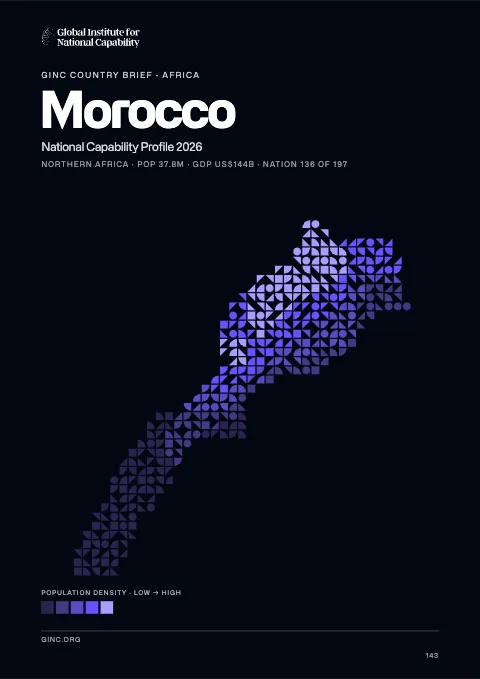
The whole brief
Morocco National Capability Profile 2026
Foundations · Chapter 01
Historical Context
🇲🇦 Morocco’s understanding the origins and evolution of the modern nation
BackgroundBack to top ↑
In 788, about a century after the Arab conquest of North Africa, a series of Moroccan Muslim dynasties began to rule in Morocco. In the 16th century, the Sa'adi monarchy, particularly under Ahmad al-MANSUR (1578-1603), repelled foreign invaders and inaugurated a golden age. The Alaouite Dynasty, to which the current Moroccan royal family belongs, dates from the 17th century. In 1860, Spain occupied northern Morocco and ushered in a half century of trade rivalry among European powers that saw Morocco's sovereignty steadily erode; in 1912, the French imposed a protectorate over the country. A protracted independence struggle with France ended successfully in 1956. The internationalized city of Tangier and most Spanish possessions were turned over to the new country that same year. Sultan MOHAMMED V, the current monarch's grandfather, organized the new state as a constitutional monarchy and in 1957 assumed the title of king. Although Morocco is not the UN-recognized Administering Power for the Western Sahara, it exercises de facto administrative control over 80% of the territory. The UN since 1991 has monitored a ceasefire between Morocco and the Polisario Front and leads ongoing negotiations over the status of the territory. King MOHAMMED VI in early 2011 responded to the spread of pro-democracy protests in the region by implementing a reform program that included a new constitution, passed by popular referendum in July 2011, under which some new powers were extended to parliament and the prime minister but ultimate authority remains in the hands of the monarch. In November 2012, the Justice and Development Party - a moderate Islamist party - won the largest number of seats in parliamentary elections, becoming the first Islamist party to lead the Moroccan Government.
IndependenceBack to top ↑
2 March 1956 (from France)
National holidayBack to top ↑
Throne Day (accession of King MOHAMMED VI to the throne), 30 July (1999)
Foundations · Chapter 02
Geography
🇲🇦 Morocco’s territory, resources and strategic position
Location and areaBack to top ↑
Northern Africa, bordering the North Atlantic Ocean and the Mediterranean Sea, between Algeria and Western Sahara
32 00 N, 5 00 W
Africa
slightly larger than California
1,835 km
Terrain and resourcesBack to top ↑
northern coast and interior are mountainous with large areas of bordering plateaus, intermontane valleys, and rich coastal plains
phosphates, iron ore, manganese, lead, zinc, fish, salt
14,850 sq km (2004)
Settlement and hazardsBack to top ↑
northern mountains geologically unstable and subject to earthquakes; periodic droughts
strategic location along Strait of Gibraltar
OtherBack to top ↑
29 cu km (2011)
land degradation/desertification (soil erosion resulting from farming of marginal areas, overgrazing, destruction of vegetation); water supplies contaminated by raw sewage; siltation of reservoirs; oil pollution of coastal waters
Foundations · Chapter 03
Environment
🇲🇦 Morocco’s environmental conditions, resources and national resilience
ClimateBack to top ↑
Mediterranean, becoming more extreme in the interior
Emissions and pollutionBack to top ↑
Water, waste and foodBack to top ↑
Resources and agreementsBack to top ↑
GINC Capability Domains · Chapter 04
Critical Technology
🇲🇦 Morocco’s technology frontiers and the pursuit of national advantage
Two counts are set side by side for 2015–2024: on the left, the papers researchers in Morocco published; on the right, the patent families that began there and were filed in more than one country. First by capability group, then group by group with each group’s capabilities. The badge on a card is the nation’s place among all nations. Papers are from GINC Research Analytics, patent families from GINC Patents.
Research by capability group
#43 WorldPapers published, 2015–2024
3,141
1,248
1,033
906
497
309
279
260
139
19
Patents by capability group
#61 WorldInternational patent families, 2015–2024
Advanced Materials & ManufacturingBack to top ↑
Research
#45 WorldPapers published, 2015–2024
Patents
#62 WorldInternational patent families, 2015–2024
Energy TechnologiesBack to top ↑
Research
#33 WorldPapers published, 2015–2024
Patents
#48 WorldInternational patent families, 2015–2024
Semiconductors & Advanced ComputingBack to top ↑
Research
#50 WorldPapers published, 2015–2024
No research topic: Semiconductor Design & EDA · Advanced Semiconductor Fabrication · Semiconductor Equipment & Materials · Advanced Packaging & Heterogeneous Integration
Patents
International patent families, 2015–2024
No international patent families on record for 2015–2024.
Artificial IntelligenceBack to top ↑
Research
#33 WorldPapers published, 2015–2024
Patents
#52 WorldInternational patent families, 2015–2024
Quantum TechnologiesBack to top ↑
Research
#39 WorldPapers published, 2015–2024
Patents
International patent families, 2015–2024
No international patent families on record for 2015–2024.
Connectivity, Cyber & Trust TechnologiesBack to top ↑
Research
#31 WorldPapers published, 2015–2024
Patents
#58 WorldInternational patent families, 2015–2024
Sensing, Timing & NavigationBack to top ↑
Research
#43 WorldPapers published, 2015–2024
Patents
#54 WorldInternational patent families, 2015–2024
Robotics & Autonomous SystemsBack to top ↑
Research
#51 WorldPapers published, 2015–2024
No research topic: Human-Machine Interfaces
Patents
#59 WorldInternational patent families, 2015–2024
Biotechnology & Health TechnologiesBack to top ↑
Research
#62 WorldPapers published, 2015–2024
Patents
#62 WorldInternational patent families, 2015–2024
Medicine and BioTech
Clinical research and life-science invention, drawn from the same series that drive the metric pages. Each card opens the full cross-country comparison.
Space TechnologiesBack to top ↑
Research
#38 WorldPapers published, 2015–2024
Patents
#41 WorldInternational patent families, 2015–2024
GINC Capability Domains · Chapter 05
Strategic Infrastructure
🇲🇦 Morocco’s energy, connectivity and the material foundations of capability
Resource InfrastructureBack to top ↑
5,057 bbl/day (2012 est.)
0 bbl/day (2010 est.)
122,900 bbl/day (2010 est.)
680,000 bbl (1 January 2013 est.)
131,500 bbl/day (2010 est.)
203,600 bbl/day (2011 est.)
20,830 bbl/day (2010 est.)
143,000 bbl/day (2010 est.)
60 million cu m (2011 est.)
560 million cu m (2010 est.)
0 cu m (2011 est.)
150 million cu m (2011 est.)
1.444 billion cu m (1 January 2013 est.)
gas 944 km; oil 270 km; refined products 175 km (2013)
Agriculture & Food InfrastructureBack to top ↑
- Irrigation & Agricultural Water
- Livestock & Veterinary
- Fisheries & Aquaculture
- Storage, Cold Chain & Markets
Energy InfrastructureBack to top ↑
- Thermal Generation
- Nuclear Generation
- Nuclear Fuel Cycle & Radioactive Waste
- Hydropower
- Renewable Generation
- Transmission & Distribution
- System Control & Dispatch
- Storage & Fuel Supply
6.62 million kW (2010 est.)
21.13 billion kWh (2010 est.)
23.61 billion kWh (2010 est.)
0 kWh (2012 est.)
3.94 billion kWh (2010 est.)
69.3% of total installed capacity (2010 est.)
0% of total installed capacity (2010 est.)
19.4% of total installed capacity (2010 est.)
4.3% of total installed capacity (2010 est.)
43.71 million Mt (2011 est.)
Water, Sanitation & Waste InfrastructureBack to top ↑
- Dams, Reservoirs & Flood Defence
- Water Supply & Treatment
- Bulk Water Transfer & Desalination
- Wastewater & Sanitation
- Solid Waste & Recycling
Advanced ManufacturingBack to top ↑
- Materials & Inputs
- Chemicals & Hazardous Process Industry
- Production Systems
- Supply Chain & Ecosystem
- Workforce & Innovation
Transport InfrastructureBack to top ↑
- Seaports & Terminals
- Air Infrastructure
- Air Navigation & Traffic Management
- Inland Waterways & Ferries
- Rail Infrastructure
- Roads & Bridges
- Logistics, Multimodal & Border Infrastructure
- Postal & Parcel
55 (2013)
1 (2013)
Communications & Digital InfrastructureBack to top ↑
- Subsea Cables & International Gateways
- Core & Backbone Networks
- Mobile & Wireless Networks
- Spectrum & Broadcasting
- Data Centres, Compute & Cloud
- Data Resources
- AI Tools & Applications
3.28 million (2012)
39.016 million (2012)
13.213 million (2009)
277,338 (2012)
.ma
Financial InfrastructureBack to top ↑
- Currency & Reserves
- Payments & Settlement Systems
- Markets, Exchanges & Depositories
- Banks, Insurers & Systemic Institutions
Social InfrastructureBack to top ↑
- Health Infrastructure
- Public Health & Laboratories
- Medical Supply & Stockpiles
- Education & Skills Infrastructure
- Research & Scientific Facilities
- Housing, Community & Social Services
- Government & Public Administration
- Cultural, Community & Recreational Infrastructure
- Justice & Corrections
- Emergency Services & Civil Protection
- Hydrometeorology & Early Warning
Space, Aerospace & Defence InfrastructureBack to top ↑
GINC Capability Domains · Chapter 06
National Security
🇲🇦 Morocco’s force, intelligence and the defence of the nation
Disputes and terrorismBack to top ↑
claims and administers Western Sahara whose sovereignty remains unresolved; Morocco protests Spain's control over the coastal enclaves of Ceuta, Melilla, and Penon de Velez de la Gomera, the islands of Penon de Alhucemas and Islas Chafarinas, and surrounding waters; both countries claim Isla Perejil (Leila Island); discussions have not progressed on a comprehensive maritime delimitation, setting limits on resource exploration and refugee interdiction, since Morocco's 2002 rejection of Spain's unilateral designation of a median line from the Canary Islands; Morocco serves as one of the primary launching areas of illegal migration into Spain from North Africa; Algeria's border with Morocco remains an irritant to bilateral relations, each nation accusing the other of harboring militants and arms smuggling; the National Liberation Front's assertions of a claim to Chirac Pastures in southeastern Morocco is a dormant dispute
Force Generation & MobilisationBack to top ↑
Royal Armed Forces (Forces Armees Royales, FAR): Royal Moroccan Army (includes Air Defense), Royal Moroccan Navy (includes Coast Guard, Marines), Royal Moroccan Air Force (Al Quwwat al Jawyiya al Malakiya Marakishiya; Force Aerienne Royale Marocaine) (2010)
20 years of age for voluntary military service; no conscription; service obligation - 18 months (2012)
3.55% of GDP (2012)//3.37% of GDP (2011)//3.55% of GDP (2010)
Forces under arms
Active-duty strength on the Correlates of War series, which reaches back to 1816 and so carries a nation’s whole record of mobilisation rather than its present establishment. The card opens the full cross-country comparison.
Intelligence & AssessmentBack to top ↑
- Imagery & Geospatial Intelligence
- Signals & Cyber Intelligence
- Technical & Measurement Intelligence
- Open-Source & Financial Intelligence
- Human Intelligence & Counterintelligence
- All-Source Analysis & Warning
Joint Command, Projection & SustainmentBack to top ↑
- Command, Control & Communications
- Strategic Lift & Mobility
- Expeditionary & Peace Operations
- Operational Sustainment & War Reserves
- Defence Industrial Mobilisation
- CBRN Defence
Land PowerBack to top ↑
- Combined Arms Manoeuvre
- Land Fires
- Battlefield Aviation & Uncrewed Systems
- Special Operations & Irregular Warfare
Maritime PowerBack to top ↑
- Maritime Security & Constabulary
- Sea Denial & Undersea Warfare
- Sea Control
- Amphibious & Expeditionary Operations
Air PowerBack to top ↑
- Air Sovereignty & Policing
- Control of the Air
- Air Strike & Interdiction
- Airborne ISR, Early Warning & Battle Management
Strategic Strike & Missile DefenceBack to top ↑
Space OperationsBack to top ↑
Cyber & Electromagnetic OperationsBack to top ↑
Nuclear DeterrenceBack to top ↑
GINC Capability Domains · Chapter 07
Human Capital
🇲🇦 Morocco’s population, health and the skills that sustain capability
DemographyBack to top ↑
32,987,206 (July 2014 est.)
1.02% (2014 est.)
18.47 births/1,000 population (2014 est.)
4.79 deaths/1,000 population (2014 est.)
2.15 children born/woman (2014 est.)
25.4
67.4% (2011)
Migration and urbanisationBack to top ↑
-3.46 migrant(s)/1,000 population (2014 est.)
Casablanca 3.046 million; RABAT (capital) 1.843 million; Fes 1.088 million; Marrakech 939,000; Tangier 810,000; Agadir 805,000 (2011)
Welfare and equityBack to top ↑
15% (2007 est.)
40.9 (2007 est.)//39.5 (1999 est.)
Early Childhood DevelopmentBack to top ↑
3.1% (2011)
Foundational EducationBack to top ↑
5.4% of GDP (2009)
Advanced EducationBack to top ↑
Technical & Vocational SkillsBack to top ↑
Digital & AI CompetenceBack to top ↑
Generative AI adoption
Modelled share of working-age adults using generative AI, from Microsoft telemetry scaled to each country’s 15–64 population. A measure of how fast a workforce is absorbing the technology rather than of how much of it a nation builds. The card opens the full cross-country comparison.
Lifelong Learning & ReskillingBack to top ↑
Research Talent & Knowledge CreationBack to top ↑
Population HealthBack to top ↑
100 deaths/100,000 live births (2010)
16.4% (2008)
0.1% (2012 est.)
30,000 (2012 est.)
1,200 (2012 est.)
Health System CapabilityBack to top ↑
6% of GDP (2011)
0.62 physicians/1,000 population (2009)
1.1 beds/1,000 population (2009)
GINC Capability Domains · Chapter 08
Governance and Integrity
🇲🇦 Morocco’s institutions, law and the integrity of the state
State structureBack to top ↑
constitutional monarchy
15 regions; Grand Casablanca, Chaouia-Ouardigha, Doukkala-Abda, Fes-Boulemane, Gharb-Chrarda-Beni Hssen, Guelmim-Es Smara, Laayoune-Boujdour-Sakia El Hamra, Marrakech-Tensift-Al Haouz, Meknes-Tafilalet, Oriental, Rabat-Sale-Zemmour-Zaer, Souss-Massa-Draa, Tadla-Azilal, Tanger-Tetouan, Taza-Al Hoceima-Taounate
several previous; latest drafted 17 June 2011, approved by referendum 1 July 2011; note - sources disagree on whether the 2011 referendum was for a new constitution or for reforms to the previous constitution (2011)
18 years of age; universal
Political Institutions & Civic ParticipationBack to top ↑
- Electoral Management & Integrity
- Legislature & Deliberative Institutions
- Citizen Participation & Civic Space
bicameral Parliament consists of the Chamber of Counselors or Majlis al-Mustacharin (270 seats - to be reduced to a maximum of 120; members elected indirectly by local councils, professional organizations, and labor syndicates to serve six-year terms; one-third of the members are elected every three years) and Chamber of Representatives or Majlis al-Nuwab (395 seats; members elected by popular vote to serve five-year terms)
Action Party or PA [Mohammed EL IDRISSI]//Al Ahd (The Covenant) Party [Najib EL OUAZZANI]//Alliance des Libert'es (Alliance of Liberties) or ADL [Ali BELHAJ]//An-Nahj Ad-Dimocrati or An-Nahj [Abdellah EL HARIF]//Authenticity and Modernity Party or PAM [Mustapha BAKKOURY, secretary general]//Choura et Istiqlal (Consultation and Independence) Party or PCI [Abdelwahed MAACH]//Citizens' Forces or FC [Abderrahman LAHJOUJI]//Citizenship and Development Initiative or ICD [Mohamed BENHAMOU]//Constitutional Union Party or UC [Mohammed ABIED]//Democratic and Social Movement or MDS [Mahmoud ARCHANE]//Democratic Forces Front or FFD [Touhami EL KHIARI]//Democratic Socialist Vanguard Party or PADS [Ahmed BENJELLOUN]//Democratic Society Party or PSD [Zhor CHEKKAFI]//Democratic Union or UD [Bouazza IKKEN]//Environment and Development Party or PED [Ahmed EL ALAMI]//Istiqlal (Independence) Party or PI [Hamid CHABAT]////Labor Party or LP [Abdelkrim BENATIK]//Moroccan Liberal Party or PML [Mohamed ZIANE]//National Democratic Party or PND [Abdallah KADIRI]//National Ittihadi Congress Party or CNI [Abdelmajid BOUZOUBAA]//National Popular Movement or MNP [Mahjoubi AHERDANE]//National Rally of Independents or RNI [Salaheddine MEZOUAR]//National Union of Popular Forces or UNFP [Abdellah IBRAHIM]//Party of Justice and Development or PJD [Abdelillah BENKIRANE]; Popular Movement or MP [Mohamed LAENSER]//Progress and Socialism Party or PPS [Nabil BENABDELLAH]//Reform and Development Party or PRD [Abderrahmane EL KOUHEN]//Renaissance and Virtue Party or PRV [Mohamed KHALIDI]//Renewal and Equity Party or PRE [Chakir ACHABAR]//Social Center Party or PSC [Lahcen MADIH]//Socialist Democratic Party or PSD [Aissa OUARDIGHI]//Socialist Union of Popular Forces or USFP [Driss LACHGAR]//Unified Socialist Left Party or PGSU [Mohamed Ben Said AIT IDDER]
Democratic Confederation of Labor or CDT [Noubir AMAOUI]//General Union of Moroccan Workers or UGTM [Abderrazzak AFILAL]//Justice and Charity Organization or JCO//Moroccan Employers Association or CGEM [Hassan CHAMI]//National Labor Union of Morocco or UNMT [Abdelslam MAATI]//Union of Moroccan Workers or UMT [Mahjoub BENSEDDIK]
Justice System & Fundamental RightsBack to top ↑
- Judicial Independence & Court Capability
- Access to Justice & Legal Services
- Fundamental Rights Protection
- Human Rights Institutions & Equality Bodies
mixed legal system of civil law based on French law and Islamic law; judicial review of legislative acts by Supreme Court
has not submitted an ICJ jurisdiction declaration; non-party state to the ICCt
Internal Security & OrderBack to top ↑
one of the world's largest producers of illicit hashish; shipments of hashish mostly directed to Western Europe; transit point for cocaine from South America destined for Western Europe; significant consumer of cannabis
Regulatory Governance & Strategic ControlsBack to top ↑
- Regulatory Quality & Better Regulation
- Regulatory Delivery & Independent Regulators
- Strategic Controls & Economic Security Administration
Government Effectiveness & Public AdministrationBack to top ↑
- Centre of Government & Policy Coordination
- Civil Service & Public Workforce
- Digital Government & Service Delivery
- Legal Identity & Civil Registration
- Statistical & Data Capability
Public Integrity & Anti-CorruptionBack to top ↑
Transparency, Oversight & AccountabilityBack to top ↑
- Right to Information & Open Government
- Independent Oversight & Supreme Audit
- Independent Media & Journalist Safety
National Resilience & Crisis ManagementBack to top ↑
GINC Capability Domains · Chapter 09
Information and Influence
🇲🇦 Morocco’s identity, media and the projection of influence
Identity and cultureBack to top ↑
Arabic (official), Berber languages (Tamazight (official), Tachelhit, Tarifit), French (often the language of business, government, and diplomacy)
Muslim 99% (official; virtually all Sunni,
Arab-Berber 99%, other 1%
pentacle symbol; lion
red with a green pentacle (five-pointed, linear star) known as Sulayman's (Solomon's) seal in the center of the flag; red and green are traditional colors in Arab flags, although the use of red is more commonly associated with the Arab states of the Persian gulf; the pentacle represents the five pillars of Islam and signifies the association between God and the nation; design dates to 1912
Diplomatic Statecraft & Global NetworksBack to top ↑
- Diplomatic Network & Consular Reach
- Multilateral Leadership & Norm Setting
- Agenda-Setting & Convening
- Mediation & Crisis Diplomacy
ABEDA, AfDB, AFESD, AMF, AMU, CAEU, CD, EBRD, FAO, G-11, G-77, IAEA, IBRD, ICAO, ICC (national committees), ICRM, IDA, IDB, IFAD, IFC, IFRCS, IHO, ILO, IMF, IMO, IMSO, Interpol, IOC, IOM, IPU, ISO, ITSO, ITU, ITUC (NGOs), LAS, MIGA, MONUSCO, NAM, OAS (observer), OIC, OIF, OPCW, OSCE (partner), Pacific Alliance (observer), Paris Club (associate), PCA, UN, UN Security Council (temporary), UNCTAD, UNESCO, UNHCR, UNIDO, UNOCI, UNSC (temporary), UNWTO, UPU, WCO, WHO, WIPO, WMO, WTO
Alliances & Security CooperationBack to top ↑
Development Cooperation & Global AssistanceBack to top ↑
Culture, Language & Education DiplomacyBack to top ↑
- Cultural & Language Institutes
- Creative Industries & Cultural Export Reach
- Heritage & Cultural Institutions
- Education Diplomacy & Alumni Networks
- Sports & Major Events
Diaspora & Global CommunitiesBack to top ↑
Information Environment & Strategic CommunicationBack to top ↑
- Strategic Communications & Public Diplomacy
- International Media & Broadcasting
- Information Defence & Counter-Interference
2 TV broadcast networks with state-run Radio-Television Marocaine (RTM) operating one network and the state partially owning the other; foreign TV broadcasts are available via satellite dish; 3 radio broadcast networks with RTM operating one; the government-owned network includes 10 regional radio channels in addition to its national service (2007)
GINC Capability Domains · Chapter 10
Financial Strength
🇲🇦 Morocco’s fiscal depth, reserves and the capacity to act
Monetary & Currency CapabilityBack to top ↑
- Monetary Policy & Price Stability
- Exchange Rate & External Account Management
- Currency Issuance & Digital Money
2.5% (2013 est.)//1.2% (2012 est.)
Moroccan dirhams (MAD) per US dollar -//8.439 (2013 est.)//8.6026 (2012 est.)//8.4172 (2010 est.)//8.0571 (2009)//7.526 (2008)
6.5% (31 December 2010 est.)//3.31% (31 December 2009 est.)
6.3% (31 December 2013 est.)//6.3% (31 December 2012 est.)
$75.71 billion (31 December 2013 est.)//$71.51 billion (31 December 2012 est.)
$90.76 billion (31 December 2013 est.)//$84.52 billion (31 December 2012 est.)
Fiscal Capacity & Public FinanceBack to top ↑
- Revenue Mobilisation & Tax Administration
- Public Expenditure & Budget Management
- Sovereign Debt & Treasury Management
- Public Investment Management
24.9% of GDP (2013 est.)
-8% of GDP (2013 est.)
76.9% of GDP (2013 est.)//71.2% of GDP (2012 est.)
calendar year
Financial System Depth & AccessBack to top ↑
- Banking System Capacity
- Capital Markets Depth & Development
- Long-Term & Institutional Capital
- Financial Inclusion & Household Access
- Development & Policy Finance
$121 billion (31 December 2013 est.)//$111.6 billion (31 December 2012 est.)
$NA (31 December 2012 est.)//$60.09 billion (31 December 2011)//$69.15 billion (31 December 2010 est.)
25.4% of GDP (2013 est.)//25.1% of GDP (2012 est.)//27.6% of GDP (2011 est.)
Financial Regulation & IntegrityBack to top ↑
- Prudential Regulation & Supervision
- Financial Integrity & Illicit Finance Control
- Market Conduct & Consumer Protection
- Payment & Market Infrastructure Oversight
Financial Stability & Crisis ManagementBack to top ↑
- Macroprudential & Systemic Oversight
- Crisis Management, Resolution & Deposit Insurance
- External Liquidity & Financial Safety Nets
Sovereign Capital & External Financial PowerBack to top ↑
- Official Reserves Management
- Sovereign Wealth & Public Asset Management
- Currency Internationalisation & Reserve Status
- Capital Account & Flow Management
- International Financial Centre Capability
$19.16 billion (31 December 2013 est.)//$17.54 billion (31 December 2012 est.)
$36.51 billion (31 December 2013 est.)//$32.15 billion (31 December 2012 est.)
GINC Capability Domains · Chapter 11
Production and Innovation
🇲🇦 Morocco’s output, industry and the engine of prosperity
Economic Output & ProductivityBack to top ↑
Morocco has capitalized on its proximity to Europe and relatively low labor costs to build a diverse, open, market-oriented economy. In the 1980s Morocco was a heavily indebted country before pursuing austerity measures and pro-market reforms, overseen by the IMF. Since taking the throne in 1999, King MOHAMMED VI has presided over a stable economy marked by steady growth, low inflation, and gradually falling unemployment, although a poor harvest and economic difficulties in Europe contributed to an economic slowdown in 2012. Industrial development strategies and infrastructure improvements - most visibly illustrated by a new port and free trade zone near Tangier - are improving Morocco's competitiveness. Morocco also seeks to expand its renewable energy capacity with a goal of making renewable 40% of electricity output by 2020. Key sectors of the economy include agriculture, tourism, phosphates, textiles, apparel, and subcomponents. To boost exports, Morocco entered into a bilateral Free Trade Agreement with the United States in 2006 and an Advanced Status agreement with the European Union in 2008. Despite Morocco's economic progress, the country suffers from high unemployment, poverty, and illiteracy, particularly in rural areas. In 2011 and 2012, high prices on fuel - which is subsidized and almost entirely imported - strained the government's budget and widened the country's current account deficit. In the fall of 2013, Morocco capped some of its fuel subsidies in an effort to gradually reduce the country’s large budgetary deficit. Key economic challenges for Morocco include fighting corruption and reforming the education system, the judiciary, and the government's costly subsidy program.
$180 billion (2013 est.)//$171.2 billion (2012 est.)//$166.7 billion (2011 est.)
5.1% (2013 est.)//2.7% (2012 est.)//5% (2011 est.)
$5,500 (2013 est.)//$5,300 (2012 est.)//$5,200 (2011 est.)
$104.8 billion (2013 est.)
Labour & EmploymentBack to top ↑
- Employment & Labour Force Participation
- Labour Market Institutions & Wage Setting
- Employment Services & Skills Matching
- Labour Adjustment, Transition & Formalisation
11.73 million (2013 est.)
9.5% (2013 est.)//9% (2012 est.)
Industrial & Sectoral BaseBack to top ↑
- Manufacturing & Advanced Industry
- Foundational & Process Industries
- Agrifood & Primary Production
- Services Economy
barley, wheat, citrus fruits, grapes, vegetables, olives; livestock; wine
phosphate mining and processing, food processing, leather goods, textiles, construction, energy, tourism
1.2% (2013 est.)
Structural Transformation & ComplexityBack to top ↑
Business Dynamism & EntrepreneurshipBack to top ↑
- Entrepreneurship & Firm Creation
- Risk Capital & Scale-Up Finance
- Firm Growth, Exit & Renewal
- Competition & Market Contestability
Innovation & CommercialisationBack to top ↑
- Business Innovation Capability
- Research Commercialisation & Knowledge Transfer
- Intellectual Property & Intangible Assets
- Innovation Ecosystems & Clusters
Technology Adoption & DiffusionBack to top ↑
GINC Capability Domains · Chapter 12
Trade and Investment
🇲🇦 Morocco’s markets, capital and the terms of global exchange
Overall tradeBack to top ↑
$59.9B of exports to 184 partners and $95.1B of imports from 196 in 2024, a deficit of $35.2B.
- Exports
- $59.9B184 partners
- Imports
- $95.1B196 partners
- Balance
- −$35.2Bdeficit
- Total trade
- $155B2024
ExportsBack to top ↑
Where its exports go
The largest partners in 2024, with each one's share of the nation's exports.
| Partner | Value | Share | |
|---|---|---|---|
| Spain | $11.5B | 19% | |
| France | $9.18B | 15% | |
| Germany | $3.82B | 6.4% | |
| United Kingdom | $2.71B | 4.5% | |
| Italy | $2.56B | 4.3% | |
| United States | $2.25B | 3.8% | |
| India | $1.87B | 3.1% | |
| Turkey | $1.85B | 3.1% | |
| Poland | $1.48B | 2.5% | |
| Brazil | $1.35B | 2.2% | |
| Netherlands | $1.21B | 2.0% | |
| China | $1.13B | 1.9% | |
| Belgium | $1.09B | 1.8% | |
| Bangladesh | $1.07B | 1.8% | |
| Australia | $875M | 1.5% | |
| Djibouti | $832M | 1.4% | |
| Romania | $810M | 1.4% | |
| Canada | $684M | 1.1% | |
| Portugal | $668M | 1.1% | |
| Czech Republic | $624M | 1.0% |
What it exports
The largest categories in 2024.
| Category | Value | Share | |
|---|---|---|---|
| Electrical, electronic equipment | $10.9B | 18% | |
| Vehicles other than railway, tramway | $10.1B | 17% | |
| Fertilizers | $8.93B | 15% | |
| Articles of apparel, not knit or crocheted | $5.22B | 8.7% | |
| Edible fruits, nuts, peel of citrus fruit, melons | $2.87B | 4.8% | |
| Edible vegetables and certain roots and tubers | $2.65B | 4.4% | |
| Articles of apparel, knit or crocheted | $2.07B | 3.5% | |
| Inorganic chemicals, precious metal compound, isotope | $1.85B | 3.1% | |
| Salt, sulphur, earth, stone, plaster, lime and cement | $1.65B | 2.8% | |
| Meat, fish and seafood preparations | $1.63B | 2.7% | |
| Fish, crustaceans, molluscs, aquatics invertebrates | $1.22B | 2.0% | |
| Machinery, nuclear reactors, boilers | $986M | 1.6% | |
| Furniture, lighting signs, prefabricated buildings | $862M | 1.4% | |
| Aircraft, spacecraft | $852M | 1.4% | |
| Sugars and sugar confectionery | $772M | 1.3% |
ImportsBack to top ↑
Where its imports come from
The largest partners in 2024, with each one's share of the nation's imports.
| Partner | Value | Share | |
|---|---|---|---|
| Spain | $15.9B | 17% | |
| China | $10.5B | 11% | |
| France | $9.89B | 10% | |
| United States | $8.84B | 9.3% | |
| Germany | $5.08B | 5.3% | |
| Turkey | $4.65B | 4.9% | |
| Italy | $4.26B | 4.5% | |
| Saudi Arabia | $2.96B | 3.1% | |
| Portugal | $2.82B | 3.0% | |
| Romania | $1.90B | 2.0% | |
| Brazil | $1.72B | 1.8% | |
| United Arab Emirates | $1.71B | 1.8% | |
| Belgium | $1.68B | 1.8% | |
| India | $1.65B | 1.7% | |
| Poland | $1.40B | 1.5% | |
| Egypt | $1.36B | 1.4% | |
| Kazakhstan | $1.25B | 1.3% | |
| United Kingdom | $1.20B | 1.3% | |
| Netherlands | $1.05B | 1.1% | |
| Czech Republic | $898M | 0.9% |
What it imports
The largest categories in 2024.
| Category | Value | Share | |
|---|---|---|---|
| Mineral fuels, oils, distillation products | $12.4B | 13% | |
| Electrical, electronic equipment | $10.3B | 11% | |
| Vehicles other than railway, tramway | $10.3B | 11% | |
| Machinery, nuclear reactors, boilers | $9.53B | 10% | |
| Plastics | $4.33B | 4.6% | |
| Aircraft, spacecraft | $2.93B | 3.1% | |
| Cereals | $2.66B | 2.8% | |
| Inorganic chemicals, precious metal compound, isotope | $2.63B | 2.8% | |
| Iron and steel | $2.50B | 2.6% | |
| Copper | $1.98B | 2.1% | |
| Salt, sulphur, earth, stone, plaster, lime and cement | $1.92B | 2.0% | |
| Articles of iron or steel | $1.85B | 1.9% | |
| Manmade staple fibers | $1.76B | 1.8% | |
| Aluminum | $1.61B | 1.7% | |
| Optical, photo, technical, medical apparatus | $1.41B | 1.5% |
In a list, the bar runs to the largest in that list. The line is each figure’s history from 2000, drawn to its own peak: it shows the shape of the years, and the value shows the size.
External balanceBack to top ↑
-$9.595 billion (2013 est.)//-$9.843 billion (2012 est.)
Trade Facilitation & LogisticsBack to top ↑
Trade Policy & Market AccessBack to top ↑
- Trade Policy & Negotiation Capability
- Market Access & Agreements Network
- Trade Law & Enforcement
- Standards, Conformity & Quality Infrastructure
Digital & Services TradeBack to top ↑
- Services Trade Capability
- Digital Trade & E-Commerce
- Data Flows & Digital Trade Governance
- Tourism & Visitor Economy
Investment Attraction & ProjectionBack to top ↑
- Investment Attraction & Facilitation
- Investment Absorption & Linkages
- Outward Investment & Global Corporate Presence
$51.82 billion (31 December 2013 est.)//$48.18 billion (31 December 2012 est.)
$1.972 billion (31 December 2013 est.)//$2.423 billion (31 December 2012 est.)
Export Capability & SophisticationBack to top ↑
$16.78 billion (2013 est.)//$16.99 billion (2012 est.)
France 21%, Spain 17.3%, Brazil 5.4%, India 4.9%, US 4.6% (2012)
clothing and textiles, electric components, inorganic chemicals, transistors, crude minerals, fertilizers (including phosphates), petroleum products, citrus fruits, vegetables, fish
Global Value Chain PositionBack to top ↑
- Value Chain Participation & Integration
- Value Chain Position & Upgrading
- Regional Integration & Hub Anchoring
Economic Leverage & DependenceBack to top ↑
- Strategic Supply Security
- Concentration Risk & Revenue Stabilisation
- Economic Leverage & Coercion Resistance
$38.66 billion (2013 est.)//$38.88 billion (2012 est.)
Spain 13.1%, France 12.1%, China 6.9%, US 6.8%, Saudi Arabia 6.2%, Italy 5.1%, Russia 5%, Germany 4.9% (2012)
crude petroleum, textile fabric, telecommunications equipment, wheat, gas and electricity, transistors, plastics
Morocco · you are in
Historical Context
Foundations
GINC Capability Domains
Find in this brief · Morocco