
Bangladesh
Bangladesh is a parliamentary democracy in South Asia, home to 166 million people, with its capital at Dhaka.
Contents
12 chapters
Foundations
01–03
At a glance
- Area
- 144Kkm²#95 World#4 South Asia
- Population
- 166.3M#8 World#2 South Asia
- GDP (market)
- $140B
- GDP (PPP)
- $324.6B#43 World#2 South Asia
- GDP per capita
- $2.1K#193 World#5 South Asia
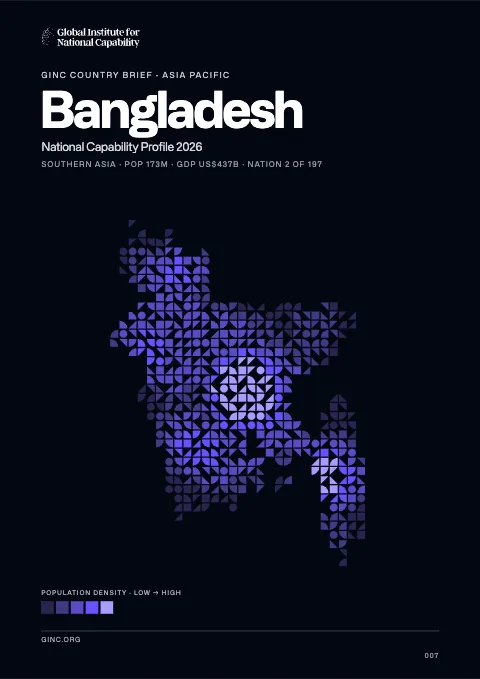
The whole brief
Bangladesh National Capability Profile 2026
Foundations · Chapter 01
Historical Context
🇧🇩 Bangladesh’s understanding the origins and evolution of the modern nation
BackgroundBack to top ↑
Muslim conversions and settlement in the region now referred to as Bangladesh began in the 10th century, primarily from Arab and Persian traders and preachers. Europeans began to set up trading posts in the area in the 16th century. Eventually the area known as Bengal, primarily Hindu in the western section and mostly Muslim in the eastern half, became part of British India. Partition in 1947 resulted in an eastern wing of Pakistan in the Muslim-majority area, which became East Pakistan. Calls for greater autonomy and animosity between the eastern and western wings of Pakistan led to a Bengali independence movement. That movement, led by the Awami League (AL) and supported by India, won independence for Bangladesh in a brief war in 1971, during which at least 300,000 civilians died. The post-independence, AL government faced daunting challenges and in 1975 was overthrown by the military, triggering a series of military coups that resulted in a military-backed government and subsequent creation of the Bangladesh Nationalist Party (BNP). That government also ended in a coup in 1981, followed by military-backed rule until democratic elections in 1991. The BNP and AL have alternately held power since then, with the exception of a military-backed, emergency caretaker regime that suspended parliamentary elections planned for January 2007 in an effort to reform the political system and root out corruption. That government returned the country to fully democratic rule in December 2008 with the election of the AL and Prime Minister Sheikh HASINA. In January 2014, the AL won the national election by an overwhelming majority after the BNP boycotted, extending HASINA's term as prime minister. With the help of international development assistance, Bangladesh has made great progress in food security since independence, and the economy has grown at an average of about 6 percent over the last two decades.
IndependenceBack to top ↑
16 December 1971 (from West Pakistan)
National holidayBack to top ↑
Independence Day, 26 March (1971); Victory Day; note - March 1971 is the date of the Awami League's declaration of an independent Bangladesh, and 16 December, known as Victory Day, memorializes the military victory over Pakistan and the official creation of the state of Bangladesh
Foundations · Chapter 02
Geography
🇧🇩 Bangladesh’s territory, resources and strategic position
Location and areaBack to top ↑
Southern Asia, bordering the Bay of Bengal, between Burma and India
24 00 N, 90 00 E
Asia
slightly smaller than Iowa
580 km
Terrain and resourcesBack to top ↑
mostly flat alluvial plain; hilly in southeast
natural gas, arable land, timber, coal
50,500 sq km (2008)
Settlement and hazardsBack to top ↑
droughts; cyclones; much of the country routinely inundated during the summer monsoon season
most of the country is situated on deltas of large rivers flowing from the Himalayas: the Ganges unites with the Jamuna (main channel of the Brahmaputra) and later joins the Meghna to eventually empty into the Bay of Bengal
OtherBack to top ↑
1,227 cu km (2011)
many people are landless and forced to live on and cultivate flood-prone land; waterborne diseases prevalent in surface water; water pollution, especially of fishing areas, results from the use of commercial pesticides; ground water contaminated by naturally occurring arsenic; intermittent water shortages because of falling water tables in the northern and central parts of the country; soil degradation and erosion; deforestation; severe overpopulation
Foundations · Chapter 03
Environment
🇧🇩 Bangladesh’s environmental conditions, resources and national resilience
ClimateBack to top ↑
tropical; mild winter (October to March); hot, humid summer (March to June); humid, warm rainy monsoon (June to October)
Emissions and pollutionBack to top ↑
Water, waste and foodBack to top ↑
Resources and agreementsBack to top ↑
GINC Capability Domains · Chapter 04
Critical Technology
🇧🇩 Bangladesh’s technology frontiers and the pursuit of national advantage
Two counts are set side by side for 2015–2024: on the left, the papers researchers in Bangladesh published; on the right, the patent families that began there and were filed in more than one country. First by capability group, then group by group with each group’s capabilities. The badge on a card is the nation’s place among all nations. Papers are from GINC Research Analytics, patent families from GINC Patents.
Research by capability group
#32 WorldPapers published, 2015–2024
5,660
1,151
1,087
981
917
577
255
188
168
7
Patents by capability group
#100 WorldInternational patent families, 2015–2024
Advanced Materials & ManufacturingBack to top ↑
Research
#51 WorldPapers published, 2015–2024
Patents
International patent families, 2015–2024
No international patent families on record for 2015–2024.
Energy TechnologiesBack to top ↑
Research
#32 WorldPapers published, 2015–2024
Patents
International patent families, 2015–2024
No international patent families on record for 2015–2024.
Semiconductors & Advanced ComputingBack to top ↑
Research
#42 WorldPapers published, 2015–2024
No research topic: Semiconductor Design & EDA · Advanced Semiconductor Fabrication · Semiconductor Equipment & Materials · Advanced Packaging & Heterogeneous Integration
Patents
International patent families, 2015–2024
No international patent families on record for 2015–2024.
Artificial IntelligenceBack to top ↑
Research
#21 WorldPapers published, 2015–2024
Patents
#89 WorldInternational patent families, 2015–2024
Quantum TechnologiesBack to top ↑
Research
#47 WorldPapers published, 2015–2024
Patents
International patent families, 2015–2024
No international patent families on record for 2015–2024.
Connectivity, Cyber & Trust TechnologiesBack to top ↑
Research
#29 WorldPapers published, 2015–2024
Patents
#79 WorldInternational patent families, 2015–2024
Sensing, Timing & NavigationBack to top ↑
Research
#46 WorldPapers published, 2015–2024
Patents
International patent families, 2015–2024
No international patent families on record for 2015–2024.
Robotics & Autonomous SystemsBack to top ↑
Research
#48 WorldPapers published, 2015–2024
No research topic: Human-Machine Interfaces
Patents
International patent families, 2015–2024
No international patent families on record for 2015–2024.
Biotechnology & Health TechnologiesBack to top ↑
Research
#35 WorldPapers published, 2015–2024
Patents
#84 WorldInternational patent families, 2015–2024
Medicine and BioTech
Clinical research and life-science invention, drawn from the same series that drive the metric pages. Each card opens the full cross-country comparison.
Space TechnologiesBack to top ↑
Research
#55 WorldPapers published, 2015–2024
Patents
International patent families, 2015–2024
No international patent families on record for 2015–2024.
GINC Capability Domains · Chapter 05
Strategic Infrastructure
🇧🇩 Bangladesh’s energy, connectivity and the material foundations of capability
Resource InfrastructureBack to top ↑
5,452 bbl/day (2012 est.)
0 bbl/day (2010 est.)
23,620 bbl/day (2010 est.)
28 million bbl (1 January 2013 est.)
22,710 bbl/day (2010 est.)
108,900 bbl/day (2011 est.)
3,288 bbl/day (2010 est.)
84,490 bbl/day (2010 est.)
20.11 billion cu m (2011 est.)
19.91 billion cu m (2010 est.)
0 cu m (2011 est.)
0 cu m (2011 est.)
183.7 billion cu m (1 January 2013 est.)
gas 2,950 km (2013)
Agriculture & Food InfrastructureBack to top ↑
- Irrigation & Agricultural Water
- Livestock & Veterinary
- Fisheries & Aquaculture
- Storage, Cold Chain & Markets
Energy InfrastructureBack to top ↑
- Thermal Generation
- Nuclear Generation
- Nuclear Fuel Cycle & Radioactive Waste
- Hydropower
- Renewable Generation
- Transmission & Distribution
- System Control & Dispatch
- Storage & Fuel Supply
10.26 million kW (2013 est.)
40.08 billion kWh (2011 est.)
38.89 billion kWh (2010 est.)
0 kWh (2012 est.)
500,000 kWh (2013 est.)
97.7% of total installed capacity (2013 est.)
0% of total installed capacity (2013 est.)
2.3% of total installed capacity (2013 est.)
0% of total installed capacity (2013 est.)
58.81 million Mt (2011 est.)
Water, Sanitation & Waste InfrastructureBack to top ↑
- Dams, Reservoirs & Flood Defence
- Water Supply & Treatment
- Bulk Water Transfer & Desalination
- Wastewater & Sanitation
- Solid Waste & Recycling
Advanced ManufacturingBack to top ↑
- Materials & Inputs
- Chemicals & Hazardous Process Industry
- Production Systems
- Supply Chain & Ecosystem
- Workforce & Innovation
Transport InfrastructureBack to top ↑
- Seaports & Terminals
- Air Infrastructure
- Air Navigation & Traffic Management
- Inland Waterways & Ferries
- Rail Infrastructure
- Roads & Bridges
- Logistics, Multimodal & Border Infrastructure
- Postal & Parcel
18 (2013)
3 (2013)
8,370 km (includes up to 3,060 km of main cargo routes; the network is reduced to 5,200 km in the dry season) (2011)
the International Maritime Bureau reports the territorial waters of Bangladesh remain a risk for armed robbery against ships; attacks against vessels have decreased over the last few years in response to improved local security
Communications & Digital InfrastructureBack to top ↑
- Subsea Cables & International Gateways
- Core & Backbone Networks
- Mobile & Wireless Networks
- Spectrum & Broadcasting
- Data Centres, Compute & Cloud
- Data Resources
- AI Tools & Applications
962,000 (2012)
97.18 million (2011)
617,300 (2009)
71,164 (2012)
.bd
Financial InfrastructureBack to top ↑
- Currency & Reserves
- Payments & Settlement Systems
- Markets, Exchanges & Depositories
- Banks, Insurers & Systemic Institutions
Social InfrastructureBack to top ↑
- Health Infrastructure
- Public Health & Laboratories
- Medical Supply & Stockpiles
- Education & Skills Infrastructure
- Research & Scientific Facilities
- Housing, Community & Social Services
- Government & Public Administration
- Cultural, Community & Recreational Infrastructure
- Justice & Corrections
- Emergency Services & Civil Protection
- Hydrometeorology & Early Warning
Space, Aerospace & Defence InfrastructureBack to top ↑
GINC Capability Domains · Chapter 06
National Security
🇧🇩 Bangladesh’s force, intelligence and the defence of the nation
Disputes and terrorismBack to top ↑
Bangladesh referred its maritime boundary claims with Burma and India to the International Tribunal on the Law of the Sea; Indian Prime Minister Singh's September 2011 visit to Bangladesh resulted in the signing of a Protocol to the 1974 Land Boundary Agreement between India and Bangladesh, which had called for the settlement of longstanding boundary disputes over undemarcated areas and the exchange of territorial enclaves, but which had never been implemented; Bangladesh struggles to accommodate 29,000 Rohingya, Burmese Muslim minority from Arakan State, living as refugees in Cox's Bazar; Burmese border authorities are constructing a 200 km (124 mi) wire fence designed to deter illegal cross-border transit and tensions from the military build-up along border
Force Generation & MobilisationBack to top ↑
Bangladesh Defense Force: Bangladesh Army (Sena Bahini), Bangladesh Navy (Noh Bahini, BN), Bangladesh Air Force (Biman Bahini, BAF) (2013)
16-19 years of age for voluntary military service; Bangladeshi birth and 10th grade education required; initial obligation 15 years (2012)
1.35% of GDP (2012)//1.44% of GDP (2011)//1.35% of GDP (2010)
Forces under arms
Active-duty strength on the Correlates of War series, which reaches back to 1816 and so carries a nation’s whole record of mobilisation rather than its present establishment. The card opens the full cross-country comparison.
Intelligence & AssessmentBack to top ↑
- Imagery & Geospatial Intelligence
- Signals & Cyber Intelligence
- Technical & Measurement Intelligence
- Open-Source & Financial Intelligence
- Human Intelligence & Counterintelligence
- All-Source Analysis & Warning
Joint Command, Projection & SustainmentBack to top ↑
- Command, Control & Communications
- Strategic Lift & Mobility
- Expeditionary & Peace Operations
- Operational Sustainment & War Reserves
- Defence Industrial Mobilisation
- CBRN Defence
Land PowerBack to top ↑
- Combined Arms Manoeuvre
- Land Fires
- Battlefield Aviation & Uncrewed Systems
- Special Operations & Irregular Warfare
Maritime PowerBack to top ↑
- Maritime Security & Constabulary
- Sea Denial & Undersea Warfare
- Sea Control
- Amphibious & Expeditionary Operations
Air PowerBack to top ↑
- Air Sovereignty & Policing
- Control of the Air
- Air Strike & Interdiction
- Airborne ISR, Early Warning & Battle Management
Strategic Strike & Missile DefenceBack to top ↑
Space OperationsBack to top ↑
Cyber & Electromagnetic OperationsBack to top ↑
Nuclear DeterrenceBack to top ↑
GINC Capability Domains · Chapter 07
Human Capital
🇧🇩 Bangladesh’s population, health and the skills that sustain capability
DemographyBack to top ↑
166,280,712 (July 2014 est.)
1.6% (2014 est.)
21.61 births/1,000 population (2014 est.)
5.64 deaths/1,000 population (2014 est.)
2.45 children born/woman (2014 est.)
18.1
61.2% (2011/12)
Migration and urbanisationBack to top ↑
-0.02 migrant(s)/1,000 population (2014 est.)
DHAKA (capital) 15.391 million; Chittagong 5.239 million; Khulna 1.781 million; Rajshahi 932,000 (2011)
Welfare and equityBack to top ↑
31.5% (2010 est.)
32.1 (2010)//33.6 (1996)
DisplacementBack to top ↑
Early Childhood DevelopmentBack to top ↑
36.8% (2011)
Foundational EducationBack to top ↑
2.2% of GDP (2009)
Advanced EducationBack to top ↑
Technical & Vocational SkillsBack to top ↑
Digital & AI CompetenceBack to top ↑
Generative AI adoption
Modelled share of working-age adults using generative AI, from Microsoft telemetry scaled to each country’s 15–64 population. A measure of how fast a workforce is absorbing the technology rather than of how much of it a nation builds. The card opens the full cross-country comparison.
Lifelong Learning & ReskillingBack to top ↑
Research Talent & Knowledge CreationBack to top ↑
Population HealthBack to top ↑
240 deaths/100,000 live births (2010)
1.1% (2008)
0.1% (2012 est.)
8,000 (2012 est.)
400 (2012 est.)
Health System CapabilityBack to top ↑
3.7% of GDP (2011)
0.36 physicians/1,000 population (2011)
0.6 beds/1,000 population (2011)
GINC Capability Domains · Chapter 08
Governance and Integrity
🇧🇩 Bangladesh’s institutions, law and the integrity of the state
State structureBack to top ↑
parliamentary democracy
7 divisions; Barisal, Chittagong, Dhaka, Khulna, Rajshahi, Rangpur, Sylhet
previous 1935, 1956, 1962 (preindependence); latest enacted 4 November 1972, effective 16 December 1972, suspended March 1982, restored November 1986; amended many times, last in 2011 (2011)
18 years of age; universal
Political Institutions & Civic ParticipationBack to top ↑
- Electoral Management & Integrity
- Legislature & Deliberative Institutions
- Citizen Participation & Civic Space
unicameral National Parliament or Jatiya Sangsad; 300 seats (45 reserved for women) elected by popular vote from single territorial constituencies; members serve five-year terms
Awami League or AL [Sheikh HASINA]//Communist Party of Bangladesh or CPB [Manjurul A. KHAN]//Bangladesh Nationalist Front or BNF [Abdul Kalam AZADI]//Bangladesh Nationalist Party or BNP [Khaleda ZIA]//Bikalpa Dhara Bangladesh or BDB [Badrudozza CHOWDHURY]//Islami Oikya Jote or IOJ [multiple leaders]//Jatiya Party or JP (Ershad faction) [Hussain Mohammad ERSHAD]//Liberal Democratic Party or LDP [Oli AHMED]//National Socialist Party or JSD [KHALEQUZZAMAN]//Tarikat Foundation [Syed Nozibul Bashar MAIZBHANDARI]//Workers Party or WP [Rashed Khan MENON]
Advocacy to End Gender-based Violence through the MoWCA (Ministry of Women's and Children's Affairs)//Ain o Salish Kendro (Law and Order Center)//Bangladesh Rural Advancement Committee or BRAC//Bangladesh Center for Worker Solidarity//Federation of Bangladesh Chambers of Commerce and Industry//Odikhar (Human Rights)
Justice System & Fundamental RightsBack to top ↑
- Judicial Independence & Court Capability
- Access to Justice & Legal Services
- Fundamental Rights Protection
- Human Rights Institutions & Equality Bodies
mixed legal system of mostly English common law and Islamic law
has not submitted an ICJ jurisdiction declaration; accepts ICCt jurisdiction
Internal Security & OrderBack to top ↑
transit country for illegal drugs produced in neighboring countries
Regulatory Governance & Strategic ControlsBack to top ↑
- Regulatory Quality & Better Regulation
- Regulatory Delivery & Independent Regulators
- Strategic Controls & Economic Security Administration
Government Effectiveness & Public AdministrationBack to top ↑
- Centre of Government & Policy Coordination
- Civil Service & Public Workforce
- Digital Government & Service Delivery
- Legal Identity & Civil Registration
- Statistical & Data Capability
Public Integrity & Anti-CorruptionBack to top ↑
Transparency, Oversight & AccountabilityBack to top ↑
- Right to Information & Open Government
- Independent Oversight & Supreme Audit
- Independent Media & Journalist Safety
National Resilience & Crisis ManagementBack to top ↑
GINC Capability Domains · Chapter 09
Information and Influence
🇧🇩 Bangladesh’s identity, media and the projection of influence
Identity and cultureBack to top ↑
Bangla (official, also known as Bengali), English
Muslim 89.5%, Hindu 9.6%, other 0.9% (2004)
Bengali 98%, other 2% (includes tribal groups, non-Bengali Muslims) (1998)
Bengal tiger, water lily
green field with a large red disk shifted slightly to the hoist side of center; the red disk represents the rising sun and the sacrifice to achieve independence; the green field symbolizes the lush vegetation of Bangladesh
Diplomatic Statecraft & Global NetworksBack to top ↑
- Diplomatic Network & Consular Reach
- Multilateral Leadership & Norm Setting
- Agenda-Setting & Convening
- Mediation & Crisis Diplomacy
ADB, ARF, BIMSTEC, C, CD, CICA (observer), CP, D-8, FAO, G-77, IAEA, IBRD, ICAO, ICC (national committees), ICRM, IDA, IDB, IFAD, IFC, IFRCS, IHO, ILO, IMF, IMO, IMSO, Interpol, IOC, IOM, IPU, ISO, ITSO, ITU, ITUC (NGOs), MIGA, MINURSO, MINUSMA, MONUSCO, NAM, OIC, OPCW, PCA, SAARC, SACEP, UN, UNAMID, UNCTAD, UNESCO, UNHCR, UNIDO, UNIFIL, UNISFA, UNMIL, UNMISS, UNMIT, UNOCI, UNWTO, UPU, WCO, WFTU (NGOs), WHO, WIPO, WMO, WTO
Alliances & Security CooperationBack to top ↑
Development Cooperation & Global AssistanceBack to top ↑
Culture, Language & Education DiplomacyBack to top ↑
- Cultural & Language Institutes
- Creative Industries & Cultural Export Reach
- Heritage & Cultural Institutions
- Education Diplomacy & Alumni Networks
- Sports & Major Events
Diaspora & Global CommunitiesBack to top ↑
Information Environment & Strategic CommunicationBack to top ↑
- Strategic Communications & Public Diplomacy
- International Media & Broadcasting
- Information Defence & Counter-Interference
state-owned Bangladesh Television (BTV) operates 1 terrestrial TV station, 3 radio networks, and about 10 local stations; 8 private satellite TV stations and 3 private radio stations also broadcasting; foreign satellite TV stations are gaining audience share in the large cities; several international radio broadcasters are available (2007)
GINC Capability Domains · Chapter 10
Financial Strength
🇧🇩 Bangladesh’s fiscal depth, reserves and the capacity to act
Monetary & Currency CapabilityBack to top ↑
- Monetary Policy & Price Stability
- Exchange Rate & External Account Management
- Currency Issuance & Digital Money
7.6% (2013 est.)//6.6% (2012 est.)
taka (BDT) per US dollar -//78.19 (2013 est.)//81.863 (2012 est.)//69.649 (2010 est.)//69.04 (2009)//68.554 (2008)
5% (31 December 2010 est.)//5% (31 December 2009 est.)
13% (31 December 2013 est.)//13% (31 December 2012 est.)
$17.11 billion (31 December 2013 est.)//$14.85 billion (31 December 2012 est.)
$85.61 billion (31 December 2013 est.)//$70.87 billion (31 December 2012 est.)
Fiscal Capacity & Public FinanceBack to top ↑
- Revenue Mobilisation & Tax Administration
- Public Expenditure & Budget Management
- Sovereign Debt & Treasury Management
- Public Investment Management
12.3% of GDP (2013 est.)
-4.9% of GDP (2013 est.)
30.9% of GDP (2013 est.)//32.2% of GDP (2012 est.)
1 July - 30 June
Financial System Depth & AccessBack to top ↑
- Banking System Capacity
- Capital Markets Depth & Development
- Long-Term & Institutional Capital
- Financial Inclusion & Household Access
- Development & Policy Finance
$93.38 billion (31 December 2013 est.)//$79.32 billion (31 December 2012 est.)
$NA (February 2014 est.)//$17.48 billion (31 December 2012)//$23.55 billion (31 December 2011 est.)
28.3% of GDP (2013 est.)//27% of GDP (2012 est.)//25% of GDP (2011 est.)
Financial Regulation & IntegrityBack to top ↑
- Prudential Regulation & Supervision
- Financial Integrity & Illicit Finance Control
- Market Conduct & Consumer Protection
- Payment & Market Infrastructure Oversight
Financial Stability & Crisis ManagementBack to top ↑
- Macroprudential & Systemic Oversight
- Crisis Management, Resolution & Deposit Insurance
- External Liquidity & Financial Safety Nets
Sovereign Capital & External Financial PowerBack to top ↑
- Official Reserves Management
- Sovereign Wealth & Public Asset Management
- Currency Internationalisation & Reserve Status
- Capital Account & Flow Management
- International Financial Centre Capability
$15.74 billion (31 December 2013 est.)//$12.75 billion (31 December 2012 est.)
$30.69 billion (31 December 2013 est.)//$29.53 billion (31 December 2012 est.)
GINC Capability Domains · Chapter 11
Production and Innovation
🇧🇩 Bangladesh’s output, industry and the engine of prosperity
Economic Output & ProductivityBack to top ↑
Bangladesh's economy has grown roughly 6% per year since 1996 despite political instability, poor infrastructure, corruption, insufficient power supplies, slow implementation of economic reforms, and the 2008-09 global financial crisis and recession. Although more than half of GDP is generated through the service sector, almost half of Bangladeshis are employed in the agriculture sector with rice as the single-most-important product. Garment exports, the backbone of Bangladesh’s industrial sector and 80% of total exports, surpassed $21 billion last year, 18% of GDP. The sector has remained resilient in recent years amidst a series of factory accidents that have killed over 1,000 workers and crippling strikes that shut down virtually all economic activity. Steady garment export growth combined with remittances from overseas Bangladeshis, which totaled almost $15 billion and 13% of GDP IN 2013, are the largest contributors to Bangladesh’s current account surplus and record foreign exchange holdings.
$324.6 billion (2013 est.)//$307 billion (2012 est.)//$289.2 billion (2011 est.)
5.8% (2013 est.)//6.1% (2012 est.)//6.5% (2011 est.)
$2,100 (2013 est.)//$2,000 (2012 est.)//$1,900 (2011 est.)
$140.2 billion (2013 est.)
Labour & EmploymentBack to top ↑
- Employment & Labour Force Participation
- Labour Market Institutions & Wage Setting
- Employment Services & Skills Matching
- Labour Adjustment, Transition & Formalisation
78.62 million
5% (2013 est.)//5% (2012 est.)
Industrial & Sectoral BaseBack to top ↑
- Manufacturing & Advanced Industry
- Foundational & Process Industries
- Agrifood & Primary Production
- Services Economy
rice, jute, tea, wheat, sugarcane, potatoes, tobacco, pulses, oilseeds, spices, fruit; beef, milk, poultry
jute, cotton, garments, paper, leather, fertilizer, iron and steel, cement, petroleum products, tobacco, pharmaceuticals, ceramics, tea, salt, sugar, edible oils, soap and detergent, fabricated metal products, electricity, natural gas
9% (2013 est.)
Structural Transformation & ComplexityBack to top ↑
Business Dynamism & EntrepreneurshipBack to top ↑
- Entrepreneurship & Firm Creation
- Risk Capital & Scale-Up Finance
- Firm Growth, Exit & Renewal
- Competition & Market Contestability
Innovation & CommercialisationBack to top ↑
- Business Innovation Capability
- Research Commercialisation & Knowledge Transfer
- Intellectual Property & Intangible Assets
- Innovation Ecosystems & Clusters
Technology Adoption & DiffusionBack to top ↑
GINC Capability Domains · Chapter 12
Trade and Investment
🇧🇩 Bangladesh’s markets, capital and the terms of global exchange
Overall tradeBack to top ↑
$58.8B of exports to 130 partners and $63.6B of imports from 111 in 2024, a deficit of $4.76B.
- Exports
- $58.8B130 partners
- Imports
- $63.6B111 partners
- Balance
- −$4.76Bdeficit
- Total trade
- $122B2024
ExportsBack to top ↑
Where its exports go
The largest partners in 2024, with each one's share of the nation's exports.
| Partner | Value | Share | |
|---|---|---|---|
| United States | $8.69B | 15% | |
| Germany | $8.57B | 15% | |
| France | $4.29B | 7.3% | |
| United Kingdom | $4.17B | 7.1% | |
| Poland | $3.99B | 6.8% | |
| Spain | $3.80B | 6.5% | |
| India | $1.86B | 3.2% | |
| Italy | $1.68B | 2.9% | |
| Netherlands | $1.67B | 2.8% | |
| Canada | $1.57B | 2.7% | |
| Japan | $1.52B | 2.6% | |
| Austria | $1.26B | 2.1% | |
| China | $1.16B | 2.0% | |
| Denmark | $1.15B | 2.0% | |
| Switzerland | $1.07B | 1.8% | |
| Australia | $1.04B | 1.8% | |
| Czech Republic | $1.02B | 1.7% | |
| Turkey | $876M | 1.5% | |
| Mexico | $685M | 1.2% | |
| South Korea | $683M | 1.2% |
What it exports
The largest categories in 2024.
| Category | Value | Share | |
|---|---|---|---|
| Articles of apparel, knit or crocheted | $27.5B | 47% | |
| Articles of apparel, not knit or crocheted | $23.4B | 40% | |
| Footwear, gaiters and the like | $1.65B | 2.8% | |
| Other made textile articles, sets, worn clothing | $1.12B | 1.9% | |
| Vegetable textile fibers not specified elsewhere, paper yarn, woven fabric | $614M | 1.0% | |
| Headgear and parts thereof | $576M | 1.0% | |
| Articles of leather, animal gut, harness, travel good | $557M | 0.9% | |
| Fish, crustaceans, molluscs, aquatics invertebrates | $368M | 0.6% | |
| Bird skin, feathers, artificial flowers, human hair | $274M | 0.5% | |
| Plastics | $190M | 0.3% | |
| Pharmaceutical products | $159M | 0.3% | |
| Tobacco and manufactures tobacco substitutes | $156M | 0.3% | |
| Animal, vegetable fats and oils, cleavage products | $156M | 0.3% | |
| Cereal, flour, starch, milk preparations and products | $136M | 0.2% | |
| Cotton | $134M | 0.2% |
ImportsBack to top ↑
Where its imports come from
The largest partners in 2024, with each one's share of the nation's imports.
| Partner | Value | Share | |
|---|---|---|---|
| China | $22.8B | 36% | |
| India | $11.3B | 18% | |
| Indonesia | $3.04B | 4.8% | |
| Singapore | $2.93B | 4.6% | |
| Malaysia | $2.59B | 4.1% | |
| Brazil | $2.47B | 3.9% | |
| United States | $2.18B | 3.4% | |
| Japan | $1.46B | 2.3% | |
| Australia | $1.32B | 2.1% | |
| South Korea | $1.30B | 2.0% | |
| Morocco | $1.07B | 1.7% | |
| Taiwan | $1.06B | 1.7% | |
| Thailand | $1.04B | 1.6% | |
| Hong Kong | $871M | 1.4% | |
| Pakistan | $778M | 1.2% | |
| Canada | $744M | 1.2% | |
| Saudi Arabia | $672M | 1.1% | |
| Germany | $594M | 0.9% | |
| Argentina | $485M | 0.8% | |
| Benin | $481M | 0.8% |
What it imports
The largest categories in 2024.
| Category | Value | Share | |
|---|---|---|---|
| Mineral fuels, oils, distillation products | $8.82B | 14% | |
| Cotton | $7.69B | 12% | |
| Machinery, nuclear reactors, boilers | $4.42B | 6.9% | |
| Electrical, electronic equipment | $3.56B | 5.6% | |
| Iron and steel | $3.11B | 4.9% | |
| Plastics | $2.67B | 4.2% | |
| Knitted or crocheted fabric | $2.28B | 3.6% | |
| Manmade staple fibers | $2.16B | 3.4% | |
| Animal, vegetable fats and oils, cleavage products | $2.06B | 3.2% | |
| Fertilizers | $2.04B | 3.2% | |
| Manmade filaments | $1.92B | 3.0% | |
| Organic chemicals | $1.48B | 2.3% | |
| Vehicles other than railway, tramway | $1.32B | 2.1% | |
| Edible vegetables and certain roots and tubers | $1.25B | 2.0% | |
| Oil seed, oleaginous fruits, grain, seed, fruits | $1.15B | 1.8% |
In a list, the bar runs to the largest in that list. The line is each figure’s history from 2000, drawn to its own peak: it shows the shape of the years, and the value shows the size.
External balanceBack to top ↑
$3.541 billion (2013 est.)//$1.754 billion (2012 est.)
Trade Facilitation & LogisticsBack to top ↑
Trade Policy & Market AccessBack to top ↑
- Trade Policy & Negotiation Capability
- Market Access & Agreements Network
- Trade Law & Enforcement
- Standards, Conformity & Quality Infrastructure
Digital & Services TradeBack to top ↑
- Services Trade Capability
- Digital Trade & E-Commerce
- Data Flows & Digital Trade Governance
- Tourism & Visitor Economy
Investment Attraction & ProjectionBack to top ↑
- Investment Attraction & Facilitation
- Investment Absorption & Linkages
- Outward Investment & Global Corporate Presence
$7.04 billion (31 December 2013 est.)//$6.64 billion (31 December 2012 est.)
$110.1 million (31 December 2013 est.)//$108.1 million (31 December 2012 est.)
Export Capability & SophisticationBack to top ↑
$26.91 billion (2013 est.)//$24.92 billion (2012 est.)
US 18.7%, Germany 15.8%, UK 10.2%, France 6.2%, Spain 4.6%, Canada 4.3%, Italy 4% (2013 est.)
garments, knitwear, agricultural products, frozen food (fish and seafood), jute and jute goods, leather
Global Value Chain PositionBack to top ↑
- Value Chain Participation & Integration
- Value Chain Position & Upgrading
- Regional Integration & Hub Anchoring
Economic Leverage & DependenceBack to top ↑
- Strategic Supply Security
- Concentration Risk & Revenue Stabilisation
- Economic Leverage & Coercion Resistance
$32.94 billion (2013 est.)//$32.29 billion (2012 est.)
China 21.7%, India 16.3%, Malaysia 5.2%, Republic of Korea 4.5%, Japan 4.1% (2013 est.)
machinery and equipment, chemicals, iron and steel, textiles, foodstuffs, petroleum products, cement
Bangladesh · you are in
Historical Context
Foundations
GINC Capability Domains
Find in this brief · Bangladesh