
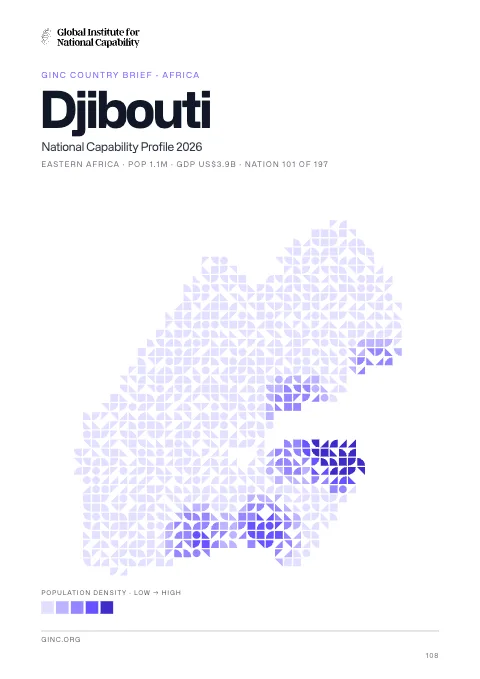
Djibouti
Djibouti is a republic in Africa, home to 810,000 people, with its capital at Djibouti.
Contents
12 chapters
Foundations
01–03
At a glance
- Area
- 23.2Kkm²#150 World#48 Africa
- Population
- 810.2K#162 World#49 Africa
- GDP (market)
- $1.5B
- GDP (PPP)
- $2.5B#187 World#49 Africa
- GDP per capita
- $2.7K#181 World#20 Africa
The whole brief
Djibouti National Capability Profile 2026
Foundations · Chapter 01
Historical Context
🇩🇯 Djibouti’s understanding the origins and evolution of the modern nation
BackgroundBack to top ↑
The French Territory of the Afars and the Issas became Djibouti in 1977. Hassan Gouled APTIDON installed an authoritarian one-party state and proceeded to serve as president until 1999. Unrest among the Afar minority during the 1990s led to a civil war that ended in 2001 with a peace accord between Afar rebels and the Somali Issa-dominated government. In 1999, Djibouti's first multiparty presidential elections resulted in the election of Ismail Omar GUELLEH as president; he was reelected to a second term in 2005 and extended his tenure in office via a constitutional amendment, which allowed him to begin a third term in 2011. Djibouti occupies a strategic geographic location at the intersection of the Red Sea and the Gulf of Aden and serves as an important shipping portal for goods entering and leaving the east African highlands and transshipments between Europe, the Middle East, and Asia. The government holds longstanding ties to France, which maintains a significant military presence in the country, and has strong ties with the United States. Djibouti hosts several thousand members of US armed services at US-run Camp Lemonnier.
IndependenceBack to top ↑
27 June 1977 (from France)
National holidayBack to top ↑
Independence Day, 27 June (1977)
Foundations · Chapter 02
Geography
🇩🇯 Djibouti’s territory, resources and strategic position
Location and areaBack to top ↑
Eastern Africa, bordering the Gulf of Aden and the Red Sea, between Eritrea and Somalia
11 30 N, 43 00 E
Africa
slightly smaller than New Jersey
314 km
Terrain and resourcesBack to top ↑
coastal plain and plateau separated by central mountains
potential geothermal power, gold, clay, granite, limestone, marble, salt, diatomite, gypsum, pumice, petroleum
10.12 sq km (2003)
Settlement and hazardsBack to top ↑
earthquakes; droughts; occasional cyclonic disturbances from the Indian Ocean bring heavy rains and flash floods
strategic location near world's busiest shipping lanes and close to Arabian oilfields; terminus of rail traffic into Ethiopia; mostly wasteland; Lac Assal (Lake Assal) is the lowest point in Africa and the saltiest lake in the world
OtherBack to top ↑
0.3 cu km (2011)
inadequate supplies of potable water; limited arable land; desertification; endangered species
Foundations · Chapter 03
Environment
🇩🇯 Djibouti’s environmental conditions, resources and national resilience
ClimateBack to top ↑
desert; torrid, dry
Emissions and pollutionBack to top ↑
Water, waste and foodBack to top ↑
Resources and agreementsBack to top ↑
GINC Capability Domains · Chapter 04
Critical Technology
🇩🇯 Djibouti’s technology frontiers and the pursuit of national advantage
Two counts are set side by side for 2015–2024: on the left, the papers researchers in Djibouti published; on the right, the patent families that began there and were filed in more than one country. First by capability group, then group by group with each group’s capabilities. The badge on a card is the nation’s place among all nations. Papers are from GINC Research Analytics, patent families from GINC Patents.
Research by capability group
#197 WorldPapers published, 2015–2024
Patents by capability group
International patent families, 2015–2024
No international patent families on record for 2015–2024.
Advanced Materials & ManufacturingBack to top ↑
- Structural & Composite Materials
- Functional Materials & Coatings
- Nanomaterials & Metamaterials
- Superconducting, Magnetic & Photonic Materials
- Energetic Materials
- Additive & Precision Manufacturing
- Advanced Chemical & Process Manufacturing
Energy TechnologiesBack to top ↑
Research
#146 WorldPapers published, 2015–2024
Patents
International patent families, 2015–2024
No international patent families on record for 2015–2024.
Semiconductors & Advanced ComputingBack to top ↑
Research
#136 WorldPapers published, 2015–2024
No research topic: Semiconductor Design & EDA · Advanced Semiconductor Fabrication · Semiconductor Equipment & Materials · Advanced Packaging & Heterogeneous Integration
Patents
International patent families, 2015–2024
No international patent families on record for 2015–2024.
Artificial IntelligenceBack to top ↑
Research
#182 WorldPapers published, 2015–2024
Patents
International patent families, 2015–2024
No international patent families on record for 2015–2024.
Quantum TechnologiesBack to top ↑
Connectivity, Cyber & Trust TechnologiesBack to top ↑
- Advanced Optical Communication & Photonics
- Advanced Wireless Communication
- Resilient & Infrastructure-Independent Networks
- Protective Cybersecurity Technologies
- Privacy, Identity & Trust Technologies
Sensing, Timing & NavigationBack to top ↑
- Precision Timing & Atomic Clocks
- Resilient Positioning & Navigation
- Advanced Imaging & Photonic Sensing
- Radar & Radiofrequency Sensing
- Acoustic & Undersea Sensing
Robotics & Autonomous SystemsBack to top ↑
- Advanced Robotics
- Autonomous Systems & Trusted Autonomy
- Uncrewed & Collaborative Systems
- Human-Machine Interfaces
Biotechnology & Health TechnologiesBack to top ↑
Research
#206 WorldPapers published, 2015–2024
Patents
International patent families, 2015–2024
No international patent families on record for 2015–2024.
Space TechnologiesBack to top ↑
- Space Launch & Reusable Systems
- Advanced Propulsion & Hypersonic Systems
- Satellite & Constellation Technologies
GINC Capability Domains · Chapter 05
Strategic Infrastructure
🇩🇯 Djibouti’s energy, connectivity and the material foundations of capability
Resource InfrastructureBack to top ↑
0 bbl/day (2012 est.)
0 bbl/day (2010 est.)
0 bbl/day (2010 est.)
0 bbl (1 January 2013 est.)
0 bbl/day (2010 est.)
12,460 bbl/day (2011 est.)
19 bbl/day (2010 est.)
8,089 bbl/day (2010 est.)
0 cu m (2011 est.)
0 cu m (2010 est.)
0 cu m (2011 est.)
0 cu m (2011 est.)
0 cu m (1 January 2013 est.)
Agriculture & Food InfrastructureBack to top ↑
- Irrigation & Agricultural Water
- Livestock & Veterinary
- Fisheries & Aquaculture
- Storage, Cold Chain & Markets
Energy InfrastructureBack to top ↑
- Thermal Generation
- Nuclear Generation
- Nuclear Fuel Cycle & Radioactive Waste
- Hydropower
- Renewable Generation
- Transmission & Distribution
- System Control & Dispatch
- Storage & Fuel Supply
130,000 kW (2010 est.)
325 million kWh (2010 est.)
302.3 million kWh (2010 est.)
0 kWh (2012 est.)
0 kWh (2012 est.)
100% of total installed capacity (2010 est.)
0% of total installed capacity (2010 est.)
0% of total installed capacity (2010 est.)
0% of total installed capacity (2010 est.)
1.15 million Mt (2011 est.)
Water, Sanitation & Waste InfrastructureBack to top ↑
- Dams, Reservoirs & Flood Defence
- Water Supply & Treatment
- Bulk Water Transfer & Desalination
- Wastewater & Sanitation
- Solid Waste & Recycling
Advanced ManufacturingBack to top ↑
- Materials & Inputs
- Chemicals & Hazardous Process Industry
- Production Systems
- Supply Chain & Ecosystem
- Workforce & Innovation
Transport InfrastructureBack to top ↑
- Seaports & Terminals
- Air Infrastructure
- Air Navigation & Traffic Management
- Inland Waterways & Ferries
- Rail Infrastructure
- Roads & Bridges
- Logistics, Multimodal & Border Infrastructure
- Postal & Parcel
13 (2013)
while attacks decreased significantly in 2012, the International Maritime Bureau reports offshore waters in the Gulf of Aden remain a high risk for piracy; the presence of several naval task forces in the Gulf of Aden and additional anti-piracy measures on the part of ship operators, including the use of on-board armed security teams, contributed to the drop in incidents
Communications & Digital InfrastructureBack to top ↑
- Subsea Cables & International Gateways
- Core & Backbone Networks
- Mobile & Wireless Networks
- Spectrum & Broadcasting
- Data Centres, Compute & Cloud
- Data Resources
- AI Tools & Applications
18,000 (2012)
209,000 (2012)
25,900 (2009)
215 (2012)
.dj
Financial InfrastructureBack to top ↑
- Currency & Reserves
- Payments & Settlement Systems
- Markets, Exchanges & Depositories
- Banks, Insurers & Systemic Institutions
Social InfrastructureBack to top ↑
- Health Infrastructure
- Public Health & Laboratories
- Medical Supply & Stockpiles
- Education & Skills Infrastructure
- Research & Scientific Facilities
- Housing, Community & Social Services
- Government & Public Administration
- Cultural, Community & Recreational Infrastructure
- Justice & Corrections
- Emergency Services & Civil Protection
- Hydrometeorology & Early Warning
Space, Aerospace & Defence InfrastructureBack to top ↑
GINC Capability Domains · Chapter 06
National Security
🇩🇯 Djibouti’s force, intelligence and the defence of the nation
Disputes and terrorismBack to top ↑
Djibouti maintains economic ties and border accords with "Somaliland" leadership while maintaining some political ties to various factions in Somalia; Kuwait is chief investor in the 2008 restoration and upgrade of the Ethiopian-Djibouti rail link; in 2008, Eritrean troops moved across the border on Ras Doumera peninsula and occupied Doumera Island with undefined sovereignty in the Red Sea
Force Generation & MobilisationBack to top ↑
Djibouti Armed Forces (Forces Armees Djiboutiennes, FAD): Djibouti National Army (includes Navy, Djiboutian Air Force (Force Aerienne Djiboutienne, FAD), National Gendarmerie (GN)) (2013)
18 years of age for voluntary military service; 16-25 years of age for voluntary military training; no conscription (2012)
Forces under arms
Active-duty strength on the Correlates of War series, which reaches back to 1816 and so carries a nation’s whole record of mobilisation rather than its present establishment. The card opens the full cross-country comparison.
Intelligence & AssessmentBack to top ↑
- Imagery & Geospatial Intelligence
- Signals & Cyber Intelligence
- Technical & Measurement Intelligence
- Open-Source & Financial Intelligence
- Human Intelligence & Counterintelligence
- All-Source Analysis & Warning
Joint Command, Projection & SustainmentBack to top ↑
- Command, Control & Communications
- Strategic Lift & Mobility
- Expeditionary & Peace Operations
- Operational Sustainment & War Reserves
- Defence Industrial Mobilisation
- CBRN Defence
Land PowerBack to top ↑
- Combined Arms Manoeuvre
- Land Fires
- Battlefield Aviation & Uncrewed Systems
- Special Operations & Irregular Warfare
Maritime PowerBack to top ↑
- Maritime Security & Constabulary
- Sea Denial & Undersea Warfare
- Sea Control
- Amphibious & Expeditionary Operations
Air PowerBack to top ↑
- Air Sovereignty & Policing
- Control of the Air
- Air Strike & Interdiction
- Airborne ISR, Early Warning & Battle Management
Strategic Strike & Missile DefenceBack to top ↑
Space OperationsBack to top ↑
Cyber & Electromagnetic OperationsBack to top ↑
Nuclear DeterrenceBack to top ↑
GINC Capability Domains · Chapter 07
Human Capital
🇩🇯 Djibouti’s population, health and the skills that sustain capability
DemographyBack to top ↑
810,179 (July 2014 est.)
2.23% (2014 est.)
24.08 births/1,000 population (2014 est.)
7.84 deaths/1,000 population (2014 est.)
2.47 children born/woman (2014 est.)
17.8% (2006)
Migration and urbanisationBack to top ↑
6.06 migrant(s)/1,000 population (2014 est.)
DJIBOUTI (capital) 496,000 (2011)
Welfare and equityBack to top ↑
18.8%
40.9 (2002)
DisplacementBack to top ↑
Early Childhood DevelopmentBack to top ↑
29.8% (2012)
Foundational EducationBack to top ↑
8.4% of GDP (2007)
Advanced EducationBack to top ↑
Technical & Vocational SkillsBack to top ↑
Digital & AI CompetenceBack to top ↑
Lifelong Learning & ReskillingBack to top ↑
Research Talent & Knowledge CreationBack to top ↑
Population HealthBack to top ↑
200 deaths/100,000 live births (2010)
9.4% (2008)
1.2% (2012 est.)
7,700 (2012 est.)
800 (2012 est.)
Health System CapabilityBack to top ↑
7.9% of GDP (2011)
0.23 physicians/1,000 population (2006)
1.4 beds/1,000 population (2010)
GINC Capability Domains · Chapter 08
Governance and Integrity
🇩🇯 Djibouti’s institutions, law and the integrity of the state
State structureBack to top ↑
republic
6 districts (cercles, singular - cercle); Ali Sabieh, Arta, Dikhil, Djibouti, Obock, Tadjourah
approved by referendum 4 September 1992; amended 2006, 2008, 2010 (2010)
18 years of age; universal
Political Institutions & Civic ParticipationBack to top ↑
- Electoral Management & Integrity
- Legislature & Deliberative Institutions
- Citizen Participation & Civic Space
unicameral Chamber of Deputies or Chambre des Deputes (65 seats; members elected by popular vote to serve five-year terms); note - constitutional amendments in 2010 provided for the establishment of a senate
Democratic National Party or PND [ADEN Robleh Awaleh]//Democratic Renewal Party or PRD [Abdillahi HAMARITEH]//Djibouti Development Party or PDD [Mohamed Daoud CHEHEM]//Front pour la Restauration de l'Unite Democratique or FRUD [Ali Mohamed DAOUD]//Movement for Development and Liberty or MODEL [Sheikh Guirreh MEIDAL]//People's Rally for Progress or RPP [Ismail Omar GUELLEH] (governing party)//Peoples Social Democratic Party or PPSD [Moumin Bahdon FARAH]//Republican Alliance for Democracy or ARD [Ahmed YOUSSOUF]//Union for a Presidential Majority or UMP (a coalition of parties including RPP, FRUD, PND, and PPSD)//Union for Democracy and Justice or UDJ [Ismail GUEDI Hared]//Union for National Salvation or USN (an umbrella coalition comprising PRD, PDD, MODEL, ARD, and UDJ) [Ahmed Youssouf HOUMER]
NA
Justice System & Fundamental RightsBack to top ↑
- Judicial Independence & Court Capability
- Access to Justice & Legal Services
- Fundamental Rights Protection
- Human Rights Institutions & Equality Bodies
mixed legal system based primarily on the French civil code (as it existed in 1997), Islamic religious law (in matters of family law and successions), and customary law
accepts compulsory ICJ jurisdiction with reservations; accepts ICCt jurisdiction
Internal Security & OrderBack to top ↑
Regulatory Governance & Strategic ControlsBack to top ↑
- Regulatory Quality & Better Regulation
- Regulatory Delivery & Independent Regulators
- Strategic Controls & Economic Security Administration
Government Effectiveness & Public AdministrationBack to top ↑
- Centre of Government & Policy Coordination
- Civil Service & Public Workforce
- Digital Government & Service Delivery
- Legal Identity & Civil Registration
- Statistical & Data Capability
Public Integrity & Anti-CorruptionBack to top ↑
Transparency, Oversight & AccountabilityBack to top ↑
- Right to Information & Open Government
- Independent Oversight & Supreme Audit
- Independent Media & Journalist Safety
National Resilience & Crisis ManagementBack to top ↑
GINC Capability Domains · Chapter 09
Information and Influence
🇩🇯 Djibouti’s identity, media and the projection of influence
Identity and cultureBack to top ↑
French (official), Arabic (official), Somali, Afar
Muslim 94%, Christian 6%
Somali 60%, Afar 35%, other 5% (includes French, Arab, Ethiopian, and Italian)
two equal horizontal bands of light blue (top) and light green with a white isosceles triangle based on the hoist side bearing a red five-pointed star in the center; blue stands for sea and sky and the Issa Somali people; green symbolizes earth and the Afar people; white represents peace; the red star recalls the struggle for independence and stands for unity
Diplomatic Statecraft & Global NetworksBack to top ↑
- Diplomatic Network & Consular Reach
- Multilateral Leadership & Norm Setting
- Agenda-Setting & Convening
- Mediation & Crisis Diplomacy
ACP, AfDB, AFESD, AMF, AU, CAEU (candidates), COMESA, FAO, G-77, IBRD, ICAO, ICRM, IDA, IDB, IFAD, IFC, IFRCS, IGAD, ILO, IMF, IMO, Interpol, IOC, IOM, IPU, ITU, ITUC (NGOs), LAS, MIGA, MINURSO, NAM, OIC, OIF, OPCW, UN, UNCTAD, UNESCO, UNHCR, UNIDO, UNWTO, UPU, WCO, WFTU (NGOs), WHO, WIPO, WMO, WTO
Alliances & Security CooperationBack to top ↑
Development Cooperation & Global AssistanceBack to top ↑
Culture, Language & Education DiplomacyBack to top ↑
- Cultural & Language Institutes
- Creative Industries & Cultural Export Reach
- Heritage & Cultural Institutions
- Education Diplomacy & Alumni Networks
- Sports & Major Events
Diaspora & Global CommunitiesBack to top ↑
Information Environment & Strategic CommunicationBack to top ↑
- Strategic Communications & Public Diplomacy
- International Media & Broadcasting
- Information Defence & Counter-Interference
state-owned Radiodiffusion-Television de Djibouti (RTD) operates the sole terrestrial TV station as well as the only 2 domestic radio networks; no private TV or radio stations; transmissions of several international broadcasters are available (2007)
GINC Capability Domains · Chapter 10
Financial Strength
🇩🇯 Djibouti’s fiscal depth, reserves and the capacity to act
Monetary & Currency CapabilityBack to top ↑
- Monetary Policy & Price Stability
- Exchange Rate & External Account Management
- Currency Issuance & Digital Money
2.5% (2013 est.)//7.9% (2012 est.)
Djiboutian francs (DJF) per US dollar -//177.7 (2013 est.)//177.72 (2012 est.)//177.72 (2010 est.)
11% (31 December 2013 est.)//12% (31 December 2012 est.)
$850.8 million (31 December 2013 est.)//$758.9 million (31 December 2012 est.)
$1.256 billion (31 December 2013 est.)//$1.16 billion (31 December 2012 est.)
Fiscal Capacity & Public FinanceBack to top ↑
- Revenue Mobilisation & Tax Administration
- Public Expenditure & Budget Management
- Sovereign Debt & Treasury Management
- Public Investment Management
35.1% of GDP (2013 est.)
-1.4% of GDP (2013 est.)
38.6% of GDP (2012 est.)
calendar year
Financial System Depth & AccessBack to top ↑
- Banking System Capacity
- Capital Markets Depth & Development
- Long-Term & Institutional Capital
- Financial Inclusion & Household Access
- Development & Policy Finance
$523.4 million (31 December 2013 est.)//$483.4 million (31 December 2012 est.)
21.5% of GDP (2013 est.)//17% of GDP (2012 est.)//16.2% of GDP (2011 est.)
Financial Regulation & IntegrityBack to top ↑
- Prudential Regulation & Supervision
- Financial Integrity & Illicit Finance Control
- Market Conduct & Consumer Protection
- Payment & Market Infrastructure Oversight
Financial Stability & Crisis ManagementBack to top ↑
- Macroprudential & Systemic Oversight
- Crisis Management, Resolution & Deposit Insurance
- External Liquidity & Financial Safety Nets
Sovereign Capital & External Financial PowerBack to top ↑
- Official Reserves Management
- Sovereign Wealth & Public Asset Management
- Currency Internationalisation & Reserve Status
- Capital Account & Flow Management
- International Financial Centre Capability
$821.6 million (31 December 2013 est.)//$773.9 million (31 December 2012 est.)
GINC Capability Domains · Chapter 11
Production and Innovation
🇩🇯 Djibouti’s output, industry and the engine of prosperity
Economic Output & ProductivityBack to top ↑
Djibouti's economy is based on service activities connected with the country's strategic location as a deepwater port on the Red Sea. Three-fourths of Djibouti's inhabitants live in the capital city; the remainder are mostly nomadic herders. Scant rainfall limits crop production to small quantities of fruits and vegetables, and most food must be imported. Djibouti provides services as both a transit port for the region and an international transshipment and refueling center. Imports, exports, and re-exports - primarily of coffee from landlocked neighbor Ethiopia - represent 70% of port activity at Djibouti's container terminal. Djibouti has few natural resources and little industry. The nation is, therefore, heavily dependent on foreign assistance to help support its balance of payments and to finance development projects. An unemployment rate of nearly 60% continues to be a major problem. While inflation is not a concern, due to the fixed tie of the Djiboutian franc to the US dollar, the artificially high value of the Djiboutian franc adversely affects Djibouti's balance of payments. Djibouti holds foreign reserves amounting to less than six months of import coverage. Djibouti has experienced relatively minimal impact from the global economic downturn, but its reliance on diesel-generated electricity and imported food leave average consumers vulnerable to global price shocks. President GUELLEH in 2013 told international investors that Djibouti’s development plan is to increase its prominence in financial and communication sectors.
$2.505 billion (2013 est.)//$2.386 billion (2012 est.)//$2.275 billion (2011 est.)
5% (2013 est.)//4.8% (2012 est.)//4.5% (2011 est.)
$2,700 (2013 est.)//$2,700 (2012 est.)//$2,600 (2011 est.)
$1.459 billion (2013 est.)
Labour & EmploymentBack to top ↑
- Employment & Labour Force Participation
- Labour Market Institutions & Wage Setting
- Employment Services & Skills Matching
- Labour Adjustment, Transition & Formalisation
294,600 (2012)
59% (2007 est.)
Industrial & Sectoral BaseBack to top ↑
- Manufacturing & Advanced Industry
- Foundational & Process Industries
- Agrifood & Primary Production
- Services Economy
fruits, vegetables; goats, sheep, camels, animal hides
construction, agricultural processing
8% (2013 est.)
Structural Transformation & ComplexityBack to top ↑
Business Dynamism & EntrepreneurshipBack to top ↑
- Entrepreneurship & Firm Creation
- Risk Capital & Scale-Up Finance
- Firm Growth, Exit & Renewal
- Competition & Market Contestability
Innovation & CommercialisationBack to top ↑
- Business Innovation Capability
- Research Commercialisation & Knowledge Transfer
- Intellectual Property & Intangible Assets
- Innovation Ecosystems & Clusters
Technology Adoption & DiffusionBack to top ↑
GINC Capability Domains · Chapter 12
Trade and Investment
🇩🇯 Djibouti’s markets, capital and the terms of global exchange
Overall tradeBack to top ↑
$194M of exports to 78 partners and $6.91B of imports from 83 in 2024, a deficit of $6.71B.
- Exports
- $194M78 partners
- Imports
- $6.91B83 partners
- Balance
- −$6.71Bdeficit
- Total trade
- $7.10B2024
ExportsBack to top ↑
Where its exports go
The largest partners in 2024, with each one's share of the nation's exports.
| Partner | Value | Share | |
|---|---|---|---|
| Saudi Arabia | $100M | 52% | |
| China | $20.6M | 11% | |
| Egypt | $13.8M | 7.1% | |
| Israel | $9.93M | 5.1% | |
| Slovakia | $8.15M | 4.2% | |
| India | $7.84M | 4.0% | |
| Qatar | $7.06M | 3.6% | |
| Netherlands | $3.94M | 2.0% | |
| Malaysia | $3.22M | 1.7% | |
| Poland | $1.78M | 0.9% | |
| United States | $1.77M | 0.9% | |
| Singapore | $1.51M | 0.8% | |
| Guyana | $1.48M | 0.8% | |
| United Kingdom | $1.46M | 0.8% | |
| Germany | $1.19M | 0.6% | |
| Turkey | $887K | 0.5% | |
| Hong Kong | $881K | 0.5% | |
| Australia | $760K | 0.4% | |
| New Zealand | $597K | 0.3% | |
| Mauritania | $505K | 0.3% |
What it exports
The largest categories in 2024.
| Category | Value | Share | |
|---|---|---|---|
| Live animals | $104M | 53% | |
| Inorganic chemicals, precious metal compound, isotope | $34.4M | 18% | |
| Coffee, tea, mate and spices | $11.5M | 5.9% | |
| Oil seed, oleaginous fruits, grain, seed, fruits | $8.86M | 4.6% | |
| Copper | $7.48M | 3.9% | |
| Miscellaneous chemical products | $4.55M | 2.3% | |
| Machinery, nuclear reactors, boilers | $4.46M | 2.3% | |
| Pharmaceutical products | $4.46M | 2.3% | |
| Cereals | $2.40M | 1.2% | |
| Ores slag and ash | $2.01M | 1.0% | |
| Milling products, malt, starches, inulin, wheat gluten | $1.06M | 0.5% | |
| Electrical, electronic equipment | $910K | 0.5% | |
| Fish, crustaceans, molluscs, aquatics invertebrates | $713K | 0.4% | |
| Articles of apparel, not knit or crocheted | $509K | 0.3% | |
| Tobacco and manufactures tobacco substitutes | $505K | 0.3% |
ImportsBack to top ↑
Where its imports come from
The largest partners in 2024, with each one's share of the nation's imports.
| Partner | Value | Share | |
|---|---|---|---|
| China | $3.04B | 44% | |
| India | $930M | 13% | |
| Morocco | $832M | 12% | |
| Turkey | $387M | 5.6% | |
| Indonesia | $329M | 4.8% | |
| Malaysia | $309M | 4.5% | |
| Saudi Arabia | $173M | 2.5% | |
| United States | $134M | 1.9% | |
| France | $113M | 1.6% | |
| Egypt | $109M | 1.6% | |
| Pakistan | $79.3M | 1.1% | |
| Brazil | $67.8M | 1.0% | |
| Japan | $62.0M | 0.9% | |
| South Africa | $44.5M | 0.6% | |
| South Korea | $39.3M | 0.6% | |
| Italy | $24.8M | 0.4% | |
| Germany | $21.9M | 0.3% | |
| Hong Kong | $21.9M | 0.3% | |
| Romania | $21.4M | 0.3% | |
| United Kingdom | $16.2M | 0.2% |
What it imports
The largest categories in 2024.
| Category | Value | Share | |
|---|---|---|---|
| Fertilizers | $900M | 13% | |
| Animal, vegetable fats and oils, cleavage products | $769M | 11% | |
| Vehicles other than railway, tramway | $583M | 8.4% | |
| Iron and steel | $432M | 6.3% | |
| Electrical, electronic equipment | $412M | 6.0% | |
| Plastics | $385M | 5.6% | |
| Mineral fuels, oils, distillation products | $371M | 5.4% | |
| Machinery, nuclear reactors, boilers | $354M | 5.1% | |
| Sugars and sugar confectionery | $289M | 4.2% | |
| Footwear, gaiters and the like | $212M | 3.1% | |
| Cereals | $200M | 2.9% | |
| Furniture, lighting signs, prefabricated buildings | $162M | 2.3% | |
| Articles of iron or steel | $126M | 1.8% | |
| Manmade filaments | $107M | 1.5% | |
| Ceramic products | $104M | 1.5% |
In a list, the bar runs to the largest in that list. The line is each figure’s history from 2000, drawn to its own peak: it shows the shape of the years, and the value shows the size.
External balanceBack to top ↑
-$219.5 million (2013 est.)//-$216.2 million (2012 est.)
Trade Facilitation & LogisticsBack to top ↑
Trade Policy & Market AccessBack to top ↑
- Trade Policy & Negotiation Capability
- Market Access & Agreements Network
- Trade Law & Enforcement
- Standards, Conformity & Quality Infrastructure
Digital & Services TradeBack to top ↑
- Services Trade Capability
- Digital Trade & E-Commerce
- Data Flows & Digital Trade Governance
- Tourism & Visitor Economy
Investment Attraction & ProjectionBack to top ↑
- Investment Attraction & Facilitation
- Investment Absorption & Linkages
- Outward Investment & Global Corporate Presence
$630.6 million (31 December 2013 est.)//$510.6 million (31 December 2012 est.)
Export Capability & SophisticationBack to top ↑
$90.8 million (2013 est.)//$87.9 million (2012 est.)
Somalia 80.1%, UAE 4.4%, Yemen 4.1% (2012)
reexports, hides and skins, coffee (in transit)
Global Value Chain PositionBack to top ↑
- Value Chain Participation & Integration
- Value Chain Position & Upgrading
- Regional Integration & Hub Anchoring
Economic Leverage & DependenceBack to top ↑
- Strategic Supply Security
- Concentration Risk & Revenue Stabilisation
- Economic Leverage & Coercion Resistance
$593.3 million (2013 est.)//$574.2 million (2012 est.)
China 24.4%, Saudi Arabia 16.4%, India 10.6%, Indonesia 7.3% (2012)
foods, beverages, transport equipment, chemicals, petroleum products
Djibouti · you are in
Historical Context
Foundations
GINC Capability Domains
Find in this brief · Djibouti