
Guyana
Guyana is a republic in South America, home to 736,000 people, with its capital at Georgetown.
Contents
12 chapters
Foundations
01–03
At a glance
- Area
- 215Kkm²#85 World#10 S. America
- Population
- 735.6K#164 World#11 S. America
- GDP (market)
- $3B
- GDP (PPP)
- $6.6B#162 World#12 S. America
- GDP per capita
- $8.5K#130 World#11 S. America
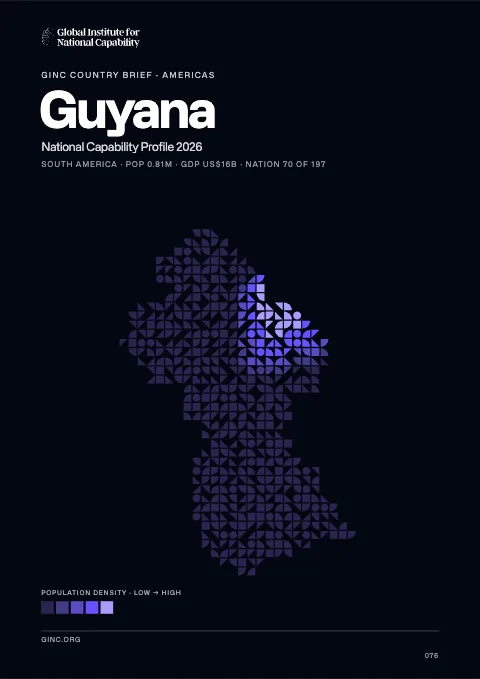
The whole brief
Guyana National Capability Profile 2026
Foundations · Chapter 01
Historical Context
🇬🇾 Guyana’s understanding the origins and evolution of the modern nation
BackgroundBack to top ↑
Originally a Dutch colony in the 17th century, by 1815 Guyana had become a British possession. The abolition of slavery led to settlement of urban areas by former slaves and the importation of indentured servants from India to work the sugar plantations. The resulting ethnocultural divide has persisted and has led to turbulent politics. Guyana achieved independence from the UK in 1966, and since then it has been ruled mostly by socialist-oriented governments. In 1992, Cheddi JAGAN was elected president in what is considered the country's first free and fair election since independence. After his death five years later, his wife, Janet JAGAN, became president but resigned in 1999 due to poor health. Her successor, Bharrat JAGDEO, was reelected in 2001 and again in 2006. Donald RAMOTAR was elected president in 2011.
IndependenceBack to top ↑
26 May 1966 (from the UK)
National holidayBack to top ↑
Republic Day, 23 February (1970)
Foundations · Chapter 02
Geography
🇬🇾 Guyana’s territory, resources and strategic position
Location and areaBack to top ↑
Northern South America, bordering the North Atlantic Ocean, between Suriname and Venezuela
5 00 N, 59 00 W
South America
slightly smaller than Idaho
459 km
Terrain and resourcesBack to top ↑
mostly rolling highlands; low coastal plain; savanna in south
bauxite, gold, diamonds, hardwood timber, shrimp, fish
1,501 sq km (2003)
Settlement and hazardsBack to top ↑
flash flood threat during rainy seasons
the third-smallest country in South America after Suriname and Uruguay; substantial portions of its western and eastern territories are claimed by Venezuela and Suriname respectively
OtherBack to top ↑
241 cu km (2011)
water pollution from sewage and agricultural and industrial chemicals; deforestation
Foundations · Chapter 03
Environment
🇬🇾 Guyana’s environmental conditions, resources and national resilience
ClimateBack to top ↑
tropical; hot, humid, moderated by northeast trade winds; two rainy seasons (May to August, November to January)
Emissions and pollutionBack to top ↑
Water, waste and foodBack to top ↑
Resources and agreementsBack to top ↑
GINC Capability Domains · Chapter 04
Critical Technology
🇬🇾 Guyana’s technology frontiers and the pursuit of national advantage
Two counts are set side by side for 2015–2024: on the left, the papers researchers in Guyana published; on the right, the patent families that began there and were filed in more than one country. First by capability group, then group by group with each group’s capabilities. The badge on a card is the nation’s place among all nations. Papers are from GINC Research Analytics, patent families from GINC Patents.
Research by capability group
#178 WorldPapers published, 2015–2024
Patents by capability group
International patent families, 2015–2024
No international patent families on record for 2015–2024.
Advanced Materials & ManufacturingBack to top ↑
- Structural & Composite Materials
- Functional Materials & Coatings
- Nanomaterials & Metamaterials
- Superconducting, Magnetic & Photonic Materials
- Energetic Materials
- Additive & Precision Manufacturing
- Advanced Chemical & Process Manufacturing
Energy TechnologiesBack to top ↑
- Batteries & Energy Storage
- Hydrogen, Ammonia & Sustainable Fuels
- Next-Generation Solar & Renewables
- Advanced Nuclear & Fusion
- Directed Energy Technologies
Semiconductors & Advanced ComputingBack to top ↑
- Semiconductor Design & EDA
- Advanced Semiconductor Fabrication
- Semiconductor Equipment & Materials
- Advanced Packaging & Heterogeneous Integration
- Compound & Power Semiconductors
- High-Performance & AI Computing
Artificial IntelligenceBack to top ↑
Research
#172 WorldPapers published, 2015–2024
Patents
International patent families, 2015–2024
No international patent families on record for 2015–2024.
Quantum TechnologiesBack to top ↑
Connectivity, Cyber & Trust TechnologiesBack to top ↑
Research
#157 WorldPapers published, 2015–2024
Patents
International patent families, 2015–2024
No international patent families on record for 2015–2024.
Sensing, Timing & NavigationBack to top ↑
- Precision Timing & Atomic Clocks
- Resilient Positioning & Navigation
- Advanced Imaging & Photonic Sensing
- Radar & Radiofrequency Sensing
- Acoustic & Undersea Sensing
Robotics & Autonomous SystemsBack to top ↑
Research
#160 WorldPapers published, 2015–2024
No research topic: Human-Machine Interfaces
Patents
International patent families, 2015–2024
No international patent families on record for 2015–2024.
Biotechnology & Health TechnologiesBack to top ↑
Research
#167 WorldPapers published, 2015–2024
Patents
International patent families, 2015–2024
No international patent families on record for 2015–2024.
Medicine and BioTech
Clinical research and life-science invention, drawn from the same series that drive the metric pages. Each card opens the full cross-country comparison.
Space TechnologiesBack to top ↑
- Space Launch & Reusable Systems
- Advanced Propulsion & Hypersonic Systems
- Satellite & Constellation Technologies
GINC Capability Domains · Chapter 05
Strategic Infrastructure
🇬🇾 Guyana’s energy, connectivity and the material foundations of capability
Resource InfrastructureBack to top ↑
0 bbl/day (2012 est.)
0 bbl/day (2010 est.)
0 bbl/day (2010 est.)
0 bbl (1 January 2013 est.)
0 bbl/day (2010 est.)
10,910 bbl/day (2011 est.)
0 bbl/day (2010 est.)
10,780 bbl/day (2010 est.)
0 cu m (2011 est.)
0 cu m (2010 est.)
0 cu m (2011 est.)
0 cu m (2011 est.)
0 cu m (1 January 2013 est.)
Agriculture & Food InfrastructureBack to top ↑
- Irrigation & Agricultural Water
- Livestock & Veterinary
- Fisheries & Aquaculture
- Storage, Cold Chain & Markets
Energy InfrastructureBack to top ↑
- Thermal Generation
- Nuclear Generation
- Nuclear Fuel Cycle & Radioactive Waste
- Hydropower
- Renewable Generation
- Transmission & Distribution
- System Control & Dispatch
- Storage & Fuel Supply
362,500 kW (2010 est.)
700 million kWh (2010 est.)
512 million kWh (2010 est.)
0 kWh (2012 est.)
0 kWh (2012 est.)
96% of total installed capacity (2010 est.)
0% of total installed capacity (2010 est.)
0.3% of total installed capacity (2010 est.)
3.7% of total installed capacity (2010 est.)
1.673 million Mt (2011 est.)
Water, Sanitation & Waste InfrastructureBack to top ↑
- Dams, Reservoirs & Flood Defence
- Water Supply & Treatment
- Bulk Water Transfer & Desalination
- Wastewater & Sanitation
- Solid Waste & Recycling
Advanced ManufacturingBack to top ↑
- Materials & Inputs
- Chemicals & Hazardous Process Industry
- Production Systems
- Supply Chain & Ecosystem
- Workforce & Innovation
Transport InfrastructureBack to top ↑
- Seaports & Terminals
- Air Infrastructure
- Air Navigation & Traffic Management
- Inland Waterways & Ferries
- Rail Infrastructure
- Roads & Bridges
- Logistics, Multimodal & Border Infrastructure
- Postal & Parcel
117 (2013)
330 km (the Berbice, Demerara, and Essequibo rivers are navigable by oceangoing vessels for 150 km, 100 km, and 80 km respectively) (2012)
Communications & Digital InfrastructureBack to top ↑
- Subsea Cables & International Gateways
- Core & Backbone Networks
- Mobile & Wireless Networks
- Spectrum & Broadcasting
- Data Centres, Compute & Cloud
- Data Resources
- AI Tools & Applications
154,200 (2012)
547,000 (2012)
189,600 (2009)
24,936 (2012)
.gy
Financial InfrastructureBack to top ↑
- Currency & Reserves
- Payments & Settlement Systems
- Markets, Exchanges & Depositories
- Banks, Insurers & Systemic Institutions
Social InfrastructureBack to top ↑
- Health Infrastructure
- Public Health & Laboratories
- Medical Supply & Stockpiles
- Education & Skills Infrastructure
- Research & Scientific Facilities
- Housing, Community & Social Services
- Government & Public Administration
- Cultural, Community & Recreational Infrastructure
- Justice & Corrections
- Emergency Services & Civil Protection
- Hydrometeorology & Early Warning
Space, Aerospace & Defence InfrastructureBack to top ↑
GINC Capability Domains · Chapter 06
National Security
🇬🇾 Guyana’s force, intelligence and the defence of the nation
Disputes and terrorismBack to top ↑
all of the area west of the Essequibo River is claimed by Venezuela preventing any discussion of a maritime boundary; Guyana has expressed its intention to join Barbados in asserting claims before UN Convention on the Law of the Sea (UNCLOS) that Trinidad and Tobago's maritime boundary with Venezuela extends into their waters; Suriname claims a triangle of land between the New and Kutari/Koetari rivers in a historic dispute over the headwaters of the Courantyne; Guyana seeks arbitration under provisions of the UNCLOS to resolve the long-standing dispute with Suriname over the axis of the territorial sea boundary in potentially oil-rich waters
Force Generation & MobilisationBack to top ↑
Guyana Defense Force: Army (includes Air Corps, Coast Guard) (2012)
18 years of age or older for voluntary military service; no conscription (2014)
1.09% of GDP (2012)//1.17% of GDP (2011)//1.09% of GDP (2010)
Forces under arms
Active-duty strength on the Correlates of War series, which reaches back to 1816 and so carries a nation’s whole record of mobilisation rather than its present establishment. The card opens the full cross-country comparison.
Intelligence & AssessmentBack to top ↑
- Imagery & Geospatial Intelligence
- Signals & Cyber Intelligence
- Technical & Measurement Intelligence
- Open-Source & Financial Intelligence
- Human Intelligence & Counterintelligence
- All-Source Analysis & Warning
Joint Command, Projection & SustainmentBack to top ↑
- Command, Control & Communications
- Strategic Lift & Mobility
- Expeditionary & Peace Operations
- Operational Sustainment & War Reserves
- Defence Industrial Mobilisation
- CBRN Defence
Land PowerBack to top ↑
- Combined Arms Manoeuvre
- Land Fires
- Battlefield Aviation & Uncrewed Systems
- Special Operations & Irregular Warfare
Maritime PowerBack to top ↑
- Maritime Security & Constabulary
- Sea Denial & Undersea Warfare
- Sea Control
- Amphibious & Expeditionary Operations
Air PowerBack to top ↑
- Air Sovereignty & Policing
- Control of the Air
- Air Strike & Interdiction
- Airborne ISR, Early Warning & Battle Management
Strategic Strike & Missile DefenceBack to top ↑
Space OperationsBack to top ↑
Cyber & Electromagnetic OperationsBack to top ↑
Nuclear DeterrenceBack to top ↑
GINC Capability Domains · Chapter 07
Human Capital
🇬🇾 Guyana’s population, health and the skills that sustain capability
DemographyBack to top ↑
735,554
Guyana is the only English-speaking country in South America and shares cultural and historical bonds with the Anglophone Caribbean. Guyana's two largest ethnic groups are the Afro-Guyanese (descendants of African slaves) and the Indo-Guyanese (descendants of Indian indentured laborers), which together comprise about three quarters of Guyana's population. Tensions periodically have boiled over between the two groups, which back ethnically based political parties and vote along ethnic lines. Poverty reduction has stagnated since the late 1990s. About one-third of the Guyanese population lives below the poverty line; indigenous people are disproportionately affected. Although Guyana's literacy rate is reported to be among the highest in the Western Hemisphere, the level of functional literacy is considerably lower, which has been attributed to poor education quality, teacher training, and infrastructure.//Guyana's emigration rate is among the highest in the world - more than 55% of its citizens reside abroad - and it is one of the largest recipients of remittances relative to GDP among Latin American and Caribbean counties. Although remittances are a vital source of income for most citizens, the pervasive emigration of skilled workers deprives Guyana of professionals in healthcare and other key sectors. More than 80% of Guyanese nationals with tertiary level educations have emigrated. Brain drain and the concentration of limited medical resources in Georgetown hamper Guyana's ability to meet the health needs of its predominantly rural population. Guyana has one of the highest HIV prevalence rates in the region and continues to rely on international support for its HIV treatment and prevention programs.
-0.11% (2014 est.)
15.9 births/1,000 population (2014 est.)
7.3 deaths/1,000 population (2014 est.)
2.14 children born/woman (2014 est.)
20.8
42.5% (2009)
Migration and urbanisationBack to top ↑
-9.67 migrant(s)/1,000 population (2014 est.)
GEORGETOWN (capital) 127,000 (2011)
Welfare and equityBack to top ↑
35% (2006)
44.6 (2007)//43.2 (1999)
Early Childhood DevelopmentBack to top ↑
11.1% (2009)
Foundational EducationBack to top ↑
3.2% of GDP (2012)
Advanced EducationBack to top ↑
Technical & Vocational SkillsBack to top ↑
Digital & AI CompetenceBack to top ↑
Generative AI adoption
Modelled share of working-age adults using generative AI, from Microsoft telemetry scaled to each country’s 15–64 population. A measure of how fast a workforce is absorbing the technology rather than of how much of it a nation builds. The card opens the full cross-country comparison.
Lifelong Learning & ReskillingBack to top ↑
Research Talent & Knowledge CreationBack to top ↑
Population HealthBack to top ↑
280 deaths/100,000 live births (2010)
17.2% (2008)
1.3% (2012 est.)
7,200 (2012 est.)
100 (2012 est.)
Health System CapabilityBack to top ↑
5.9% of GDP (2011)
0.21 physicians/1,000 population (2010)
2 beds/1,000 population (2009)
GINC Capability Domains · Chapter 08
Governance and Integrity
🇬🇾 Guyana’s institutions, law and the integrity of the state
State structureBack to top ↑
republic
10 regions; Barima-Waini, Cuyuni-Mazaruni, Demerara-Mahaica, East Berbice-Corentyne, Essequibo Islands-West Demerara, Mahaica-Berbice, Pomeroon-Supenaam, Potaro-Siparuni, Upper Demerara-Berbice, Upper Takutu-Upper Essequibo
several previous; latest promulgated 6 October 1980; amended many times, last in 2007 (2013)
18 years of age; universal
Political Institutions & Civic ParticipationBack to top ↑
- Electoral Management & Integrity
- Legislature & Deliberative Institutions
- Citizen Participation & Civic Space
unicameral National Assembly (65 seats; members elected by popular vote, also not more than 4 non-elected non-voting ministers and 2 non-elected non-voting parliamentary secretaries appointed by the president; members to serve five-year terms)
Alliance for Change or AFC [Khemraj RAMJATTAN]//Justice for All Party [C.N. SHARMA]//A Partnership for National Unity or APNU [David GRANGER]//People's Progressive Party/Civic or PPP/C [Donald RAMOTAR]//Rise, Organize, and Rebuild or ROAR [Ravi DEV]//The United Force or TUF [Manzoor NADIR]//The Unity Party [Joey JAGAN]//Vision Guyana [Peter RAMSAROOP]
Amerindian People's Association//Guyana Bar Association//Guyana Citizens Initiative//Guyana Human Rights Association//Guyana Public Service Union or GPSU//Private Sector Commission//Trades Union Congress
Justice System & Fundamental RightsBack to top ↑
- Judicial Independence & Court Capability
- Access to Justice & Legal Services
- Fundamental Rights Protection
- Human Rights Institutions & Equality Bodies
common law system, based on the English model, with some Roman-Dutch civil law influence
has not submitted an ICJ jurisdiction declaration; accepts ICCt jurisdiction
Internal Security & OrderBack to top ↑
transshipment point for narcotics from South America - primarily Venezuela - to Europe and the US; producer of cannabis; rising money laundering related to drug trafficking and human smuggling
Regulatory Governance & Strategic ControlsBack to top ↑
- Regulatory Quality & Better Regulation
- Regulatory Delivery & Independent Regulators
- Strategic Controls & Economic Security Administration
Government Effectiveness & Public AdministrationBack to top ↑
- Centre of Government & Policy Coordination
- Civil Service & Public Workforce
- Digital Government & Service Delivery
- Legal Identity & Civil Registration
- Statistical & Data Capability
Public Integrity & Anti-CorruptionBack to top ↑
Transparency, Oversight & AccountabilityBack to top ↑
- Right to Information & Open Government
- Independent Oversight & Supreme Audit
- Independent Media & Journalist Safety
National Resilience & Crisis ManagementBack to top ↑
GINC Capability Domains · Chapter 09
Information and Influence
🇬🇾 Guyana’s identity, media and the projection of influence
Identity and cultureBack to top ↑
English, Amerindian dialects, Creole, Caribbean Hindustani (a dialect of Hindi), Urdu
Protestant 30.5% (Pentecostal 16.9%, Anglican 6.9%, Seventh Day Adventist 5%, Methodist 1.7%), Hindu 28.4%, Roman Catholic 8.1%, Muslim 7.2%, Jehovah's Witnesses 1.1%, other Christian 17.7%, other 1.9%, none 4.3%, unspecified 0.9% (2002 est.)
East Indian 43.5%, black (African) 30.2%, mixed 16.7%, Amerindian 9.1%, other 0.5% (2002 census)
Canje pheasant (hoatzin); jaguar
green, with a red isosceles triangle (based on the hoist side) superimposed on a long, yellow arrowhead; there is a narrow, black border between the red and yellow, and a narrow, white border between the yellow and the green; green represents forest and foliage; yellow stands for mineral resources and a bright future; white symbolizes Guyana's rivers; red signifies zeal and the sacrifice of the people; black indicates perseverance
Diplomatic Statecraft & Global NetworksBack to top ↑
- Diplomatic Network & Consular Reach
- Multilateral Leadership & Norm Setting
- Agenda-Setting & Convening
- Mediation & Crisis Diplomacy
ACP, AOSIS, C, Caricom, CD, CDB, CELAC, FAO, G-77, IADB, IBRD, ICAO, ICRM, IDA, IFAD, IFC, IFRCS, ILO, IMF, IMO, Interpol, IOC, IOM, ISO (correspondent), ITU, LAES, MIGA, NAM, OAS, OIC, OPANAL, OPCW, PCA, Petrocaribe, UN, UNASUR, UNCTAD, UNESCO, UNIDO, UPU, WCO, WFTU (NGOs), WHO, WIPO, WMO, WTO
Alliances & Security CooperationBack to top ↑
Development Cooperation & Global AssistanceBack to top ↑
Culture, Language & Education DiplomacyBack to top ↑
- Cultural & Language Institutes
- Creative Industries & Cultural Export Reach
- Heritage & Cultural Institutions
- Education Diplomacy & Alumni Networks
- Sports & Major Events
Diaspora & Global CommunitiesBack to top ↑
Information Environment & Strategic CommunicationBack to top ↑
- Strategic Communications & Public Diplomacy
- International Media & Broadcasting
- Information Defence & Counter-Interference
government-dominated broadcast media; the National Communications Network (NCN) TV is state-owned; a few private TV stations relay satellite services; the state owns and operates 2 radio stations broadcasting on multiple frequencies capable of reaching the entire country; government limits on licensing of new private radio stations continue to constrain competition in broadcast media (2007)
GINC Capability Domains · Chapter 10
Financial Strength
🇬🇾 Guyana’s fiscal depth, reserves and the capacity to act
Monetary & Currency CapabilityBack to top ↑
- Monetary Policy & Price Stability
- Exchange Rate & External Account Management
- Currency Issuance & Digital Money
3.9% (2013 est.)//2.4% (2012 est.)
Guyanese dollars (GYD) per US dollar -//205.9 (2013 est.)//204.36 (2012 est.)//203.64 (2010 est.)//203.95 (2009)//203.86 (2008)
5.5% (31 December 2011 est.)//4.25% (31 December 2010 est.)
13.8% (31 December 2013 est.)//13.86% (31 December 2012 est.)
$601.8 million (31 December 2013 est.)//$550.4 million (31 December 2012 est.)
$1.617 billion (31 December 2013 est.)//$1.49 billion (31 December 2012 est.)
Fiscal Capacity & Public FinanceBack to top ↑
- Revenue Mobilisation & Tax Administration
- Public Expenditure & Budget Management
- Sovereign Debt & Treasury Management
- Public Investment Management
25.1% of GDP (2013 est.)
-6.4% of GDP (2013 est.)
59.9% of GDP (2013 est.)//59.5% of GDP (2012 est.)
calendar year
Financial System Depth & AccessBack to top ↑
- Banking System Capacity
- Capital Markets Depth & Development
- Long-Term & Institutional Capital
- Financial Inclusion & Household Access
- Development & Policy Finance
$1.352 billion (31 December 2013 est.)//$1.223 billion (31 December 2012 est.)
$610.9 million (31 December 2012 est.)//$440.4 million (31 December 2011)//$NA (31 December 2010 est.)
6.2% of GDP (2013 est.)//8.3% of GDP (2012 est.)//9.4% of GDP (2011 est.)
Financial Regulation & IntegrityBack to top ↑
- Prudential Regulation & Supervision
- Financial Integrity & Illicit Finance Control
- Market Conduct & Consumer Protection
- Payment & Market Infrastructure Oversight
Financial Stability & Crisis ManagementBack to top ↑
- Macroprudential & Systemic Oversight
- Crisis Management, Resolution & Deposit Insurance
- External Liquidity & Financial Safety Nets
Sovereign Capital & External Financial PowerBack to top ↑
- Official Reserves Management
- Sovereign Wealth & Public Asset Management
- Currency Internationalisation & Reserve Status
- Capital Account & Flow Management
- International Financial Centre Capability
$854.7 million (31 December 2013 est.)//$864 million (31 December 2012 est.)
$1.846 billion (31 December 2011 est.)//$1.846 billion (31 December 2011 est.)
GINC Capability Domains · Chapter 11
Production and Innovation
🇬🇾 Guyana’s output, industry and the engine of prosperity
Economic Output & ProductivityBack to top ↑
The Guyanese economy exhibited moderate economic growth in recent years and is based largely on agriculture and extractive industries. The economy is heavily dependent upon the export of six commodities - sugar, gold, bauxite, shrimp, timber, and rice - which represent nearly 60% of the country's GDP and are highly susceptible to adverse weather conditions and fluctuations in commodity prices. Guyana's entrance into the Caricom Single Market and Economy (CSME) in January 2006 has broadened the country's export market, primarily in the raw materials sector. Guyana has experienced positive growth almost every year over the past decade. Inflation has been kept under control. Recent years have seen the government's stock of debt reduced significantly - with external debt now less than half of what it was in the early 1990s. Chronic problems include a shortage of skilled labor and a deficient infrastructure. Despite recent improvements, the government is still juggling a sizable external debt against the urgent need for expanded public investment. In March 2007, the Inter-American Development Bank, Guyana's principal donor, canceled Guyana's nearly $470 million debt, equivalent to 21% of GDP, which along with other Highly Indebted Poor Country (HIPC) debt forgiveness brought the debt-to-GDP ratio down from 183% in 2006 to 60% in 2013. Guyana had become heavily indebted as a result of the inward-looking, state-led development model pursued in the 1970s and 1980s. Much of Guyana's growth in recent years has come from a surge in gold production in response to global prices, although downward trends in gold prices may threaten future growth. In 2013, production of sugar dropped to a 23-year low.
$6.593 billion (2013 est.)//$6.26 billion (2012 est.)//$5.972 billion (2011 est.)
5.3% (2013 est.)//4.8% (2012 est.)//5.4% (2011 est.)
$8,500 (2013 est.)//$8,100 (2012 est.)//$7,700 (2011 est.)
$3.02 billion (2013 est.)
Labour & EmploymentBack to top ↑
- Employment & Labour Force Participation
- Labour Market Institutions & Wage Setting
- Employment Services & Skills Matching
- Labour Adjustment, Transition & Formalisation
313,100 (2009 est.)
11% (2007)
Industrial & Sectoral BaseBack to top ↑
- Manufacturing & Advanced Industry
- Foundational & Process Industries
- Agrifood & Primary Production
- Services Economy
sugarcane, rice, edible oils; beef, pork, poultry; shrimp, fish
bauxite, sugar, rice milling, timber, textiles, gold mining
13.5% (2013 est.)
Structural Transformation & ComplexityBack to top ↑
Business Dynamism & EntrepreneurshipBack to top ↑
- Entrepreneurship & Firm Creation
- Risk Capital & Scale-Up Finance
- Firm Growth, Exit & Renewal
- Competition & Market Contestability
Innovation & CommercialisationBack to top ↑
- Business Innovation Capability
- Research Commercialisation & Knowledge Transfer
- Intellectual Property & Intangible Assets
- Innovation Ecosystems & Clusters
Technology Adoption & DiffusionBack to top ↑
GINC Capability Domains · Chapter 12
Trade and Investment
🇬🇾 Guyana’s markets, capital and the terms of global exchange
Overall tradeBack to top ↑
$23.0B of exports to 147 partners and $7.39B of imports from 159 in 2024, a surplus of $15.6B.
- Exports
- $23.0B147 partners
- Imports
- $7.39B159 partners
- Balance
- +$15.6Bsurplus
- Total trade
- $30.4B2024
ExportsBack to top ↑
Where its exports go
The largest partners in 2024, with each one's share of the nation's exports.
| Partner | Value | Share | |
|---|---|---|---|
| United States | $5.21B | 23% | |
| Netherlands | $2.75B | 12% | |
| Panama | $2.54B | 11% | |
| Germany | $2.16B | 9.4% | |
| Spain | $1.50B | 6.6% | |
| Sweden | $1.04B | 4.5% | |
| United Kingdom | $910M | 4.0% | |
| Brazil | $908M | 4.0% | |
| Romania | $626M | 2.7% | |
| United Arab Emirates | $455M | 2.0% | |
| China | $430M | 1.9% | |
| Republic of the Congo | $413M | 1.8% | |
| Belgium | $379M | 1.6% | |
| Poland | $348M | 1.5% | |
| Barbados | $252M | 1.1% | |
| Turkey | $235M | 1.0% | |
| Greece | $214M | 0.9% | |
| Singapore | $213M | 0.9% | |
| Canada | $202M | 0.9% | |
| Trinidad and Tobago | $190M | 0.8% |
What it exports
The largest categories in 2024.
| Category | Value | Share | |
|---|---|---|---|
| Mineral fuels, oils, distillation products | $19.9B | 87% | |
| Pearls, precious stones, metals, coins | $1.25B | 5.4% | |
| Ships, boats, and other floating structures | $739M | 3.2% | |
| Cereals | $273M | 1.2% | |
| Railway, tramway locomotives, rolling stock, equipment | $165M | 0.7% | |
| Ores slag and ash | $139M | 0.6% | |
| Machinery, nuclear reactors, boilers | $131M | 0.6% | |
| Fish, crustaceans, molluscs, aquatics invertebrates | $48.9M | 0.2% | |
| Aircraft, spacecraft | $45.6M | 0.2% | |
| Wood and articles of wood, wood charcoal | $35.9M | 0.2% | |
| Beverages, spirits and vinegar | $35.2M | 0.2% | |
| Optical, photo, technical, medical apparatus | $25.7M | 0.1% | |
| Articles of iron or steel | $23.5M | 0.1% | |
| Electrical, electronic equipment | $21.2M | <0.1% | |
| Sugars and sugar confectionery | $20.7M | <0.1% |
ImportsBack to top ↑
Where its imports come from
The largest partners in 2024, with each one's share of the nation's imports.
| Partner | Value | Share | |
|---|---|---|---|
| United States | $2.41B | 33% | |
| China | $981M | 13% | |
| South Korea | $490M | 6.6% | |
| Brazil | $454M | 6.1% | |
| Trinidad and Tobago | $419M | 5.7% | |
| United Kingdom | $298M | 4.0% | |
| Japan | $233M | 3.2% | |
| Mexico | $178M | 2.4% | |
| Suriname | $166M | 2.2% | |
| Netherlands | $145M | 2.0% | |
| India | $141M | 1.9% | |
| Italy | $102M | 1.4% | |
| Turkey | $100M | 1.4% | |
| Spain | $75.5M | 1.0% | |
| Dominican Republic | $74.5M | 1.0% | |
| Sweden | $72.6M | 1.0% | |
| Panama | $68.3M | 0.9% | |
| Singapore | $64.7M | 0.9% | |
| Germany | $63.1M | 0.9% | |
| Canada | $57.7M | 0.8% |
What it imports
The largest categories in 2024.
| Category | Value | Share | |
|---|---|---|---|
| Machinery, nuclear reactors, boilers | $1.70B | 23% | |
| Mineral fuels, oils, distillation products | $1.08B | 15% | |
| Articles of iron or steel | $722M | 9.8% | |
| Ships, boats, and other floating structures | $548M | 7.4% | |
| Vehicles other than railway, tramway | $528M | 7.2% | |
| Electrical, electronic equipment | $456M | 6.2% | |
| Plastics | $177M | 2.4% | |
| Optical, photo, technical, medical apparatus | $175M | 2.4% | |
| Salt, sulphur, earth, stone, plaster, lime and cement | $173M | 2.3% | |
| Iron and steel | $141M | 1.9% | |
| Aircraft, spacecraft | $134M | 1.8% | |
| Furniture, lighting signs, prefabricated buildings | $122M | 1.6% | |
| Beverages, spirits and vinegar | $98.5M | 1.3% | |
| Dairy products, eggs, honey, edible products | $91.4M | 1.2% | |
| Miscellaneous chemical products | $76.1M | 1.0% |
In a list, the bar runs to the largest in that list. The line is each figure’s history from 2000, drawn to its own peak: it shows the shape of the years, and the value shows the size.
External balanceBack to top ↑
-$510.7 million (2013 est.)//-$394.8 million (2012 est.)
Trade Facilitation & LogisticsBack to top ↑
Trade Policy & Market AccessBack to top ↑
- Trade Policy & Negotiation Capability
- Market Access & Agreements Network
- Trade Law & Enforcement
- Standards, Conformity & Quality Infrastructure
Digital & Services TradeBack to top ↑
- Services Trade Capability
- Digital Trade & E-Commerce
- Data Flows & Digital Trade Governance
- Tourism & Visitor Economy
Investment Attraction & ProjectionBack to top ↑
- Investment Attraction & Facilitation
- Investment Absorption & Linkages
- Outward Investment & Global Corporate Presence
Export Capability & SophisticationBack to top ↑
$1.337 billion (2013 est.)//$1.396 billion (2012 est.)
US 30.8%, Canada 28.9%, UK 6.2% (2012)
sugar, gold, bauxite, alumina, rice, shrimp, molasses, rum, timber
Global Value Chain PositionBack to top ↑
- Value Chain Participation & Integration
- Value Chain Position & Upgrading
- Regional Integration & Hub Anchoring
Economic Leverage & DependenceBack to top ↑
- Strategic Supply Security
- Concentration Risk & Revenue Stabilisation
- Economic Leverage & Coercion Resistance
$2.039 billion (2013 est.)//$1.978 billion (2012 est.)
US 22.2%, Trinidad and Tobago 21.9%, China 12.3%, Cuba 6.1%, Suriname 4% (2012)
manufactures, machinery, petroleum, food
Guyana · you are in
Historical Context
Foundations
GINC Capability Domains
Find in this brief · Guyana