
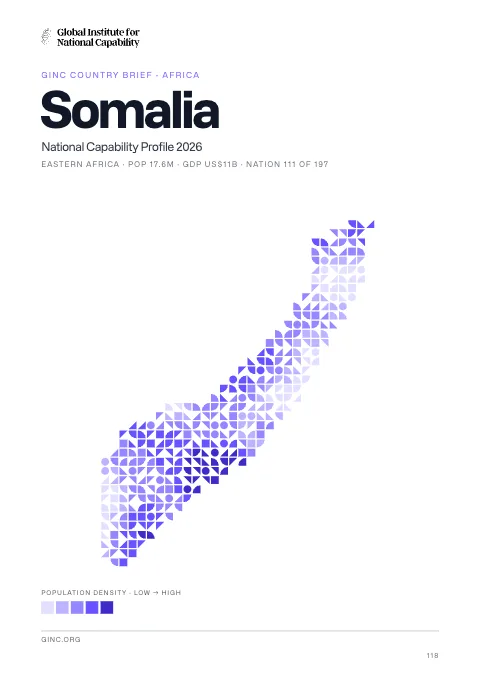
Somalia
Somalia is an in the process of building a federal parliamentary republic in Africa, home to 10 million people, with its capital at Mogadishu.
Contents
12 chapters
Foundations
01–03
At a glance
- Area
- 637.7Kkm²#44 World#19 Africa
- Population
- 10.4M#84 World#30 Africa
- GDP (market)
- $2.4B
- GDP (PPP)
- $5.9B#166 World#42 Africa
- GDP per capita
- $600#226 World#54 Africa
The whole brief
Somalia National Capability Profile 2026
Foundations · Chapter 01
Historical Context
🇸🇴 Somalia’s understanding the origins and evolution of the modern nation
BackgroundBack to top ↑
Britain withdrew from British Somaliland in 1960 to allow its protectorate to join with Italian Somaliland and form the new nation of Somalia. In 1969, a coup headed by Mohamed SIAD Barre ushered in an authoritarian socialist rule characterized by the persecution, jailing, and torture of political opponents and dissidents. After the regime's collapse early in 1991, Somalia descended into turmoil, factional fighting, and anarchy. In May 1991, northern clans declared an independent Republic of Somaliland that now includes the administrative regions of Awdal, Woqooyi Galbeed, Togdheer, Sanaag, and Sool. Although not recognized by any government, this entity has maintained a stable existence and continues efforts to establish a constitutional democracy, including holding municipal, parliamentary, and presidential elections. The regions of Bari, Nugaal, and northern Mudug comprise a neighboring semi-autonomous state of Puntland, which has been self-governing since 1998 but does not aim at independence; it has also made strides toward reconstructing a legitimate, representative government but has suffered some civil strife. Puntland disputes its border with Somaliland as it also claims portions of eastern Sool and Sanaag. Beginning in 1993, a two-year UN humanitarian effort (primarily in the south) was able to alleviate famine conditions, but when the UN withdrew in 1995, having suffered significant casualties, order still had not been restored. In 2000, the Somalia National Peace Conference (SNPC) held in Djibouti resulted in the formation of an interim government, known as the Transitional National Government (TNG). When the TNG failed to establish adequate security or governing institutions, the Government of Kenya, under the auspices of the Intergovernmental Authority on Development (IGAD), led a subsequent peace process that concluded in October 2004 with the election of Abdullahi YUSUF Ahmed as President of a second interim government, known as the Transitional Federal Government (TFG) of the Somali Republic. The TFG included a 275-member parliamentary body, known as the Transitional Federal Parliament (TFP). President YUSUF resigned late in 2008 while United Nations-sponsored talks between the TFG and the opposition Alliance for the Re-Liberation of Somalia (ARS) were underway in Djibouti. In January 2009, following the creation of a TFG-ARS unity government, Ethiopian military forces, which had entered Somalia in December 2006 to support the TFG in the face of advances by the opposition Islamic Courts Union (ICU), withdrew from the country. The TFP was doubled in size to 550 seats with the addition of 200 ARS and 75 civil society members of parliament. The expanded parliament elected Sheikh SHARIF Sheikh Ahmed, the former ICU and ARS chairman as president in January 2009. The creation of the TFG was based on the Transitional Federal Charter (TFC), which outlined a five-year mandate leading to the establishment of a new Somali constitution and a transition to a representative government following national elections. In 2009, the TFP amended the TFC to extend TFG's mandate until 2011 and in 2011 Somali principals agreed to institute political transition by August 2012. The transition process ended in September 2012 when clan elders replaced the TFP by appointing 275 members to a new parliament who subsequently elected a new president.
IndependenceBack to top ↑
1 July 1960 (from a merger of British Somaliland that became independent from the UK on 26 June 1960 and Italian Somaliland that became independent from the Italian-administered UN trusteeship on 1 July 1960 to form the Somali Republic)
National holidayBack to top ↑
Foundation of the Somali Republic, 1 July (1960); note - 26 June (1960) in Somaliland
Foundations · Chapter 02
Geography
🇸🇴 Somalia’s territory, resources and strategic position
Location and areaBack to top ↑
Eastern Africa, bordering the Gulf of Aden and the Indian Ocean, east of Ethiopia
10 00 N, 49 00 E
Africa
almost five times the size of Alabama; slightly smaller than Texas
3,025 km
Terrain and resourcesBack to top ↑
mostly flat to undulating plateau rising to hills in north
uranium and largely unexploited reserves of iron ore, tin, gypsum, bauxite, copper, salt, natural gas, likely oil reserves
2,000 sq km (2003)
Settlement and hazardsBack to top ↑
recurring droughts; frequent dust storms over eastern plains in summer; floods during rainy season
strategic location on Horn of Africa along southern approaches to Bab el Mandeb and route through Red Sea and Suez Canal
OtherBack to top ↑
14.7 cu km (2011)
famine; use of contaminated water contributes to human health problems; deforestation; overgrazing; soil erosion; desertification
Foundations · Chapter 03
Environment
🇸🇴 Somalia’s environmental conditions, resources and national resilience
ClimateBack to top ↑
principally desert; northeast monsoon (December to February), moderate temperatures in north and hot in south; southwest monsoon (May to October), torrid in the north and hot in the south, irregular rainfall, hot and humid periods (tangambili) between monsoons
Emissions and pollutionBack to top ↑
Water, waste and foodBack to top ↑
Resources and agreementsBack to top ↑
GINC Capability Domains · Chapter 04
Critical Technology
🇸🇴 Somalia’s technology frontiers and the pursuit of national advantage
Two counts are set side by side for 2015–2024: on the left, the papers researchers in Somalia published; on the right, the patent families that began there and were filed in more than one country. First by capability group, then group by group with each group’s capabilities. The badge on a card is the nation’s place among all nations. Papers are from GINC Research Analytics, patent families from GINC Patents.
Research by capability group
#161 WorldPapers published, 2015–2024
Patents by capability group
International patent families, 2015–2024
No international patent families on record for 2015–2024.
Advanced Materials & ManufacturingBack to top ↑
- Structural & Composite Materials
- Functional Materials & Coatings
- Nanomaterials & Metamaterials
- Superconducting, Magnetic & Photonic Materials
- Energetic Materials
- Additive & Precision Manufacturing
- Advanced Chemical & Process Manufacturing
Energy TechnologiesBack to top ↑
Research
#146 WorldPapers published, 2015–2024
Patents
International patent families, 2015–2024
No international patent families on record for 2015–2024.
Semiconductors & Advanced ComputingBack to top ↑
- Semiconductor Design & EDA
- Advanced Semiconductor Fabrication
- Semiconductor Equipment & Materials
- Advanced Packaging & Heterogeneous Integration
- Compound & Power Semiconductors
- High-Performance & AI Computing
Artificial IntelligenceBack to top ↑
Research
#143 WorldPapers published, 2015–2024
Patents
International patent families, 2015–2024
No international patent families on record for 2015–2024.
Quantum TechnologiesBack to top ↑
Connectivity, Cyber & Trust TechnologiesBack to top ↑
Research
#157 WorldPapers published, 2015–2024
Patents
International patent families, 2015–2024
No international patent families on record for 2015–2024.
Sensing, Timing & NavigationBack to top ↑
Research
#147 WorldPapers published, 2015–2024
Patents
International patent families, 2015–2024
No international patent families on record for 2015–2024.
Robotics & Autonomous SystemsBack to top ↑
- Advanced Robotics
- Autonomous Systems & Trusted Autonomy
- Uncrewed & Collaborative Systems
- Human-Machine Interfaces
Biotechnology & Health TechnologiesBack to top ↑
Research
#149 WorldPapers published, 2015–2024
Patents
International patent families, 2015–2024
No international patent families on record for 2015–2024.
Medicine and BioTech
Clinical research and life-science invention, drawn from the same series that drive the metric pages. Each card opens the full cross-country comparison.
Space TechnologiesBack to top ↑
- Space Launch & Reusable Systems
- Advanced Propulsion & Hypersonic Systems
- Satellite & Constellation Technologies
GINC Capability Domains · Chapter 05
Strategic Infrastructure
🇸🇴 Somalia’s energy, connectivity and the material foundations of capability
Resource InfrastructureBack to top ↑
0 bbl/day (2012 est.)
0 bbl/day (2010 est.)
0 bbl/day (2010 est.)
0 bbl (1 January 2013 est.)
0 bbl/day (2010 est.)
5,659 bbl/day (2011 est.)
0 bbl/day (2010 est.)
5,399 bbl/day (2010 est.)
0 cu m (2011 est.)
0 cu m (2010 est.)
0 cu m (2011 est.)
0 cu m (2011 est.)
5.663 billion cu m (1 January 2013 est.)
Agriculture & Food InfrastructureBack to top ↑
- Irrigation & Agricultural Water
- Livestock & Veterinary
- Fisheries & Aquaculture
- Storage, Cold Chain & Markets
Energy InfrastructureBack to top ↑
- Thermal Generation
- Nuclear Generation
- Nuclear Fuel Cycle & Radioactive Waste
- Hydropower
- Renewable Generation
- Transmission & Distribution
- System Control & Dispatch
- Storage & Fuel Supply
80,000 kW (2010 est.)
310 million kWh (2010 est.)
288.3 million kWh (2010 est.)
0 kWh (2012 est.)
0 kWh (2012 est.)
100% of total installed capacity (2010 est.)
0% of total installed capacity (2010 est.)
0% of total installed capacity (2010 est.)
0% of total installed capacity (2010 est.)
753,400 Mt (2011 est.)
Water, Sanitation & Waste InfrastructureBack to top ↑
- Dams, Reservoirs & Flood Defence
- Water Supply & Treatment
- Bulk Water Transfer & Desalination
- Wastewater & Sanitation
- Solid Waste & Recycling
Advanced ManufacturingBack to top ↑
- Materials & Inputs
- Chemicals & Hazardous Process Industry
- Production Systems
- Supply Chain & Ecosystem
- Workforce & Innovation
Transport InfrastructureBack to top ↑
- Seaports & Terminals
- Air Infrastructure
- Air Navigation & Traffic Management
- Inland Waterways & Ferries
- Rail Infrastructure
- Roads & Bridges
- Logistics, Multimodal & Border Infrastructure
- Postal & Parcel
61 (2013)
despite a dramatic drop in the number of attacks in 2012, the International Maritime Bureau continues to report the territorial and offshore waters in the Gulf of Aden and Indian Ocean as a region of significant risk for piracy and armed robbery against ships accounting for 25% of all attacks in 2012; 75 vessels, including commercial shipping and pleasure craft, were attacked or hijacked both at anchor and while underway compared with 237 in 2011; the number of hijackings off the coast of Somalia was reduced to 14 in 2012, down from 28 in 2011; as of April 2013, 77 vessels and 7 hostages were being held for ransom by Somali pirates; the presence of several naval task forces in the Gulf of Aden and additional anti-piracy measures on the part of ship operators, including the use of on-board armed security teams, have reduced piracy incidents in that body of water; in response Somali-based pirates, using hijacked fishing trawlers as "mother ships" to extend their range, shifted operations as far south as the Mozambique Channel, eastward to the vicinity of the Maldives, and northeastward to the Strait of Hormuz
Communications & Digital InfrastructureBack to top ↑
- Subsea Cables & International Gateways
- Core & Backbone Networks
- Mobile & Wireless Networks
- Spectrum & Broadcasting
- Data Centres, Compute & Cloud
- Data Resources
- AI Tools & Applications
100,000 (2012)
658,000 (2012)
106,000 (2009)
186 (2012)
.so
Financial InfrastructureBack to top ↑
- Currency & Reserves
- Payments & Settlement Systems
- Markets, Exchanges & Depositories
- Banks, Insurers & Systemic Institutions
Social InfrastructureBack to top ↑
- Health Infrastructure
- Public Health & Laboratories
- Medical Supply & Stockpiles
- Education & Skills Infrastructure
- Research & Scientific Facilities
- Housing, Community & Social Services
- Government & Public Administration
- Cultural, Community & Recreational Infrastructure
- Justice & Corrections
- Emergency Services & Civil Protection
- Hydrometeorology & Early Warning
Space, Aerospace & Defence InfrastructureBack to top ↑
GINC Capability Domains · Chapter 06
National Security
🇸🇴 Somalia’s force, intelligence and the defence of the nation
Disputes and terrorismBack to top ↑
Ethiopian forces invaded southern Somalia and routed Islamist Courts from Mogadishu in January 2007; "Somaliland" secessionists provide port facilities in Berbera to landlocked Ethiopia and have established commercial ties with other regional states; "Puntland" and "Somaliland" "governments" seek international support in their secessionist aspirations and overlapping border claims; the undemarcated former British administrative line has little meaning as a political separation to rival clans within Ethiopia's Ogaden and southern Somalia's Oromo region; Kenya works hard to prevent the clan and militia fighting in Somalia from spreading south across the border, which has long been open to nomadic pastoralists
Force Generation & MobilisationBack to top ↑
National Security Force (NSF): Somali Army (2011)
18 is the legal minimum age for compulsory and voluntary military service (2012)
Forces under arms
Active-duty strength on the Correlates of War series, which reaches back to 1816 and so carries a nation’s whole record of mobilisation rather than its present establishment. The card opens the full cross-country comparison.
Intelligence & AssessmentBack to top ↑
- Imagery & Geospatial Intelligence
- Signals & Cyber Intelligence
- Technical & Measurement Intelligence
- Open-Source & Financial Intelligence
- Human Intelligence & Counterintelligence
- All-Source Analysis & Warning
Joint Command, Projection & SustainmentBack to top ↑
- Command, Control & Communications
- Strategic Lift & Mobility
- Expeditionary & Peace Operations
- Operational Sustainment & War Reserves
- Defence Industrial Mobilisation
- CBRN Defence
Land PowerBack to top ↑
- Combined Arms Manoeuvre
- Land Fires
- Battlefield Aviation & Uncrewed Systems
- Special Operations & Irregular Warfare
Maritime PowerBack to top ↑
- Maritime Security & Constabulary
- Sea Denial & Undersea Warfare
- Sea Control
- Amphibious & Expeditionary Operations
Air PowerBack to top ↑
- Air Sovereignty & Policing
- Control of the Air
- Air Strike & Interdiction
- Airborne ISR, Early Warning & Battle Management
Strategic Strike & Missile DefenceBack to top ↑
Space OperationsBack to top ↑
Cyber & Electromagnetic OperationsBack to top ↑
Nuclear DeterrenceBack to top ↑
GINC Capability Domains · Chapter 07
Human Capital
🇸🇴 Somalia’s population, health and the skills that sustain capability
DemographyBack to top ↑
10,428,043
1.75% (2014 est.)
40.87 births/1,000 population (2014 est.)
13.91 deaths/1,000 population (2014 est.)
6.08 children born/woman (2014 est.)
14.6% (2006)
Migration and urbanisationBack to top ↑
-9.51 migrant(s)/1,000 population (2014 est.)
MOGADISHU (capital) 1.554 million (2011)
Welfare and equityBack to top ↑
NA%
Early Childhood DevelopmentBack to top ↑
32.8% (2006)
Foundational EducationBack to top ↑
NA
Advanced EducationBack to top ↑
Technical & Vocational SkillsBack to top ↑
Digital & AI CompetenceBack to top ↑
Generative AI adoption
Modelled share of working-age adults using generative AI, from Microsoft telemetry scaled to each country’s 15–64 population. A measure of how fast a workforce is absorbing the technology rather than of how much of it a nation builds. The card opens the full cross-country comparison.
Lifelong Learning & ReskillingBack to top ↑
Research Talent & Knowledge CreationBack to top ↑
Population HealthBack to top ↑
1,000 deaths/100,000 live births (2010)
4.8% (2008)
0.5% (2012 est.)
31,200 (2012 est.)
2,500 (2012 est.)
Health System CapabilityBack to top ↑
0.04 physicians/1,000 population (2006)
GINC Capability Domains · Chapter 08
Governance and Integrity
🇸🇴 Somalia’s institutions, law and the integrity of the state
State structureBack to top ↑
in the process of building a federal parliamentary republic
18 regions (plural - NA, singular - gobolka); Awdal, Bakool, Banaadir, Bari, Bay, Galguduud, Gedo, Hiiraan, Jubbada Dhexe (Middle Jubba), Jubbada Hoose (Lower Jubba), Mudug, Nugaal, Sanaag, Shabeellaha Dhexe (Middle Shabeelle), Shabeellaha Hoose (Lower Shabeelle), Sool, Togdheer, Woqooyi Galbeed
previous 1961, 1979; latest drafted 12 June 2012, approved 1 August 2012 (provisional) (2012)
18 years of age; universal
regional and local governing bodies continue to exist and control various areas of the country, including the self-declared Republic of Somaliland in northwestern Somalia and the semi-autonomous state of Puntland in northeastern Somalia
Political Institutions & Civic ParticipationBack to top ↑
- Electoral Management & Integrity
- Legislature & Deliberative Institutions
- Citizen Participation & Civic Space
bicameral National Parliament consisting of the House of the People of the Federal Parliament (275 seats, elected by Somali citizens) and the Upper House of the Federal Parliament (54 seats, elected by people of the federal member states)
none
Justice System & Fundamental RightsBack to top ↑
- Judicial Independence & Court Capability
- Access to Justice & Legal Services
- Fundamental Rights Protection
- Human Rights Institutions & Equality Bodies
mixed legal system of civil law, Islamic law, and customary law (referred to as Xeer)
accepts compulsory ICJ jurisdiction with reservations; non-party state to the ICCt
Internal Security & OrderBack to top ↑
Regulatory Governance & Strategic ControlsBack to top ↑
- Regulatory Quality & Better Regulation
- Regulatory Delivery & Independent Regulators
- Strategic Controls & Economic Security Administration
Government Effectiveness & Public AdministrationBack to top ↑
- Centre of Government & Policy Coordination
- Civil Service & Public Workforce
- Digital Government & Service Delivery
- Legal Identity & Civil Registration
- Statistical & Data Capability
Public Integrity & Anti-CorruptionBack to top ↑
Transparency, Oversight & AccountabilityBack to top ↑
- Right to Information & Open Government
- Independent Oversight & Supreme Audit
- Independent Media & Journalist Safety
National Resilience & Crisis ManagementBack to top ↑
GINC Capability Domains · Chapter 09
Information and Influence
🇸🇴 Somalia’s identity, media and the projection of influence
Identity and cultureBack to top ↑
Somali (official), Arabic (official, according to the Transitional Federal Charter), Italian, English
Sunni Muslim (Islam) (official, according to the Transitional Federal Charter)
Somali 85%, Bantu and other non-Somali 15% (including 30,000 Arabs)
leopard
light blue with a large white five-pointed star in the center; the blue field was originally influenced by the flag of the UN, but today is said to denote the sky and the neighboring Indian Ocean; the five points of the star represent the five regions in the horn of Africa that are inhabited by Somali people: the former British Somaliland and Italian Somaliland (which together make up Somalia), Djibouti, Ogaden (Ethiopia), and the North East Province (Kenya)
Diplomatic Statecraft & Global NetworksBack to top ↑
- Diplomatic Network & Consular Reach
- Multilateral Leadership & Norm Setting
- Agenda-Setting & Convening
- Mediation & Crisis Diplomacy
ACP, AfDB, AFESD, AMF, AU, CAEU (candidate), FAO, G-77, IBRD, ICAO, ICRM, IDA, IDB, IFAD, IFC, IFRCS, IGAD, ILO, IMF, IMO, Interpol, IOC, IOM, ITSO, ITU, LAS, NAM, OIC, UN, UNCTAD, UNESCO, UNHCR, UNIDO, UPU, WFTU (NGOs), WHO, WIPO, WMO
Somalia does not have an embassy in the US (ceased operations on 8 May 1991); note - the Somali Government is represented in the US through its Permanent Mission to the UN
the US does not have an embassy in Somalia; US interests are represented by the US Special Representative for Somalia, Ambassador James P. MCANULTY, operating out of the US Embassy in Nairobi, Kenya at United Nations Avenue, Nairobi; mailing address: Unit 64100, Nairobi; APO AE 09831; telephone: [254] (20) 363-6000; FAX [254] (20) 363-6157
Alliances & Security CooperationBack to top ↑
Development Cooperation & Global AssistanceBack to top ↑
Culture, Language & Education DiplomacyBack to top ↑
- Cultural & Language Institutes
- Creative Industries & Cultural Export Reach
- Heritage & Cultural Institutions
- Education Diplomacy & Alumni Networks
- Sports & Major Events
Diaspora & Global CommunitiesBack to top ↑
Information Environment & Strategic CommunicationBack to top ↑
- Strategic Communications & Public Diplomacy
- International Media & Broadcasting
- Information Defence & Counter-Interference
2 private TV stations rebroadcast Al-Jazeera and CNN; Somaliland has 1 government-operated TV station and Puntland has 1 private TV station; the transitional government operates Radio Mogadishu; 1 SW and roughly 10 private FM radio stations broadcast in Mogadishu; several radio stations operate in central and southern regions; Somaliland has 1 government-operated radio station; Puntland has roughly a half dozen private radio stations; transmissions of at least 2 international broadcasters are available (2007)
GINC Capability Domains · Chapter 10
Financial Strength
🇸🇴 Somalia’s fiscal depth, reserves and the capacity to act
Monetary & Currency CapabilityBack to top ↑
- Monetary Policy & Price Stability
- Exchange Rate & External Account Management
- Currency Issuance & Digital Money
NA%
Somali shillings (SOS) per US dollar -//1,600 (2012 est.)//31,900 (2011 est.)
NA%
NA%
Fiscal Capacity & Public FinanceBack to top ↑
- Revenue Mobilisation & Tax Administration
- Public Expenditure & Budget Management
- Sovereign Debt & Treasury Management
- Public Investment Management
NA
Financial System Depth & AccessBack to top ↑
- Banking System Capacity
- Capital Markets Depth & Development
- Long-Term & Institutional Capital
- Financial Inclusion & Household Access
- Development & Policy Finance
Financial Regulation & IntegrityBack to top ↑
- Prudential Regulation & Supervision
- Financial Integrity & Illicit Finance Control
- Market Conduct & Consumer Protection
- Payment & Market Infrastructure Oversight
Financial Stability & Crisis ManagementBack to top ↑
- Macroprudential & Systemic Oversight
- Crisis Management, Resolution & Deposit Insurance
- External Liquidity & Financial Safety Nets
Sovereign Capital & External Financial PowerBack to top ↑
- Official Reserves Management
- Sovereign Wealth & Public Asset Management
- Currency Internationalisation & Reserve Status
- Capital Account & Flow Management
- International Financial Centre Capability
$3.05 billion (31 December 2011 est.)//$2.942 billion (31 December 2010 est.)
GINC Capability Domains · Chapter 11
Production and Innovation
🇸🇴 Somalia’s output, industry and the engine of prosperity
Economic Output & ProductivityBack to top ↑
Despite the lack of effective national governance, Somalia maintains an informal economy largely based on livestock, remittance/money transfer companies, and telecommunications. Agriculture is the most important sector with livestock normally accounting for about 40% of GDP and more than 50% of export earnings. Nomads and semi-pastoralists, who are dependent upon livestock for their livelihood, make up a large portion of the population. Livestock, hides, fish, charcoal, and bananas are Somalia's principal exports, while sugar, sorghum, corn, qat, and machined goods are the principal imports. Somalia's small industrial sector, based on the processing of agricultural products, has largely been looted and the machinery sold as scrap metal. Telecommunication firms provide wireless services in most major cities and offer the lowest international call rates on the continent. Mogadishu's main market offers a variety of goods from food to electronic gadgets. Hotels continue to operate and are supported with private-security militias. Somalia's government lacks the ability to collect domestic revenue, and arrears to the IMF have continued to grow. Somalia's capital city - Mogadishu - has witnessed the development of the city's first gas stations, supermarkets, and flights between Europe (Istanbul-Mogadishu) since the collapse of central authority in 1991. This economic growth has yet to expand outside of Mogadishu, and within the city, security concerns dominate business. In the absence of a formal banking sector, money transfer/remittance services have sprouted throughout the country, handling up to $1.6 billion in remittances annually, although international concerns over the money transfers into Somalia currently threatens these services.
$5.896 billion (2010 est.)//$5.75 billion (2009 est.)//$5.607 billion (2008 est.)
2.6% (2010 est.)//2.6% (2012 est.)//2.6% (2008 est.)
$600 (2010 est.)//$600 (2009 est.)//$600 (2008 est.)
$2.372 billion (2010 est.)
Labour & EmploymentBack to top ↑
- Employment & Labour Force Participation
- Labour Market Institutions & Wage Setting
- Employment Services & Skills Matching
- Labour Adjustment, Transition & Formalisation
3.447 million (2007)
NA%
Industrial & Sectoral BaseBack to top ↑
- Manufacturing & Advanced Industry
- Foundational & Process Industries
- Agrifood & Primary Production
- Services Economy
bananas, sorghum, corn, coconuts, rice, sugarcane, mangoes, sesame seeds, beans; cattle, sheep, goats; fish
a few light industries, including sugar refining, textiles, wireless communication
NA%
Structural Transformation & ComplexityBack to top ↑
Business Dynamism & EntrepreneurshipBack to top ↑
- Entrepreneurship & Firm Creation
- Risk Capital & Scale-Up Finance
- Firm Growth, Exit & Renewal
- Competition & Market Contestability
Innovation & CommercialisationBack to top ↑
- Business Innovation Capability
- Research Commercialisation & Knowledge Transfer
- Intellectual Property & Intangible Assets
- Innovation Ecosystems & Clusters
Technology Adoption & DiffusionBack to top ↑
GINC Capability Domains · Chapter 12
Trade and Investment
🇸🇴 Somalia’s markets, capital and the terms of global exchange
Overall tradeBack to top ↑
$512M of exports to 91 partners and $3.20B of imports from 76 in 2024, a deficit of $2.69B.
- Exports
- $512M91 partners
- Imports
- $3.20B76 partners
- Balance
- −$2.69Bdeficit
- Total trade
- $3.71B2024
ExportsBack to top ↑
Where its exports go
The largest partners in 2024, with each one's share of the nation's exports.
| Partner | Value | Share | |
|---|---|---|---|
| Saudi Arabia | $352M | 69% | |
| India | $34.7M | 6.8% | |
| Qatar | $22.4M | 4.4% | |
| Turkey | $21.2M | 4.1% | |
| Bahrain | $16.1M | 3.1% | |
| Kuwait | $10.5M | 2.1% | |
| France | $7.31M | 1.4% | |
| Japan | $6.75M | 1.3% | |
| Egypt | $4.82M | 0.9% | |
| Kenya | $4.22M | 0.8% | |
| China | $3.10M | 0.6% | |
| Lebanon | $3.01M | 0.6% | |
| South Korea | $2.66M | 0.5% | |
| Germany | $2.59M | 0.5% | |
| United States | $2.54M | 0.5% | |
| Ivory Coast | $2.38M | 0.5% | |
| Pakistan | $1.74M | 0.3% | |
| Senegal | $1.69M | 0.3% | |
| Poland | $1.31M | 0.3% | |
| Ukraine | $1.04M | 0.2% |
What it exports
The largest categories in 2024.
| Category | Value | Share | |
|---|---|---|---|
| Live animals | $394M | 77% | |
| Oil seed, oleaginous fruits, grain, seed, fruits | $26.8M | 5.2% | |
| Machinery, nuclear reactors, boilers | $16.6M | 3.2% | |
| Iron and steel | $12.5M | 2.4% | |
| Lac, gums, resins | $10.1M | 2.0% | |
| Edible fruits, nuts, peel of citrus fruit, melons | $7.74M | 1.5% | |
| Fish, crustaceans, molluscs, aquatics invertebrates | $6.87M | 1.3% | |
| Paper and paperboard, articles of pulp, paper and board | $5.45M | 1.1% | |
| Copper | $4.93M | 1.0% | |
| Vehicles other than railway, tramway | $4.22M | 0.8% | |
| Meat and edible meat offal | $3.96M | 0.8% | |
| Mineral fuels, oils, distillation products | $2.90M | 0.6% | |
| Miscellaneous chemical products | $2.84M | 0.6% | |
| Animal, vegetable fats and oils, cleavage products | $2.49M | 0.5% | |
| Raw hides and skins (other than furskins) and leather | $2.22M | 0.4% |
ImportsBack to top ↑
Where its imports come from
The largest partners in 2024, with each one's share of the nation's imports.
| Partner | Value | Share | |
|---|---|---|---|
| China | $968M | 30% | |
| India | $803M | 25% | |
| Turkey | $356M | 11% | |
| Brazil | $154M | 4.8% | |
| Kenya | $130M | 4.1% | |
| Egypt | $123M | 3.8% | |
| Indonesia | $98.5M | 3.1% | |
| Malaysia | $96.9M | 3.0% | |
| Pakistan | $90.6M | 2.8% | |
| United States | $39.2M | 1.2% | |
| United Kingdom | $34.5M | 1.1% | |
| Saudi Arabia | $31.2M | 1.0% | |
| Slovenia | $31.1M | 1.0% | |
| Italy | $27.8M | 0.9% | |
| Germany | $25.3M | 0.8% | |
| Spain | $20.2M | 0.6% | |
| Thailand | $18.0M | 0.6% | |
| Ukraine | $16.7M | 0.5% | |
| South Korea | $14.6M | 0.5% | |
| France | $13.6M | 0.4% |
What it imports
The largest categories in 2024.
| Category | Value | Share | |
|---|---|---|---|
| Sugars and sugar confectionery | $450M | 14% | |
| Cereals | $302M | 9.4% | |
| Electrical, electronic equipment | $166M | 5.2% | |
| Cereal, flour, starch, milk preparations and products | $151M | 4.7% | |
| Machinery, nuclear reactors, boilers | $148M | 4.6% | |
| Manmade staple fibers | $141M | 4.4% | |
| Pharmaceutical products | $127M | 4.0% | |
| Milling products, malt, starches, inulin, wheat gluten | $123M | 3.8% | |
| Animal, vegetable fats and oils, cleavage products | $114M | 3.6% | |
| Plastics | $107M | 3.4% | |
| Vehicles other than railway, tramway | $107M | 3.3% | |
| Articles of apparel, not knit or crocheted | $88.6M | 2.8% | |
| Iron and steel | $78.4M | 2.5% | |
| Articles of iron or steel | $75.0M | 2.3% | |
| Wood and articles of wood, wood charcoal | $71.9M | 2.2% |
In a list, the bar runs to the largest in that list. The line is each figure’s history from 2000, drawn to its own peak: it shows the shape of the years, and the value shows the size.
Trade Facilitation & LogisticsBack to top ↑
Trade Policy & Market AccessBack to top ↑
- Trade Policy & Negotiation Capability
- Market Access & Agreements Network
- Trade Law & Enforcement
- Standards, Conformity & Quality Infrastructure
Digital & Services TradeBack to top ↑
- Services Trade Capability
- Digital Trade & E-Commerce
- Data Flows & Digital Trade Governance
- Tourism & Visitor Economy
Investment Attraction & ProjectionBack to top ↑
- Investment Attraction & Facilitation
- Investment Absorption & Linkages
- Outward Investment & Global Corporate Presence
Export Capability & SophisticationBack to top ↑
$515.8 million (2012 est.)//$594.3 million (2011 est.)
UAE 51.7%, Yemen 18.1%, Oman 13% (2012)
livestock, bananas, hides, fish, charcoal, scrap metal
Global Value Chain PositionBack to top ↑
- Value Chain Participation & Integration
- Value Chain Position & Upgrading
- Regional Integration & Hub Anchoring
Economic Leverage & DependenceBack to top ↑
- Strategic Supply Security
- Concentration Risk & Revenue Stabilisation
- Economic Leverage & Coercion Resistance
$1.263 billion (2010 est.)//$798 million (2006 est.)
Djibouti 27.3%, India 13.2%, Kenya 7.1%, China 6.7%, Pakistan 6.4%, Oman 5.1%, UAE 5%, Yemen 4.4% (2012)
manufactures, petroleum products, foodstuffs, construction materials, qat
Somalia · you are in
Historical Context
Foundations
GINC Capability Domains
Find in this brief · Somalia