
Sudan
Sudan is a federal republic ruled by the National Congress Party in Africa, home to 35 million people, with its capital at Khartoum, and the world’s 16th-largest country by area.
Contents
12 chapters
Foundations
01–03
At a glance
- Area
- 1.9Mkm²#16 World#3 Africa
- Population
- 35.5M#36 World#10 Africa
- GDP (market)
- $52.5B
- GDP (PPP)
- $90B#78 World#10 Africa
- GDP per capita
- $2.6K#183 World#21 Africa
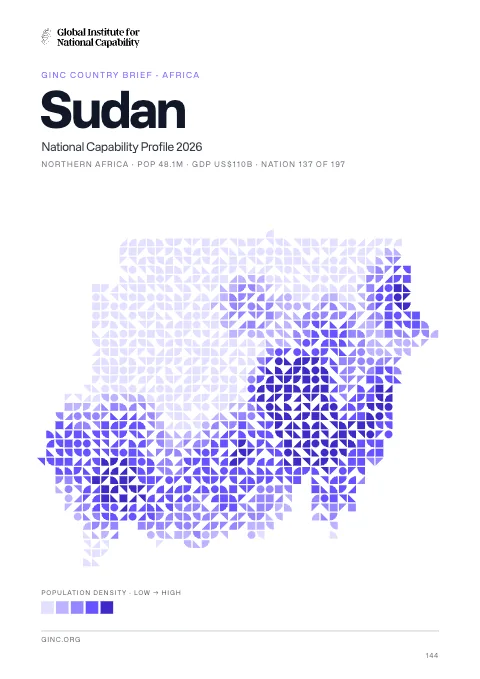
The whole brief
Sudan National Capability Profile 2026
Foundations · Chapter 01
Historical Context
🇸🇩 the Sudan’s understanding the origins and evolution of the modern nation
BackgroundBack to top ↑
Military regimes favoring Islamic-oriented governments have dominated national politics since independence from Anglo-Egyptian co rule in 1956. Sudan was embroiled in two prolonged civil wars during most of the remainder of the 20th century. These conflicts were rooted in northern economic, political, and social domination of largely non-Muslim, non-Arab southern Sudanese. The first civil war ended in 1972 but another broke out in 1983. Peace talks gained momentum in 2002-04 with the signing of several accords. The final North/South Comprehensive Peace Agreement (CPA), signed in January 2005, granted the southern rebels autonomy for six years followed by a referendum on independence for Southern Sudan. The referendum was held in January 2011 and indicated overwhelming support for independence. South Sudan became independent on 9 July 2011. Sudan and South Sudan have yet to fully implement security and economic agreements signed on September 27, 2012 relating to the normalization of relations between the two countries. The final disposition of the contested Abyei region has also to be decided. Since South Sudan's independence, conflict has broken out between the government and the Sudan People's Liberation Movement-North (SPLM-N) in Southern Kordofan and Blue Nile states, which has resulted in 1.2 million internally displaced persons or severely affected persons in need of humanitarian assistance. A separate conflict, which broke out in the western region of Darfur in 2003, has displaced nearly two million people and caused an estimated 200,000 to 400,000 deaths. Violence in Darfur in 2013 resulted in an additional estimated 6,000 civilians killed and 500,000 displaced. The UN and the African Union have jointly commanded a Darfur peacekeeping operation known as the African Union-United Nations Hybrid Mission in Darfur (UNAMID) since 2007. Peacekeeping troops have struggled to stabilize the situation and have increasingly become targets for attacks by armed groups. In 2013, 16 peacekeepers were killed, UNAMID's deadliest year so far. Sudan also has faced refugee influxes from neighboring countries, primarily Ethiopia, Eritrea, Chad, Central African Republic, and South Sudan. Armed conflict, poor transport infrastructure, and government denial of access have impeded the provision of humanitarian assistance to affected populations.
IndependenceBack to top ↑
1 January 1956 (from Egypt and the UK)
National holidayBack to top ↑
Independence Day, 1 January (1956)
Foundations · Chapter 02
Geography
🇸🇩 the Sudan’s territory, resources and strategic position
Location and areaBack to top ↑
north-eastern Africa, bordering the Red Sea, between Egypt and Eritrea
15 00 N, 30 00 E
Africa
slightly less than one-fifth the size of the US
853 km
Terrain and resourcesBack to top ↑
generally flat, featureless plain; desert dominates the north
petroleum; small reserves of iron ore, copper, chromium ore, zinc, tungsten, mica, silver, gold; hydropower
18,900 sq km (2010)
Settlement and hazardsBack to top ↑
dust storms and periodic persistent droughts
dominated by the Nile and its tributaries
OtherBack to top ↑
64.5 cu km (2011)
inadequate supplies of potable water; wildlife populations threatened by excessive hunting; soil erosion; desertification; periodic drought
Foundations · Chapter 03
Environment
🇸🇩 the Sudan’s environmental conditions, resources and national resilience
ClimateBack to top ↑
hot and dry; arid desert; rainy season varies by region (April to November)
Emissions and pollutionBack to top ↑
Water, waste and foodBack to top ↑
Resources and agreementsBack to top ↑
GINC Capability Domains · Chapter 04
Critical Technology
🇸🇩 the Sudan’s technology frontiers and the pursuit of national advantage
Two counts are set side by side for 2015–2024: on the left, the papers researchers in the Sudan published; on the right, the patent families that began there and were filed in more than one country. First by capability group, then group by group with each group’s capabilities. The badge on a card is the nation’s place among all nations. Papers are from GINC Research Analytics, patent families from GINC Patents.
Research by capability group
#89 WorldPapers published, 2015–2024
238
211
98
68
49
48
22
15
6
4
Patents by capability group
#118 WorldInternational patent families, 2015–2024
Advanced Materials & ManufacturingBack to top ↑
Research
#97 WorldPapers published, 2015–2024
Patents
International patent families, 2015–2024
No international patent families on record for 2015–2024.
Energy TechnologiesBack to top ↑
Research
#81 WorldPapers published, 2015–2024
Patents
International patent families, 2015–2024
No international patent families on record for 2015–2024.
Semiconductors & Advanced ComputingBack to top ↑
Research
#93 WorldPapers published, 2015–2024
No research topic: Semiconductor Design & EDA · Advanced Semiconductor Fabrication · Semiconductor Equipment & Materials · Advanced Packaging & Heterogeneous Integration
Patents
International patent families, 2015–2024
No international patent families on record for 2015–2024.
Artificial IntelligenceBack to top ↑
Research
#88 WorldPapers published, 2015–2024
Patents
#89 WorldInternational patent families, 2015–2024
Quantum TechnologiesBack to top ↑
Research
#107 WorldPapers published, 2015–2024
Patents
International patent families, 2015–2024
No international patent families on record for 2015–2024.
Connectivity, Cyber & Trust TechnologiesBack to top ↑
Research
#93 WorldPapers published, 2015–2024
Patents
International patent families, 2015–2024
No international patent families on record for 2015–2024.
Sensing, Timing & NavigationBack to top ↑
Research
#91 WorldPapers published, 2015–2024
Patents
International patent families, 2015–2024
No international patent families on record for 2015–2024.
Robotics & Autonomous SystemsBack to top ↑
Research
#90 WorldPapers published, 2015–2024
No research topic: Human-Machine Interfaces
Patents
International patent families, 2015–2024
No international patent families on record for 2015–2024.
Biotechnology & Health TechnologiesBack to top ↑
Research
#71 WorldPapers published, 2015–2024
Patents
#94 WorldInternational patent families, 2015–2024
Medicine and BioTech
Clinical research and life-science invention, drawn from the same series that drive the metric pages. Each card opens the full cross-country comparison.
Space TechnologiesBack to top ↑
Research
#66 WorldPapers published, 2015–2024
Patents
International patent families, 2015–2024
No international patent families on record for 2015–2024.
GINC Capability Domains · Chapter 05
Strategic Infrastructure
🇸🇩 the Sudan’s energy, connectivity and the material foundations of capability
Resource InfrastructureBack to top ↑
28,830 bbl/day (2012 est.)
97,270 bbl/day (2010 est.)
0 bbl/day (2010 est.)
1.25 billion bbl (1 January 2013 est.)
124,900 bbl/day (2010 est.)
95,450 bbl/day (2011 est.)
14,950 bbl/day (2010 est.)
4,349 bbl/day (2008 est.)
0 cu m (2011 est.)
0 cu m (2010 est.)
0 cu m (2011 est.)
0 cu m (2011 est.)
21.24 billion cu m (1 January 2013 est.)
gas 156 km; oil 4,070 km; refined products 1,613 km (2013)
Agriculture & Food InfrastructureBack to top ↑
- Irrigation & Agricultural Water
- Livestock & Veterinary
- Fisheries & Aquaculture
- Storage, Cold Chain & Markets
Energy InfrastructureBack to top ↑
- Thermal Generation
- Nuclear Generation
- Nuclear Fuel Cycle & Radioactive Waste
- Hydropower
- Renewable Generation
- Transmission & Distribution
- System Control & Dispatch
- Storage & Fuel Supply
2.083 million kW (2010 est.)
7.193 billion kWh (2010 est.)
5.665 billion kWh (2010 est.)
0 kWh (2012 est.)
0 kWh (2012 est.)
30.7% of total installed capacity (2010 est.)
0% of total installed capacity (2010 est.)
66.3% of total installed capacity (2010 est.)
3% of total installed capacity (2010 est.)
16.45 million Mt (2011 est.)
Water, Sanitation & Waste InfrastructureBack to top ↑
- Dams, Reservoirs & Flood Defence
- Water Supply & Treatment
- Bulk Water Transfer & Desalination
- Wastewater & Sanitation
- Solid Waste & Recycling
Advanced ManufacturingBack to top ↑
- Materials & Inputs
- Chemicals & Hazardous Process Industry
- Production Systems
- Supply Chain & Ecosystem
- Workforce & Innovation
Transport InfrastructureBack to top ↑
- Seaports & Terminals
- Air Infrastructure
- Air Navigation & Traffic Management
- Inland Waterways & Ferries
- Rail Infrastructure
- Roads & Bridges
- Logistics, Multimodal & Border Infrastructure
- Postal & Parcel
74 (2013)
6 (2013)
4,068 km (1,723 km open year round on White and Blue Nile rivers) (2011)
Communications & Digital InfrastructureBack to top ↑
- Subsea Cables & International Gateways
- Core & Backbone Networks
- Mobile & Wireless Networks
- Spectrum & Broadcasting
- Data Centres, Compute & Cloud
- Data Resources
- AI Tools & Applications
425,000 (2012)
27.659 million (2012)
4.2 million (2008)
99 (2012)
.sd
Financial InfrastructureBack to top ↑
- Currency & Reserves
- Payments & Settlement Systems
- Markets, Exchanges & Depositories
- Banks, Insurers & Systemic Institutions
Social InfrastructureBack to top ↑
- Health Infrastructure
- Public Health & Laboratories
- Medical Supply & Stockpiles
- Education & Skills Infrastructure
- Research & Scientific Facilities
- Housing, Community & Social Services
- Government & Public Administration
- Cultural, Community & Recreational Infrastructure
- Justice & Corrections
- Emergency Services & Civil Protection
- Hydrometeorology & Early Warning
Space, Aerospace & Defence InfrastructureBack to top ↑
GINC Capability Domains · Chapter 06
National Security
🇸🇩 the Sudan’s force, intelligence and the defence of the nation
Disputes and terrorismBack to top ↑
the effects of Sudan's almost constant ethnic and rebel militia fighting since the mid-20th century have penetrated all of the neighboring states; Chad wishes to be a helpful mediator in resolving the Darfur conflict, and in 2010 established a joint border monitoring force with Sudan, which has helped to reduce cross-border banditry and violence; as of mid-2013, Chad, Egypt, Ethiopia, Israel, the Central African Republic, and South Sudan provided shelter for more than 600,000 Sudanese refugees; during the same period, Sudan, in turn, hosted about 115,000 Eritreans, 32,000 Chadians, and smaller numbers of Ethiopians and Central Africans; Sudan accuses Eritrea of supporting Sudanese rebel groups; efforts to demarcate the porous boundary with Ethiopia proceed slowly due to civil and ethnic fighting in eastern Sudan; Sudan claims but Egypt de facto administers security and economic development of the Halaib region north of the 22nd parallel boundary; periodic violent skirmishes with Sudanese residents over water and grazing rights persist among related pastoral populations along the border with the Central African Republic; South Sudan-Sudan boundary represents 1 January 1956 alignment, final alignment pending negotiations and demarcation; final sovereignty status of Abyei Area pending negotiations between South Sudan and Sudan
Force Generation & MobilisationBack to top ↑
Sudanese Armed Forces (SAF): Land Forces, Navy (includes Marines), Sudanese Air Force (Sikakh al-Jawwiya as-Sudaniya), Popular Defense Forces (2011)
18-33 years of age for male and female compulsory or voluntary military service; 1-2 year service obligation; a requirement that completion of national service was mandatory before entering public or private sector employment has been cancelled (2012)
Forces under arms
Active-duty strength on the Correlates of War series, which reaches back to 1816 and so carries a nation’s whole record of mobilisation rather than its present establishment. The card opens the full cross-country comparison.
Intelligence & AssessmentBack to top ↑
- Imagery & Geospatial Intelligence
- Signals & Cyber Intelligence
- Technical & Measurement Intelligence
- Open-Source & Financial Intelligence
- Human Intelligence & Counterintelligence
- All-Source Analysis & Warning
Joint Command, Projection & SustainmentBack to top ↑
- Command, Control & Communications
- Strategic Lift & Mobility
- Expeditionary & Peace Operations
- Operational Sustainment & War Reserves
- Defence Industrial Mobilisation
- CBRN Defence
Land PowerBack to top ↑
- Combined Arms Manoeuvre
- Land Fires
- Battlefield Aviation & Uncrewed Systems
- Special Operations & Irregular Warfare
Maritime PowerBack to top ↑
- Maritime Security & Constabulary
- Sea Denial & Undersea Warfare
- Sea Control
- Amphibious & Expeditionary Operations
Air PowerBack to top ↑
- Air Sovereignty & Policing
- Control of the Air
- Air Strike & Interdiction
- Airborne ISR, Early Warning & Battle Management
Strategic Strike & Missile DefenceBack to top ↑
Space OperationsBack to top ↑
Cyber & Electromagnetic OperationsBack to top ↑
Nuclear DeterrenceBack to top ↑
GINC Capability Domains · Chapter 07
Human Capital
🇸🇩 the Sudan’s population, health and the skills that sustain capability
DemographyBack to top ↑
35,482,233 (July 2014 est.)
1.78% (2014 est.)
30.01 births/1,000 population (2014 est.)
7.87 deaths/1,000 population (2014 est.)
3.92 children born/woman (2014 est.)
9% (2010)
Migration and urbanisationBack to top ↑
-4.36 migrant(s)/1,000 population (2014 est.)
KHARTOUM (capital) 4.632 million (2011)
Welfare and equityBack to top ↑
46.5% (2009 est.)
DisplacementBack to top ↑
Early Childhood DevelopmentBack to top ↑
31.7% (2006)
Foundational EducationBack to top ↑
Advanced EducationBack to top ↑
Technical & Vocational SkillsBack to top ↑
Digital & AI CompetenceBack to top ↑
Generative AI adoption
Modelled share of working-age adults using generative AI, from Microsoft telemetry scaled to each country’s 15–64 population. A measure of how fast a workforce is absorbing the technology rather than of how much of it a nation builds. The card opens the full cross-country comparison.
Lifelong Learning & ReskillingBack to top ↑
Research Talent & Knowledge CreationBack to top ↑
Population HealthBack to top ↑
730 deaths/100,000 live births (2010)
6% (2008)
1.1% (2009 est.)
260,000 (2009 est.)
12,000 (2009 est.)
Health System CapabilityBack to top ↑
8.4% of GDP (2011)
0.28 physicians/1,000 population (2008)
0.7 beds/1,000 population (2009)
GINC Capability Domains · Chapter 08
Governance and Integrity
🇸🇩 the Sudan’s institutions, law and the integrity of the state
State structureBack to top ↑
federal republic ruled by the National Congress Party (NCP), which seized power by military coup in 1989; the CPA-mandated Government of National Unity, which between 2005 and 2011 provided a percentage of leadership posts to the southern Sudan-based Sudan People's Liberation Movement (SPLM), was disbanded following the secession of South Sudan
17 states (wilayat, singular - wilayah); Al Bahr al Ahmar (Red Sea), Al Jazira (Gezira), Al Khartoum (Khartoum), Al Qadarif (Gedaref), An Nil al Abyad (White Nile), An Nil al Azraq (Blue Nile), Ash Shimaliyya (Northern), Gharb Darfur (Western Darfur), Janub Darfur (Southern Darfur), Janub Kurdufan (Southern Kordofan), Kassala, Nahr an Nil (River Nile), Sharq Darfur (Eastern Darfur), Shimal Darfur (Northern Darfur), Shimal Kurdufan (Northern Kordofan), Sinnar, Wasat Darfur (Central Darfur)
previous 1998; latest (interim) adopted 6 July 2005, effective 9 July 2005; note - in 2011, the Government of Sudan initiated a process for drafting a new constitution (2013)
17 years of age; universal
Political Institutions & Civic ParticipationBack to top ↑
- Electoral Management & Integrity
- Legislature & Deliberative Institutions
- Citizen Participation & Civic Space
bicameral National Legislature consists of a Council of States (50 seats; members indirectly elected by state legislatures to serve six-year terms) and a National Assembly (450 seats; 60% from geographic constituencies, 25% from a women's list, and 15% from party lists; members to serve six-year terms)
Democratic Unionist Party or DUP [Muhammad Uthman al-MIRGHANI]//Muslim Brotherhood or MB//National Congress Party or NCP [Umar Hassan al-BASHIR]//National Umma Party or UP [Siddiq al-MAHDI]//Popular Congress Party or PCP [Hassan al-TURABI]//Reform Now Party or RNP [Dr. Ghazi Salah ADDEEN]//Sudanese Communist Party (SCP) [Mohammed Moktar Al-KHATEEB]//Sudanese Congress Party [Ibrahim Al Shiek ABDULRAHMAN]//Unionist Movement Party or UMP [Nagla AL-AZHARI]
Sudan People's Liberation Movement-North (SPLM-N) [Malik AGAR]//Sudan Revolutionary Front (SRF) [Malik AGAR]//National Consensus Front (NCF) [Farouq ABU ISSA]//Darfur rebel groups including the Justice and Equality Movement or JEM [Gibril Fidail IBRAHIM], the Sudan Liberation Movement or SLM-AW [Abdel Wahid NUR] [various factional leaders], Sudan Liberation or SLM-MM /[Minni Arkou MINAWI]
Justice System & Fundamental RightsBack to top ↑
- Judicial Independence & Court Capability
- Access to Justice & Legal Services
- Fundamental Rights Protection
- Human Rights Institutions & Equality Bodies
mixed legal system of Islamic law and English common law
accepts compulsory ICJ jurisdiction with reservations; withdrew acceptance of ICCt jurisdiction in 2008
Internal Security & OrderBack to top ↑
Regulatory Governance & Strategic ControlsBack to top ↑
- Regulatory Quality & Better Regulation
- Regulatory Delivery & Independent Regulators
- Strategic Controls & Economic Security Administration
Government Effectiveness & Public AdministrationBack to top ↑
- Centre of Government & Policy Coordination
- Civil Service & Public Workforce
- Digital Government & Service Delivery
- Legal Identity & Civil Registration
- Statistical & Data Capability
Public Integrity & Anti-CorruptionBack to top ↑
Transparency, Oversight & AccountabilityBack to top ↑
- Right to Information & Open Government
- Independent Oversight & Supreme Audit
- Independent Media & Journalist Safety
National Resilience & Crisis ManagementBack to top ↑
GINC Capability Domains · Chapter 09
Information and Influence
🇸🇩 the Sudan’s identity, media and the projection of influence
Identity and cultureBack to top ↑
Arabic (official), English (official), Nubian, Ta Bedawie, Fur
Sunni Muslim, small Christian minority
Sudanese Arab (approximately 70%), Fur, Beja, Nuba, Fallata
secretary bird
three equal horizontal bands of red (top), white, and black with a green isosceles triangle based on the hoist side; colors and design based on the Arab Revolt flag of World War I, but the meanings of the colors are expressed as follows: red signifies the struggle for freedom, white is the color of peace, light, and love, black represents Sudan itself (in Arabic 'Sudan' means black), green is the color of Islam, agriculture, and prosperity
Diplomatic Statecraft & Global NetworksBack to top ↑
- Diplomatic Network & Consular Reach
- Multilateral Leadership & Norm Setting
- Agenda-Setting & Convening
- Mediation & Crisis Diplomacy
ABEDA, ACP, AfDB, AFESD, AMF, AU, CAEU, COMESA, FAO, G-77, IAEA, IBRD, ICAO, ICC (NGOs), ICRM, IDA, IDB, IFAD, IFC, IFRCS, IGAD, ILO, IMF, IMO, Interpol, IOC, IOM, IPU, ISO, ITSO, ITU, LAS, MIGA, NAM, OIC, OPCW, PCA, UN, UNCTAD, UNESCO, UNHCR, UNIDO, UNWTO, UPU, WCO, WFTU (NGOs), WHO, WIPO, WMO, WTO (observer)
Alliances & Security CooperationBack to top ↑
Development Cooperation & Global AssistanceBack to top ↑
Culture, Language & Education DiplomacyBack to top ↑
- Cultural & Language Institutes
- Creative Industries & Cultural Export Reach
- Heritage & Cultural Institutions
- Education Diplomacy & Alumni Networks
- Sports & Major Events
Diaspora & Global CommunitiesBack to top ↑
Information Environment & Strategic CommunicationBack to top ↑
- Strategic Communications & Public Diplomacy
- International Media & Broadcasting
- Information Defence & Counter-Interference
the Sudanese Government directly controls TV and radio, requiring that both media reflect government policies; TV has a permanent military censor; a private radio station is in operation (2007)
GINC Capability Domains · Chapter 10
Financial Strength
🇸🇩 the Sudan’s fiscal depth, reserves and the capacity to act
Monetary & Currency CapabilityBack to top ↑
- Monetary Policy & Price Stability
- Exchange Rate & External Account Management
- Currency Issuance & Digital Money
25% (2013 est.)//37.4% (2012 est.)
Sudanese pounds (SDG) per US dollar -//5.83 (2013 est.)//3.57 (2012 est.)//2.31 (2010 est.)//2.3 (2009)//2.1 (2008)
$8.035 billion (31 December 2013 est.)//$7.927 billion (31 December 2012 est.)
$12.82 billion (31 December 2013 est.)//$13.23 billion (31 December 2012 est.)
Fiscal Capacity & Public FinanceBack to top ↑
- Revenue Mobilisation & Tax Administration
- Public Expenditure & Budget Management
- Sovereign Debt & Treasury Management
- Public Investment Management
8.6% of GDP (2013 est.)
-4.4% of GDP (2013 est.)
111% of GDP (2013 est.)//101.7% of GDP (2012 est.)
calendar year
Financial System Depth & AccessBack to top ↑
- Banking System Capacity
- Capital Markets Depth & Development
- Long-Term & Institutional Capital
- Financial Inclusion & Household Access
- Development & Policy Finance
$9.785 billion (31 December 2013 est.)//$11.64 billion (31 December 2012 est.)
$NA
26.6% of GDP (2013 est.)//18.1% of GDP (2012 est.)//26.8% of GDP (2011 est.)
Financial Regulation & IntegrityBack to top ↑
- Prudential Regulation & Supervision
- Financial Integrity & Illicit Finance Control
- Market Conduct & Consumer Protection
- Payment & Market Infrastructure Oversight
Financial Stability & Crisis ManagementBack to top ↑
- Macroprudential & Systemic Oversight
- Crisis Management, Resolution & Deposit Insurance
- External Liquidity & Financial Safety Nets
Sovereign Capital & External Financial PowerBack to top ↑
- Official Reserves Management
- Sovereign Wealth & Public Asset Management
- Currency Internationalisation & Reserve Status
- Capital Account & Flow Management
- International Financial Centre Capability
$202.2 million (31 December 2013 est.)//$192.6 million (31 December 2012 est.)
$40.92 billion (31 December 2013 est.)//$39.54 billion (31 December 2012 est.)
GINC Capability Domains · Chapter 11
Production and Innovation
🇸🇩 the Sudan’s output, industry and the engine of prosperity
Economic Output & ProductivityBack to top ↑
Sudan is an extremely poor country that has experienced protracted social conflict, civil war, and, in July 2011, the loss of three-quarters of its oil production due to the secession of South Sudan. The oil sector had driven much of Sudan's GDP growth since 1999. For nearly a decade, the economy boomed on the back of rising oil production, high oil prices, and significant inflows of foreign direct investment. Since the economic shock of South Sudan's secession, Sudan has struggled to stabilize its economy and make up for the loss of foreign exchange earnings. The interruption of oil production in South Sudan in 2012 for over a year and the consequent loss of oil transit fees further exacerbated the fragile state of Sudan’s economy. Sudan is also subject to comprehensive US sanctions. Sudan is attempting to develop non-oil sources of revenues, such as gold mining, while carrying out an austerity program to reduce expenditures. The world’s largest exporter of gum Arabic, Sudan produces 75-80% of the world’s total output. Agriculture continues to employ 80% of the work force. Sudan introduced a new currency, still called the Sudanese pound, following South Sudan's secession, but the value of the currency has fallen since its introduction. Khartoum formally devalued the currency in June 2012, when it passed austerity measures that included gradually repealing fuel subsidies. Sudan also faces rising inflation, which reached 47% on an annual basis in November 2012, but subsided to 25% in 2013. Ongoing conflicts in Southern Kordofan, Darfur, and the Blue Nile states, lack of basic infrastructure in large areas, and reliance by much of the population on subsistence agriculture keep close to half of the population at or below the poverty line.
$89.97 billion (2013 est.)//$86.59 billion (2012 est.)//$89.51 billion (2011 est.)
3.9% (2013 est.)//-3.3% (2012 est.)//-1.8% (2011 est.)
$2,600 (2013 est.)//$2,600 (2012 est.)//$2,700 (2011 est.)
$52.5 billion (2013 est.)
Labour & EmploymentBack to top ↑
- Employment & Labour Force Participation
- Labour Market Institutions & Wage Setting
- Employment Services & Skills Matching
- Labour Adjustment, Transition & Formalisation
11.92 million (2007 est.)
20% (2012 est.)//18.7% (2002 est.)
Industrial & Sectoral BaseBack to top ↑
- Manufacturing & Advanced Industry
- Foundational & Process Industries
- Agrifood & Primary Production
- Services Economy
cotton, groundnuts (peanuts), sorghum, millet, wheat, gum arabic, sugarcane, cassava (manioc, tapioca), mangoes, papaya, bananas, sweet potatoes, sesame seeds; sheep and other livestock
oil, cotton ginning, textiles, cement, edible oils, sugar, soap distilling, shoes, petroleum refining, pharmaceuticals, armaments, automobile/light truck assembly
11% (2013 est.)
Structural Transformation & ComplexityBack to top ↑
Business Dynamism & EntrepreneurshipBack to top ↑
- Entrepreneurship & Firm Creation
- Risk Capital & Scale-Up Finance
- Firm Growth, Exit & Renewal
- Competition & Market Contestability
Innovation & CommercialisationBack to top ↑
- Business Innovation Capability
- Research Commercialisation & Knowledge Transfer
- Intellectual Property & Intangible Assets
- Innovation Ecosystems & Clusters
Technology Adoption & DiffusionBack to top ↑
GINC Capability Domains · Chapter 12
Trade and Investment
🇸🇩 the Sudan’s markets, capital and the terms of global exchange
Overall tradeBack to top ↑
$3.10B of exports to 91 partners and $3.70B of imports from 84 in 2024, a deficit of $599M.
- Exports
- $3.10B91 partners
- Imports
- $3.70B84 partners
- Balance
- −$599Mdeficit
- Total trade
- $6.80B2024
ExportsBack to top ↑
Where its exports go
The largest partners in 2024, with each one's share of the nation's exports.
| Partner | Value | Share | |
|---|---|---|---|
| Saudi Arabia | $799M | 26% | |
| China | $561M | 18% | |
| India | $419M | 14% | |
| Malaysia | $315M | 10% | |
| Egypt | $292M | 9.4% | |
| Italy | $288M | 9.3% | |
| France | $94.3M | 3.0% | |
| Singapore | $92.5M | 3.0% | |
| Turkey | $67.9M | 2.2% | |
| Lebanon | $40.7M | 1.3% | |
| Tunisia | $20.6M | 0.7% | |
| Germany | $17.0M | 0.5% | |
| United Kingdom | $14.7M | 0.5% | |
| United States | $13.2M | 0.4% | |
| Greece | $13.0M | 0.4% | |
| Japan | $11.5M | 0.4% | |
| Qatar | $10.2M | 0.3% | |
| Slovakia | $4.48M | 0.1% | |
| Thailand | $4.09M | 0.1% | |
| Nigeria | $3.71M | 0.1% |
What it exports
The largest categories in 2024.
| Category | Value | Share | |
|---|---|---|---|
| Oil seed, oleaginous fruits, grain, seed, fruits | $978M | 32% | |
| Live animals | $863M | 28% | |
| Mineral fuels, oils, distillation products | $680M | 22% | |
| Edible vegetables and certain roots and tubers | $211M | 6.8% | |
| Lac, gums, resins | $180M | 5.8% | |
| Cotton | $94.0M | 3.0% | |
| Residues, wastes of food industry, animal fodder | $23.4M | 0.8% | |
| Pearls, precious stones, metals, coins | $21.6M | 0.7% | |
| Beverages, spirits and vinegar | $11.3M | 0.4% | |
| Copper | $5.86M | 0.2% | |
| Lead | $5.65M | 0.2% | |
| Raw hides and skins (other than furskins) and leather | $4.69M | 0.2% | |
| Machinery, nuclear reactors, boilers | $3.66M | 0.1% | |
| Meat and edible meat offal | $2.44M | <0.1% | |
| Edible fruits, nuts, peel of citrus fruit, melons | $1.81M | <0.1% |
ImportsBack to top ↑
Where its imports come from
The largest partners in 2024, with each one's share of the nation's imports.
| Partner | Value | Share | |
|---|---|---|---|
| Egypt | $866M | 23% | |
| China | $833M | 23% | |
| India | $545M | 15% | |
| Saudi Arabia | $516M | 14% | |
| Turkey | $276M | 7.4% | |
| Uganda | $66.7M | 1.8% | |
| Belgium | $50.1M | 1.4% | |
| Japan | $50.0M | 1.4% | |
| South Korea | $48.4M | 1.3% | |
| Kenya | $46.8M | 1.3% | |
| United States | $46.1M | 1.2% | |
| Thailand | $29.6M | 0.8% | |
| Cyprus | $26.9M | 0.7% | |
| Indonesia | $24.9M | 0.7% | |
| France | $24.3M | 0.7% | |
| United Kingdom | $20.8M | 0.6% | |
| Romania | $19.6M | 0.5% | |
| Italy | $18.7M | 0.5% | |
| Germany | $17.9M | 0.5% | |
| Netherlands | $14.8M | 0.4% |
What it imports
The largest categories in 2024.
| Category | Value | Share | |
|---|---|---|---|
| Sugars and sugar confectionery | $564M | 15% | |
| Machinery, nuclear reactors, boilers | $274M | 7.4% | |
| Milling products, malt, starches, inulin, wheat gluten | $257M | 7.0% | |
| Pharmaceutical products | $236M | 6.4% | |
| Electrical, electronic equipment | $208M | 5.6% | |
| Vehicles other than railway, tramway | $198M | 5.4% | |
| Animal, vegetable fats and oils, cleavage products | $124M | 3.4% | |
| Iron and steel | $118M | 3.2% | |
| Cereals | $118M | 3.2% | |
| Plastics | $114M | 3.1% | |
| Miscellaneous edible preparations | $107M | 2.9% | |
| Edible vegetables and certain roots and tubers | $105M | 2.8% | |
| Cereal, flour, starch, milk preparations and products | $94.1M | 2.5% | |
| Coffee, tea, mate and spices | $87.3M | 2.4% | |
| Articles of iron or steel | $77.8M | 2.1% |
In a list, the bar runs to the largest in that list. The line is each figure’s history from 2000, drawn to its own peak: it shows the shape of the years, and the value shows the size.
External balanceBack to top ↑
-$1.98 billion (2013 est.)//-$5.282 billion (2012 est.)
Trade Facilitation & LogisticsBack to top ↑
Trade Policy & Market AccessBack to top ↑
- Trade Policy & Negotiation Capability
- Market Access & Agreements Network
- Trade Law & Enforcement
- Standards, Conformity & Quality Infrastructure
Digital & Services TradeBack to top ↑
- Services Trade Capability
- Digital Trade & E-Commerce
- Data Flows & Digital Trade Governance
- Tourism & Visitor Economy
Investment Attraction & ProjectionBack to top ↑
- Investment Attraction & Facilitation
- Investment Absorption & Linkages
- Outward Investment & Global Corporate Presence
Export Capability & SophisticationBack to top ↑
$4.145 billion (2013 est.)//$3.368 billion (2012 est.)
UAE 63.2%, Saudi Arabia 9.2%, Ethiopia 5.3% (2012)
gold; oil and petroleum products; cotton, sesame, livestock, groundnuts, gum arabic, sugar
Global Value Chain PositionBack to top ↑
- Value Chain Participation & Integration
- Value Chain Position & Upgrading
- Regional Integration & Hub Anchoring
Economic Leverage & DependenceBack to top ↑
- Strategic Supply Security
- Concentration Risk & Revenue Stabilisation
- Economic Leverage & Coercion Resistance
$5.941 billion (2013 est.)//$8.123 billion (2012 est.)
Macau 18.1%, India 8.8%, Saudi Arabia 7.9%, Egypt 6.7%, UAE 5.2% (2012)
foodstuffs, manufactured goods, refinery and transport equipment, medicines and chemicals, textiles, wheat
Sudan · you are in
Historical Context
Foundations
GINC Capability Domains
Find in this brief · Sudan