
Burkina Faso
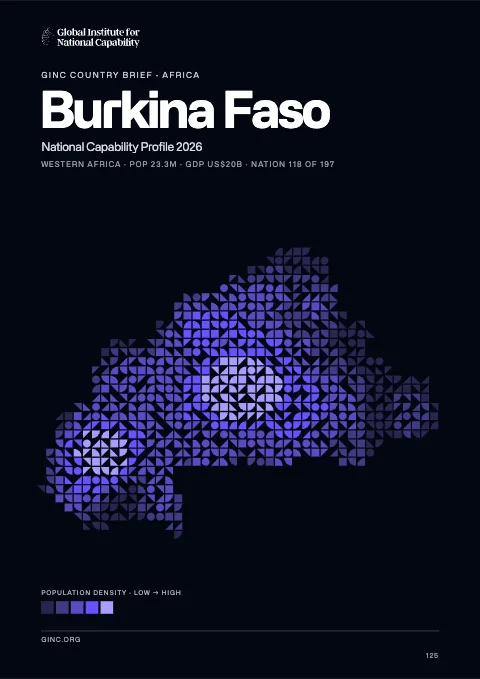
Burkina Faso is a landlocked parliamentary republic in Africa, home to 18 million people, with its capital at Ouagadougou.
Contents
12 chapters
Foundations
01–03
At a glance
- Area
- 274.2Kkm²#75 World#29 Africa
- Population
- 18.4M#59 World#18 Africa
- GDP (market)
- $12.1B
- GDP (PPP)
- $26.5B#122 World#23 Africa
- GDP per capita
- $1.5K#203 World#35 Africa
The whole brief
Burkina Faso National Capability Profile 2026
Foundations · Chapter 01
Historical Context
🇧🇫 Burkina Faso’s understanding the origins and evolution of the modern nation
BackgroundBack to top ↑
Burkina Faso (formerly Upper Volta) achieved independence from France in 1960. Repeated military coups during the 1970s and 1980s were followed by multiparty elections in the early 1990s. Current President Blaise COMPAORE came to power in a 1987 military coup and has won every election since then. There have been increasing protests over the belief that the president may try to run for a currently unconstitutional third term in the 2015 presidential elections. Burkina Faso's high population growth and limited natural resources result in poor economic prospects for the majority of its citizens.
IndependenceBack to top ↑
5 August 1960 (from France)
National holidayBack to top ↑
Republic Day, 11 December (1958); note - commemorates the day that Upper Volta became an autonomous republic in the French Community
Foundations · Chapter 02
Geography
🇧🇫 Burkina Faso’s territory, resources and strategic position
Location and areaBack to top ↑
Western Africa, north of Ghana
13 00 N, 2 00 W
Africa
slightly larger than Colorado
0 km (landlocked)
none (landlocked)
Terrain and resourcesBack to top ↑
mostly flat to dissected, undulating plains; hills in west and southeast
manganese, limestone, marble; small deposits of gold, phosphates, pumice, salt
250 sq km (2003)
Settlement and hazardsBack to top ↑
recurring droughts
landlocked savanna cut by the three principal rivers of the Black, Red, and White Voltas
OtherBack to top ↑
12.5 cu km (2011)
recent droughts and desertification severely affecting agricultural activities, population distribution, and the economy; overgrazing; soil degradation; deforestation
Foundations · Chapter 03
Environment
🇧🇫 Burkina Faso’s environmental conditions, resources and national resilience
ClimateBack to top ↑
tropical; warm, dry winters; hot, wet summers
Emissions and pollutionBack to top ↑
Water, waste and foodBack to top ↑
Resources and agreementsBack to top ↑
GINC Capability Domains · Chapter 04
Critical Technology
🇧🇫 Burkina Faso’s technology frontiers and the pursuit of national advantage
Two counts are set side by side for 2015–2024: on the left, the papers researchers in Burkina Faso published; on the right, the patent families that began there and were filed in more than one country. First by capability group, then group by group with each group’s capabilities. The badge on a card is the nation’s place among all nations. Papers are from GINC Research Analytics, patent families from GINC Patents.
Research by capability group
#122 WorldPapers published, 2015–2024
Patents by capability group
International patent families, 2015–2024
No international patent families on record for 2015–2024.
Advanced Materials & ManufacturingBack to top ↑
Research
#147 WorldPapers published, 2015–2024
Patents
International patent families, 2015–2024
No international patent families on record for 2015–2024.
Energy TechnologiesBack to top ↑
Research
#108 WorldPapers published, 2015–2024
Patents
International patent families, 2015–2024
No international patent families on record for 2015–2024.
Semiconductors & Advanced ComputingBack to top ↑
Research
#109 WorldPapers published, 2015–2024
No research topic: Semiconductor Design & EDA · Advanced Semiconductor Fabrication · Semiconductor Equipment & Materials · Advanced Packaging & Heterogeneous Integration
Patents
International patent families, 2015–2024
No international patent families on record for 2015–2024.
Artificial IntelligenceBack to top ↑
Research
#147 WorldPapers published, 2015–2024
Patents
International patent families, 2015–2024
No international patent families on record for 2015–2024.
Quantum TechnologiesBack to top ↑
Connectivity, Cyber & Trust TechnologiesBack to top ↑
Research
#130 WorldPapers published, 2015–2024
Patents
International patent families, 2015–2024
No international patent families on record for 2015–2024.
Sensing, Timing & NavigationBack to top ↑
Research
#120 WorldPapers published, 2015–2024
Patents
International patent families, 2015–2024
No international patent families on record for 2015–2024.
Robotics & Autonomous SystemsBack to top ↑
- Advanced Robotics
- Autonomous Systems & Trusted Autonomy
- Uncrewed & Collaborative Systems
- Human-Machine Interfaces
Biotechnology & Health TechnologiesBack to top ↑
Research
#84 WorldPapers published, 2015–2024
Patents
International patent families, 2015–2024
No international patent families on record for 2015–2024.
Medicine and BioTech
Clinical research and life-science invention, drawn from the same series that drive the metric pages. Each card opens the full cross-country comparison.
Space TechnologiesBack to top ↑
- Space Launch & Reusable Systems
- Advanced Propulsion & Hypersonic Systems
- Satellite & Constellation Technologies
GINC Capability Domains · Chapter 05
Strategic Infrastructure
🇧🇫 Burkina Faso’s energy, connectivity and the material foundations of capability
Resource InfrastructureBack to top ↑
0 bbl/day (2012 est.)
0 bbl/day (2010 est.)
0 bbl/day (2010 est.)
0 bbl (1 January 2013 est.)
0 bbl/day (2010 est.)
9,960 bbl/day (2011 est.)
0 bbl/day (2010 est.)
11,660 bbl/day (2010 est.)
0 cu m (2011 est.)
0 cu m (2010 est.)
0 cu m (2011 est.)
0 cu m (2011 est.)
0 cu m (1 January 2013 est.)
Agriculture & Food InfrastructureBack to top ↑
- Irrigation & Agricultural Water
- Livestock & Veterinary
- Fisheries & Aquaculture
- Storage, Cold Chain & Markets
Energy InfrastructureBack to top ↑
- Thermal Generation
- Nuclear Generation
- Nuclear Fuel Cycle & Radioactive Waste
- Hydropower
- Renewable Generation
- Transmission & Distribution
- System Control & Dispatch
- Storage & Fuel Supply
252,000 kW (2010 est.)
670 million kWh (2010 est.)
773.1 million kWh (2010 est.)
0 kWh (2012 est.)
150 million kWh (2010 est.)
87.3% of total installed capacity (2010 est.)
0% of total installed capacity (2010 est.)
12.7% of total installed capacity (2010 est.)
0% of total installed capacity (2010 est.)
1.454 million Mt (2011 est.)
Water, Sanitation & Waste InfrastructureBack to top ↑
- Dams, Reservoirs & Flood Defence
- Water Supply & Treatment
- Bulk Water Transfer & Desalination
- Wastewater & Sanitation
- Solid Waste & Recycling
Advanced ManufacturingBack to top ↑
- Materials & Inputs
- Chemicals & Hazardous Process Industry
- Production Systems
- Supply Chain & Ecosystem
- Workforce & Innovation
Transport InfrastructureBack to top ↑
- Seaports & Terminals
- Air Infrastructure
- Air Navigation & Traffic Management
- Inland Waterways & Ferries
- Rail Infrastructure
- Roads & Bridges
- Logistics, Multimodal & Border Infrastructure
- Postal & Parcel
23 (2013)
Communications & Digital InfrastructureBack to top ↑
- Subsea Cables & International Gateways
- Core & Backbone Networks
- Mobile & Wireless Networks
- Spectrum & Broadcasting
- Data Centres, Compute & Cloud
- Data Resources
- AI Tools & Applications
141,400 (2012)
9.98 million (2012)
178,100 (2009)
1,795 (2012)
.bf
Financial InfrastructureBack to top ↑
- Currency & Reserves
- Payments & Settlement Systems
- Markets, Exchanges & Depositories
- Banks, Insurers & Systemic Institutions
Social InfrastructureBack to top ↑
- Health Infrastructure
- Public Health & Laboratories
- Medical Supply & Stockpiles
- Education & Skills Infrastructure
- Research & Scientific Facilities
- Housing, Community & Social Services
- Government & Public Administration
- Cultural, Community & Recreational Infrastructure
- Justice & Corrections
- Emergency Services & Civil Protection
- Hydrometeorology & Early Warning
Space, Aerospace & Defence InfrastructureBack to top ↑
GINC Capability Domains · Chapter 06
National Security
🇧🇫 Burkina Faso’s force, intelligence and the defence of the nation
Disputes and terrorismBack to top ↑
adding to illicit cross-border activities, Burkina Faso has issues concerning unresolved boundary alignments with its neighbors; demarcation is currently underway with Mali, the dispute with Niger was referred to the ICJ in 2010, and a dispute over several villages with Benin persists; Benin retains a border dispute with Burkina Faso around the town of Koualou
Force Generation & MobilisationBack to top ↑
Army, Air Force of Burkina Faso (Force Aerienne de Burkina Faso, FABF), National Gendarmerie (2011)
18 years of age for voluntary military service; no conscription; women may serve in supporting roles (2013)
1.39% of GDP (2012)//1.34% of GDP (2011)//1.39% of GDP (2010)
Forces under arms
Active-duty strength on the Correlates of War series, which reaches back to 1816 and so carries a nation’s whole record of mobilisation rather than its present establishment. The card opens the full cross-country comparison.
Intelligence & AssessmentBack to top ↑
- Imagery & Geospatial Intelligence
- Signals & Cyber Intelligence
- Technical & Measurement Intelligence
- Open-Source & Financial Intelligence
- Human Intelligence & Counterintelligence
- All-Source Analysis & Warning
Joint Command, Projection & SustainmentBack to top ↑
- Command, Control & Communications
- Strategic Lift & Mobility
- Expeditionary & Peace Operations
- Operational Sustainment & War Reserves
- Defence Industrial Mobilisation
- CBRN Defence
Land PowerBack to top ↑
- Combined Arms Manoeuvre
- Land Fires
- Battlefield Aviation & Uncrewed Systems
- Special Operations & Irregular Warfare
Maritime PowerBack to top ↑
- Maritime Security & Constabulary
- Sea Denial & Undersea Warfare
- Sea Control
- Amphibious & Expeditionary Operations
Air PowerBack to top ↑
- Air Sovereignty & Policing
- Control of the Air
- Air Strike & Interdiction
- Airborne ISR, Early Warning & Battle Management
Strategic Strike & Missile DefenceBack to top ↑
Space OperationsBack to top ↑
Cyber & Electromagnetic OperationsBack to top ↑
Nuclear DeterrenceBack to top ↑
GINC Capability Domains · Chapter 07
Human Capital
🇧🇫 Burkina Faso’s population, health and the skills that sustain capability
DemographyBack to top ↑
18,365,123
3.05% (2014 est.)
42.42 births/1,000 population (2014 est.)
11.96 deaths/1,000 population (2014 est.)
5.93 children born/woman (2014 est.)
19.4
16.2% (2010/11)
Migration and urbanisationBack to top ↑
0 migrant(s)/1,000 population (2014 est.)
OUAGADOUGOU (capital) 2.053 million (2011)
Welfare and equityBack to top ↑
46.7% (2009 est.)
39.5 (2007)//48.2 (1994)
Early Childhood DevelopmentBack to top ↑
26.2% (2010)
Foundational EducationBack to top ↑
3.4% of GDP (2011)
Advanced EducationBack to top ↑
Technical & Vocational SkillsBack to top ↑
Digital & AI CompetenceBack to top ↑
Generative AI adoption
Modelled share of working-age adults using generative AI, from Microsoft telemetry scaled to each country’s 15–64 population. A measure of how fast a workforce is absorbing the technology rather than of how much of it a nation builds. The card opens the full cross-country comparison.
Lifelong Learning & ReskillingBack to top ↑
Research Talent & Knowledge CreationBack to top ↑
Population HealthBack to top ↑
300 deaths/100,000 live births (2010)
2.3% (2008)
1% (2012 est.)
114,500 (2012 est.)
5,500 (2012 est.)
Health System CapabilityBack to top ↑
6.5% of GDP (2011)
0.05 physicians/1,000 population (2010)
0.4 beds/1,000 population (2010)
GINC Capability Domains · Chapter 08
Governance and Integrity
🇧🇫 Burkina Faso’s institutions, law and the integrity of the state
State structureBack to top ↑
parliamentary republic
13 regions; Boucle du Mouhoun, Cascades, Centre, Centre-Est, Centre-Nord, Centre-Ouest, Centre-Sud, Est, Hauts-Bassins, Nord, Plateau-Central, Sahel, Sud-Ouest
several previous; latest approved by referendum 2 June 1991, adopted 11 June 1991; amended several times, last in 2012 (2012)
18 years of age; universal
Political Institutions & Civic ParticipationBack to top ↑
- Electoral Management & Integrity
- Legislature & Deliberative Institutions
- Citizen Participation & Civic Space
unicameral National Assembly or Assemblee Nationale (127 seats; members are elected by proportional representation in one national constituency of 16 seats, and 45 multi-member constituencies having between 2 and 9 seats with members serving five-year terms)
African Democratic Rally-Alliance for Democracy and Federation or ADF-RDA [Gilbert OUEDRAOGO]//Citizen's Popular Rally or RPC [Antoine QUARE]//Coalition of Democratic Forces of Burkina or CFD-B [Zio Eric FRANCOIS]//Congress for Democracy and Progress or CDP [Assimi KOUANDA]//Democratic and Popular Rally or RDP [Nana THIBAUT]//Movement for Tolerance and Progress or MTP [Nayabtigungou Congo KABORE]//Party for African Independence or PAI [Soumane TOURE]//Party for Democracy and Progress-Socialist Party or PDP-PS [Francois O. KABORE]//Party for Democracy and Socialism/Metba or PDS/Metba [Hama Arba DIALLO]//Party for National Rebirth or PAREN [Barry TAHIROU]//People's Movement for Progress or MPP [Roch March KABORE]//Rally for the Development of Burkina or RDB [Celestin Saidou COMPAORE]//Rally of Ecologists of Burkina Faso or RDEB [Ram OUEDRAGO]//Republican Party for Integration and Solidarity or PARIS//Union for Democracy and Social Progress or UDPS [Fidele HIEN]//Union for Progress and Change or UPC [Zephirin DIABRE]//Union for Rebirth - Sankarist Movement or UNIR-MS [Benewende Stanislas SANKARA]//Union for the Republic or UPR [Toussaint Abel COULIBALY]//Union of Sankarist Parties or UPS [Ernest Nongma OUEDRAOGO]
Burkinabe General Confederation of Labor or CGTB [Tole SAGNON]//Burkinabe Movement for Human Rights or MBDHP [Chrysigone ZOUGMORE]//Citizen's Resistance Front [Luc Marius IBRIGA]//Group of 14 February [Benewende Stanislas SANKARA]//National Confederation of Burkinabe Workers or CNTB [Laurent OUEDRAOGO]//National Organization of Free Unions or ONSL [Paul KABORE]
Justice System & Fundamental RightsBack to top ↑
- Judicial Independence & Court Capability
- Access to Justice & Legal Services
- Fundamental Rights Protection
- Human Rights Institutions & Equality Bodies
civil law based on the French model and customary law
has not submitted an ICJ jurisdiction declaration; accepts ICCt jurisdiction
Internal Security & OrderBack to top ↑
Regulatory Governance & Strategic ControlsBack to top ↑
- Regulatory Quality & Better Regulation
- Regulatory Delivery & Independent Regulators
- Strategic Controls & Economic Security Administration
Government Effectiveness & Public AdministrationBack to top ↑
- Centre of Government & Policy Coordination
- Civil Service & Public Workforce
- Digital Government & Service Delivery
- Legal Identity & Civil Registration
- Statistical & Data Capability
Public Integrity & Anti-CorruptionBack to top ↑
Transparency, Oversight & AccountabilityBack to top ↑
- Right to Information & Open Government
- Independent Oversight & Supreme Audit
- Independent Media & Journalist Safety
National Resilience & Crisis ManagementBack to top ↑
GINC Capability Domains · Chapter 09
Information and Influence
🇧🇫 Burkina Faso’s identity, media and the projection of influence
Identity and cultureBack to top ↑
French (official), native African languages belonging to Sudanic family spoken by 90% of the population
Muslim 60.5%, Catholic 19%, animist 15.3%, Protestant 4.2%, other 0.6%, none 0.4% (2006 est.)
Mossi over 40%, other approximately 60% (includes Gurunsi, Senufo, Lobi, Bobo, Mande, and Fulani)
white stallion
two equal horizontal bands of red (top) and green with a yellow five-pointed star in the center; red recalls the country's struggle for independence, green is for hope and abundance, and yellow represents the country's mineral wealth
Diplomatic Statecraft & Global NetworksBack to top ↑
- Diplomatic Network & Consular Reach
- Multilateral Leadership & Norm Setting
- Agenda-Setting & Convening
- Mediation & Crisis Diplomacy
ACP, AfDB, AU, CD, ECOWAS, EITI (candidate country), Entente, FAO, FZ, G-77, IAEA, IBRD, ICAO, ICC (NGOs), ICRM, IDA, IDB, IFAD, IFC, IFRCS, ILO, IMF, Interpol, IOC, IOM, IPU, ISO (correspondent), ITSO, ITU, ITUC (NGOs), MIGA, MINUSMA, MONUSCO, NAM, OIC, OIF, OPCW, PCA, UN, UNAMID, UNCTAD, UNESCO, UNIDO, UNISFA, UNITAR, UNWTO, UPU, WADB (regional), WAEMU, WCO, WFTU (NGOs), WHO, WIPO, WMO, WTO
Alliances & Security CooperationBack to top ↑
Development Cooperation & Global AssistanceBack to top ↑
Culture, Language & Education DiplomacyBack to top ↑
- Cultural & Language Institutes
- Creative Industries & Cultural Export Reach
- Heritage & Cultural Institutions
- Education Diplomacy & Alumni Networks
- Sports & Major Events
Diaspora & Global CommunitiesBack to top ↑
Information Environment & Strategic CommunicationBack to top ↑
- Strategic Communications & Public Diplomacy
- International Media & Broadcasting
- Information Defence & Counter-Interference
2 TV stations - 1 state-owned and 1 privately owned; state-owned radio runs a national and regional network; substantial number of privately owned radio stations; transmissions of several international broadcasters available in Ouagadougou (2007)
GINC Capability Domains · Chapter 10
Financial Strength
🇧🇫 Burkina Faso’s fiscal depth, reserves and the capacity to act
Monetary & Currency CapabilityBack to top ↑
- Monetary Policy & Price Stability
- Exchange Rate & External Account Management
- Currency Issuance & Digital Money
2.1% (2013 est.)//3.8% (2012 est.)
Communaute Financiere Africaine francs (XOF) per US dollar -//500.7 (2013 est.)//510.53 (2012 est.)//495.28 (2010 est.)//472.19 (2009)//447.81 (2008)
4.25% (31 December 2010 est.)//4.25% (31 December 2009 est.)
NA%
$2.22 billion (31 December 2013 est.)//$1.845 billion (31 December 2012 est.)
$4.211 billion (31 December 2013 est.)//$3.343 billion (31 December 2012 est.)
Fiscal Capacity & Public FinanceBack to top ↑
- Revenue Mobilisation & Tax Administration
- Public Expenditure & Budget Management
- Sovereign Debt & Treasury Management
- Public Investment Management
23.4% of GDP (2013 est.)
-3.2% of GDP (2013 est.)
calendar year
Financial System Depth & AccessBack to top ↑
- Banking System Capacity
- Capital Markets Depth & Development
- Long-Term & Institutional Capital
- Financial Inclusion & Household Access
- Development & Policy Finance
$2.711 billion (31 December 2013 est.)//$2.123 billion (31 December 2012 est.)
$NA
12.2% of GDP (2013 est.)//14.1% of GDP (2012 est.)//16.6% of GDP (2011 est.)
Financial Regulation & IntegrityBack to top ↑
- Prudential Regulation & Supervision
- Financial Integrity & Illicit Finance Control
- Market Conduct & Consumer Protection
- Payment & Market Infrastructure Oversight
Financial Stability & Crisis ManagementBack to top ↑
- Macroprudential & Systemic Oversight
- Crisis Management, Resolution & Deposit Insurance
- External Liquidity & Financial Safety Nets
Sovereign Capital & External Financial PowerBack to top ↑
- Official Reserves Management
- Sovereign Wealth & Public Asset Management
- Currency Internationalisation & Reserve Status
- Capital Account & Flow Management
- International Financial Centre Capability
$1.115 billion (31 December 2013 est.)//$1.025 billion (31 December 2012 est.)
$2.863 billion (31 December 2013 est.)//$2.607 billion (31 December 2012 est.)
GINC Capability Domains · Chapter 11
Production and Innovation
🇧🇫 Burkina Faso’s output, industry and the engine of prosperity
Economic Output & ProductivityBack to top ↑
Burkina Faso is a poor, landlocked country that depends on adequate rainfall. About 90% of the population is engaged in subsistence agriculture and cotton is the main cash crop. The country has few natural resources and a weak industrial base. Cotton and gold are key exports. Since 1998, Burkina Faso has begun to privatize state-owned enterprises and in 2004 revised its investment code to attract foreign investment. As a result, the country has seen an upswing in gold exploration, production, and export. The Burkinabe economy experienced high levels of growth over the last few years but growth is highly dependent on swings in gold and cotton prices. In 2013 Burkina Faso experienced a number of public protests over the cost of living, corruption, and other socioeconomic issues. To defuse tensions the government has offered higher housing bonuses, reduced income taxes, and price controls. Turmoil in neighboring Mali, unreliable energy supplies, and poor transportation links pose longer-term challenges.
$26.51 billion (2013 est.)//$24.9 billion (2012 est.)//$22.85 billion (2011 est.)
6.5% (2013 est.)//9% (2012 est.)//5% (2011 est.)
$1,500 (2013 est.)//$1,400 (2012 est.)//$1,300 (2011 est.)
$12.13 billion (2013 est.)
Labour & EmploymentBack to top ↑
- Employment & Labour Force Participation
- Labour Market Institutions & Wage Setting
- Employment Services & Skills Matching
- Labour Adjustment, Transition & Formalisation
6.668 million
77% (2004)
Industrial & Sectoral BaseBack to top ↑
- Manufacturing & Advanced Industry
- Foundational & Process Industries
- Agrifood & Primary Production
- Services Economy
cotton, peanuts, shea nuts, sesame, sorghum, millet, corn, rice; livestock
cotton lint, beverages, agricultural processing, soap, cigarettes, textiles, gold
6.5% (2013 est.)
Structural Transformation & ComplexityBack to top ↑
Business Dynamism & EntrepreneurshipBack to top ↑
- Entrepreneurship & Firm Creation
- Risk Capital & Scale-Up Finance
- Firm Growth, Exit & Renewal
- Competition & Market Contestability
Innovation & CommercialisationBack to top ↑
- Business Innovation Capability
- Research Commercialisation & Knowledge Transfer
- Intellectual Property & Intangible Assets
- Innovation Ecosystems & Clusters
Technology Adoption & DiffusionBack to top ↑
GINC Capability Domains · Chapter 12
Trade and Investment
🇧🇫 Burkina Faso’s markets, capital and the terms of global exchange
Overall tradeBack to top ↑
$9.47B of exports to 128 partners and $6.55B of imports from 163 in 2024, a surplus of $2.92B.
- Exports
- $9.47B128 partners
- Imports
- $6.55B163 partners
- Balance
- +$2.92Bsurplus
- Total trade
- $16.0B2024
ExportsBack to top ↑
Where its exports go
The largest partners in 2024, with each one's share of the nation's exports.
| Partner | Value | Share | |
|---|---|---|---|
| Switzerland | $6.33B | 67% | |
| United Arab Emirates | $1.48B | 16% | |
| Uganda | $433M | 4.6% | |
| India | $174M | 1.8% | |
| Ivory Coast | $169M | 1.8% | |
| Mali | $130M | 1.4% | |
| Ghana | $84.3M | 0.9% | |
| Togo | $80.9M | 0.9% | |
| Greece | $55.2M | 0.6% | |
| South Africa | $55.0M | 0.6% | |
| China | $54.2M | 0.6% | |
| Singapore | $43.8M | 0.5% | |
| Japan | $40.3M | 0.4% | |
| Netherlands | $38.1M | 0.4% | |
| Germany | $24.6M | 0.3% | |
| Senegal | $20.8M | 0.2% | |
| France | $20.8M | 0.2% | |
| Ethiopia | $20.3M | 0.2% | |
| United States | $19.1M | 0.2% | |
| Niger | $17.5M | 0.2% |
What it exports
The largest categories in 2024.
| Category | Value | Share | |
|---|---|---|---|
| Pearls, precious stones, metals, coins | $8.27B | 87% | |
| Cotton | $353M | 3.7% | |
| Oil seed, oleaginous fruits, grain, seed, fruits | $213M | 2.2% | |
| Edible fruits, nuts, peel of citrus fruit, melons | $205M | 2.2% | |
| Salt, sulphur, earth, stone, plaster, lime and cement | $71.7M | 0.8% | |
| Mineral fuels, oils, distillation products | $49.2M | 0.5% | |
| Machinery, nuclear reactors, boilers | $43.1M | 0.5% | |
| Animal, vegetable fats and oils, cleavage products | $37.9M | 0.4% | |
| Edible vegetables and certain roots and tubers | $35.3M | 0.4% | |
| Vehicles other than railway, tramway | $24.2M | 0.3% | |
| Live animals | $19.6M | 0.2% | |
| Iron and steel | $19.3M | 0.2% | |
| Residues, wastes of food industry, animal fodder | $18.6M | 0.2% | |
| Tobacco and manufactures tobacco substitutes | $16.4M | 0.2% | |
| Beverages, spirits and vinegar | $14.4M | 0.2% |
ImportsBack to top ↑
Where its imports come from
The largest partners in 2024, with each one's share of the nation's imports.
| Partner | Value | Share | |
|---|---|---|---|
| China | $1.08B | 16% | |
| Russia | $751M | 11% | |
| Ivory Coast | $701M | 11% | |
| Ghana | $573M | 8.8% | |
| India | $334M | 5.1% | |
| France | $333M | 5.1% | |
| Belgium | $227M | 3.5% | |
| United States | $184M | 2.8% | |
| Senegal | $147M | 2.2% | |
| Togo | $134M | 2.0% | |
| Morocco | $118M | 1.8% | |
| Turkey | $107M | 1.6% | |
| Japan | $102M | 1.6% | |
| Spain | $102M | 1.6% | |
| Germany | $96.4M | 1.5% | |
| Italy | $90.0M | 1.4% | |
| Thailand | $87.4M | 1.3% | |
| Egypt | $85.2M | 1.3% | |
| Brazil | $78.8M | 1.2% | |
| United Arab Emirates | $76.1M | 1.2% |
What it imports
The largest categories in 2024.
| Category | Value | Share | |
|---|---|---|---|
| Mineral fuels, oils, distillation products | $2.14B | 33% | |
| Machinery, nuclear reactors, boilers | $574M | 8.8% | |
| Electrical, electronic equipment | $459M | 7.0% | |
| Vehicles other than railway, tramway | $422M | 6.4% | |
| Pharmaceutical products | $261M | 4.0% | |
| Cereals | $256M | 3.9% | |
| Articles of iron or steel | $197M | 3.0% | |
| Salt, sulphur, earth, stone, plaster, lime and cement | $195M | 3.0% | |
| Plastics | $175M | 2.7% | |
| Iron and steel | $150M | 2.3% | |
| Fish, crustaceans, molluscs, aquatics invertebrates | $107M | 1.6% | |
| Miscellaneous edible preparations | $107M | 1.6% | |
| Animal, vegetable fats and oils, cleavage products | $103M | 1.6% | |
| Sugars and sugar confectionery | $93.7M | 1.4% | |
| Inorganic chemicals, precious metal compound, isotope | $89.7M | 1.4% |
In a list, the bar runs to the largest in that list. The line is each figure’s history from 2000, drawn to its own peak: it shows the shape of the years, and the value shows the size.
External balanceBack to top ↑
-$364.9 million (2013 est.)//-$247.6 million (2012 est.)
Trade Facilitation & LogisticsBack to top ↑
Trade Policy & Market AccessBack to top ↑
- Trade Policy & Negotiation Capability
- Market Access & Agreements Network
- Trade Law & Enforcement
- Standards, Conformity & Quality Infrastructure
Digital & Services TradeBack to top ↑
- Services Trade Capability
- Digital Trade & E-Commerce
- Data Flows & Digital Trade Governance
- Tourism & Visitor Economy
Investment Attraction & ProjectionBack to top ↑
- Investment Attraction & Facilitation
- Investment Absorption & Linkages
- Outward Investment & Global Corporate Presence
Export Capability & SophisticationBack to top ↑
$2.844 billion (2013 est.)//$2.746 billion (2012 est.)
China 25.9%, Turkey 24.8%, Belgium 5.2% (2012)
gold, cotton, livestock
Global Value Chain PositionBack to top ↑
- Value Chain Participation & Integration
- Value Chain Position & Upgrading
- Regional Integration & Hub Anchoring
Economic Leverage & DependenceBack to top ↑
- Strategic Supply Security
- Concentration Risk & Revenue Stabilisation
- Economic Leverage & Coercion Resistance
$2.941 billion (2013 est.)//$2.675 billion (2012 est.)
Cote dIvoire 17.6%, France 15.2%, Ghana 4.8%, Togo 4.4% (2012)
capital goods, foodstuffs, petroleum
Burkina Faso · you are in
Historical Context
Foundations
GINC Capability Domains
Find in this brief · Burkina Faso