
Côte d'Ivoire
Côte d'Ivoire is a republic in Africa, home to 23 million people.
Contents
12 chapters
Foundations
01–03
At a glance
- Area
- —
- Population
- —
- GDP (market)
- $28.3B
- GDP (PPP)
- —
- GDP per capita
- —
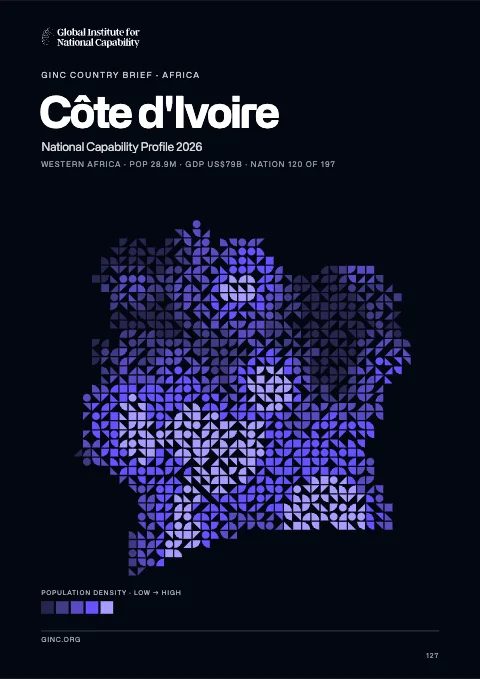
The whole brief
Côte d'Ivoire National Capability Profile 2026
Foundations · Chapter 01
Historical Context
🇨🇮 Côte d'Ivoire's understanding the origins and evolution of the modern nation
BackgroundBack to top ↑
Close ties to France following independence in 1960, the development of cocoa production for export, and foreign investment all made Cote d'Ivoire one of the most prosperous of the West African states but did not protect it from political turmoil. In December 1999, a military coup - the first ever in Cote d'Ivoire's history - overthrew the government. Junta leader Robert GUEI blatantly rigged elections held in late 2000 and declared himself the winner. Popular protest forced him to step aside and brought Laurent GBAGBO into power. Ivorian dissidents and disaffected members of the military launched a failed coup attempt in September 2002 that developed into a rebellion and then a civil war. The war ended in 2003 with a cease fire that left the country divided with the rebels holding the north, the government the south, and peacekeeping forces a buffer zone between the two. In March 2007, President GBAGBO and former New Forces rebel leader Guillaume SORO signed an agreement in which SORO joined GBAGBO's government as prime minister and the two agreed to reunite the country by dismantling the buffer zone, integrating rebel forces into the national armed forces, and holding elections. Difficulties in preparing electoral registers delayed balloting until 2010. In November 2010, Alassane Dramane OUATTARA won the presidential election over GBAGBO, but GBAGBO refused to hand over power, resulting in a five-month stand-off. In April 2011, after widespread fighting, GBAGBO was formally forced from office by armed OUATTARA supporters with the help of UN and French forces. Several thousand UN peacekeepers and several hundred French troops remain in Cote d'Ivoire to support the transition process. OUATTARA is focused on rebuilding the country's infrastructure and military after the five months of post-electoral fighting and faces ongoing threats from GBAGBO supporters, many of whom have sought shelter in Ghana. GBAGBO is in The Hague awaiting trial for crimes against humanity.
IndependenceBack to top ↑
7 August 1960 (from France)
National holidayBack to top ↑
Independence Day, 7 August (1960)
Foundations · Chapter 02
Geography
🇨🇮 Côte d'Ivoire's territory, resources and strategic position
Location and areaBack to top ↑
Western Africa, bordering the North Atlantic Ocean, between Ghana and Liberia
8 00 N, 5 00 W
Africa
slightly larger than New Mexico
515 km
Terrain and resourcesBack to top ↑
mostly flat to undulating plains; mountains in northwest
petroleum, natural gas, diamonds, manganese, iron ore, cobalt, bauxite, copper, gold, nickel, tantalum, silica sand, clay, cocoa beans, coffee, palm oil, hydropower
727.5 sq km (2003)
Settlement and hazardsBack to top ↑
coast has heavy surf and no natural harbors; during the rainy season torrential flooding is possible
most of the inhabitants live along the sandy coastal region; apart from the capital area, the forested interior is sparsely populated
OtherBack to top ↑
81.14 cu km (2011)
deforestation (most of the country's forests - once the largest in West Africa - have been heavily logged); water pollution from sewage and industrial and agricultural effluents
Foundations · Chapter 03
Environment
🇨🇮 Côte d'Ivoire's environmental conditions, resources and national resilience
ClimateBack to top ↑
tropical along coast, semiarid in far north; three seasons - warm and dry (November to March), hot and dry (March to May), hot and wet (June to October)
Emissions and pollutionBack to top ↑
Water, waste and foodBack to top ↑
Resources and agreementsBack to top ↑
GINC Capability Domains · Chapter 04
Critical Technology
🇨🇮 Côte d'Ivoire's technology frontiers and the pursuit of national advantage
Two counts are set side by side for 2015–2024: on the left, the papers researchers in Côte d'Ivoire published; on the right, the patent families that began there and were filed in more than one country. First by capability group, then group by group with each group’s capabilities. The badge on a card is the nation’s place among all nations. Papers are from GINC Research Analytics, patent families from GINC Patents.
Research by capability group
#132 WorldPapers published, 2015–2024
Patents by capability group
#118 WorldInternational patent families, 2015–2024
Advanced Materials & ManufacturingBack to top ↑
Research
#119 WorldPapers published, 2015–2024
Patents
International patent families, 2015–2024
No international patent families on record for 2015–2024.
Energy TechnologiesBack to top ↑
Research
#110 WorldPapers published, 2015–2024
Patents
International patent families, 2015–2024
No international patent families on record for 2015–2024.
Semiconductors & Advanced ComputingBack to top ↑
Research
#136 WorldPapers published, 2015–2024
No research topic: Semiconductor Design & EDA · Advanced Semiconductor Fabrication · Semiconductor Equipment & Materials · Advanced Packaging & Heterogeneous Integration
Patents
International patent families, 2015–2024
No international patent families on record for 2015–2024.
Artificial IntelligenceBack to top ↑
Research
#139 WorldPapers published, 2015–2024
Patents
#84 WorldInternational patent families, 2015–2024
Quantum TechnologiesBack to top ↑
Research
#134 WorldPapers published, 2015–2024
Patents
International patent families, 2015–2024
No international patent families on record for 2015–2024.
Connectivity, Cyber & Trust TechnologiesBack to top ↑
Research
#128 WorldPapers published, 2015–2024
Patents
International patent families, 2015–2024
No international patent families on record for 2015–2024.
Sensing, Timing & NavigationBack to top ↑
Research
#111 WorldPapers published, 2015–2024
Patents
International patent families, 2015–2024
No international patent families on record for 2015–2024.
Robotics & Autonomous SystemsBack to top ↑
Research
#149 WorldPapers published, 2015–2024
No research topic: Human-Machine Interfaces
Patents
International patent families, 2015–2024
No international patent families on record for 2015–2024.
Biotechnology & Health TechnologiesBack to top ↑
Research
#116 WorldPapers published, 2015–2024
Patents
International patent families, 2015–2024
No international patent families on record for 2015–2024.
Medicine and BioTech
Clinical research and life-science invention, drawn from the same series that drive the metric pages. Each card opens the full cross-country comparison.
Space TechnologiesBack to top ↑
- Space Launch & Reusable Systems
- Advanced Propulsion & Hypersonic Systems
- Satellite & Constellation Technologies
GINC Capability Domains · Chapter 05
Strategic Infrastructure
🇨🇮 Côte d'Ivoire's energy, connectivity and the material foundations of capability
Resource InfrastructureBack to top ↑
38,560 bbl/day (2012 est.)
32,190 bbl/day (2010 est.)
49,780 bbl/day (2010 est.)
100 million bbl (1 January 2013 est.)
55,890 bbl/day (2010 est.)
24,630 bbl/day (2011 est.)
38,300 bbl/day (2010 est.)
4,810 bbl/day (2010 est.)
1.5 billion cu m (2011 est.)
1.5 billion cu m (2010 est.)
0 cu m (2011 est.)
0 cu m (2011 est.)
28.32 billion cu m (1 January 2013 est.)
condensate 101 km; gas 256 km; oil 118 km; oil/gas/water 5 km; water 7 km (2013)
Agriculture & Food InfrastructureBack to top ↑
- Irrigation & Agricultural Water
- Livestock & Veterinary
- Fisheries & Aquaculture
- Storage, Cold Chain & Markets
Energy InfrastructureBack to top ↑
- Thermal Generation
- Nuclear Generation
- Nuclear Fuel Cycle & Radioactive Waste
- Hydropower
- Renewable Generation
- Transmission & Distribution
- System Control & Dispatch
- Storage & Fuel Supply
1.222 million kW (2010 est.)
5.721 billion kWh (2010 est.)
3.865 billion kWh (2010 est.)
471 million kWh (2010 est.)
0 kWh (2012 est.)
50.6% of total installed capacity (2010 est.)
0% of total installed capacity (2010 est.)
49.4% of total installed capacity (2010 est.)
0% of total installed capacity (2010 est.)
6.68 million Mt (2011 est.)
Water, Sanitation & Waste InfrastructureBack to top ↑
- Dams, Reservoirs & Flood Defence
- Water Supply & Treatment
- Bulk Water Transfer & Desalination
- Wastewater & Sanitation
- Solid Waste & Recycling
Advanced ManufacturingBack to top ↑
- Materials & Inputs
- Chemicals & Hazardous Process Industry
- Production Systems
- Supply Chain & Ecosystem
- Workforce & Innovation
Transport InfrastructureBack to top ↑
- Seaports & Terminals
- Air Infrastructure
- Air Navigation & Traffic Management
- Inland Waterways & Ferries
- Rail Infrastructure
- Roads & Bridges
- Logistics, Multimodal & Border Infrastructure
- Postal & Parcel
27 (2013)
1 (2013)
980 km (navigable rivers, canals, and numerous coastal lagoons) (2011)
Communications & Digital InfrastructureBack to top ↑
- Subsea Cables & International Gateways
- Core & Backbone Networks
- Mobile & Wireless Networks
- Spectrum & Broadcasting
- Data Centres, Compute & Cloud
- Data Resources
- AI Tools & Applications
268,000 (2012)
19.827 million (2012)
967,300 (2009)
9,115 (2012)
.ci
Financial InfrastructureBack to top ↑
- Currency & Reserves
- Payments & Settlement Systems
- Markets, Exchanges & Depositories
- Banks, Insurers & Systemic Institutions
Social InfrastructureBack to top ↑
- Health Infrastructure
- Public Health & Laboratories
- Medical Supply & Stockpiles
- Education & Skills Infrastructure
- Research & Scientific Facilities
- Housing, Community & Social Services
- Government & Public Administration
- Cultural, Community & Recreational Infrastructure
- Justice & Corrections
- Emergency Services & Civil Protection
- Hydrometeorology & Early Warning
Space, Aerospace & Defence InfrastructureBack to top ↑
GINC Capability Domains · Chapter 06
National Security
🇨🇮 Côte d'Ivoire's force, intelligence and the defence of the nation
Disputes and terrorismBack to top ↑
disputed maritime border between Cote d'Ivoire and Ghana
Force Generation & MobilisationBack to top ↑
Republican Forces of Cote d'Ivoire (Force Republiques de Cote d'Ivoire, FRCI): Army, Navy, Cote d'Ivoire Air Force (Force Aerienne de la Cote d'Ivoire)
18-25 years of age for compulsory and voluntary male and female military service; conscription is not enforced; voluntary recruitment of former rebels into the new national army is restricted to ages 22-29 (2012)
1.65% of GDP (2012)//1.49% of GDP (2011)//1.65% of GDP (2010)
Forces under arms
Active-duty strength on the Correlates of War series, which reaches back to 1816 and so carries a nation’s whole record of mobilisation rather than its present establishment. The card opens the full cross-country comparison.
Intelligence & AssessmentBack to top ↑
- Imagery & Geospatial Intelligence
- Signals & Cyber Intelligence
- Technical & Measurement Intelligence
- Open-Source & Financial Intelligence
- Human Intelligence & Counterintelligence
- All-Source Analysis & Warning
Joint Command, Projection & SustainmentBack to top ↑
- Command, Control & Communications
- Strategic Lift & Mobility
- Expeditionary & Peace Operations
- Operational Sustainment & War Reserves
- Defence Industrial Mobilisation
- CBRN Defence
Land PowerBack to top ↑
- Combined Arms Manoeuvre
- Land Fires
- Battlefield Aviation & Uncrewed Systems
- Special Operations & Irregular Warfare
Maritime PowerBack to top ↑
- Maritime Security & Constabulary
- Sea Denial & Undersea Warfare
- Sea Control
- Amphibious & Expeditionary Operations
Air PowerBack to top ↑
- Air Sovereignty & Policing
- Control of the Air
- Air Strike & Interdiction
- Airborne ISR, Early Warning & Battle Management
Strategic Strike & Missile DefenceBack to top ↑
Space OperationsBack to top ↑
Cyber & Electromagnetic OperationsBack to top ↑
Nuclear DeterrenceBack to top ↑
GINC Capability Domains · Chapter 07
Human Capital
🇨🇮 Côte d'Ivoire's population, health and the skills that sustain capability
DemographyBack to top ↑
22,848,945
1.96% (2014 est.)
29.25 births/1,000 population (2014 est.)
9.67 deaths/1,000 population (2014 est.)
3.63 children born/woman (2014 est.)
19.8
18.2% (2012)
Migration and urbanisationBack to top ↑
0 migrant(s)/1,000 population (2014 est.)
ABIDJAN (seat of government) 4.288 million; YAMOUSSOUKRO (capital) 966,000 (2011)
Welfare and equityBack to top ↑
42% (2006 est.)
41.5 (2008)//36.7 (1995)
DisplacementBack to top ↑
Early Childhood DevelopmentBack to top ↑
29.4% (2007)
Foundational EducationBack to top ↑
4.6% of GDP (2008)
Advanced EducationBack to top ↑
Technical & Vocational SkillsBack to top ↑
Digital & AI CompetenceBack to top ↑
Generative AI adoption
Modelled share of working-age adults using generative AI, from Microsoft telemetry scaled to each country’s 15–64 population. A measure of how fast a workforce is absorbing the technology rather than of how much of it a nation builds. The card opens the full cross-country comparison.
Lifelong Learning & ReskillingBack to top ↑
Research Talent & Knowledge CreationBack to top ↑
Population HealthBack to top ↑
400 deaths/100,000 live births (2010)
6.2% (2008)
3.2% (2012 est.)
450,000 (2012 est.)
31,200 (2012 est.)
Health System CapabilityBack to top ↑
6.8% of GDP (2011)
0.14 physicians/1,000 population (2008)
0.4 beds/1,000 population (2006)
GINC Capability Domains · Chapter 08
Governance and Integrity
🇨🇮 Côte d'Ivoire's institutions, law and the integrity of the state
State structureBack to top ↑
republic; multiparty presidential regime established 1960
12 districts and 2 autonomous districts*; Abidjan*, Bas-Sassandra, Comoe, Denguele, Goh-Djiboua, Lacs, Lagunes, Montagnes, Sassandra-Marahoue, Savanes, Vallee du Bandama, Woroba, Yamoussoukro*, Zanzan
previous 1960; latest approved by referendum 23 July 2000; amended 2012 (2012)
18 years of age; universal
Political Institutions & Civic ParticipationBack to top ↑
- Electoral Management & Integrity
- Legislature & Deliberative Institutions
- Citizen Participation & Civic Space
unicameral National Assembly or Assemblee Nationale (255 seats; members elected in single- and multi-district elections by direct popular vote to serve five-year terms)
Citizen's Democratic Union or UDCY [Theodore MEL EG]//Democracy and Liberty for the Republic or LIDER [Mamadou KOULIBALY]//Democratic Party of Cote d'Ivoire or PDCI [Henri Konan BEDIE]//Ivorian Popular Front or FPI [Pascal AFFI NGUESSAN]//Ivorian Worker's Party or PIT [Daniel AKA AHIZ]//Movement of the Future Forces or MFA [Innocent Augustin ANAKY KOBENA]//Rally of the Republicans or RDR [Alassane OUATTARA]//Union for Democracy and Peace in Cote d'Ivoire or UDPCI [Toikeuse MABRI]//over 144 smaller registered parties
Federation of University and High School Students of Cote d'Ivoire or FESCI [Augustin MIAN]//National Congress for the Resistance and Democracy or CNRD [Bernard DADIE]//Panafrican Congress for Justice and Peoples Equality or COJEP [Roselin BLY]//Rally of Houphouetists for Democracy and Peace or RHDP
Justice System & Fundamental RightsBack to top ↑
- Judicial Independence & Court Capability
- Access to Justice & Legal Services
- Fundamental Rights Protection
- Human Rights Institutions & Equality Bodies
civil law system based on the French civil code; judicial review of legislation held in the Constitutional Chamber of the Supreme Court
accepts compulsory ICJ jurisdiction with reservations; accepts ICCt jurisdiction under Article 12(3)of the Rome Statute
Internal Security & OrderBack to top ↑
illicit producer of cannabis, mostly for local consumption; utility as a narcotic transshipment point to Europe reduced by ongoing political instability; while rampant corruption and inadequate supervision leave the banking system vulnerable to money laundering, the lack of a developed financial system limits the country's utility as a major money-laundering center (2008)
Regulatory Governance & Strategic ControlsBack to top ↑
- Regulatory Quality & Better Regulation
- Regulatory Delivery & Independent Regulators
- Strategic Controls & Economic Security Administration
Government Effectiveness & Public AdministrationBack to top ↑
- Centre of Government & Policy Coordination
- Civil Service & Public Workforce
- Digital Government & Service Delivery
- Legal Identity & Civil Registration
- Statistical & Data Capability
Public Integrity & Anti-CorruptionBack to top ↑
Transparency, Oversight & AccountabilityBack to top ↑
- Right to Information & Open Government
- Independent Oversight & Supreme Audit
- Independent Media & Journalist Safety
National Resilience & Crisis ManagementBack to top ↑
GINC Capability Domains · Chapter 09
Information and Influence
🇨🇮 Côte d'Ivoire's identity, media and the projection of influence
Identity and cultureBack to top ↑
French (official), 60 native dialects of which Dioula is the most widely spoken
Muslim 38.6%, Christian 32.8%, indigenous 11.9%, none 16.7% (2008 est.)
Akan 42.1%, Voltaiques or Gur 17.6%, Northern Mandes 16.5%, Krous 11%, Southern Mandes 10%, other 2.8% (includes 130,000 Lebanese and 14,000 French) (1998)
elephant
three equal vertical bands of orange (hoist side), white, and green; orange symbolizes the land (savannah) of the north and fertility, white stands for peace and unity, green represents the forests of the south and the hope for a bright future
Diplomatic Statecraft & Global NetworksBack to top ↑
- Diplomatic Network & Consular Reach
- Multilateral Leadership & Norm Setting
- Agenda-Setting & Convening
- Mediation & Crisis Diplomacy
ACP, AfDB, AU, ECOWAS, EITI (candidate country), Entente, FAO, FZ, G-24, G-77, IAEA, IBRD, ICAO, ICC, ICRM, IDA, IDB, IFAD, IFC, IFRCS, ILO, IMF, IMO, Interpol, IOC, IOM, IPU, ISO, ITSO, ITU, ITUC (NGOs), MIGA, MINUSMA, NAM, OIC, OIF, OPCW, UN, UNCTAD, UNESCO, UNHCR, UNIDO, Union Latina, UNWTO, UPU, WADB (regional), WAEMU, WCO, WFTU (NGOs), WHO, WIPO, WMO, WTO
Alliances & Security CooperationBack to top ↑
Development Cooperation & Global AssistanceBack to top ↑
Culture, Language & Education DiplomacyBack to top ↑
- Cultural & Language Institutes
- Creative Industries & Cultural Export Reach
- Heritage & Cultural Institutions
- Education Diplomacy & Alumni Networks
- Sports & Major Events
Diaspora & Global CommunitiesBack to top ↑
Information Environment & Strategic CommunicationBack to top ↑
- Strategic Communications & Public Diplomacy
- International Media & Broadcasting
- Information Defence & Counter-Interference
2 state-owned TV stations; no private terrestrial TV stations, but satellite TV subscription service is available; 2 state-owned radio stations; some private radio stations; transmissions of several international broadcasters are available (2007)
GINC Capability Domains · Chapter 10
Financial Strength
🇨🇮 Côte d'Ivoire's fiscal depth, reserves and the capacity to act
Monetary & Currency CapabilityBack to top ↑
- Monetary Policy & Price Stability
- Exchange Rate & External Account Management
- Currency Issuance & Digital Money
2.9% (2013 est.)//1.3% (2012 est.)
Communaute Financiere Africaine francs (XOF) per US dollar -//504.6 (2013 est.)//510.29 (2012 est.)//495.28 (2010 est.)//472.19 (2009)//447.81 (2008)
4.25% (31 December 2010 est.)//4.25% (31 December 2009 est.)
3.8% (31 December 2013 est.)//4% (31 December 2012 est.)
$7.606 billion (31 December 2013 est.)//$6.552 billion (31 December 2012 est.)
$11.46 billion (31 December 2013 est.)//$9.877 billion (31 December 2012 est.)
Fiscal Capacity & Public FinanceBack to top ↑
- Revenue Mobilisation & Tax Administration
- Public Expenditure & Budget Management
- Sovereign Debt & Treasury Management
- Public Investment Management
20.2% of GDP (2013 est.)
-3.4% of GDP (2013 est.)
45.2% of GDP (2013 est.)//47.8% of GDP (2012 est.)
calendar year
Financial System Depth & AccessBack to top ↑
- Banking System Capacity
- Capital Markets Depth & Development
- Long-Term & Institutional Capital
- Financial Inclusion & Household Access
- Development & Policy Finance
$7.953 billion (31 December 2013 est.)//$6.918 billion (31 December 2012 est.)
$7.829 billion (31 December 2012 est.)//$NA (31 December 2011)//$7.099 billion (31 December 2010 est.)
Financial Regulation & IntegrityBack to top ↑
- Prudential Regulation & Supervision
- Financial Integrity & Illicit Finance Control
- Market Conduct & Consumer Protection
- Payment & Market Infrastructure Oversight
Financial Stability & Crisis ManagementBack to top ↑
- Macroprudential & Systemic Oversight
- Crisis Management, Resolution & Deposit Insurance
- External Liquidity & Financial Safety Nets
Sovereign Capital & External Financial PowerBack to top ↑
- Official Reserves Management
- Sovereign Wealth & Public Asset Management
- Currency Internationalisation & Reserve Status
- Capital Account & Flow Management
- International Financial Centre Capability
$4.085 billion (31 December 2013 est.)//$3.928 billion (31 December 2012 est.)
$8.959 billion (31 December 2013 est.)//$8.096 billion (31 December 2012 est.)
GINC Capability Domains · Chapter 11
Production and Innovation
🇨🇮 Côte d'Ivoire's output, industry and the engine of prosperity
Economic Output & ProductivityBack to top ↑
Cote d'Ivoire is heavily dependent on agriculture and related activities, which engage roughly two-thirds of the population. Cote d'Ivoire is the world's largest producer and exporter of cocoa beans and a significant producer and exporter of coffee and palm oil. Consequently, the economy is highly sensitive to fluctuations in international prices for these products and in climatic conditions. Cocoa, oil, and coffee are the country's top export revenue earners, but the country is also producing gold. The country also produces oil and boasted two offshore oil finds in 2012. Since the end of the civil war in 2003, political turmoil has continued to damage the economy, resulting in the loss of foreign investment and slow economic growth. In June 2012, the IMF and the World Bank announced $4.4 billion in debt relief for Cote d'Ivoire under the Highly Indebted Poor Countries Initiative. Cote d'Ivoire's long-term challenges include political instability and degrading infrastructure.
$43.67 billion (2013 est.)//$40.43 billion (2012 est.)//$36.84 billion (2011 est.)
8% (2013 est.)//9.8% (2012 est.)//-4.7% (2011 est.)
$1,800 (2013 est.)//$1,700 (2012 est.)//$1,600 (2011 est.)
$28.28 billion (2013 est.)
Labour & EmploymentBack to top ↑
- Employment & Labour Force Participation
- Labour Market Institutions & Wage Setting
- Employment Services & Skills Matching
- Labour Adjustment, Transition & Formalisation
7.928 million (2013 est.)
NA%
Industrial & Sectoral BaseBack to top ↑
- Manufacturing & Advanced Industry
- Foundational & Process Industries
- Agrifood & Primary Production
- Services Economy
coffee, cocoa beans, bananas, palm kernels, corn, rice, cassava (manioc, tapioca), sweet potatoes, sugar, cotton, rubber; timber
foodstuffs, beverages; wood products, oil refining, gold mining, truck and bus assembly, textiles, fertilizer, building materials, electricity
7% (2013 est.)
Structural Transformation & ComplexityBack to top ↑
Business Dynamism & EntrepreneurshipBack to top ↑
- Entrepreneurship & Firm Creation
- Risk Capital & Scale-Up Finance
- Firm Growth, Exit & Renewal
- Competition & Market Contestability
Innovation & CommercialisationBack to top ↑
- Business Innovation Capability
- Research Commercialisation & Knowledge Transfer
- Intellectual Property & Intangible Assets
- Innovation Ecosystems & Clusters
Technology Adoption & DiffusionBack to top ↑
GINC Capability Domains · Chapter 12
Trade and Investment
🇨🇮 Côte d'Ivoire's markets, capital and the terms of global exchange
Overall tradeBack to top ↑
$25.4B of exports to 152 partners and $18.2B of imports from 195 in 2024, a surplus of $7.22B.
- Exports
- $25.4B152 partners
- Imports
- $18.2B195 partners
- Balance
- +$7.22Bsurplus
- Total trade
- $43.7B2024
ExportsBack to top ↑
Where its exports go
The largest partners in 2024, with each one's share of the nation's exports.
| Partner | Value | Share | |
|---|---|---|---|
| Switzerland | $5.50B | 22% | |
| Netherlands | $2.81B | 11% | |
| Mali | $1.67B | 6.6% | |
| United States | $1.23B | 4.8% | |
| France | $1.12B | 4.4% | |
| Germany | $1.01B | 4.0% | |
| Spain | $967M | 3.8% | |
| Malaysia | $922M | 3.6% | |
| Vietnam | $831M | 3.3% | |
| China | $768M | 3.0% | |
| Burkina Faso | $701M | 2.8% | |
| Belgium | $553M | 2.2% | |
| South Africa | $542M | 2.1% | |
| Turkey | $523M | 2.1% | |
| India | $503M | 2.0% | |
| United Kingdom | $484M | 1.9% | |
| Italy | $462M | 1.8% | |
| Brazil | $287M | 1.1% | |
| Canada | $284M | 1.1% | |
| Ghana | $276M | 1.1% |
What it exports
The largest categories in 2024.
| Category | Value | Share | |
|---|---|---|---|
| Cocoa and cocoa preparations | $8.78B | 34% | |
| Pearls, precious stones, metals, coins | $5.86B | 23% | |
| Mineral fuels, oils, distillation products | $3.20B | 13% | |
| Rubbers | $2.70B | 11% | |
| Edible fruits, nuts, peel of citrus fruit, melons | $1.72B | 6.7% | |
| Animal, vegetable fats and oils, cleavage products | $380M | 1.5% | |
| Cotton | $300M | 1.2% | |
| Essential oils, perfumes, cosmetics, toiletries | $230M | 0.9% | |
| Plastics | $199M | 0.8% | |
| Ores slag and ash | $198M | 0.8% | |
| Miscellaneous edible preparations | $170M | 0.7% | |
| Coffee, tea, mate and spices | $167M | 0.7% | |
| Machinery, nuclear reactors, boilers | $162M | 0.6% | |
| Wood and articles of wood, wood charcoal | $130M | 0.5% | |
| Soaps, lubricants, waxes, candles, modelling pastes | $112M | 0.4% |
ImportsBack to top ↑
Where its imports come from
The largest partners in 2024, with each one's share of the nation's imports.
| Partner | Value | Share | |
|---|---|---|---|
| China | $3.03B | 17% | |
| Nigeria | $2.36B | 13% | |
| France | $1.20B | 6.6% | |
| Belgium | $910M | 5.0% | |
| United States | $872M | 4.8% | |
| India | $839M | 4.6% | |
| Russia | $442M | 2.4% | |
| Germany | $440M | 2.4% | |
| Morocco | $435M | 2.4% | |
| United Kingdom | $420M | 2.3% | |
| Italy | $417M | 2.3% | |
| Vietnam | $413M | 2.3% | |
| Netherlands | $378M | 2.1% | |
| Spain | $336M | 1.8% | |
| Turkey | $320M | 1.8% | |
| Egypt | $298M | 1.6% | |
| Thailand | $277M | 1.5% | |
| Colombia | $265M | 1.5% | |
| Japan | $257M | 1.4% | |
| South Korea | $239M | 1.3% |
What it imports
The largest categories in 2024.
| Category | Value | Share | |
|---|---|---|---|
| Mineral fuels, oils, distillation products | $4.62B | 25% | |
| Machinery, nuclear reactors, boilers | $1.60B | 8.8% | |
| Cereals | $1.25B | 6.9% | |
| Vehicles other than railway, tramway | $1.20B | 6.6% | |
| Fish, crustaceans, molluscs, aquatics invertebrates | $939M | 5.2% | |
| Plastics | $761M | 4.2% | |
| Electrical, electronic equipment | $759M | 4.2% | |
| Articles of iron or steel | $504M | 2.8% | |
| Pharmaceutical products | $501M | 2.7% | |
| Iron and steel | $329M | 1.8% | |
| Miscellaneous chemical products | $315M | 1.7% | |
| Fertilizers | $290M | 1.6% | |
| Paper and paperboard, articles of pulp, paper and board | $285M | 1.6% | |
| Salt, sulphur, earth, stone, plaster, lime and cement | $275M | 1.5% | |
| Furniture, lighting signs, prefabricated buildings | $245M | 1.3% |
In a list, the bar runs to the largest in that list. The line is each figure’s history from 2000, drawn to its own peak: it shows the shape of the years, and the value shows the size.
External balanceBack to top ↑
-$623 million (2013 est.)//-$266.5 million (2012 est.)
Trade Facilitation & LogisticsBack to top ↑
Trade Policy & Market AccessBack to top ↑
- Trade Policy & Negotiation Capability
- Market Access & Agreements Network
- Trade Law & Enforcement
- Standards, Conformity & Quality Infrastructure
Digital & Services TradeBack to top ↑
- Services Trade Capability
- Digital Trade & E-Commerce
- Data Flows & Digital Trade Governance
- Tourism & Visitor Economy
Investment Attraction & ProjectionBack to top ↑
- Investment Attraction & Facilitation
- Investment Absorption & Linkages
- Outward Investment & Global Corporate Presence
$NA
$NA
Export Capability & SophisticationBack to top ↑
$12.96 billion (2013 est.)//$12.53 billion (2012 est.)
Netherlands 8.8%, US 8.1%, Nigeria 8%, Germany 7.5%, France 4.5%, Canada 4.2% (2012)
cocoa, coffee, timber, petroleum, cotton, bananas, pineapples, palm oil, fish
Global Value Chain PositionBack to top ↑
- Value Chain Participation & Integration
- Value Chain Position & Upgrading
- Regional Integration & Hub Anchoring
Economic Leverage & DependenceBack to top ↑
- Strategic Supply Security
- Concentration Risk & Revenue Stabilisation
- Economic Leverage & Coercion Resistance
$9.859 billion (2013 est.)//$8.973 billion (2012 est.)
Nigeria 25%, France 11%, China 7.2% (2012)
fuel, capital equipment, foodstuffs
Côte d'Ivoire · you are in
Historical Context
Foundations
GINC Capability Domains
Find in this brief · Côte d'Ivoire